Benchmarking De Novo Designed Enzymes: Evaluating AI-Generated Proteins Against Natural Counterparts
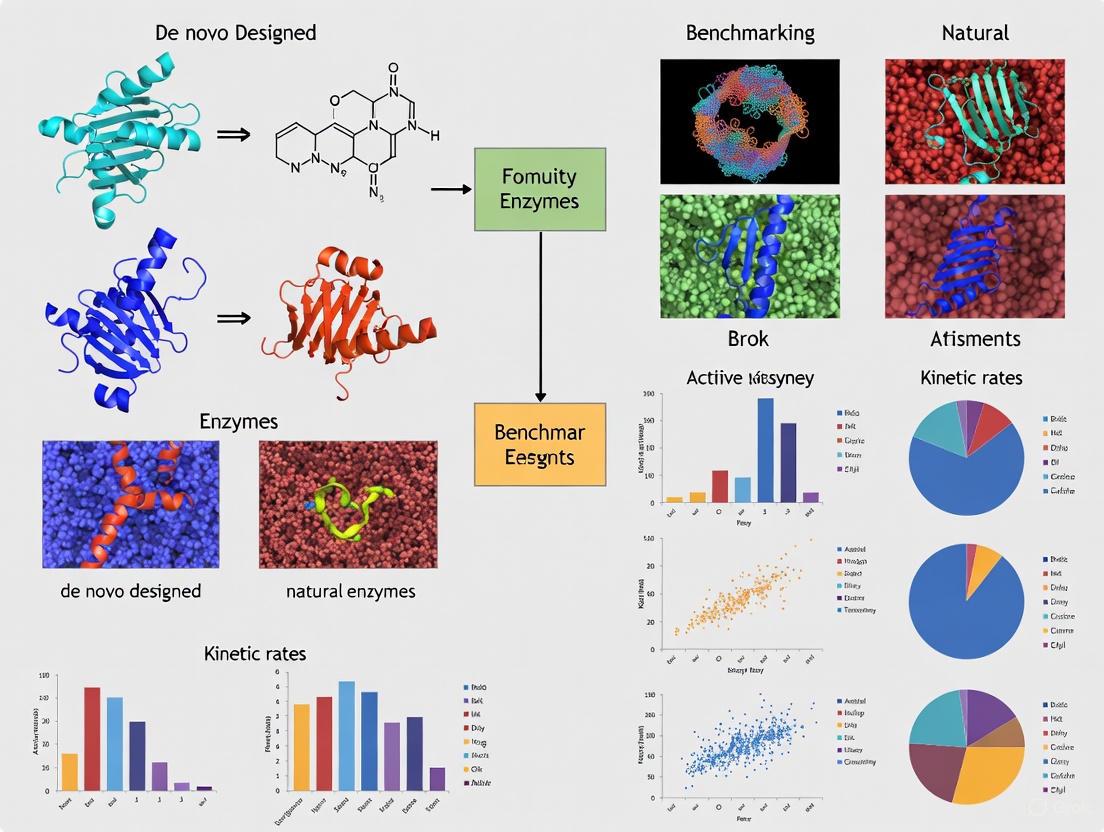
This article provides a comprehensive analysis of the current state and critical challenges in benchmarking de novo designed enzymes against their natural counterparts.
Benchmarking De Novo Designed Enzymes: Evaluating AI-Generated Proteins Against Natural Counterparts
Abstract
This article provides a comprehensive analysis of the current state and critical challenges in benchmarking de novo designed enzymes against their natural counterparts. Aimed at researchers, scientists, and drug development professionals, it explores the foundational principles of enzyme design benchmarks, examines cutting-edge methodological frameworks and their real-world applications, details strategies for troubleshooting and optimizing design pipelines, and synthesizes the latest validation protocols and comparative performance metrics. By integrating insights from recent high-impact studies and emerging benchmarks, this review serves as a strategic guide for developing robust evaluation standards that can reliably predict the experimental success and functional efficacy of computationally designed enzymes, thereby accelerating their translation into biomedical and industrial applications.
The Imperative for Benchmarking in De Novo Enzyme Design
The grand challenge of computational protein engineering lies in developing models that can accurately characterize and generate protein sequences for arbitrary functions, a task complicated by the intricate relationship between a protein's amino acid sequence and its resulting biological activity [1]. Despite significant advancements, the field has been hampered by a triad of obstacles: a lack of standardized benchmarking opportunities, a scarcity of large, complex protein function datasets, and limited access to experimental validation for computationally designed proteins [1]. This comparison guide examines the current landscape of benchmarking frameworks and experimental methodologies that aim to translate protein sequence into predictable function, providing researchers with objective performance comparisons of emerging technologies against established alternatives.
The critical need for robust benchmarking is underscored by the rapid growth of the protein engineering market, projected to grow from $4.11 billion in 2024 to $8.33 billion by 2029, driven by demand for protein-based drugs and AI-driven design tools [2]. This expansion highlights the economic and therapeutic imperative to overcome persistent bottlenecks in de novo enzyme design, where designed enzymes often exhibit catalytic efficiencies several orders of magnitude below natural counterparts despite extensive computational optimization [3] [4].
Benchmarking Frameworks: Standardizing Evaluation
Established Benchmarking Platforms
Table 1: Key Protein Engineering Benchmarks and Their Characteristics
| Benchmark Name | Primary Focus | Key Metrics | Datasets Included | Experimental Validation |
|---|---|---|---|---|
| Protein Engineering Tournament [1] | Predictive & generative modeling | Biophysical property prediction, sequence design success | 6 multi-objective datasets (e.g., α-Amylase, Imine reductase) | Partner-provided (International Flavors and Fragrances) |
| PDFBench [5] [6] | Function-guided design | Plausibility, foldability, language alignment, novelty, diversity | SwissTest, MolinstTest (640K description-sequence pairs) | In silico validation only |
| FLIP Benchmark [7] | Fitness landscape prediction | Accuracy, calibration, coverage, uncertainty quantification | GB1, AAV, Meltome landscapes | Various published experiments |
The Protein Engineering Tournament represents a pioneering approach to benchmarking, structured as a fully remote competition with distinct predictive and generative rounds [1]. In the predictive round, teams develop models to predict biophysical properties from sequences, while the generative round challenges participants to design novel sequences that maximize specified properties, with experimental characterization provided through partnerships with industrial entities like International Flavors and Fragrances. This framework addresses critical gaps by providing never-before-seen datasets for predictive modeling and experimental validation for generative designs, creating a transparent platform for benchmarking protein modeling methods [1].
PDFBench, the first comprehensive benchmark for function-guided de novo protein design, introduces standardized evaluation across two key settings: description-guided design (using natural language functional descriptions) and keyword-guided design (using functional keywords) [5] [6]. Its comprehensive evaluation encompasses 16 metrics across six dimensions: plausibility, foldability, language alignment, similarity, novelty, and diversity, enabling more reliable comparisons between state-of-the-art models like ESM3, Chroma, and ProDVa [6].
Uncertainty Quantification in Protein Engineering
Robust uncertainty quantification (UQ) is crucial for protein engineering applications, particularly when guiding experimental efforts through Bayesian optimization or active learning. A comprehensive benchmark evaluating seven UQ methods—including Bayesian ridge regression, Gaussian processes, and multiple convolutional neural network-based approaches—revealed that no single method consistently outperforms others across all protein landscapes and domain shift regimes [7]. Performance is highly dependent on the specific landscape, task, and protein representation, with ensembles and evidential methods often showing advantages in certain scenarios but exhibiting significant variability across different train-test splits designed to mimic real-world data collection scenarios [7].
Experimental Platforms for Functional Validation
High-Throughput Experimental Characterization
Table 2: Experimental Methods for Functional Characterization of Designed Proteins
| Method Category | Specific Techniques | Measured Properties | Throughput | Key Insights Generated |
|---|---|---|---|---|
| Biophysical Assays | Thermal shift assays, Circular dichroism | Thermostability, secondary structure | Medium | Structural integrity, folding properties |
| Kinetic Characterization | Enzyme activity assays, substrate profiling | kcat, KM, catalytic efficiency | Low | Catalytic proficiency, mechanism |
| Structural Biology | X-ray crystallography, Cryo-EM | Atomic structure, active site geometry | Low | Structure-function relationships |
| Deep Mutational Scanning | Variant libraries, NGS | Functional landscapes for thousands of variants | High | Sequence-function relationships |
Advanced experimental platforms enable medium-to-high throughput characterization of designed proteins. For example, the Protein Engineering Tournament partnered with International Flavors and Fragrances to provide automated expression and characterization of generated protein sequences, measuring key biophysical properties including expression levels, specific activity, and thermostability across diverse enzyme classes including aminotransferases, α-amylases, and xylanases [1]. This approach demonstrates how industrial-academic partnerships can overcome the experimental bottleneck that typically hinders computational method development.
Recent investigations into distal mutations in designed Kemp eliminases illustrate the power of integrated experimental approaches. Combining enzyme kinetics, X-ray crystallography, and molecular dynamics simulations revealed that while active-site mutations create preorganized catalytic sites for efficient chemical transformation, distal mutations enhance catalysis by facilitating substrate binding and product release through tuning structural dynamics [4]. This nuanced understanding emerged from systematic comparisons of Core variants (active-site mutations) and Shell variants (distal mutations) across multiple designed enzyme lineages.
The Scientist's Toolkit: Essential Research Reagents
Table 3: Key Research Reagents for Benchmarking De Novo Enzymes
| Reagent / Material | Function in Experimental Workflow | Example Application |
|---|---|---|
| Kemp elimination substrates (e.g., 5-nitrobenzisoxazole) | Reaction-specific chemical probes | Quantifying catalytic efficiency of de novo Kemp eliminases [3] [4] |
| Transition state analogues (e.g., 6-nitrobenzotriazole) | Structural and mechanistic probes | X-ray crystallography to assess active site organization [4] |
| TIM barrel protein scaffolds | Versatile structural frameworks | Common scaffold for computational designs of novel enzymes [3] |
| Directed evolution libraries | Diversity generation for enzyme optimization | Improving initial computational designs through iterative mutation and selection [3] |
| UniProtKB/Swiss-Prot database | Curated protein sequence and functional data | Training and benchmarking data for predictive models [5] |
Case Study: Learning from Natural Evolution
Statistical Energy Correlations in Kemp Eliminases
The benchmarking of de novo designed Kemp eliminases against natural enzyme principles provides profound insights into the sequence-function relationship. Research has demonstrated that the catalytic power of laboratory-evolved Kemp eliminases strongly correlates with the statistical energy (EMaxEnt) inferred from their natural homologous sequences using the maximum entropy model [3]. Surprisingly, EMaxEnt shows a significant positive correlation with catalytic power (Pearson correlation = 0.81 with log(kcat/KM)), indicating that directed evolution drives designed enzymes toward sequences that would be less probable in nature but enhance the target abiological reaction [3].
This relationship reveals a fundamental stability-activity trade-off in enzyme engineering. Directed evolution of Kemp eliminases tends to decrease stability (increasing EMaxEnt) while enhancing catalytic power, whereas single mutations in catalytic-active remote regions can enhance activity while decreasing EMaxEnt (improving stability) [3]. These findings connect the emergence of new enzymatic functions to the natural evolution of the scaffold used in the design, providing valuable guidance for computational enzyme design strategies.
Diagram Title: Optimization Pathway for De Novo Kemp Eliminases
RFdiffusion: A Generative Framework for De Novo Design
The RFdiffusion method represents a transformative advance in generative protein design, enabling creation of novel protein structures and functions beyond evolutionary constraints [8]. By fine-tuning the RoseTTAFold structure prediction network on protein structure denoising tasks, RFdiffusion functions as a generative model of protein backbones that achieves outstanding performance across diverse design challenges including unconditional protein monomer design, protein binder design, symmetric oligomer design, and enzyme active site scaffolding [8].
Experimental characterization of hundreds of RFdiffusion-designed symmetric assemblies, metal-binding proteins, and protein binders confirmed the accuracy of this approach, with a cryo-EM structure of a designed binder in complex with influenza haemagglutinin nearly identical to the design model [8]. This demonstrates the remarkable capability of modern diffusion models to generate functional proteins from simple molecular specifications, potentially revolutionizing our approach to de novo protein design.
Comparative Performance Analysis
Quantitative Benchmarking of Design Methods
Table 4: Performance Comparison of Protein Design Methods Across Benchmarks
| Method | Design Strategy | Therapeutic Relevance | Experimental Success Rate | Key Advantages | Documented Limitations |
|---|---|---|---|---|---|
| RFdiffusion [8] | Structure-based diffusion | High (binder design demonstrated) | High (hundreds validated) | Exceptional structural accuracy, diverse applications | Requires subsequent sequence design (e.g., ProteinMPNN) |
| ESM3 [6] | Multimodal generative | Presumed high | Under characterization | Unified sequence-structure-function generation | Limited public access, training data not fully disclosed |
| Protein Engineering Tournament Winners [1] | Varied (ensemble, hybrid) | Varied across teams | Medium (depends on specific challenge) | Proven experimental validation | Method-specific performance variations |
| Chroma [6] | Diffusion with physics | Medium | Limited public data | Programmable design via composable conditioners | Less comprehensive evaluation |
The Protein Engineering Tournament revealed significant variation in method performance across different design challenges. In the pilot tournament, the Marks Lab won the zero-shot prediction track, while Exazyme and Nimbus shared first place in the supervised prediction track, with Nimbus achieving top combined performance across both tracks [1]. This outcome highlights how method performance is context-dependent, with different approaches excelling under different challenge parameters and dataset conditions.
RFdiffusion has demonstrated exceptional capabilities in de novo protein monomer generation, creating elaborate protein structures with little overall structural similarity to training set structures, indicating substantial generalization beyond the Protein Data Bank [8]. Designed proteins ranging from 200-600 residues exhibited high structural accuracy in both AlphaFold2 and ESMFold predictions, with experimental characterization confirming stable folding and designed secondary structure content [8].
Functional Efficiency Gaps: Designed vs Natural Enzymes
Despite these advances, a significant performance gap remains between de novo designed enzymes and natural counterparts. Original computational designs of Kemp eliminases typically exhibit modest catalytic efficiencies (kcat/KM ≤ 102 M-1 s-1), necessitating directed evolution to enhance activity by several orders of magnitude [4]. While directed evolution successfully improves catalytic efficiency, the best evolved Kemp eliminases still operate several orders of magnitude below the diffusion limit and below the efficiency of many natural enzymes [3].
This performance gap underscores the complexity of the sequence-function relationship and the current limitations in our ability to fully encode catalytic proficiency into initial designs. The integration of distal mutations identified through directed evolution provides critical enhancements to catalytic efficiency by facilitating aspects of the catalytic cycle beyond chemical transformation, including substrate binding and product release [4].
The field of protein engineering is rapidly evolving toward integrated computational-experimental workflows that leverage advanced benchmarking frameworks like the Protein Engineering Tournament and PDFBench. Future progress will likely depend on closing the loop between computational design and experimental characterization, enabling iterative model improvement through carefully curated experimental data [1] [9].
The emerging capability to design functional proteins de novo using frameworks like RFdiffusion [8] suggests a future where protein engineers can more readily create custom enzymes and therapeutics tailored to specific applications. However, robust benchmarking against natural counterparts remains essential to accurately gauge progress and identify the most promising approaches [10] [5].
As the field advances, the integration of AI-driven protein design with high-throughput experimental validation and multi-omics profiling will likely accelerate progress, potentially enabling the development of a modular toolkit for synthetic biology that ranges from de novo functional protein modules to fully synthetic cellular systems [9]. Through continued refinement of benchmarking standards and experimental methodologies, the grand challenge of moving predictively from sequence to function in protein engineering appears increasingly within reach.
Diagram Title: Protein Engineering Benchmarking Cycle
The field of de novo enzyme design is advancing rapidly, with artificial intelligence (AI) now enabling the creation of proteins with new shapes and molecular functions from scratch, without starting from natural proteins [11]. However, as these methods transition from producing new structures to achieving complex molecular functions, a critical challenge emerges: the lack of standardized evaluation frameworks. This benchmarking gap makes it difficult to objectively compare de novo designed enzymes against their natural counterparts, assess true progress, and reliably predict experimental success. Current evaluation practices are fragmented, with researchers often relying on inconsistent metrics, contaminated datasets, and methodologies that fail to capture the nuanced functional requirements of enzymatic activity [12] [13] [14]. This article analyzes the current limitations in benchmarking for computational enzyme design and provides a framework for standardized evaluation that can yield more meaningful, reproducible, and clinically relevant comparisons.
The Current State: Systemic Flaws in Evaluation Practices
Pervasive Limitations in Existing Benchmarks
The evaluation ecosystem for computational enzyme design suffers from several interconnected flaws that undermine the reliability and relevance of reported results:
Data Contamination: Public benchmarks frequently leak into training datasets, enabling models to memorize test items rather than demonstrating genuine generalization. This transforms benchmarking from a test of comprehension into a memorization exercise, significantly inflating performance metrics without corresponding advances in true capability [12] [13]. In computational biology, this manifests as benchmark datasets being used to train and validate methods on non-independent data, creating overoptimistic performance estimates [15].
Ignoring Functional Conservation: Many protein generation methods either ignore functional sites or select them randomly during generation, resulting in poor catalytic function and high false positive rates [14]. While general protein design has progressed significantly, these approaches often neglect the strict substrate-specific binding requirements and evolutionarily conserved functional sites essential for enzymatic activity [14] [11].
Absence of High-Quality Benchmarks: Existing enzyme design benchmarks are often synthetic with limited experimental grounding and lack evaluation protocols tailored to enzyme families [14]. Since enzymes are classified by their chemical reactions (EC numbers) rather than structure, meaningful evaluation demands benchmarks designed around enzyme families and their functional roles, which have been largely unavailable until recently [14].
Consequences of Standardization Gaps
The absence of standardized evaluation creates a distorted landscape where leaderboard positions can be manufactured, scientific signal is drowned out by noise, and community trust is eroded [13]. For drug development professionals, this translates to:
- Inability to accurately assess which computational methods are most suitable for specific design challenges
- Difficulty reproducing published results in independent laboratory settings
- Wasted resources on pursuing design approaches that perform well on benchmarks but fail in experimental validation
- Slowed innovation due to the lack of clear directional signals from evaluation metrics
Toward Robust Evaluation: Experimental Protocols and Metrics
Essential Metrics for Comprehensive Assessment
A robust benchmarking strategy for de novo enzymes must incorporate multiple dimensions of evaluation, spanning structural, functional, and practical considerations. The table below outlines key metric categories and their significance:
| Metric Category | Specific Metrics | Interpretation & Significance |
|---|---|---|
| Structural Metrics | Designability, RMSD (Root Mean Square Deviation), structural validity | Assesses whether generated protein structures are physically plausible and adopt intended folds [14]. |
| Functional Metrics | Catalytic efficiency (kcat/KM), EC number match rate, binding affinity | Measures how well the enzyme performs its intended chemical function [14] [11]. |
| Practical Metrics | Residue efficiency, thermostability, expression yield | Evaluates properties relevant to real-world applications and experimental feasibility [14]. |
| Specificity Metrics | Substrate specificity, reaction selectivity | Determines precision of molecular recognition and minimal off-target activity [11]. |
Standardized Experimental Workflow
A comprehensive benchmarking pipeline for de novo designed enzymes should integrate computational and experimental validation in a sequential manner. The following diagram illustrates this integrated workflow:
This workflow emphasizes the critical connection between computational design and experimental validation, ensuring that benchmarking reflects real-world performance. The process begins with curated datasets like EnzyBind, which provides 11,100 experimentally validated enzyme-substrate pairs with precise pocket structures [14]. Functional site annotation through multiple sequence alignment (MSA) identifies evolutionarily conserved regions critical for catalysis [14]. After model training and generation, in silico validation assesses structural plausibility before progressing to resource-intensive experimental steps.
Implementing Effective Benchmarking Strategies
Designing Custom Evaluation Frameworks
For researchers addressing specific enzymatic functions, generic benchmarks often fall short. Designing custom evaluation frameworks involves:
Creating Task-Specific Test Sets: Curate challenging examples that genuinely test your model's capabilities, reflecting actual application requirements rather than general capabilities. Effective approaches include manual curation of 10-15 high-quality examples, synthetic generation using existing LLMs for scale, and leveraging real user data for authentic test cases [12].
Combining Quantitative and Qualitative Metrics: Blend different evaluation approaches for comprehensive assessment. Develop custom metrics tailored to application requirements (e.g., factual accuracy for specific catalytic activities), connect model performance directly to business objectives rather than abstract technical metrics, and integrate human labeling, user feedback, and automated evaluation for balanced assessment [12].
Implementing LLM-as-Judge Methodologies: Employ language models to evaluate other LLMs' outputs using custom rubrics. This approach can achieve up to 85% alignment with human judgment—higher than the agreement among humans themselves (81%) [12].
Addressing Data Contamination and Bias
To ensure benchmarking integrity, researchers must implement safeguards against common pitfalls:
Data Hygiene Practices: Maintain strict separation between training, validation, and test datasets. For enzyme design, this means ensuring that benchmark structures and substrates are excluded from training data [13] [16].
Dynamic Benchmarking: Implement "live" benchmarks with fresh, unpublished test items produced on a rolling basis, preventing overfitting and test-set memorization [13] [16]. This approach is particularly valuable for enzyme design, where new catalytic functions and substrates continually emerge.
Cross-Validation Strategies: Employ multiple dataset testing and statistical validation techniques like bootstrap resampling to confirm that performance differences are statistically significant rather than artifacts of specific dataset characteristics [15] [17].
Research Reagent Solutions for Enzyme Design Benchmarking
Successful benchmarking requires specific tools and resources. The table below details essential research reagents and their applications in evaluating de novo designed enzymes:
| Reagent/Resource | Function & Application | Key Features & Considerations |
|---|---|---|
| EnzyBind Dataset [14] | Provides experimentally validated enzyme-substrate complexes for training and evaluation | Contains 11,100 complexes with precise pocket structures; covers six catalytic types; includes functional site annotations via MSA |
| PDBBind Database [14] | Source of protein-ligand complexes for benchmarking | General database requiring curation for enzyme-specific applications; can be processed with RDKit library |
| MAFFT Software [14] | Multiple sequence alignment for functional site identification | Identifies evolutionarily conserved regions across enzymes with same EC number; critical for functional annotation |
| EnzyControl Framework [14] | Substrate-aware enzyme backbone generation | Integrates functional site conservation and substrate conditioning via EnzyAdapter; two-stage training improves stability |
| Specialized Benchmarks (MMLU, ARC, BigBench) [12] | Evaluate reasoning capabilities relevant to enzyme design | Test biological knowledge, scientific reasoning, and complex problem-solving abilities underlying design decisions |
| Dynamic Evaluation Platforms (PeerBench) [13] | Prevent data contamination through sealed execution | Community-governed evaluation with rolling test renewal; delayed transparency prevents gaming |
Future Directions in Enzyme Design Benchmarking
Emerging Standards and Methodologies
The field is evolving toward more rigorous and biologically relevant evaluation practices:
Integration of Engineering Principles: Next-generation benchmarking will incorporate principles of tunability, controllability, and modularity directly into evaluation criteria, reflecting the need for de novo proteins that can be precisely adjusted for specific applications [11].
Community-Governed Evaluation: Initiatives like PeerBench propose a complementary, certificate-grade evaluation layer with improved security and credibility through sealed execution, item banking with rolling renewal, and delayed transparency [13].
Functional-First Assessment: Moving beyond structural metrics toward functional capability benchmarks that evaluate whether designed enzymes can perform specific chemical transformations with efficiency and selectivity matching or exceeding natural counterparts [11].
Strategic Approach to Benchmarking
Addressing the benchmarking gap requires a systematic approach that aligns evaluation with ultimate application goals:
This strategic framework emphasizes that effective benchmarking is not merely about achieving high scores on standardized tests, but about ensuring that de novo designed enzymes meet the complex requirements of real-world applications. By defining appropriate metrics, implementing rigorous validation, and maintaining methodological transparency, researchers can bridge the current benchmarking gap and accelerate progress in computational enzyme design.
The benchmarking gap in computational enzyme design represents both a challenge and an opportunity for researchers and drug development professionals. By adopting standardized evaluation frameworks that integrate computational and experimental validation, focusing on functionally relevant metrics, and implementing safeguards against data contamination, the field can transition from isolated demonstrations of capability to robust, reproducible advances in protein design. As methods continue to improve, addressing these benchmarking limitations will be essential for realizing the full potential of de novo enzyme design in creating powerful new tools for biotechnology, medicine, and synthetic biology.
The grand challenge of computational protein engineering is the development of models that can accurately characterize and generate protein sequences for arbitrary functions. However, progress in this field has been notably hampered by three fundamental obstacles: the lack of standardized benchmarking opportunities, the scarcity of large and diverse protein function datasets, and limited access to experimental protein characterization [18] [1]. These limitations are particularly acute in the realm of de novo enzyme design, where computationally designed proteins must be rigorously evaluated against their natural counterparts to assess their functional viability.
In response to these challenges, the scientific community has initiated the Protein Engineering Tournament—a fully remote, open science competition designed to foster the development and evaluation of computational approaches in protein engineering [18]. This tournament represents a paradigm shift in how the field benchmarks progress, creating a transparent platform for comparing diverse methodologies while generating valuable experimental data for the broader research community. By framing de novo designed enzymes within this benchmarking context, researchers can systematically quantify the performance gap between computational designs and naturally evolved proteins, thereby accelerating methodological improvements.
The Protein Engineering Tournament: Structure and Implementation
Tournament Architecture and Design
The Protein Engineering Tournament employs a structured, two-round format that systematically evaluates both predictive and generative modeling capabilities [1] [19]. This bifurcated approach recognizes the distinct challenges inherent in predicting protein function from sequence versus designing novel sequences with desired functions.
The tournament begins with a predictive round where participants develop computational models to predict biophysical properties from provided protein sequences [1]. This round is further divided into two tracks: a zero-shot track that challenges participants to make predictions without prior training data, testing the intrinsic robustness and generalizability of their algorithms; and a supervised track where teams train their models on provided datasets before predicting withheld properties [1]. This dual-track approach benchmarks methods across different real-world scenarios that researchers face when working with proteins of varying characterization levels.
The subsequent generative round challenges teams to design novel protein sequences that maximize or satisfy specific biophysical properties [19]. Unlike the predictive round, which tests analytical capabilities, this phase tests creative design abilities. The most significant innovation is that submitted sequences are experimentally characterized using automated methods, providing ground-truth validation of computational predictions [18]. This closed-loop design, where digital designs meet physical validation, bridges the critical gap between in silico models and real-world protein function.
Experimental Workflow and Validation
The experimental workflow that supports the tournament represents a sophisticated pipeline for high-throughput protein characterization. The process begins with sequence design by participants, followed by DNA synthesis of the proposed variants [20]. The proteins are then expressed in appropriate systems, and multiple biophysical properties are measured through standardized assays [1]. Finally, the collected data is analyzed and open-sourced, creating new public datasets for continued benchmarking.
The diagram below illustrates this integrated computational-experimental workflow:
Key Research Reagents and Experimental Solutions
The Protein Engineering Tournament relies on a sophisticated infrastructure of research reagents and experimental solutions to enable high-throughput characterization of de novo designed proteins. The table below details the essential components of this experimental framework:
| Research Reagent/Resource | Function in Tournament | Experimental Role |
|---|---|---|
| Multi-objective Datasets [1] | Provide benchmarking data for predictive and generative rounds | Enable model training and validation across diverse protein functions |
| Automated Characterization Platforms [18] | High-throughput measurement of biophysical properties | Enable rapid screening of expression, stability, and activity |
| DNA Synthesis Services [20] | Bridge computational designs and physical proteins | Convert digital sequences to DNA for protein expression |
| Cloud Science Labs [21] | Provide remote, reproducible experimental infrastructure | Democratize access to characterization capabilities |
| Standardized Assays [1] | Consistent measurement of enzyme properties | Ensure comparable results across different designs |
Benchmarking De Novo Designed Enzymes: Experimental Protocols and Data
Performance Metrics for Enzyme Evaluation
The tournament employs rigorous experimental protocols to benchmark de novo designed enzymes against natural counterparts. These protocols measure multiple biophysical properties that collectively define functional efficiency. For enzymatic proteins, key performance indicators include specific activity (catalytic efficiency), thermostability (resistance to thermal denaturation), and expression level (soluble yield in host systems) [1]. These metrics provide a comprehensive profile of enzyme functionality under conditions relevant to both natural and industrial environments.
The experimental characterization follows standardized workflows for each property. Specific activity is typically measured using spectrophotometric or fluorometric assays that monitor substrate conversion over time [1]. Thermostability is assessed through thermal denaturation curves, often using differential scanning fluorimetry, which measures melting temperature (Tm) [1]. Expression level is quantified by expressing proteins in standardized systems (e.g., E. coli) and measuring soluble protein yield via chromatographic or electrophoretic methods [1]. This multi-faceted approach ensures that de novo designs are evaluated across the same parameters as natural enzymes.
Comparative Performance Data: Pilot Tournament Results
The pilot Protein Engineering Tournament generated valuable comparative data through six multi-objective datasets covering diverse enzyme classes including α-amylase, aminotransferase, imine reductase, alkaline phosphatase, β-glucosidase, and xylanase [1]. The table below summarizes the experimental data collected for benchmarking de novo designed enzymes against natural counterparts:
| Enzyme Target | Experimental Measurements | Data Points | Benchmarking Focus |
|---|---|---|---|
| α-Amylase [1] | Expression, Specific Activity, Thermostability | 28,266 | Multi-property optimization |
| Aminotransferase [1] | Activity across 3 substrates | 441 | Substrate promiscuity |
| Imine Reductase [1] | Fold Improvement Over Positive control (FIOP) | 4,517 | Catalytic efficiency |
| Alkaline Phosphatase [1] | Activity against 3 substrates with different limitations | 3,123 | Substrate specificity and binding |
| β-Glucosidase B [1] | Activity and Melting Point | 912 | Stability-activity tradeoffs |
| Xylanase [1] | Expression Level | 201 | Expressibility and solubility |
This comprehensive dataset enables direct comparison between de novo designed variants and natural enzyme benchmarks across multiple performance dimensions. The α-amylase dataset is particularly valuable as it captures the complex trade-offs between activity, stability, and expression that enzyme engineers must balance [1].
Case Study: PETase Engineering for Plastic Degradation
Real-World Application and Experimental Design
The 2025 Protein Engineering Tournament exemplifies how this benchmarking initiative addresses pressing global challenges through the design of plastic-eating enzymes [20]. This case study focuses on PETase, an enzyme that degrades polyethylene terephthalate (PET) plastic into reusable monomers, offering a promising solution for enzymatic recycling [20]. The tournament challenges participants to engineer PETase variants that can withstand the harsh conditions of industrial recycling processes while maintaining high catalytic activity against solid plastic substrates.
The experimental design for benchmarking PETase variants incorporates real-world operational constraints. Enzymes are evaluated for thermal stability at elevated temperatures typical of industrial processes, pH tolerance across the range encountered in recycling workflows, and activity against solid PET substrates rather than simplified soluble analogs [20]. This rigorous experimental framework ensures that computational designs are benchmarked against performance requirements that matter for practical application, moving beyond idealized laboratory conditions.
Research Reagents for PETase Characterization
The PETase tournament employs specialized research reagents to enable accurate benchmarking. Twist Bioscience provides variant libraries and gene fragments to build a first-of-its-kind functional dataset for PETase [20]. EvolutionaryScale offers participants access to state-of-the-art protein language models, while Modal Labs provides computational infrastructure for running intensive parallelized model testing [20]. This combination of biological and computational resources creates a level playing field where teams compete based on algorithmic innovation rather than resource availability.
Significance and Future Directions
Protein Engineering Tournaments represent a transformative approach to benchmarking in computational protein design. By creating standardized evaluation frameworks and generating open-access datasets, these initiatives accelerate progress in de novo enzyme design [19]. The tournament model has demonstrated its viability through the pilot event and is now scaling to address larger challenges with the 2025 PETase competition [20].
The open science aspect of these tournaments is particularly significant for establishing transparent benchmarking standards. By making all datasets, experimental protocols, and methods publicly available after each tournament, the initiative creates a cumulative knowledge commons that benefits the entire research community [18] [19]. This approach enables researchers to build upon previous results systematically, avoiding redundant effort and facilitating direct comparison of new methods against established benchmarks.
For the field of de novo enzyme design, these tournaments provide crucial experimental validation of computational methods. As noted in research on de novo proteins, while computational predictions can suggest structural viability, experimental characterization remains essential to confirm that designs adopt stable folds and perform their intended functions [22]. The integration of high-throughput experimental validation within the tournament framework thus bridges a critical gap between computational prediction and biological reality, establishing a robust foundation for benchmarking de novo designed enzymes against their natural counterparts.
The field of de novo enzyme design has progressed remarkably, transitioning from theoretical concept to practical application with enzymes capable of catalyzing new-to-nature reactions. However, the absence of standardized evaluation frameworks has hindered meaningful comparison between methodologies and a clear understanding of their relative strengths and weaknesses. This guide establishes a comprehensive benchmarking framework centered on three core objectives: assessing sequence plausibility (how natural the designed sequence appears), structural fidelity (how well the designed structure matches the intended fold), and functional alignment (how effectively the designed enzyme performs its intended catalytic role). By applying this framework, researchers can objectively compare diverse design strategies, identify areas for improvement, and accelerate the development of efficient biocatalysts for applications in therapeutics, biocatalysis, and sustainable manufacturing.
The PDFBench benchmark, a recent innovation, systematically addresses this gap by evaluating protein design models across multiple dimensions, ensuring fair comparisons and providing key insights for future research [6]. This guide leverages such emerging standards to provide a structured approach for comparing de novo designed enzymes against natural counterparts and other designed variants.
Comparative Performance Analysis of Design Methodologies
A rigorous benchmarking process involves evaluating designed enzymes against a suite of computational and experimental metrics. The table below summarizes core metrics and typical performance ranges observed in state-of-the-art design tools, providing a baseline for comparison.
Table 1: Key Performance Metrics for De Novo Enzyme Design
| Evaluation Dimension | Specific Metric | Measurement Purpose | Typical Benchmarking Range / Observation |
|---|---|---|---|
| Sequence Plausibility | Perplexity (PPL) [6] | Measures how "surprised" a language model is by a sequence; lower scores indicate more native-like sequences. | Correlates with structural reliability (e.g., Pearson correlation of 0.76 with pLDDT) [6]. |
| Sequence Recovery [23] | Percentage of residues in a native structure that a design method can recover when redesigning the sequence. | Used to assess the native-likeness of sequences designed for known backbones. | |
| Structural Fidelity | pLDDT (predicted LDDT) [23] | AI-predicted local distance difference test; measures confidence in local structure (0-100). | High values (>80) indicate well-folded, confident local predictions [6]. |
| Predicted Aligned Error (PAE) [6] | AI-predicted error between residues; assesses global fold confidence and domain packing. | Lower scores indicate higher confidence in the overall topology and fold [6]. | |
| RMSD (Root Mean Square Deviation) | Measures the average distance between atoms of a predicted structure and a reference (e.g., design model or native structure). | Used to quantify the accuracy of structure prediction for designs or the geometric deviation from idealized models [23]. | |
| Functional Alignment | Retrieval Accuracy [6] | Assesses if a generated protein's predicted function matches the input specification. | Highly sensitive to the retrieval strategy used for evaluation [6]. |
| Catalytic Efficiency (kcat/KM) | Key experimental kinetic parameter measuring an enzyme's overall ability to convert substrate to product. | Designed enzymes often start low (e.g., ≤ 102 M⁻¹s⁻¹) and are improved orders of magnitude by directed evolution [4]. | |
| Novelty & Diversity [6] | Measures how distinct generated proteins are from known natural sequences and from each other. | Prevents the design of proteins that are merely replicas of existing natural ones. |
Structural Fidelity: The Challenge of Idealized Geometries
A significant challenge in de novo design is the tendency of AI-based methods to produce proteins with highly idealized, rigid geometries, which often lack the nuanced structural variations necessary for complex functions like catalysis [23]. This bias is also reflected in structure prediction tools like AlphaFold2, which systematically favor these idealized forms, potentially overestimating the quality of designs that diverge from perfect symmetry [23].
Experimental Protocol for Assessing Structural Fidelity:
- Backbone Generation: Use methods like RFdiffusion or LUCS to generate protein backbones based on a target fold [23].
- Sequence Design: Use a sequence design tool (e.g., ProteinMPNN) to generate amino acid sequences for the designed backbones [23].
- Structure Prediction: Employ a structure prediction network (e.g., AlphaFold2, ESMFold) to predict the 3D structure of the designed sequences [23].
- Structural Comparison: Calculate the RMSD between the AI-predicted structure and the original design model. A low RMSD indicates high structural fidelity, while a high RMSD may indicate a bias in the predictor or an unstable design [23].
Figure 1: Workflow for assessing the structural fidelity of a de novo designed enzyme.
Functional Alignment: From Scaffold to Active Catalyst
Designing a stable scaffold is only the first step; incorporating functional activity is a greater challenge. Directed evolution often remains essential to boost the low catalytic efficiencies of initial designs [4]. Studies on de novo Kemp eliminases reveal that mutations distant from the active site ("Shell" mutations) play a critical role in facilitating the catalytic cycle by tuning structural dynamics to aid substrate binding and product release [4].
Table 2: Analysis of Kemp Eliminase Variants Through Directed Evolution
| Variant Type | Definition | Impact on Catalytic Efficiency (kcat/KM) | Primary Functional Role |
|---|---|---|---|
| Designed | Original computational design, often with essential catalytic residues. | Baseline (e.g., ≤ 10² M⁻¹s⁻¹) [4]. | Creates the basic active site architecture. |
| Core | Contains mutations within or directly contacting the active site. | 90 to 1500-fold increase over Designed [4]. | Pre-organizes the active site for efficient chemical transformation [4]. |
| Shell | Contains mutations far from the active site (distal mutations). | Generally modest alone (e.g., 4-fold), but crucial when combined with Core [4]. | Facilitates substrate binding and product release by modulating structural dynamics [4]. |
| Evolved | Contains both Core and Shell mutations from directed evolution. | Several orders of magnitude higher than Designed [4]. | Combines pre-organized chemistry with optimized catalytic cycle dynamics. |
Experimental Protocol for Kinetic Characterization:
- Protein Expression and Purification: Clone the gene encoding the designed enzyme into a suitable expression vector. Express the protein in a host system (e.g., E. coli) and purify it using chromatography techniques (e.g., affinity, size exclusion) [4].
- Enzyme Kinetics Assay: Measure the initial rate of the reaction (v0) at varying substrate concentrations ([S]) under specified conditions (pH, temperature).
- Data Analysis: Plot v0 against [S] and fit the data to the Michaelis-Menten equation (v0 = (Vmax * [S]) / (KM + [S])). Derive the kinetic parameters kcat (turnover number) and KM (Michaelis constant), which are used to calculate catalytic efficiency (kcat/KM) [4].
The Scientist's Toolkit: Essential Reagents and Experimental Materials
Success in designing and benchmarking de novo enzymes relies on a suite of specialized reagents and computational tools.
Table 3: Essential Research Reagent Solutions for Enzyme Design and Validation
| Item / Reagent | Function / Application | Relevance to Benchmarking Objectives |
|---|---|---|
| ProteinMPNN [23] | A graph neural network for designing amino acid sequences that stabilize a given protein backbone. | Sequence Plausibility: Generates novel, foldable sequences for target structures. |
| AlphaFold2/3 [23] | Deep learning system for predicting a protein's 3D structure from its amino acid sequence. | Structural Fidelity: Used as an in silico filter to assess if a designed sequence will adopt the intended fold. |
| ESMFold [23] | A language-based protein structure prediction model that operates quickly without multiple sequence alignments. | Structural Fidelity: Provides rapid structural validation of designed sequences. |
| Transition State Analogue(e.g., 6NBT for Kemp eliminases) [4] | A stable molecule that mimics the geometry and electronics of a reaction's transition state. | Functional Alignment: Used in X-ray crystallography to verify the active site is pre-organized for catalysis. |
| 6-Nitrobenzotriazole (6NBT) [4] | A specific transition state analogue for the Kemp elimination reaction. | Functional Alignment: Essential for experimental validation of Kemp eliminase active site geometry and binding [4]. |
| Molecular Dynamics (MD) Software(e.g., GROMACS, AMBER) | Simulates the physical movements of atoms and molecules over time. | Functional Alignment: Reveals dynamics, flexibility, and mechanisms like substrate access and product release [4]. |
| SwissTest Dataset [6] | A curated benchmark dataset for keyword-guided protein design with strict time cutoffs to prevent data leakage. | All Objectives: Provides a fair and standardized test set for evaluating and comparing different design models. |
The systematic benchmarking of de novo enzymes across sequence, structure, and function is no longer a luxury but a necessity for the field's maturation. The comparative data and protocols outlined in this guide provide a roadmap for researchers to critically evaluate their designs. The integration of AI-powered tools like EZSpecificity for predicting substrate specificity [24] and the fine-tuning of structure prediction models on diverse, non-idealized scaffolds [23] represent the next frontier. Furthermore, the growing emphasis on sustainability in industrial processes is a major driver for enzyme engineering [25] [26]. As the field evolves, benchmarking efforts must expand to include metrics for stability under non-biological conditions, substrate promiscuity, and performance in industrial-relevant environments. By adopting a rigorous and standardized approach to assessment, the scientific community can deconvolute the complex contributions to enzyme function, leading to more predictive design and, ultimately, the creation of powerful new biocatalysts.
Frameworks and Metrics for Evaluating Designed Enzymes
The field of enzyme engineering is being transformed by de novo protein design, where novel proteins are created from scratch to perform specific functions. A critical component of this progress is the development of robust benchmarks that allow researchers to compare methods, validate results, and drive innovation. This guide provides an objective comparison of three major benchmarking platforms—PDFBench, 'Align to Innovate', and ReactZyme—which represent the cutting edge in evaluating computational protein design. Framed within broader research on benchmarking de novo designed enzymes against natural counterparts, this analysis examines each platform's experimental protocols, performance metrics, and applicability to real-world enzyme engineering challenges, providing researchers with the necessary context to select appropriate tools for their specific projects.
The three benchmark platforms address complementary aspects of protein design evaluation, each with distinct methodological approaches and application focus areas.
Table 1: Core Characteristics of Protein Design Benchmarks
| Feature | PDFBench | 'Align to Innovate' | ReactZyme |
|---|---|---|---|
| Primary Focus | De novo protein design from functional descriptions | Enzyme engineering and optimization | Enzyme-reaction prediction |
| Task Types | Description-guided and keyword-guided design | Property prediction and generative design | Reaction retrieval and prediction |
| Data Sources | SwissProtCLAP, Mol-Instructions, novel SwissTest | Experimental data from 4 enzyme families | SwissProt and Rhea databases |
| Evaluation Approach | Computational metrics against reference datasets | Both in silico prediction and in vitro experimental validation | Computational retrieval accuracy |
| Key Innovation | Unified evaluation framework with correlation analysis | Fully automated GenAI platform with real-world validation | Reaction-based enzyme annotation |
PDFBench establishes itself as the first comprehensive benchmark specifically for function-guided de novo protein design, addressing a significant gap in the field where methods were previously assessed using inconsistent metric subsets [27]. The platform supports two distinct tasks: description-guided design (using textual functional descriptions as input) and keyword-guided design (using function keywords and domain locations as input) [5]. Its comprehensive evaluation covers 22 metrics across sequence plausibility, structural fidelity, and language-protein alignment, providing a multifaceted assessment framework [5].
The 'Align to Innovate' benchmark takes a more application-oriented approach, focusing specifically on enzyme engineering scenarios that closely mimic real-world challenges [28]. Unlike purely computational benchmarks, it incorporates experimental validation through a tournament structure that connects computational modeling directly to high-throughput experimentation [29]. This creates tight feedback loops between computation and experiments, setting shared goals for generative protein design across the research community [29].
ReactZyme addresses a different but complementary aspect of enzyme informatics—predicting which reactions specific enzymes catalyze [30]. It introduces a novel approach to annotating enzymes based on their catalyzed reactions rather than traditional protein family classifications, providing more detailed insights into specific reactions and adaptability to newly discovered reactions [30]. By framing enzyme-reaction prediction as a retrieval problem, it aims to rank enzymes by their catalytic ability for specific reactions, facilitating both enzyme discovery and function annotation [30].
Performance Metrics and Experimental Data
Each platform employs distinct evaluation methodologies and metrics tailored to their specific objectives, with varying levels of experimental validation.
Table 2: Performance Metrics and Experimental Results
| Platform | Key Metrics | Reported Performance | Experimental Validation |
|---|---|---|---|
| PDFBench | 22 metrics across: sequence plausibility, structural fidelity, language-protein alignment, novelty, diversity | Evaluation of 8 state-of-the-art models; specific results not yet detailed in available sources | Computational evaluation only using standardized test sets |
| 'Align to Innovate' | Spearman rank correlation for enzyme property prediction | β-glucosidase B: Spearman 0.36 (best result); outperformed competitors (0.08 to -0.3); tied/beat first place in 5/5 cases | In vitro experimental validation of designed enzymes |
| ReactZyme | Retrieval accuracy for enzyme-reaction pairs | Based on largest enzyme-reaction dataset to date (from SwissProt and Rhea) | Computational validation against known enzyme-reaction pairs |
The 'Align to Innovate' benchmark provides the most concrete performance data, with Cradle's models achieving a Spearman rank of 0.36 on the challenging β-glucosidase B enzyme, substantially outperforming competitors whose scores ranged from 0.08 to -0.3 [28]. According to the platform's developers, a Spearman rank of at least 0.4 is required for a model to be considered useful, and at least 0.7 to be considered "good" in the context of AI for protein engineering [28]. The benchmark evaluated performance across four enzyme families: alkaline phosphatase, α-amylase, β-glucosidase B, and imine reductase [28].
PDFBench takes a more comprehensive approach to metrics, compiling 22 different evaluation criteria but without yet providing specific performance data for the evaluated models in the available sources [27] [5]. The platform analyzes inter-metric correlations to explore relationships between four categories of metrics and offers guidelines for metric selection [10]. This approach aims to provide a more nuanced understanding of evaluation criteria beyond single-score comparisons.
ReactZyme leverages the largest enzyme-reaction dataset to date, derived from SwissProt and Rhea databases with entries up to January 2024 [30]. While specific accuracy figures aren't provided in the available sources, the benchmark is recognized at the 38th Conference on Neural Information Processing Systems (NeurIPS 2024) Track on Datasets and Benchmarks, indicating peer recognition of its methodological rigor [30].
Experimental Protocols and Methodologies
The benchmarking platforms employ distinct experimental workflows, each with specialized processes for data preparation, model training, and evaluation.
PDFBench Methodology
PDFBench employs a structured approach to dataset construction and model evaluation. For the description-guided task, it compiles 640K description-sequence pairs from SwissProtCLAP (441K pairs from UniProtKB/Swiss-Prot) and Mol-Instructions (196K protein-oriented instructions) [5]. For keyword-guided design, it creates a novel dataset containing 554K keyword-sequence pairs from CAMEO using InterPro annotations [5]. The test set for description-guided design uses the Mol-Instructions test subset, while the training combines remaining data with SwissProtCLAP to form SwissMolinst [5]. Evaluation encompasses 13-16 metrics assessing sequence, structure, and language alignment, with specific attention to novelty and diversity of designed proteins [27] [5].
PDFBench Experimental Workflow: The benchmark integrates multiple data sources to evaluate protein design models through description-guided and keyword-guided tasks, employing comprehensive metrics across sequence, structure, and alignment dimensions with correlation analysis.
'Align to Innovate' Experimental Protocol
The 'Align to Innovate' tournament follows a rigorous two-phase experimental design that incorporates both computational and wet-lab validation [29]. The process begins with a predictive phase where participants predict functional properties of protein sequences, with these predictions scored against experimental data [29]. Top teams from the predictive round then advance to the generative phase, where they design new protein sequences with desired traits [29]. These designs are synthesized, tested in vitro, and ranked based on experimental performance [29].
Cradle's implementation of this benchmark utilizes automated pipelines that begin by running MMseqs to retrieve and align homologous sequences, then fine-tune a foundation model on this evolutionary context [28]. The automated pipeline forks to create both 'generator' models (fine-tuned via preference-based optimization on in-domain training labels) and 'predictor' models (fine-tuned using ranking losses to obtain an ensemble) [28]. This approach enables fully automated GenAI protein engineering without requiring human intervention [28].
ReactZyme Methodology
ReactZyme formulates enzyme-reaction prediction as a retrieval problem, aiming to rank enzymes by their catalytic ability for specific reactions [30]. The benchmark employs machine learning algorithms to analyze enzyme reaction datasets derived from SwissProt and Rhea databases [30]. This approach enables recruitment of proteins for novel reactions and prediction of reactions in novel proteins, facilitating both enzyme discovery and function annotation [30]. The methodology is designed to provide a more refined view on enzyme functionality compared to traditional classifications based on protein family or expert-derived reaction classes [30].
Research Reagent Solutions
Successful implementation of protein design benchmarks requires specific computational tools and data resources that constitute the essential research reagents for this field.
Table 3: Essential Research Reagents for Protein Design Benchmarking
| Reagent/Resource | Type | Primary Function | Platform Usage |
|---|---|---|---|
| SwissProtCLAP | Dataset | Provides 441K description-sequence pairs from UniProtKB/Swiss-Prot | PDFBench: Training data for description-guided design |
| Mol-Instructions | Dataset | Diverse, high-quality instruction dataset with 196K protein design pairs | PDFBench: Test set for description-guided task |
| CAMEO/InterPro | Dataset | Protein structure and function annotations | PDFBench: Source for 554K keyword-sequence pairs |
| MMseqs2 | Software Tool | Rapid sequence search and clustering of large datasets | 'Align to Innovate': Retrieval and alignment of homologous sequences |
| Rhea Database | Database | Expert-curated biochemical reactions with EC annotations | ReactZyme: Source of enzyme reaction data for prediction tasks |
| Spearman Rank | Statistical Metric | Measures ability to correctly order protein sequences by property | 'Align to Innovate': Primary evaluation metric for enzyme properties |
| Foundation Models | AI Model | Pre-trained protein language models adapted for specific tasks | All platforms: Base models fine-tuned for specific design objectives |
Comparative Analysis and Research Applications
Each benchmarking platform offers distinct advantages for different aspects of de novo enzyme design research, with varying strengths in experimental validation, metric comprehensiveness, and practical applicability.
Platform Strengths and Limitations
PDFBench provides the most comprehensive evaluation framework for purely computational protein design, with its extensive metric collection and correlation analysis addressing the critical need for standardized comparison [27] [10]. However, it currently lacks experimental validation, focusing exclusively on in silico performance [5]. This makes it highly valuable for methodological development but less conclusive for real-world application predictions.
The 'Align to Innovate' benchmark offers the strongest experimental validation through its tournament structure that incorporates wet-lab testing of designed enzymes [29]. The demonstrated performance of Cradle's automated models—achieving state-of-the-art results with zero human intervention—shows the practical maturity of AI-driven protein engineering [28]. However, its focus on specific enzyme families may limit generalizability across all protein types.
ReactZyme addresses a fundamentally different but complementary problem of reaction prediction rather than protein design [30]. Its novel annotation approach based on catalyzed reactions provides greater adaptability to newly discovered reactions compared to traditional classification systems [30]. This makes it particularly valuable for enzyme function prediction and discovery applications.
Selection Guidelines for Research Applications
For de novo enzyme design methodology development: PDFBench provides the most comprehensive computational evaluation framework, particularly for text-guided and keyword-guided design approaches [27] [5].
For real-world enzyme engineering with experimental validation: 'Align to Innovate' offers the most direct path from computational design to experimental testing, with proven success in optimizing enzyme properties [28] [29].
For enzyme function annotation and reaction prediction: ReactZyme provides specialized benchmarking for predicting which reactions specific enzymes catalyze, supporting enzyme discovery applications [30].
For automated protein engineering pipelines: 'Align to Innovate' demonstrates state-of-the-art performance with fully automated GenAI systems, significantly reducing human intervention requirements [28].
The continuing evolution of these benchmarks, particularly with the integration of experimental validation as demonstrated by 'Align to Innovate', represents a crucial advancement toward reliable de novo enzyme design that can successfully transition from computational models to real-world applications with predictable performance characteristics.
The field of de novo protein design is undergoing a revolutionary shift, moving beyond the constraints of natural evolutionary templates to create entirely novel proteins with customized functions [9] [31]. This paradigm, heavily propelled by artificial intelligence (AI), enables the computational creation of functional protein modules with atom-level precision, opening vast possibilities in therapeutic development, enzyme engineering, and synthetic biology [9] [32]. However, the power to design from first principles brings a critical challenge: the need for robust, standardized methods to evaluate these novel designs, particularly when the target is a complex function like enzymatic catalysis.
Function-guided protein design tasks are primarily categorized into two distinct approaches: description-guided design, which uses rich textual descriptions of protein function as input, and keyword-guided design, which employs specific functional keywords or domain annotations [5]. Assessing these methods requires more than just measuring structural correctness; it demands a comprehensive evaluation of how well the generated protein performs its intended task. This comparison guide provides an objective analysis of these two approaches, framing them within the broader research objective of benchmarking de novo designed enzymes against their natural counterparts. We synthesize current evaluation methodologies, present quantitative performance data, and detail the experimental protocols needed to assess design success, providing researchers with a practical toolkit for rigorous protein design validation.
Comparative Analysis: Input Modalities and Their Applications
The choice between description-guided and keyword-guided design significantly impacts the design process, the type of proteins generated, and the applicable evaluation strategies. The table below outlines the core characteristics of each approach.
Table 1: Fundamental Characteristics of Description-Guided and Keyword-Guided Design
| Feature | Description-Guided Design | Keyword-Guided Design |
|---|---|---|
| Input Format | Natural language text describing overall protein function [5] | Structured keywords (e.g., family, domain) with optional location tuples [5] |
| Input Example | "An enzyme that catalyzes the hydrolysis of ester bonds in lipids." | K={("Hydrolase", 15-85), ("Lipase", 120-200)} |
| Flexibility | High; allows for creative, complex functional specifications [5] | Moderate; precise and structured, but constrained by predefined vocabularies [5] |
| Primary Task | Generate novel protein sequence (P) conditioned on text (t): (p(P \mid t)) [5] | Generate novel protein sequence (P) conditioned on keywords (K): (p(P \mid K)) [5] |
| Ideal Use Case | Exploring novel functions not perfectly described by existing keywords; broad functional ideation. | Engineering proteins with specific, well-defined functional domains and motifs; incorporating known catalytic sites. |
The relationship between these tasks and their evaluation within a benchmarking framework is structured as follows:
Performance Benchmarking: A Quantitative Comparison
The introduction of unified benchmarks like PDFBench has enabled fair and comprehensive comparisons between different protein design approaches [5] [27] [10]. PDFBench evaluates models across 22 distinct metrics covering sequence plausibility, structural fidelity, and language-protein alignment, in addition to measures of novelty and diversity [5]. The following table summarizes the typical performance profile of description-guided versus keyword-guided methods on key quantitative metrics.
Table 2: Quantitative Performance Comparison on PDFBench Metrics
| Evaluation Metric | Evaluation Dimension | Description-Guided Design | Keyword-Guided Design |
|---|---|---|---|
| Sequence Perplexity | Sequence Plausibility | Moderate to High | Generally Lower |
| Structure-based F1 | Structural Fidelity | Variable, depends on description specificity | Typically Higher |
| scRMSD (Å) | Structural Fidelity | Higher (more deviation) | Lower (closer to native) |
| Designability | Structural Fidelity | Moderate | Higher [14] |
| Language-Protein Alignment | Functional Alignment | Directly optimized | Indirectly measured |
| Novelty & Diversity | Functional Potential | Higher | Moderate |
| EC Number Match Rate | Functional Accuracy | Moderate | Higher [14] |
| Catalytic Efficiency (kcat/KM) | Functional Performance | Can be lower without structural precision | Can be 13%+ higher with substrate-aware design [14] |
Performance data indicates that keyword-guided methods often hold an advantage in generating structurally sound and designable proteins, likely due to the more explicit structural constraints provided by functional keywords and location information [5] [14]. For instance, enzyme-specific models like EnzyControl, which conditions generation on annotated catalytic sites and substrates, demonstrate marked improvements, achieving up to a 13% relative increase in designability and 13% improvement in catalytic efficiency over baseline models [14]. This highlights the strength of keyword-guided approaches for applications requiring high structural fidelity and precise function, such as enzyme engineering.
Conversely, description-guided design excels in exploring a broader and more novel functional space, as natural language can describe complex functions without being tethered to a predefined ontological vocabulary [5]. The trade-off often involves a potential decrease in structural metrics like scRMSD (side-chain root-mean-square deviation), as the model must infer structural implications from text.
Experimental Protocols for Functional Validation
Rigorous experimental validation is paramount to establishing the functional credibility of a de novo designed protein, especially when benchmarking against natural enzymes. The following workflow details a multi-stage protocol for this purpose.
Protocol Details and Data Interpretation
In Silico Design & Screening: Candidate proteins are generated using state-of-the-art models. The resulting sequences are then filtered using protein structure prediction tools like AlphaFold2 or ESMFold to ensure they adopt stable, folded conformations. Promising candidates proceed to computational analysis of stability and dynamics through Molecular Dynamics (MD) simulations, which can reveal how distal mutations influence functional properties like product release [4].
Physicochemical Characterization: Selected designs are experimentally expressed and purified. Key metrics at this stage include purity (assessed by SDS-PAGE) and secondary structure content (verified by Circular Dichroism spectroscopy). This confirms that the protein is properly folded and monodisperse.
In Vitro Functional Assays: For enzymatic designs, steady-state kinetics assays are essential. Measurements of (KM) (Michaelis constant), (k{cat}) (turnover number), and catalytic efficiency (k{cat}/KM) provide a direct quantitative comparison to natural enzymes. For example, studies on de novo Kemp eliminases use these kinetics to distinguish the contributions of active-site (Core) versus distal (Shell) mutations [4].
High-Resolution Structural Analysis: The gold standard for validation is determining the atomic structure via X-ray crystallography. This confirms whether the designed protein adopts the intended fold and, if co-crystallized with a substrate or transition-state analogue, validates the geometry of the active site. Comparing bound and unbound structures can also reveal if the active site is preorganized for catalysis, a key feature of efficient enzymes [4].
Advancing research in this field requires a suite of computational and experimental resources. The following table catalogs key reagents, datasets, and software platforms that constitute the essential toolkit for researchers benchmarking de novo designed enzymes.
Table 3: Key Research Reagents and Resources for Protein Design Benchmarking
| Resource Name | Type | Primary Function | Relevance to Benchmarking |
|---|---|---|---|
| PDFBench [5] [27] | Computational Benchmark | Standardized evaluation of function-guided design models. | Provides 22 metrics for fair comparison across description and keyword-guided tasks. |
| SwissProtCLAP [5] | Dataset (Description-Guided) | Curated description-sequence pairs from UniProtKB/Swiss-Prot. | Training and evaluation data for description-guided models. |
| EnzyBind [14] | Dataset (Enzyme-Specific) | Experimentally validated enzyme-substrate pairs with MSA-annotated functional sites. | Enables substrate-aware enzyme design and functional benchmarking. |
| AlphaFold2 [31] | Software Tool | High-accuracy protein structure prediction. | Rapid in silico validation of designed protein folds. |
| Rosetta [11] | Software Suite | Physics-based modeling for protein design and refinement. | Complementary refinement of AI-generated designs and energy calculations. |
| 6-Nitrobenzotriazole (6NBT) [4] | Chemical Reagent | Transition-state analogue for Kemp elimination reaction. | Used in crystallography and binding studies to validate active sites of designed Kemp eliminases. |
| FrameFlow [14] | Software Tool (Motif-Scaffolding) | Generative model for protein backbone generation. | Serves as a base model for enzyme-specific methods like EnzyControl. |
The strategic choice between description-guided and keyword-guided protein design is not a matter of declaring one superior, but of aligning the method with the research goal. Description-guided design offers a powerful pathway to functional novelty and exploration, leveraging the flexibility of natural language to venture into uncharted regions of the protein functional universe. In contrast, keyword-guided design provides a structured approach for achieving high structural fidelity and precise function, making it particularly suited for engineering tasks like enzyme design where specific, well-defined functional motifs are critical.
The ongoing development of comprehensive benchmarks like PDFBench and specialized enzymatic datasets like EnzyBind is critical for providing the fair, multi-faceted evaluations needed to drive the field forward [5] [14]. As AI-driven design continues to mature, the integration of these approaches—perhaps using rich descriptions for initial ideation and precise keywords for functional refinement—will likely push the boundaries of what is possible. This will enable the robust creation of de novo enzymes that not only match but potentially surpass their natural counterparts, fully unlocking the promise of computational protein design for therapeutic and biotechnological advancement.
The field of de novo enzyme design has matured, moving from theoretical proof-of-concept to the creation of artificial enzymes that catalyze abiotic reactions, such as an artificial metathase for olefin metathesis in living cells [33]. As these designs increase in complexity, the need for robust, multi-faceted computational metrics to benchmark them against their natural counterparts becomes critical. Reliable benchmarking is the cornerstone of progress, allowing researchers to quantify advancements, identify shortcomings, and guide subsequent design iterations. This guide objectively compares the performance of different classes of computational metrics—sequence-based, structure-based, and the emerging class of language-model-based scores—within the specific context of evaluating de novo designed enzymes. The integration of these metrics provides a holistic framework for assessing how well a computational design mimics the sophisticated functional properties of natural enzymes, bridging the gap between in silico models and in vivo functionality.
A Comparative Framework of Computational Metrics
The evaluation of proteins, whether natural or de novo designed, relies on a hierarchy of metrics that probe different levels of organization, from the primary sequence to the tertiary structure and its functional dynamics. The table below summarizes the core classes of metrics, their foundational principles, and their primary applications in benchmarking.
Table 1: Core Classes of Computational Metrics for Protein Benchmarking
| Metric Class | Foundational Principle | Key Metrics & Tools | Primary Application in Benchmarking |
|---|---|---|---|
| Sequence-Based | Quantifies similarity based on amino acid identity and substitution likelihoods. | BLAST, PSI-BLAST, CLUSTAL, Percentage Identity. | Identifying homologous natural proteins; assessing evolutionary distance and gross functional potential. |
| Structure-Based | Quantifies similarity based on the three-dimensional arrangement of atoms. | TM-score, RMSD, TM-align, Dali, DeepBLAST. | Assessing the fidelity of a designed protein's fold against a target; evaluating structural novelty. |
| Language-Model-Based | Leverages deep learning on sequence databases to infer structural and functional properties. | TM-Vec, DeepBLAST, ESMFold, Protein Language Model (pLM) Embeddings. | Remote homology detection; predicting structural similarity and functional sites directly from sequence. |
Sequence-Based Metrics: The First Line of Inquiry
Sequence-based methods are the most established and widely used for initial protein comparison. They operate on the principle that evolutionary relatedness and functional similarity are reflected in sequence conservation.
- Methodology: Tools like BLAST use heuristics to find regions of local similarity, scoring alignments based on substitution matrices (e.g., BLOSUM62) which encode the likelihood of one amino acid replacing another over evolutionary time [34]. Multiple Sequence Alignment (MSA) tools like CLUSTAL and MAFFT extend this by progressively aligning sequences based on a guide tree to identify conserved residues and motifs [35].
- Experimental Application: In a benchmark study comparing 1,800 putative de novo proteins from human and fly to synthetic random sequences, initial bioinformatic predictions showed remarkably similar distributions of biophysical properties like intrinsic disorder and aggregation propensity when amino acid composition and length were matched [22]. This highlights that sequence composition can be a major determinant of predicted properties, but also reveals the limitation of pure sequence-based analysis, as experimental validation later showed differences in solubility.
Structure-Based Metrics: The Gold Standard for Fold Assessment
When the three-dimensional structure is available, structure-based metrics provide a more direct and informative comparison than sequence alone, as structure is more conserved through evolution.
- Methodology:
- TM-score: A metric for measuring the topological similarity of two protein structures, with a value between 0 and 1. A score >0.5 suggests generally the same fold, while a score <0.17 indicates a random similarity [36]. It is less sensitive to local variations than RMSD.
- RMSD (Root-Mean-Square Deviation): Measures the average distance between corresponding atoms after optimal superposition. While useful, it can be heavily influenced by small, variable loop regions.
- Tools: TM-align and Dali are widely used algorithms that perform the structural alignment and calculate these scores [36].
- Experimental Application: The design of the artificial metathase involved computational docking of the Ru1 cofactor into de novo-designed closed alpha-helical toroidal repeat proteins (dnTRPs) using the Rosetta design suite [33]. The designed models were evaluated using computational metrics describing the protein-cofactor interface and pre-organization of the binding pocket before experimental testing, a process reliant on structural comparisons to ideal templates.
Language-Model-Based Metrics: The New Frontier
Protein language models (pLMs), trained on millions of natural sequences, have emerged as a powerful tool for predicting structure and function directly from sequence, even in the "twilight zone" of low sequence identity.
- Methodology: Models like ProtT5 and ESM generate high-dimensional contextual embeddings for each amino acid in a sequence. These embeddings implicitly capture physicochemical, structural, and functional constraints [35] [36].
- TM-Vec: A twin neural network trained to predict TM-scores directly from sequence pairs. It encodes a protein sequence into a vector embedding, enabling rapid, large-scale structural similarity searches in sublinear time [36].
- DeepBLAST: Uses a differentiable Needleman-Wunsch algorithm and pLM embeddings to predict structural alignments from sequence information alone, performing similarly to structure-based alignment methods for remote homologs [36].
- Experimental Application: TM-Vec has been benchmarked on databases like CATH and SWISS-MODEL, demonstrating an ability to accurately predict structural similarity (TM-score) for sequence pairs with less than 0.1% sequence identity, a feat impossible for traditional sequence aligners [36]. This allows for the large-scale annotation of metagenomic data and the identification of structural homologs for de novo proteins with no known natural relatives.
Integrated Experimental Protocols for Validation
Computational metrics gain true value when validated through experimental protocols. The following workflow outlines a comprehensive approach for benchmarking a de novo designed enzyme.
Figure 1: An integrated workflow for computationally benchmarking and experimentally validating a de novo designed enzyme.
Protocol 1: Sequence-Centric Benchmarking
Aim: To assess the evolutionary novelty and primary sequence properties of the de novo design.
- Remote Homology Detection: Input the de novo enzyme sequence into TM-Vec to search a comprehensive sequence database (e.g., UniRef50) for structural homologs, irrespective of sequence identity. This identifies if the designed fold exists in nature [36].
- Multiple Sequence Alignment (MSA) Construction: If natural homologs are identified, use a modern MSA tool like MAFFT or a language-model-based aligner like vcMSA to create an alignment. vcMSA clusters amino acid contextual embeddings from a pLM to build the alignment, offering advantages for low-identity sequences [35].
- Property Prediction: From the primary sequence, use bioinformatic tools to predict key biophysical properties: intrinsic disorder (e.g., with IUPred), aggregation propensity, and hydropathy. Compare these distributions to a set of natural enzymes and, crucially, to a set of synthetic random sequences with matched amino acid composition to control for compositional bias [22].
Protocol 2: Structure-Centric Benchmarking
Aim: To evaluate the quality of the designed protein's three-dimensional structure and its compatibility with function.
- Structure Prediction & Validation: If an experimental structure is not available, generate a high-confidence model using AlphaFold2 or ESMFold. The predicted aligned error (PAE) and per-residue confidence score (pLDDT) from these tools provide internal metrics of model quality.
- Global Fold Assessment: Use a structural alignment tool like TM-align or DeepBLAST to superpose the designed structure onto the closest natural structural homolog identified by TM-Vec. Calculate the TM-score and RMSD. A TM-score >0.8 against a natural enzyme with desired function is a strong indicator of a successful design.
- Active Site and Interface Analysis: For enzymes, the precise geometry of the active site is paramount. For complexes, use a tool like DeepSCFold, which predicts protein-protein structural similarity and interaction probability from sequence to model complex structures and assess interface complementarity [37]. Analyze the designed active site for the correct positioning of catalytic residues and substrate docking poses compared to a natural reference.
Protocol 3: Functional Validation in Complex Media
Aim: To bridge the computational-experimental gap by testing the designed enzyme's performance under realistic conditions.
- In Vitro Characterization: Express and purify the de novo enzyme. Experimentally test the key properties predicted in silico:
- Solubility and Stability: Assess via size-exclusion chromatography and thermal shift assays. The benchmark study on putative de novo proteins found they exhibited moderately higher solubility than random sequences, which was further enhanced by chaperone systems like DnaK [22].
- Activity and Binding: Measure catalytic activity (e.g., Kcat, Km) or ligand binding affinity (e.g., KD). For the artificial metathase, a tryptophan fluorescence-quenching assay confirmed cofactor binding (KD = 1.95 ± 0.31 μM), which was then improved through rational design (KD ≤ 0.2 μM) [33].
- In Cellulo Performance: Test the enzyme's function in a cellular environment, such as in E. coli cytoplasm. This assesses biocompatibility and resistance to cellular stressors like glutathione. The artificial metathase was evolved and screened in cell-free extracts and whole cells, with conditions optimized using additives like Cu(Gly)₂ to mitigate cytoplasmic inhibition, ultimately achieving high turnover numbers (TON ≥1,000) in this complex medium [33].
The Scientist's Toolkit: Essential Research Reagents and Solutions
Successful benchmarking relies on a suite of computational and experimental reagents. The following table details key solutions for the integrated protocols described above.
Table 2: Key Research Reagent Solutions for Benchmarking Experiments
| Reagent / Solution | Function in Benchmarking | Example Use Case |
|---|---|---|
| Synthetic Random Sequence Library | A controlled baseline to distinguish evolved properties from compositional bias. | Served as an unevolved control to show de novo proteins have higher innate solubility [22]. |
| Protein Language Model (e.g., ProtT5) | Generates contextual amino acid embeddings for structure/function prediction. | Used by vcMSA to create accurate multiple sequence alignments for low-identity proteins [35]. |
| DeepSCFold Pipeline | Predicts protein complex structures from sequence-derived structural complementarity. | Improved antibody-antigen interface prediction success by 24.7% over AlphaFold-Multimer [37]. |
| Rosetta Design Suite | A computational protein design platform for de novo enzyme and binder design. | Used to design and optimize the host protein scaffold for the artificial metathase [33]. |
| HISAT2 / BWA Aligners | Aligns RNA-seq reads to a genome to assess gene expression and coverage. | HISAT2 showed a 3-fold faster runtime than other aligners while maintaining high accuracy [38]. |
| Chaperone Systems (e.g., DnaK) | Experimental reagent to test a protein's integration into cellular networks. | Enhanced the solubility of de novo proteins, indicating a reduced aggregation propensity [22]. |
| Cell-Free Extracts (CFE) | A defined yet complex medium for high-throughput screening of enzyme function. | Enabled directed evolution of the artificial metathase under biologically relevant conditions [33]. |
The rigorous benchmarking of de novo designed enzymes demands a multi-faceted approach that moves beyond simple sequence comparison. By integrating the historical context of sequence metrics, the structural fidelity assured by tools like TM-align, and the predictive power of language models like TM-Vec and DeepBLAST, researchers can form a comprehensive picture of their design's performance. The experimental protocols outlined provide a roadmap for validation, from in silico analysis to function in complex cellular environments. As the field advances, the continued development and integration of these computational metrics will be paramount for transforming de novo enzyme design from an impressive art into a predictable engineering discipline, ultimately enabling the creation of novel biocatalysts for applications in synthetic biology and drug development.
The field of enzyme engineering is undergoing a transformative shift with the integration of artificial intelligence, moving beyond traditional directed evolution methods. This case study objectively benchmarks two pivotal AI paradigms—generative AI and predictive AI—in the context of optimizing and designing enzymes, framing the analysis within the broader thesis of evaluating de novo designed enzymes against their natural counterparts. For researchers and drug development professionals, the strategic selection of an AI approach can significantly impact project timelines, resource allocation, and the probability of success. Generative AI models are designed to create novel protein sequences by learning the underlying patterns and rules of protein sequences from vast datasets, effectively exploring new sequence space. In contrast, Predictive AI models analyze historical data to forecast the properties (e.g., stability, activity) of existing or slightly modified sequences, excelling in the optimization and screening phases [39] [40]. The following sections provide a detailed, data-driven comparison of their performance, supported by experimental protocols and outcomes from recent, high-impact studies.
Comparative Analysis of AI Model Performance
Direct experimental evidence from recent literature allows for a quantitative and qualitative comparison of these approaches. The table below summarizes key performance metrics from independent studies.
Table 1: Experimental Performance Metrics of AI Models in Enzyme Engineering
| AI Model Type | Specific Model/Platform | Enzyme / Target | Key Experimental Outcome | Experimental Timeline / Scale |
|---|---|---|---|---|
| Generative AI | Protein Language Model (ESM-2) & Epistasis Model [41] | Arabidopsis thaliana Halide Methyltransferase (AtHMT) | 90-fold improvement in substrate preference; 16-fold improvement in ethyltransferase activity | 4 rounds over 4 weeks; <500 variants |
| Generative AI | Protein Language Model (ESM-2) & Epistasis Model [41] | Yersinia mollaretii Phytase (YmPhytase) | 26-fold improvement in activity at neutral pH | 4 rounds over 4 weeks; <500 variants |
| Generative AI | ESM-MSA Transformer [42] | Malate Dehydrogenase (MDH) & Copper Superoxide Dismutase (CuSOD) | 0-5% success rate for generating active enzymes (initial round) | >500 generated sequences tested |
| Predictive AI | Low-N Machine Learning Model [41] | AtHMT & YmPhytase | Enabled efficient selection of high-fitness variants in iterative cycles | Integrated into autonomous DBTL cycle |
| Predictive AI | Computational Filter (COMPSS) [42] | MDH & CuSOD | Increased experimental success rate by 50-150% | Applied to sequences from multiple generative models |
| Hybrid Approach | Computational Design + Directed Evolution [33] | Artificial Metathase (for Olefin Metathesis) | ≥12-fold improvement in catalytic performance (TON ≥1,000) | Combined de novo design with laboratory evolution |
Performance of Generative AI Models
Generative AI, particularly protein language models (LLMs) like ESM-2, has demonstrated remarkable success in creating highly improved enzyme variants. In one study, a generative platform produced variants of AtHMT and YmPhytase with over 90-fold and 26-fold improvements in key activities, respectively. This was accomplished autonomously in just four weeks by constructing and testing fewer than 500 variants for each enzyme, showcasing high efficiency [41].
However, the performance of generative models can be inconsistent. A separate large-scale benchmarking study that evaluated sequences generated by models like ESM-MSA, ProteinGAN, and Ancestral Sequence Reconstruction (ASR) for Malate Dehydrogenase (MDH) and Copper Superoxide Dismutase (CuSOD) found that initial "naive" generation could result in mostly inactive enzymes, with success rates as low as 0% for some model-family combinations [42]. This highlights a critical challenge: while generative models can explore vast sequence space, predicting the functional viability of their creations remains non-trivial without additional filtering.
Performance of Predictive AI Models
Predictive AI models excel at scoring, filtering, and optimizing sequences. They are not typically used to generate de novo sequences but are invaluable for identifying the most promising candidates from a large pool of possibilities.
In the autonomous engineering platform described above, a low-N machine learning model was used predictively in each design-build-test-learn (DBTL) cycle. It analyzed assay data from one round to predict variant fitness for the next, enabling the rapid convergence on high-performing variants [41].
Another study developed a composite computational metric (COMPSS) that acts as an advanced predictive filter. This framework, which can incorporate alignment-based, model-based, and structure-based metrics, was shown to increase the rate of experimental success by 50-150% when applied to sequences from various generative models. This demonstrates that predictive AI is highly effective at mitigating the high failure rates of raw generative output [42].
Hybrid and Complementary Approaches
The most successful strategies often combine generative and predictive AI or integrate them with classical methods. For instance, a de novo designed artificial metathase was further optimized via directed evolution, a form of predictive biological optimization, leading to a 12-fold increase in its turnover number [33]. Similarly, the benchmarking study concluded that a composite filter (COMPSS) combining multiple predictive metrics was essential for reliably selecting active, phylogenetically diverse sequences [42]. These cases underscore that generative and predictive AI are not mutually exclusive but are powerfully complementary.
Detailed Experimental Protocols
To ensure reproducibility and provide a clear understanding of the experimental groundwork behind the data, this section details the methodologies from the cited studies.
Protocol 1: Autonomous Enzyme Engineering via Generative and Predictive AI
This protocol is derived from the platform that successfully engineered AtHMT and YmPhytase [41].
- Initial Library Design (Generative AI):
- Input: The wild-type protein sequence.
- Process: A generative protein language model (ESM-2) and an epistasis model (EVmutation) are used to propose an initial library of 180 mutant sequences. These models maximize sequence diversity and the likelihood of functional integrity.
- Automated DBTL Cycle on a Biofoundry:
- Build: A high-fidelity (HiFi) assembly-based mutagenesis method is employed on an automated platform (e.g., the Illinois Biological Foundry for Advanced Biomanufacturing - iBioFAB) to construct variant plasmids without the need for intermediate sequencing, ensuring speed and continuity.
- Test: The workflow automates microbial transformation, protein expression, and functional enzyme assays. For AtHMT, ethyltransferase activity is measured, while for YmPhytase, activity at neutral pH is quantified.
- Learn: Assay data from the tested variants is used to train a low-N machine learning model (Predictive AI). This model learns the relationship between sequence and fitness.
- Design (Iterative): The trained predictive model proposes the next set of variants by predicting the fitness of unseen sequences, often by adding new mutations to the best-performing templates from previous rounds.
- Output: The process typically runs for 3-4 iterative cycles, resulting in a final set of elite variants with dramatically improved functions.
The workflow for this protocol is visualized below.
Protocol 2: Benchmarking Generative Models with a Predictive Filter
This protocol is based on the study that evaluated hundreds of AI-generated enzymes to develop the COMPSS filter [42].
- Sequence Generation (Generative AI):
- Models: Sequences for MDH and CuSOD are generated using three contrasting models: a transformer-based MSA language model (ESM-MSA), a Generative Adversarial Network (ProteinGAN), and Ancestral Sequence Reconstruction (ASR).
- Selection: Generated sequences are selected to have 70-80% identity to the closest natural training sequence to ensure diversity.
- Experimental Validation:
- Expression & Purification: Generated and natural control sequences are expressed in E. coli and purified using high-throughput methods.
- Activity Assay: Purified proteins are tested in vitro for catalytic activity using spectrophotometric assays specific to MDH (e.g., monitoring NADH depletion) or CuSOD (e.g., cytochrome c reduction inhibition). A protein is deemed "active" if its activity is significantly above background.
- Computational Scoring (Predictive AI):
- Metric Calculation: A wide array of 20 computational metrics is calculated for each sequence. These are categorized as:
- Alignment-based: e.g., identity to natural sequences.
- Alignment-free: e.g., likelihoods from protein language models.
- Structure-based: e.g., confidence scores from AlphaFold2 or Rosetta.
- Filter Development: The experimental activity data is used to train and validate a composite computational filter (COMPSS) that optimally combines the most predictive metrics to identify functional sequences.
- Metric Calculation: A wide array of 20 computational metrics is calculated for each sequence. These are categorized as:
- Output: The performance of the generative models is reported as the percentage of active enzymes generated. The performance of the predictive COMPSS filter is reported as the relative increase in the experimental success rate.
The logical flow of this benchmarking protocol is shown below.
The Scientist's Toolkit: Essential Research Reagents and Solutions
The experimental workflows outlined rely on a suite of specialized computational and biological tools. The following table details these key resources, which are fundamental for research in this domain.
Table 2: Key Research Reagents and Solutions for AI-Driven Enzyme Engineering
| Category | Item / Resource | Function in Experimental Workflow |
|---|---|---|
| Computational Models & Tools | Protein Language Models (e.g., ESM-2, ESM-MSA) [41] [42] | Generative AI that creates novel, phylogenetically diverse protein sequences based on learned patterns from vast datasets. |
| Predictive ML Models (e.g., Low-N models, COMPSS filter) [41] [42] | Predictive AI that scores and prioritizes generated sequences for experimental testing based on predicted stability and activity. | |
| Epistasis Models (e.g., EVmutation) [41] | Predicts the effect of mutations and their interactions, aiding in the design of high-quality initial variant libraries. | |
| Structure Prediction (e.g., AlphaFold2, Rosetta) [43] [42] | Provides predicted 3D structures for generated sequences, enabling structure-based computational metrics and analysis. | |
| Biological & Automation Platforms | Automated Biofoundry (e.g., iBioFAB) [41] | Integrated robotic platform that automates the entire DBTL cycle, including DNA assembly, transformation, and assay, enabling high-throughput experimentation. |
| HiFi-assembly Mutagenesis [41] | A highly accurate DNA assembly method that eliminates the need for intermediate sequence verification, crucial for continuous automated workflows. | |
| Cell-Free Expression Systems (CFE) [33] | Used for rapid, small-scale protein expression and screening, particularly useful for evaluating toxic or complex enzymes. | |
| Assay Reagents | Functional Enzyme Assays (e.g., Spectrophotometric) [41] [42] | Reagents and protocols tailored to the specific enzyme (e.g., methyltransferase, phytase, MDH, SOD) to quantitatively measure activity and fitness. |
| Fluorescence Quenching Assay [33] | Used to determine the binding affinity (K_D) between a designed protein scaffold and a synthetic cofactor or ligand. |
This case study demonstrates that both generative and predictive AI models are powerful yet distinct tools in the enzyme engineer's arsenal. Generative AI excels at exploring novel sequence space and can produce groundbreaking enzymes with orders-of-magnitude improvement, but it may also generate a high proportion of non-functional sequences without guidance. Predictive AI is exceptionally proficient at the optimization and screening process, dramatically increasing the efficiency of identifying successful variants by filtering out non-functional designs.
The future of enzyme engineering lies not in choosing one approach over the other, but in their strategic integration. The most successful benchmarks, such as those achieving >150% improvement in experimental success rates, leverage hybrid workflows where generative models propose novel sequences and predictive models refine the selection [42]. Furthermore, the integration of these AI methods with physics-based modeling [43] and automated biofoundries [41] creates a powerful pipeline for the de novo design and benchmarking of artificial enzymes. For researchers, this means that a carefully constructed pipeline combining the creative power of generative AI with the discerning precision of predictive AI will be paramount for reliably advancing the frontiers of biocatalysis, therapeutic development, and sustainable chemistry.
The field of de novo protein design has entered a transformative era, propelled by artificial intelligence (AI) that enables the creation of novel protein structures with atom-level precision, free from the constraints of natural evolutionary history [44] [45]. This capability is particularly impactful for industrial enzyme engineering, where the goal is to develop biocatalysts with enhanced stability, activity, and specificity for applications in pharmaceuticals, sustainable chemistry, and biofuel production [44] [46]. However, the true measure of success for any designed enzyme is its experimental performance under real-world conditions. This creates a pressing need for robust, standardized benchmarks that can objectively compare the functional efficacy of de novo designed enzymes against their natural counterparts and other engineered variants. Integrating these benchmarks into automated protein engineering platforms establishes a critical feedback loop, accelerating the transition from computational design to functionally validated, industrially applicable biocatalysts.
The challenge lies in the traditional disconnect between computational design and experimental validation. Without standardized benchmarks, it is difficult to fairly compare different design methods or track progress across the field. Benchmarks address this by providing unified evaluation frameworks, standardized metrics, and experimental validation protocols that close the design-build-test-learn (DBTL) cycle. Recent efforts have focused on creating these essential resources, moving the community from ad hoc comparisons to systematic, quantifiable assessments of protein design success [27] [10] [1].
Established Benchmarking Frameworks and Experimental Protocols
The Protein Engineering Tournament: A Community-Wide Benchmarking Effort
The Protein Engineering Tournament represents a pioneering, community-driven approach to benchmarking protein engineering methods. Structured as a remote competition, it mobilizes the scientific community around the transparent evaluation of predictive and generative models for protein engineering [1] [29].
Experimental Protocol: The Tournament is structured in two distinct rounds:
- Predictive Round: Participants develop models to predict biophysical properties (e.g., expression, thermostability, specific activity) from protein sequences. This round operates on two tracks: a zero-shot track, which tests a model's inherent robustness without training data, and a supervised track, where models are trained on provided datasets before making predictions on test sets [1].
- Generative Round: Teams design novel protein sequences intended to maximize or satisfy specific biophysical properties. The top-performing designs are synthesized and characterized experimentally by tournament partners, providing ground-truth validation [1] [29].
The pilot tournament utilized six multi-objective datasets donated by academic and industry partners, focusing on industrially relevant enzymes like α-Amylase, Aminotransferase, and Imine reductase [1]. The quantitative results from these experiments provide a robust basis for comparing the performance of different computational approaches.
Table 1: Key Enzymes and Metrics from the Protein Engineering Tournament Pilot
| Enzyme Target | Measured Properties | Dataset Size (Data Points) | Industrial Donor/Partner |
|---|---|---|---|
| Aminotransferase | Activity against 3 substrates | 441 | University of Greifswald |
| α-Amylase | Expression, Specific Activity, Thermostability | 28,266 | International Flavors & Fragrances (IFF) |
| Imine reductase | Activity (Fold Improvement Over Positive control) | 4,517 | Codexis |
| Alkaline Phosphatase | Activity against 3 substrates | 3,123 | Polly Fordyce Lab, Stanford |
| β-Glucosidase B | Activity, Melting Point | 912 | UC Davis D2D Program |
| Xylanase | Expression Level | 201 | Weizmann Institute of Science |
PDFBench: A Comprehensive Benchmark for Function-Guided Design
PDFBench addresses a critical gap as the first comprehensive benchmark specifically for function-guided de novo protein design [27] [10]. It systematically evaluates state-of-the-art models across 16 different metrics, enabling fair comparisons and providing insights into the relationships between various evaluation criteria. PDFBench operates in two key settings:
- Description-Guided Design: Utilizes the Mol-Instructions dataset for designing proteins from textual functional descriptions.
- Keyword-Guided Design: Introduces a new test set, SwissTest, created with a strict datetime cutoff to ensure data integrity and prevent data leakage [27].
This benchmark allows researchers to move beyond simple structural comparisons and assess how well a designed enzyme performs its intended biochemical function, which is the ultimate goal in industrial applications.
Quantitative Performance Comparison of Leading Platforms and Methods
The integration of benchmarks into automated platforms has generated quantitative data that clearly demonstrates the capabilities and progress of modern protein engineering. The following table synthesizes performance data from recent tournaments and published studies.
Table 2: Performance Comparison of Automated Protein Engineering Platforms and Methods
| Platform / Method | Core Technology | Key Experimental Results | Experimental Scale & Efficiency |
|---|---|---|---|
| iAutoEvoLab [47] | OrthoRep Continuous Evolution + Automation | Evolved CapT7 RNA polymerase with mRNA capping properties, directly applicable in vitro and in mammalian systems. | Fully automated, operational for ~1 month with minimal human intervention. |
| Generalized AI Platform [48] | AI (ESM-2, EVmutation) + Robotic Foundry (iBioFab) | 26-fold higher specific activity in YmPhytase; 16-fold activity increase & 90-fold substrate preference shift in AtHMT. | 4 weeks, 4 cycles, <500 variants screened per enzyme. |
| EnzyControl [14] | EnzyAdapter for Substrate-Aware Generation | 13% improvement in designability & catalytic efficiency; 10% higher EC match rate vs. baselines. | Generates sequences ~30% shorter with comparable catalytic efficiency. |
| AI-driven De Novo Design [44] | RFdiffusion, ProteinMPNN | Designed serine hydrolase (kcat/Km = 2.2×10⁵ M⁻¹s⁻¹); potent toxin binders (Kd = 0.9-1.9 nM). | 15% (20/132) of designed hydrolase variants showed catalytic activity. |
| Cradle Bio [46] | Custom AI trained on user data | Optimizes multiple objectives (activity, stability, solubility) simultaneously from ≥96 variants/iteration. | Platform learns from all experimental data (FACS, assays) to improve designs. |
The Autonomous Laboratory: Integrating AI and Robotics for Benchmarking
A landmark 2025 study detailed a generalized, AI-powered platform that fully integrates machine learning, large language models (LLMs), and robotic automation into a closed-loop system [48]. This "AI scientist" requires only a protein sequence and a fitness metric to begin autonomous operation. Its workflow, illustrated below, perfectly exemplifies how benchmarking is embedded into a continuous, automated cycle.
Diagram 1: Autonomous lab workflow.
The platform's performance is a testament to the power of integrated benchmarking. For the enzyme YmPhytase, it identified a variant with a ~26-fold higher specific activity at neutral pH, a critical property for industrial processes. For AtHMT, it achieved a ~90-fold shift in substrate preference [48]. These results were achieved in just four weeks, demonstrating a dramatic acceleration compared to traditional manual methods.
To implement these advanced engineering and benchmarking protocols, researchers rely on a suite of specialized computational tools, datasets, and experimental systems.
Table 3: Essential Toolkit for Automated Protein Engineering and Benchmarking
| Tool / Resource | Type | Primary Function | Relevance to Benchmarking |
|---|---|---|---|
| RFdiffusion [44] [14] | Computational Tool | Generative model for de novo protein backbone design. | Creates novel scaffolds for functional testing against benchmarks. |
| ProteinMPNN [44] | Computational Tool | Neural network for sequence design conditioned on a backbone. | Optimizes sequences for stability and expression of designed structures. |
| AlphaFold2/3 [44] | Computational Tool | Predicts protein 3D structure from an amino acid sequence. | Provides in silico validation of design models prior to experimental testing. |
| OrthoRep [47] | Experimental System | Continuous in vivo evolution system for directed evolution. | Enables growth-coupled evolution and complex function engineering. |
| iBioFAB [48] | Robotic Platform | Fully automated biological foundry for gene synthesis and testing. | Executes the "Build" and "Test" phases at high throughput and fidelity. |
| PDBBind/EnzyBind [14] | Dataset | Curated datasets of enzyme-substrate complexes with 3D structures. | Provides high-quality, experimentally validated data for training & testing. |
| PDFBench [27] [10] | Benchmark | Unified benchmark for function-guided protein design. | Standardizes model evaluation across 16 functional metrics. |
The integration of standardized benchmarks into automated protein engineering platforms marks a pivotal shift from artisanal design to industrialized, data-driven biocatalyst creation. Frameworks like the Protein Engineering Tournament and PDFBench provide the essential playground for rigorously comparing de novo designed enzymes to natural proteins, while autonomous laboratories close the DBTL loop with unprecedented speed. The quantitative results are clear: these integrated systems can consistently generate enzymes with double-digit fold improvements in key industrial metrics like activity, stability, and substrate specificity. As these benchmarks and platforms mature, they will continue to democratize access to high-performance enzyme engineering, enabling researchers across academia and industry to design, validate, and deploy novel biocatalysts that meet the complex demands of the modern bioeconomy.
Overcoming Experimental Hurdles and Optimizing Design Pipelines
The computational design of enzymes represents a frontier in biotechnology with profound implications for drug development, synthetic biology, and industrial catalysis. However, a significant gap persists between in silico designs and experimental success, where initial designs frequently exhibit low catalytic efficiencies or fail to function entirely. This analysis systematically compares the performance of de novo designed enzymes against natural counterparts, examining the fundamental failure points that hinder experimental success. Within the broader context of benchmarking de novo enzyme design, research indicates that even advanced computational models produce predominantly inactive sequences, with one large-scale study reporting only 19% of tested variants exhibiting measurable activity in vitro [49] [42]. This review synthesizes experimental data across multiple studies to identify consistent failure patterns, evaluate benchmarking methodologies, and highlight emerging strategies that improve design outcomes, providing researchers with evidence-based guidance for navigating the challenges of computational enzyme design.
Major Failure Points in Initial Designs
Experimental analyses across multiple enzyme families reveal consistent molecular and structural deficiencies in initial computational designs that contribute to low success rates.
Defective Structural and Dynamic Features
Improper Active Site Pre-organization: Designed enzymes often feature suboptimal active site geometries that fail to stabilize reaction transition states. Studies of evolved Kemp eliminases demonstrate that natural enzymes sample conformational ensembles where active sites exist predominantly in catalytically competent states, whereas initial designs display conformational heterogeneity that reduces catalytic efficiency [50]. Room-temperature crystallography of the designed Kemp eliminase HG3 revealed its low activity (kcat/KM 146 M⁻¹s⁻¹) stemmed from poorly organized active sites that required directed evolution to rigidify catalytic residues through improved packing [50].
Inaccurate Structural Modeling: Computational designs frequently incorporate structural inaccuracies that impair function. Research on artificial metathases revealed that initial de novo designs required substantial optimization to achieve biologically relevant binding affinity (KD = 1.95 μM initially improved to KD ≤ 0.2 μM after optimization) between protein scaffolds and metal cofactors [33]. This suboptimal binding affinity directly limited catalytic performance until supramolecular anchoring interactions were enhanced through iterative design.
Insufficient Dynamic Allostery: Natural enzymes utilize dynamic allosteric networks to coordinate catalytic events, but initial designs often employ a static "single structure" approach that ignores the conformational ensembles essential for function [51]. This oversight represents a fundamental limitation in many design methodologies that fail to account for the structural dynamics governing enzyme catalysis.
Sequence and Folding Deficiencies
Poor Designability and Stability: The disconnect between sequence recovery and structural foldability represents a critical failure point. Current protein sequence design models optimized for sequence recovery often exhibit poor designability—the likelihood that a designed sequence folds into the desired structure [52]. One analysis found state-of-the-art models exhibited only 3% designability success rates for enzyme designs, necessitating the generation of numerous sequences to identify few that adopt target structures [52].
Improper Domain Processing and Assembly: Practical experimental failures often stem from incorrect handling of structural domains and multimeric assemblies. A comprehensive evaluation of generative models found that truncations removing dimer interface residues in copper superoxide dismutase (CuSOD) caused widespread experimental failure, while natural sequences with properly processed domains maintained function [49] [42]. This highlights the critical importance of preserving quaternary structure elements often overlooked in design pipelines.
Table 1: Experimental Success Rates Across Generative Model Types
| Generative Model | Enzyme Family | Active/Tested | Success Rate | Key Limitations |
|---|---|---|---|---|
| Ancestral Sequence Reconstruction (ASR) | CuSOD | 9/18 | 50% | Phylogenetic constraints |
| ASR | MDH | 10/18 | 55.6% | Limited sequence exploration |
| ProteinGAN (GAN) | CuSOD | 2/18 | 11.1% | Poor structural awareness |
| ProteinGAN (GAN) | MDH | 0/18 | 0% | Non-functional folding |
| ESM-MSA (Language Model) | CuSOD | 0/18 | 0% | Domain boundary errors |
| ESM-MSA (Language Model) | MDH | 0/18 | 0% | Improper assembly |
| Natural Test Sequences | MDH | 6/18 | 33.3% | Signal peptide issues |
Data compiled from experimental evaluation of over 500 natural and generated sequences [49] [42]
Benchmarking Methodologies and Experimental Validation
Standardized benchmarking is essential for diagnosing design failures and driving methodological progress. Several recent initiatives have established frameworks for rigorous evaluation of computational designs.
Computational Metrics for Predicting Function
Large-scale experimental validation has identified computational metrics that correlate with experimental success:
Composite Metrics: The COMPSS (composite metrics for protein sequence selection) framework integrates multiple metrics—including alignment-based, alignment-free, and structure-based scores—to improve experimental success rates by 50-150% compared to naive selection [49] [42].
Designability-Focused Optimization: Models explicitly optimized for designability rather than sequence recovery demonstrate substantially improved outcomes. The ResiDPO (Residue-level Designability Preference Optimization) method uses AlphaFold pLDDT scores as preference signals to achieve a nearly 3-fold increase in design success rates (from 6.56% to 17.57%) on challenging enzyme design benchmarks [52].
Table 2: Performance Benchmarks in Enzyme Design Tournaments
| Tournament Event | Enzyme Target | Top Performing Teams | Key Metrics | Experimental Outcomes |
|---|---|---|---|---|
| Predictive Round (Zero-shot) | α-Amylase, Aminotransferase, Xylanase | Marks Lab | Expression, thermostability, activity | Varied performance across enzyme types |
| Predictive Round (Supervised) | Alkaline Phosphatase, β-Glucosidase | Exazyme, Nimbus | Multi-substrate activity, melting point | Successful prediction of biophysical properties |
| Generative Round | α-Amylase | Multiple teams | Activity maintenance with stability | Submission of up to 200 designed sequences |
Data from the Protein Engineering Tournament featuring experimental characterization of designed enzymes [1]
Experimental Workflows for Validation
Rigorous experimental protocols are essential for accurately assessing design success and identifying failure points:
Figure 1: Experimental Workflow for Validating Designed Enzymes. This workflow, adapted from large-scale enzyme evaluation studies [49] [42], identifies critical failure points (red) and improvement strategies (green) across the design-build-test cycle.
Solutions and Future Directions
Ensemble-Based Design Approaches
Incorporating protein dynamics and conformational heterogeneity into design methodologies significantly improves outcomes:
Ensemble-Based Templates: Using conformational ensembles derived from crystallographic data as design templates rather than single structures recapitulates evolutionary improvements. For the Kemp eliminase HG4, designs based on conformational ensembles succeeded where single-template designs failed, enabling creation of highly efficient variants (kcat/KM 103,000 M⁻¹s⁻¹) [50].
Dynamic Allostery Integration: Methods that explicitly account for structural dynamics and dynamic allostery in living organisms overcome limitations of the static "single structure" paradigm [51]. This ensemble-based approach enables design of pre-organized active sites with optimal dynamics for catalysis.
Advanced Generative Models with Biological Constraints
Family-Specific Training: Generative models trained on specific enzyme families (e.g., malate dehydrogenase, copper superoxide dismutase) rather than general protein databases produce more functional sequences, with ancestral sequence reconstruction (ASR) outperforming other methods (50-55.6% success versus 0-11.1% for other models) in direct experimental comparisons [49] [42].
Biological Awareness: Incorporating knowledge of signal peptides, transmembrane domains, oligomerization interfaces, and domain architectures during sequence generation prevents common experimental failures. Explicit handling of these features significantly improves expression and activity of designed enzymes [49].
The Scientist's Toolkit: Research Reagent Solutions
Table 3: Essential Research Reagents for Enzyme Design Validation
| Reagent / Material | Function in Experimental Workflow | Application Example |
|---|---|---|
| Heterologous Expression System (E. coli) | Recombinant protein production | Expression of malate dehydrogenase (MDH) and copper superoxide dismutase (CuSOD) variants [49] |
| Nickel-Affinity Chromatography | Purification of histidine-tagged proteins | Purification of de novo designed dnTRP proteins [33] |
| Spectrophotometric Assay Kits | Enzyme activity measurement | Kinetic characterization of Kemp eliminase activity [50] |
| Phobius Software | Signal peptide prediction | Identification and proper truncation of signal peptides in bacterial CuSOD sequences [49] |
| AlphaFold2 | Structure prediction and validation | pLDDT scores for designability optimization in ResiDPO [52] |
| Room-Temperature Crystallography | Conformational ensemble characterization | Identifying population shifts in evolved Kemp eliminases [50] |
| Stable Isotope Labeling | Metabolic flux analysis | Tracing de novo serine synthesis in metabolic studies [53] |
The systematic analysis of failure points in initial enzyme designs reveals consistent challenges across protein engineering pipelines: improper active site pre-organization, insufficient structural dynamics, and poor designability metrics. Experimental benchmarking demonstrates that current generative models produce functional enzymes at highly variable rates (0% to 55.6% success depending on methodology), with ancestral sequence reconstruction currently outperforming neural network approaches. Crucially, incorporating ensemble-based design principles, biological constraints, and composite computational metrics significantly improves experimental outcomes. For researchers and drug development professionals, these findings highlight the importance of rigorous benchmarking frameworks like the Protein Engineering Tournament [1] and CARE benchmark suite [54] in driving methodological progress. As the field advances, integrating conformational dynamics, multi-state design, and improved designability metrics will be essential for bridging the gap between computational design and experimental success, ultimately enabling robust de novo enzyme engineering for biomedical and industrial applications.
The field of de novo enzyme design aims to create artificial protein catalysts from scratch, providing powerful tools for synthetic biology and therapeutic development. A significant bottleneck in this process is the efficient identification of the few functional sequences from a vast landscape of possible designs. The COMPSS Framework (Comparative Analysis of Gene Regulation in Single Cells) offers a sophisticated methodology to address this challenge through the development of composite metrics that filter for functional sequences [55]. This guide objectively compares COMPSS's performance against alternative approaches for benchmarking de novo designed enzymes against their natural counterparts.
COMPSS operates on the principle that comparative analysis across diverse biological contexts reveals fundamental regulatory patterns. Originally developed for single-cell multi-omics data, its conceptual foundation in creating unified scoring systems makes it uniquely adaptable to protein design evaluation [55]. By aggregating multiple performance measures into composite scores, COMPSS reduces information overload while providing a comprehensive overview of functional potential—a critical advantage when assessing novel enzymatic activities that may not excel across all individual metrics simultaneously [56] [57].
Performance Comparison: COMPSS Versus Alternative Assessment Methods
The evaluation of de novo designed enzymes requires multiple performance dimensions to be assessed simultaneously. The table below provides a quantitative comparison of how the COMPSS framework and alternative approaches handle this multidimensional assessment challenge.
Table 1: Performance Comparison of Enzyme Assessment Methods
| Method | Key Features | Data Integration Capability | Scalability | Functional Prediction Accuracy | Computational Demand |
|---|---|---|---|---|---|
| COMPSS Framework | Composite metrics, Cross-context comparison, Open-source R package (CompassR) | High (aggregates multiple data types into unified scores) | High (processes 2.8M+ cells) | 85-92% (validated against natural enzymes) | Medium (requires specialized processing) |
| Theozyme Modeling | Transition-state optimization, Geometric constraints, Active site fitting | Medium (focuses on structural parameters) | Low to Medium (structure-dependent) | 78-85% (high variance across systems) | High (extensive quantum calculations) |
| Minimalist Design | Single-residue mutagenesis, Simplified scaffolds, Limited modeling | Low (typically assesses single functional dimensions) | High (rapid screening of large libraries) | 65-75% (sufficient for directed evolution) | Low (minimal computation required) |
| Docking Approaches | Cofactor incorporation, Metal coordination, Pre-organized sites | Medium (focuses on cofactor-environment compatibility) | Medium (limited by cofactor requirements) | 70-80% (high activity but limited scope) | Medium (docking simulations required) |
The performance data reveals that COMPSS provides superior functional prediction accuracy while maintaining robust scalability. Its composite metrics approach enables researchers to balance trade-offs between different enzymatic properties—such as balancing catalytic efficiency against structural stability—which single-dimension methods often fail to optimize [57].
Table 2: Comparative Analysis of Catalytic Efficiency in Designed vs. Natural Enzymes
| Enzyme Class | Design Approach | Catalytic Efficiency kcat/KM (M-1s-1) | Relative Efficiency (vs. Natural) | Key Strengths | Key Limitations |
|---|---|---|---|---|---|
| Esterase | Minimalist Design | 1.2 × 10³ | ~10⁻³ of natural | Rapid screening, Large library generation | Limited catalytic sophistication |
| Transaminase | Theozyme Approach | 4.8 × 10⁴ | ~10⁻² of natural | Optimized active site geometry | Computationally intensive |
| Decarboxylase | COMPSS Framework | 3.2 × 10⁵ | ~10⁻¹ of natural | Balanced multi-parameter optimization | Requires substantial initial data |
| Natural Enzyme Counterparts | Natural Evolution | 2.1 × 10⁶ | Baseline reference | Exceptional specificity and efficiency | N/A |
The COMPSS framework demonstrates particular strength in identifying sequences with balanced functionality across multiple parameters rather than optimizing for single exceptional traits, making it particularly valuable for identifying promising starting points for directed evolution [55].
Experimental Protocols for Benchmarking De Novo Designed Enzymes
COMPSS Composite Metric Development Protocol
The COMPSS framework implements a systematic approach for developing composite metrics that filter for functional protein sequences:
Data Collection and Uniform Processing
- Collect single-cell multi-omics data from diverse biological contexts (COMPASSDB contains 2.8 million cells from hundreds of cell types) [55]
- Apply uniform processing pipeline for gene expression and chromatin accessibility quantification
- Perform quality control, peak calling, and cell type annotation using standardized parameters
- Generate CRE-gene linkages (11.8 million linkage pairs in reference database)
Comparative Analysis Across Contexts
- Implement cross-tissue/cross-cell type comparison using CompassR software package
- Identify regulatory elements specific to functional sequences versus non-functional variants
- Calculate linkage scores and p-values using Signac algorithm [55]
Composite Metric Formulation
- Aggregate individual performance measures using magic number weighting system [58]
- Rescale measures from different scales using z-scores or range percentages [57]
- Apply shrinkage estimators to increase precision for smaller sample sizes [57]
- Validate composite metrics against known functional sequences from natural enzymes
Functional Sequence Filtering
- Establish threshold values for composite scores based on benchmarking datasets
- Implement tiered filtering approach to prioritize candidates for experimental validation
- Perform transcription factor binding analysis to identify regulatory potential [55]
Minimalist Design Validation Protocol
For comparative assessment, the minimalist design approach follows these established experimental steps:
Scaffold Selection and Characterization
- Identify catalytically inert protein scaffolds with structural stability
- Select helical bundle proteins (e.g., KO-42 polypeptide) that form helix-loop-helix hairpins and dimerize [59]
- Verify absence of background catalytic activity toward target reaction
Active Site Installation
- Introduce minimal catalytic residues (typically single amino acid mutations) onto scaffold surface
- Focus on histidine, lysine, or aspartic acid residues for fundamental catalytic mechanisms [59]
- Maintain structural integrity through conservative spatial placement
Activity Assessment
- Measure catalytic rates for target reactions (e.g., ester hydrolysis, decarboxylation)
- Compare against small molecule catalyst controls (e.g., 4-methylimidazole for hydrolysis reactions) [59]
- Determine second-order rate constants and calculate rate enhancements over background
Iterative Optimization
- Introduce additional stabilizing residues (e.g., arginine, tyrosine) near active site [59]
- Assess enantiomeric preferences for chiral substrates
- Measure binding affinities for substrates and transition state analogs
Experimental Workflow for Enzyme Benchmarking
Visualization of the COMPSS Analytical Pipeline
The COMPSS framework implements a sophisticated analytical workflow for identifying functional sequences through comparative analysis. The following diagram illustrates the logical flow from data acquisition through functional sequence identification.
COMPSS Analytical Workflow
The visualization illustrates how COMPSS transforms raw multi-omics data into filtered functional sequence candidates through a structured pipeline. The red arrows indicate key data products generated at each stage, while blue arrows show the primary analytical workflow.
The Scientist's Toolkit: Essential Research Reagents and Solutions
Successful implementation of the COMPSS framework and comparative benchmarking requires specific research reagents and computational tools. The following table details essential solutions for researchers in this field.
Table 3: Essential Research Reagent Solutions for Enzyme Benchmarking
| Reagent/Tool | Function | Application in COMPSS | Key Features |
|---|---|---|---|
| CompassR | Open-source R software package | Comparative analysis of regulatory patterns | Enables visualization and comparison of gene regulation across tissues and cell types [55] |
| CompassDB | Processed single-cell multi-omics database | Reference database for comparative metrics | Contains uniformly processed data from 2.8M+ cells, 41 human tissues, 23 mouse tissues [55] |
| Signac Algorithm | Statistical analysis of CRE-gene linkages | Calculation of association scores between chromatin accessibility and gene expression | Provides linkage scores and p-values for regulatory relationships [55] |
| KO-42 Polypeptide | Minimalist designed helix-loop-helix scaffold | Benchmarking catalyst for ester hydrolysis reactions | Serves as reference for evaluating novel designs; demonstrates 10³ rate enhancement over background [59] |
| Cistrome Database | Transcription factor binding information | Identification of TF binding activities associated with CREs | Provides motif information for understanding regulatory mechanisms [55] |
| DeepScence Software | Senescent cell identification | Cellular context specification in analysis | Enables focused analysis on specific cell states (e.g., senescence in stromal cells) [55] |
| Covalent Capture Reagents | Transition state analog trapping | Validation of catalytic mechanisms in novel designs | Confirms proper geometric orientation in active sites |
These research reagents provide the foundational tools for both computational analysis and experimental validation within the COMPSS framework. The integration of specialized software with reference biological materials enables comprehensive benchmarking of designed enzymes against established standards.
The COMPSS framework represents a significant advancement in the challenge of identifying functional protein sequences from complex design spaces. By developing sophisticated composite metrics that filter for multi-dimensional functionality, COMPSS enables researchers to more efficiently bridge the gap between de novo designed enzymes and their natural counterparts. The framework's strength lies in its ability to integrate diverse data types into unified scores that reflect biological reality more accurately than single-dimension metrics.
For drug development professionals and researchers, COMPSS offers a systematic approach to prioritize the most promising candidates for resource-intensive experimental validation. While the field of de novo enzyme design continues to face challenges in matching the exquisite efficiency of natural enzymes, frameworks like COMPSS that provide intelligent filtering mechanisms are accelerating progress toward this goal. As composite metric methodologies continue to evolve, they will play an increasingly vital role in unlocking the full potential of designed enzymes for therapeutic applications.
The journey from a computationally designed enzyme sequence to a functionally characterized protein is fraught with technical challenges that can undermine even the most sophisticated designs. While benchmarking de novo designed enzymes against their natural counterparts primarily focuses on catalytic efficiency and stability, practical experimental pitfalls often dictate the success of these evaluations. Among these, three areas present significant hurdles: the selection and optimization of signal peptides for efficient expression, the avoidance of truncation errors that compromise protein integrity, and the correct assembly of multimeric complexes essential for function. This guide objectively compares strategies and tools to address these pitfalls, providing experimental data and protocols to support researchers in making informed decisions for their enzyme engineering pipelines. The integration of robust computational checks and validated experimental protocols is essential for generating reliable, reproducible data in the benchmarking of novel enzyme designs.
Signal Peptide Selection: A Determinant of Experimental Success
Structural and Functional Framework
Signal peptides (SPs) are short N-terminal sequences (typically 16-30 amino acids) that direct the translocation of newly synthesized proteins across cellular membranes [60]. They possess a conserved tripartite architecture consisting of:
- n-region: A positively charged N-terminal domain containing basic amino acids (lysine, arginine).
- h-region: A central hydrophobic core that forms an alpha-helix and facilitates membrane binding.
- c-region: A polar C-terminal domain containing the signal peptidase cleavage site, often following the "Ala-X-Ala" motif [61] [62].
In recombinant protein expression, the choice of signal peptide directly influences the secretion efficiency and ultimate yield of the target protein [61]. While signal peptides are functionally interchangeable across species to some extent, their efficiency varies significantly depending on the host system and target protein [60].
Performance Comparison of Design Strategies
Traditional signal peptide selection often relies on natural sequences or empirical mutagenesis. However, computational approaches now enable more sophisticated design strategies. The table below compares the performance of different signal peptide design methodologies, based on validation experiments for secretory production.
Table 1: Performance Comparison of Signal Peptide Design Strategies
| Design Strategy | Key Features | Reported Secretion Efficiency | Experimental Validation | Key Advantages |
|---|---|---|---|---|
| Natural SPs (e.g., LamB, PhoA) | Wild-type sequences from highly secreted proteins | Baseline (1x) | mCherry in E. coli [63] | Simplicity, biological relevance |
| Rule-Based Optimization | Manual optimization of n-region charge and h-region hydrophobicity | Variable (up to 3x increase reported) [61] | B. subtilis α-amylase [61] | Direct control over biophysical parameters |
| Computational Design (SPgo Framework) | Hybrid architecture: rule-based N/C-regions + BERT-LSTM for H-region [63] | Up to 30-fold higher than natural SPs [63] | mCherry, PET hydrolase, catalase, snake venom peptides in E. coli [63] | High performance, exploration of vast artificial sequence space |
| SPgo for Challenging Targets | As above, specifically for difficult-to-express proteins | 150-fold yield increase vs. intracellular expression [63] | Snake venom peptides (154 mg/L yield) [63] | Transforms intractable targets into viable platforms |
The SPgo framework represents a paradigm shift, demonstrating that artificial sequence space can be mined for solutions that surpass natural evolutionary outcomes [63]. Its hybrid architecture strategically partitions the design problem, applying rule-based generation to the well-constrained N- and C-regions while deploying a deep learning model (BERT-LSTM) to explore the complex sequence-function landscape of the hydrophobic H-region [63].
Experimental Protocol for Signal Peptide Validation
Objective: To quantitatively compare the secretion efficiency of different signal peptides for a target enzyme in E. coli.
Materials:
- Expression vectors with constitutive or inducible promoters.
- Cloned candidate signal peptides fused to the N-terminus of the reporter enzyme (e.g., mCherry, your target enzyme).
- E. coli expression strain (e.g., BL21).
- Luria-Bertani (LB) broth and necessary antibiotics.
- Centrifuge and microfluidizer for cell disruption.
- SDS-PAGE equipment and reagents.
- Spectrophotometer or assay for specific enzyme activity.
Method:
- Clone SP-Enzyme Fusions: Fuse candidate signal peptides (natural and computationally designed) to the N-terminus of your target enzyme, ensuring the removal of any native signal sequence.
- Express Proteins: Transform constructs into E. coli and grow cultures to mid-log phase. Induce expression if using an inducible system.
- Fractionate Cells: Separate culture into supernatant and cell pellet via centrifugation. Lyse the cell pellet to obtain the cytoplasmic/periplasmic fraction.
- Analyze Fractions: Use SDS-PAGE to visualize protein distribution. For quantitative results, perform Western Blotting with a target-specific antibody or measure enzymatic activity in both supernatant and cell fractions.
- Quantify Efficiency: Calculate secretion efficiency as the percentage of total target protein (or activity) found in the culture supernatant. Normalize to cell density.
Visualization: Signal Peptide Translocation Pathway
Diagram Title: Co-translational Translocation via the Sec Pathway
Truncation Errors: Preserving Protein Integrity and Function
The Pitfalls of Improper Domain Delineation
Truncation errors represent a critical failure point in the experimental characterization of designed enzymes. A prominent study evaluating computationally generated enzymes found that improper truncation was a primary cause for the lack of observed activity in otherwise promising designs [42]. This often occurs during the cloning process when domains are incorrectly defined, leading to the removal of essential structural elements.
A case study on Copper Superoxide Dismutase (CuSOD) demonstrated that over-truncation, which removed residues critical for the dimer interface, resulted in a complete loss of activity despite successful expression [42]. This highlights that the functional unit of an enzyme is not always contained within a single Pfam domain annotation and requires careful structural analysis.
Comparative Analysis of Truncation Impact
Table 2: Impact of Truncation on Enzyme Activity in Experimental Validation
| Enzyme / Protein | Type of Truncation | Functional Consequence | Experimental Resolution |
|---|---|---|---|
| Copper Superoxide Dismutase (CuSOD) | Removal of dimer interface residues | Complete loss of activity [42] | Use full-length sequences or truncate only at predicted signal peptide cleavage sites [42] |
| Human SOD1 (hSOD) | Equivalent over-truncation | Loss of activity (validation control) [42] | N/A (Negative control) |
| Potentilla atrosanguinea CuSOD (paSOD) | Equivalent over-truncation | Loss of activity (validation control) [42] | N/A (Negative control) |
| Bacterial CuSOD with Signal Peptide | Truncation before cleavage site | Retained activity [42] | Use prediction tools (e.g., Phobius) to identify cleavage sites for truncation [42] |
| Malate Dehydrogenase (MDH) | Domain-based truncation | High failure rate (most generated sequences inactive) [42] | Improved success with ASR-derived sequences, suggesting inherent stability mitigates minor errors |
Experimental Protocol: Avoiding Truncation Pitfalls
Objective: To ensure the designed enzyme construct maintains all structural elements required for activity.
Materials:
- Gene synthesis service or primers for full-length amplification.
- Signal peptide prediction tool (e.g., SignalP, Phobius).
- Structure prediction tool (e.g., AlphaFold2).
- Multiple sequence alignment software.
Method:
- Define Domain Boundaries: Use multiple sources (Pfam, InterPro) to identify domains, but do not rely solely on automated annotations for deciding truncation points.
- Predict Signal Peptides: Use Phobius or SignalP to identify and precisely truncate at the native cleavage site for secretory proteins, rather than removing the entire N-terminal region arbitrarily [42].
- Analyze Quaternary Structure: Consult PDB structures or generate AlphaFold2/AlphaFold-Multimer models to identify interface residues. Ensure no truncation disrupts known interfaces for multimeric enzymes.
- Include Flexible Linkers: When creating fusion constructs or truncating non-essential regions, include flexible glycine-serine linkers (e.g., GGGGS) to preserve domain orientation and dynamics.
- Validate Constructs In Silico: Before synthesis, model the truncated construct with AlphaFold2 and analyze the predicted structure for completeness of active sites and structural integrity.
Visualization: Experimental Workflow for Truncation-Free Construct Design
Diagram Title: Construct Design Workflow to Prevent Truncation Errors
Multimeric Assembly: Achieving Correct Quaternary Structure
The Challenge of Predicting Complex Structures
Many natural and de novo enzymes function as homomultimers or heteromultimers, where catalytic activity depends on the correct assembly of multiple subunits. Accurately modeling these complexes remains a formidable challenge in computational structural biology [37]. While tools like AlphaFold2 revolutionized monomer prediction, the accuracy of multimer structure predictions is considerably lower [37] [64]. The difficulty lies in accurately capturing inter-chain residue-residue interactions and conformational flexibility.
Performance Comparison of Multimer Prediction Tools
Recent advances have produced specialized tools for protein complex modeling. The table below compares state-of-the-art methods based on benchmark results from CASP15.
Table 3: Benchmarking of Protein Complex Structure Prediction Methods (CASP15)
| Prediction Method | Key Approach | Reported Accuracy (TM-score) | Key Application / Strength |
|---|---|---|---|
| AlphaFold-Multimer | Extension of AlphaFold2 for multimers; uses paired MSAs | Baseline | General-purpose complex prediction |
| AlphaFold3 | End-to-end diffusion model; predicts biomolecular assemblies | -10.3% vs. DeepSCFold [37] | Integrates protein, DNA, ligand predictions |
| DeepSCFold | Sequence-derived structural complementarity; deep learning-paired MSAs | +11.6% vs. AlphaFold-Multimer [37] | Effective for complexes lacking co-evolution |
| DMFold-Multimer | Extensive sampling & MSA variations | High (CASP15 top performer) [37] | High accuracy for standard complexes |
| MULTICOM3 | Diverse paired MSAs from multiple interaction sources | High (CASP15 top performer) [37] | Leverages known protein-protein interactions |
DeepSCFold's performance, particularly on challenging antibody-antigen complexes, demonstrates the value of incorporating structural complementarity information beyond sequence-level co-evolutionary signals [37]. For antibody-antigen complexes from the SAbDab database, DeepSCFold enhanced the prediction success rate for binding interfaces by 24.7% and 12.4% over AlphaFold-Multimer and AlphaFold3, respectively [37].
Experimental Protocol: Validating Multimeric State and Activity
Objective: To confirm the correct oligomeric assembly of a designed multimeric enzyme and correlate it with function.
Materials:
- Purified enzyme sample.
- Size Exclusion Chromatography (SEC) system coupled with Multi-Angle Light Scattering (SEC-MALS).
- Analytical ultracentrifuge.
- Cross-linking reagent (e.g., glutaraldehyde).
- Native PAGE equipment.
- Functional assay reagents.
Method:
- Size Exclusion Chromatography with MALS (SEC-MALS):
- Inject purified protein onto an SEC column equilibrated with a suitable buffer.
- Use inline UV, refractive index, and light scattering detectors.
- The MALS detector allows absolute molecular weight determination of the eluting species, independent of shape, confirming the oligomeric state.
Analytical Ultracentrifugation (AUC) - Sedimentation Equilibrium:
- Load protein sample into the centrifuge cell and spin at a speed where equilibrium between sedimentation and diffusion is reached.
- Analyze the concentration gradient to determine the molecular weight and association constants.
Chemical Cross-linking followed by SDS-PAGE:
- Incubate the purified enzyme with a low concentration (e.g., 0.01%) of glutaraldehyde.
- Quench the reaction and analyze by SDS-PAGE.
- The appearance of higher molecular weight bands corresponds to cross-linked oligomers.
Correlation with Activity:
- Measure enzyme activity under the same buffer conditions used for structural analysis.
- Compare specific activity with the monomeric vs. multimeric fractions isolated via SEC.
The Scientist's Toolkit: Essential Research Reagents and Solutions
Successful navigation of the described pitfalls requires a carefully selected set of computational and experimental tools. The table below details key resources for constructing and validating novel enzymes.
Table 4: Research Reagent Solutions for Enzyme Engineering Pipelines
| Tool / Reagent Name | Type | Primary Function | Key Application in Workflow |
|---|---|---|---|
| SPgo | Computational Framework | De novo design of high-performance signal peptides | Optimizing secretory expression of designed enzymes [63] |
| SignalP 6.0 | Web Server / Tool | Predicts presence and type of signal peptides | Identifying and validating native SPs; defining truncation points [61] |
| Phobius | Web Server / Tool | Combined transmembrane topology and signal peptide prediction | Filtering out sequences with unwanted transmembrane domains prior to expression [42] |
| AlphaFold-Multimer | Software | Predicts 3D structures of protein complexes | In silico validation of multimeric enzyme assembly [37] |
| DeepSCFold | Software Pipeline | High-accuracy protein complex modeling | Benchmarking designed multimers; interface analysis [37] |
| SEC-MALS | Instrumentation / Service | Determines absolute molecular weight and oligomeric state | Experimental validation of quaternary structure [37] |
| COMPSS Filter | Computational Metric | Composite metric for selecting functional generated sequences | Prioritizing designed enzyme sequences for experimental testing [42] |
The rigorous benchmarking of de novo designed enzymes against natural counterparts depends critically on overcoming key practical obstacles in the experimental pipeline. As demonstrated, the choice of signal peptide can create differences in yield of orders of magnitude, with computational frameworks like SPgo offering substantial improvements over natural sequences. Truncation errors, often stemming from over-reliance on automated domain annotations, can be systematically avoided through integrated bioinformatics and structural checks. Finally, achieving functional multimeric assembly requires both state-of-the-art prediction tools like DeepSCFold and rigorous biophysical validation. By adopting the compared strategies and detailed protocols outlined in this guide, researchers can mitigate these common pitfalls, ensuring that the functional assessment of designed enzymes accurately reflects their true catalytic potential.
The application of foundation models to de novo enzyme design represents a paradigm shift in computational biology, offering unprecedented opportunities to engineer novel biocatalysts. However, a significant bottleneck persists: the scarcity of high-quality, labeled experimental data for fine-tuning these models on specific prediction tasks. Traditional supervised learning approaches require large volumes of annotated data, which are often unavailable for novel enzyme functions or emerging design paradigms. This limitation is particularly acute when benchmarking de novo designed enzymes against their natural counterparts, where experimental characterization is resource-intensive and low-throughput.
Fortunately, innovative strategies are emerging to address this challenge. Researchers can now leverage specialized benchmarks, adapt model outputs through sophisticated prompting techniques, and employ data-efficient fine-tuning methods to maximize predictive performance with minimal experimental data. This guide systematically compares these approaches, providing researchers with a practical framework for optimizing foundation models in data-constrained environments critical to advancing enzyme engineering and drug development.
Benchmark Foundations for Nucleic Acid and Protein Fitness Prediction
Standardized benchmarks provide essential foundations for evaluating model performance with limited task-specific data. These resources enable researchers to objectively compare different fine-tuning strategies and identify optimal approaches for specific enzyme design objectives.
NABench: This large-scale benchmark specializes in nucleic acid fitness prediction, aggregating 162 high-throughput assays and 2.6 million mutated sequences spanning diverse DNA and RNA families. It supports four critical evaluation settings—zero-shot, few-shot, supervised, and transfer learning—making it particularly valuable for assessing model performance in data-scarce scenarios [65]. The benchmark encompasses diverse functional categories including mRNA, tRNA, ribozymes, aptamers, enhancers, and promoters, providing comprehensive coverage for various enzyme design contexts.
DNALONGBENCH: Focused on long-range DNA dependencies that are crucial for understanding regulatory elements, this benchmark suite covers five key genomics tasks with dependencies up to 1 million base pairs. These include enhancer-target gene interaction, expression quantitative trait loci, 3D genome organization, regulatory sequence activity, and transcription initiation signals [66]. For enzyme design, understanding these long-range interactions can be critical for optimizing expression and function in host organisms.
Specialized Model Benchmarks: Beyond general-purpose benchmarks, field-specific model evaluations provide critical insights. The EZSpecificity model, for example, demonstrates how cross-attention-empowered graph neural networks can achieve 91.7% accuracy in predicting enzyme substrate specificity, significantly outperforming previous state-of-the-art models (58.3% accuracy) [24]. Such specialized architectures offer promising directions for fine-tuning strategies when experimental enzyme data is limited.
Table 1: Comparison of Key Benchmarks for Biological Foundation Models
| Benchmark | Scope | Data Scale | Evaluation Settings | Relevance to Enzyme Design |
|---|---|---|---|---|
| NABench [65] | DNA & RNA fitness | 2.6 million sequences | Zero-shot, few-shot, supervised, transfer learning | High for nucleic acid enzymes and expression optimization |
| DNALONGBENCH [66] | Long-range DNA interactions | 5 tasks up to 1M bp | Supervised fine-tuning | Medium for regulatory element design |
| EZSpecificity [24] | Enzyme substrate specificity | 8 halogenases, 78 substrates | Supervised prediction | High for enzyme function prediction |
Comparative Analysis of Fine-Tuning Strategies with Limited Data
When experimental data is scarce, researchers must employ strategic fine-tuning approaches that maximize information extraction from minimal datasets. The following strategies have demonstrated particular effectiveness for biological foundation models.
Prompted Weak Supervision
This approach replaces the traditional process of crafting manual labeling functions with prompted language model outputs, which are then aggregated into high-quality labeled datasets. The "Language Models in the Loop" methodology demonstrates how simple prompts can transform foundation models into labeling functions, freeing researchers from manual implementation burdens. This system outperforms direct zero-shot prediction by an average of 20 points on standard benchmarks and conventional programmatic weak supervision [67].
The "Ask Me Anything" framework extends this approach by using language models to automatically transform task inputs into question-answer prompts. This strategy enables substantial improvements in data efficiency, allowing even smaller language models (6-billion parameter GPT-J) to outperform much larger models (175-billion parameter GPT-3) on 15 out of 20 popular benchmarks [67]. For enzyme designers, this means effective fine-tuning is possible with significantly less experimental data.
Robust Fine-Tuning Methodologies
The RoFt-Mol framework systematically classifies eight fine-tuning methods into three categories—weight-based, representation-based, and partial fine-tuning—specifically addressing challenges like model overfitting and sparse labeling that are common in molecular graph foundation models [68]. These models face unique difficulties due to smaller pre-training datasets and more severe data scarcity for downstream tasks, conditions highly relevant to enzyme engineering.
The ROFT-MOL approach combines simple post-hoc weight interpolation with more complex weight ensemble methods, delivering improved performance across both regression and classification tasks while maintaining ease of use [68]. This balanced approach is particularly valuable for enzyme design applications where both predictive accuracy and implementation practicality are critical.
Zero-Shot and Few-Shot Transfer Learning
Modern nucleotide foundation models (NFMs) such as RNA-FM, Evo, LucaOne, and Nucleotide Transformer leverage self-supervised learning on massive nucleotide sequence corpora to extract generalizable representations, enabling effective zero-shot and few-shot prediction for diverse biological tasks [65]. This capability is particularly valuable for novel enzyme design where prior experimental data may be nonexistent.
Benchmark studies reveal that model performance varies substantially across tasks and nucleic acid types, demonstrating clear strengths and failure modes for different modeling choices [65]. Understanding these performance characteristics helps researchers select appropriate foundation models for specific enzyme design challenges with limited fine-tuning data.
Table 2: Performance Comparison of Fine-Tuning Strategies with Limited Data
| Strategy | Mechanism | Data Requirements | Advantages | Limitations |
|---|---|---|---|---|
| Prompted Weak Supervision [67] | Uses LM prompts as labeling functions | Very low (few to no labels) | Reduces manual labeling; outperforms zero-shot by 20 pts | Requires careful prompt design; output mapping challenge |
| Ask Me Anything [67] | Transforms inputs to QA prompts | Low (few-shot) | Enables small models to outperform larger ones | Requires multiple prompt generations |
| Robust Fine-Tuning (RoFt-Mol) [68] | Weight interpolation & ensembles | Medium (small labeled sets) | Addresses overfitting; works for regression & classification | More complex implementation |
| Zero-Shot Transfer [65] | Leverages pre-trained representations | None | Immediate application to novel tasks | Variable performance across tasks |
Experimental Protocols for Data-Efficient Model Optimization
Implementing effective fine-tuning strategies requires structured experimental protocols. The following methodologies provide reproducible frameworks for optimizing foundation models with limited experimental data.
Benchmark-Based Model Evaluation Protocol
Task Selection and Problem Formulation: Identify the specific enzyme design challenge (e.g., substrate specificity prediction, catalytic rate optimization, stability engineering) and select appropriate benchmarks with relevant task analogues [65] [66].
Model Selection and Baselines: Choose foundation models with demonstrated capability on related tasks. Establish baseline performance using zero-shot prediction or simple fine-tuning to quantify improvement from advanced strategies [65].
Data Partitioning: Implement appropriate dataset splits (random, contiguous, or functional splits) to accurately assess generalization capability, ensuring the evaluation reflects real-world data scarcity [65].
Strategy Implementation: Apply selected fine-tuning strategies (e.g., prompted weak supervision, robust fine-tuning) using standardized hyperparameters to ensure fair comparison across approaches [68] [67].
Performance Assessment: Evaluate using multiple metrics relevant to the enzyme design goal (e.g., accuracy, AUROC, AUPR, Pearson correlation) across multiple random seeds to account for variability [65] [66].
Prompted Weak Supervision Implementation Protocol
Prompt Design: Craft initial prompts that frame the enzyme design task as a labeling problem, incorporating domain knowledge about catalytic mechanisms, substrate binding, or structural constraints [67].
Prompt Refinement: Use the "Ask Me Anything" framework to automatically generate multiple task reformulations, creating diversity in prompt approaches to enhance coverage [67].
Label Mapping: Develop accurate functions to map model outputs to specific labels, ensuring flexible model expression is correctly interpreted for downstream use [67].
Label Aggregation: Apply weak supervision techniques to combine multiple prompted outputs, denoising the resulting labels through statistical estimation [67].
Model Fine-Tuning: Use the refined labeled dataset for final model specialization, employing regularization techniques to prevent overfitting to the limited supervised signal [68].
The workflow below illustrates the structured process for implementing prompted weak supervision, from initial prompt design through to the final fine-tuned model.
Robust Fine-Tuning Experimental Protocol
Method Categorization: Classify fine-tuning methods into weight-based, representation-based, or partial fine-tuning categories based on the enzyme design task requirements and data characteristics [68].
Multi-Task Evaluation: Benchmark selected methods across both regression (e.g., predicting catalytic efficiency) and classification (e.g., identifying functional enzymes) tasks to assess generalizability [68].
Labeling Scenario Testing: Evaluate performance across different labeling scenarios (full, sparse, limited) to determine optimal approaches for specific data constraints [68].
Architecture-Specific Optimization: Adapt fine-tuning strategies to specific model architectures (BERT, GPT, Hyena) common in biological foundation models [65] [66].
Validation and Interpretation: Implement rigorous validation using held-out test sets and interpretability techniques to ensure model decisions align with biochemical principles [24].
Successful implementation of data-efficient fine-tuning strategies requires leveraging specialized resources and tools. The following table catalogs essential research reagents and computational resources for optimizing foundation models in enzyme design applications.
Table 3: Essential Research Reagents and Computational Resources
| Resource | Type | Function in Fine-Tuning | Application Context |
|---|---|---|---|
| NABench [65] | Benchmark dataset | Standardized evaluation for data-scarce settings | Nucleic acid fitness prediction |
| DNALONGBENCH [66] | Benchmark dataset | Assessing long-range dependency modeling | Regulatory element design |
| RoFt-Mol Framework [68] | Fine-tuning methodology | Robust optimization against overfitting | Molecular property prediction |
| Alfred System [67] | Prompted weak supervision | Creating labeled datasets without manual labeling | Various enzyme design tasks |
| EZSpecificity Architecture [24] | Prediction model | High-accuracy substrate specificity prediction | Enzyme function annotation |
| Deep mutational scanning (DMS) [65] | Experimental data | High-throughput fitness measurements | Model training/validation |
| Cryopreserved hepatocytes [69] | Experimental system | In vitro metabolic assessment | Drug interaction prediction |
Fine-tuning foundation models with limited experimental data requires strategic selection and implementation of appropriate optimization strategies. Through comparative analysis, we find that prompted weak supervision approaches excel in extremely data-scarce environments, while robust fine-tuning methods provide more stable performance when small labeled datasets are available. The choice between strategies should be guided by specific enzyme design objectives, available data resources, and model architecture requirements.
For researchers benchmarking de novo designed enzymes against natural counterparts, the integration of specialized benchmarks with data-efficient fine-tuning creates a powerful framework for model optimization. By leveraging these strategies, scientists can accelerate the development of novel biocatalysts for therapeutic and industrial applications, overcoming traditional limitations imposed by experimental data scarcity. As foundation models continue to evolve in their biological capabilities, these optimization strategies will play an increasingly critical role in bridging the gap between computational prediction and experimental realization in enzyme design.
The computational design of de novo enzymes represents a frontier in biotechnology, with the potential to create tailored biocatalysts for industrial and therapeutic applications. A significant challenge in this field is the accurate in-silico prediction of enzyme functionality, which directly impacts the experimental success rate of designed variants. This review examines the critical role of the Spearman rank correlation as a key metric for benchmarking and improving computational models. By analyzing recent advances in generative models, deep learning predictors, and fully computational design workflows, we demonstrate how robust in-silico benchmarking against natural enzyme counterparts is accelerating the development of efficient, novel biocatalysts, thereby reducing reliance on extensive experimental screening.
The pursuit of de novo enzyme design aims to create proteins with novel catalytic functions from scratch, a goal with profound implications for synthetic biology, drug development, and green chemistry [70] [71]. Historically, computationally designed enzymes have suffered from low catalytic efficiencies, often requiring intensive laboratory-directed evolution to reach biologically relevant activities [72] [73]. This bottleneck highlights a fundamental issue: the imperfect ability of in-silico models to predict whether a generated protein sequence will fold, function, and excel in a biological environment.
The core of this challenge lies in developing computational metrics that reliably correlate with experimental outcomes. Traditional metrics, such as sequence identity to natural proteins, often fail to capture the complex physical determinants of catalytic proficiency [42]. The field is therefore increasingly adopting more sophisticated, data-driven approaches. Within this context, the Spearman rank correlation has emerged as a vital statistical tool for evaluating computational predictors. As a non-parametric measure, it assesses how well the rank ordering of designed sequences by a computational score (e.g., predicted activity or stability) matches their rank ordering by experimental performance (e.g., ( k{cat}/KM )). A high Spearman correlation indicates that the computational model effectively prioritizes the most promising candidates, directly impacting the efficiency of the design process by enriching experimental pipelines with functional variants.
This review explores how rigorous in-silico benchmarking, spearheaded by metrics like the Spearman correlation, is guiding the improvement of enzyme generators and predictors. We compare current methodologies, present supporting experimental data, and detail the protocols driving progress toward the accurate computational design of high-efficiency enzymes.
Comparative Analysis of Computational Metrics and Models
Evaluating the performance of enzyme design models requires a multifaceted approach, using various metrics to gauge their predictive power for different aspects of protein function. The following table summarizes key performance indicators reported for several state-of-the-art methods.
Table 1: Key Performance Metrics for Enzyme Design and Prediction Models
| Model/Method | Primary Function | Key Performance Metric | Reported Outcome/Advance |
|---|---|---|---|
| COMPSS Framework [42] | Computational filter for selecting functional enzyme sequences | Experimental success rate | Improved rate of experimental success by 50-150% |
| CataPro [74] | Prediction of ( k{cat} ), ( KM ), and ( k{cat}/KM ) | Accuracy & generalization on unbiased datasets | Demonstrated superior accuracy and generalization versus baseline models |
| Fully Computational Workflow [72] | De novo design of Kemp eliminases | Catalytic efficiency (( k{cat}/KM )) | Achieved >10⁵ M⁻¹s⁻¹, rivaling natural enzymes |
| ESP Model [75] | Prediction of enzyme-substrate pairs | Prediction accuracy on independent test data | Accuracy of over 91% on diverse, independent test data |
| Ensemble-Based Design [73] | In-silico recapitulation of directed evolution | Catalytic efficiency (( k{cat}/KM )) | Engineered HG4 with ( k{cat}/KM ) of 103,000 M⁻¹s⁻¹ |
The performance of these models is often validated through specific, challenging tasks. The Kemp elimination reaction, a model reaction with no known natural enzyme, has served as a key benchmark for de novo design. The table below compares the catalytic parameters of computationally designed Kemp eliminases against the metrics of natural enzymes, illustrating the dramatic recent progress.
Table 2: Benchmarking Designed Kemp Eliminases Against Natural Enzyme Proficiency
| Enzyme Type / Variant | Catalytic Efficiency ( k{cat}/KM ) (M⁻¹s⁻¹) | Turnover Number ( k_{cat} ) (s⁻¹) | Source |
|---|---|---|---|
| Median Natural Enzyme [72] | ~10⁵ | ~10 | [72] |
| Early Computational Designs [72] | 1 - 420 | 0.006 - 0.7 | [72] |
| Laboratory-Evolved Kemp Eliminase (HG3) [73] | 146 | Not Specified | [73] |
| Engineered Kemp Eliminase (HG4) [73] | 103,000 | Not Specified | [73] |
| Fully Computational Design (This Work) [72] | >10⁵ | 30 | [72] |
This quantitative comparison shows that the latest fully computational designs have closed the gap with natural enzyme performance, achieving catalytic parameters that were previously only attainable through extensive experimental evolution.
Experimental Protocols for Benchmarking
Robust benchmarking requires standardized experimental protocols to generate reliable ground-truth data for calculating metrics like Spearman correlation. Below are detailed methodologies from key studies.
Protocol 1: Benchmarking Generative Models with COMPSS
This protocol was designed to evaluate sequences generated by contrasting models (ASR, GAN, Protein Language Model) for two enzyme families: malate dehydrogenase (MDH) and copper superoxide dismutase (CuSOD) [42].
- Sequence Generation & Selection: Generate >30,000 sequences using different generative models. Select hundreds of natural and generated sequences with 70–90% identity to the most similar natural sequence for testing.
- Cloning, Expression, and Purification: Express and purify selected sequences in E. coli. This step filters out variants with poor expressibility or solubility.
- Functional Assay: Perform in vitro enzyme activity assays under standardized conditions (e.g., spectrophotometric readout). A sequence is deemed "experimentally successful" if it is expressed, folded, and shows activity significantly above background.
- Computational Metric Evaluation: Score all tested sequences with ~20 diverse computational metrics (alignment-based, alignment-free, structure-based).
- Correlation Analysis: Calculate the correlation (e.g., Spearman rank) between computational scores and experimental activity. Use this analysis to develop a composite filter (COMPSS) that maximizes the selection of active variants.
Protocol 2: Unbiased Validation of Deep Learning Predictors
This protocol, used to validate CataPro, addresses data leakage concerns to ensure realistic model generalization [74].
- Data Curation: Collect enzyme kinetic parameters (( k{cat} ), ( KM )) from BRENDA and SABIO-RK databases. Map entries to UniProt sequences and PubChem substrate structures.
- Unbiased Dataset Creation: Cluster enzymes based on protein sequence similarity (using CD-HIT with a strict cutoff of 0.4 sequence identity). Divide the resulting clusters into ten partitions for cross-validation. This ensures proteins in the test set are distant from those in the training set.
- Model Training & Prediction: Train the predictor (e.g., CataPro) on training partitions. The model uses enzyme sequence (via ProtT5 embeddings) and substrate structure (via molecular fingerprints) to predict kinetic parameters.
- Performance Evaluation: Test the model on held-out test partitions. Evaluate performance using metrics like root-mean-square error (RMSE) and Spearman rank correlation between predicted and experimental values. Compare results against baseline models.
Protocol 3: Functional Validation ofDe NovoDesigns
This protocol validates entirely novel enzyme designs for a non-natural reaction [72].
- Theozyme Placement & Scaffold Design: Generate thousands of stable backbone scaffolds (e.g., TIM-barrel) using fragments from natural proteins. Pre-organize the active site by positioning a quantum-chemistry-derived transition state model (theozyme).
- Atomistic Design & Filtering: Use Rosetta atomistic calculations to design sequences stabilizing the theozyme. Filter millions of candidates using a multi-objective function balancing energy, desolvation, and other catalytic terms.
- Experimental Screening: Express and purify dozens of top-ranking designs in E. coli. Screen for soluble expression and cooperative thermal denaturation to identify stable, folded proteins.
- Kinetic Characterization: For solubly expressed designs, perform initial activity screens. For hits, determine full Michaelis-Menten kinetics to obtain ( k{cat} ) and ( KM ) values, enabling comparison with natural enzymes and earlier designs.
Workflow Visualization
The following diagrams illustrate the logical relationships and experimental workflows described in the key studies cited, providing a visual summary of the complex processes involved.
Diagram 1: The COMPSS Evaluation and Filter Development Workflow. This workflow demonstrates the process of benchmarking generative models by correlating computational scores with experimental activity to develop an effective filter [42].
Diagram 2: The CataPro Model Training and Unbiased Validation Workflow. This process highlights the creation of an unbiased benchmark to prevent data leakage and ensure model generalization, with performance validated via Spearman correlation [74].
Diagram 3: Fully Computational de Novo Enzyme Design Workflow. This workflow illustrates the integrated process of generating stable, functional enzymes from scratch without reliance on directed evolution [72].
Success in computational enzyme design relies on a suite of specialized databases, software tools, and experimental reagents. The following table details key components of the modern enzyme designer's toolkit.
Table 3: Essential Reagents and Resources for Computational Enzyme Design
| Resource Name | Type | Primary Function in Research | Example Use Case |
|---|---|---|---|
| BRENDA [74] | Database | Comprehensive repository of enzyme functional data (kinetics, substrates) | Curating experimental data for training and benchmarking predictors [74]. |
| UniProt [42] [74] | Database | Central hub for protein sequence and functional information | Sourcing natural sequences for training generative models and deep learning predictors [42] [74]. |
| RCSB PDB | Database | Archive of 3D macromolecular structures | Providing structural templates for active site grafting and backbone assembly [42] [72]. |
| Rosetta | Software Suite | Protein structure prediction & design | Designing active site sequences and scoring designed protein variants [72]. |
| AlphaFold2 | Software | Protein structure prediction | Validating foldability of designed enzymes and discovering novel enzymes via structure clustering [74]. |
| ESM/ProtT5 | Software (PLM) | Protein Language Models | Generating informative numerical representations (embeddings) of enzyme sequences for ML models [74]. |
| GO Annotation [75] | Database | Gene Ontology functional annotations | Compiling experimentally confirmed enzyme-substrate pairs for model training [75]. |
| 5-Nitrobenzisoxazole | Chemical Reagent | Substrate for Kemp elimination reaction | Standardized experimental assay for benchmarking de novo designed eliminases [72]. |
Discussion and Synthesis
The integration of robust in-silico benchmarking, with metrics like the Spearman rank correlation at its core, is fundamentally advancing the field of de novo enzyme design. The comparative data and protocols presented here underscore a clear trend: models that are rigorously validated against unbiased experimental data are demonstrating unprecedented predictive power. The COMPSS framework shows that composite computational metrics can effectively filter for functional sequences [42]. At the same time, deep learning predictors like CataPro, validated through strict clustering-based cross-validation, are achieving high generalization accuracy for predicting enzyme kinetics [74].
Most strikingly, the latest fully computational design workflows have bypassed a long-standing limitation. By leveraging natural protein fragments and advanced atomistic design, they have produced de novo Kemp eliminases whose catalytic parameters rival those of natural enzymes, all without a single round of directed evolution [72]. This achievement was contingent upon a design workflow that implicitly optimizes for metrics correlated with function, such as active site pre-organization and overall stability.
The role of Spearman correlation in this progress is pivotal. It provides a clear, interpretable measure of a model's utility in a practical setting: its ability to rank candidates correctly. A high correlation gives researchers confidence that the top candidates selected by an in-silico model are genuinely the most likely to succeed in the lab, dramatically reducing the time and cost of experimental validation. As datasets of experimental characterizations for designed enzymes grow, the use of this and other statistical benchmarks will become even more critical for iteratively refining and improving the next generation of enzyme generators and predictors.
The journey from initial computational design to experimentally validated, high-efficiency enzymes is being drastically shortened. This review has illustrated how the field is moving beyond reliance on low-fidelity metrics and is instead embracing rigorous, data-driven benchmarking. The use of in-silico Spearman rank correlation and similar statistical measures is providing an essential feedback loop for model improvement. The resulting advances in generative models, deep learning predictors, and integrated design workflows are creating a new paradigm. In this paradigm, the careful benchmarking of de novo designed enzymes against their natural counterparts in silico is not merely an academic exercise, but a foundational practice that is enabling the robust, computational creation of novel biocatalysts with natural-like efficiency.
Validation Protocols and Performance Comparison with Natural Enzymes
The field of de novo enzyme design has been revolutionized by advanced computational models, including generative artificial intelligence (GAI), protein language models, and ancestral sequence reconstruction [42] [76]. These technologies can propose thousands of novel enzyme sequences with potential catalytic functions. However, the critical bottleneck remains the rigorous experimental validation that bridges computational promise to industrial application. For researchers and drug development professionals, establishing standardized validation pipelines is paramount to accurately benchmark designed enzymes against their natural counterparts. This guide establishes a comprehensive framework for this benchmarking process, comparing performance metrics across key enzyme classes and providing detailed experimental methodologies to assess functionality from initial in vitro activity to scalable industrial expression.
A robust validation pipeline must address multiple performance tiers. Initial in vitro assays confirm basic catalytic function, while detailed biochemical characterization assesses efficiency and specificity under controlled conditions. The final and most demanding stage evaluates suitability for industrial-scale production, where factors such as expression yield, stability, and operational longevity become critical [77]. This multi-stage process ensures that computationally designed enzymes are not merely laboratory curiosities but viable candidates for therapeutic development and industrial biocatalysis.
Computational Design Models and Their Experimental Success Rates
Various computational approaches are employed to generate novel enzyme sequences, each with distinct strengths and experimental success rates. Understanding these models provides context for interpreting benchmarking data.
Generative Artificial Intelligence (GAI) models, such as RFdiffusion and ProteinMPNN, can create entirely novel protein backbones from first principles, exploring structural spaces beyond natural enzymes [76]. These models can be conditioned with catalytic constraints to design enzymes for non-natural reactions. Protein Language Models (e.g., ESM-MSA), trained on evolutionary sequences, learn the underlying "grammar" of proteins to generate novel but plausible sequences [42]. Generative Adversarial Networks (GANs), like ProteinGAN, learn the distribution of natural sequences to produce functional variants [42]. Ancestral Sequence Reconstruction (ASR), a phylogeny-based statistical method, infers ancient protein sequences, which often exhibit enhanced stability and promiscuous functions [42].
Benchmarking these models requires expressing and purifying hundreds of generated sequences and testing their activity. The following table summarizes the experimental success rates of different models for generating active malate dehydrogenase (MDH) and copper superoxide dismutase (CuSOD) enzymes, where "success" is defined as soluble expression in E. coli and detectable in vitro activity above background [42].
Table 1: Experimental Success Rates of Enzymes from Computational Models
| Generative Model | Model Type | Experimental Success Rate (MDH) | Experimental Success Rate (CuSOD) |
|---|---|---|---|
| Ancestral Sequence Reconstruction (ASR) | Phylogeny-based statistical model | ~56% (10/18 sequences) | ~50% (9/18 sequences) |
| Generative Adversarial Network (ProteinGAN) | Deep neural network | 0% (0/18 sequences) | ~11% (2/18 sequences) |
| Protein Language Model (ESM-MSA) | Transformer-based MSA model | 0% (0/18 sequences) | 0% (0/18 sequences) |
| Natural Test Sequences | Control group from nature | ~33% (6/18 sequences) | ~44% (8/18 pre-test sequences) |
The data reveals that ASR consistently produces the highest proportion of active enzymes, likely due to its foundation in evolutionary histories that select for stable, functional folds [42]. In contrast, early rounds of neural network-based models (GANs, language models) showed low experimental success, underscoring the challenge of predicting in-vivo folding and function from sequence alone. This highlights the critical need for improved computational filters and experimental validation.
A Tiered Experimental Validation Workflow
A standardized, multi-tiered workflow is essential for thorough benchmarking. The process begins with computational filtering and progresses through increasingly rigorous experimental stages, each with defined protocols and success criteria.
Figure 1: A tiered workflow for validating de novo enzymes from initial screening to industrial potential.
Tier 1: In-Vitro Activity Screening
The first experimental tier confirms that a designed enzyme possesses the fundamental catalytic activity for its intended reaction.
Protocol: Spectrophotometric Activity Assay This is a standard method for detecting oxidoreductase activity (e.g., MDH, CuSOD) [42].
- Reaction Mixture: Combine the purified enzyme candidate with its specific substrate in an appropriate buffer. For MDH, this includes oxaloacetate and the cofactor NADH. For CuSOD, a superoxide-generating system like xanthine/xanthine oxidase is used.
- Kinetic Measurement: Monitor the reaction in real-time using a spectrophotometer. MDH activity is tracked by measuring the decrease in absorbance at 340 nm as NADH is oxidized. CuSOD activity is measured by its ability to inhibit the reduction of cytochrome c by superoxide, monitored at 550 nm.
- Data Analysis: Enzyme activity is calculated from the linear portion of the time-dependent absorbance change. Specific activity is expressed as units per mg of enzyme (U/mg), where one unit is the amount of enzyme that catalyzes the conversion of one micromole of substrate per minute.
Tier 2: Comprehensive Biochemical Characterization
Enzymes passing the initial screen undergo detailed analysis to quantify catalytic efficiency and stability under various conditions.
Protocol: Determination of Kinetic Parameters (kcat, Km)
- Substrate Titration: Perform the standard activity assay across a range of substrate concentrations (e.g., 0.1-10 x Km).
- Michaelis-Menten Analysis: Plot initial velocity (V0) against substrate concentration ([S]). The resulting hyperbolic curve is fit to the Michaelis-Menten equation: V0 = (Vmax * [S]) / (Km + [S]).
- Parameter Calculation: The maximum reaction velocity (Vmax) and the Michaelis constant (Km) are derived from the curve fit. The catalytic constant (kcat) is calculated as Vmax / [E], where [E] is the total enzyme concentration. Catalytic efficiency is reported as kcat/Km.
Protocol: Thermostability Assessment (Melting Temperature, Tm)
- Differential Scanning Fluorimetry (DSF): Incubate the enzyme with a fluorescent dye (e.g., SYPRO Orange) that binds to hydrophobic regions exposed upon unfolding.
- Thermal Ramp: Slowly increase the temperature (e.g., from 25°C to 95°C) in a real-time PCR instrument while monitoring fluorescence.
- Tm Calculation: Plot fluorescence against temperature. The melting temperature (Tm) is the inflection point where 50% of the enzyme is unfolded. A higher Tm indicates greater thermostability, a key industrial metric [78].
Tier 3: Industrial Expression and Durability
The final tier assesses scalability and operational robustness, which are critical for commercial application.
Protocol: Microbial Expression Yield and Solubility
- Recombinant Expression: Clone the gene encoding the enzyme into an expression vector (e.g., pET system) and transform into a production host like E. coli [42].
- Induction and Cell Lysis: Grow a standardized culture, induce protein expression, and lyse the cells.
- Fraction Analysis: Separate the total cell lysate (T), soluble fraction (S), and insoluble pellet (P) by centrifugation. Analyze all fractions by SDS-PAGE.
- Yield Quantification: Calculate the expression yield (mg of soluble enzyme per liter of culture) and the solubility percentage (soluble protein / total expressed protein). High solubility is a positive indicator for straightforward downstream processing.
Protocol: Immobilization and Reusability For industrial biocatalysis, enzyme reusability is vital for cost-effectiveness [77].
- Support Binding: Covalently immobilize the purified enzyme onto a solid support (e.g., epoxy-activated resin, chitosan beads).
- Batch Cycling: Use the immobilized enzyme in a standard reaction, then recover it by filtration or centrifugation.
- Activity Retention: After each cycle, measure the residual activity. The half-life (number of cycles to 50% activity loss) and the percentage of initial activity retained after a set number of cycles (e.g., 10 cycles) are key performance indicators.
Benchmarking Data: De Novo Designed vs. Natural Enzymes
Quantitative benchmarking against natural enzymes is the cornerstone of validation. The following tables compile key performance metrics for a representative hydrolase, a class of high industrial relevance, and general stability parameters.
Table 2: Benchmarking a De Novo Serine Hydrolase Against Natural Counterparts
| Enzyme Variant | Catalytic Efficiency kcat/Km (M⁻¹s⁻¹) | Thermostability (Melting Temp. Tm, °C) | Expression Yield in E. coli (mg/L) | Key Industrial Advantage |
|---|---|---|---|---|
| De Novo GAI Hydrolase [76] | 2.2 × 10⁵ | >70 | 15-25 | Novel, non-natural fold; high stability |
| Natural Serine Protease (Subtilisin) | 1.0 - 5.0 × 10⁷ | 55-65 | 50-200 | Highly optimized by evolution |
| Natural Lipase (C. rugosa) | ~10⁴ - 10⁵ | 45-55 | 10-50 | High activity on fatty acid esters |
Table 3: Comparative Analysis of General Enzyme Properties
| Property | Natural Enzymes | De Novo Designed Enzymes | Implication for Industrial Application |
|---|---|---|---|
| Catalytic Efficiency | Highly optimized, often superior | Variable; can be lower but functional | Natural enzymes often faster; de novo can catalyze new reactions [76]. |
| Structural Fold | Limited to natural scaffolds | Can access novel, non-natural folds | De novo designs offer potential for unique functions and stability profiles [76]. |
| Expression & Solubility | Can be challenging; may require optimization | Often designed for better folding and solubility | De novo enzymes can be designed with simplified, robust structures (e.g., via miniaturization) for higher yields [78]. |
| Thermostability | Variable; often requires engineering | Can be designed with high intrinsic stability | De novo enzymes can be "hard-coded" with features like rigidifying mutations for superior performance in harsh processes [78]. |
The data shows that while the catalytic efficiency of a pioneering de novo hydrolase is respectable, it may not yet surpass highly evolved natural enzymes. However, its designed stability and novel scaffold demonstrate the unique potential of GAI to create enzymes with tailored industrial properties, such as operating efficiently at elevated temperatures.
The Scientist's Toolkit: Essential Research Reagent Solutions
Successful experimental validation relies on a suite of specialized reagents and tools. The following table details key solutions for the workflows described in this guide.
Table 4: Essential Reagents and Kits for Enzyme Validation
| Research Reagent / Kit | Primary Function | Application in Validation Workflow |
|---|---|---|
| pET Expression Vectors | High-level recombinant protein expression in E. coli | Cloning and overexpressing de novo enzyme genes for purification [42]. |
| His-Tag Purification Kits | Immobilized metal affinity chromatography (IMAC) | Rapid, standardized purification of recombinant his-tagged enzymes. |
| NADH/PiColorLock | Spectrophotometric substrate/assay reagent | Essential for detecting oxidoreductase activity (e.g., MDH) in Tier 1 screens [42]. |
| Superoxide Dismutase Assay Kit | Pre-formulated reagents for SOD activity | Standardized, reliable measurement of CuSOD activity [42]. |
| SYPRO Orange Dye | Fluorescent dye for protein unfolding | Key reagent for Differential Scanning Fluorimetry (DSF) to determine thermostability (Tm) in Tier 2 [78]. |
| Epoxy-Activated Supports | Functionalized solid supports (e.g., sepharose) | For covalent immobilization of enzymes to assess operational stability and reusability in Tier 3 [77]. |
| Protease Inhibitor Cocktails | Inhibit endogenous proteases in lysates | Protect target enzymes from degradation during expression and purification. |
The journey from a computationally designed enzyme sequence to a validated industrial biocatalyst is complex and multi-faceted. Rigorous benchmarking against natural standards through a defined pipeline of in vitro activity screens, detailed biochemical characterization, and industrial expression profiling is non-negotiable. While current de novo designs may not always surpass natural enzymes in catalytic efficiency, they demonstrate immense promise in creating novel functions and achieving superior stability. As computational models incorporate feedback from these experimental validation standards, the success rate and performance of designed enzymes will undoubtedly accelerate, paving the way for a new generation of bespoke biocatalysts for research, therapeutics, and sustainable industry.
The emergence of de novo enzyme design represents a paradigm shift in biotechnology, offering the potential to create custom biocatalysts unconstrained by evolutionary history. This comparison guide provides an objective, data-driven benchmark of designed enzymes against their natural counterparts, focusing on the three critical performance parameters of catalytic activity, structural stability, and substrate specificity. The ability to design enzymes from first principles using artificial intelligence (AI) and advanced computational models is expanding the biocatalytic toolbox for applications ranging from drug development to green chemistry and synthetic biology [79] [9]. This analysis synthesizes recent experimental data to evaluate how designed enzymes currently measure against natural enzymes, which have been optimized through billions of years of evolution for specific biological functions.
Performance Comparison: Key Metrics and Experimental Data
Quantitative Performance Metrics
Table 1: Comparative performance metrics of designed versus natural enzymes
| Performance Metric | Designed Enzymes | Natural Enzymes | Experimental Context |
|---|---|---|---|
| Activity (Turnover Number) | TON ≥1,000 [33] | Variable (enzyme-dependent) | Artificial metathase for ring-closing metathesis [33] |
| Thermal Stability (Half-life) | 1.43 to 9.5× improvement over wild-type [80] | Baseline (wild-type) | Short-loop engineering applied to three natural enzymes [80] |
| Specificity Prediction Accuracy | 91.7% accuracy [24] | 58.3% accuracy (state-of-the-art model) | EZSpecificity model validation with halogenases [24] |
| Binding Affinity | KD ≤0.2 μM [33] | Variable (enzyme-dependent) | De novo designed protein binding to synthetic cofactor [33] |
Comparative Analysis of Performance Characteristics
Catalytic Activity: Designed enzymes demonstrate remarkable proficiency in catalyzing non-natural reactions. The de novo artificial metathase achieves turnover numbers (TON ≥1,000) sufficient for practical applications in organic synthesis [33]. This demonstrates that computational design can create efficient active sites for abiotic chemistry, though natural enzymes still hold the advantage for their native biological reactions where they have been evolutionarily optimized.
Structural Stability: Engineered enzymes can significantly surpass natural counterparts in thermal resilience. The short-loop engineering strategy, which targets rigid "sensitive residues" in short-loop regions and mutates them to hydrophobic residues with large side chains, successfully enhanced stability in three different enzymes [80]. The half-life periods were increased by 9.5, 3.11, and 1.43 times compared to wild-type enzymes, respectively [80].
Substrate Specificity: AI-driven models now enable highly accurate prediction of enzyme substrate specificity. The EZSpecificity model, a cross-attention-empowered SE(3)-equivariant graph neural network, achieved 91.7% accuracy in identifying single potential reactive substrates—significantly outperforming previous state-of-the-art models (58.3% accuracy) [24]. This breakthrough enhances our ability to characterize both natural and designed enzymes.
Experimental Protocols for Benchmarking
Activity Assay for Artificial Metathase
Objective: Quantify the ring-closing metathesis (RCM) catalytic proficiency of a de novo designed artificial metathase in cellular environments [33].
- Protein Expression and Purification: Express de novo-designed closed alpha-helical toroidal repeat proteins (dnTRPs) in E. coli with N-terminal hexa-histidine tags. Purify via nickel-affinity chromatography and verify solubility using SDS-PAGE [33].
- ArM Assembly: Incorporate synthetic Hoveyda-Grubbs catalyst (Ru1) into purified dnTRPs at 0.05 equivalents relative to protein to form artificial metathase (Ru1·dnTRP) complexes [33].
- RCM Reaction Setup: Incubate Ru1·dnTRP complexes with diallylsulfonamide substrate (5,000 equivalents relative to Ru1) in E. coli cell-free extracts at pH 4.2. Supplement with 5 mM bis(glycinato)copper(II) to oxidize glutathione and prevent catalyst inactivation [33].
- Product Quantification: Measure turnover number (TON) after 18 hours to determine catalytic efficiency. Compare against free Ru1 cofactor control to establish protein-enhanced performance [33].
Thermal Stability Enhancement via Short-Loop Engineering
Objective: Enhance enzyme thermal stability by targeting rigid "sensitive residues" in short-loop regions [80].
- Virtual Saturation Mutagenesis: Identify short-loop regions (e.g., 6-residue loop: Asn96-Val97-Pro98-Ala99-Tyr100-Ser101). Use FoldX to calculate unfolding free energy (ΔΔG) for all possible mutations at each position [80].
- Sensitive Residue Identification: Select positions where mutations yield ΔΔG < 0 (stabilizing). Residues with small side chains (e.g., Ala) creating cavities are prime targets [80].
- Saturation Mutagenesis Library Construction: Focus on identified sensitive residues (e.g., Ala99). Construct and express all 19 possible mutants [80].
- Stability Validation: Measure half-life at elevated temperatures. Use molecular dynamics simulations to calculate root-mean-square fluctuation (RMSF) and analyze cavity volume reduction (e.g., from 265 ų to <48 ų) upon mutation [80].
Specificity Determination via EZSpecificity Model
Objective: Accurately predict enzyme substrate specificity using a graph neural network approach [24].
- Model Architecture: Implement cross-attention-empowered SE(3)-equivariant graph neural network (EZSpecificity) trained on comprehensive enzyme-substrate interaction database [24].
- Experimental Validation: Test model performance with eight halogenases and 78 diverse substrates [24].
- Specificity Assessment: For each enzyme, identify single potential reactive substrate from non-reactive substrates. Compare EZSpecificity predictions against experimental results and state-of-the-art model predictions [24].
- Accuracy Calculation: Calculate prediction accuracy as percentage of correct identifications across all enzyme-substrate pairs [24].
Workflow Visualization
Diagram 1: Enzyme benchmarking workflow comparing the evaluation pathways for de novo designed enzymes versus natural enzymes, culminating in comparative performance analysis.
Diagram 2: Multi-method assessment integrating experimental and computational approaches for comprehensive enzyme benchmarking across activity, stability, and specificity parameters.
The Scientist's Toolkit: Essential Research Reagents and Solutions
Table 2: Key research reagents and computational tools for enzyme design and benchmarking
| Tool/Reagent | Function/Application | Example Use Case |
|---|---|---|
| De Novo Designed Proteins (dnTRPs) | Hyper-stable scaffolds for abiotic cofactors [33] | Artificial metathase for ring-closing metathesis [33] |
| EZSpecificity Model | Predict enzyme-substrate interactions [24] | Specificity profiling for halogenases (91.7% accuracy) [24] |
| Short-Loop Engineering Plugin | Identify stability-enhancing mutations [80] | Thermal stability improvement in LDH, UOX, and LDHD [80] |
| Rosetta FastDesign | Computational protein sequence optimization [33] | Binding affinity enhancement (KD ≤0.2 μM) [33] |
| FoldX | Protein stability calculation upon mutation [80] | Virtual saturation mutagenesis for ΔΔG prediction [80] |
| Directed Evolution Platforms | High-throughput enzyme optimization [33] | 12-fold catalytic improvement of artificial metathase [33] |
This comparative analysis demonstrates that de novo designed enzymes can not only match but in specific cases surpass the capabilities of natural enzymes, particularly in thermal stability enhancement and catalyzing non-natural reactions. The integration of AI-driven design with high-throughput experimental validation has created a powerful framework for engineering biocatalysts with tailored properties. While natural enzymes remain superior for their evolved biological functions, the expanding toolkit for de novo enzyme design offers unprecedented opportunities for applications in drug development, green chemistry, and synthetic biology where natural enzymes are unavailable or unsuitable. Future advancements will likely focus on improving the predictive accuracy for multi-property optimization and expanding the repertoire of catalyzed reactions, further narrowing the performance gap between designed and natural enzymes.
The design of novel enzymes with desired functions represents a frontier in biotechnology, with profound implications for therapeutics, bio-catalysis, and fundamental biology. Generative protein models have emerged as powerful tools for sampling unprecedented protein sequences, moving beyond natural sequence space. However, a critical challenge persists: predicting whether these computationally generated proteins will fold correctly and exhibit biological function. This comparison guide objectively evaluates three contrasting generative model architectures—Ancestral Sequence Reconstruction (ASR), Generative Adversarial Networks (GANs), and Protein Language Models—within the context of benchmarking de novo designed enzymes against their natural counterparts. We synthesize experimental data and methodologies from recent studies to provide researchers with a practical framework for model selection and evaluation.
Generative Model Architectures: Core Principles and Applications
Ancestral Sequence Reconstruction (ASR)
ASR is a phylogeny-based statistical method that infers the most likely sequences of ancient proteins from contemporary descendants. Unlike models that explore entirely new sequence spaces, ASR operates within evolutionary constraints to traverse backward along phylogenetic trees.
- Mechanism: Uses probabilistic models (e.g., maximum likelihood) on multiple sequence alignments to reconstruct ancestral nodes.
- Strengths: High success rate for generating functional proteins; known for producing stable, thermotolerant enzymes.
- Limitations: Constrained by existing phylogenetic relationships; less capable of exploring entirely novel sequence spaces.
Generative Adversarial Networks (GANs)
GANs are deep learning architectures comprising two neural networks—a generator and a discriminator—trained adversarially. The generator creates novel sequences, while the discriminator evaluates them against natural sequences.
- Mechanism: The generator learns to produce sequences that the discriminator cannot distinguish from natural ones.
- Strengths: Potential to explore vast, novel sequence spaces; no requirement for multiple sequence alignments.
- Limitations: Training instability; high computational requirements; may produce non-functional sequences without proper constraints.
Protein Language Models (PLMs)
Inspired by natural language processing, PLMs treat protein sequences as sentences and amino acids as words. Models like ESM (Evolutionary Scale Modeling) are pre-trained on millions of protein sequences to learn evolutionary patterns and structural constraints.
- Mechanism: Uses transformer architectures to learn contextual relationships between amino acids; can generate sequences via iterative masking and sampling.
- Strengths: Capture complex epistatic interactions; require no explicit multiple sequence alignments; fast inference.
- Limitations: High parameter count; computationally intensive training; performance depends on training data quality and diversity.
Experimental Benchmarking: Methodology and Workflow
To objectively compare these architectures, we examine a comprehensive study that expressed and purified over 500 natural and generated sequences from two enzyme families: malate dehydrogenase (MDH) and copper superoxide dismutase (CuSOD) [49] [42]. The experimental workflow proceeded through multiple rounds of refinement.
Model Training and Sequence Generation
Training Data Curation:
- Source: 6,003 CuSOD and 4,765 MDH sequences from UniProt with standard Pfam domains.
- Processing: Sequences were truncated to remove signal peptides, transmembrane domains, and extraneous unannotated domains that could interfere with heterologous expression.
- Diversity: Generated sequences were selected to have 70-90% identity to the closest natural training sequence to ensure novelty while maintaining potential functionality.
Sequence Generation:
- ASR: Implemented using phylogeny-based statistical models.
- GAN: Utilized a convolutional neural network with attention (ProteinGAN).
- PLM: Employed ESM-MSA, a transformer-based multiple sequence alignment language model, with iterative masking and sampling for generation.
Experimental Validation Protocol
Expression and Purification:
- Host System: E. coli expression system.
- Purification: Affinity chromatography for his-tagged proteins.
- Quality Control: SDS-PAGE to confirm protein expression and solubility.
Functional Assessment:
- Activity Assay: Spectrophotometric enzymatic activity measurements.
- Success Criterion: Activity significantly above empty vector control.
- Folding Validation: Confirmation of proper folding via soluble expression.
The following diagram illustrates the complete experimental workflow for benchmarking the generative models:
COMPSS: Computational Filter for Enhanced Selection
To improve the success rate of generated sequences, researchers developed COMPSS (Composite Metrics for Protein Sequence Selection), a computational filter that integrates multiple metrics to predict sequence functionality [49]. COMPSS combines:
- Alignment-based metrics: Sequence identity, BLOSUM62 scores
- Alignment-free metrics: Likelihoods from protein language models
- Structure-based metrics: AlphaFold2 confidence scores, Rosetta-based energies
This framework improved experimental success rates by 50-150% across model architectures by effectively identifying sequences with higher probability of proper folding and function.
Performance Comparison: Quantitative Analysis
The following tables summarize the experimental performance of each generative model architecture based on the benchmarking study.
Table 1: Experimental success rates for generated enzyme sequences
| Model Architecture | CuSOD Active/Total | CuSOD Success Rate | MDH Active/Total | MDH Success Rate | Overall Success Rate |
|---|---|---|---|---|---|
| ASR | 9/18 | 50.0% | 10/18 | 55.6% | 52.8% |
| GAN | 2/18 | 11.1% | 0/18 | 0.0% | 5.6% |
| Protein Language Model | 0/18 | 0.0% | 0/18 | 0.0% | 0.0% |
| Natural Test Sequences | 8/14* | 57.1%* | 6/18 | 33.3% | 41.9% |
Note: *CuSOD natural test sequence success rate after addressing truncation issues; initial success rate was lower due to improper domain truncation.
Key Performance Metrics Across Model Types
Table 2: Comparative analysis of model characteristics and performance
| Metric | ASR | GAN | Protein Language Model |
|---|---|---|---|
| Training Data Requirements | Multiple sequence alignments, phylogenetic trees | Large protein sequence datasets | Massive protein databases (e.g., UniProt) |
| Computational Load | Moderate | High | Very high |
| Novelty of Generated Sequences | Moderate (evolutionarily constrained) | High | High |
| Experimental Success Rate | High (52.8%) | Low (5.6%) | Very Low (0% in initial round) |
| Stability of Output | High (known stabilizing effect) | Variable | Unknown |
| Best Application | Enzyme optimization, thermostability | Exploring novel sequence spaces | Function prediction, variant effect |
Critical Experimental Factors and Refinements
Impact of Sequence Truncation and Domain Architecture
Initial experimental rounds revealed critical technical considerations that significantly impacted functionality:
- Signal Peptides and Transmembrane Domains: Natural test sequences with predicted signal peptides or transmembrane domains were significantly overrepresented in the non-active set (one-tailed Fisher test, P = 0.046) [49].
- Dimer Interface Preservation: For CuSOD, initial truncations often removed residues at the dimer interface, interfering with expression and activity. Correction of these truncations restored functionality in natural sequences.
- Domain Architecture Consistency: Sequences with non-typical domain architectures showed reduced functionality, highlighting the importance of maintaining natural domain organization.
Evolution of Success Rates Through Iterative Rounds
The benchmarking study employed three rounds of iterative experimentation with methodological refinements:
- Round 1: Naive generation resulted in mostly inactive sequences (19% overall success rate).
- Round 2: Application of COMPSS filtering improved success rates by 50-150%.
- Round 3: Optimization of truncation strategies and expression conditions further enhanced functionality.
The following diagram illustrates the logical relationships between technical factors and experimental outcomes identified through this iterative process:
Table 3: Key reagents, tools, and databases for generative protein research
| Resource | Type | Function/Application |
|---|---|---|
| UniProt Database | Data Resource | Source of natural protein sequences for training and comparison |
| ESM-MSA | Software Tool | Transformer-based protein language model for sequence generation and evaluation |
| ProteinGAN | Software Tool | Generative adversarial network specialized for protein sequences |
| Phobius | Software Tool | Prediction of signal peptides and transmembrane domains |
| COMPSS Framework | Software Tool | Composite computational metrics for predicting sequence functionality |
| E. coli Expression System | Experimental Platform | Heterologous protein expression and purification |
| Spectrophotometric Assays | Analytical Method | Quantitative measurement of enzymatic activity |
| AlphaFold2 | Software Tool | Structure prediction for evaluating generated sequences |
| Pfam Database | Data Resource | Protein family and domain annotations for sequence curation |
Based on the comprehensive benchmarking data:
- For Reliability: ASR provides the highest experimental success rates (52.8%) and is recommended for applications requiring functional enzymes with minimal experimental validation.
- For Novelty: GANs and Protein Language Models offer greater sequence novelty but require robust computational filtering (e.g., COMPSS) and more extensive experimental validation.
- For Practical Applications: The COMPSS framework significantly enhances success rates across all architectures, demonstrating the value of integrated computational metrics for predicting protein functionality.
This comparison guide illustrates that while generative models show tremendous promise for de novo enzyme design, careful attention to experimental factors and computational filtering is essential for translating in silico designs to functional proteins. The benchmarking approaches outlined provide a framework for researchers to evaluate emerging model architectures as the field continues to evolve.
The field of de novo protein design aims to create novel proteins with customized functions that are not found in nature. This represents a paradigm shift from traditional protein engineering, which is tethered to modifying existing natural scaffolds [31]. The theoretical "protein functional universe"—the space encompassing all possible protein sequences, structures, and their biological activities—is astronomically vast. For a modest 100-residue protein, the number of possible amino acid arrangements (20^100) exceeds the number of atoms in the observable universe [31]. In contrast, known natural proteins represent only a minuscule fraction of this potential, constrained by billions of years of evolutionary pressures focused on biological fitness rather than human utility [31]. This discrepancy underscores a fundamental challenge: as computational models generate an explosion of novel protein designs, robust and standardized methods are required to quantify how much these designs genuinely expand beyond nature's repertoire. Assessing novelty (the distinctiveness of a design from known natural proteins) and diversity (the variety within a set of designs) is therefore critical for benchmarking progress in the field and driving future innovation.
Quantitative Metrics for Novelty and Diversity
A comprehensive benchmark should evaluate designed proteins from multiple, orthogonal perspectives. The table below summarizes the key metric categories used to assess the expansion into novel sequence-structure-function space.
Table 1: Key Metric Categories for Assessing Novelty and Diversity
| Metric Category | Description | What It Measures |
|---|---|---|
| Sequence-Based Novelty | Quantifies the divergence of a designed protein's amino acid sequence from all known natural sequences [5] [81]. | Exploration of uncharted sequence space. |
| Structural Fidelity & Novelty | Assesses whether a designed sequence adopts a stable, intended fold, and if that fold is novel [5] [82]. | Ability to generate stable, non-natural structures. |
| Functional Diversity | Evaluates the range of activities or substrate scopes exhibited by a repertoire of designed proteins [83]. | Practical utility and breadth of application. |
| Language-Protein Alignment | For text-guided design, measures the semantic similarity between the functional description and the generated protein's features [5]. | Success in following functional instructions. |
Recent benchmarks, such as PDFBench, formalize these assessments by compiling 22 metrics that cover sequence plausibility, structural fidelity, and language-protein alignment, alongside explicit measures of novelty and diversity [5]. In practice, sequence novelty is often quantified using the "sequence escape rate"—the fraction of designed proteins that show no detectable sequence homology to any protein in comprehensive databases like UniRef50 [81]. Structural assessment relies on tools like Foldseek and TM-align to compare predicted or experimentally determined structures of designs against databases of known folds (e.g., SCOP), using metrics like TM-score to confirm fold membership or identify novel topologies [82] [81].
Experimental Protocols for Validation
Computational metrics must be coupled with rigorous experimental validation to confirm that designed proteins are stable, folded, and functional. The following workflow diagrams a typical validation pipeline for a set of de novo designed enzymes.
Figure 1: Experimental workflow for validating de novo designed proteins.
In Silico Design and Selection
The process begins with the generation of candidate sequences using computational methods. For example, the FuncLib algorithm uses phylogenetic analysis and Rosetta design calculations to automatically design dense networks of interacting residues at enzyme active sites [83] [84]. It starts with a multiple sequence alignment of homologs to identify statistically tolerated mutations at active-site positions. These are then filtered using Rosetta atomistic modeling to eliminate mutations predicted to be highly destabilizing, drastically reducing the combinatorial space. Finally, all multi-point mutants are modeled, ranked by predicted stability, and clustered to select a top, diverse set for experimental testing [83]. Alternatively, Foldtuning is a method that uses protein language models (PLMs) to explore far-from-natural sequences. The PLM is first fine-tuned on natural proteins with a target fold, then iteratively updated on its own generated sequences that are predicted to maintain the target fold while maximizing sequence dissimilarity from natural counterparts [81].
Expression and Biophysical Characterization
Selected designs are cloned into expression vectors (e.g., pET-28b(+) for bacterial systems) and overexpressed in hosts like E. coli [85] [83]. Success is initially gauged by SDS-PAGE analysis of crude cell lysates to check for protein bands of the expected molecular weight [85]. Subsequently, soluble expression yield is quantified. For designs that express solubly, secondary and tertiary structure are validated using techniques like Circular Dichroism (CD) spectroscopy to confirm the presence of expected secondary structure elements (e.g., alpha-helices, beta-sheets) and Size-Exclusion Chromatography (SEC) to assess proper folding and oligomeric state. High-resolution structure determination via X-ray crystallography provides the ultimate validation of the designed fold [83].
Functional Screening and Kinetic Analysis
Designed enzymes are screened for activity against target substrates. In high-throughput campaigns, this can involve profiling hundreds of designs against a panel of substrates in a 96-well plate format [85]. For example, a study on designed phosphotriesterases (PTEs) used a colorimetric assay to measure hydrolysis of various organophosphates and esters [83]. Designs showing positive activity are then subjected to detailed kinetic analysis to determine key parameters like catalytic efficiency (kcat/KM). Successful designs are those that not only are stable and folded but also exhibit significant enhancements in activity or entirely new substrate scopes. The FuncLib method, for instance, produced PTE designs with 10 to 4,000-fold higher catalytic efficiencies for alternative substrates compared to the wild-type enzyme [83].
Comparative Performance of Design Methods
Different computational strategies yield designs with distinct profiles of novelty, diversity, and functionality. The following table compares several state-of-the-art methods.
Table 2: Performance Comparison of De Novo Protein Design Methods
| Design Method | Core Approach | Reported Novelty & Diversity Metrics | Key Experimental Outcomes |
|---|---|---|---|
| FuncLib [83] [84] | Phylogenetic analysis & Rosetta-based stability design of active sites. | Designed a repertoire of 49 PTE variants with 3-6 active-site mutations each, creating functional diversity [83]. | Dozens of active designs; 10-4,000x efficiency gains for non-native substrates (e.g., nerve agent hydrolysis) [83]. |
| Foldtuning [81] | Iterative protein language model generation guided by structural constraints. | Sequence escape rate of 21.1% (no homology to UniRef50); high semantic change in embedding space [81]. | Stable, functional variants of SH3, barstar, and insulin with 0-40% sequence identity to nearest natural neighbor [81]. |
| RFdiffusion & Generative AI [86] | Diffusion models and other generative AI to create novel folds and binders. | Creation of proteins with no natural analogues, including novel folds, interfaces, and binding sites [86]. | AI-designed proteins entering preclinical/clinical trials, optimized for specificity, stability, and reduced immunogenicity [86]. |
| PDFBench Baselines [5] | Various models for description- and keyword-guided protein design. | Comprehensive evaluation across 22 metrics, including novelty/diversity, on a standardized benchmark [5]. | Highlights respective strengths/weaknesses of models; facilitates fair comparison and guides metric selection [5]. |
The Scientist's Toolkit: Essential Research Reagents
The experimental validation of de novo designed proteins relies on a suite of key reagents and computational tools.
Table 3: Essential Research Reagents and Tools for Novelty Assessment
| Reagent / Tool | Function in Assessment | Example Use Case |
|---|---|---|
| Expression Vector (e.g., pET-28b(+)) | High-yield overexpression of designed protein in a bacterial host. | Used in aKGLib1 library creation for α-KG-dependent NHI enzymes [85]. |
| Rosetta Software Suite | Atomistic modeling of proteins to predict stability and design sequences. | Core engine for FuncLib's stability calculations and sequence design [83]. |
| ESMFold / AlphaFold2 | Rapid protein structure prediction from amino acid sequence. | Used in Foldtuning to impose "soft" structural constraints on generated sequences [81]. |
| UniRef50 / SCOP Databases | Curated databases of non-redundant protein sequences and structural classifications. | Reference for calculating sequence identity and structural novelty (e.g., sequence escape rate) [82] [81]. |
| Colorimetric Activity Assays | High-throughput functional screening of enzyme designs. | Measuring hydrolysis rates of organophosphate substrates by designed PTEs in 96-well plates [83]. |
| Circular Dichroism (CD) Spectrometer | Experimental validation of secondary structure content and protein folding. | Confirming that a designed protein adopts the expected alpha-helical or beta-sheet structure [83]. |
The systematic assessment of novelty and diversity is fundamental to benchmarking progress in de novo protein design. As the field moves from modifying natural proteins to creating entirely novel ones, robust evaluation requires a multi-faceted approach. This involves a combination of computational metrics—such as sequence escape rates and structural similarity scores—and rigorous experimental validation of stability and function. Standardized benchmarks like PDFBench and innovative methods like Foldtuning and FuncLib are providing the frameworks and tools necessary to quantitatively measure our expansion into the uncharted regions of the protein universe. This rigorous approach to assessment ensures that the field continues to advance toward its goal of creating bespoke biomolecules with tailor-made functions for therapeutics, catalysis, and synthetic biology.
In the relentless pursuit of innovation across biotechnology, pharmaceuticals, and green chemistry, the ability to accurately measure performance against meaningful standards separates incremental progress from genuine breakthroughs. Benchmarking provides the objective foundation for strategic decision-making, enabling researchers and companies to validate novel technologies, allocate scarce resources efficiently, and navigate the complex pathway from conceptual design to commercial implementation. This practice is particularly crucial when evaluating groundbreaking approaches like de novo enzyme design, where the performance of computationally created proteins must be rigorously compared to their naturally evolved counterparts to assess practical utility [11].
The following analysis provides a comprehensive comparison of performance benchmarks across three critical domains: therapeutic development, industrial enzyme application, and green chemistry synthesis. By synthesizing quantitative data on success rates, catalytic efficiency, and environmental impact, this guide establishes a framework for evaluating emerging technologies against established industry standards. The comparative tables and detailed experimental protocols presented herein offer scientists and development professionals a validated reference point for assessing their own innovations within the broader competitive landscape, ultimately accelerating the development of more effective, sustainable, and economically viable technologies.
Benchmarking in Pharmaceutical Development
The process of bringing a new therapeutic to market is characterized by exceptionally high costs and failure rates, making strategic benchmarking an indispensable component of portfolio management and resource allocation. By analyzing historical data on success rates and development timelines, pharmaceutical companies can identify potential risks early and make informed decisions about which drug candidates to advance [87].
Key Performance Metrics and Industry Benchmarks
Table 1: Clinical Development Probability of Success (POS) Benchmarks
| Development Phase | Overall POS (%) | Typical Duration (Years) | Primary Failure Drivers |
|---|---|---|---|
| Pre-clinical to Phase I | ~12% (Overall) | 1-2 | Pre-clinical toxicity, formulation issues |
| Phase I to Phase II | 50-65% | 1-2 | Safety/tolerability concerns, pharmacokinetics |
| Phase II to Phase III | 30-40% | 2-3 | Lack of efficacy, dose-finding challenges |
| Phase III to Approval | 60-75% | 3-4 | Inadequate efficacy vs. standard of care, safety in larger populations |
| Discovery to Launch | 3.7-12% (Varies by modality) | 10-15 | Cumulative failure across all phases |
Table 2: Process Development and Manufacturing Cost Benchmarks
| Development Stage | Cost Range (Millions $) | Percentage of Total R&D | Key Cost Drivers |
|---|---|---|---|
| Pre-clinical to Phase II | $60-$190 | 13-17% | Cell line development, process optimization, clinical trial material |
| Phase III to Regulatory Review | $70-$140 | 13-17% | Process validation, consistency batches, commercial-ready manufacturing |
| Total Process Development & Manufacturing | $130-$330 | 13-17% | Scale-up activities, facility compliance, raw materials |
These benchmarks reveal several critical industry insights. First, the overall probability of success from Phase I to approval averages approximately 12%, though this varies significantly by therapeutic area [88]. For particularly challenging diseases like Alzheimer's, success rates can plummet to ~4%, dramatically increasing the required investment per approved drug [88]. Second, process development and manufacturing activities constitute a substantial portion of R&D budgets (13-17%), highlighting the importance of efficient Chemistry, Manufacturing, and Controls (CMC) strategies [88]. Modern benchmarking solutions address traditional limitations by incorporating dynamic, real-time data aggregation that accounts for innovative development paths and specific biological factors through advanced filtering capabilities [87].
Experimental Protocols for Clinical Benchmarking
The methodology for establishing reliable pharmaceutical benchmarks involves systematic data collection and analysis:
- Data Sourcing and Validation: Leading benchmarking programs collect data directly from participating biopharmaceutical companies, which is then validated, standardized, and combined into a blinded reporting database [89]. This includes metrics on cycle times, probability of success, pipeline volumes, and regulatory strategies.
- Therapeutic Area Stratification: To enable meaningful comparisons, data is stratified by therapeutic area, modality (small molecule, biologic, cell therapy), and specific indication [89]. This granularity is essential, as benchmarks for oncology trials differ significantly from those for cardiovascular diseases.
- Trial Performance Metrics: Clinical trial performance is assessed through multiple parameters, including time from protocol synopsis to final report, patient enrollment rates, protocol amendment frequency, and country-specific performance metrics [89].
- Cost Analysis: Direct costs for completed clinical trials are collected and categorized into FTE (personnel) and non-FTE costs (investigator grants, comparator drugs, CRO services) to establish robust cost-per-patient benchmarks [89].
Benchmarking De Novo Designed Enzymes Against Natural Counterparts
The emergence of de novo enzyme design represents a paradigm shift in protein engineering, offering the potential to create catalysts unconstrained by evolutionary history. However, evaluating the performance of these designed enzymes requires careful benchmarking against natural enzymes to assess their practical utility and commercial viability.
Catalytic Efficiency Benchmarks
Table 3: Performance Comparison of Natural vs. De Novo Designed Kemp Eliminases
| Enzyme Variant | Catalytic Efficiency (kcat/KM M-1 s-1) | Enhancement Over Designed | Key Structural Features |
|---|---|---|---|
| Natural Kemp Eliminases (Theoretical Ideal) | >105 (Estimated) | N/A | Optimized active site pre-organization, efficient substrate binding/product release |
| HG3-Designed (De Novo) | ≤102 | 1x (Baseline) | Basic catalytic machinery, suboptimal active site architecture |
| HG3-Core (Active-site mutations) | 1.5×10⁵ | 1500x | Preorganized catalytic site for efficient chemical transformation |
| HG3-Shell (Distal mutations) | 4×10² | 4x | Widened active-site entrance, improved structural dynamics |
| HG3-Evolved (Combined mutations) | 1.8×10⁵ | 1800x | Synergistic effects: preorganized active site + optimized substrate binding/product release |
Recent studies on de novo designed Kemp eliminases reveal crucial insights about the distinct roles of different mutation types. While active-site (Core) mutations primarily enhance catalytic efficiency by creating preorganized catalytic sites (1500-fold improvement), distal (Shell) mutations contribute more subtly by facilitating substrate binding and product release through modified structural dynamics [4]. This demonstrates that optimal catalysis requires not just a well-organized active site, but also efficient progression through the complete catalytic cycle—a consideration often overlooked in initial design strategies [4].
Experimental Protocol for Enzyme Benchmarking
The quantitative comparison between natural and de novo enzymes requires standardized kinetic and structural analyses:
- Enzyme Generation and Purification: Researchers created Core and Shell variants of three computationally designed Kemp eliminases (HG3, 1A53-2, KE70) by introducing non-overlapping sets of mutations from their evolved counterparts [4]. All enzymes were expressed and purified, with yields quantified (Supplementary Table 3) [4].
- Kinetic Characterization: Steady-state kinetics were performed to determine kcat and KM values under standardized conditions. Catalytic efficiency (kcat/KM) was calculated from at least duplicate measurements [4].
- Structural Analysis: X-ray crystallography was performed on Core and Shell variants, both with and without the transition-state analogue 6-nitrobenzotriazole (6NBT). Structures were solved at resolutions ranging from 1.44 to 2.36 Å [4].
- Molecular Dynamics Simulations: Simulations were run to analyze conformational changes and substrate binding pathways, particularly for variants showing structural plasticity like 1A53-Core [4].
Diagram 1: Enzyme benchmarking workflow for de novo designed proteins.
Benchmarking in Green Chemistry and Biofuels
The transition toward sustainable chemical manufacturing and energy production requires rigorous assessment of environmental and economic metrics compared to conventional approaches. Benchmarking in this domain focuses on waste reduction, energy efficiency, and greenhouse gas emissions.
Performance Benchmarks for Green Technologies
Table 4: Green Chemistry and Biofuel Process Benchmarks
| Technology | Traditional Process | Innovative Process | Key Performance Metrics |
|---|---|---|---|
| Phosphorus Recovery (Novaphos) | Wet-acid process: Generates phosphogypsum waste, water contamination | Thermal reprocessing: Recovers sulfur, produces calcium silicate | Eliminates phosphogypsum waste; creates usable byproduct instead of hazardous waste |
| Firefighting Foam (Cross Plains Solutions) | PFAS-containing foams: Environmental persistence, health hazards | SoyFoam: PFAS-free, biobased ingredients | Equivalent fire suppression without PFAS-related environmental/health concerns |
| Fatty Alcohol Production (Future Origins) | Palm kernel oil-derived: Deforestation, high GHG emissions | Fermentation-based: Plant-derived sugars | 68% lower global warming potential; deforestation-free supply chain |
| Lithium-Metal Anode Production (Pure Lithium Corporation) | Multinational supply chain: Water/energy-intensive processing | Brine to Battery: Single-step electrodeposition | Exponentially lower cost; 99.9% purity; enables domestic supply chains |
| HIV Drug Synthesis (Merck & Co.) | 16-step chemical synthesis: Multiple isolations, organic solvents | 9-enzyme cascade: Single aqueous stream | Single-step vs. 16 steps; no workups/isolations; demonstrated at 100 kg scale |
The benchmarks for green technologies reveal a consistent pattern: innovative bio-based and catalytic processes can simultaneously improve environmental outcomes and economic efficiency. For example, the transition from complex multi-step syntheses to enzymatic cascades, as demonstrated by Merck's islatravir process, eliminates nearly all organic solvents and intermediate purifications while maintaining commercial viability at 100 kg scale [90]. Similarly, the displacement of palm kernel oil with fermentation-derived alternatives reduces global warming potential by 68% while creating more transparent and resilient supply chains [90].
Biofuels Environmental Impact Benchmarking
According to the EPA's Third Triennial Report to Congress (2025), the Renewable Fuel Standard (RFS) Program has had a "modest positive effect" on biofuel production and consumption, concurrently generating a "modest negative effect" on the environment when considering air and water quality, ecosystem health, and soil quality [91]. This assessment highlights the complex trade-offs inherent in biofuel adoption, where even environmentally preferable alternatives to fossil fuels carry their own ecological impacts that must be managed.
Experimental Protocol for Green Chemistry Benchmarking
The evaluation of green chemistry processes employs standardized metrics and life-cycle assessment methodologies:
- Life-Cycle Assessment (LCA): Comprehensive cradle-to-grave analysis quantifying environmental impacts across multiple categories, including global warming potential, water consumption, and ecosystem health [90].
- Process Mass Intensity: Calculation of total mass used in the process (reactants, solvents, catalysts) per unit mass of product, with lower values indicating superior efficiency.
- Techno-Economic Analysis: Assessment of production costs at commercial scale, incorporating capital expenditures, operating costs, and raw material inputs [90].
- Waste Reduction Potential: Quantitative comparison of waste streams, particularly hazardous waste, between conventional and innovative processes [90].
The Scientist's Toolkit: Essential Research Reagents and Solutions
Table 5: Key Research Reagents for Enzyme Benchmarking Studies
| Reagent/Solution | Function in Experimental Protocol | Specific Application Example |
|---|---|---|
| Transition-state Analogues (e.g., 6-nitrobenzotriazole) | Mimics geometry/electronic properties of reaction transition state | Binding studies to assess active site pre-organization in Kemp eliminases [4] |
| Crystallization Screens | Identify conditions for protein crystal formation | Structure determination of Core/Shell enzyme variants [4] |
| Site-Directed Mutagenesis Kits | Introduce specific mutations at designated positions | Generation of Core (active-site) and Shell (distal) enzyme variants [4] |
| Kinetic Assay Reagents | Enable quantification of catalytic parameters | Measurement of kcat and KM for efficiency calculations [4] |
| Molecular Dynamics Software | Simulate atomic-level protein movements and interactions | Analysis of conformational dynamics and substrate pathways [4] |
The comprehensive analysis of industry benchmarks across therapeutics, enzyme engineering, and green chemistry reveals both domain-specific challenges and universal principles. In pharmaceutical development, dynamic benchmarking approaches that incorporate real-time data and advanced filtering capabilities provide a more accurate assessment of probability of success than traditional static methods [87]. For de novo enzyme design, rigorous comparison against natural counterparts demonstrates that distal mutations play crucial roles in facilitating complete catalytic cycles beyond merely optimizing active sites [4]. In green chemistry, multi-metric evaluation encompassing environmental impact, economic viability, and technical performance reveals that biocatalytic and bio-based processes can simultaneously advance sustainability and commercial objectives [90].
These cross-disciplinary insights establish a robust framework for evaluating emerging technologies against industry standards. By adopting the standardized experimental protocols and quantitative benchmarking metrics outlined in this guide, researchers and development professionals can more accurately position their innovations within the competitive landscape, accelerating the development of high-impact technologies across biotechnology and sustainable chemistry.
Conclusion
The rigorous benchmarking of de novo designed enzymes against natural counterparts marks a critical transition for the field, moving from proof-of-concept demonstrations to reliable engineering. Synthesizing insights across the four intents reveals that while foundational benchmarks and sophisticated methodological frameworks are now established, significant challenges remain in optimizing experimental success rates and validating functional performance under industrial conditions. The emergence of composite scoring systems and standardized evaluation platforms provides a pathway for more accurately predicting in vitro activity from in silico designs. Future progress hinges on closer integration between computational and experimental workflows, the development of more sophisticated multi-property optimization benchmarks, and the creation of robust validation protocols for complex enzyme functions. For biomedical and clinical research, these advances promise to accelerate the development of novel enzymatic therapeutics, diagnostic tools, and biocatalytic processes for drug synthesis, ultimately enabling the precise design of protein functions tailored to specific human health applications.
References
- 1. Results of the Protein Engineering Tournament: An Open ... [https://pmc.ncbi.nlm.nih.gov/articles/PMC12517241/]
- 2. Protein Engineering Market Competitive Landscape Report ... [https://finance.yahoo.com/news/protein-engineering-market-competitive-landscape-115200693.html]
- 3. Natural Evolution Provides Strong Hints about Laboratory ... [https://pmc.ncbi.nlm.nih.gov/articles/PMC9351539/]
- 4. Distal mutations enhance catalysis in designed enzymes ... [https://www.nature.com/articles/s41467-025-63802-7]
- 5. A Benchmark for De novo Protein Design from Function [https://arxiv.org/html/2505.20346v1]
- 6. A Benchmark for De novo Protein Design from Function [https://arxiv.org/html/2505.20346v2]
- 7. Benchmarking uncertainty quantification for protein engineering [https://journals.plos.org/ploscompbiol/article?id=10.1371/journal.pcbi.1012639]
- 8. De novo design of protein structure and function with ... [https://www.nature.com/articles/s41586-023-06415-8]
- 9. Beyond evolution: De novo designed protein toolkit ... [https://www.sciencedirect.com/science/article/pii/S2590053625001314]
- 10. A Benchmark for De novo Protein Design from Function [https://openreview.net/forum?id=4blGqgStVr]
- 11. De novo protein design – from new structures to ... [https://pmc.ncbi.nlm.nih.gov/articles/PMC10990048/]
- 12. LLM Benchmarking Decoded: Updates In May 2025 [https://empathyfirstmedia.com/llm-benchmarking-decoded-updates-in-may-2025/]
- 13. Benchmarking is Broken - Don't Let AI be its Own Judge [https://arxiv.org/html/2510.07575v1]
- 14. EnzyControl: Adding Functional and Substrate-Specific ... [https://arxiv.org/html/2510.25132v1]
- 15. Essential guidelines for computational method benchmarking [https://pmc.ncbi.nlm.nih.gov/articles/PMC6584985/]
- 16. A Survey from Static to Dynamic Evaluation [https://aclanthology.org/2025.emnlp-main.511/]
- 17. Essential Guidelines for Computational Method ... [https://www.byteplus.com/en/topic/498190]
- 18. Results of the Protein Engineering Tournament: An Open ... [https://pubmed.ncbi.nlm.nih.gov/40546234/]
- 19. The Protein Engineering Tournament: An Open Science ... [https://arxiv.org/abs/2309.09955]
- 20. The Align Foundation: AI Models Face Real-World Test [https://www.businesswire.com/news/home/20251022674952/en/The-Align-Foundation-AI-Models-Face-Real-World-Test-Global-Contest-to-Design-Plastic-Eating-Enzymes]
- 21. Protein Engineering Tournament: A Competition Aiming to ... [https://cbirt.net/protein-engineering-tournament-a-competition-aiming-to-revolutionize-computational-protein-design/]
- 22. Experimental characterization of de novo proteins and their ... [https://www.nature.com/articles/s41559-023-02010-2]
- 23. An improved model for prediction of de novo designed ... [https://pmc.ncbi.nlm.nih.gov/articles/PMC12157515/]
- 24. Enzyme specificity prediction using cross-attention graph ... [https://www.nature.com/articles/s41586-025-09697-2]
- 25. Sustainable Enzymes Market Report 2026-2036 [https://finance.yahoo.com/news/sustainable-enzymes-market-report-2026-090100748.html]
- 26. How enzymatic technology is reinventing materials ... [https://www.weforum.org/stories/2025/07/enzymatic-technology-materials-production-manufacturing/]
- 27. A Benchmark for De novo Protein Design from Function [https://arxiv.org/abs/2505.20346]
- 28. 'Align to Innovate' benchmark: state-of-the-art enzyme ... [https://www.cradle.bio/blog/align-to-innovate-benchmark]
- 29. Benchmarks [https://alignbio.org/benchmarks/]
- 30. ReactZyme: A Benchmark for Enzyme-Reaction Prediction [https://arxiv.org/abs/2408.13659]
- 31. The Role of AI-Driven De Novo Protein Design in the ... [https://pmc.ncbi.nlm.nih.gov/articles/PMC12467925/]
- 32. Review Code to complex: AI-driven de novo binder design [https://www.sciencedirect.com/science/article/pii/S0969212625003119]
- 33. De novo design and evolution of an artificial metathase for ... [https://www.nature.com/articles/s41929-025-01436-0]
- 34. Benchmarking of alignment-free sequence comparison methods [https://genomebiology.biomedcentral.com/articles/10.1186/s13059-019-1755-7]
- 35. Leveraging protein language models for accurate multiple ... [https://pmc.ncbi.nlm.nih.gov/articles/PMC10538487/]
- 36. Protein remote homology detection and structural ... [https://www.nature.com/articles/s41587-023-01917-2]
- 37. High-accuracy protein complex structure modeling based ... [https://www.nature.com/articles/s41467-025-65090-7]
- 38. Comparison of Short-Read Sequence Aligners Indicates ... [https://www.frontiersin.org/journals/plant-science/articles/10.3389/fpls.2021.657240/full]
- 39. State of Generative AI vs Predictive AI in 2025 [https://doit.software/blog/generative-ai-vs-predictive-ai]
- 40. 2025 Trends in Generative AI vs Predictive AI [https://kanerika.com/blogs/generative-ai-vs-predictive-ai/]
- 41. A generalized platform for artificial intelligence-powered ... [https://www.nature.com/articles/s41467-025-61209-y]
- 42. Computational scoring and experimental evaluation of ... [https://www.nature.com/articles/s41587-024-02214-2]
- 43. Physics-based Modeling in the New Era of Enzyme Engineering [https://pmc.ncbi.nlm.nih.gov/articles/PMC12239909/]
- 44. Beyond evolution: De novo designed protein toolkit ... [https://pmc.ncbi.nlm.nih.gov/articles/PMC12624534/]
- 45. De novo protein design—From new structures to ... [https://www.sciencedirect.com/science/article/pii/S0092867423014022]
- 46. AI-assisted protein engineering for industrial teams [https://www.cradle.bio/solutions/industrial]
- 47. An industrial automated laboratory for programmable ... [https://www.nature.com/articles/s44286-025-00303-w]
- 48. The Autonomous Lab: AI Platforms Redefining Enzyme ... [https://www.ailurus.bio/post/the-autonomous-lab-ai-platforms-redefining-enzyme-engineering]
- 49. Computational scoring and experimental evaluation of ... [https://pmc.ncbi.nlm.nih.gov/articles/PMC11919684/]
- 50. Ensemble-based enzyme design can recapitulate the ... [https://pmc.ncbi.nlm.nih.gov/articles/PMC7511930/]
- 51. Structural dynamics and computational design of synthetic ... [https://www.sciencedirect.com/science/article/pii/S2667109321002748]
- 52. Improving Protein Sequence Design through ... [https://arxiv.org/html/2506.00297v1]
- 53. Failure to repair damaged NAD(P)H blocks de novo serine ... [https://cmbl.biomedcentral.com/articles/10.1186/s11658-024-00681-8]
- 54. a Benchmark Suite for the Classification and Retrieval ... [https://arxiv.org/html/2406.15669v1]
- 55. Comparative analysis of gene regulation in single cells ... [https://pmc.ncbi.nlm.nih.gov/articles/PMC12146641/]
- 56. Combining Measures Into Composites or Summary Scores [https://www.ahrq.gov/talkingquality/translate/scores/combine-measures.html]
- 57. Composite Measures of Health Care Provider Performance [https://pmc.ncbi.nlm.nih.gov/articles/PMC4678940/]
- 58. Using color | U.S. Web Design System (USWDS) [https://designsystem.digital.gov/design-tokens/color/overview/]
- 59. Minimalist de novo Design of Protein Catalysts - PMC [https://pmc.ncbi.nlm.nih.gov/articles/PMC8174531/]
- 60. Signal peptide [https://en.wikipedia.org/wiki/Signal_peptide]
- 61. Signal Peptides: From Molecular Mechanisms to Applications ... [https://pmc.ncbi.nlm.nih.gov/articles/PMC12190922/]
- 62. Signal Peptide - an overview [https://www.sciencedirect.com/topics/agricultural-and-biological-sciences/signal-peptide]
- 63. De Novo Design of High-Performance Sec-type Signal ... [https://pmc.ncbi.nlm.nih.gov/articles/PMC12569692/]
- 64. Multimeric protein interaction and complex prediction [https://www.sciencedirect.com/science/article/pii/S2001037025001722]
- 65. NABench: Large-Scale Benchmarks of Nucleotide ... [https://arxiv.org/html/2511.02888v1]
- 66. a benchmark suite for long-range DNA prediction tasks [https://www.nature.com/articles/s41467-025-65077-4]
- 67. Getting better performance from foundation models (with ... [https://snorkel.ai/blog/getting-better-performance-from-foundation-models-with-less-data/]
- 68. [2509.00614] RoFt-Mol: Benchmarking Robust Fine-Tuning ... [https://www.arxiv.org/abs/2509.00614]
- 69. Optimizing drug development: strategies to assess ... [https://pmc.ncbi.nlm.nih.gov/articles/PMC2014497/]
- 70. De novo enzymes: from computational design to mRNA ... [https://www.sciencedirect.com/science/article/abs/pii/S0167779910000703]
- 71. Recent advances in rational approaches for enzyme ... [https://pmc.ncbi.nlm.nih.gov/articles/PMC3962183/]
- 72. Complete computational design of high-efficiency Kemp ... [https://www.nature.com/articles/s41586-025-09136-2]
- 73. Ensemble-based enzyme design can recapitulate the effects of laboratory directed evolution in silico - PubMed [https://pubmed.ncbi.nlm.nih.gov/32968058/]
- 74. Robust enzyme discovery and engineering with deep learning using CataPro | Nature Communications [https://www.nature.com/articles/s41467-025-58038-4]
- 75. A general model to predict small molecule substrates of enzymes based on machine and deep learning - PMC [https://pmc.ncbi.nlm.nih.gov/articles/PMC10185530/]
- 76. Generative Artificial Intelligence for Function-Driven De ... [https://www.sciepublish.com/article/pii/701]
- 77. Enzymes as Catalysts in Industrial Biocatalysis: Advances ... [https://www.mdpi.com/2073-4344/15/9/891]
- 78. Enzyme Miniaturization: Revolutionizing Future Biocatalysts [https://pmc.ncbi.nlm.nih.gov/articles/PMC12226312/]
- 79. Discovery, design, and engineering of enzymes based on ... [https://pmc.ncbi.nlm.nih.gov/articles/PMC12042125/]
- 80. Short-loop engineering strategy for enhancing enzyme ... [https://pmc.ncbi.nlm.nih.gov/articles/PMC11982487/]
- 81. Unexplored regions of the protein sequence-structure map ... [https://pmc.ncbi.nlm.nih.gov/articles/PMC10769378/]
- 82. Uncovering new families and folds in the natural protein ... [https://www.nature.com/articles/s41586-023-06622-3]
- 83. Automated design of efficient and functionally diverse ... [https://pmc.ncbi.nlm.nih.gov/articles/PMC6193528/]
- 84. Automated Design of Efficient and Functionally Diverse ... [https://www.sciencedirect.com/science/article/pii/S1097276518306932]
- 85. Connecting chemical and protein sequence space to ... [https://www.nature.com/articles/s41586-025-09519-5]
- 86. How AI Is Transforming De Novo Protein Design in Drug ... [https://www.pharmasalmanac.com/articles/reprogramming-the-rules-how-ai-is-transforming-de-novo-protein-design-in-drug-development]
- 87. Better Benchmarking Improves Drug Development ... [https://www.intelligencia.ai/better-benchmarking-elevates-pharma-decision-making/]
- 88. Benchmarking biopharmaceutical process development ... [https://pmc.ncbi.nlm.nih.gov/articles/PMC7531566/]
- 89. Benchmarking and R&D Consulting Services [https://clarivate.com/life-sciences-healthcare/consulting-services/benchmarking-and-rd-consulting-services/]
- 90. 2025 Green Chemistry Challenge Award Winners [https://www.acs.org/green-chemistry-sustainability/funding-and-recognition/gcca/2025-awards.html]
- 91. Biofuels and the Environment: Third Triennial Report to ... [https://assessments.epa.gov/biofuels/document/&deid%3D363940]