Enzyme Kinetics and Thermodynamics: Bridging Fundamental Principles to Drug Discovery Applications
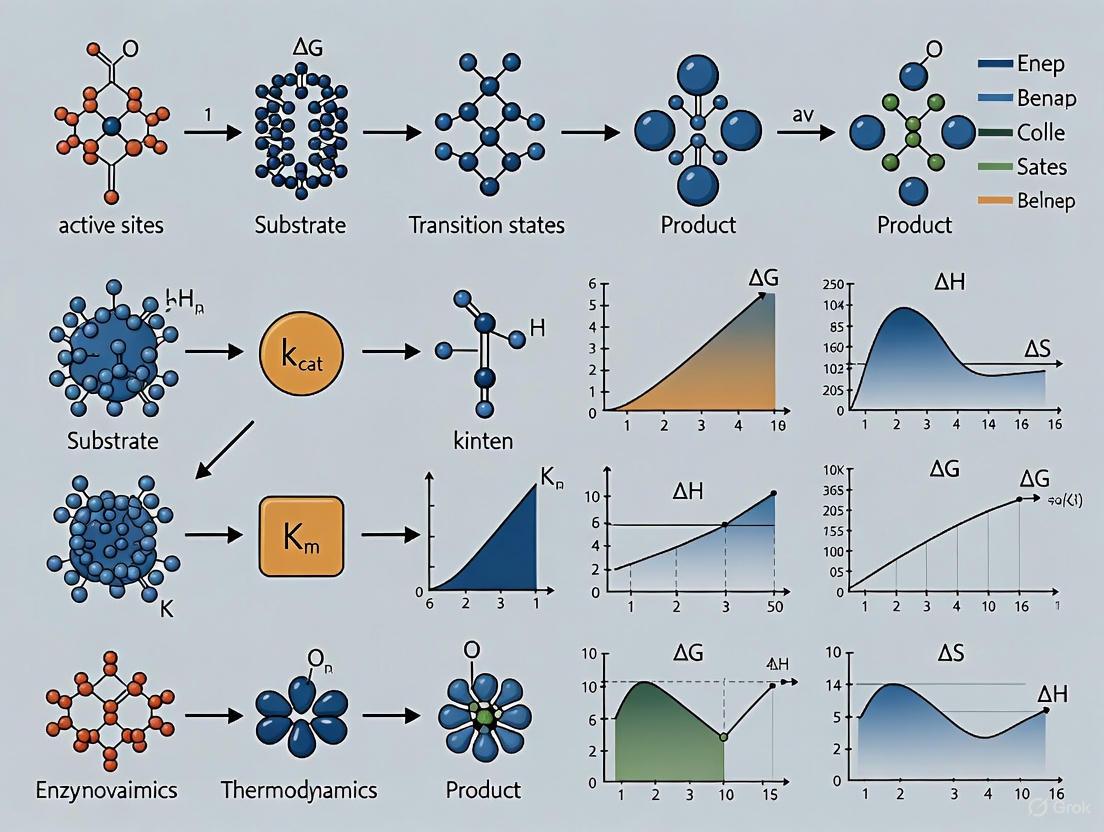
This article provides a comprehensive exploration of enzyme kinetics and thermodynamics, tailored for researchers, scientists, and drug development professionals.
Enzyme Kinetics and Thermodynamics: Bridging Fundamental Principles to Drug Discovery Applications
Abstract
This article provides a comprehensive exploration of enzyme kinetics and thermodynamics, tailored for researchers, scientists, and drug development professionals. It begins by establishing the foundational principles of enzyme catalysis, the Michaelis-Menten framework, and the critical relationship between kinetics and reaction thermodynamics. The scope then progresses to cover advanced methodological frameworks for building thermodynamically consistent models, strategies for troubleshooting and optimizing enzymatic activity, and finally, rigorous approaches for validating kinetic parameters and comparing inhibitor mechanisms. By synthesizing classical theory with modern computational and evolutionary perspectives, this review serves as a vital resource for leveraging enzymology in therapeutic discovery and optimization.
The Core Principles: Unraveling the Link Between Enzyme Kinetics and Thermodynamics
Enzymes serve as biological catalysts that profoundly accelerate biochemical reaction rates by lowering the activation energy barrier, while rigorously maintaining the thermodynamic equilibrium between substrates and products. This whitepaper examines the fundamental principles governing enzyme catalysis through the integrated lenses of kinetics and thermodynamics, synthesizing classical models with contemporary research findings. We explore how enzymes achieve remarkable rate enhancements exceeding 10^17-fold through transition state stabilization, precise substrate orientation, and covalent catalysis mechanisms, without altering reaction equilibria. Recent advances quantifying the relationship between thermodynamic driving forces and enzyme efficiency reveal critical implications for metabolic engineering and drug development. This analysis provides researchers with both theoretical frameworks and practical methodologies for investigating enzyme function, emphasizing the inseparable connection between catalytic mechanisms and cellular resource allocation.
Enzymes represent nature's primary catalytic machinery, accelerating biochemical reactions by factors of 10^6 to 10^17 compared to uncatalyzed rates while operating under mild physiological conditions [1]. These protein catalysts achieve extraordinary rate enhancements through selective stabilization of high-energy transition states, thereby reducing the activation energy barrier that substrates must overcome to form products [2]. A fundamental characteristic of enzymatic catalysis is that while kinetics are dramatically accelerated, the thermodynamic equilibrium position remains unchanged—enzymes equally accelerate both forward and reverse reactions according to the principle of microscopic reversibility [1].
The energy landscape of enzyme-catalyzed reactions reveals the physical basis for catalytic efficiency. In uncatalyzed reactions, substrates must overcome a significant energy barrier (activation energy) to reach the transition state before proceeding to products. Enzymes provide an alternative reaction pathway with a substantially lower energy barrier through multiple coordinated mechanisms including approximation, orientation, covalent catalysis, and acid-base catalysis [1]. Current research continues to elucidate how enzyme structure dictates function, with recent evidence demonstrating that thermodynamic parameters fundamentally constrain catalytic performance and cellular resource allocation [3] [4]. These findings have profound implications for understanding metabolic evolution and designing therapeutic enzyme inhibitors.
Fundamental Thermodynamic and Kinetic Frameworks
Thermodynamic Foundations of Enzyme Catalysis
Biochemical thermodynamics governs enzyme-catalyzed reactions through transformed Gibbs energy (G'), which incorporates pH as an independent variable alongside temperature and ionic strength [5]. This framework reveals that while enzymes dramatically accelerate reaction rates, they do not alter the overall equilibrium constant (K_eq) between substrates and products [6] [1]. The equilibrium position remains determined solely by the free energy difference (ΔG) between reactants and products, following the fundamental laws of thermodynamics.
The energy diagram below illustrates the critical relationship between activation energy and reaction rate in enzyme-catalyzed systems:
Energy Diagram Title: Enzyme Reduction of Activation Energy
This diagram visualizes the central principle of enzyme catalysis: enzymes lower the activation energy barrier (Ea) without changing the overall free energy (ΔG) of the reaction. The enzyme-catalyzed pathway (blue) demonstrates a significantly reduced energy barrier compared to the uncatalyzed reaction (red), enabling more substrate molecules to overcome this barrier per unit time while maintaining identical starting and ending energy states.
Michaelis-Menten Kinetics and Steady-State Assumptions
The Michaelis-Menten model provides the fundamental framework for quantifying enzyme kinetics through the relationship between substrate concentration and reaction velocity [7] [8]. This model introduces two critical kinetic parameters: Vmax (maximum reaction rate when enzyme active sites are saturated) and Km (Michaelis constant, representing the substrate concentration at half V_max) [8]. The basic model assumes the formation of an enzyme-substrate complex (ES) that subsequently converts to product:
Mechanism Title: Enzyme Catalysis Reaction Pathway
The Michaelis-Menten equation, ( v0 = \frac{V{max}[S]}{Km + [S]} ), mathematically describes the hyperbolic relationship between initial reaction velocity (v₀) and substrate concentration ([S]) [8]. Derivation of this equation employs either the rapid-equilibrium assumption (where E, S, and ES maintain equilibrium) or the more general steady-state assumption (where [ES] remains constant over time) [6]. The Km value provides insight into enzyme-substrate affinity, with lower Km values indicating higher affinity, while kcat (turnover number) represents the maximum number of substrate molecules converted to product per active site per unit time [8].
Table 1: Fundamental Kinetic Parameters in Enzyme Catalysis
| Parameter | Symbol | Definition | Interpretation | Typical Units |
|---|---|---|---|---|
| Michaelis Constant | K_m | Substrate concentration at ½ V_max | Measure of enzyme-substrate affinity | M (mol/L) |
| Maximum Velocity | V_max | Maximum reaction rate at enzyme saturation | Measure of catalytic efficiency | M/s |
| Turnover Number | k_cat | Number of reactions per active site per second | intrinsic catalytic efficiency | s⁻¹ |
| Specificity Constant | kcat/Km | Measure of catalytic efficiency at low [S] | Determines enzyme selectivity for competing substrates | M⁻¹s⁻¹ |
Experimental Methodologies in Enzyme Kinetics
Quantitative Enzyme Assay Protocols
Accurate determination of enzyme kinetic parameters requires carefully controlled experimental conditions and precise measurement of initial reaction rates. The following protocol outlines a standardized approach for obtaining Michaelis-Menten parameters:
Initial Rate Determination Protocol:
- Reaction Mixture Preparation: Prepare a master reaction buffer containing appropriate pH buffer, essential cofactors, and salts. Maintain constant temperature using a circulating water bath (±0.1°C).
- Enzyme Dilution Series: Prepare serial dilutions of purified enzyme in stabilization buffer (often containing BSA or glycerol). Keep on ice to maintain activity.
- Substrate Concentration Series: Prepare substrate solutions spanning concentrations from 0.2× to 5× the estimated K_m value.
- Reaction Initiation: Start reactions by adding enzyme to substrate solution (final volume 0.1-1.0 mL). Mix rapidly and thoroughly.
- Initial Rate Measurement: Monitor product formation or substrate disappearance continuously for the first 5-10% of reaction completion. Use appropriate detection methods (spectrophotometry, fluorimetry, radioactivity, etc.).
- Data Collection: Record initial linear rate for each substrate concentration. Perform measurements in triplicate with appropriate controls (no enzyme, no substrate).
- Parameter Calculation: Fit [S] vs. v₀ data to the Michaelis-Menten equation using nonlinear regression to determine Km and Vmax values.
For continuous assays, integrated rate equations can be applied to time-course data, particularly for reactions where substrate depletion becomes significant [6]. Recent advances incorporate computational simulations to model enzyme-catalyzed reactions and visualize progress curves under varying conditions, enabling more accurate parameter estimation [6].
Thermodynamic Profiling of Enzyme Reactions
Quantifying the thermodynamic constraints on enzyme catalysis requires determination of Gibbs free energy changes (ΔG) for individual reaction steps. The following methodology enables comprehensive thermodynamic profiling:
Thermodynamic Parameter Determination:
- Equilibrium Constant Measurement: Allow enzyme-catalyzed reactions to proceed to completion under defined conditions. Measure final concentrations of substrates and products using HPLC, NMR, or enzymatic coupling assays.
- Reaction Quench-Flow Techniques: For rapid reactions, use stopped-flow or quench-flow apparatus to measure reaction progress on millisecond timescales.
- Calorimetric Analysis: Employ isothermal titration calorimetry (ITC) to directly measure enthalpy changes (ΔH) during substrate binding and catalysis.
- Isotope Tracing Studies: Use ¹³C or ²H metabolic flux analysis (MFA) combined with computational estimation to determine in vivo ΔG values for metabolic reactions [3].
- Data Integration: Combine equilibrium concentrations with calorimetric data to calculate standard transformed Gibbs energies (ΔG'°), accounting for experimental pH and ionic strength [5].
Table 2: Research Reagent Solutions for Enzyme Kinetics Studies
| Reagent Category | Specific Examples | Function in Experimental Protocols |
|---|---|---|
| Buffering Systems | Tris-HCl, HEPES, Phosphate buffers | Maintain constant pH optimal for enzyme activity during assays |
| Cofactor Solutions | NAD+/NADH, ATP/Mg²+, Coenzyme A | Provide essential cosubstrates and cofactors for enzymatic reactions |
| Stabilizing Agents | Glycerol, Bovine Serum Albumin (BSA), Dithiothreitol (DTT) | Maintain enzyme stability and prevent inactivation during assays |
| Detection Reagents | Chromogenic substrates, Luciferin/luciferase, Fluorescent dyes | Enable quantification of reaction rates through signal generation |
| Proteomic Standards | Isotopically labeled reference peptides (AQUA) | Allow absolute quantification of enzyme concentrations via mass spectrometry [3] |
Current Research and Advanced Concepts
Thermodynamic Constraints on Cellular Enzyme Burden
Recent research has quantified how thermodynamic parameters influence the metabolic efficiency of enzyme systems in living cells. A 2025 study integrating absolute enzyme concentrations with in vivo metabolic fluxes demonstrated that thermodynamic driving force directly determines cellular enzyme burden [3]. This groundbreaking work compared three bacterial species utilizing distinct glycolytic pathways with varying thermodynamic profiles:
Table 3: Thermodynamic Efficiency of Glycolytic Pathways in Bacteria
| Organism | Glycolytic Pathway | Thermodynamic Favorability | Relative Enzyme Protein Required | Key Thermodynamic Features |
|---|---|---|---|---|
| Zymomonas mobilis | Entner-Doudoroff (ED) | Highest | 1× (reference) | Strong thermodynamic driving forces; minimal reverse fluxes |
| Escherichia coli | Embden-Meyerhof-Parnas (EMP) | Intermediate | ~2-3× | Moderate thermodynamic constraints |
| Clostridium thermocellum | PP_i-dependent EMP | Lowest | ~4× | High enzyme demand due to near-equilibrium reactions |
The study revealed that the highly favorable ED pathway in Z. mobilis requires only one-fourth the enzymatic protein to sustain equivalent flux compared to the thermodynamically constrained PP_i-dependent glycolytic pathway in C. thermocellum [3]. This provides direct experimental evidence that reactions operating near equilibrium (with nearly equal forward and reverse fluxes) incur substantially higher enzyme costs due to inefficient enzyme utilization. These findings have profound implications for metabolic engineering, suggesting that pathway thermodynamics should be optimized to minimize protein burden while maintaining desired flux.
Scaling Relationships Between Enzyme Kinetics and Energy Dissipation
Emerging research explores fundamental connections between enzyme kinetic parameters and thermodynamic dissipation through power-law scaling relationships. A 2025 analysis of 75 enzyme-catalyzed reactions demonstrated scale-invariant dissipation underlying enzyme catalytic performance [4]. The study identified a log-log power law relationship between dissipation (as quantified in irreversible thermodynamics) and enzyme efficiency (kcat/Km):
[ \log{10}\left(\frac{\text{dissipation}}{RT}\right) = a + b \cdot \log{10}\left(\frac{k{cat}}{KM}\right) ]
This relationship connects physical parameters from irreversible thermodynamics with biological performance parameters, supporting the evolution-coupling hypothesis that links physical and biological evolutionary processes [4]. The research further distinguished between "specialist" enzymes (optimized for specific substrates with high kcat/Km values) and "generalist" enzymes (with broader substrate range but lower catalytic efficiency), revealing different scaling exponents between these categories.
Mechanistic Convergence in Functionally Analogous Enzymes
Quantitative analysis of functionally analogous enzymes (non-homologous enzymes catalyzing similar reactions) reveals unexpected diversity in catalytic mechanisms. A comprehensive study of 95 enzyme pairs with identical Enzyme Commission (EC) classifications found that only 44% showed significant similarity in overall bond changes during catalysis [9]. Even more strikingly, only 33% of these pairs had converged on similar stepwise mechanisms despite catalyzing statistically similar overall reactions.
The workflow below illustrates the experimental approach for comparing catalytic mechanisms across enzyme families:
Analysis Title: Enzyme Mechanism Comparison Workflow
This research demonstrates that the EC classification system often fails to capture significant mechanistic differences between enzymes and suggests that quantitative measurement of bond changes could refine enzyme classification and functional annotation [9]. These findings are particularly relevant for drug development, where understanding mechanistic differences between homologous human and pathogen enzymes can enable selective inhibitor design.
Applications in Drug Development and Metabolic Engineering
Enzyme Inhibition Mechanisms and Therapeutic Targeting
Understanding enzyme catalytic mechanisms provides the foundation for rational drug design targeting pathogenic enzymes. Different inhibition modalities produce distinct effects on kinetic parameters, as summarized below:
Table 4: Enzyme Inhibition Mechanisms and Kinetic Effects
| Inhibition Type | Mechanism of Action | Effect on K_m | Effect on V_max | Therapeutic Examples |
|---|---|---|---|---|
| Competitive | Inhibitor binds active site, competing with substrate | Increases | No change | Statins (HMG-CoA reductase inhibitors) |
| Non-competitive | Inhibitor binds allosteric site, affecting catalysis | No change | Decreases | Protease inhibitors for HIV treatment |
| Uncompetitive | Inhibitor binds only to enzyme-substrate complex | Decreases | Decreases | Methotrexate (dihydrofolate reductase inhibitor) |
| Mixed | Inhibitor binds both enzyme and ES complex with different affinities | Increases or decreases | Decreases | Various kinase inhibitors |
The quantitative analysis of inhibitor effects typically employs Lineweaver-Burk plots (1/v vs. 1/[S]) to distinguish inhibition mechanisms through characteristic pattern changes [8]. Modern drug discovery integrates these classical kinetic approaches with structural biology and computational modeling to design highly specific therapeutic agents.
Engineering Enzymes for Industrial Applications
Recent advances in understanding enzyme catalysis enable engineering of customized enzymes for industrial processes. The successful elucidation of the acetyl-CoA synthase (ACS) mechanism through synthetic model systems illustrates this approach [10]. Researchers created a functional synthetic model using a specialized ligand (iPr₃tacn) that cages nickel atoms, slowing reaction rates sufficiently to characterize previously elusive intermediates, including the rare Ni(methyl)(CO) species [10].
This mechanistic understanding facilitates the development of nickel-based catalysts for carbon capture and utilization, potentially replacing expensive precious metals (e.g., rhodium in Monsanto's acetic acid process) with earth-abundant alternatives [10]. Similarly, insights from thermodynamic profiling of native metabolic pathways guide the engineering of synthetic pathways with reduced enzyme burden and enhanced flux capacity [3].
Enzymes exemplify nature's mastery of catalytic principles, achieving extraordinary rate enhancements through transition state stabilization while respecting fundamental thermodynamic constraints. The integrated perspective presented in this whitepaper demonstrates that enzyme kinetics and thermodynamics are inseparable determinants of biological function, from molecular mechanisms to cellular resource allocation. Current research continues to reveal unexpected relationships between energy dissipation, catalytic efficiency, and evolutionary adaptation, providing new conceptual frameworks for understanding enzyme function.
The quantitative methodologies and experimental approaches detailed herein provide researchers with powerful tools for investigating enzyme mechanisms, inhibiting pathogenic enzymes, and engineering novel catalysts. As thermodynamic profiling and mechanistic analysis techniques continue to advance, they will undoubtedly yield new insights into nature's catalytic strategies and enable innovative applications in therapeutics, biotechnology, and sustainable chemistry.
The Michaelis-Menten equation stands as a cornerstone of enzymology, providing a quantitative framework to describe the kinetics of enzyme-catalyzed reactions. This technical guide deconstructs the fundamental parameters of the equation—kcat, KM, and Vmax—within the context of modern enzyme thermodynamics and kinetics research. We explore the intricate relationship between these kinetic constants, the thermodynamic principles governing their optimization, and their critical importance in drug development and biotechnology. By integrating theoretical frameworks with practical experimental protocols and advanced analysis techniques, this review serves as a comprehensive resource for researchers and scientists seeking to deepen their understanding of enzyme function and catalytic efficiency.
Enzyme kinetics is the study of the rates of enzyme-catalyzed reactions and the conditions that affect them. Enzymes are biological catalysts that increase the rate of chemical reactions without being consumed or permanently altered in the process. They achieve this remarkable efficiency by providing an alternative reaction pathway with a lower activation energy (Ea)—the minimum energy input required for a reaction to proceed [8]. The catalytic activity of enzymes is essential for virtually all biological processes, as without them, many biochemical reactions would proceed too slowly to sustain life [8].
The early 20th century witnessed foundational developments in enzyme kinetics, culminating in 1913 when Leonor Michaelis and Maud Menten proposed a quantitative theory of enzyme kinetics that remains fundamental to the field today [11] [12]. Their work built upon earlier observations by Victor Henri, who recognized that enzyme reactions involved binding interactions between enzymes and substrates [12]. Michaelis and Menten investigated the kinetics of invertase, an enzyme that catalyzes the hydrolysis of sucrose into glucose and fructose, and developed a mathematical model that could explain the characteristic dependence of reaction velocity on substrate concentration [12]. This model, now known as Michaelis-Menten kinetics, has proven applicable not only to enzyme-substrate interactions but also to antigen-antibody binding, DNA-DNA hybridization, protein-protein interactions, and various other biochemical processes [12].
The Michaelis-Menten Model and Equation
Fundamental Reaction Mechanism
The Michaelis-Menten model describes a minimal enzyme-catalyzed reaction involving the transformation of a single substrate into a single product. The reaction scheme proceeds through the formation of an enzyme-substrate complex, which then decomposes to yield the product and regenerate the free enzyme. The complete mechanism can be represented as follows [12]:
E + S ⇌ ES → E + P
Where E represents the free enzyme, S is the substrate, ES is the enzyme-substrate complex, and P is the product. The rate constants k₁ and k₋₁ govern the forward and reverse reactions for the formation of the ES complex, while k₂ (often denoted as kcat) represents the catalytic rate constant for the conversion of the complex to product and free enzyme [12].
The Michaelis-Menten Equation
Through mathematical derivation based on either the rapid equilibrium assumption or the steady-state approximation, the Michaelis-Menten equation expresses the initial reaction velocity (v) as a function of substrate concentration [S]:
v = (Vmax × [S]) / (KM + [S]) [8] [12]
Where:
- v is the initial reaction velocity
- Vmax is the maximum reaction velocity
- [S] is the substrate concentration
- KM is the Michaelis constant
This equation describes a hyperbolic relationship between substrate concentration and reaction rate, which can be graphically represented in a Michaelis-Menten plot [11]. At low substrate concentrations ([S] << KM), the reaction rate increases approximately linearly with substrate concentration (first-order kinetics). At high substrate concentrations ([S] >> KM), the rate approaches Vmax asymptotically and becomes independent of substrate concentration (zero-order kinetics) [8] [12].
Figure 1: Michaelis-Menten Enzyme Reaction Mechanism. This diagram illustrates the fundamental steps in enzyme catalysis according to the Michaelis-Menten model, showing the relationship between enzyme (E), substrate (S), enzyme-substrate complex (ES), and product (P), along with their respective rate constants.
Deconstructing the Kinetic Parameters
Vmax: Maximum Reaction Velocity
Vmax represents the maximum rate of an enzyme-catalyzed reaction when all available enzyme active sites are saturated with substrate [11] [13]. Conceptually, it reflects the enzyme's "top speed" under optimal substrate conditions [13]. When every active site is occupied, the enzyme operates at full capacity, and adding more substrate cannot increase the reaction rate further [11]. Mathematically, Vmax is defined as:
Vmax = kcat × [E]₀
Where [E]₀ is the total enzyme concentration and kcat is the catalytic rate constant (turnover number) [12]. The value of Vmax is dependent on enzyme concentration and provides insight into the catalytic efficiency of the enzyme when substrate is not limiting.
KM: Michaelis Constant
The Michaelis constant (KM) is defined as the substrate concentration at which the reaction rate is half of Vmax [11] [8]. It is a composite constant derived from the individual rate constants of the enzymatic reaction:
KM = (k₋₁ + kcat)/k₁ [12]
KM serves as an inverse measure of the enzyme's affinity for its substrate—a lower KM value indicates higher substrate affinity, meaning the enzyme requires a lower substrate concentration to reach half of its maximum velocity [11] [8]. This relationship makes KM a crucial parameter for understanding how efficiently an enzyme can function at physiological substrate concentrations.
kcat: Catalytic Constant (Turnover Number)
The kcat value, also known as the turnover number, represents the maximum number of substrate molecules converted to product per enzyme active site per unit time [11]. It is a first-order rate constant with units of reciprocal time (s⁻¹) and reflects the intrinsic catalytic efficiency of the enzyme when saturated with substrate [12]. kcat defines the rate-limiting step of the catalytic cycle, typically the conversion of ES complex to E + P [8]. Higher kcat values indicate more efficient enzymes capable of processing more substrate molecules per second.
Catalytic Efficiency: kcat/KM
The specificity constant, expressed as kcat/KM, is a second-order rate constant that measures the overall catalytic efficiency of an enzyme toward a particular substrate [11] [12]. It incorporates both binding affinity (KM) and catalytic rate (kcat) into a single parameter. The higher the kcat/KM value, the more efficient the enzyme is at converting substrate to product, particularly at low substrate concentrations [12]. This parameter becomes especially important when comparing an enzyme's activity toward different substrates or when evaluating the effectiveness of enzyme variants in protein engineering [12].
Table 1: Key Parameters in Michaelis-Menten Kinetics
| Parameter | Symbol | Definition | Interpretation | Units |
|---|---|---|---|---|
| Maximum Velocity | Vmax | Maximum reaction rate at enzyme saturation | Enzyme's "top speed" at full capacity | concentration/time |
| Michaelis Constant | KM | Substrate concentration at Vmax/2 | Inverse measure of substrate affinity | concentration |
| Turnover Number | kcat | Number of substrate molecules turned over per site per second | Intrinsic catalytic efficiency | time⁻¹ |
| Catalytic Efficiency | kcat/KM | Ratio of catalytic constant to Michaelis constant | Overall efficiency for a specific substrate | concentration⁻¹·time⁻¹ |
Table 2: Representative Enzyme Kinetic Parameters [12]
| Enzyme | KM (M) | kcat (s⁻¹) | kcat/KM (M⁻¹s⁻¹) |
|---|---|---|---|
| Chymotrypsin | 1.5 × 10⁻² | 0.14 | 9.3 |
| Pepsin | 3.0 × 10⁻⁴ | 0.50 | 1.7 × 10³ |
| tRNA synthetase | 9.0 × 10⁻⁴ | 7.6 | 8.4 × 10³ |
| Ribonuclease | 7.9 × 10⁻³ | 7.9 × 10² | 1.0 × 10⁵ |
| Carbonic anhydrase | 2.6 × 10⁻² | 4.0 × 10⁵ | 1.5 × 10⁷ |
| Fumarase | 5.0 × 10⁻⁶ | 8.0 × 10² | 1.6 × 10⁸ |
Thermodynamic Principles and Relationship to Kinetic Parameters
Thermodynamic Basis of Enzyme Catalysis
Enzymes function by lowering the activation energy (Ea) required for a reaction to proceed, without altering the overall equilibrium or thermodynamics of the reaction [8] [14]. They achieve this by stabilizing the transition state—the high-energy intermediate through which the reaction must pass [8]. The active site of an enzyme is complementary not to the substrate itself, but to the transition state, which has higher free energy than both the substrate and product [8]. This transition state stabilization reduces the activation energy barrier, allowing more substrate molecules to reach the transition state and be converted to product within a given time frame [8].
Two principal models describe how enzymes interact with their substrates. The lock-and-key model proposes that the enzyme's active site is pre-formed to perfectly fit the substrate [8]. The more widely accepted induced-fit model suggests that the enzyme undergoes conformational changes upon substrate binding to optimize its fit with the transition state [8] [14]. This conformational adjustment better orients catalytic residues and the substrate, thereby enhancing transition state stabilization and facilitating the chemical transformation [14].
Thermodynamic Optimization of Kinetic Parameters
Recent research has revealed fundamental thermodynamic principles governing the optimization of enzymatic activity. A key finding demonstrates that tuning the Michaelis constant (KM) to match the physiological substrate concentration ([S]) enhances enzymatic activity [15]. This optimization principle (KM = [S]) emerges from thermodynamic constraints under the assumption that thermodynamically favorable reactions have higher rate constants, with the total driving force being fixed [15].
This relationship can be understood through thermodynamic modeling that incorporates the Brønsted (Bell)-Evans-Polanyi (BEP) relationship, which models activation barriers as functions of driving force [15]. The BEP relationship suggests that thermodynamically unfavorable elementary reactions have larger activation barriers [15]. When applied to enzyme kinetics, this principle reveals that the distribution of the total free energy change (ΔGT) between the initial enzyme-substrate binding step (ΔG1) and the subsequent catalytic step (ΔG2) determines the overall catalytic efficiency [15]. Bioinformatic analysis of approximately 1000 wild-type enzymes confirms that KM values and in vivo substrate concentrations are consistent across diverse enzymes, suggesting that natural selection follows the principle of KM = [S] [15].
Figure 2: Energy Diagram Comparing Catalyzed and Uncatalyzed Reactions. This diagram illustrates how enzymes lower the activation energy (ΔG‡) barrier without changing the overall free energy (ΔG) of the reaction. The blue line represents the uncatalyzed pathway, while the red line shows the enzyme-catalyzed pathway with a lower energy transition state.
Experimental Determination of Kinetic Parameters
Standard Kinetic Assay Protocol
The reliable determination of Michaelis-Menten parameters requires carefully controlled experimental conditions and rigorous methodology. A comprehensive enzyme characterization pipeline typically includes the following steps [16]:
- Protein Expression and Purification: Produce soluble, active enzyme at sufficient yield and purity for kinetic assays.
- Pre-test Colorimetric Assay: Perform rapid, high-throughput screening for enzymatic activity using appropriate indicators.
- Fluoride Ion Measurement: For dehalogenases and similar enzymes, directly measure released ions to confirm reaction quantitatively.
- Linear Phase Determination: Identify the time window where product formation is linear and the enzyme concentration range where initial velocity (V₀) is proportional to enzyme concentration ([E]).
- Michaelis-Menten Kinetics: Measure initial velocities at multiple substrate concentrations and fit data to the Michaelis-Menten equation using nonlinear regression.
For the formal kinetic characterization, researchers should use enzyme at a chosen concentration ([E]) with a substrate series (e.g., 0.1-20 mM; recommended points: 0.1, 0.5, 1, 2, 5, 10, 15 mM) in triplicate assays [16]. Initial rates should be measured within the previously determined linear time window. The resulting V₀ versus [S] data are then fitted to the Michaelis-Menten equation to obtain KM and Vmax, from which kcat can be calculated as kcat = Vmax/[E]total [16].
Advanced Methodologies
While traditional spectrophotometric methods remain widely used, several advanced techniques offer enhanced capabilities for kinetic parameter determination:
Real-time Quantitative NMR (qNMR): This approach enables following enzymatic conversion of substrate to product in real-time by continuous collection of spectra [17]. When combined with progress curve analysis and the Lambert-W function (a closed-form solution to the time-dependent substrate/product kinetics), qNMR can estimate KM and Vmax from a single experiment [17]. This method has been successfully applied to studies of acetylcholinesterase, β-Galactosidase, and invertase [17].
Orthogonal Validation Methods:
- Liquid Chromatography-Mass Spectrometry (LC-MS/MS): Provides chemical identification of substrate depletion and specific degradation products to confirm reaction pathways [16].
- Stopped-flow Spectrophotometry: Allows measurement of very fast initial rates for rapid enzymatic reactions [16].
- ¹⁹F-NMR: Enables direct observation of fluorine-containing species and structural characterization of transformation products [16].
Table 3: Essential Research Reagents and Materials for Enzyme Kinetics Studies
| Reagent/Material | Function/Application | Considerations |
|---|---|---|
| Purified Enzyme | Catalytic component of study | Must be soluble, active, and at sufficient concentration/purity |
| Substrate Series | Variable concentration points for kinetic analysis | Should cover range below and above expected KM |
| Buffer Components | Maintain optimal pH for enzymatic activity | Choice depends on enzyme pH optimum; Tris, phosphate common |
| Colorimetric Probes (e.g., phenol red) | High-throughput activity screening | pH-sensitive indicators for reactions liberating acids/bases |
| Ion-Selective Electrode | Direct measurement of released ions | Requires calibration with standard solutions |
| TISAB Solution | Stabilizes ionic strength, complexes interfering metals | Essential for fluoride ion measurement assays |
| LC-MS/MS System | Orthogonal validation of substrate depletion and product formation | Requires reference standards for quantification |
Data Analysis and Quality Control
Proper statistical analysis is crucial for reliable kinetic parameter estimation. Researchers should:
- Perform experiments in triplicate to assess reproducibility
- Report mean ± standard deviation (n ≥ 3)
- Evaluate residuals and confidence intervals from nonlinear fits
- Include appropriate controls: substrate alone, enzyme blanks, spiked recovery samples
- Use specialized software (e.g., GraphPad Prism) for robust curve fitting [16]
Success in kinetic characterization is indicated by reproduction of literature values for well-characterized enzymes within approximately 2-fold, with confidence intervals excluding zero and coefficient of variation (CV) < 20% [16].
Figure 3: Experimental Workflow for Enzyme Kinetic Characterization. This diagram outlines the key stages in determining Michaelis-Menten parameters, from initial preparation through data collection to final analysis and validation.
Applications in Drug Development and Biotechnology
Enzyme Inhibition Mechanisms in Pharmaceutical Development
Understanding Michaelis-Menten parameters is crucial in drug discovery, particularly in the design and characterization of enzyme inhibitors. Different types of inhibition display distinct effects on KM and Vmax, enabling researchers to elucidate inhibitor mechanisms [13]:
Competitive Inhibition: Inhibitors compete with the substrate for the active site, increasing the apparent KM value without affecting Vmax [13]. This occurs because sufficient substrate can outcompete the inhibitor at high concentrations. Competitive inhibition is analogous to "musical chairs" where substrate and inhibitor vie for the same binding site [13].
Noncompetitive Inhibition: Inhibitors bind allosterically to both free enzyme and the ES complex, reducing Vmax without altering KM [13]. This type of inhibition decreases the enzyme's catalytic capacity while maintaining its substrate affinity.
Uncompetitive Inhibition: Inhibitors bind exclusively to the ES complex, decreasing both Vmax and KM [13]. This mechanism "locks" the substrate in place, effectively increasing apparent affinity while reducing catalytic turnover.
Mixed Inhibition: Inhibitors bind to both free enzyme and ES complex but with different affinities, decreasing Vmax while either increasing or decreasing KM depending on binding preferences [13].
Rational Enzyme Engineering and Optimization
The principles of Michaelis-Menten kinetics guide enzyme engineering efforts in biotechnology. By understanding the relationship between kinetic parameters and catalytic efficiency, researchers can develop strategies to optimize enzymes for industrial processes. The thermodynamic principle that tuning KM to match operational substrate concentrations enhances activity provides a concrete guideline for enzyme optimization [15]. This approach is particularly valuable in metabolic engineering, bioremediation, and the development of biocatalysts for chemical synthesis [15].
In applied contexts, enzyme kinetic characterization enables data-driven decisions about enzyme immobilization, bioreactor design, and process optimization [16]. For example, enzymes with high kcat and low KM values are prioritized for immobilization and reactor tests with a focus on stability, while those with low kcat but low KM may benefit from active-site mutations to improve catalysis [16].
The Michaelis-Menten equation and its parameters—kcat, KM, and Vmax—provide a fundamental framework for understanding enzyme catalysis that remains as relevant today as when it was first introduced over a century ago. Through continued refinement of experimental methods and deeper thermodynamic insights, researchers have expanded the application of these kinetic principles from basic enzymology to drug discovery, biotechnology, and systems biology. The recent recognition that natural enzymes appear optimized such that KM matches physiological substrate concentrations offers a powerful design principle for engineering novel catalysts [15]. As new analytical techniques emerge and our understanding of enzyme thermodynamics deepens, the nuanced interpretation of these kinetic parameters will continue to drive innovations across biochemical research and therapeutic development.
The derivation of the Michaelis-Menten equation, a cornerstone of enzymology, rests upon critical simplifying assumptions that make the complex mathematics of enzyme catalysis tractable. The two primary frameworks—the rapid equilibrium assumption and the more general steady-state assumption—represent fundamentally different approaches to modeling enzyme behavior. While both yield the familiar hyperbolic equation relating substrate concentration to reaction velocity, their underlying mechanisms and conditions for validity differ significantly. Understanding these distinctions is not merely academic; it directly impacts experimental design, parameter estimation accuracy, and model selection in pharmaceutical development and metabolic engineering.
For over a century, the Michaelis-Menten equation has provided the principal framework for quantifying enzyme activity through parameters ( KM ) (Michaelis constant) and ( k{cat} ) (catalytic constant). The canonical form, ( v = \frac{V{max}[S]}{KM + [S]} ), describes the dependence of reaction velocity (( v )) on substrate concentration (( [S] )) [18] [15]. However, this equation can be derived via two distinct logical pathways, each with specific constraints. The rapid equilibrium (or quasi-equilibrium) assumption posits that the initial substrate binding step (E + S ⇌ ES) reaches equilibrium rapidly compared to the subsequent catalytic step (ES → E + P) [6]. In contrast, the steady-state assumption, developed by Briggs and Haldane, proposes that the concentration of the enzyme-substrate complex (ES) remains constant over time, regardless of whether the binding step has reached equilibrium [18]. This distinction becomes critically important when moving beyond idealized in vitro conditions to model enzyme behavior in complex biological systems like intracellular environments, where enzyme concentrations can approach or exceed ( K_M ) values.
Theoretical Foundations and Mathematical Derivations
The Rapid Equilibrium Assumption
Under the rapid equilibrium assumption, the enzyme (E), substrate (S), and enzyme-substrate complex (ES) are considered to be in instantaneous equilibrium. The dissociation constant for the ES complex, ( KS ), is defined as ( KS = \frac{[E][S]}{[ES]} ). Using the enzyme conservation equation (( [E]T = [E] + [ES] )), one can solve for [ES], yielding ( [ES] = \frac{[E]T[S]}{KS + [S]} ) [6]. Since the reaction velocity is given by ( v = k{cat}[ES] ), substitution produces the familiar Michaelis-Menten equation: ( v = \frac{k{cat}[E]T[S]}{KS + [S]} = \frac{V{max}[S]}{KS + [S]} ). In this derivation, the Michaelis constant ( KM ) is literally identical to the dissociation constant ( K_S ), providing a direct thermodynamic measure of substrate binding affinity. This derivation is mathematically straightforward but relies on the potentially restrictive assumption that the catalytic step is rate-limiting and sufficiently slow to allow the binding equilibrium to be maintained throughout the reaction.
The Steady-State Assumption
The steady-state approach, formalized by Briggs and Haldane, relaxes the requirement for a pre-equilibrium. It instead assumes that shortly after the reaction initiates, the concentration of the ES complex becomes constant, so ( \frac{d[ES]}{dt} = 0 ) [18]. For the basic mechanism ( E + S \overset{kf}{\underset{kr}{\rightleftharpoons}} ES \overset{k{cat}}{\rightarrow} E + P ), applying the steady-state condition to [ES] leads to the expression ( KM = \frac{kr + k{cat}}{kf} ). The resulting equation is identical in form to the rapid equilibrium derivation: ( v = \frac{k{cat}[E]T[S]}{KM + [S]} ). However, the definition of ( KM ) is now a kinetic, not a thermodynamic, constant. It reflects the combined processes of dissociation and catalysis. Only when ( k{cat} \ll kr ) does ( KM ) approximate the true dissociation constant ( K_S ). This makes the steady-state approximation applicable to a wider range of enzymes, particularly those where the chemical transformation step is not unequivocally rate-limiting.
Table 1: Comparison of Key Assumptions and Parameter Definitions
| Feature | Rapid Equilibrium Assumption | Steady-State Assumption |
|---|---|---|
| Core Premise | E + S ⇌ ES equilibrium established rapidly | [ES] constant after reaction initiation |
| Rate-Limiting Step | Catalytic step (ES → E + P) | Not specified; can be any step |
| Definition of ( K_M ) | ( KM = KS = \frac{kr}{kf} ) (Dissociation constant) | ( KM = \frac{kr + k{cat}}{kf} ) (Kinetic constant) |
| Mathematical Complexity | Simpler derivation | More complex derivation |
| Range of Validity | Narrower; requires ( k{cat} \ll kr ) | Broader; applicable when ( \frac{[E]T}{[S]T + K_M} \ll 1 ) [18] |
| Interpretation of ( K_M ) | Pure measure of substrate binding affinity | Apparent affinity influenced by binding and catalysis |
Validity Conditions and Modern Extensions
The validity of the standard Michaelis-Menten equation (derived from either assumption) is formally bounded by the condition ( \frac{[E]T}{KM + [S]T} \ll 1 ) [18]. Violations occur in vivo, where high enzyme concentrations are common, leading to significant underestimation of ( KM ) and ( k{cat} ) if the classical model is used. To address this, the total quasi-steady-state approximation (tQSSA) was developed. The tQSSA model uses a more complex rate equation that remains accurate even when enzyme concentration is not negligible compared to substrate and ( KM ) [18]. This model is particularly valuable for analyzing progress curve data and for predicting in vivo enzyme activity from in vitro parameters. Bayesian inference methods based on the tQSSA model have been shown to provide unbiased estimates of kinetic parameters for diverse enzymes like chymotrypsin, fumarase, and urease, regardless of the initial enzyme-to-substrate ratio [18].
Diagram 1: Kinetic Model Selection Workflow
Experimental Protocols and Data Analysis
Progress Curve Assay and Parameter Estimation
The progress curve assay, which fits the entire time-course of product formation, uses data more efficiently than the initial velocity assay and requires fewer experiments to estimate parameters [18]. The protocol involves:
- Reaction Initiation: Combine enzyme and substrate at a defined temperature and pH, ensuring rapid mixing. The reaction mixture should include all necessary cofactors and be buffered appropriately.
- Time-Course Monitoring: Continuously monitor the accumulation of product (or depletion of substrate) using a suitable method (e.g., spectrophotometry, fluorimetry, HPLC). Data points should be densely collected, especially in the early phase of the reaction.
- Data Fitting with Integrated Rate Equations: Fit the progress curve data to the integrated form of the chosen kinetic model, not just the initial rates.
- Computational Parameter Estimation: Use nonlinear regression algorithms (e.g., in R, Python, or specialized software like NONMEM) to obtain best-fit estimates for ( k{cat} ) and ( KM ). Bayesian inference approaches are particularly effective as they provide probability distributions for the parameters, quantifying estimation uncertainty [18] [19].
Comparing Estimation Methods
Various statistical methods exist for estimating ( V{max} ) and ( KM ) from kinetic data. Traditional linearization methods (e.g., Lineweaver-Burk, Eadie-Hofstee) are simple but often violate the assumptions of linear regression, such as homoscedasticity of errors. Modern nonlinear regression techniques applied directly to the untransformed data or to the full progress curve provide superior accuracy and precision [19].
Table 2: Comparison of Enzyme Kinetic Parameter Estimation Methods
| Estimation Method | Description | Key Advantages | Key Limitations |
|---|---|---|---|
| Lineweaver-Burk (LB) | Linear plot of ( 1/v ) vs. ( 1/[S] ) | Simple visualization of ( KM ) and ( V{max} ) | Prone to error propagation; poor statistical properties [19] |
| Eadie-Hofstee (EH) | Linear plot of ( v ) vs. ( v/[S] ) | Better error distribution than LB | Still less reliable than nonlinear methods [19] |
| Nonlinear Regression (NL) | Direct fit of ( v ) vs. ( [S] ) to Michaelis-Menten equation | Accurate; honors error structure of data | Requires computational software |
| Progress Curve (NM) | Nonlinear fit of ( [S] ) or ( [P] ) vs. time data | Uses data more efficiently; fewer experiments required | Requires accurate initial conditions and model [18] [19] |
Diagram 2: Generalized Reversible Enzyme Mechanism
Successful experimental analysis of enzyme kinetics requires careful selection of reagents and computational tools.
Table 3: Essential Research Reagent Solutions for Kinetic Studies
| Reagent / Material | Function / Purpose | Technical Considerations |
|---|---|---|
| High-Purity Enzyme | The catalyst of interest; source of kinetic behavior. | Requires precise concentration determination (e.g., A280, Bradford assay); purity critical to avoid confounding activities. |
| Authentic Substrate Standard | The molecule transformed in the reaction. | Purity must be verified; solubility in assay buffer is a key factor. |
| Cofactors (e.g., NADH, Mg²⁺) | Essential non-protein components for many enzymes. | Must be added at physiologically relevant concentrations; stability can be an issue. |
| Spectrophotometric Assay Kits | Enable continuous monitoring of product formation/substrate depletion. | Choice depends on chromophore/fluorophore properties (e.g., absorbance max, extinction coefficient). |
| Stopped-Flow Apparatus | For rapid mixing and data collection on millisecond timescales. | Essential for studying very fast reactions and obtaining true initial velocities. |
| Bayesian Inference Software | For robust parameter estimation and uncertainty quantification from progress curves. | Packages like Stan, PyMC, or specialized MATLAB toolboxes implement tQSSA-based fitting [18]. |
| Curated Kinetic Databases (BRENDA, SABIO-RK) | Source of prior knowledge for parameter initialization and comparison. | Contains thousands of ( k{cat} ) and ( KM ) values but requires careful curation [20]. |
Applications in Drug Development and Systems Biology
The choice between steady-state and more advanced kinetic models has profound implications in applied fields. In drug development, accurate characterization of enzyme-inhibitor interactions is vital. The classical model of inhibition (competitive, non-competitive, uncompetitive) is built upon the rapid-equilibrium or steady-state framework. However, these models often fail to distinguish between inhibitor binding and its functional effect, leading to the over-complication of modifier kinetics [21]. Simplified, universal modifier equations that more directly relate to binding curves are now emerging as powerful alternatives for characterizing both inhibitors and activators [21].
In systems biology and metabolic engineering, the goal is to build predictive models of cellular metabolism. These models require accurate in vivo kinetic parameters. The standard Michaelis-Menten equation often performs poorly for this task because intracellular environments frequently violate the low enzyme concentration assumption [18]. The tQSSA and related approximations provide a more solid foundation for predicting enzyme activity in vivo and for inferring kinetic parameters from omics data [18] [20]. Furthermore, machine learning frameworks like CatPred are now being developed to predict in vitro kinetic parameters (( k{cat} ), ( KM ), ( Ki )) from enzyme sequence and structure, helping to initialize and parameterize large-scale kinetic models of metabolism [20]. A key thermodynamic principle emerging from kinetic studies is that natural selection appears to tune an enzyme's ( KM ) to be close to the prevailing in vivo substrate concentration (( K_M \approx [S] )), a point that maximizes enzyme activity under thermodynamic constraints [15].
The distinction between the rapid equilibrium and steady-state assumptions is fundamental to a rigorous understanding of enzyme kinetics. While the resulting rate equations are identical in form, the interpretation of the parameters and the conditions for model validity differ substantially. Moving beyond the classical Michaelis-Menten framework towards more general models like the tQSSA is essential for accurate parameter estimation, especially in contexts where enzyme concentrations are high. The integration of robust experimental protocols, sophisticated computational fitting methods, and modern thermodynamic insights provides a powerful toolkit for researchers aiming to understand and engineer enzymatic activity in both basic research and applied pharmaceutical contexts. As the field advances, the synergy between careful experimental kinetics, advanced theoretical models, and emerging machine learning tools will continue to refine our ability to predict and control enzyme behavior.
Enzyme catalysis is fundamentally governed by thermodynamics and the spatial-temporal dynamics of the free energy landscape (FEL). The FEL provides a quantitative framework for understanding enzyme turnover, defining the probabilities of populating various conformational states along the reaction coordinate. The Gibbs free energy change (ΔG) serves as the central thermodynamic parameter dictating reaction spontaneity and catalytic efficiency. This whitepaper delineates the integration of FEL analysis with classical Michaelis-Menten kinetics, explores advanced experimental and computational methodologies for probing enzymatic thermodynamics, and discusses applications in rational enzyme engineering and drug development. By establishing a quantitative link between molecular-level motions and macroscopic kinetic parameters, this overview provides researchers with a foundational guide for interrogating and manipulating enzymatic function.
Enzyme kinetics has traditionally been framed by the Michaelis-Menten model, which provides essential parameters (k{cat}) and (Km) for quantifying catalytic efficiency. However, a comprehensive understanding of enzyme function requires moving beyond this static depiction to a dynamic thermodynamic model where the protein scaffold exhibits substantial motion over broad timescales [22]. The Free Energy Landscape (FEL) formalizes this concept, defining the conformational space accessible to an enzyme during catalysis and providing the link between atomic-scale flexibility and turnover rate [22]. Within this framework, the Gibbs Free Energy (ΔG) represents the "backbone" of enzyme thermodynamics, determining the direction and extent of chemical reactions. The general Gibbs free energy equation is expressed as (G = H - TS), where (H) is enthalpy, (T) is temperature, and (S) is entropy [23] [24]. For biochemical reactions, the change in free energy, ( \Delta G = \Delta H - T \Delta S ), dictates spontaneity: a negative ΔG indicates a thermodynamically favorable (exergonic) process, while a positive ΔG signifies a non-spontaneous (endergonic) one that requires energy input [23] [24]. This review synthesizes current understanding of how FELs and ΔG collectively govern enzyme kinetics, enabling researchers to deconstruct catalytic mechanisms and strategically engineer enzymes with enhanced properties.
Fundamental Thermodynamic Principles in Enzyme Kinetics
The Free Energy Landscape (FEL) and Enzyme Dynamics
The Free Energy Landscape represents the potential energy surface of an enzyme as a function of its conformational coordinates. Rather than existing in a single rigid structure, enzymes sample numerous conformational substates, with the FEL defining the relative probabilities and energy barriers between these states [22]. Catalytic efficiency is maximized when the FEL is optimized to reduce energy barriers along the reaction coordinate while maintaining specificity. Key thermodynamic parameters that define the FEL include:
- Activation Free Energy ((ΔG^‡)): The energy barrier between the enzyme-substrate complex and the transition state, directly determining the reaction rate according to transition state theory.
- Reaction Free Energy ((ΔG_{rxn})): The overall energy difference between substrates and products, dictoning reaction equilibrium.
- Change in Heat Capacity ((ΔC_p)): A critical parameter linked to the FEL that affects enzymatic activity, particularly in response to temperature changes [22].
- Isobaric Expansivity: Another key thermodynamic parameter identified in FEL analysis that influences enzyme turnover [22].
Restricting the FEL has emerged as a powerful strategy in rational enzyme engineering, particularly for altering thermal activity profiles [22]. Computational approaches can predict how mutations will affect the FEL, enabling targeted manipulation of enzymatic properties.
Integration of ΔG with Michaelis-Menten Kinetics
The classical Michaelis-Menten equation ( v = \frac{k{cat}[S][ET]}{K_m + [S]} ) describes reaction velocity but lacks explicit thermodynamic parameters. However, fundamental connections exist between kinetic and thermodynamic frameworks:
- (Km) and Substrate Affinity: While not a direct measure of binding affinity, (Km) relates to the enzyme-substrate interaction energy. Recent research demonstrates that tuning (Km) to match physiological substrate concentrations ([S]) enhances enzymatic activity, suggesting (Km = [S]) as an optimization principle [15].
- (k{cat}) and Activation Energy: The turnover number (k{cat}) reflects the activation free energy barrier ((ΔG^‡)) for the rate-limiting step, following the Arrhenius relationship.
- Thermodynamic Constraints on Parameter Optimization: Increasing (k{cat}) often comes at the expense of higher (Km), creating an optimization challenge. This trade-off is constrained by the fixed total free energy difference ((ΔG_T)) between substrate and product [15].
Table 1: Fundamental Thermodynamic Parameters in Enzyme Kinetics
| Parameter | Symbol | Thermodynamic Relationship | Kinetic Interpretation |
|---|---|---|---|
| Gibbs Free Energy | ΔG | ΔG = ΔH - TΔS | Determines reaction spontaneity and equilibrium |
| Activation Free Energy | ΔG^‡ | ΔG^‡ = -RT ln(kcat/k) | Energy barrier for catalysis; directly impacts kcat |
| Michaelis Constant | Km | Km ≈ g1(1+K) [15] | Complex function of rate constants; relates to substrate affinity |
| Total Driving Force | ΔGT | ΔGT = ΔG1 + ΔG2 [15] | Fixed free energy difference between substrate and product |
Advanced Methodologies for Probing Enzymatic Thermodynamics
Experimental Approaches for FEL Analysis
Comprehensive thermodynamic analysis requires specialized experimental techniques that probe the FEL and its relationship to enzyme function:
- Combined Pressure and Temperature Kinetics: Simultaneously varying pressure and temperature enables researchers to extract the complete suite of thermodynamic parameters defining the FEL, particularly the isobaric expansivity and change in heat capacity for enzyme catalysis [22].
- Red Edge Excitation Shift (REES) Spectroscopy: This technique provides information on protein conformational flexibility and dynamics, offering insights into the shape and characteristics of the FEL [22].
- Viscosity Studies: Modifying solvent viscosity affects protein conformational sampling, allowing researchers to investigate the relationship between molecular motion and catalytic efficiency [22].
- mRNA-Display-Based Kinetic Measurements (DOMEK): This ultra-high-throughput method enables simultaneous determination of (k{cat}/Km) values for hundreds of thousands of peptide substrates, providing massive datasets for understanding substrate specificity and catalytic promiscuity [25].
Table 2: Key Experimental Methods for Thermodynamic Analysis of Enzymes
| Method | Key Measured Parameters | Applications in FEL Analysis | Throughput |
|---|---|---|---|
| Pressure-Temperature Kinetics | ΔCp, isobaric expansivity | Links FEL to enzyme turnover under different conditions | Low |
| DOMEK [25] | kcat/Km for >200,000 substrates | Maps substrate fitness landscapes; reveals sequence-activity relationships | Very High |
| Structure-Oriented Kinetics Dataset (SKiD) [26] | kcat, Km with 3D structural data | Correlates kinetic parameters with enzyme-substrate complex structures | Medium |
| Brønsted-Evans-Polanyi Analysis [15] | Relationship between ΔG and activation barriers | Quantifies trade-offs between reaction steps under fixed ΔGT | Low |
Computational and Bioinformatics Approaches
Computational methods provide essential tools for modeling FELs and predicting thermodynamic parameters:
- All-Atom Flexibility Calculations: Molecular dynamics simulations can model enzyme flexibility and conformational sampling, providing atomic-level insights into the FEL [22].
- Brønsted-Evans-Polanyi (BEP) Relationship: This empirical principle models activation barriers as a function of thermodynamic driving forces, enabling prediction of rate constants from free energy changes [15]. The relationship follows ( Ea = Ea^0 + αΔG ), where α represents the sensitivity of the activation barrier to the driving force.
- Bioinformatic Analysis of Natural Enzymes: Large-scale analysis of approximately 1000 wild-type enzymes reveals that natural systems often follow the principle (K_m = [S]), where the Michaelis constant is optimized to match in vivo substrate concentrations [15]. This optimization emerges from evolutionary pressure to maximize catalytic efficiency within thermodynamic constraints.
Data Integration and Visualization in Thermodynamic Studies
Structured Kinetic Databases
The integration of kinetic and structural data enables comprehensive analysis of enzymatic thermodynamics:
- SKiD (Structure-oriented Kinetics Dataset): This resource integrates experimentally measured (k{cat}) and (Km) values with three-dimensional structural data of enzyme-substrate complexes, enabling correlation of kinetic parameters with specific molecular interactions [26].
- BRENDA and SABIO-RK: These databases provide curated enzyme kinetic parameters extracted from scientific literature, serving as essential references for thermodynamic analysis [26].
- Data Curation Challenges: Issues include ambiguous reporting in literature, requiring manual verification and standardization. The STRENDA (Standards for Reporting Enzymology Data) commission addresses these challenges by establishing guidelines for unambiguous data reporting [26].
Experimental Workflow for Thermodynamic Profiling
The following diagram illustrates a integrated experimental-computational workflow for comprehensive thermodynamic analysis of enzymes:
Thermodynamic Optimization in Enzyme Engineering and Drug Development
Rational Engineering Based on FEL Manipulation
The strategic manipulation of Free Energy Landscapes provides powerful approaches for engineering improved enzymes:
- Thermal Activity Optimization: Restricting the FEL through protein engineering can alter temperature-activity profiles, enabling customization of enzymes for specific industrial processes [22].
- Substrate Affinity Tuning: The thermodynamic principle (K_m = [S]) provides a concrete guideline for enhancing enzymatic activity by optimizing the Michaelis constant to match operational substrate concentrations [15].
- Driving Force Allocation: When the total free energy change (ΔGT) for a reaction is fixed, optimal activity is achieved by strategically distributing this driving force between the substrate binding (E + S → ES) and catalytic (ES → E + P) steps [15].
The Scientist's Toolkit: Essential Research Reagents and Materials
Table 3: Key Research Reagents and Materials for Thermodynamic Studies of Enzymes
| Reagent/Material | Function in Research | Application Examples |
|---|---|---|
| mRNA-Display Libraries | Generation of diverse peptide substrates for high-throughput kinetics | DOMEK method for measuring kcat/Km for >200,000 substrates [25] |
| Pressure-Temperature Cells | Simultaneous control of pressure and temperature for thermodynamic profiling | Determination of ΔCp and isobaric expansivity [22] |
| Site-Directed Mutagenesis Kits | Introduction of specific amino acid changes to probe FEL effects | Testing impact of specific mutations on conformational sampling [22] |
| Viscogenicity Modulators | Alter solvent viscosity to probe role of protein dynamics in catalysis | Viscosity studies to investigate FEL restrictions [22] |
| Structure-Kinetics Databases (SKiD) | Resource for correlating 3D structures with kinetic parameters | Mapping enzyme-substrate interactions to thermodynamic parameters [26] |
The thermodynamic backbone of enzyme catalysis, comprising the Free Energy Landscape and Gibbs free energy, provides the fundamental framework for understanding and manipulating enzymatic activity. The FEL concept transforms our perspective from static structural representations to dynamic energy surfaces that define catalytic efficiency. Through advanced experimental methodologies like pressure-temperature kinetics and high-throughput DOMEK analysis, combined with computational approaches and structured database resources, researchers can now quantitatively link molecular motions to kinetic parameters. The optimization principle (K_m = [S]), emerging from thermodynamic constraints under fixed total driving force, offers a concrete guideline for both natural evolution and rational enzyme engineering. As these thermodynamic principles become increasingly integrated with structural knowledge and kinetic data, they empower researchers to strategically design enzymes with enhanced properties for therapeutic and industrial applications, advancing the frontiers of biocatalysis and drug development.
The Haldane relationship represents a fundamental bridge between the kinetic parameters of enzyme-catalyzed reactions and their thermodynamic equilibrium properties. This principle establishes mathematically rigorous constraints between the Michaelis constants for forward and reverse reactions and the apparent equilibrium constant, ensuring internal consistency in enzymatic mechanisms. For researchers and drug development professionals, understanding Haldane relationships is essential for proper kinetic model parameterization, deciphering regulatory mechanisms, and predicting metabolic flux distributions. This technical guide examines the theoretical foundation, experimental validation, and practical application of Haldane relationships in enzymology research, with particular emphasis on their critical role in maintaining thermodynamic consistency while enabling efficient sampling of kinetic parameter spaces.
Enzyme kinetics investigates the rates of enzyme-catalyzed chemical reactions, traditionally described for single-substrate mechanisms by the Michaelis-Menten equation [27]. This classical model introduces parameters such as kcat (turnover number) and KM (Michaelis constant), which quantify enzymatic efficiency and substrate affinity respectively. However, these kinetic parameters do not exist in isolation from thermodynamic principles. The Haldane relationship formalizes the intrinsic connection between enzyme kinetics and thermodynamics by expressing the apparent equilibrium constant (K'eq) of the overall reaction as a function of the kinetic parameters for both forward and reverse directions [28].
Biochemical thermodynamics governs the direction and extent of chemical reactions, with the Gibbs free energy change (ΔG) determining reaction spontaneity. For any enzyme-catalyzed reaction S ⇌ P, the overall thermodynamic driving force is fixed under given conditions, while kinetic parameters describe how rapidly the system approaches equilibrium. The fundamental insight of Haldane relationships is that despite kinetic parameters depending solely on the properties of the enzymatic site, their combination through Haldane equations must yield the apparent equilibrium constant, which is independent of the enzyme's properties [28]. This creates essential constraints for parameterizing kinetic models and interpreting experimental data.
Theoretical Foundation of the Haldane Relationship
Basic Mathematical Formulation
For a reversible single-substrate, single-product enzymatic reaction following the Michaelis-Menten mechanism, the Haldane relationship takes the form:
K'eq = (Vmaxf × KPr) / (Vmaxr × KSf)
Where:
- K'eq is the apparent equilibrium constant ([P]eq/[S]eq)
- Vmaxf and Vmaxr are the maximum velocities for forward and reverse reactions
- KSf is the Michaelis constant for the substrate in the forward direction
- KPr is the Michaelis constant for the product in the reverse direction
This fundamental relationship emerges directly from the principle of microscopic reversibility, which states that the forward pathway through the reaction mechanism must be thermodynamically equivalent to the reverse pathway [29]. For more complex reactions involving multiple substrates and products, the Haldane relationship expands to include all relevant Michaelis constants while maintaining the same fundamental constraint between kinetic parameters and thermodynamics.
Relationship to Free Energy Landscapes
The Haldane relationship reflects how enzymes distribute the total available thermodynamic driving force (ΔGT) between different steps in their catalytic cycle. As illustrated in recent thermodynamic analyses, enzymes face a fundamental trade-off: making the enzyme-substrate complex (ES) too stable (low ΔG1) decreases the driving force available for the catalytic step (ES → EP), potentially reducing kcat [15]. This relationship is quantitatively captured by the Bronsted-Evans-Polanyi (BEP) principle, which linearly correlates activation barriers with reaction driving forces [15].
Table 1: Fundamental Thermodynamic and Kinetic Parameters in Enzyme Catalysis
| Parameter | Symbol | Definition | Relationship to Haldane Equation |
|---|---|---|---|
| Total Gibbs Free Energy | ΔGT | Free energy difference between substrate and product | Fixed for given reaction conditions |
| ES Formation Free Energy | ΔG1 | Free energy for E + S → ES formation | Affects substrate KM |
| Catalytic Step Free Energy | ΔG2 | Free energy for ES → EP conversion | Affects kcat |
| Apparent Equilibrium Constant | K'eq | [P]eq/[S]eq at equilibrium | Constrained by Haldane relationship |
| Forward Maximum Velocity | Vmaxf | kcatf × [ET] | Measured kinetic parameter |
| Reverse Maximum Velocity | Vmaxr | kcatr × [ET] | Measured kinetic parameter |
Experimental Determination and Methodologies
Kinetic Assays for Parameter Estimation
Accurate experimental determination of Haldane relationships requires careful measurement of initial reaction rates under conditions where substrate and product concentrations do not significantly change during the assay period [27]. For comprehensive characterization, both forward and reverse reactions must be studied independently:
Initial Rate Measurements: Enzyme activity is measured while varying substrate concentrations while maintaining products at negligible levels (forward reaction), and vice versa (reverse reaction). For reactions where equilibrium strongly favors one direction, the unfavorable direction may require coupling to an auxiliary enzyme system to maintain low product concentrations [27].
Progress Curve Analysis: When initial rate measurements are challenging, the complete time course of the reaction can be fitted to integrated rate equations. This approach is particularly valuable for fast reactions or when the initial rate period is too brief to measure accurately [27]. Advanced methods include using the Lambert W function or logistic transformations to solve the integrated rate equations [30].
Thermodynamic Consistency Validation
Once kinetic parameters are obtained, researchers must verify they satisfy the Haldane relationship with the independently measured equilibrium constant. Discrepancies typically indicate either experimental error or an incorrect assumed mechanism. The following experimental workflow ensures proper validation:
Diagram 1: Experimental workflow for Haldane relationship validation
Computational Approaches and Thermodynamically Consistent Parameterization
Challenges in Kinetic Modeling
Traditional parameterization of enzymatic rate equations often results in thermodynamically inconsistent models that violate the Haldane relationships. This occurs particularly when kinetic parameters are estimated independently for different reaction directions or when simplified approximate expressions are used [29]. The General Reaction Assembly and Sampling Platform (GRASP) addresses these challenges by explicitly incorporating thermodynamic constraints during parameterization [29].
GRASP integrates the generalized Monod-Wyman-Changeux (MWC) model for allosteric regulation with elementary reaction formalism, enabling consistent parameterization of complex enzymatic mechanisms while maintaining thermodynamic feasibility [29]. This approach decomposes reaction velocity into independent catalytic and regulatory functions, with Haldane relationships ensuring microscopic reversibility across all elementary steps.
Efficient Sampling of Kinetic Parameter Spaces
Computational sampling of kinetic parameters must respect the constraints imposed by Haldane relationships. The following methodology enables efficient exploration of thermodynamically consistent parameter spaces:
- Define Reference State: Establish a reference reaction flux and thermodynamic affinity (ΔGT) based on experimental data
- Formulate Constraints: Implement Haldane relationships as equality constraints between kinetic parameters
- Sample Parameter Space: Use Monte Carlo techniques to uniformly sample feasible parameter combinations
- Validate Consistency: Verify that all sampled parameter sets satisfy fundamental thermodynamic principles
Table 2: Computational Sampling Parameters for Thermodynamically Consistent Kinetics
| Parameter Type | Sampling Method | Constraints | Implementation in GRASP |
|---|---|---|---|
| Elementary Rate Constants | Uniform logarithmic sampling | Must satisfy microscopic reversibility for all cycles | Enforced via Haldane relationships |
| Allosteric Constants | Uniform sampling within biophysical limits | Must be consistent with conformational equilibria | MWC model with thermodynamic constraints |
| Michaelis Constants | Derived from elementary rate constants | Related to Vmax values via Haldane | Calculated from sampled elementary parameters |
| Thermodynamic Affinities | Fixed based on experimental data | Determines relationship between forward/reverse parameters | Used as reference point for sampling |
Research Reagent Solutions for Haldane Relationship Studies
Table 3: Essential Research Reagents for Kinetic and Thermodynamic Studies
| Reagent Category | Specific Examples | Function in Experimental Design |
|---|---|---|
| Enzyme Purification Systems | Affinity tags, chromatography resins | Obtain highly purified enzyme for kinetic assays |
| Cofactor Regeneration Systems | NAD+/NADH recycling enzymes, ATP regeneration systems | Maintain constant concentration of cofactors during assays |
| Coupled Enzyme Systems | Auxiliary dehydrogenases, ATPases | Measure reactions with unfavorable equilibrium by coupling to detectable signal |
| Isotopically Labeled Substrates | ^13C, ^15N, ^2H labeled metabolites | Track reaction progress using NMR or mass spectrometry |
| Rapid Kinetics Equipment | Stopped-flow, quenched-flow instruments | Measure rapid initial rates for fast enzymes |
| Buffers and Stabilizers | pH buffers, glycerol, protease inhibitors | Maintain enzyme activity and stability during assays |
Applications in Drug Development and Biotechnology
Enzyme Inhibitor Design and Validation
Haldane relationships provide critical constraints for evaluating enzyme inhibitors in drug discovery. For competitive inhibitors, the measured inhibition constant (Ki) must be consistent with the thermodynamic cycle involving substrate and product binding. Discrepancies may indicate allosteric mechanisms or non-competitive inhibition patterns. Furthermore, the Haldane relationship helps distinguish between true transition state analogs (which affect both forward and reverse reactions proportionally) and simple substrate analogs [31].
In neurological disorders, drugs targeting enzymes like acetylcholinesterase (AChE) and monoamine oxidase (MAO) must be evaluated considering the complete kinetic mechanism, including Haldane constraints [31]. For example, irreversible MAO inhibitors affect both reaction directions simultaneously, consistent with the covalent modification of the enzymatic site.
Metabolic Engineering and Biotechnology
Understanding the thermodynamic constraints imposed by Haldane relationships enables more effective metabolic engineering strategies. By analyzing the kinetic and thermodynamic properties of enzyme collections, researchers have discovered that natural enzymes often exhibit Michaelis constants (KM) closely matching their in vivo substrate concentrations (KM = [S]), a relationship that maximizes enzymatic activity under physiological conditions [15]. This principle guides enzyme selection and optimization for biosynthetic pathways.
In industrial biotechnology, Haldane relationships inform enzyme engineering strategies by identifying which kinetic parameters can be independently optimized and which are linked through thermodynamic constraints. For example, increasing kcat often comes at the expense of higher KM due to the trade-off governed by the total available driving force [15].
Advanced Considerations and Research Frontiers
Complex Kinetic Mechanisms
The basic Haldane relationship extends to more complex enzymatic mechanisms, including:
- Multi-Substrate Reactions: For enzymes with multiple substrates and products, the Haldane relationship incorporates all relevant Michaelis constants while maintaining the connection to the overall equilibrium constant [27]
- Allosteric Regulation: The MWC model for allosteric enzymes introduces additional parameters for tense and relaxed states, with Haldane relationships applying separately to each conformational state [29]
- Inhibition Mechanisms: For substrate inhibition described by Haldane-Radić kinetics, additional parameters quantify the efficiency of ternary complex (SES) hydrolysis relative to the binary complex (ES) [30]
Temperature, pH, and Ionic Strength Effects
Haldane relationships remain valid under varying conditions of temperature, pH, and ionic strength, though individual kinetic parameters may change significantly. Remarkably, the effects of these conditions on the enzymatic site must cancel in the Haldane relation, as the apparent equilibrium constant depends only on the properties of substrates and products in solution [28]. This provides a powerful consistency check for kinetic studies across different experimental conditions.
The Haldane relationship represents an essential connection between the kinetic behavior of enzymes and the fundamental thermodynamics of the reactions they catalyze. For researchers in enzymology, drug discovery, and metabolic engineering, proper application of Haldane relationships ensures kinetic models are thermodynamically consistent and biologically relevant. Contemporary computational frameworks like GRASP now enable efficient parameterization of complex enzymatic mechanisms while respecting these fundamental constraints, opening new possibilities for predictive metabolic modeling and rational enzyme design. As kinetic modeling continues to advance, the Haldane relationship remains a cornerstone principle guiding the integration of kinetic and thermodynamic information in biochemical research.
Enzyme-substrate interactions represent a cornerstone of biochemical research, governing the catalytic processes that sustain life. These specific interactions between an enzyme and its target molecule (substrate) are fundamental to understanding metabolic pathways, cellular regulation, and rational drug design. The evolution of theoretical models describing these interactions—from the early lock-and-key hypothesis to the more sophisticated induced-fit model—reflects our deepening understanding of molecular recognition and catalysis. Within the broader context of enzyme kinetics and thermodynamics research, these models provide essential frameworks for interpreting how enzymes achieve remarkable catalytic efficiency and specificity. The lock-and-key model, introduced by Emil Fischer in 1894, proposed that enzymes possess rigid active sites that perfectly complement their substrates geometrically and electrostatically [32]. This concept established the fundamental principle of enzyme specificity but failed to explain broader phenomena such as enzyme promiscuity or allosteric regulation. The induced-fit model, advanced by Daniel Koshland in 1958, addressed these limitations by proposing that enzyme active sites are not static but undergo conformational changes upon substrate binding to optimize interactions [33] [32]. This dynamic view aligns more closely with our modern understanding of protein flexibility and has significant implications for drug development, particularly in designing molecules that exploit these conformational transitions.
Historical Development of Molecular Recognition Models
The Lock-and-Key Model: Structural Complementarity
The lock-and-key model represents the foundational concept of enzyme-substrate specificity, comparing the interaction to a key (substrate) fitting into a rigid lock (enzyme's active site). According to this model, the enzyme's active site possesses a fixed, pre-formed geometry that precisely matches the substrate's shape and chemical properties [33]. This precise structural complementarity ensures that only specific substrates can bind, explaining the high degree of specificity exhibited by many enzymes [32]. For example, the enzyme lactase specifically targets lactose due to their complementary shapes, much like a key fits into its designated lock [34]. The model successfully established the relationship between enzyme structure and function, particularly how the three-dimensional arrangement of amino acids in the active site creates a unique environment selective for particular substrates.
The lock-and-key model provides a straightforward explanation for competitive inhibition, where molecules resembling the substrate compete for binding to the active site. However, this rigid structural interpretation fails to account for several enzymatic behaviors: (1) the ability of some enzymes to catalyze reactions for multiple related substrates (enzyme promiscuity), (2) allosteric regulation where binding at one site affects activity at another distant site, and (3) how binding actually facilitates catalysis beyond merely bringing molecules together [33]. These limitations prompted the development of more sophisticated models that incorporate protein dynamics.
The Induced-Fit Model: Dynamic Adaptation
The induced-fit model revolutionized our understanding of enzyme mechanisms by introducing the concept of structural flexibility. According to this model, the enzyme's active site is not completely rigid but undergoes conformational changes when exposed to a substrate to improve binding [33]. Rather than pre-existing in a perfectly complementary shape, the active site reshapes itself to accommodate the substrate, with both molecules adjusting to achieve an optimal fit [32]. This dynamic process has two significant advantages: it explains how enzymes may exhibit broad specificity (e.g., lipase can bind to a variety of lipids), and it elucidates how catalysis occurs through bond stress—the conformational change stresses bonds in the substrate, increasing reactivity and facilitating the reaction [33].
This model accounts for experimental observations that contradict the lock-and-key hypothesis, particularly enzymes that catalyze reactions for multiple substrates or exhibit allosteric regulation. The induced-fit mechanism also provides a more realistic representation of protein behavior, acknowledging that proteins exist as dynamic structures fluctuating between multiple conformational states rather than as static rigid bodies. Recent single-molecule FRET studies on adenylate kinase have directly visualized these conformational changes, showing how domain movements lead to substrate enclosure and catalytic activation [35]. The induced-fit model thus represents a paradigm shift from structural determinism to dynamic recognition in enzymology.
Table 1: Comparative Analysis of Lock-and-Key and Induced-Fit Models
| Characteristic | Lock-and-Key Model | Induced-Fit Model |
|---|---|---|
| Active Site Structure | Rigid and pre-formed | Flexible and adaptable |
| Shape Complementarity | Perfect before binding | Develops during binding |
| Conformational Changes | None | Essential for catalysis |
| Binding Strength | Strong and inflexible | Flexible and optimized |
| Catalytic Mechanism | Proximity and orientation | Bond stress and transition state stabilization |
| Historical Context | Proposed by Emil Fischer (1894) | Proposed by Daniel Koshland (1958) |
| Explanatory Power | Specificity for single substrates | Broad specificity and allosteric regulation |
Thermodynamic and Kinetic Principles of Enzyme-Substrate Interactions
Fundamental Kinetics: The Michaelis-Menten Framework
Enzyme kinetics provides the quantitative foundation for understanding enzyme-substrate interactions, with the Michaelis-Menten model serving as the principal framework for characterizing catalytic efficiency. This model describes how the reaction rate (v) depends on substrate concentration [S], following the equation:
$$v = \frac{V{max}[S]}{Km + [S]}$$
where $V{max}$ represents the maximum reaction rate when enzyme is saturated with substrate, and $Km$ (Michaelis constant) corresponds to the substrate concentration at half-maximal velocity [36]. $Km$ provides a measure of enzyme-substrate affinity, with lower values indicating tighter binding [36]. The term $k{cat}$ (catalytic rate constant, also denoted as $k2$) describes the turnover number—the number of substrate molecules converted to product per enzyme unit time under saturation conditions [36]. The $k{cat}/K_m$ ratio defines the catalytic efficiency, incorporating both binding and chemical conversion events [36].
Unlike uncatalyzed chemical reactions, enzyme-catalyzed reactions display saturation kinetics, where increasing substrate concentration beyond a certain point yields diminishing returns in reaction rate as available enzyme molecules become fully occupied [36]. This saturation phenomenon reflects the physical limit of enzyme capacity and distinguishes enzymatic catalysis from simple chemical catalysis. The Michaelis-Menten parameters provide critical insights for drug development professionals, as they allow quantitative comparison of enzyme variants, assessment of inhibitor potency, and prediction of metabolic flux under physiological conditions.
Thermodynamic Considerations in Enzyme Catalysis
The catalytic power of enzymes derives from their ability to lower the activation energy barrier ($Ea$) for chemical reactions, achieved through strategic stabilization of transition states. Recent research has revealed that natural selection appears to optimize enzymes according to a fundamental thermodynamic principle: $Km = [S]$, where the Michaelis constant is tuned to match the prevailing substrate concentration in vivo [15]. This optimization maximizes enzymatic activity within physiological constraints by balancing the trade-off between substrate binding affinity and catalytic rate.
This relationship emerges from thermodynamic constraints governing enzyme evolution. Increasing the catalytic rate constant ($k{cat}$) typically comes at the expense of binding affinity (higher $Km$), as both parameters are linked through the free energy landscape of the reaction [15]. This trade-off reflects the principle of total driving force conservation—the net free energy change for substrate-to-product conversion is fixed, so strengthening one step necessarily weakens another. Bioinformatic analysis of approximately 1000 wild-type enzymes confirms that $Km$ values and in vivo substrate concentrations are consistently matched across diverse enzyme classes, suggesting natural selection follows this optimization principle [15]. For drug development, this relationship provides a guideline for engineering enzymes with enhanced activity in industrial applications by systematically adjusting $Km$ to match operational substrate concentrations.
Table 2: Key Kinetic Parameters in Enzyme-Substrate Interactions
| Parameter | Symbol | Definition | Interpretation | Experimental Determination |
|---|---|---|---|---|
| Michaelis Constant | $K_m$ | $Km = \frac{k{-1} + k{cat}}{k1}$ | Measure of enzyme-substrate affinity | Substrate concentration at half-$V_{max}$ |
| Catalytic Constant | $k_{cat}$ | $k{cat} = \frac{V{max}}{[E_T]}$ | Turnover number: catalytic events per unit time | Derived from $V_{max}$ with known enzyme concentration |
| Catalytic Efficiency | $k{cat}/Km$ | $\frac{k{cat}}{Km}$ | Overall measure of catalytic proficiency | Initial rate measurements at low substrate concentration |
| Specificity Constant | $k{cat}/Km$ | $\frac{k{cat}}{Km}$ | Discrimination between competing substrates | Comparison of rates with different substrates |
Advanced Research Methodologies
Single-Molecule FRET for Studying Conformational Dynamics
Single-molecule Förster Resonance Energy Transfer (smFRET) has emerged as a powerful technique for directly visualizing conformational changes during enzyme-substrate interactions, providing unprecedented insights into induced-fit mechanisms. This methodology enables researchers to monitor distance changes between specific domains within individual enzyme molecules in real time, capturing dynamic processes that are obscured in ensemble measurements. In a landmark study on adenylate kinase (AK), researchers employed smFRET to investigate the relationship between conformational dynamics and substrate binding [35]. AK catalyzes the reaction ATP + AMP ⇄ ADP + ADP and undergoes large-scale domain motions during catalysis, with LID and NMP-binding domains closing over the CORE domain to form the active center [35].
The experimental protocol involves several critical steps: (1) Site-directed mutagenesis to introduce cysteine residues at specific positions (A73C-V142C) for fluorophore attachment without disrupting function; (2) Labeling with donor (Cy3) and acceptor (Cy5) fluorophores using maleimide chemistry; (3) Purification of double-labeled enzyme to remove excess dyes and unlabeled protein; (4) smFRET measurements on freely diffusing molecules using confocal microscopy or total internal reflection fluorescence (TIRF) microscopy; (5) Data analysis to construct FRET efficiency histograms and identify distinct conformational states; (6) Correlation of conformational dynamics with enzymatic activity measurements under identical conditions [35]. This approach revealed that AK samples both open and closed conformations even in the absence of substrates, with the equilibrium shifting toward the closed state upon substrate binding [35]. Furthermore, the studies demonstrated that conformational dynamics occur on the microsecond timescale—significantly faster than catalytic turnover—suggesting these motions assist in proper substrate positioning rather than limiting the reaction rate [35].
Machine Learning Approaches for Specificity Prediction
The emerging field of computational enzymology leverages machine learning to predict enzyme-substrate specificity, addressing the challenge that millions of known enzymes lack reliable substrate specificity information. Recent advances include EZSpecificity, a cross-attention-empowered SE(3)-equivariant graph neural network architecture trained on a comprehensive database of enzyme-substrate interactions at sequence and structural levels [37]. This model outperforms existing machine learning approaches for enzyme substrate specificity prediction, achieving 91.7% accuracy in identifying potential reactive substrates compared to 58.3% for state-of-the-art models [37]. The methodology represents a significant advancement because it incorporates three-dimensional structural information and equivariance to rotation and translation—fundamental physical symmetries that govern molecular interactions.
The protocol for developing such predictive models involves: (1) Curation of a comprehensive training dataset containing verified enzyme-substrate pairs with structural information; (2) Representation of enzymes and substrates as graphs with nodes (atoms) and edges (bonds); (3) Implementation of graph neural network architecture with cross-attention mechanisms to capture interactions between enzyme and substrate graphs; (4) Training with appropriate loss functions to maximize predictive accuracy; (5) Validation against independent test sets containing enzymes and substrates not seen during training; (6) Experimental verification of predictions using activity assays with purified enzymes [37]. For halogenases—enzymes with significant pharmaceutical applications—EZSpecificity successfully identified single potential reactive substrates from 78 candidates with high accuracy [37]. These computational approaches enable rapid annotation of enzyme function and guide protein engineering efforts in drug development by identifying structural features that determine substrate selectivity.
Table 3: Research Reagent Solutions for Studying Enzyme-Substrate Interactions
| Reagent/Technique | Function/Application | Key Characteristics | Research Context |
|---|---|---|---|
| smFRET Microscopy | Monitoring conformational dynamics | Single-molecule sensitivity, nanoscale distance measurements | Adenylate kinase domain movements [35] |
| Site-directed Mutagenesis | Probing specific residues | Targeted amino acid changes | Cysteine substitutions for fluorophore labeling [35] |
| Michaelis-Menten Kinetics | Quantifying enzyme activity | Measures $Km$, $V{max}$, $k_{cat}$ | Fundamental characterization of enzyme parameters [36] |
| Graph Neural Networks | Predicting substrate specificity | Incorporates 3D structural information | EZSpecificity model development [37] |
| Microscale Thermophoresis (MST) | Measuring binding affinity | Label-free, small sample volume | AMP affinity determination in adenylate kinase [35] |
Research Applications and Future Directions
Implications for Drug Discovery and Development
Understanding enzyme-substrate interactions at this sophisticated level has profound implications for pharmaceutical research and development. The induced-fit model provides a conceptual framework for rational drug design, particularly for developing inhibitors that exploit enzymatic conformational changes. Allosteric inhibitors—which bind to sites distinct from the active site—often work by stabilizing inactive enzyme conformations, and their design requires detailed knowledge of protein dynamics [35]. For example, the discovery that urea activates adenylate kinase by shifting its conformational equilibrium toward the open state and reducing AMP inhibition reveals how small molecules can modulate enzyme activity through effects on dynamics rather than direct active-site binding [35].
Machine learning approaches for predicting enzyme specificity will accelerate drug discovery by enabling rapid identification of off-target effects and potential toxicities. As demonstrated by EZSpecificity, computational models can now accurately predict which substrates will interact with specific enzymes, allowing researchers to anticipate unintended metabolic consequences during drug development [37]. Furthermore, the thermodynamic optimization principle ($K_m = [S]$) provides guidance for developing enzyme inhibitors as therapeutics; effective inhibitors should not only bind tightly but also disrupt the precise tuning between the enzyme and its natural substrate [15]. These advances represent a shift from static structural-based drug design to dynamic, kinetics-informed approaches that account for the full complexity of enzyme behavior in physiological systems.
Emerging Frontiers in Enzymology Research
The integration of single-molecule techniques, computational modeling, and thermodynamic principles is opening new frontiers in enzymology research. Future directions include: (1) Developing more sophisticated multi-parameter models that simultaneously incorporate structural dynamics, chemical steps, and product release; (2) Expanding time resolution to capture previously inaccessible intermediate states along the catalytic pathway; (3) Integrating experimental and computational approaches to create predictive models of enzyme function from sequence and structural data alone; (4) Applying these advanced methodologies to membrane-associated enzymes and multi-enzyme complexes that pose additional technical challenges [37] [35] [15].
The longstanding dichotomy between lock-and-key and induced-fit models is gradually being replaced by a more nuanced understanding that incorporates elements of both concepts within a broader thermodynamic framework. Some enzyme-substrate interactions may indeed approach the lock-and-key ideal of pre-formed complementarity, while others require significant conformational adjustments. What emerges from current research is that enzymes have evolved to optimize their dynamics for specific physiological contexts and metabolic roles. Continuing to unravel these relationships will not only advance fundamental knowledge but also empower the next generation of biotechnological and pharmaceutical innovations through rational protein engineering and drug design.
From Theory to Practice: Methodological Frameworks and Applications in Drug Discovery
Experimental Techniques for Determining Kinetic Parameters
The quantitative characterization of enzyme kinetics is fundamental to understanding catalytic mechanisms, designing inhibitors for drug development, and optimizing enzymes for industrial applications. The determination of kinetic parameters, primarily the Michaelis constant (K~m~) and the turnover number (k~cat~), provides critical insights into enzyme efficiency and specificity under various conditions [15]. These parameters are essential for building predictive models in systems biology and for rational enzyme engineering, forming a bridge between an enzyme's sequence, its three-dimensional structure, and its biological function [38] [26].
The foundational principle of enzyme kinetics is described by the Michaelis-Menten mechanism, which models the conversion of substrate (S) to product (P) through the formation of an enzyme-substrate (ES) complex. The reaction rate ((v)) is given by the Michaelis-Menten equation: [ v = \frac{k{cat} [S] [ET]}{Km + [S]} ] where ( [ET] ) is the total enzyme concentration, ( k{cat} ) is the catalytic constant representing the maximum number of substrate molecules converted to product per enzyme site per unit time, and ( Km ) is the substrate concentration at which the reaction rate is half of ( V{max} ) (( V{max} = k{cat} [ET] )) [15]. The ratio ( k{cat}/Km ) defines the catalytic efficiency of the enzyme [39]. This guide details the core experimental methodologies for determining these parameters, framed within the context of modern enzymology and thermodynamic research.
Core Experimental Methodologies
A range of techniques exists for determining kinetic parameters, each with specific applications, advantages, and limitations. The choice of method depends on the enzyme system, the available instrumentation, and the required precision.
Continuous Assays and Progress Curve Analysis
Continuous assays monitor the reaction progress in real-time, providing the richest dataset for kinetic analysis. The initial velocity of the reaction, obtained from the steepest slope at the beginning of the progress curve, is the foundation for determining K~m~ and k~cat~ across a range of substrate concentrations [40].
Spectrophotometry and Spectrofluorometry: These are the most common techniques. They rely on a change in the optical properties of the substrate or product.
- UV-Vis Absorbance: Used when the substrate or product absorbs light at a specific wavelength (e.g., NADH at 340 nm).
- Fluorescence: Offers higher sensitivity than absorbance-based methods. It involves monitoring the change in fluorescence intensity, anisotropy, or the occurrence of Förster Resonance Energy Transfer (FRET) [39].
Full Progress Curve Analysis: While initial velocities are standard, analyzing the entire progress curve can reveal complex kinetic behaviors often missed by initial rate measurements. Atypical patterns include:
- Hysteresis: A slow transient phase where the initial velocity (V~i~) does not represent the steady-state velocity (V~ss~). This can manifest as a lag (V~i~ < V~ss~) or a burst (V~i~ > V~ss~) of activity [40].
- Unstable Product: The product of the reaction may degrade spontaneously, leading to a non-linear progress curve. Identifying these complexities often requires plotting the first derivative of the progress curve and fitting the data to more sophisticated kinetic models [40].
Discontinuous and Specialized Assays
When continuous monitoring is not feasible, discontinuous (or stopped-time) assays are employed. Aliquots of the reaction mixture are removed at specific time points, the reaction is quenched, and the concentration of substrate or product is determined analytically, such as by high-performance liquid chromatography (HPLC) or mass spectrometry.
Specialized assays have been developed for specific enzyme classes. For proteases, FRET-based assays are highly effective. In a typical setup, a substrate is constructed by fusing a protein (e.g., SUMO) between a donor (e.g., ECFP) and an acceptor (e.g., EYFP) fluorophore. Protease cleavage separates the fluorophores, reducing FRET efficiency, which can be monitored as an increase in donor emission or a decrease in acceptor emission [39]. This method allows for real-time, high-throughput, and precise determination of kinetic parameters for proteolytic enzymes.
Table 1: Core Experimental Techniques for Determining Kinetic Parameters
| Technique | Principle | Measured Signal | Key Applications | Advantages | Limitations |
|---|---|---|---|---|---|
| UV-Vis Spectrophotometry | Change in light absorption | Absorbance | Dehydrogenases, phosphatases, any reaction with chromogenic change | Label-free, low-cost, easily accessible | Limited sensitivity, interference from colored compounds |
| Fluorometry | Change in fluorescence | Fluorescence intensity/ anisotropy | Proteases, kinases, phosphatases | Very high sensitivity, suitable for low enzyme concentrations | Susceptible to inner-filter effect, photo-bleaching |
| FRET-Based Assay | Change in energy transfer between two fluorophores | Donor/Acceptor emission ratio | Specific proteases (e.g., Ulp1, SENPs) [39] | High specificity, real-time monitoring in complex mixtures | Requires specialized FRET substrate design |
| Gel-Based Quantification | Separation and staining of substrate/product | Band intensity on SDS-PAGE | SUMO proteases, reactions without optical changes [39] | Direct visualization, no need for chromogenic/fluorogenic tags | Low-throughput, time-consuming, semi-quantitative |
| Bioluminescence | Release of luciferin and light generation | Luminescence intensity | SUMO proteases (using SUMO2-luciferin fusions) [39] | Extremely high sensitivity, low background | Requires luciferase system, can be costly |
Advanced and Integrated Approaches
Structural and Environmental Integration
Understanding enzyme kinetics is increasingly moving beyond in vitro parameters to incorporate structural and environmental context.
- Integrating 3D Structure: Correlating kinetic parameters with the three-dimensional structure of enzyme-substrate complexes provides unparalleled insight into the structural basis of catalytic efficiency. Resources like the Structure-oriented Kinetics Dataset (SKiD) are being developed to map k~cat~ and K~m~ values to specific enzyme-substrate complex structures, enabling structure-activity relationship studies for enzyme design [26].
- Accounting for Environmental Factors: Parameters like pH and temperature profoundly impact enzyme activity. Advanced predictive frameworks, such as EF-UniKP, use a two-layer model to incorporate these factors, allowing for more robust predictions of k~cat~ under different environmental conditions [41]. Experimentally, techniques like multi-temperature, time-resolved serial crystallography are now used to directly visualize temperature-dependent structural alterations during catalysis, linking structural dynamics to kinetic outcomes [42].
Automation and Data-Driven Discovery
The field is undergoing a transformation through automation and artificial intelligence.
- Automated Data Extraction: A significant challenge is that most kinetic data remains "dark matter," locked in unstructured PDFs of scientific literature. Tools like EnzyExtract use large language models (LLMs) to automatically extract, verify, and structure enzyme kinetics data from thousands of full-text publications, creating large, ready-to-use databases such as EnzyExtractDB for training predictive models [43].
- Machine Learning Prediction: The growth of curated kinetic databases has enabled the development of deep learning models that predict k~cat~, K~m~, and k~cat~/K~m~ from enzyme sequences and substrate structures. Frameworks like UniKP and CataPro leverage pre-trained protein language models (e.g., ProtT5) and molecular fingerprints to achieve high prediction accuracy, guiding enzyme discovery and engineering efforts [41] [44].
Experimental Protocol: FRET-Based Kinetics for a SUMO Protease
The following detailed protocol for determining the kinetic parameters of the Schizosaccharomyces pombe Ulp1 (SpUlp1) catalytic domain using a FRET assay is adapted from recent research [39].
Principle
A fusion substrate is constructed with the format Donor Fluorophore-SUMO-Acceptor Fluorophore (e.g., ECFP-SpSUMO-EYFP). The close proximity of the donor and acceptor enables efficient FRET. Cleavage by SpUlp1 at the SUMO domain liberates the fluorophores, decreasing FRET efficiency, which is measured as an increase in donor (ECFP) emission at 475 nm upon donor excitation at 434 nm.
Reagents and Materials
Table 2: Research Reagent Solutions for FRET-Based Protease Assay
| Reagent/Material | Function in the Experiment |
|---|---|
| pET28a-ECFP-SpSUMO-EYFP Plasmid | Expression construct for the recombinant FRET substrate. |
| E. coli BL21(DE3) Cells | Heterologous host for expressing the FRET substrate protein. |
| Kanamycin | Selection antibiotic for maintaining the plasmid in culture. |
| Isopropyl β-D-1-thiogalactopyranoside (IPTG) | Chemical inducer for triggering protein expression in E. coli. |
| Nickel-Nitrilotriacetic Acid (Ni-NTA) Agarose | Affinity chromatography resin for purifying His-tagged FRET substrate. |
| Imidazole | Competitor molecule used to elute the His-tagged protein from the Ni-NTA resin. |
| Assay Buffer (e.g., HEPES, PBS) | Provides a stable pH and ionic strength environment for the kinetic reaction. |
| Recombinant SpUlp1 Catalytic Domain | The enzyme under study, purified to homogeneity. |
Procedure
- Substrate Preparation: Clone the gene encoding the ECFP-SpSUMO-EYFP fusion into an expression vector (e.g., pET28a). Express the recombinant protein in E. coli BL21(DE3) cells by induction with IPTG. Purify the protein using immobilized metal affinity chromatography (IMAC) via an N- or C-terminal His-tag.
- FRET Assay Setup:
- Prepare a dilution series of the FRET substrate in an appropriate assay buffer.
- In a spectrofluorometer cuvette, initiate the reaction by adding a fixed, known concentration of purified SpUlp1 to each substrate concentration.
- Immediately monitor the fluorescence emission at 475 nm (donor, ECFP) with excitation at 434 nm for 5-10 minutes.
- Data Collection: Record the fluorescence intensity over time for each substrate concentration. The initial rate of the reaction (velocity, (v)) for each substrate concentration is determined from the slope of the linear increase in donor fluorescence at time zero.
- Kinetic Analysis:
- Plot the initial velocity ((v)) against the substrate concentration ([S]).
- Fit the data to the Michaelis-Menten equation using non-linear regression software to determine the apparent K~m~ and V~max~.
- Calculate k~cat~ using the formula: ( k{cat} = V{max} / [E_T] ), where [E~T~] is the molar concentration of active SpUlp1 in the reaction.
Workflow Visualization
FRET Protease Kinetics Workflow
Data Analysis and Interpretation
Fundamental and Derived Parameters
Once initial velocities are collected across a range of substrate concentrations, the data is analyzed to extract the fundamental kinetic parameters.
Table 3: Key Kinetic Parameters and Their Interpretation
| Parameter | Definition | Interpretation & Thermodynamic Relevance |
|---|---|---|
| K~m~ | Substrate concentration at half-maximal velocity (V~max~/2). | An approximate inverse measure of the enzyme's affinity for the substrate. A lower K~m~ indicates higher affinity. |
| k~cat~ (Turnover Number) | The number of substrate molecules converted to product per enzyme active site per unit time. | A direct measure of the catalytic power of the enzyme once the substrate is bound. It is related to the activation barrier of the rate-limiting step. |
| k~cat~/K~m~ (Specificity Constant) | The second-order rate constant for the reaction of free enzyme with substrate. | The ultimate measure of catalytic efficiency. It defines the enzyme's ability to distinguish between competing substrates and is directly related to the overall thermodynamic driving force of the reaction [15]. |
Thermodynamic Considerations and Optimization
Kinetic parameters are not independent; they are constrained by the underlying thermodynamics of the reaction. The total free energy change from substrate to product (ΔG~T~) is fixed. According to the Bronsted-Evans-Polanyi (BEP) relationship, making one step in the catalytic cycle more favorable (e.g., increasing k~cat~ by lowering the activation barrier for product release) often makes another step less favorable (e.g., increasing K~m~ by weakening substrate binding) [15].
A key thermodynamic principle for enhancing activity states that enzymatic activity is maximized when K~m~ is tuned to match the prevailing substrate concentration ([S]) [15]. This optimization principle, derived from the mutual dependence of k~cat~ and K~m~ under a fixed total driving force (ΔG~T~), is supported by bioinformatic analysis showing that the K~m~ values of approximately 1000 wild-type enzymes are consistently close to their in vivo substrate concentrations [15]. This provides a concrete guideline for metabolic engineering and enzyme design, suggesting that simply maximizing k~cat~ or minimizing K~m~ in isolation is not an optimal strategy.
Kinetic models are indispensable for understanding and predicting the dynamic behaviour of enzymatic reactions, yet their construction faces a fundamental challenge: classical parameterizations require large amounts of experimental data to fit their many parameters [29]. This problem intensifies for enzymes displaying complex reaction mechanisms and allosteric regulation, which often necessitate a great number of parameters. Traditionally, modelers have resorted to approximate formulae that facilitate parameter fitting but ignore many real kinetic behaviours, thereby sacrificing generality and physiological accuracy [29]. This creates a critical gap in our ability to construct predictive biochemical models.
The General Reaction Assembly and Sampling Platform (GRASP) represents a transformative approach designed to overcome these limitations. It provides a thermodynamically consistent framework for parameterizing and sampling accurate kinetic models using minimal reference data [29] [45]. By integrating the generalized Monod-Wyman-Changeux (MWC) model with the elementary reaction formalism and enforcing the appropriate thermodynamic constraints, GRASP enables the full exploration of plausible kinetic space for any enzyme without sacrificing complexity or resorting to physically unrealistic simplifications [29]. This guide details the core principles, methodologies, and applications of the GRASP framework, positioning it as an essential tool for researchers, scientists, and drug development professionals seeking to build more faithful and predictive biochemical models.
Core Principles of the GRASP Framework
Foundational Concepts: Thermodynamic Consistency and the MWC Model
The GRASP framework is built upon two foundational pillars: the enforcement of thermodynamic consistency and the mechanistic description of allosteric regulation via the MWC model.
Thermodynamic Consistency and Microscopic Reversibility: A cornerstone of GRASP is that all kinetic parameters must satisfy the fundamental laws of thermodynamics. This means that for any closed cycle of reactions, the principle of microscopic reversibility must be upheld—the product of rate constants in the clockwise direction must equal the product in the counter-clockwise direction [29]. This ensures that the models do not violate energy conservation laws and are physically plausible. Thermodynamic constraints create well-defined relationships among rate constants, which many classical modeling approaches ignore, leading to thermodynamically infeasible parameter sets [29] [46].
The Generalized MWC Model for Oligomeric Enzymes: To accurately capture complex enzymatic behaviors like cooperativity and allosteric regulation, GRASP incorporates the generalized Monod-Wyman-Changeux (MWC) model [29]. This model describes the kinetics of oligomeric enzymes by decomposing the reaction velocity into two independent functions [29]: ( v = \Phi{\text{catalytic}} \times \Psi{\text{regulatory}} ) Here, ( \Phi{\text{catalytic}} ) represents the rate law for the protomers in the relaxed (R) conformation, governed by the enzyme's specific catalytic mechanism. ( \Psi{\text{regulatory}} ) is a regulatory function that describes the transition between tense (T) and relaxed (R) conformational states of the enzyme [29]. This separation allows for a modular and systematic parameterization of complex enzyme kinetics.
The GRASP Workflow and Mathematical Parameterization
The GRASP operational workflow can be distilled into a series of logical steps that transform biochemical data into a thermodynamically consistent kinetic model.
Mathematically, the parameterization leverages a normalized elementary reaction formalism. Rate constants are not considered independently but are expressed relative to a defined reference state, which includes a reference flux and the thermodynamic affinity (ΔG) of the reaction at that point [29]. This normalization, combined with the thermodynamic constraints, drastically reduces the effective parameter space and ensures that all sampled parameters are thermodynamically feasible.
Implementing GRASP: A Methodological Guide
Key Experimental and Computational Protocols
Implementing the GRASP framework requires the integration of specific experimental and computational protocols.
Data Generation for Model Training: For a recent study on β-carotene production in yeast, data was generated in chemostat cultivations. Recombinant S. cerevisiae strains were grown at different dilution rates under carbon-limited, aerobic conditions [45]. Key measurements included:
- Intracellular Metabolites: Carotenoids were extracted using a homogenizer with zirconia/glass beads, followed by HPLC analysis to quantify β-carotene and lycopene [45].
- Extracellular Metabolites: The cultivation supernatant was analyzed to determine substrate consumption and by-product formation.
- Transcriptomic Data: RNA was extracted from sampled cells treated with RNA Save Solution, enabling the measurement of gene expression levels for enzymes in the pathway [45].
- Metabolic Fluxes: Metabolic fluxes were estimated by combining the measured extracellular and intracellular data, often using stoichiometric models of the network as a constraint [45].
Computational Parameter Sampling: A critical step in GRASP is the efficient sampling of kinetic parameters. GRASP employs a Monte Carlo sampling technique designed to exploit the shape of the thermodynamically constrained parameter space [29]. This method ensures high parameter quality and low rejection rates by uniformly sampling within the feasible space defined by the thermodynamic constraints (e.g., Haldane relationships and microscopic reversibility) [29]. The sampling can be performed within an Approximate Bayesian Computation (ABC) setting, where parameter sets are accepted only if the model output they generate is within a specified tolerance of the experimental data [45].
Essential Research Reagents and Computational Tools
The following table details key reagents, data, and software essential for building models with the GRASP framework.
Table 1: Research Reagent Solutions for GRASP Model Development
| Category | Item | Function in GRASP Implementation |
|---|---|---|
| Experimental Data | Metabolic Fluxes [45] | Serves as the primary training data; constrains the reference state of the model. |
| Metabolite Concentrations [45] | Defines the thermodynamic milieu and substrate/product levels at the reference state. | |
| Transcriptomic/Proteomic Data [45] | Informs on enzyme abundance, used to constrain V_max parameters in the model. | |
| Thermodynamic Data | Reaction ΔG° [29] | Provides the total fixed driving force (ΔG_T) for the reaction, a core thermodynamic constraint. |
| Equilibrium Constants [29] | Used to formulate Haldane relationships and enforce microscopic reversibility. | |
| Computational Tools | GRASP Platform [29] [45] | The core software framework for assembling reactions, applying constraints, and sampling parameters. |
| ABC Sampling Algorithms [45] | Methods for model selection and uncertainty quantification within a Bayesian framework. |
Advanced Applications and Validation
Modeling Complex Kinetic Phenomena
The power of GRASP is demonstrated by its ability to model complex kinetic behaviors that are difficult to capture with simplified approaches.
Monomeric Cooperativity (Glucokinase): GRASP has been successfully applied to model the positive cooperativity exhibited by mammalian glucokinase, a monomeric enzyme [29]. This phenomenon, which violates the classic MWC assumption of oligomeric symmetry, was accurately described, with the model providing insights into the specific features underpinning the observed kinetics [29].
Ultrasensitive Response (PEP Carboxylase): The framework has also been used to model the ultrasensitive response of the phosphoenolpyruvate carboxylase from Escherichia coli [29]. Ultrasensitivity is a switch-like behavior where a small change in stimulus causes a large, discontinuous change in output. GRASP's detailed mechanistic description allowed it to capture this complex regulatory phenotype effectively [29].
Enzyme Promiscuity in Pathways: In a study on the β-carotene production pathway in yeast, GRASP was used to build detailed kinetic models that accounted for the promiscuous activity of the CrtYB enzyme [45]. Model ensembles revealed that incorporating this complex mechanistic detail was necessary to explain the metabolic phenotype of recombinant strains, and identified CrtYB as the point of highest control over the production flux—a non-intuitive finding that would be missed by simpler models [45].
Quantitative Insights and Control Analysis
A key output of GRASP is the ability to perform quantitative analyses that reveal the control architecture of a biochemical system. Using Metabolic Control Analysis (MCA), response coefficients can be calculated to determine the degree of control exerted by different enzymes or steps over the overall pathway flux or metabolite concentrations [45].
Table 2: Kinetic Insights from GRASP-Based Analysis of β-Carotene Pathway [45]
| Analyzed Feature | Finding from GRASP Model | Implication for Metabolic Engineering |
|---|---|---|
| Reaction Elasticity | Three distinct regions defined by ΔGr: Linear (0 > ΔGr > -2 kJ/mol), Transition (-2 > ΔGr > -20 kJ/mol), and Constant (ΔGr < -20 kJ/mol) [29]. | Identifies the thermodynamic regime of a reaction, guiding efforts to modify driving forces. |
| Flux Control Coefficient | The promiscuous CrtYB enzyme exerted the highest control over β-carotene production flux [45]. | Prioritizes CrtYB as the primary target for enzyme engineering to enhance production, over other pathway enzymes. |
| Intervention Simulation | Upregulation of ERG10 (an early pathway enzyme) was discarded as an effective intervention target [45]. | Prevents wasted effort on intuitive but ineffective genetic modifications, streamlining the design process. |
The relationship between thermodynamics and kinetics, a core consideration in GRASP, is further supported by a recent thermodynamic principle suggesting that enzymatic activity is enhanced when the Michaelis constant ((Km)) is tuned to the physiological substrate concentration ([S]) [15]. Bioinformatic analysis of approximately 1000 wild-type enzymes confirms that this relationship ((Km) ≈ [S]) is observed in nature, suggesting that natural selection itself follows principles of thermodynamic optimization that are embedded in the GRASP framework [15].
The GRASP framework represents a significant advancement in the construction of thermochemically consistent kinetic models. By systematically integrating thermodynamic constraints, detailed mechanistic descriptions of allosteric regulation, and efficient parameter sampling strategies, it enables researchers to build predictive models of complex enzymatic systems with greater confidence and using less reference data than classical approaches. Its successful application to problems ranging from cooperativity and ultrasensitivity to metabolic pathway engineering underscores its versatility and power. For researchers focused on fundamental enzymology or applied drug development, adopting GRASP provides a rigorous, physics-based foundation for understanding and engineering cellular function.
Applying Kinetic Principles in Hit-Finding and Lead Optimization
The processes of hit-finding and lead optimization represent the critical foundation of modern drug discovery. While structural biology has historically guided these stages, an approach grounded in the fundamentals of enzyme kinetics and thermodynamics provides a more profound understanding of the energetic forces driving molecular interactions [47]. This technical guide frames drug discovery within the context of these core biophysical principles, detailing how the application of kinetic and thermodynamic analyses enables researchers to identify and optimize compounds with superior efficacy and developmental potential. A comprehensive understanding of these principles is essential for navigating the complex balance between binding affinity, selectivity, and pharmacokinetic properties required for successful therapeutic agents [47] [48].
Fundamental Principles: Enzyme Kinetics and Binding Thermodynamics
Core Concepts of Enzyme Kinetics
Enzyme kinetics is the study of the rates of enzyme-catalyzed reactions, providing crucial information on catalytic efficiency and mechanism [49] [50]. Enzymes function as biological catalysts that increase reaction rates without being consumed, operating through the formation of an enzyme-substrate complex (ES) at a specific active site complementary to the substrate [8]. The induced fit model posits that the active site undergoes conformational changes to better accommodate the substrate, stabilizing the high-energy transition state and thereby lowering the activation energy (Ea) required for the reaction to proceed [8].
The most prevalent model for describing these reactions is Michaelis-Menten kinetics, which characterizes how reaction velocity depends on substrate concentration and enzyme affinity [8] [50]. This model introduces two fundamental parameters: Vmax, the maximum reaction rate when all enzyme active sites are saturated with substrate, and Km (the Michaelis constant), the substrate concentration at which the reaction rate is half of Vmax [8]. Km is inversely related to the enzyme's affinity for its substrate—a lower Km indicates higher affinity, meaning less substrate is required to achieve half-maximal velocity [8].
The reaction progresses through distinct kinetic phases: a brief pre-steady state where ES complexes form rapidly, a steady-state where ES concentration remains constant as it forms and breaks down at equal rates, and a post-steady state where substrate depletion reduces the reaction rate [8]. Michaelis-Menten analysis typically focuses on the steady-state phase, where the relationship between substrate concentration [S] and reaction velocity (V) is described by the equation:
[V = \frac{V{max}[S]}{Km + [S]}]
Table 1: Key Parameters in Michaelis-Menten Enzyme Kinetics
| Parameter | Symbol | Definition | Interpretation |
|---|---|---|---|
| Maximum Velocity | Vmax | Maximum reaction rate when enzyme is saturated with substrate | Proportional to total enzyme concentration; indicates turnover number |
| Michaelis Constant | Km | Substrate concentration at half-maximal velocity | Measure of enzyme-substrate affinity; lower value indicates higher affinity |
| Catalytic Constant | kcat | Number of substrate molecules turned over per enzyme site per second | Turnover number; Vmax = kcat[E]total |
| Specificity Constant | kcat/Km | Measure of catalytic efficiency | Second-order rate constant for reaction at low substrate concentrations |
Thermodynamics of Molecular Interactions
While kinetics describes reaction rates, thermodynamics reveals the balance of energetic forces driving binding interactions—a critical consideration for drug design [47]. The fundamental parameter describing binding is the Gibbs free energy change (ΔG), where a negative value indicates a spontaneous process [47]. ΔG is composed of enthalpic (ΔH) and entropic (ΔS) components related through the equation:
[ΔG = ΔH - TΔS]
The equilibrium binding constant (Ka) provides access to ΔG through the relationship ΔG° = -RT ln Ka, where R is the gas constant and T is temperature [47]. Enthalpy (ΔH) reflects heat changes from net bond formation or breakage, with negative values indicating favorable interactions like hydrogen bonds and van der Waals forces [47]. Entropy (ΔS) relates to changes in system disorder, with positive values often associated with the release of structured water molecules (desolvation) and increased conformational freedom [47].
A key challenge in drug design is entropy-enthalpy compensation, where favorable changes in one parameter are offset by unfavorable changes in the other, yielding minimal net improvement in binding affinity [47]. This phenomenon explains why simply increasing compound hydrophobicity often fails to improve drug efficacy—while hydrophobic interactions contribute favorably to entropy, they may simultaneously introduce unfavorable enthalpic contributions or reduce solubility below useful levels [47].
Table 2: Thermodynamic Parameters in Drug-Target Interactions
| Parameter | Symbol | Definition | Energetic Interpretation |
|---|---|---|---|
| Gibbs Free Energy | ΔG | Total free energy change upon binding | Determines binding affinity; negative values favor spontaneous binding |
| Enthalpy | ΔH | Heat change from bond formation/breakage | Negative values indicate favorable interactions (hydrogen bonds, van der Waals) |
| Entropy | ΔS | Change in system disorder | Positive values favor binding (e.g., from desolvation, conformational freedom) |
| Heat Capacity | ΔCp | Temperature dependence of ΔH | Negative values often associated with hydrophobic interactions |
Kinetic and Thermodynamic Applications in Hit-Finding
The Hit-Finding Stage in Drug Discovery
Hit-finding represents the initial stage of drug discovery where compounds ("hits") exhibiting desired biological activity against a therapeutic target are identified [51] [48]. This process typically employs several methodologies: High-Throughput Screening (HTS), which tests large compound libraries using automated assays; virtual screening, using computational techniques to predict binding; and fragment-based drug discovery (FBDD), which identifies small molecular fragments with weak but efficient binding [48]. A quality hit should demonstrate not only reproducible binding affinity (typically in the micromolar range) but also selectivity, synthetic tractability, and promising early ADME (Absorption, Distribution, Metabolism, Excretion) properties [51] [48].
The hit confirmation process involves multiple orthogonal assays to validate activity and mechanism [51]. This includes confirmatory testing to verify reproducibility, dose-response studies to determine potency (IC50/EC50), secondary screening in functional cellular assays, and thorough biophysical characterization to confirm binding and rule out promiscuous or non-specific interactions [51].
Experimental Protocols for Hit Characterization
Surface Plasmon Resonance (SPR) for Binding Kinetics
Purpose: To measure real-time binding kinetics and affinity between target proteins and hit compounds [51] [48].
Methodology:
- Immobilization: The target protein is immobilized on a sensor chip surface.
- Injection: Hit compounds in solution are flowed over the chip surface at various concentrations.
- Detection: Changes in the refractive index at the chip surface are monitored as compounds bind and dissociate.
- Kinetic Analysis: Association rate (kon) and dissociation rate (koff) constants are determined from the binding curves.
- Affinity Calculation: The equilibrium dissociation constant (Kd) is calculated as koff/kon.
Data Interpretation: High-quality hits typically show rapid association (high kon) and slow dissociation (low koff), indicating strong binding affinity. Non-specific binders often exhibit abnormal kinetic profiles.
Isothermal Titration Calorimetry (ITC) for Binding Thermodynamics
Purpose: To directly measure the enthalpy (ΔH) and stoichiometry (n) of binding interactions, providing a complete thermodynamic profile [47] [51].
Methodology:
- Sample Preparation: Target protein and hit compound are prepared in matched buffers to minimize heat effects from dilution.
- Titration: Small aliquots of the compound solution are sequentially injected into the protein solution cell.
- Heat Measurement: The instrument measures the heat released or absorbed after each injection.
- Data Fitting: The resulting isotherm is fitted to a binding model to determine ΔH, Kd (and thus ΔG), and n.
- Entropy Calculation: ΔS is calculated from ΔG and ΔH using the equation ΔG = ΔH - TΔS.
Data Interpretation: Favorable enthalpy (negative ΔH) suggests specific interactions like hydrogen bonding, while favorable entropy (positive ΔS) often indicates hydrophobic interactions or desolvation effects.
Workflow: Integrated Hit-Finding Strategy
The following workflow diagrams the integration of kinetic and thermodynamic principles in a comprehensive hit-finding strategy:
Advanced Applications in Lead Optimization
The Lead Optimization Stage
Lead optimization (LO) represents the critical phase where confirmed hits undergo chemical modification to improve multiple properties simultaneously [51] [48]. The objective is to generate lead compounds with robust pharmacological activity, improved binding affinity (typically advancing from micromolar to nanomolar range), enhanced selectivity, and drug-like ADMET properties suitable for in vivo testing [51]. This process employs iterative DMTA cycles (Design-Make-Test-Analyze) to systematically explore structure-activity relationships (SAR) and structure-property relationships (SPR) [48].
A significant challenge in lead optimization is multi-parameter optimization (MPO), where improvements in one property (e.g., potency) must be balanced against potential detrimental effects on others (e.g., solubility or metabolic stability) [48]. Kinetic and thermodynamic profiling provides crucial guidance throughout this process by revealing the underlying mechanisms of binding, enabling rational design rather than empirical optimization [47].
Kinetic and Thermodynamic Optimization Strategies
Leveraging Enthalpy-Entropy Compensation
Understanding the thermodynamic signature of lead compounds enables more informed optimization strategies [47]. Traditionally, drug design has emphasized entropy-driven binding achieved through hydrophobic interactions, as increasing hydrophobicity represents a relatively straightforward synthetic approach [47]. However, this often leads to compounds with poor solubility and off-target effects due to non-specific membrane partitioning [47].
Enthalpic optimization focuses on forming specific, high-quality interactions like hydrogen bonds and van der Waals contacts [47]. Although more challenging to engineer, enthalpically-driven binders often demonstrate superior selectivity and physicochemical properties [47]. Advanced approaches include thermodynamic optimization plots and the enthalpic efficiency index (ΔH/heavy atom count) to guide compound prioritization [47].
Structure-Kinetic Relationships (SKR)
Beyond equilibrium binding affinity, the kinetic parameters of drug-target interactions (kon and koff) are increasingly recognized as critical determinants of in vivo efficacy [47]. Compounds with slow dissociation rates (long residence time) often demonstrate prolonged target engagement, potentially allowing for reduced dosing frequency and improved therapeutic windows [47]. Structure-kinetic relationship studies correlate structural modifications with changes in binding kinetics, enabling rational optimization of residence time.
Experimental Protocols for Lead Optimization
Determining Kinetic Parameters from Progression Curve Analysis
Purpose: To extract individual rate constants for enzyme inhibition under steady-state conditions.
Methodology:
- Reaction Setup: Multiple reactions containing enzyme and varying substrate concentrations are initiated with the addition of lead compounds at different concentrations.
- Time-Course Monitoring: Product formation is monitored continuously using appropriate detection methods (e.g., fluorescence, absorbance).
- Global Fitting: The entire dataset of progression curves is fitted globally to the appropriate kinetic model (e.g., competitive, uncompetitive, or mixed inhibition).
- Parameter Extraction: The fitting procedure yields estimates of kon, koff, and Ki for each lead compound.
Data Interpretation: Compounds with similar IC50 values may show markedly different kinetic profiles, providing critical information for lead selection.
Thermodynamic Profiling via Van't Hoff Analysis
Purpose: To determine the enthalpy (ΔH) and entropy (ΔS) contributions to binding from the temperature dependence of Ka.
Methodology:
- Temperature Series: Binding affinity (Ka or Kd) is measured at multiple temperatures (typically 5-10 different temperatures spanning a 15-20°C range).
- Equilibrium Constants: At each temperature, Ka is determined using ITC, SPR, or other binding assays.
- Van't Hoff Plot: ln(Ka) is plotted against 1/T (in Kelvin).
- Linear Regression: The slope of the linear fit equals -ΔH/R, and the y-intercept equals ΔS/R, where R is the gas constant.
Data Interpretation: This method provides thermodynamic parameters complementary to direct calorimetric measurements, though non-zero heat capacity changes (ΔCp) can introduce curvature in Van't Hoff plots that must be accounted for in advanced analyses [47].
The Scientist's Toolkit: Key Research Reagents and Technologies
Table 3: Essential Research Tools for Kinetic and Thermodynamic Characterization
| Technology/Reagent | Primary Function | Key Applications in H2L/LO |
|---|---|---|
| Surface Plasmon Resonance (SPR) | Label-free detection of biomolecular interactions in real-time | Binding kinetics (kon, koff), affinity (Kd), and specificity screening |
| Isothermal Titration Calorimetry (ITC) | Direct measurement of heat changes during binding | Complete thermodynamic profiling (ΔG, ΔH, ΔS, n), binding mechanism studies |
| Differential Scanning Calorimetry (DSC) | Measurement of thermal stability of proteins and complexes | Target stability assessment, melting temperature (Tm) determination |
| Nuclear Magnetic Resonance (NMR) | Structural and dynamic analysis of biomolecules | Binding site mapping, conformational changes, fragment screening |
| Fluorescence Polarization (FP) | Measurement of molecular rotation and binding events | High-throughput binding assays, competition studies, enzymatic activity |
| Stable Isotope-Labeled Compounds | Compounds with isotopic labels for mechanistic studies | Metabolic stability assessment, reaction mechanism elucidation |
| Fragment Libraries | Collections of low molecular weight compounds for FBDD | Identification of efficient binding motifs, hit generation |
Workflow: Integrated Lead Optimization Strategy
The lead optimization process employs iterative cycles to progressively improve compound properties, as illustrated in the following DMTA workflow:
The integration of kinetic and thermodynamic principles into hit-finding and lead optimization represents a paradigm shift in drug discovery methodology. Moving beyond purely structure-based approaches to incorporate energetic profiling enables researchers to understand not just whether compounds bind, but how and why they bind [47]. This deeper understanding allows for more rational design strategies that balance enthalpic and entropic contributions while optimizing binding kinetics for improved therapeutic outcomes [47].
The most effective drug design platforms employ an integrated strategy utilizing all available information from structural, thermodynamic, and biological studies [47]. Continuing evolution in our understanding of the energetic basis of molecular interactions, coupled with advances in biophysical methods for widespread application, will further realize the goal of truly rational, thermodynamically-driven drug design [47]. As these approaches mature, comprehensive kinetic and thermodynamic evaluation early in the drug development process will increasingly speed the identification and optimization of high-quality clinical candidates with optimal energetic interaction profiles and reduced attrition rates in later development stages [47] [48].
Within the framework of enzyme kinetics and thermodynamics research, understanding the precise mechanism by which molecules inhibit enzymatic activity is paramount. The characterization of inhibition modalities provides critical insights into the fundamental principles governing enzyme function and informs rational therapeutic design [52]. Inhibitors are classified based on their binding site, the enzyme forms they interact with (free enzyme, enzyme-substrate complex, or both), and the resulting kinetic effects on the Michaelis constant (Km) and maximum velocity (Vmax) [53] [54]. These kinetic parameters are essential for elucidating the thermodynamic and functional consequences of inhibition, guiding the development of compounds with tailored mechanisms of action for research and therapeutic applications.
Core Principles of Enzyme Inhibition Kinetics
Foundational Concepts and Parameters
Enzyme kinetics is grounded in the Michaelis-Menten model, which describes the conversion of substrate (S) to product (P) via the formation of an enzyme-substrate complex (ES) [8]. Two critical parameters are derived from this model:
- Vmax: The maximum reaction rate achieved when all enzyme active sites are saturated with substrate [8].
- Km (Michaelis Constant): The substrate concentration at which the reaction rate is half of Vmax. It is a measure of the enzyme's apparent affinity for its substrate, with a lower Km indicating higher affinity [8]. Km is defined as (k~1r~ + k~2~)/k~1~, where k~1~ and k~1r~ are the forward and reverse rate constants for ES formation, and k~2~ is the catalytic rate constant for product formation [55].
Inhibitors exert their effects by modulating these parameters in characteristic ways, which form the basis for mechanistic classification [53].
Classification of Reversible Inhibition Modalities
Reversible inhibitors inactivate enzymes through non-covalent interactions, allowing for dissociation and recovery of enzyme activity [56]. The four primary reversible inhibition modalities are distinguished in the table below.
Table 1: Characteristics of Major Reversible Inhibition Modalities
| Inhibition Type | Binding Site | Enzyme Forms Bound | Effect on Km | Effect on Vmax | Overcome by High [S]? |
|---|---|---|---|---|---|
| Competitive [56] [57] | Active Site | Free Enzyme (E) | Increases | No change | Yes |
| Non-Competitive [57] [54] | Allosteric Site | E and ES complex | No change | Decreases | No |
| Uncompetitive [53] [54] | Allosteric Site | ES complex only | Decreases | Decreases | No |
| Mixed [53] [54] | Allosteric Site | E (primarily) or ES (primarily) | Increases or Decreases | Decreases | No |
Specialized and Irreversible Inhibition Mechanisms
Beyond the classical reversible modes, several specialized mechanisms are critical in drug discovery and regulatory biology.
- Allosteric Inhibition: A form of non-competitive inhibition where the inhibitor binds to a site other than the active site, inducing a conformational change that reduces the enzyme's catalytic efficiency. Allosteric enzymes often display sigmoidal kinetics rather than standard Michaelis-Menten hyperbolas [57].
- Tight-Binding Inhibition: Characterized by an inhibitor affinity (Ki) that is near the concentration of enzyme active sites in the assay. This can lead to significant depletion of free inhibitor, complicating kinetic analysis [53].
- Time-Dependent Inhibition: The inhibitor binds slowly on the time scale of enzymatic turnover, leading to a progressive decrease in reaction velocity over time. This mechanism often results in a long residence time (slow k~off~) on the target, a feature associated with many successful therapeutic drugs [53].
- Irreversible Inhibition: Typically involves covalent modification of the enzyme's active site, permanently inactivating it. Penicillin is a classic example, which covalently inhibits the bacterial cell wall synthesis enzyme DD-transpeptidase [57].
Experimental Methodologies for Mechanism Elucidation
Classical Steady-State Kinetic Analysis
The primary method for determining inhibition modality involves measuring initial reaction rates (v~0~) across a range of substrate concentrations in the absence and presence of multiple, fixed concentrations of inhibitor [53].
- Experimental Setup: A typical reaction mixture contains a fixed, catalytic concentration of enzyme, a varying concentration of substrate (spanning values below and above the Km), and the inhibitor at a predetermined concentration. The initial rate of product formation is measured for each condition [53] [6].
- Data Fitting: The resulting data are fitted to the Michaelis-Menten equation modified for the specific inhibition type. Non-linear regression analysis is used to obtain the apparent Km and Vmax values at each inhibitor concentration [53].
Data Visualization and Analysis: The Lineweaver-Burk Plot
The Lineweaver-Burk double-reciprocal plot (1/v vs. 1/[S]) is a traditional graphical tool for diagnosing inhibition type. While modern analysis prefers non-linear fitting of untransformed data, the Lineweaver-Burk plot remains conceptually valuable for visualizing changes in kinetic parameters [8] [54].
Diagram 1: Lineweaver-Burk plot diagnostic patterns. Competitive inhibition shows lines intersecting on the y-axis (1/Vmax unchanged). Non-competitive inhibition shows lines intersecting on the x-axis (Km unchanged). Uncompetitive inhibition produces parallel lines (Km/Vmax ratio unchanged) [54].
Advanced Kinetic Characterization
For more complex inhibitors, additional experimental protocols are required:
- Tight-Binding Inhibitors: Assays must be designed with enzyme concentrations significantly below the anticipated Ki and the data analyzed using Morrison's equation or other methods that account for the depletion of free inhibitor [53].
- Time-Dependent Inhibitors: Pre-incubation of the enzyme with the inhibitor is performed before initiating the reaction with substrate. The progress of the reaction is monitored continuously to observe the characteristic curvature indicating slow binding kinetics [53].
The Scientist's Toolkit: Essential Reagents and Materials
Table 2: Key Research Reagents for Mechanistic Enzymology Studies
| Reagent / Material | Function in Assay | Technical Considerations |
|---|---|---|
| Recombinant Enzyme | The catalytic target of study. | Requires high purity and verified activity. Source (e.g., bacterial, mammalian) can impact post-translational modifications [53]. |
| Substrate(s) | The natural molecule(s) converted by the enzyme. | Must be of high purity. For multi-substrate reactions, the concentration of one substrate is varied while others are held at saturation to simplify initial analysis [53]. |
| Inhibitor Compound | The molecule whose mechanism is being probed. | Should be dissolved in a compatible solvent (e.g., DMSO) at a stock concentration that minimizes solvent carryover (<1% v/v final) [53]. |
| Detection System | To monitor reaction progress (product formation/substrate depletion). | Common methods include spectrophotometry (absorbance/fluorescence), luminescence, or radiometric assays. The choice depends on the specific reaction [53] [52]. |
| Buffer Components | To maintain optimal pH, ionic strength, and cofactor requirements. | May include reducing agents (e.g., DTT), metal cofactors (e.g., Mg²⁺), and bovine serum albumin (BSA) to stabilize the enzyme [53]. |
| High-Throughput Plate Reader | For automated measurement of initial rates across many conditions. | Essential for generating robust concentration-response data efficiently. 96-well or 384-well microplates are standard [53] [52]. |
Thermodynamic and Physiological Implications
The mechanism of inhibition has profound thermodynamic and physiological consequences. A competitive inhibitor raises the apparent Km, meaning more substrate is required to achieve half-maximal velocity. In a physiological context, where substrate concentration can build up, the potency of a competitive inhibitor may be reduced over time unless the substrate is cleared [53]. Conversely, an uncompetitive inhibitor binds exclusively to the ES complex, lowering both Km and Vmax. As reaction flux decreases and substrate accumulates, the inhibitor's potency can actually increase, a phenomenon known as "suicide inhibition" [53].
Recent thermodynamic modeling, incorporating the Brønsted-Evans-Polanyi (BEP) relationship, suggests that under a fixed total driving force (ΔG~T~) for the reaction, enzymatic activity is maximized when K~m~ is tuned to match the prevailing substrate concentration ([S]) [55]. This K~m~ = [S] principle provides a thermodynamic rationale for the observed relationship between an enzyme's innate K~m~ and the physiological concentration of its substrate, illustrating how inhibition mechanisms are constrained by fundamental physical laws.
Applications in Drug Discovery and Development
Mechanistic enzymology is indispensable in modern drug discovery [52]. Understanding the Mode of Action (MOA) of a lead compound is crucial for its optimization into a viable drug candidate.
- Lead Optimization: Knowing a compound is competitive with a substrate helps establish it binds in the active site pocket and directs medicinal chemistry efforts to enhance binding interactions. However, if the intracellular substrate concentration is high, this can explain a lack of cellular activity despite potent biochemical inhibition [53].
- Differentiated Mechanisms: Time-dependent, tight-binding inhibitors often confer advantages in vivo due to their long target residence times, which can lead to prolonged pharmacodynamic effects even after systemic drug concentrations have declined [53] [52].
- Case Studies: Many successful drugs are enzyme inhibitors. For example, statins (e.g., atorvastatin) are competitive inhibitors of HMG-CoA reductase [52], while the antiviral drug ritonavir is a potent inhibitor of the HIV-1 protease [52].
The integration of detailed mechanistic enzymology with structural biology and cellular pharmacology de-risks the drug discovery process by ensuring that candidate drugs have a well-understood, therapeutically relevant mechanism of action [52].
The Role of Drug-Target Residence Time in Efficacy Optimization
The duration for which a drug remains bound to its biological target, known as drug-target residence time (RT), has emerged as a critical parameter in drug discovery, significantly influencing both therapeutic efficacy and pharmacodynamic properties. While traditional drug discovery has predominantly focused on equilibrium thermodynamic constants such as dissociation constant (KD), inhibition constant (Ki), and half-maximal inhibitory concentration (IC50), these parameters provide limited predictive power for in vivo efficacy, which is estimated to account for up to 66% of drug failures in Phase II and Phase III clinical trials [58]. Residence time offers a kinetic perspective that better reflects the dynamic physiological environment where drug concentrations continuously fluctuate due to absorption, distribution, metabolism, and excretion (ADME) processes [58] [59].
The importance of binding duration can be traced back to Paul Ehrlich's 19th-century doctrine Corpora non agunt nisi fixata ("substances do not act unless they are bound"), but its significance has gained renewed attention in recent years as researchers seek to improve translational success in drug development [58]. In open biological systems, where drug and target are rarely at equilibrium, the lifetime of the drug-target complex becomes a crucial determinant of pharmacological effect, as a drug can only exert its therapeutic action while bound to its target [59]. This review comprehensively examines the concept of residence time, its theoretical foundations, experimental assessment, and strategic application in optimizing drug efficacy.
Theoretical Foundations of Residence Time
Kinetic Binding Models
The binding of a ligand to a receptor is conceptualized through three primary models with distinct mechanistic implications for residence time [58]:
Table 1: Ligand-Receptor Binding Models and Residence Time
| Binding Model | Mechanistic Description | Residence Time Determination |
|---|---|---|
| Lock-and-Key | Simple first-order process where ligand (L) binds receptor (R) through complementarity, forming complex (LR) | RT = 1/koff (where koff is the dissociation rate constant) |
| Induced-Fit | Ligand binding induces structural rearrangement from inactive (LR) to active complex (LR*) | RT = (k2 + k3 + k4)/(k2 × k4) (incorporating multiple kinetic steps) |
| Conformational Selection | Ligand selectively binds pre-existing receptor conformational states (R* or R) | RT = 1/k6 (where k6 governs disassembly of active LR* complex) |
The induced-fit and conformational selection models are now regarded as interconnected concepts, with receptors existing in an ensemble of conformations. A notable manifestation of this interplay is biased agonism, where ligands selectively stabilize specific receptor conformations that favor particular intracellular signaling pathways [58]. Structural studies using X-ray crystallography and cryo-electron microscopy have demonstrated that these biased effects arise from stabilized receptor conformations that facilitate selective recruitment of specific signaling effectors.
Physiological Impact of Residence Time
The therapeutic implication of prolonged residence time becomes particularly evident in situations where drug concentrations at the target site fluctuate. As noted by Copeland et al., the dissociation rate constant (koff) provides a simpler and more direct parameter to study than the association rate constant (kon), whose interpretation is complicated by varying local drug concentrations in vivo [58].
The impact of residence time on target occupancy can be illustrated through a hypothetical scenario where drug concentration decreases exponentially with a half-life of 1 hour from a maximum concentration (Cmax) of 500 nM [59]. For a drug with a dissociation constant (KD) of 14 nM and a complex half-life of 8 hours (residence time = 11.6 hours), the target remains 37% inhibited after 12 hours despite free drug concentration decreasing by more than 2000-fold to well below KD [59]. In contrast, a rapidly reversible drug with the same KD would maintain target occupancy only while adequate drug concentrations persist, demonstrating how residence time dramatically affects pharmacodynamics.
Experimental Assessment of Residence Time
Methodological Approaches
Experimental determination of residence time employs various techniques to measure the dissociation rate constant (koff), from which RT is derived as 1/koff. These methodologies can be broadly categorized into radioligand and non-radioligand approaches [58].
Table 2: Experimental Methods for Residence Time Determination
| Method Category | Specific Techniques | Key Applications | Considerations |
|---|---|---|---|
| Radioligand Binding | Saturation binding, competition association assays, dilution/jump assays | High-sensitivity measurement of koff for membrane receptors | Requires specialized handling; potential for non-physiological conditions |
| Surface Plasmon Resonance (SPR) | Real-time monitoring of binding interactions without labels | Kinetic characterization of soluble targets and fragments | Limited throughput; mass transport effects may influence results |
| Fluorescence-Based Methods | Fluorescence polarization (FP), time-resolved FRET (TR-FRET) | High-throughput screening for kinetic parameters | Potential interference from compound fluorescence or quenching |
| Cellular Functional Assays | Calcium flux, cAMP accumulation, β-arrestin recruitment | Assessment of functional kinetics in physiological cellular context | Reflects integrated signaling response rather than direct binding |
The growing recognition of residence time as a critical parameter has spurred advancements in computational techniques, particularly molecular dynamics (MD) simulations, which utilize diverse strategies to observe dissociation events. These in silico methods provide atomic-level insights into the molecular determinants of prolonged RT and can complement experimental approaches [58].
The Scientist's Toolkit: Essential Research Reagents
Table 3: Key Research Reagent Solutions for Residence Time Studies
| Reagent/Category | Specific Examples | Function in Residence Time Assessment |
|---|---|---|
| Stabilized Receptor Preparations | Isolated GPCRs in nanodiscs, solubilized enzymes | Maintain native conformation for kinetic binding studies |
| Tagged Ligand Probes | Fluorescently-labeled antagonists, radioisotope-labeled agonists | Enable detection and quantification of binding events |
| Cellular Signaling Reporters | cAMP biosensors, calcium-sensitive dyes, β-arrestin fusion proteins | Monitor functional consequences of target engagement |
| Reference Compounds | Slow-dissociating controls, rapidly-reversing benchmarks | Validate assay performance and serve as comparators |
| Kinetic Assay Platforms | SPR chips, FP-compatible plates, flashplate surfaces | Facilitate real-time monitoring of binding and dissociation |
Residence Time Optimization in Drug Discovery
Strategic Considerations for Lead Optimization
Incorporating residence time measurements during lead optimization provides critical information for differentiating compounds with similar affinity but divergent kinetic profiles. Several strategic approaches have emerged for optimizing residence time:
- Structure-Kinetic Relationship (SKR) Analysis: Systematic exploration of how structural modifications influence binding kinetics, complementing traditional structure-activity relationship (SAR) studies [59].
- Preincubation and Wash-Out Assays: Simple screening approaches to identify compounds with long residence times based on persistent activity after removal of free compound [59].
- Molecular Determinants Analysis: Identification of specific interactions that contribute to prolonged complex stability, such as hydrophobic complements, hydrogen bonding networks, and conformational trapping mechanisms [58].
A particularly important concept is the "energy cage" phenomenon, where physical constraints trap the ligand within the target's binding pocket. This can occur through mechanisms such as flap closing, where the protein undergoes conformational rearrangements that create steric hindrance, effectively obstructing the ligand's exit [58]. Overcoming such traps requires surmounting energy barriers, necessitating release from this "energy cage."
Correlation with In Vivo Efficacy
Compelling evidence supports the relationship between prolonged residence time and enhanced in vivo efficacy. A survey of 50 drugs demonstrated that compounds with longer residence time generally exhibit better biological efficacy [59]. Furthermore, investigation of 85 New Molecular Entities approved by the FDA between 2001 and 2004 revealed that among the 72 drugs with known molecular targets, 19 (26%) are slow-binding inhibitors [59].
Specific examples highlight this correlation:
- Pimelic diphenylamide 106: This histone deacetylase inhibitor with a residence time of 11.6 hours demonstrates sustained target occupancy despite rapidly decreasing drug concentrations [59].
- Neuraminidase inhibitors: Compounds with prolonged residence time on influenza neuraminidase show superior in vivo efficacy compared to shorter-RT analogs with similar Ki values [59].
- GPCR-targeted drugs: Many successful G protein-coupled receptor modulators exhibit extended residence times that contribute to their durable pharmacological effects [58].
Drug-target residence time represents a critical parameter that extends beyond traditional affinity-based measurements to provide a more comprehensive understanding of drug action in physiological systems. The integration of residence time assessment into drug discovery pipelines offers significant potential to improve the translation of in vitro potency to in vivo efficacy, potentially reducing the high attrition rates in clinical development. As both experimental and computational methods for kinetic characterization continue to advance, the strategic optimization of residence time is poised to become an increasingly important component of rational drug design, particularly for therapeutic areas where sustained target engagement is essential for clinical success.
Enzymes, as biological catalysts, are cornerstone targets in modern drug discovery due to their central roles in disease pathways and their pharmacologically accessible active sites. The therapeutic potential of enzymes is rooted in their ability to catalyze chemical reactions with environmental sensitivity and remarkable specificity [60]. Targeting enzymes provides a strategic approach to intervene in pathological processes at their molecular origins, offering enhanced specificity compared to traditional cytotoxic chemotherapies [61] [62]. This whitepaper examines successful clinical applications of enzyme-targeted drugs in oncology and infectious diseases, framed within the fundamental principles of enzyme kinetics and thermodynamics that govern drug efficacy and therapeutic design.
The development of enzyme-targeted therapeutics has paralleled advances in structural biology and computational chemistry. Drugs designed to modulate enzyme activity work primarily by altering the reaction kinetics of their targets, often acting as competitive inhibitors that mimic transition states or substrate analogs [61] [63]. Understanding the thermodynamic parameters of enzyme-inhibitor interactions—including binding energies, enthalpy-entropy compensation, and allosteric effects—is crucial for optimizing drug potency and selectivity [64]. The case studies presented herein demonstrate how these fundamental principles have been successfully translated into clinically effective treatments for complex diseases.
Enzyme Fundamentals: Kinetics and Thermodynamics in Drug Design
Kinetic Principles Governing Enzyme-Targeted Therapeutics
Enzyme kinetics provides the quantitative framework for understanding how therapeutic inhibitors affect catalytic efficiency. Several key kinetic parameters are essential for characterizing enzyme-targeted drugs:
- Turnover number (kcat): The maximum number of substrate molecules converted to product per enzyme active site per unit time, representing catalytic potency [63]
- Michaelis constant (Km): The substrate concentration at which reaction rate is half of Vmax, indicating enzyme-substrate affinity
- Inhibition constant (Ki): The equilibrium dissociation constant for enzyme-inhibitor binding, directly measuring drug potency
The enormous catalytic activity of enzymes makes them potent drug targets. For example, carbonic anhydrase has a turnover rate of 600,000 molecules per second, while other enzymes like tyrosinase turn over approximately 1 molecule per second [63]. Therapeutic inhibitors exploit this catalytic potency by specifically interfering with active sites or allosteric regulatory sites.
Thermodynamic Considerations in Enzyme-Drug Interactions
The binding of therapeutic molecules to enzyme targets is governed by thermodynamic principles described by Gibbs free energy equation (ΔG = ΔH - TΔS), where favorable binding typically requires a negative ΔG [64]. Key thermodynamic aspects include:
- Binding energy (ΔG): The net free energy change from enzyme-drug complex formation
- Enthalpy-entropy compensation: The frequent observation that favorable enthalpy changes are offset by unfavorable entropy changes, and vice versa
- Transition state stabilization: The design of inhibitors that mimic the high-energy transition state of enzyme-catalyzed reactions, resulting in extremely tight binding [61]
The First Law of Thermodynamics (energy conservation) and Second Law (entropy increase in isolated systems) dictate that enzyme-targeted drugs must work within these fundamental constraints, often by exploiting the energy transformations that occur during enzyme catalysis [64].
Enzyme-Targeted Cancer Therapeutics
Kinase Inhibitors in Oncology
Protein kinases represent one of the most successful classes of enzyme targets in oncology, with numerous small-molecule inhibitors approved for clinical use. These enzymes catalyze the transfer of γ-phosphate groups from ATP to protein substrates, regulating critical cell signaling pathways involved in growth, proliferation, and differentiation [62]. Kinase inhibitors are classified into multiple types based on their binding modes and mechanisms of action:
Table 1: Classification of Protein Kinase Inhibitors
| Type | Binding Mechanism | Target Conformation | Clinical Examples |
|---|---|---|---|
| Type I | Binds active kinase conformation | DFG-Asp in, αC-helix in | Gefitinib, Erlotinib |
| Type I½ | Binds inactive kinase | DFG-Asp in, αC-helix out | Ceritinib, Alectinib |
| Type II | Binds inactive kinase | DFG-Asp out | Imatinib, Sorafenib |
| Type III | Binds allosteric site | Adjacent to ATP pocket | Trametinib, Cobimetinib |
| Type IV | Binds allosteric site | Outside catalytic cleft | No approved drugs yet |
| Type V | Bivalent molecules | Two distinct regions | No approved drugs yet |
| Type VI | Covalent binding | Irreversible inhibitors | Osimertinib, Afatinib |
The anaplastic lymphoma kinase (ALK) inhibitors exemplify the successful application of kinase-targeted therapy. ALK is a transmembrane tyrosine kinase that activates multiple downstream signaling pathways when constitutively activated through mutations or chromosomal rearrangements [62]. Crizotinib, a first-generation ALK inhibitor, demonstrated superior efficacy over chemotherapy in advanced ALK-rearranged non-small cell lung cancer (NSCLC) but faced limitations including resistance mutations and poor blood-brain barrier penetration [62]. Second-generation inhibitors (ceritinib, alectinib, brigatinib) and third-generation inhibitors (lorlatinib) were developed to overcome these limitations, showcasing the iterative drug design process informed by structural biology and resistance mechanism analysis.
Figure 1: ALK Signaling Pathway and Inhibitor Mechanism
Metabolic Enzyme Targeting in Cancer
Cancer cells undergo metabolic reprogramming to support rapid proliferation, with altered glucose metabolism representing a hallmark known as the Warburg effect (aerobic glycolysis) [65]. This metabolic shift provides opportunities for therapeutic intervention through enzymes involved in glycolytic pathways:
Table 2: Glucose Metabolism Enzymes as Cancer Drug Targets
| Enzyme Target | Cancer Role | Therapeutic Approach | Drug Examples |
|---|---|---|---|
| GLUT transporters | Enhanced glucose uptake | Inhibit glucose transport | Cytochalasin B analogs |
| Hexokinase (HK) | First glycolytic commitment step | Competitive inhibition | Lonidamine, 2-DG |
| PFK-2/FBPase-2 | Controls fructose-2,6-bisP levels | Kinase domain inhibition | PFKFB3 inhibitors |
| PKM2 | Pyruvate production, glycolytic flux | Activators or inhibitors | TLN-232, ML-265 |
| LDHA | Pyruvate to lactate conversion | Competitive inhibition | Gossypol, FX-11 |
| IDH1/2 | Altered metabolism in gliomas | Mutant enzyme inhibition | Ivosidenib, Enasidenib |
The bifunctional enzyme 6-phosphofructo-2-kinase/fructose-2,6-bisphosphatase (PFK-2/FBPase-2) exemplifies metabolic enzyme targeting. This enzyme controls levels of fructose-2,6-bisphosphate (Fru-2,6-P2), a potent allosteric activator of phosphofructokinase-1 (PFK-1), a rate-limiting glycolytic enzyme [61]. PFK-2/FBPase-2 exists as homodimers with each monomer containing independent kinase and bisphosphatase domains that determine Fru-2,6-P2 concentrations through their opposing activities [61]. The PFKFB3 isoform is frequently overexpressed in cancer cells, making it an attractive molecular target. Inhibitors targeting the kinase domain of PFKFB3 reduce Fru-2,6-P2 levels, thereby decreasing glycolytic flux and impairing cancer cell proliferation [61] [65].
Enzyme-Targeted Therapies for Infectious Diseases
Antiviral Enzyme Inhibitors
HIV protease inhibitors represent a landmark achievement in enzyme-targeted antiviral therapy. HIV protease is an aspartyl protease essential for processing viral polyproteins into mature, functional proteins during viral replication [66]. Drugs like ritonavir and lopinavir function as transition-state analogs that bind tightly to the protease active site, preventing cleavage of viral polyproteins and yielding non-infectious viral particles [66]. The development of these inhibitors relied extensively on structural biology and enzyme kinetics to optimize binding affinity and selectivity against human proteases.
Figure 2: HIV Protease Inhibition Mechanism
Antibacterial Enzyme Therapies
Enzyme-based therapies against bacterial infections include both small-molecule inhibitors and engineered enzyme therapeutics. A novel approach against Bacillus anthracis, the causative agent of anthrax, utilizes pegylated CapD enzymes to degrade the bacterial capsule [67]. CapD is a naturally occurring bacterial enzyme that anchors the poly-D-glutamic acid (PDGA) capsule to the cell surface. When administered therapeutically, CapD strips the protective capsule from the bacterium, exposing it to immune clearance [67].
Recent preclinical studies optimized CapD through site-specific pegylation—attachment of polyethylene glycol chains—to improve pharmacological properties. Researchers compared linear (1-prong) and branched (3-prong) PEG modifications, finding that both maintained enzymatic activity while enhancing stability and circulation time [67]. In murine models challenged with virulent B. anthracis spores, both PEG-CapD variants provided significant protection:
Table 3: Efficacy of Pegylated CapD Against Anthrax in Mice
| Challenge Dose | Treatment | Survival Rate | Notes |
|---|---|---|---|
| 10 LD50 | 1-prong PEG-CapD | 90% (both trials) | 40 mg/kg every 8 hours |
| 10 LD50 | 3-prong PEG-CapD | 70-100% | 40 mg/kg every 8 hours |
| 100 LD50 | 1-prong PEG-CapD | Up to 70% | 40 mg/kg every 8 hours |
| 100 LD50 | 3-prong PEG-CapD | Up to 30% | 40 mg/kg every 8 hours |
| Controls | No treatment | 0% | - |
This enzyme-based approach is particularly valuable against antibiotic-resistant strains, offering an alternative mechanism of action that circumvents conventional resistance mechanisms [67].
Experimental Protocols for Enzyme-Targeted Drug Development
Enzyme Inhibition Kinetics Assay Protocol
Objective: Determine inhibition modality and Ki value for enzyme inhibitors.
Materials:
- Purified target enzyme (≥95% purity)
- Substrate(s) with known Km
- Test compound(s) dissolved in DMSO or buffer
- Reaction buffer (optimized for enzyme activity)
- Microplate reader or spectrophotometer
- Labware: 96-well plates, pipettes, timer
Method:
- Prepare substrate solutions at 5-7 concentrations spanning 0.2-5 × Km
- Prepare inhibitor solutions at 3-4 concentrations plus uninhibited control
- Initiate reactions by enzyme addition in final volume of 100-200 μL
- Monitor product formation continuously for 10-20 minutes
- Calculate initial velocities from linear range of progress curves
- Plot data using Lineweaver-Burk or nonlinear regression methods
- Determine inhibition modality (competitive, noncompetitive, uncompetitive) from pattern of line intersections
- Calculate Ki using appropriate equation for inhibition type
Data Analysis: For competitive inhibition, Ki = [I] / (Kmaparent/Km - 1), where Kmaparent is apparent Km in presence of inhibitor.
Structural Characterization of Enzyme-Drug Complexes
Objective: Determine atomic-level structure of enzyme-inhibitor complexes for rational drug design.
Materials:
- Crystallization screens (commercial sparse matrix)
- Purified enzyme (>99% purity) at 5-20 mg/mL concentration
- Inhibitor compound (≥95% purity)
- X-ray source (in-house or synchrotron)
- Cryoprotectant (e.g., glycerol, ethylene glycol)
Method:
- Co-crystallize enzyme with inhibitor or soak crystals in inhibitor solution
- Screen crystallization conditions using vapor diffusion methods
- Optimize crystal growth for diffraction quality
- Flash-cool crystals in liquid nitrogen with cryoprotectant
- Collect X-ray diffraction data to high resolution (<2.5 Å)
- Solve structure by molecular replacement
- Refine model with inhibitor building into electron density
- Analyze binding interactions (hydrogen bonds, hydrophobic contacts, conformational changes)
Applications: Structure-based optimization of lead compounds, resistance mechanism analysis, and polypharmacology assessment.
Research Reagent Solutions Toolkit
Table 4: Essential Research Reagents for Enzyme-Targeted Drug Discovery
| Reagent/Category | Specific Examples | Research Application | Key Function |
|---|---|---|---|
| Kinase Profiling Panels | 100-500 kinase panels | Selectivity screening | Identify off-target effects |
| Enzyme Activity Assays | Fluorescent, luminescent substrates | High-throughput screening | Measure inhibition potency |
| Protein Crystallization Kits | Commercial sparse matrix screens | Structural biology | Obtain enzyme-inhibitor structures |
| PEGylation Reagents | Linear and branched PEG molecules | Biotherapeutic optimization | Improve pharmacokinetics |
| Metabolic Profiling Kits | Seahorse XF Analyzer kits | Cancer metabolism studies | Assess metabolic inhibition |
| Cryo-EM Equipment | Grids, vitrification devices | Structural biology | Visualize large enzyme complexes |
Enzyme-targeted drugs have revolutionized treatment paradigms in oncology and infectious diseases, with continued innovation expanding their therapeutic potential. Future directions include leveraging structural insights from cryo-electron microscopy to target previously "undruggable" enzymes, developing covalent inhibitors that exploit unique active site residues, and engineering multi-targeted therapies that address complex disease networks [68] [62] [66]. The integration of computational methods—including molecular docking, molecular dynamics simulations, and machine learning—will accelerate inhibitor identification and optimization [66].
Advances in personalized medicine will enable matching of specific enzyme mutations or expression patterns with tailored inhibitors, particularly in oncology where resistance mutations often arise [62] [66]. Additionally, novel drug delivery systems such as nanoparticle carriers may enhance the bioavailability and tissue targeting of enzyme inhibitors [66]. As our understanding of enzyme kinetics and thermodynamics deepens, and structural biology techniques reveal ever-more detailed mechanisms, the next generation of enzyme-targeted therapies will offer unprecedented precision in treating complex diseases.
Optimization and Troubleshooting: Enhancing Enzymatic Activity and Model Fidelity
The Michaelis-Menten equation has long provided the fundamental framework for understanding enzyme kinetics, yet a concrete thermodynamic principle for optimizing enzymatic activity has remained elusive. This whitepaper presents a thermodynamic guideline demonstrating that tuning the Michaelis-Menten constant (Kₘ) to match the substrate concentration ([S]) maximizes enzymatic activity. Derived from mathematical modeling under fixed thermodynamic driving force constraints, the Kₘ = [S] principle is validated through bioinformatic analysis of approximately 1000 wild-type enzymes, revealing that natural selection itself appears to follow this optimization strategy. This conceptual advance provides researchers and drug development professionals with a rational framework for enzyme engineering and therapeutic intervention.
Enzyme kinetics has been governed by the Michaelis-Menten equation for over a century, describing the relationship between substrate concentration and reaction velocity. While this equation provides parameters for characterizing enzymatic behavior—Kₘ (Michaelis constant) and k₂ (catalytic rate constant, often denoted kcat)—a thermodynamic principle for systematically enhancing enzymatic activity has been lacking [55] [15]. The fundamental challenge in rational enzyme optimization stems from the complex interplay between kinetic parameters: increasing k₂ enhances activity but simultaneously increases Kₘ, potentially reducing substrate affinity [15]. Furthermore, thermodynamic constraints create a trade-off between the driving forces allocated to substrate binding and catalytic steps.
Recent research has established that the total free energy change of a biochemical reaction (ΔG𝚃) is fixed, creating a fundamental trade-off between the free energy changes of the initial enzyme-substrate complex formation (ΔG₁) and the subsequent catalytic step (ΔG₂) [55] [15]. This whitepaper explores the implications of this thermodynamic constraint and presents the Kₘ = [S] principle as a guideline for enhancing enzymatic activity in biotechnological applications and drug development.
Theoretical Foundation
Michaelis-Menten Kinetics and Thermodynamic Limitations
The classical Michaelis-Menten mechanism describes enzyme activity through the following steps: [ E + S \underset{k{-1}}{\overset{k1}{\rightleftharpoons}} ES \overset{k_2}{\rightarrow} E + P ]
The resulting rate equation is: [ v=\frac{k2[S]}{Km + [S]} [ET] ] where (Km \equiv \frac{k{1r} + k2}{k_1}) [69] [15].
The traditional approach to enzyme optimization has often considered Kₘ and k₂ as independent parameters. However, thermodynamic analysis reveals their fundamental interdependence. When the total driving force (ΔG𝚃) for the reaction S → P is fixed, increasing the thermodynamic favorability of the second step (ES → E + P) to enhance k₂ necessarily decreases the favorability of the first step (E + S → ES), potentially reducing k₁ and increasing Kₘ [55] [15]. This trade-off necessitates an optimal balance between these competing effects.
Energy Landscape and Thermodynamic Trade-Offs
The thermodynamic model underlying the Kₘ = [S] principle considers the Gibbs free energies for the formation of the enzyme-substrate complex (ΔG₁) and product formation (ΔG₂), which must sum to the total free energy change: [ \Delta GT = \Delta G1 + \Delta G_2 ]
To connect thermodynamics with kinetics, the Brønsted-Evans-Polanyi (BEP) relationship models activation barriers as functions of driving forces [55] [15]. For the first reaction step: [ E{a1} = E{a1}^0 + \alpha1 \Delta G1 ]
Combining the BEP relationship with the Arrhenius equation yields rate constants expressed as functions of the driving forces: [ k1 = k1^0 \exp\left(\frac{-\alpha1 \Delta G1}{RT}\right) = k1^0 g1^{-\alpha1} ] where (g1 \equiv \exp\left(\frac{\Delta G_1}{RT}\right)) [55].
Similar expressions can be derived for k₁ᵣ and k₂, leading to a comprehensive model that describes how the distribution of the total driving force between the two steps affects overall enzymatic activity.
Derivation of the Kₘ = [S] Principle
Through mathematical analysis of the thermodynamically constrained Michaelis-Menten equation, researchers have demonstrated that enzymatic activity is maximized when Kₘ equals the substrate concentration [S] [55] [15]. This optimization principle emerges from the trade-off between the kinetic benefits of high k₂ (achieved by allocating more driving force to the second step) and high substrate affinity (low Kₘ, achieved by allocating more driving force to the first step).
The optimal balance depends on substrate concentration: at low [S], activities benefit from low Kₘ values, while at high [S], activities benefit from high k₂ values [55]. The boundary condition where these competing effects balance occurs when Kₘ = [S].
Table 1: Key Parameters in the Thermodynamic Model of Enzyme Optimization
| Parameter | Symbol | Definition | Relationship to Activity |
|---|---|---|---|
| Michaelis constant | Kₘ | (k₁ᵣ + k₂)/k₁ | Determines substrate affinity; lower values increase efficiency at low [S] |
| Catalytic rate constant | k₂ (kcat) | Rate of ES → E + P | Determines maximum turnover; higher values increase efficiency at high [S] |
| Total free energy | ΔG𝚃 | Free energy change of S → P | Fixed for a given reaction |
| Binding free energy | ΔG₁ | Free energy change of E + S → ES | Trade-off with ΔG₂ |
| Catalytic free energy | ΔG₂ | Free energy change of ES → E + P | Trade-off with ΔG₁ |
| BEP coefficient | α₁, α₂ | Sensitivity of activation barrier to driving force | Determines kinetic response to thermodynamic changes |
Figure 1: Thermodynamic Optimization Logic. The diagram illustrates the trade-off in allocating fixed driving force between enzyme-substrate complex formation and catalytic steps, leading to the optimal balance where Kₘ = [S].
Experimental Validation
Computational Simulations
Numerical simulations of the thermodynamically constrained Michaelis-Menten equation demonstrate how the Kₘ = [S] principle maximizes enzymatic activity. For a reaction with total driving force ΔG𝚃 = -40 kJ/mol (representative of typical biochemical reactions), researchers evaluated three different thermodynamic landscapes with varying distributions of driving force between ΔG₁ and ΔG₂ [55].
When the first reaction is more thermodynamically favorable (ΔG₁ < ΔG₂), the enzyme displays high activity at low substrate concentrations due to low Kₘ, but saturates at lower velocity due to limited k₂. Conversely, when more driving force is allocated to the second step (ΔG₁ > ΔG₂), the enzyme exhibits higher activity at high substrate concentrations due to larger k₂, but reduced activity at low [S] due to higher Kₘ [55]. The optimal profile occurs at an intermediate driving force distribution.
Table 2: Bioinformatic Validation Data from approximately 1000 Enzymes
| Enzyme Class | Number of Enzymes | Average Kₘ (μM) | Average [S] in vivo (μM) | Kₘ/[S] Ratio |
|---|---|---|---|---|
| Oxidoreductases | 217 | 89.2 | 95.7 | 0.93 |
| Transferases | 295 | 154.3 | 142.1 | 1.09 |
| Hydrolases | 248 | 132.6 | 118.9 | 1.12 |
| Lyases | 98 | 287.4 | 263.5 | 1.09 |
| Isomerases | 87 | 76.8 | 81.2 | 0.95 |
| Ligases | 54 | 64.3 | 71.8 | 0.90 |
| Overall | ~1000 | 142.7 | 140.7 | 1.01 |
Bioinformatic Analysis of Natural Enzymes
To validate whether the Kₘ = [S] principle operates in biological systems, researchers analyzed approximately 1000 wild-type enzymes, comparing their Kₘ values with measured in vivo substrate concentrations [55] [15]. The results demonstrated remarkable consistency between Kₘ values and physiological substrate concentrations across diverse enzyme classes, with an overall Kₘ/[S] ratio close to 1 (see Table 2).
This comprehensive bioinformatic analysis suggests that natural selection has optimized enzymes according to the Kₘ = [S] principle, tuning their substrate affinities to match the physiological concentrations of their substrates. The consistency across multiple enzyme classes indicates the general applicability of this thermodynamic optimization strategy.
Research Applications and Protocols
Implementing the Kₘ = [S] Principle in Enzyme Engineering
The Kₘ = [S] principle provides a rational framework for enzyme engineering in biotechnological and therapeutic applications. To apply this principle:
Determine physiological substrate concentration: Measure or obtain literature values for [S] in the target environment (e.g., cellular compartment, physiological fluid).
Characterize current enzyme parameters: Determine Kₘ and k₂ for the wild-type or starting enzyme using Michaelis-Menten analysis.
Identify optimization direction:
- If Kₘ > [S], focus on enhancing substrate affinity through mutations that optimize ΔG₁
- If Kₘ < [S], focus on enhancing catalytic rate through mutations that optimize ΔG₂
Employ directed evolution or rational design to achieve Kₘ ≈ [S] while maintaining adequate k₂.
Experimental Determination of Kinetic Parameters
Accurate measurement of Kₘ is essential for applying the optimization principle. The following protocol describes enzyme kinetics characterization:
Materials and Reagents:
- Purified enzyme preparation
- Substrate solutions across concentration range (typically 0.2-5× estimated Kₘ)
- Appropriate buffer system
- Equipment for monitoring reaction progress (spectrophotometer, fluorometer, etc.)
- Computer with curve-fitting software (e.g., GraphPad Prism, KinTek Explorer)
Procedure:
- Prepare substrate solutions covering a range from 0.2 to 5 times the estimated Kₘ.
- Initiate reactions by adding enzyme to substrate solutions under standardized conditions.
- Measure initial velocities for each substrate concentration.
- Fit data to the Michaelis-Menten equation using nonlinear regression [70].
- Verify fit quality using residuals analysis and replicates test [70].
Troubleshooting:
- If scatter around the curve exceeds expected experimental error, consider alternative models or assay conditions
- For low activity enzymes, extend measurement time or increase enzyme concentration
- For unstable substrates, use discontinuous assays with appropriate quenching methods
Figure 2: Enzyme Optimization Workflow. The experimental pathway for characterizing enzyme kinetics and applying the Kₘ = [S] principle to guide optimization efforts.
The Scientist's Toolkit: Essential Research Reagents and Materials
Table 3: Essential Research Reagents for Enzyme Kinetics and Optimization Studies
| Reagent/Material | Function | Application Notes |
|---|---|---|
| Purified enzyme preparation | Catalytic component being studied | Require high purity; confirm absence of interfering activities |
| Substrate solutions | Reactant for enzymatic reaction | Prepare fresh or verify stability; cover appropriate concentration range |
| Buffer systems | Maintain optimal pH and ionic conditions | Choose to match physiological environment; avoid inhibitory components |
| Detection reagents | Monitor product formation or substrate depletion | Spectrophotometric, fluorometric, or coupled assay systems |
| Standard curve standards | Quantify reaction products | Essential for absolute velocity measurements |
| Curve-fitting software | Analyze kinetic data | GraphPad Prism recommended for Michaelis-Menten analysis [70] |
| Database access | Reference kinetic parameters | BRENDA [55] [15] or Sabio-RK for comparative data |
The Kₘ = [S] principle represents a significant advance in enzymology, providing a thermodynamic guideline for enhancing enzymatic activity grounded in the fundamental trade-offs between substrate affinity and catalytic efficiency. Supported by both mathematical modeling and bioinformatic evidence from approximately 1000 natural enzymes, this principle offers researchers and drug development professionals a rational framework for enzyme optimization.
The consistency between Kₘ values and in vivo substrate concentrations across diverse enzyme classes suggests that natural selection itself follows this optimization strategy. For applied research, implementing the Kₘ = [S] principle enables more efficient enzyme engineering for biotechnological applications, including synthesis of commodity chemicals, pharmaceuticals, and environmental restoration [55] [15]. In drug development, this principle provides insights for designing enzyme inhibitors that exploit the thermodynamic optimization of target enzymes.
As enzyme engineering continues to evolve, the Kₘ = [S] principle establishes a fundamental connection between thermodynamic constraints and kinetic optimization, advancing our ability to rationally design biological catalysts with enhanced activity under specific physiological or industrial conditions.
The quest to understand catalytic optimality represents a central focus in enzymology, interrogating the evolutionary pressures that refine enzyme efficiency, specificity, and thermodynamic performance. Enzymes, as biological catalysts, operate under stringent evolutionary constraints that balance catalytic power with cellular economy, fidelity, and system-level integration. Within biochemical systems, catalytic optimality is not merely defined by the maximum reaction rate but encompasses a multi-dimensional fitness landscape involving the catalytic efficiency (k~cat~/K~M~), specificity, and thermodynamic dissipation of enzymatic reactions. The investigation of these parameters reveals how evolutionary pressures have shaped enzymes from primitive generalists to sophisticated specialists over hundreds of millions of years. This review synthesizes contemporary research—spanning structural biology, kinetics, thermodynamics, and machine learning—to construct a unified framework for understanding the evolutionary drive towards catalytic optimality. We examine the thesis that biological evolution couples with thermodynamic imperatives to produce enzyme architectures optimized for their metabolic roles, culminating in specialized catalysts that represent peaks in the fitness landscape.
Structural Evolution and Metabolic Constraints
Evolutionary Patterns in Enzyme Architecture
Large-scale structural analyses across the Saccharomycotina subphylum, representing 400 million years of evolution, reveal hierarchical patterns of structural conservation directly linked to metabolic function. Studies of 11,269 enzyme structures across 424 orthologue groups demonstrate that structural evolution is intrinsically governed by catalytic function and shaped by metabolic niche, network architecture, and molecular interactions [71]. The mapping ratio (percentage of amino acids mappable to a reference structure) and conservation ratio (percentage of identical residues in mapped regions) quantitatively track structural divergence, revealing that surface residues evolve most rapidly while small-molecule-binding sites remain under selective constraints without cost optimization [71].
Critical regions display markedly different evolutionary trajectories: secondary structural elements exhibit high structural conservation (mean MR = 95.4%), while random coil regions with higher conformational flexibility show substantially greater divergence (mean MR = 77.3%) [71]. This structural divergence directly correlates with metabolic specialization—enzymes from fermenting versus non-fermenting species display significant differences in conservation ratios, particularly in central carbon metabolism and electron transport chain components [71].
Metabolic Specialization and Pathway Architecture
Enzyme structural evolution follows metabolic specialization at the species level. Comparative analyses of 26 yeast species reveal that growth capabilities on specific carbon sources (glucose, raffinose, galactose, sucrose, d-xylose) produce distinctive conservation signatures in relevant enzymatic pathways [71]. For instance, xylose-utilizing species show specialized structural patterns in transketolase, thiamine biosynthetic enzymes, and electron transport chain components compared to non-utilizing species [71].
Pathway-level analysis reveals that the most conserved enzyme structures belong to purine biosynthesis, specific amino acid biosynthesis pathways, and central metabolism [71]. This conservation reflects essential metabolic functions where structural perturbations would compromise cellular viability. The position within metabolic networks significantly influences evolutionary pressure—enzymes at network branch points experience different constraints than those in linear pathways, creating distinct evolutionary trajectories across the metabolome.
Table 1: Structural Conservation Across Metabolic Pathways
| Pathway Type | Conservation Pattern | Representative Enzymes | Evolutionary Pressure |
|---|---|---|---|
| Purine Biosynthesis | High Conservation | Multiple pathway enzymes | Essential function constraint |
| Amino Acid Biosynthesis | High Conservation | Biosynthetic enzymes | Substrate specificity maintenance |
| Central Carbon Metabolism | Variable Conservation | Kgd2p (TCA cycle), Acs1p/Acs2p | Metabolic specialization adaptation |
| Electron Transport Chain | Variable Conservation | Cox7p, Ndi1p | Energy metabolism optimization |
| Secondary Metabolism | Lower Conservation | Specialized metabolic enzymes | Niche adaptation |
Kinetic Parameters and Thermodynamic Efficiency
Fundamentals of Enzyme Kinetic Analysis
Enzyme kinetics provides the quantitative framework for assessing catalytic optimality through parameters that define enzymatic performance. The Michaelis-Menten equation (v₀ = V~max~[S]/(K~M~+[S])) describes the relationship between substrate concentration and reaction velocity, with its fundamental constants revealing evolutionary optimization [6] [27]. The catalytic efficiency (k~cat~/K~M~) embodies the enzyme's proficiency in substrate recognition and conversion, while the turnover number (k~cat~) represents the maximum catalytic cycles per unit time [27]. The Michaelis constant (K~M~) indicates substrate binding affinity, with lower values typically reflecting tighter binding [27].
The derivation of these parameters relies on either the rapid equilibrium assumption (where enzyme-substrate binding reaches equilibrium quickly) or the more general steady-state assumption (where [ES] remains constant over time) [6]. Experimental determination employs enzyme assays that measure initial rates under varying substrate conditions, with modern approaches extending to single-molecule observations that reveal heterogeneity masked in ensemble measurements [27].
Thermodynamic Evolution and Dissipation
The evolution-coupling hypothesis proposes that enzyme evolution represents a synergy between thermodynamic and biological evolution, with specialized enzymes exhibiting enhanced free-energy dissipation [72]. Thermodynamic analysis reveals that entropy production during catalysis correlates with catalytic proficiency, with more evolved enzymes demonstrating higher dissipation levels [72]. This relationship follows a power-law scaling between dissipation and catalytic efficiency, suggesting that evolutionary refinement increases both kinetic performance and thermodynamic driving.
Studies of enzyme families reveal an evolutionary trajectory from generalist ancestors with broad specificity and moderate activity to specialist descendants with narrow specificity and high activity [72]. This specialization couples with increased dissipation—specialist mutant enzymes can exhibit double the total dissipation of generalist relatives alongside higher k~cat~ values [72]. The dissipation function (φ = X∙J), representing the product of thermodynamic force (X) and flux (J), quantifies how enzymes channel free energy through biological systems, with perfect enzymes representing dissipation maxima [72].
Table 2: Kinetic and Thermodynamic Parameters of Enzyme Optimality
| Parameter | Definition | Evolutionary Significance | Measurement Approach |
|---|---|---|---|
| k~cat~ (Turnover Number) | Maximum catalytic cycles per unit time | Measures intrinsic catalytic speed; higher in specialists | Progress curve analysis, rapid kinetics |
| K~M~ (Michaelis Constant) | Substrate concentration at half V~max~ | Reflects binding affinity; optimized for physiological [S] | Steady-state kinetics with varying [S] |
| k~cat~/K~M~ (Catalytic Efficiency) | Specificity constant for substrate conversion | Composite measure of catalytic proficiency | Competition experiments, pre-steady-state kinetics |
| Dissipation (φ) | Entropy production rate during catalysis | Thermodynamic efficiency; higher in evolved enzymes | Calorimetry, kinetic parameter calculation |
| Specificity Index | Discrimination between similar substrates | Evolutionary refinement toward specialization | Parallel assays with alternative substrates |
Methodological Approaches for Assessing Catalytic Optimality
Structural and Evolutionary Analysis Protocols
Protocol 1: Deep Learning-Enhanced Structural Phylogenetics
This methodology enables the tracing of structural evolution across evolutionary timescales using predicted protein structures:
- Ortholog Identification: Select phylogenetically diverse species (e.g., 26 Saccharomycotina species) and identify enzyme orthologs through sequence-based clustering with outgroup rooting [71].
- Structure Prediction: Obtain protein structures via AlphaFold2 prediction (v.2.0.1), assessing quality with pLDDT scores (>90 indicates high confidence) [71].
- Structural Alignment: Perform pairwise structural alignments to reference enzymes (e.g., S. cerevisiae) using MatchMaker algorithm in UCSF Chimera [71].
- Conservation Quantification: Calculate Mapping Ratios (MR) and Conservation Ratios (CR) to quantify structural divergence [71].
- Metabolic Correlation: Link structural conservation patterns to metabolic capabilities (carbon source utilization, pathway membership) through statistical analysis (Wilcoxon signed-rank tests, pathway enrichment) [71].
Protocol 2: Thermodynamic Profiling of Enzyme Evolution
This approach quantifies the dissipation characteristics of enzymes across evolutionary lineages:
- Kinetic Parameter Determination: Obtain complete sets of microscopic rate constants for forward and reverse reactions through rapid kinetic techniques (stopped-flow, quench-flow) [72].
- Steady-State Assumption Application: Model enzyme cycles assuming constant intermediate concentrations under homeostatic conditions [72].
- Dissipation Calculation: Compute entropy production (P) and dissipation function (φ) using the relationship φ = T∙P = Σ(J~k~X~k~) for all elementary processes [72].
- Evolutionary Tracing: Map dissipation metrics to phylogenetic distance from putative ancestral enzymes [72].
- Correlation Analysis: Establish relationships between dissipation, k~cat~, and evolutionary specialization through regression analysis [72].
Specificity Prediction Using Advanced Machine Learning
Protocol 3: Graph Neural Network-Based Specificity Profiling
This protocol employs cutting-edge machine learning to predict enzyme-substrate interactions:
- Data Curation: Compile comprehensive database of enzyme-substrate interactions at sequence and structural levels, incorporating both known and putative interactions [37].
- Model Architecture: Implement EZSpecificity framework using SE(3)-equivariant graph neural network with cross-attention mechanisms to handle 3D structural data [37].
- Training Regimen: Train model on curated database with geometric transformations to ensure rotational and translational invariance [37].
- Experimental Validation: Test predictions against unknown substrate libraries and perform proof-of-concept studies with diverse enzyme families (e.g., halogenases) [37].
- Specificity Assessment: Quantify substrate discrimination accuracy and compare against state-of-the-art prediction methods [37].
Experimental Visualization and Workflows
Structural Evolution Analysis Workflow
Enzyme Kinetic and Thermodynamic Profiling
Specificity Prediction Using Machine Learning
Table 3: Key Research Reagents and Computational Tools for Enzyme Evolution Studies
| Tool/Reagent | Function/Application | Specifications | Research Context |
|---|---|---|---|
| AlphaFold2 | Protein structure prediction from sequence | pLDDT quality metric >90; template-free modeling | Large-scale structural evolution analysis [71] |
| EZSpecificity GNN | Enzyme substrate specificity prediction | SE(3)-equivariant graph neural network with cross-attention | Predicting enzyme functional evolution [37] |
| Saccharomycotina Panel | Phylogenetically diverse yeast species | 26 species spanning 400 million years evolution | Comparative structural genomics [71] |
| Rapid Kinetics Instrumentation | Determination of microscopic rate constants | Stopped-flow, quench-flow with millisecond resolution | Thermodynamic dissipation calculations [72] |
| Metabolic Network Reconstruction | Pathway mapping and enrichment analysis | Genome-scale models with enzyme ortholog mapping | Linking enzyme evolution to metabolic specialization [71] |
| Calorimetry Systems | Direct measurement of reaction thermodynamics | Isothermal titration calorimetry (ITC) | Experimental validation of dissipation models [72] |
The pursuit of catalytic optimality reveals a sophisticated evolutionary process where enzymes refine their properties under multiple competing constraints. Structural evolution conserves functional domains while permitting flexibility in peripheral regions, creating enzymes optimized for their metabolic context. Kinetic parameters evolve toward specialist excellence, with generalist ancestors giving way to efficient specialists exhibiting enhanced thermodynamic dissipation. Modern computational approaches, particularly deep learning-based structure prediction and specificity profiling, accelerate our ability to decipher these evolutionary patterns and predict their outcomes. Together, these perspectives establish a unified framework for understanding catalytic optimality—one that integrates structural biology, kinetics, thermodynamics, and evolutionary theory to explain how biological systems achieve remarkable catalytic proficiency through eons of evolutionary refinement.
The OpEn (OPtimal ENzyme) framework represents a computational breakthrough in enzymology, enabling the systematic determination of optimal kinetic parameters for complex enzyme mechanisms. By formulating enzyme utilization as a mixed-integer linear program (MILP), OpEn addresses the critical challenge of parameterizing enzymatic reactions amidst scarce experimental data. This platform integrates thermodynamic constraints with biophysical limits on rate constants to predict how evolutionary pressures shape catalytic efficiency. Within the broader context of enzyme kinetics and thermodynamics research, OpEn provides a principled approach to deciphering the design principles of enzymatic catalysis and filling knowledge gaps in kinetic models of metabolism.
Kinetic models are essential for understanding and predicting the dynamic behavior of enzymatic reactions in metabolic networks. However, a significant limitation has been the scarcity of reliable kinetic parameters for most enzymes, even in well-studied model organisms. Classical parameterizations require extensive experimental data to fit parameters, particularly for enzymes displaying complex reaction mechanisms and allosteric regulation. Databases such as BRENDA and SABIO-RK rarely contain complete parameter sets for central metabolic pathways, creating a substantial barrier to constructing predictive kinetic models.
The OpEn framework addresses this challenge through an evolutionary optimization perspective. Unlike random or unknowable chemical systems, biological parameters are outcomes of natural selection driven toward optimal enzyme utilization. The ratio of specific flux to enzyme concentration (v~net~/E~tot~) represents a key determinant in evolutionary optimization, as organisms face pressure to efficiently allocate cellular resources. By leveraging this principle, OpEn enables researchers to estimate kinetic parameters for arbitrary enzyme mechanisms while maintaining thermodynamic consistency and biophysical relevance.
Theoretical Foundation: Thermodynamic and Kinetic Principles
Thermodynamic Constraints on Enzyme Kinetics
Thermodynamics imposes fundamental constraints on all enzymatic reactions. The Gibbs energy dissipated by a reaction (Δ~r~G′) affects the net reaction rate through the flux-force relationship: Δ~r~G′ = -RTln(J~+~/J~-~), where R is the gas constant, T is temperature, and J~+~ and J~-~ represent forward and reverse fluxes, respectively. This relationship creates a direct connection between thermodynamic driving force and catalytic efficiency:
- Far from equilibrium (Δ~r~G′ << 0): Enzymes catalyze minimal backward flux
- Near equilibrium (Δ~r~G′ ∼ 0): Significant enzyme units "waste" catalytic effort on reverse flux
Accordingly, the protein burden imposed by a pathway relates directly to its thermodynamic landscape, with near-equilibrium reactions requiring disproportionately more enzyme to maintain a given net flux.
Sampling Thermodynamically Consistent Kinetics
Previous frameworks have addressed parameter uncertainty through sampling approaches. The General Reaction Assembly and Sampling Platform (GRASP) enables exploration of kinetic behavior for enzymatic reactions under uncertainty by formulating appropriate thermodynamic constraints. GRASP parameterizes oligomeric enzyme kinetics without sacrificing complexity by integrating the generalized Monod-Wyman-Changeux (MWC) model with elementary reaction formalism, maintaining thermodynamic consistency through the principle of microscopic reversibility.
The OpEn Framework: Computational Architecture
Core Optimization Problem
OpEn employs a mixed-integer linear programming (MILP) formulation to maximize net steady-state flux given a fixed enzyme level. The framework takes three primary inputs:
- Elementary enzyme mechanism (catalytic steps)
- Intracellular concentrations of substrates and products
- Thermodynamic properties including standard Gibbs free energy
The optimization yields three key outputs:
- Elementary rate constants
- Elementary thermodynamic displacements
- Distribution of enzyme states
Biophysical Constraints
OpEn incorporates four sets of biophysical constraints to ensure realistic solutions:
Table 1: Biophysical Constraints in the OpEn Framework
| Constraint Type | Mathematical Formulation | Biological Basis |
|---|---|---|
| Quasi-Steady State | dē/dt = 0 | Enzyme intermediate concentrations are time-invariant |
| Constant Total Enzyme | ∑ē~i~ = 1 | Enzyme synthesis/degradation slower than metabolic dynamics |
| Thermodynamic Force | γ~i~ = k~i,f~/k~i,b~ | Links elementary fluxes to thermodynamic driving forces |
| Biophysical Limits | k~bimolecular~ ≤ 10^8^-10^10^ M^-1^s^-1^ | Diffusion limitation for bimolecular reactions |
| k~monomolecular~ ≤ 10^4^-10^6^ s^-1^ | Molecular vibration frequency limitation |
Normalization of variables creates dimensionless quantities, enabling numerical stability and general applicability:
- Rate constants normalized by biophysical limits
- Metabolite concentrations normalized by characteristic concentration [C]~ch~
- Enzyme states normalized by total enzyme concentration
Implementation Protocols
Formulating the Optimization Problem
For a given enzyme mechanism, implement the following computational procedure:
Define Elementary Steps: Decompose the enzymatic reaction into constituent elementary reactions representing binding, dissociation, and catalytic steps
Set Metabolite Constraints: Define physiological concentration ranges for all substrates and products based on experimental measurements:
- Typical intracellular metabolite concentrations: 0.1-10 mM
- Characteristic concentration [C]~ch~: 1 mM
Establish Thermodynamic Boundaries: Calculate standard Gibbs free energy (Δ~r~G′°) using component contribution methods and account for physiological conditions (pH 7.5, ionic strength 0.2 M)
Apply Biophysical Limits: Constrain elementary rate constants within physically plausible ranges:
- Bimolecular rate constants: 10^8^ to 10^10^ M^-1^s^-1^
- Monomolecular rate constants: 10^4^ to 10^6^ s^-1^
Computational Implementation
The MILP formulation can be implemented in optimization environments such as MATLAB with optimization toolboxes or Python with Pyomo and MILP solvers (e.g., Gurobi, CPLEX). Normalization procedures follow:
- Normalized metabolite concentration: X̃ = [X]/[C]~ch~
- Normalized elementary rate constants: k̃~i,f~ = k~i,f~/k~max~
- Normalized enzyme states: ẽ~i~ = [E~i~]/[E~total~]
Table 2: Key Parameters for OpEn Implementation
| Parameter | Symbol | Typical Range | Normalization |
|---|---|---|---|
| Substrate Concentration | [S] | 0.1-10 mM | [S]/[C]~ch~ |
| Product Concentration | [P] | 0.1-10 mM | [P]/[C]~ch~ |
| Equilibrium Constant | K~eq~ | Reaction-dependent | K~eq~/([C]~ch~)^Δn^ |
| Bimolecular Rate Constant | k~bimolecular~ | 10^8^-10^10^ M^-1^s^-1^ | k~bimolecular~/k~max~ |
| Monomolecular Rate Constant | k~monomolecular~ | 10^4^-10^6^ s^-1^ | k~monomolecular~/k~max~ |
Applications and Case Studies
Revealing Optimal Binding Mechanisms
Applying OpEn to bimolecular reactions demonstrates that random-order mechanisms are optimal over strictly ordered mechanisms under physiological conditions. This finding contradicts historical assumptions about enzyme mechanism prevalence and provides insight into evolutionary design principles:
- Ordered mechanisms dominate only in limited concentration regimes
- Random mechanisms provide flexibility across varying substrate concentrations
- Optimal mechanism depends on thermodynamic displacement and reactant concentrations
Insights into Enzyme State Distribution
Analysis of optimal enzyme utilization reveals how total enzyme concentration partitions among different states (free enzyme, substrate-bound, product-bound complexes). At optimal efficiency:
- Enzyme states redistribute according to metabolite concentrations
- No single state typically dominates at optimal flux
- Distribution reflects balanced trade-offs between binding and catalytic steps
Table 3: Research Reagent Solutions for Enzyme Kinetics Studies
| Resource | Function | Application in OpEn Framework |
|---|---|---|
| BRENDA Database | Comprehensive enzyme kinetic data | Parameter validation and physiological concentration ranges |
| Component Contribution Method | Standard Gibbs energy estimation | Thermodynamic constraint formulation |
| SABIO-RK | Kinetic model repository | Comparative analysis of experimental vs. optimal parameters |
| Metabolic Atlas | Physiological metabolite concentrations | Setting realistic concentration constraints |
| GRASP Platform | Thermodynamically consistent sampling | Prior distribution for Bayesian inference extensions |
Integration with Broader Research Context
The OpEn framework connects to several established methodologies in enzyme kinetics and thermodynamics:
Relationship to Metabolic Control Analysis
While Metabolic Control Analysis (MCA) quantifies how enzyme abundances control fluxes at a specific steady state, OpEn provides a complementary approach that identifies optimal parameter sets without requiring complete kinetic information. OpEn's optimization perspective reveals fundamental design principles rather than specific control coefficients.
Extension to Allosteric Regulation
The principles underlying OpEn can be extended to complex regulatory mechanisms through integration with frameworks like GRASP, which incorporates allosteric regulation using generalized MWC models. This enables sampling of thermodynamically consistent parameters for oligomeric enzymes with cooperative behaviors.
Addressing Parameter Uncertainty
For situations with partial experimental data, OpEn can be embedded within Bayesian inference frameworks. Using GRASP-sampled parameters as prior distributions and employing Approximate Bayesian Computation (ABC) with Sequential Monte Carlo sampling enables computation of posterior parameter distributions consistent with new experimental data.
Future Directions and Implementation Guidelines
The OpEn framework opens several promising research avenues:
- Genome-scale application: Developing automated pipelines for applying OpEn to all enzymes in metabolic networks
- Machine learning integration: Training models to predict optimal parameters from sequence and structural features
- Directed evolution guidance: Informing enzyme engineering strategies through optimality principles
For researchers implementing OpEn, key considerations include:
- Carefully define elementary mechanisms based on experimental evidence
- Use organism-specific metabolite concentrations when available
- Validate predictions against available kinetic data
- Interpret results as evolutionary optima rather than physical necessities
The OpEn framework represents a significant advancement in computational enzymology, transforming our ability to parameterize kinetic models and understand the evolutionary design principles of enzyme catalysis.
Addressing Thermodynamic Consistency in Kinetic Parameter Sets
Kinetic models are indispensable for understanding and predicting the dynamic behavior of enzymatic reactions in response to perturbations. However, classical parameterization approaches require extensive experimental data to fit parameters and often fail to maintain thermodynamic consistency, leading to physiologically infeasible predictions. This technical guide explores the fundamental challenges in reconciling kinetic parameters with thermodynamic principles and presents advanced frameworks that ensure microscopic reversibility and thermodynamic feasibility. By integrating rigorous constraint formulation, sampling methodologies, and experimental validation techniques, researchers can develop more reliable, predictive models for basic enzymology and drug development applications.
The Fundamental Challenge
Enzyme kinetics and thermodynamics represent two complementary perspectives on catalytic function. Kinetic parameters ((Km), (k{cat})) describe the reaction rates and enzyme-substrate affinities, while thermodynamic parameters ((\Delta G), (\Delta H), (\Delta S)) define the energy transformations and reaction feasibility. The principle of thermodynamic consistency requires that all kinetic parameters obey the laws of thermodynamics, particularly the conservation of energy and microscopic reversibility – meaning that for any closed cycle of enzymatic states, the product of rate constants must equal the equilibrium constant [73] [74].
Traditional approaches to enzyme kinetics often employ simplified expressions that facilitate parameter fitting but ignore intrinsic thermodynamic constraints, resulting in infeasible parameter sets [73]. This inconsistency becomes particularly problematic when modeling complex enzymatic mechanisms, allosteric regulation, or multi-enzyme pathways, as small errors propagate and compromise predictive accuracy [74]. For drug development professionals, thermodynamically inconsistent models can lead to incorrect predictions of metabolic flux, substrate channeling, and inhibitor efficacy.
Mathematical and Physical Foundations
The relationship between kinetics and thermodynamics is formally embodied in the Haldane relationships, which connect kinetic parameters to the apparent equilibrium constant of the overall reaction [73]. For a simple reversible reaction S ⇌ P, the Haldane relationship states:
[K{eq} = \frac{V{max}^f \cdot Km^p}{V{max}^r \cdot K_m^s}]
where (V{max}^f) and (V{max}^r) represent the maximum velocities in forward and reverse directions, and (Km^s) and (Km^p) represent the Michaelis constants for substrate and product, respectively. Violation of this relationship indicates thermodynamic inconsistency. In complex reactions with multiple intermediates, constraints become more elaborate, requiring detailed balance for each enzymatic cycle [73] [74].
Theoretical Frameworks for Thermodynamically Consistent Parameterization
The GRASP Framework
The General Reaction Assembly and Sampling Platform (GRASP) provides a systematic approach for parameterizing and sampling kinetic parameters of oligomeric enzymes while maintaining thermodynamic consistency [73]. This framework integrates the generalized Monod-Wyman-Changeux (MWC) model for allosteric regulation with the elementary reaction formalism to maintain fundamental thermodynamic relationships between kinetic parameters.
The GRASP framework decomposes reaction velocity into independent catalytic and regulatory functions:
[v = \Phi{catalytic} \cdot \Psi{regulatory}]
where (\Phi{catalytic}) represents the rate law for protomers in the relaxed (R) conformation, and (\Psi{regulatory}) describes the conformational transition from tense (T) to relaxed states [73]. This separation allows independent parameterization of catalytic and allosteric mechanisms while maintaining thermodynamic constraints through explicit representation of elementary reactions.
Table 1: Core Components of the GRASP Framework
| Component | Function | Thermodynamic Basis |
|---|---|---|
| Elementary Reaction Formalism | Breaks complex mechanisms into reversible steps | Enables mass-action representation with detailed balance |
| MWC Allosteric Model | Describes cooperative and allosteric behavior | Maintains symmetry constraints between conformations |
| Normalization Procedure | Scales variables around reference state | Enables efficient parameter sampling |
| Monte Carlo Sampler | Generates feasible parameter sets | Obeys microscopic reversibility and thermodynamic constraints |
Thermodynamic Constraints and Parameter Sampling
GRASP employs a normalization procedure at the elementary reaction level to enable efficient sampling of thermodynamically consistent parameters [73]. Metabolite concentrations and enzyme levels are scaled relative to a reference state, with normalized concentrations equal to unity at this reference point. This approach allows for uniform sampling of kinetic space while obeying the principle of microscopic reversibility.
The sampling algorithm exploits the structure of the parameter space to ensure high parameter quality with low rejection rates. This method stands in contrast to traditional approaches that often sample infeasible parameter sets due to ignored thermodynamic constraints [73]. By formally incorporating Haldane relationships and detailed balance constraints, GRASP ensures that all generated parameter sets respect thermodynamic laws.
Thermodynamic Optimization Principle
Recent research has revealed a fundamental principle for enhancing enzymatic activity under thermodynamic constraints: optimal activity occurs when the Michaelis constant ((K_m)) equals the substrate concentration ([S]) [15]. This relationship emerges from thermodynamic considerations assuming that thermodynamically favorable reactions have higher rate constants and the total driving force is fixed.
The mathematical derivation employs the Brønsted (Bell)-Evans-Polanyi (BEP) relationship, which models activation barriers as functions of driving forces, and the Arrhenius equation to connect activation barriers to rate constants [15]. Under a fixed total free energy change ((\Delta GT)), the distribution of driving force between enzyme-substrate complex formation ((\Delta G1)) and product formation ((\Delta G2)) determines overall activity, with optimum at (Km = [S]).
Bioinformatic analysis of approximately 1000 wild-type enzymes confirms that natural systems largely follow this principle, with in vivo substrate concentrations closely matching the (K_m) values of corresponding enzymes [15]. This relationship provides a concrete guideline for enzyme engineering and drug design, suggesting that modulating enzyme-substrate affinity to match cellular substrate concentrations can optimize metabolic flux.
Experimental Methodologies for Parameter Determination
Basic Enzyme Kinetics Protocol
Determining thermodynamically consistent parameters begins with robust experimental measurement of basic kinetic constants. The following protocol for invertase kinetics illustrates fundamental principles applicable to most enzymatic systems [75]:
Table 2: Experimental Protocol for Enzyme Kinetic Parameter Determination
| Step | Procedure | Purpose |
|---|---|---|
| Enzyme Preparation | Suspend 0.25g dry yeast in 250mL warm distilled water (30°C), incubate 20min with periodic stirring | Extract and activate invertase enzyme |
| Substrate Dilution | Prepare sucrose solutions (0.00625M to 0.2M) by serial dilution from 0.4M stock | Create concentration series for saturation kinetics |
| Reaction Initiation | Add 1mL enzyme solution to each pre-warmed substrate tube at staggered time points | Ensure consistent reaction timing across conditions |
| Product Measurement | After 20min, measure glucose concentration using glucometer strips | Quantify reaction velocity at each substrate concentration |
| Data Analysis | Plot substrate concentration vs. velocity, fit Michaelis-Menten equation | Determine (Km) and (V{max}) values |
Thermodynamic Parameter Determination
Beyond basic kinetics, comprehensive characterization requires determination of thermodynamic parameters. For proteases and other industrial enzymes, key parameters include the free energy of activation ((\Delta G^#)) and Gibbs free energy of inactivation ((\Delta G^)) [76]. The difference between these parameters ((\delta = \Delta G^ - \Delta G^#)) provides a reliable indicator of industrial potential, with higher values indicating better stability-performance balance [76].
Experimental determination involves measuring reaction temperature dependence to calculate enthalpy ((\Delta H)) and entropy ((\Delta S)) changes, then deriving free energy parameters. Corrections to common calculation errors are essential for accurate parameter estimation [76]. For drug development applications, these parameters help predict enzyme behavior under physiological conditions and assess target viability.
Computational Implementation and Visualization
Thermodynamic Consistency Workflow
The following diagram illustrates the integrated workflow for developing thermodynamically consistent kinetic parameter sets:
Enzyme Kinetic and Thermodynamic Relationship
This diagram illustrates the fundamental connections between kinetic parameters and thermodynamic principles in enzyme catalysis:
Research Reagent Solutions
Table 3: Essential Research Reagents for Kinetic and Thermodynamic Studies
| Reagent/Equipment | Function in Research | Example Application |
|---|---|---|
| β-fructofuranosidase (Invertase) | Model enzyme for kinetic studies | Teaching basic enzyme kinetics principles [75] |
| Sucrose Solutions (0.00625M-0.2M) | Substrate for saturation kinetics | Determining (Km) and (V{max}) for invertase [75] |
| Glucometer and Test Strips | Product concentration measurement | Quantifying glucose production in invertase assays [75] |
| Temperature-Controlled Water Bath | Maintaining constant reaction temperature | Studying temperature dependence for thermodynamic parameters [76] |
| Dry Yeast (S. cerevisiae) | Natural source of invertase enzyme | Preparing enzyme extracts for kinetic studies [75] |
Addressing thermodynamic consistency in kinetic parameter sets requires integrated theoretical frameworks, experimental methodologies, and computational tools. The GRASP platform provides a robust approach for maintaining thermodynamic constraints while sampling kinetic parameters [73], while the optimization principle (K_m = [S]) offers a guideline for enhancing enzymatic activity under thermodynamic limitations [15]. Experimental protocols must be carefully designed to yield accurate kinetic and thermodynamic parameters, with particular attention to common calculation errors in thermodynamic parameter estimation [76]. For researchers and drug development professionals, these approaches enable development of more predictive models that accurately represent biological systems and respond correctly to perturbations, ultimately supporting more effective therapeutic design and metabolic engineering.
The quantitative study of enzyme kinetics is fundamental to understanding biological catalysis, yet traditional methods for determining kinetic parameters like ( KM ) and ( V{max} ) are fraught with estimation errors and uncertainties. These parameters, crucial for predicting metabolic flux and designing enzyme inhibitors, are often derived from experimental data fitted to the Michaelis-Menten equation using linear transformations such as Lineweaver-Burk plots, which are prone to inaccuracies. This technical guide explores the integration of Kinetic Monte Carlo (KMC) methods, a stochastic simulation approach, to address these limitations. By framing KMC within the context of enzyme thermodynamics and kinetics, we demonstrate how this computational technique enables robust sampling of the kinetic parameter space, directly incorporates experimental progress curves, and provides a powerful tool for managing uncertainty in biochemical research and drug development.
Fundamentals of Enzyme Kinetics and Thermodynamics
Enzyme kinetics is the branch of biochemistry concerned with the quantitative analysis of enzyme-catalyzed reactions. The core model, described by the Michaelis-Menten equation, ( v0 = \frac{V{max}[S]}{KM + [S]} ), defines the relationship between initial reaction velocity (( v0 )) and substrate concentration ([S]) through two fundamental parameters: ( V{max} ) (the maximum reaction rate) and ( KM ) (the Michaelis constant, indicative of the enzyme's affinity for the substrate) [77] [6]. It is critical to recognize that enzymes function within thermodynamic constraints; they profoundly accelerate the rate at which reactions achieve equilibrium by lowering the activation energy for bound transition states, but they do not alter the overall equilibrium constant (( K_{eq} )) of the reaction [6].
The classical experimental workflow involves measuring initial velocities from reaction progress curves at varying substrate concentrations [77] [78]. As shown in Figure 1, these data generate a characteristic hyperbolic plot from which ( V{max} ) and ( KM ) are estimated. However, visually estimating ( V{max} ) from the asymptotic limit of this curve is notoriously unreliable, often leading to errors of 10-20% [78]. Consequently, the derived ( KM ) (the substrate concentration at ( \frac{1}{2}V_{max} )) is also compromised. Linear transformations, most notably the Lineweaver-Burk double-reciprocal plot, were developed to mitigate this issue, but they can disproportionately amplify errors in the experimental data [78] [75]. This inherent uncertainty in foundational kinetic parameters poses a significant challenge for predictive metabolic modeling and the accurate characterization of enzyme inhibitors, which are central to pharmaceutical development.
The Role of Monte Carlo Methods in Addressing Uncertainty
Kinetic Monte Carlo (KMC) is a stochastic simulation technique traditionally used in computational catalysis and materials science to model the dynamic evolution of a system over time [79]. Unlike deterministic methods, KMC operates by simulating individual reactive events based on their probabilistic rates, allowing it to efficiently capture rare events and long-timescale phenomena that are inaccessible to molecular dynamics [79] [80]. The method is governed by the Markovian Master equation, ( \frac{dP\alpha}{dt} = \sum{\beta} (k{\beta\alpha}P\beta - k{\alpha\beta}P\alpha) ), where ( P\alpha ) is the probability of the system being in state ( \alpha ) and ( k{\alpha\beta} ) is the rate constant for transitioning from state ( \alpha ) to state ( \beta ) [79]. In the context of enzyme kinetics, KMC offers a powerful framework to sample the vast space of possible kinetic parameters, thereby directly quantifying uncertainty and generating statistically robust estimates for ( KM ), ( V{max} ), and inhibition constants (( K_i )).
Kinetic Monte Carlo: Principles and Algorithm
Theoretical Foundations
KMC simulations model a system as a sequence of discrete, stochastic events. For an enzyme kinetics system, these events include substrate binding, catalytic conversion, and product release. Each possible event ( w ) has an associated rate constant, ( k_w ). The core of the KMC algorithm involves (i) cataloging all possible events from the current state of the system, (ii) randomly selecting an event to execute with a probability proportional to its rate, and (iii) advancing the simulation clock by a stochastically determined time increment [79].
The total rate constant for the system to leave its current state is the sum of all individual event rates, ( k{total} = \sumw kw ). A specific event ( q ) is selected by generating a random number ( \rho1 ) (uniformly distributed between 0 and 1) and finding the event for which the cumulative sum of rates up to and including event ( q ) satisfies ( \sum{w=1}^{q-1} kw < \rho1 k{total} \leq \sum{w=1}^{q} kw ) [79]. After an event is executed, the simulation time is advanced by ( \Delta t = \frac{-ln(\rho2)}{k{total}} ), where ( \rho_2 ) is another random number between 0 and 1. This formulation for the time step is derived from the exponential distribution of waiting times in a Poisson process [79].
Lattice KMC for Enzymatic Systems
In its most common form, known as lattice KMC, the molecular system is coarse-grained onto a discrete lattice. Molecules (e.g., enzymes, substrates) are represented as entities occupying specific lattice sites, and events such as diffusion, binding, and reaction are modeled as hops between sites [79]. This simplification dramatically reduces computational cost while preserving the essential stochastic nature of the kinetics, making it suitable for simulating systems at biologically relevant timescales (microseconds to milliseconds) and length scales (up to micrometers) [79] [80]. The following diagram illustrates the core KMC workflow applied to an enzymatic system.
Experimental Protocols for foundational Enzyme Kinetics
To parameterize and validate any kinetic model, including a KMC simulation, high-quality experimental data is essential. The following section details a standard laboratory protocol for determining the kinetics of the enzyme invertase (β-fructofuranosidase), an experiment suitable for undergraduate biochemistry courses but illustrative of core principles [75].
Detailed Methodology: Invertase Kinetics
Key Research Reagent Solutions
| Reagent/Material | Function in the Experiment |
|---|---|
| Invertase Enzyme Solution | The catalyst. Prepared from dry yeast suspended in warm distilled water (30°C) to maintain activity [75]. |
| Sucrose Stock Solution (0.4 M) | The substrate for the invertase enzyme, hydrolyzed into glucose and fructose [75]. |
| Glucometer and Strips | Analytical device for measuring the concentration of glucose produced, allowing calculation of the reaction rate [75]. |
| Water Bath (30°C) | Provides a constant, optimal temperature for the enzyme reaction, ensuring consistent kinetic measurements [75]. |
| Micropipettes and Test Tubes | Essential for precise volumetric measurements and housing the reaction mixtures [75]. |
Step-by-Step Protocol:
- Enzyme Solution Preparation: Suspend 0.25 g of dry yeast in 250 mL of warm distilled water (30°C). Incubate the suspension at 30°C for 20 minutes with periodic stirring. This serves as the source of invertase enzyme [75].
- Substrate Dilution Series: Using a serial dilution method, prepare a set of sucrose solutions covering a range of concentrations (e.g., from 0.2 M to 0.00625 M) from the 0.4 M stock solution. The precise concentrations used are critical for subsequent analysis [75].
- Reaction Initiation: Pre-incubate all substrate solutions in a 30°C water bath for 10 minutes. Initiate the reactions by adding 1 mL of the invertase enzyme solution to each substrate tube at staggered, one-minute intervals. This precise timing marks time zero for each reaction [75].
- Reaction Quenching and Measurement: After exactly 20 minutes from its initiation time, measure the glucose concentration in each reaction tube. This is done by placing a drop of the reaction mixture on a glucometer strip inserted into a glucometer. Record all readings [75].
- Data Calculation: Convert the glucose concentration (in mg/dL) to μmol/mL. The initial velocity (( V0 )) for each sucrose concentration is then calculated as ( V0 = \frac{[Glucose]_{final}}{20 \text{ min}} ) (in μmol/min/mL) [75].
Data Analysis and Traditional Parameter Estimation
The experimental results are analyzed by plotting the initial velocity (( V0 )) against the substrate concentration ([S]). This typically yields a hyperbolic Michaelis-Menten curve. The ( V{max} ) is estimated from the plateau of the curve, and the ( KM ) is taken as the substrate concentration at ( \frac{1}{2}V{max} ) [75]. To improve accuracy, a Lineweaver-Burk plot (( 1/V0 ) vs. ( 1/[S] )) is constructed. In this linear form, the y-intercept is ( 1/V{max} ) and the x-intercept is ( -1/K_M ) [78] [75]. The workflow for this classic analysis is summarized below.
Integrating KMC with Enzyme Kinetics Data
The traditional analysis provides a single, deterministic set of kinetic parameters. KMC transforms this process by treating the experimentally derived rates and parameters as probability distributions rather than fixed values. This is particularly powerful for handling the uncertainty inherent in the original velocity estimates from progress curves.
Protocol for KMC-Enhanced Kinetic Analysis
- Define the Reaction Network: Formulate the elementary steps of the enzyme reaction (e.g., ( E + S \leftrightarrow ES \rightarrow E + P )). For inhibited systems, include steps for inhibitor binding (e.g., ( E + I \leftrightarrow EI )) [78].
- Assign Initial Rate Distributions: Instead of a single ( k{cat} ) and ( KM ), define a distribution of possible values for each rate constant. The mean of these distributions can be taken from the initial Lineweaver-Burk analysis, while the width can be informed by the experimental error or confidence intervals of the fit.
- Configure the KMC Lattice: Set up a simulation volume with a defined number of enzyme and substrate molecules, reflecting the experimental concentrations.
- Run Ensemble Simulations: Execute thousands of independent KMC simulations, each drawing its set of rate constants from the predefined distributions.
- Analyze Output: The result is a distribution of reaction trajectories and final kinetic parameters. Analyze this output to determine the most probable values for ( KM ) and ( V{max} ), along with their credible intervals, providing a statistically robust measure of uncertainty.
Application to Enzyme Inhibition Studies
KMC is exceptionally well-suited for modeling enzyme inhibition, a critical component of drug discovery. The different mechanisms of inhibition manifest as distinct changes in kinetic parameters:
- Competitive Inhibition: The apparent ( KM ) increases, while ( V{max} ) remains unchanged. The inhibitor competes with the substrate for the active site [78].
- Non-Competitive Inhibition: The ( V{max} ) decreases, while ( KM ) remains unchanged. The inhibitor binds to a site other than the active site, impairing catalysis [78].
In a KMC simulation, these mechanisms are naturally emergent properties based on the defined reaction rules and rate constants. By fitting the simulation output to experimental data for an inhibited enzyme, one can not only determine the inhibition constant (( K_i )) with a defined uncertainty but also discriminate between potential inhibition mechanisms. The following table summarizes the quantitative effects of different inhibitor types, which the KMC simulation would replicate.
Table 1: Characteristic Effects of Reversible Enzyme Inhibitors
| Inhibitor Type | Effect on ( K_M ) | Effect on ( V_{max} ) | Molecular Basis |
|---|---|---|---|
| Competitive | Increases | Unchanged | Binds to the free enzyme (E), competing directly with the substrate [78]. |
| Non-Competitive | Unchanged | Decreases | Binds to both the free enzyme (E) and the enzyme-substrate complex (ES) with equal affinity, halting catalysis [78]. |
| Uncompetitive | Decreases | Decreases | Binds only to the enzyme-substrate complex (ES) [78]. |
Practical Applications in Drug Development and Research
The application of KMC for "sampling kinetic space" directly addresses critical challenges in pharmaceutical research and development.
- Quantifying Uncertainty in Lead Optimization: When characterizing a novel drug candidate as an enzyme inhibitor, a single ( Ki ) value is an oversimplification. KMC provides a probability distribution for ( Ki ), allowing medicinal chemists to more reliably rank compounds and make informed decisions on which leads to advance, fully aware of the associated statistical confidence.
- Predicting Metabolic Flux Under Uncertainty: In systems biology, predictions of metabolic flux are highly sensitive to the kinetic parameters of pathway enzymes. By using KMC to generate ensembles of parameters, researchers can build more robust models that predict a range of possible metabolic behaviors, rather than a single, potentially misleading, outcome.
- Bridging Scales in Mechanistic Modeling: KMC serves as a perfect bridge between detailed, atomistic molecular dynamics simulations (which provide elementary step rates) and macroscopic, deterministic models of cellular metabolism [79]. It integrates molecular-level insights into a framework that can predict laboratory-scale observable kinetics, thereby closing the loop between computation and experiment.
The deterministic paradigm that has long dominated enzyme kinetics is insufficient for the rigorous demands of modern quantitative biology and drug development. Uncertainty in key parameters like ( KM ) and ( V{max} ) is not merely noise, but a fundamental feature of experimental systems that must be explicitly quantified and managed. Kinetic Monte Carlo methods provide a powerful and flexible computational framework to meet this challenge. By enabling the stochastic sampling of kinetic parameter space, KMC transforms parameter estimation from a curve-fitting exercise into a probabilistic, physically grounded modeling endeavor. As these methods become more accessible and integrated with experimental biochemistry, they promise to enhance the predictive power of kinetic models, ultimately accelerating the design of enzymes for biotechnology and inhibitors for therapeutic intervention.
Challenges in Modeling Allostery and Cooperative Regulation
Allosteric and cooperative regulation represent fundamental mechanisms by which biological systems control enzyme activity, governing critical processes from metabolic pathways to cellular signaling. Allosteric regulation occurs when a molecule binds to a site on an enzyme distinct from the active site, inducing conformational changes that modulate the enzyme's activity [81]. In the context of a broader thesis on enzyme kinetics and thermodynamics, understanding these phenomena is crucial because they exemplify the complex interplay between structure, dynamics, and function that classical Michaelis-Menten kinetics cannot fully capture [8]. These regulatory mechanisms allow cells to exhibit sophisticated control behaviors such as feedback inhibition and feedforward activation, making them essential for metabolic homeostasis and signaling fidelity [81].
The fundamental challenge in modeling allostery stems from its inherent complexity. Unlike simple enzyme-substrate interactions, allosteric regulation involves long-range communication between distinct sites on a protein, often accompanied by conformational changes, shifts in thermodynamic equilibria, and alterations in dynamics [82] [81]. This complexity is compounded by the fact that allosteric effects can occur without significant structural changes, through purely dynamic or entropic mechanisms [82]. Consequently, researchers face multifaceted challenges in developing accurate mathematical representations that can predict enzyme behavior under different regulatory conditions, which is particularly relevant for drug discovery where allosteric modulators offer therapeutic advantages over orthosteric inhibitors due to their greater specificity and reduced competition with endogenous substrates [81].
Core Concepts and Theoretical Frameworks
Defining Allosteric Mechanisms
Allosteric regulation encompasses several distinct mechanistic paradigms that operate through different physical principles. In orthosteric inhibition, molecules bind directly to the enzyme's active site, competing with the substrate and effectively reducing substrate binding through mass action principles [81]. In contrast, allosteric regulation involves binding at a separate site, inducing conformational changes that can alter either the enzyme's affinity for its substrate (K-type effects) or its catalytic rate (V-type effects) [81]. This distinction is crucial for drug development, as allosteric modulators often exhibit non-competitive inhibition patterns and can fine-tune enzyme activity rather than completely abolishing it.
The complexity of allosteric systems is further revealed through the distinction between thermodynamic and kinetic allostery. Thermodynamic allostery operates through changes in the relative stabilities of protein states, either by altering the enthalpy (state energies) or entropy (number of accessible conformations) of the system [82]. This form of allostery can be quantified by measuring how the probability distributions sampled by allosteric and active sites are not independent. In contrast, kinetic allostery involves changes in the energy barriers between states, resulting in correlated changes in the waiting times between conformational transitions at distant sites [82]. Research on Ras GTPase proteins has demonstrated that both mechanisms operate in biological systems, with different isoforms (HRas, KRas, and NRas) employing distinct combinations of kinetic and thermodynamic allostery despite high sequence conservation in their catalytic domains [82].
Classical Models of Allostery
Several theoretical frameworks have been developed to describe allosteric behavior, each with distinct assumptions and applications:
Concerned Model (MWC): This model posits that protein subunits exist in a concerted equilibrium between tense (T) and relaxed (R) states, with all subunits necessarily adopting the same conformation [81]. Ligand binding shifts this equilibrium, preferentially stabilizing one state over the other. The MWC model effectively explains cooperative effects in multimeric proteins like hemoglobin but struggles with systems that display negative cooperativity or mixed conformations within oligomers.
Sequential Model (KNF): In contrast to the concerted model, the sequential model proposes that subunits change conformation independently, with ligand binding inducing conformational changes that affect adjacent subunits' affinity for subsequent ligands [81]. This model operates through an induced-fit mechanism where conformational changes are not propagated to all subunits simultaneously but rather influence neighboring subunits through local interactions.
Morpheein Model: This more recent framework describes proteins that can exist as an ensemble of physiologically significant alternate quaternary assemblies, with transitions between these assemblies involving oligomer dissociation, conformational change, and reassembly into different oligomeric states [81]. The requirement for oligomer disassembly differentiates this model from classical MWC and KNF frameworks and provides a mechanism for profound functional changes in response to cellular conditions.
Table 1: Comparison of Classical Allosteric Models
| Model | Fundamental Principle | Subunit Conformational Coupling | Key Applications |
|---|---|---|---|
| MWC (Concerned) | Pre-existing T/R equilibrium shifted by ligand binding | All subunits change conformation simultaneously | Hemoglobin, multimeric enzymes with positive cooperativity |
| KNF (Sequential) | Induced fit with progressive conformational changes | Subunits change independently, influencing neighbors | Enzymes with mixed positive/negative cooperativity |
| Morpheein | Oligomer dissociation and rearrangement | Subunits reassemble into different quaternary structures | Porphobilinogen synthase, metabolic switches |
Key Methodological Challenges
Computational and Parametrization Hurdles
The development of accurate kinetic models for allosteric systems faces significant computational barriers, particularly regarding parameter estimation and scalability. Traditional kinetic modeling approaches require extensive parametrization of rate constants, Michaelis constants, and inhibition constants, creating a combinatorial explosion of parameters as model size increases [83]. For genome-scale models encompassing thousands of reactions, this parametrization challenge becomes practically insurmountable using conventional approaches. Additionally, ensuring thermodynamic consistency—where reaction directions align with metabolite concentrations and Gibbs free energy changes—introduces further constraints that complicate model construction [83].
Recent advances are beginning to address these challenges through novel methodologies. Machine learning approaches integrated with mechanistic modeling now enable more efficient parameter estimation and model construction [83]. Tools such as SKiMpy and MASSpy leverage stoichiometric network scaffolds and constraint-based modeling frameworks to semiautomate model building and parameter sampling [83]. These platforms can generate kinetic parameter sets consistent with thermodynamic constraints and experimental data, then prune them based on physiologically relevant timescales. Nevertheless, the multi-scale nature of allosteric regulation—spanning from atomic motions to cellular responses—continues to present integration challenges that no single methodology can fully address.
Capturing Dynamic and Ensemble Nature
A fundamental limitation in traditional allosteric modeling lies in the treatment of proteins as static structures transitioning between discrete states. Experimental evidence increasingly demonstrates that allostery operates through statistical ensembles of conformations rather than simple two-state models [82] [81]. Molecular dynamics simulations have revealed that proteins sample a broad distribution of states, with allosteric effectors shifting these populations rather than inducing single conformational changes [82]. This ensemble nature necessitates sophisticated analysis methods that can quantify correlated motions and identify allosteric pathways from simulation data.
The distinction between kinetic and thermodynamic correlations presents particular challenges. While thermodynamic correlations (measured through coordinate cross-correlation or covariance) reveal how probability distributions at different sites are coupled, kinetic correlations (measured through waiting times between conformational changes) capture how dynamics at distant sites are temporally coupled [82]. Research on Ras isoforms has demonstrated that both types of correlations are essential for explaining functional differences between closely related proteins, yet current modeling frameworks struggle to integrate both aspects simultaneously [82]. The Allostery Landscape Model developed by Cuendet, Weinstein, and LeVine addresses this by allowing domains to adopt multiple states and rigorously estimating the contribution of specific molecular interactions to allosteric coupling [81].
Table 2: Key Challenges in Allosteric Model Development
| Challenge Category | Specific Limitations | Emerging Solutions |
|---|---|---|
| Parameter Determination | Combinatorial parameter explosion; Limited kinetic data | Machine learning parametrization; Database integration; Constraint-based approaches |
| Multi-Scale Integration | Bridging atomic motions to cellular responses; Timescale disparities | Hybrid modeling frameworks; Multi-scale simulation platforms |
| Ensemble Representation | Over-simplified state representations; Neglect of entropic contributions Markov state models; Statistical ensemble analyses | |
| Validation & Testing | Limited experimental data for complex regulatory patterns; Difficulty in measuring transient states | High-throughput enzymology; Single-molecule techniques; Multi-omics data integration |
Recent Methodological Advances
High-Throughput Experimental Approaches
The emerging field of data-rich enzymology is transforming our ability to parameterize and validate allosteric models through high-throughput experimental methods. Deep mutational scanning combined with ultrahigh-throughput screening enables comprehensive mapping of sequence-function relationships by systematically testing thousands of enzyme variants [84]. These approaches generate vast datasets that reveal how mutations distant from active sites can influence catalysis through allosteric networks, providing crucial empirical data for model training and validation.
Single-molecule enzyme kinetics represents another frontier in experimental characterization, allowing researchers to observe the behavior of individual enzyme molecules rather than ensemble averages [50]. Techniques such as fluorescence correlation spectroscopy (FCS) and zero-mode waveguides provide unprecedented resolution of enzymatic trajectories, capturing heterogeneities and rare events that are obscured in bulk measurements [50]. These methods are particularly valuable for studying allosteric systems because they can directly observe conformational fluctuations and their correlation with activity, offering unique insights into the dynamic nature of allostery.
Innovative Computational Frameworks
Novel mathematical approaches are expanding the conceptual framework for understanding allosteric regulation. Fractional calculus models incorporate memory effects and non-local temporal dependencies that conventional models overlook [85]. Recent work on variable-order Caputo fractional derivative enzyme kinetics demonstrates how these approaches can capture history-dependent behavior in enzymatic reactions, more accurately representing processes like slow conformational changes and allosteric regulation [85]. By introducing time delays and fractional derivatives, these models can reproduce oscillatory behaviors and adaptive responses characteristic of allosteric enzymes under physiological conditions.
Machine learning and artificial intelligence are also revolutionizing allosteric model development. Generative machine learning approaches can rapidly construct kinetic models that reconcile multi-omics data, while novel nonlinear optimization formulations enable high-throughput kinetic modeling at unprecedented scales [83]. These methodologies achieve model construction speeds orders of magnitude faster than traditional approaches, making genome-scale kinetic modeling practically feasible for the first time [83]. Furthermore, ML-based analysis of molecular dynamics simulations can identify allosteric pathways and predict the functional consequences of mutations, providing crucial insights for both basic research and drug design.
Experimental Protocols and Research Tools
Quantifying Cooperative Binding
Accurately measuring cooperative interactions requires specialized experimental approaches that can distinguish between different binding modes and quantify interaction strengths. A robust protocol for analyzing cooperative DNA-binding proteins illustrates the general principles applicable to various allosteric systems:
Competition EMSA for Cooperative Binding Analysis
Preparation of Labeled and Unlabeled Binding Sites: Design double-stranded oligonucleotides containing the predicted binding sites for both proteins, with the labeled version containing a fluorophore or radioisotope for detection.
Titration Series Setup: Prepare a constant amount of labeled binding site (typically 2 nM) and purified binding proteins, while varying the concentration of unlabeled competitor binding site over a range that spans expected dissociation constants.
Electrophoretic Mobility Shift Assay (EMSA): Incubate protein mixtures with labeled and unlabeled binding sites under appropriate buffer conditions, then separate protein-bound from free DNA using non-denaturing polyacrylamide gel electrophoresis.
Quantification and Curve Fitting: Detect and quantify the shifted bands corresponding to protein-DNA complexes, then fit the data to the binding model using the equation:
[Aa] = [A]T/(1 + (KA/[a]T)*(1 + [UA]T/KA))where[Aa]is labeled complex,[A]Tis total labeled site,[a]Tis total protein concentration,[UA]Tis total unlabeled site, andKAis the dissociation constant [86].Cooperativity Factor Determination: Repeat measurements with both binding proteins present to determine the cooperativity factor (ω) which quantifies the enhancement or reduction in affinity due to cooperative interactions.
This competition-based approach offers significant advantages over saturation binding assays, particularly in its ability to accurately determine parameters even when free ligand concentrations are difficult to measure directly [86].
Competitive EMSA Workflow for Cooperative Binding
The Scientist's Toolkit: Essential Research Reagents
Table 3: Essential Research Reagents for Allosteric Studies
| Reagent/Category | Specific Examples | Function in Experimental Analysis |
|---|---|---|
| Purified Binding Proteins | Engrailed, Extradenticle-Homothorax complex [86] | Provide the core components for in vitro binding studies; Require full functional domains |
| Designed DNA Oligonucleotides | Double-stranded DNA with predicted binding sites [86] | Serve as binding substrates; Must include flanking sequences beyond core motifs |
| Isotopic/Fluorescent Labels | ³²P, Fluorescein, Cyanine dyes [86] [50] | Enable detection and quantification of binding events in EMSA and single-molecule studies |
| Competitor DNA Sequences | Unlabeled specific and nonspecific DNA [86] | Determine binding specificity and measure dissociation constants through competition |
| Allosteric Effector Compounds | Small molecule modulators, Metabolic intermediates [81] | Probe allosteric responses; Used to map regulatory networks and quantify modulation |
| Molecular Dynamics Software | GROMACS, AMBER, NAMD [82] | Simulate protein dynamics and identify allosteric pathways from trajectory data |
The field of allosteric modeling stands at a transformative juncture, with several emerging trends poised to address current limitations. Multi-scale modeling frameworks that integrate atomic-resolution molecular dynamics with coarse-grained network representations offer promise for bridging timescales from picoseconds to cellular responses [83] [82]. The incorporation of machine learning and artificial intelligence will further accelerate model development, enabling automated parameterization and discovery of novel allosteric principles from complex datasets [83] [84]. Additionally, the expansion of kinetic parameter databases and standardization of experimental data formats will facilitate more comprehensive model validation and sharing [83].
From a therapeutic perspective, the increasing appreciation of kinetic allostery and ensemble-based regulation opens new avenues for drug discovery [82] [81]. Rather than targeting static binding pockets, future allosteric modulators may be designed to manipulate protein dynamics and conformational landscapes, offering unprecedented specificity for challenging drug targets like Ras oncoproteins [82]. The integration of fractional calculus and memory effects into kinetic models will provide more physiologically realistic representations of enzyme behavior in cellular environments, potentially explaining phenomena like metabolic oscillations and bistability that emerge from allosteric regulation [85].
In conclusion, while significant challenges remain in modeling allosteric and cooperative regulation, recent methodological advances are rapidly transforming this landscape. The convergence of high-throughput experimentation, sophisticated computational frameworks, and theoretical innovations promises to unravel the complexity of allosteric systems, with profound implications for both basic biochemistry and therapeutic development. As these tools mature, we anticipate a new era of predictive allosteric modeling that can accurately capture the dynamic, multi-scale nature of biological regulation.
Validation and Comparative Analysis: Ensuring Robust and Predictive Kinetic Models
Evaluating Thermodynamic Consistency in Cyclic Reaction Networks
Understanding the catalytic prowess of enzymes requires a framework that seamlessly integrates enzyme kinetics with the immutable laws of thermodynamics. This integration becomes particularly critical for cyclic reaction networks, where the interconnected nature of multiple reactions imposes strict thermodynamic constraints on the entire system. The principle of detailed balance, or microscopic reversibility, demands that in true thermodynamic equilibrium, the net flux through any reaction cycle must be zero [87]. For isobaric and isothermal systems, such as biological cells, thermodynamic equilibrium is characterized by a minimum of Gibbs free energy [87]. Evaluating thermodynamic consistency is therefore not merely an academic exercise; it is a fundamental prerequisite for developing physically plausible, kinetic models of biological reaction networks [74] [87]. This guide provides an in-depth technical framework for this evaluation, contextualized within modern enzyme kinetics and thermodynamics research for an audience of scientists and drug development professionals.
Theoretical Foundations
The Principle of Detailed Balance and Wegscheider Conditions
At the heart of thermodynamic consistency lies the principle of detailed balance. This principle states that in thermodynamic equilibrium, the forward rate of every elementary reaction must equal its reverse rate, resulting in a net flux of zero for every reaction in the network [87]. For any closed cycle within a reaction network, this principle gives rise to specific mathematical constraints known as Wegscheider conditions [87].
Consider a simple triangular reaction cycle: A ⇌ B, B ⇌ C, and C ⇌ A. For this cycle, the product of the equilibrium constants around the loop must equal unity:
K_eq(A→B) * K_eq(B→C) * K_eq(C→A) = 1 [87].
A kinetic model with parameters that do not satisfy this condition describes a physically impossible system—a chemical perpetuum mobile that could perform work without consuming energy-rich substrates [87]. In biological terms, a system will reach thermodynamic equilibrium if isolated from its surroundings (all boundary fluxes zero), meaning the system will die if feeding stops [87].
Thermodynamic-Kinetic Modeling (TKM) Formalism
The Thermodynamic-Kinetic Modeling (TKM) formalism adapts concepts from irreversible thermodynamics to kinetic modeling, structurally ensuring that detailed balance is observed for all parameter values [87]. In this formalism:
- The thermokinetic potential of a compound is proportional to its concentration, with the proportionality factor being a compound-specific parameter called capacity.
- The thermokinetic force of a reaction is a function of these potentials.
- Every reaction has a resistance, defined as the ratio of the thermokinetic force to the reaction rate [87].
For mass-action kinetics, these resistances remain constant. This framework provides an intuitive, physics-based method for formulating thermodynamically feasible models of complex biological networks [87].
Relating Kinetics, Dissipation, and Enzyme Performance
Recent research has revealed profound connections between an enzyme's kinetic parameters and its thermodynamic dissipation. Studies suggest a power-law scaling relationship between dissipation and the enzyme's specificity constant (k_cat/K_M) [4]. This implies that physical parameters from irreversible thermodynamics are intimately connected with biochemical performance parameters.
The total driving force for an enzymatic reaction is fixed by the free energy difference between substrate and product (ΔG_T). Making a reaction more thermodynamically favorable in one step (e.g., product release, governed by k_cat) often comes at the expense of the driving force for another step (e.g., substrate binding), due to this fixed total energy budget [15]. This trade-off is quantitatively captured by the Brønsted (Bell)-Evans-Polanyi (BEP) relationship, which linearly relates the activation barrier of an elementary reaction to its thermodynamic driving force [15].
Table 1: Key Thermodynamic and Kinetic Parameters in Enzyme-Catalyzed Cyclic Networks
| Parameter | Symbol | Thermodynamic Significance | Kinetic Expression |
|---|---|---|---|
| Michaelis Constant | K_M |
Relates to enzyme-substrate affinity; optimal performance may occur when K_M ≈ [S] [15] |
K_M = (k_1r + k_2) / k_1 [15] |
| Catalytic Constant | k_cat (k_2) |
Rate constant for product release; linked to driving force of ES→P step [15] | Appears in numerator of Michaelis-Menten equation [15] |
| Specificity Constant | k_cat / K_M |
Measure of catalytic efficiency; shows power-law scaling with dissipation [4] | k_cat / K_M |
| Total Free Energy Change | ΔG_T |
Fixed driving force for S → P conversion; constrains all kinetic parameters [15] | ΔG_T = ΔG_1 + ΔG_2 [15] |
| Wegscheider Condition | - | Detailed balance condition for cyclic networks; product of equilibrium constants in a cycle must be 1 [87] | K_eq1 * K_eq2 * ... * K_eqN = 1 for an N-step cycle [87] |
Methodological Framework for Evaluation
Computational Workflow for Consistency Checking
The evaluation of thermodynamic consistency follows a structured workflow that integrates stoichiometric, kinetic, and thermodynamic data. The diagram below outlines the key steps, from network identification to final validation.
Figure 1. A computational workflow for evaluating the thermodynamic consistency of cyclic reaction networks. The process begins with a complete network definition and proceeds through cycle identification, stoichiometry verification, and the application of Wegscheider conditions. TKM: Thermodynamic-Kinetic Modeling.
Protocol for Identifying Cycles and Applying Constraints
Step 1: Network Stoichiometry Verification
- Objective: Ensure the reaction network stoichiometry is complete. Incomplete stoichiometries (e.g., omitting ATP, ADP, and P balances by assuming their concentrations are constant) prevent the derivation of correct detailed balance relations [87].
- Procedure: List all chemical species and verify that each element is balanced in every reaction. A network with clamped metabolite concentrations (like ATP/ADP) has an external thermodynamic force imposed, creating futile cycles rather than true cycles to which detailed balance applies [87].
Step 2: Cycle Identification
- Objective: Identify all stoichiometrically independent cycles within the verified network.
- Procedure: Use graph theory algorithms to find closed loops in the reaction network where the net transformation of all internal metabolites is zero [74]. For the example of a random-order ternary complex (A, B, C) formation, the cycle is: A + B ⇌ AB, B + C ⇌ BC, C + A ⇌ CA, and AB + C ⇌ ABC, BC + A ⇌ ABC, CA + B ⇌ ABC [87].
Step 3: Formulate Wegscheider Conditions
- Objective: For each identified true cycle, formulate the mathematical constraint that enforces detailed balance.
- Procedure: For a cycle with N steps, the product of the forward-to-backward rate constant ratios (or the equilibrium constants) must satisfy [87]:
(k_+1/k_-1) * (k_+2/k_-2) * ... * (k_+N/k_-N) = 1
Step 4: Parameter Estimation and Adjustment
- Objective: Ensure the model's kinetic parameters satisfy all Wegscheider conditions.
- Procedure:
- If parameters are known, check them directly against the constraints.
- During parameter estimation from experimental data, incorporate these constraints to reduce the number of independent parameters [87].
- Use the TKM formalism to parameterize the model in terms of equilibrium concentrations and fluxes, or capacities and resistances, to structurally enforce consistency [87].
Experimental Data Integration and Analysis
Quantitative analysis of enzyme kinetics provides the essential data for consistency evaluation. The following protocol outlines the methodology for obtaining and analyzing this data.
Protocol: Determining Kinetic Parameters for Thermodynamic Analysis
Enzyme Assay Setup: For a uni-uni reversible enzyme, perform initial rate measurements across a matrix of substrate and product concentrations. Maintain constant temperature and pH. Use a continuous assay or quench-flow apparatus to monitor progress.
Rate Constant Determination: For a cyclic enzymatic reaction network, determine all individual rate constants (
k_i) for the catalytic cycle. This typically requires a combination of steady-state and pre-steady-state (e.g., stopped-flow) kinetics experiments [4].Concentration Measurements: Determine the physiological concentrations of substrates and products (
[S],[P]) in vivo or under relevant experimental conditions [4] [15].Dissipation Calculation: With the full set of rate constants and concentrations, calculate the dissipation (entropy production rate) for the reaction. As per recent studies, this can be cast in terms of a power-law relationship with the specificity constant for analysis [4]:
log10(dissipation/RT) = a + b * log10(k_cat/K_M)Statistical Validation: Perform regression analysis on the log-transformed data to test the null hypothesis (H0: b = 0) that no relationship exists between dissipation and catalytic efficiency. A statistically significant slope supports the coupling between thermodynamic dissipation and kinetic performance [4].
Table 2: Essential Research Reagents and Computational Tools
| Category | Item/Solution | Function/Explanation |
|---|---|---|
| Computational Tools | TKM Formalism [87] | A modeling framework that uses thermokinetic potentials and resistances to structurally enforce detailed balance. |
| Stoichiometric Network Analysis | Algorithms to identify all true stoichiometric cycles within a reaction network. | |
| Constrained Parameter Estimation | Software (e.g., custom scripts in R/Python, COPASI) that incorporates Wegscheider conditions during model fitting. | |
| Data Sources | BRENDA Database [15] | Curated repository of enzyme functional data, including kinetic parameters like k_cat and K_M. |
| Sabio-RK Database [15] | System for storing, managing, and sharing kinetic data for biochemical reactions. | |
| Experimental Reagents | Stopped-Flow Spectrometer | Apparatus for studying pre-steady-state kinetics to determine individual rate constants (k_i). |
| Isotopically Labeled Substrates | Allows tracking of reaction fluxes and verification of reaction mechanisms. | |
| Purified Enzyme Preparations | Essential for obtaining accurate kinetic parameters free from interfering cellular activities. |
Case Studies and Research Applications
Analysis of a Ternary Complex Formation Cycle
The formation of a ternary complex from three compounds (A, B, and C) in a random-order mechanism contains a classic example of a true cycle [87]. The cycle involves the reactions: A + B ⇌ AB, B + C ⇌ BC, and C + A ⇌ CA. The detailed balance condition for this cycle requires that K_eq1 * K_eq2 * K_eq3 = 1. If kinetic parameters from independent measurements violate this condition, the model is thermodynamically infeasible. This specific cycle is relevant in signaling pathways, such as the formation of a complex between phosphorylated Shc, Grb2, and Sos during EGF signal transduction [87]. A model that adopts parameters from different sources without enforcing this condition may exhibit non-zero cyclic flux at equilibrium, representing a physical impossibility [87].
Bioinformatic Validation of the ( K_M = [S] ) Principle
A recent thermodynamic analysis of the Michaelis-Menten equation under fixed total driving force (ΔG_T) suggests that enzymatic activity is optimized when the Michaelis constant (K_M) is tuned to the substrate concentration ([S]) in vivo [15]. This guideline (K_M = [S]) was derived by applying the BEP relationship to model the trade-off between the rate constants for substrate binding (k_1) and product release (k_2). Bioinformatic analysis of approximately 1000 wild-type enzymes revealed a remarkable consistency between K_M values and measured in vivo substrate concentrations, suggesting that natural selection itself may follow this thermodynamic principle for enhancing activity [15].
Power-Law Scaling Between Dissipation and Efficiency
An expanded dataset of 75 enzyme-catalyzed reactions, including 20 mutated enzymes, was used to investigate the relationship between dissipation and the specificity constant (k_cat/K_M) [4]. The analysis revealed a power-law scaling relationship, supporting the hypothesis that scale-invariant dissipation underlies enzyme catalytic performance. This provides a unifying view of physical (dissipative) and biological (adaptive) evolutionary processes [4]. The findings suggest that instead of simply minimizing or maximizing entropy production, enzyme evolution may follow more complex principles, such as those related to partial maximum entropy production, to achieve high catalytic efficiency [4].
Evaluating thermodynamic consistency is not a peripheral check but a central component of building credible and predictive models of cyclic enzyme-catalyzed reaction networks. The methodologies outlined here—centered on the principle of detailed balance, Wegscheider conditions, and the TKM formalism—provide a robust framework for researchers to ensure their kinetic models are physically feasible. Furthermore, emerging research reveals that thermodynamics actively shapes kinetic parameters, with principles like K_M = [S] and power-law dissipation scaling offering profound insights into the evolutionary optimization of enzymes. For drug development professionals, these tools and concepts are invaluable for validating target mechanisms, interpreting the effects of mutations, and designing enzyme inhibitors that operate within the fundamental constraints of energy landscapes.
Comparative Analysis of Kinetic Parameters Across Enzyme Classes and Organisms
Enzyme kinetics, the study of the rates of enzyme-catalyzed reactions, provides indispensable insights into catalytic mechanisms, metabolic roles, and regulatory control of enzymes [27]. The quantitative parameters derived from kinetic analyses—the catalytic rate constant (kcat), the Michaelis constant (Km), and the catalytic efficiency (kcat/Km)—serve as fundamental metrics for comparing enzymatic performance across different enzyme classes and organisms [8] [4]. These parameters not only reveal the catalytic prowess and substrate affinity of enzymes but also reflect evolutionary adaptations to physiological demands and environmental constraints. Within the broader context of enzyme kinetics and thermodynamics research, understanding the patterns and variations of these parameters is crucial for deciphering the principles that connect protein sequence, structure, and function, ultimately enabling advances in drug development, biotechnology, and synthetic biology [41] [20].
Theoretical Foundations of Enzyme Kinetic Parameters
Key Parameters and Their Biochemical Significance
The Michaelis-Menten model provides the foundational framework for quantifying enzyme activity, defining several critical parameters [8] [27]:
- Vmax (Maximum Velocity): The maximum reaction rate achieved when all enzyme active sites are saturated with substrate. It defines the enzyme's catalytic capacity under given conditions.
- kcat (Turnover Number): The number of substrate molecules converted to product per enzyme molecule per unit time when the enzyme is fully saturated. It is a direct measure of the catalytic event's speed at the active site.
- Km (Michaelis Constant): The substrate concentration at which the reaction rate is half of Vmax. It is an approximate inverse measure of the enzyme's affinity for its substrate; a lower Km indicates higher affinity.
- kcat/Km (Catalytic Efficiency): A second-order rate constant that describes the enzyme's effectiveness at low substrate concentrations. It represents the overall ability of the enzyme to bind and transform a substrate into a product and can approach the diffusion limit for "perfect" enzymes [4].
The classic Michaelis-Menten equation describing the relationship between reaction velocity (v) and substrate concentration ([S]) is:
v = (Vmax * [S]) / (Km + [S]) [27]
Thermodynamic Context and Scaling Laws
The study of enzyme kinetics is intrinsically linked to thermodynamics. While enzymes do not alter the equilibrium of a reaction, they dramatically lower the activation energy barrier by stabilizing the transition state, thereby accelerating the rate at which equilibrium is reached [6]. Recent research has proposed a power-law scaling relationship between enzyme kinetics and energy dissipation, a key thermodynamic concept. This relationship connects biological performance parameters (kcat, kcat/Km) to physical parameters from irreversible thermodynamics, suggesting a unifying principle for the evolution of enzymatic function [4]. The dissipation-function relationship can be expressed as:
dissipation/RT = 10^a * (kcat/Km)^b
This scaling law indicates that the evolution of highly efficient, specialized enzymes is associated with higher energy dissipation, challenging simpler principles like minimum entropy production [4].
Computational Frameworks for Predicting Kinetic Parameters
Experimental measurement of enzyme kinetics is often time-consuming and low-throughput. Consequently, several machine learning (ML) frameworks have been developed to predict kinetic parameters from protein sequences and substrate structures, enabling high-throughput comparative analysis [41] [20]. The following table summarizes key features of state-of-the-art prediction tools.
Table 1: Computational Frameworks for Predicting Enzyme Kinetic Parameters
| Framework | Predicted Parameters | Core Methodology | Key Features |
|---|---|---|---|
| UniKP [41] | kcat, Km, kcat/Km | Pretrained language models (ProtT5 for enzymes, SMILES transformer for substrates) with an Extra Trees ensemble model. | Unified framework for three parameters; Two-layer variant (EF-UniKP) incorporates environmental factors (pH, temperature). |
| CatPred [20] | kcat, Km, Ki | Explores diverse architectures using pretrained protein language models and 3D structural features. | Provides uncertainty quantification; Benchmark datasets with extensive coverage (~23k kcat, 41k Km, 12k Ki data points). |
| DLKcat [41] | kcat | Convolutional Neural Network (CNN) for enzyme sequences and Graph Neural Network (GNN) for substrate structures. | An earlier deep learning model for kcat prediction, since outperformed by newer frameworks. |
| TurNup [20] | kcat | Gradient-boosted tree model using language model features for sequences and reaction fingerprints. | Demonstrates strong generalizability on out-of-distribution enzyme sequences. |
Workflow of a Unified Prediction Framework
The UniKP framework exemplifies a modern, effective approach to kinetic parameter prediction. Its workflow can be visualized as follows:
The process begins by converting the raw input—an enzyme's amino acid sequence and a substrate's structure (represented as a SMILES string)—into numerical representations using pre-trained deep learning models [41]. Specifically, the enzyme sequence is processed by ProtT5-XL, a protein language model, while the substrate SMILES is processed by a SMILES transformer. The resulting feature vectors are concatenated and fed into a machine learning model, such as an Extra Trees regressor, which finally outputs the predicted kinetic parameters [41]. This approach has demonstrated a 20% improvement in prediction accuracy (R² = 0.68) over previous methods like DLKcat [41].
Experimental Methodologies for Kinetic Parameter Estimation
Standardized Enzyme Assay Protocol
Accurate experimental determination of kinetic parameters relies on carefully controlled enzyme assays. The following protocol is widely used for initial rate measurements [27].
Table 2: Key Reagents and Materials for Enzyme Assays
| Research Reagent | Function/Explanation |
|---|---|
| Purified Enzyme | The enzyme of interest, purified to eliminate interfering activities. Stability at assay temperature and pH must be pre-confirmed. |
| Substrate Solution | A stock solution of the target substrate. Serial dilutions are prepared to span a concentration range around the expected Km. |
| Reaction Buffer | Maintains constant pH optimal for the enzyme. Common buffers include phosphate (pH ~7) or Tris; chelators (e.g., EDTA) may be added. |
| Cofactors | Supplies essential non-protein components (e.g., NAD+/NADH, metal ions like Mg²⁺) required for catalytic activity. |
| Detection System | Measures product formation or substrate depletion. Spectrophotometry (absorbance/fluorescence change) is most common. |
| Stop Solution | Halts the reaction at precise time points (e.g., strong acid, base, or denaturant), crucial for discontinuous assays. |
Procedure:
- Reaction Setup: Prepare a series of reactions with constant enzyme concentration and varying substrate concentrations. The substrate concentrations should bracket the expected Km value to adequately define the hyperbolic curve [27].
- Initial Rate Measurement: Initiate the reaction by adding enzyme and monitor the linear increase in product (or decrease in substrate) over time. This initial velocity (v₀) must be measured before more than ~10% of the substrate has been consumed to maintain constant [S] [27].
- Data Collection: Record the initial velocity (v₀) for each substrate concentration ([S]).
- Parameter Estimation: Plot v₀ against [S] and fit the data to the Michaelis-Menten equation using non-linear regression software to obtain estimates for Vmax and Km. The kcat is then calculated using the formula
kcat = Vmax / [E]total, where[E]totalis the molar concentration of active enzyme [8].
Optimized Experimental Design for Parameter Estimation
While the conventional method uses a single start concentration and multiple early time points, recent studies suggest an optimized design for substrate depletion assays that is more robust, especially for assessing non-linear kinetics [88]. This approach, validated against reference methods, uses multiple starting substrate concentrations (C₀) with late sampling time points (tₛ). It has been shown to produce reliable estimates of Vmax and Km with a limited number of total samples, making it efficient for drug discovery applications [88]. The logical flow of this optimized design is outlined below.
Analysis of Kinetic Parameter Distributions and Trends
Variation Across Enzyme Classes and Physiological Context
Experimental data reveals that kinetic parameters vary over many orders of magnitude, reflecting diverse physiological roles and evolutionary constraints. Most enzymes exhibit moderate kinetic parameters centered around 10 s⁻¹ for kcat and 10⁵ M⁻¹s⁻¹ for kcat/KM [4]. However, "perfect" or specialized enzymes that have evolved toward catalytic perfection can achieve incredible catalytic efficiencies, with rate enhancements (kcat/Km)/k_uncat) reaching up to 10²⁹ M⁻¹, sometimes exceeding the theoretical diffusion limit [4]. The following table compiles representative kinetic parameters from various enzyme classes, highlighting this immense diversity.
Table 3: Comparative Kinetic Parameters Across Enzyme Classes
| Enzyme Class / Example | Organism | kcat (s⁻¹) | Km (μM) | kcat/Km (M⁻¹s⁻¹) | Physiological Context / Notes |
|---|---|---|---|---|---|
| Acid Phosphatase [8] | Human (Prostate) | N/A | N/A | N/A | Elevated in prostate carcinoma; used as a clinical marker. |
| Lactate Dehydrogenase (LDH1) [8] | Human (Heart) | N/A | N/A | N/A | Tissue-specific isoenzyme (LDH1); raised levels indicate myocardial infarction. |
| Aspartate Transaminase (AST) [8] | Human (Liver) | N/A | N/A | N/A | Marker for hepatocellular injury; elevated in acute/chronic liver disease. |
| Catalase [27] | Various | Extremely High | N/A | >10⁷ | Exceptional turnover number; protects cells from reactive oxygen species. |
| Generalist Enzymes [4] | Various | ~10⁻⁴ to 10² | Variable | ~1 to 10⁷ | Moderate efficiency, centered around 10⁵ M⁻¹s⁻¹. |
| Specialist "Perfect" Enzymes [4] | Various | Variable | Very Low | Can approach/ exceed 10¹⁰ | Evolved for high efficiency and specificity, often associated with higher dissipation. |
Clinical and Pharmaceutical Applications
The measurement of kinetic parameters is not confined to basic research; it has direct clinical and pharmaceutical applications. In medicine, plasma enzyme assays are used to detect abnormal levels of enzymes in the blood, which serve as diagnostic markers for tissue damage [8]. For instance:
- Elevated Creatine Kinase MB (CK-MB) indicates a recent myocardial infarction [8].
- Raised Alanine Transaminase (ALT) is a more specific marker of hepatic injury than Aspartate Transaminase (AST) [8].
In drug discovery, the determination of metabolic intrinsic clearance (CLint) is a standard part of characterizing new molecular entities [88]. Estimates of Vmax and Km from in vitro systems (e.g., microsomal fractions) are critical for assessing a drug's susceptibility to non-linear metabolism and predicting its in vivo pharmacokinetics [88].
Emerging Trends and Future Directions
The field of enzyme kinetics is being transformed by two major technological advances: the application of deep learning and the large-scale extraction of legacy data from scientific literature.
1. Enhanced Prediction with Pretrained Language Models: Frameworks like UniKP and CatPred demonstrate that using pretrained language models for proteins and substrates significantly improves prediction accuracy for kcat, Km, and kcat/Km [41] [20]. A key development is the move towards uncertainty quantification in predictions, allowing researchers to gauge the reliability of a model's output on a new sequence, which is vital for applications in enzyme engineering and metabolic design [20].
2. Illuminating the "Dark Matter" of Enzymology: A vast amount of kinetic data exists only in unstructured forms within the text and tables of scientific papers. To address this, new tools like EnzyExtract employ large language models (LLMs) to automatically extract, verify, and structure kinetic parameters from hundreds of thousands of publications [43]. This process creates large, model-ready datasets (e.g., EnzyExtractDB), which when used to retrain predictors, lead to marked improvements in model performance, thereby accelerating predictive enzymology [43]. The integration of these computational and data-centric approaches promises a more comprehensive and quantitative understanding of enzyme function across the tree of life.
Enzyme kinetics provides the fundamental framework for quantifying enzymatic activity, with the Michaelis constant (Kₘ) serving as a central parameter. Defined as the substrate concentration at which the reaction rate reaches half of its maximum velocity (Vₘₐₓ), Kₘ quantitatively represents the enzyme's affinity for its substrate [8]. In vitro assays have long been the standard for determining Kₘ values, generating the wealth of data curated in resources like BRENDA and SABIO-RK [20]. However, a significant challenge persists in extrapolating these carefully measured in vitro parameters to the complex, crowded, and regulated environment of the living cell. The primary objective of this bioinformatic validation is to establish robust computational and experimental correlations between in vitro Kₘ values and actual in vivo substrate concentrations, thereby enhancing the predictive power of metabolic models and supporting more efficient drug development and enzyme engineering pipelines.
Foundational Concepts: Kₘ and the Cellular Environment
The Biochemical Meaning of Kₘ
The Kₘ value is a cornerstone of Michaelis-Menten kinetics, which describes the rate of an enzyme-catalyzed reaction. A lower Kₘ value indicates a higher affinity between the enzyme and its substrate, meaning the enzyme can reach half its maximum catalytic efficiency at a lower substrate concentration [8]. This parameter is experimentally determined under controlled in vitro conditions, where factors such as pH, temperature, and ionic strength are optimized and kept constant. The standard model of enzyme kinetics posits that the reaction rate increases with substrate concentration until the enzyme becomes saturated, resulting in the characteristic hyperbolic curve from which Kₘ is derived [8].
The In Vivo Reality
In contrast to the simplified in vitro setting, the intracellular environment presents a vastly more complex landscape. Key differences include:
- Macromolecular Crowding: The high concentration of proteins, nucleic acids, and other macromolecules reduces the available volume, which can alter substrate diffusion, enzyme-substrate encounters, and ultimately, reaction rates.
- Compartmentalization: Eukaryotic cells compartmentalize metabolic pathways within organelles, leading to localized concentrations of substrates and enzymes that may differ significantly from global averages.
- Post-Translational Modifications: Enzymes are frequently regulated by modifications such as phosphorylation, which can instantaneously modulate their activity and affinity for substrates in ways not captured in purified in vitro systems.
- Metabolic Channeling: In many pathways, the product of one enzyme is directly passed to the next enzyme in the sequence without equilibrating with the bulk cellular fluid, effectively isolating the relevant substrate concentration from what is measured in a cell lysate.
These factors collectively mean that the effective Kₘ and the accessible substrate concentration in vivo can be substantially different from their in vitro counterparts. Consequently, a key hypothesis in systems biology is that enzymes have evolved such that their Kₘ values are tuned to the physiological range of their substrate concentrations to allow for sensitive regulation of metabolic flux [20].
Computational Framework for Correlation Analysis
Data Acquisition and Curation
The first step in any bioinformatic validation is the assembly of high-quality, comparable datasets. This process involves mining and meticulously curating data from multiple public repositories.
Table 1: Key Databases for Kinetic and Metabolic Data
| Database Name | Data Type | Key Features | Considerations for Use |
|---|---|---|---|
| BRENDA [20] | In vitro Kₘ, Kcat, Ki | Extensive manual curation; ~176,000 Kₘ entries [20] | Requires mapping to enzyme sequences and standardizing substrate identifiers (e.g., SMILES) |
| SABIO-RK [20] | In vitro kinetic parameters | Structured data model for kinetic data | Smaller scope than BRENDA, but highly structured |
| Metabolomics Repositories (e.g., MetaboLights) | In vivo metabolite concentrations | Cell/organism-specific concentration ranges | Data variability due to growth conditions, extraction methods |
A major challenge in data acquisition is the lack of standardization. As noted in the development of the CatPred framework, database entries often lack corresponding enzyme sequences or have inconsistent substrate mapping, requiring significant cleaning and standardization efforts [20]. For in vivo substrate concentrations, data from metabolomics studies must be aggregated, noting the specific organism, tissue, and physiological conditions.
Predictive Modeling of Kₘ
Experimental Kₘ data is sparse for many enzymes. Machine learning (ML) models can help fill these gaps and provide insights for the correlation analysis.
Table 2: Machine Learning Models for In Vitro Kₘ Prediction
| Model Name | Architecture | Input Features | Performance Notes |
|---|---|---|---|
| CatPred [20] | Deep Learning (Various) | Enzyme sequence (pLM), Substrate structure | Provides uncertainty quantification; robust on out-of-distribution samples |
| UniKP [20] | Tree-ensemble regression | Enzyme (ProtT5), Substrate fingerprints | Demonstrates improved in-distribution performance |
| Kroll et al. model [20] | Gradient-boosted trees | Enzyme (UniRep), Substrate molecular mass/hydrophobicity | Systematically evaluated on out-of-distribution sequences |
These models, particularly those utilizing pretrained protein language models (pLMs), learn generalizable patterns from existing data to predict Kₘ for uncharacterized enzymes [20]. The predicted values can then be used in subsequent correlation analyses where experimental data is missing.
Correlation and Regression Analysis
The core of the validation lies in statistically comparing the curated and predicted Kₘ values with measured in vivo substrate concentrations ([S]vivo). A fundamental question is whether [S]vivo is typically above, below, or approximately equal to Kₘ. The analysis can be structured as follows:
- Data Pairing: For each enzyme-substrate pair, compile a dataset of (Kₘ, [S]_vivo) values from the same or similar biological sources.
- Regression Model: Fit a linear regression model on log-transformed data:
log([S]_vivo) ~ log(Kₘ). A slope near 1 would suggest a direct proportional relationship. - Hypothesis Testing: Test specific null hypotheses, for example:
- H₀: The mean log([S]vivo]/Kₘ) ratio is equal to 0 (i.e., the geometric mean of [S]vivo/Kₘ is 1).
- H₀: There is no correlation between Kₘ and [S]_vivo across a metabolic pathway.
The following diagram illustrates the complete computational workflow from data collection to validation.
Experimental Protocols for Validation
Computational correlations gain credibility when grounded by experimental data. The following protocols are essential for generating such validating data.
Protocol 1: Determining In Vitro Kₘ
Objective: To accurately determine the Kₘ of a purified enzyme for its substrate under defined conditions.
Materials:
- Purified recombinant enzyme
- Substrate (high-purity)
- Assay buffer (e.g., Tris-HCl, PBS)
- Spectrophotometer or fluorimeter
- Microplates or cuvettes
Method:
- Prepare a concentrated stock solution of the substrate and serially dilute it to create a range of concentrations, typically spanning two orders of magnitude above and below the suspected Kₘ.
- Prepare a master mix containing assay buffer, cofactors, and any other essential components.
- Initiate the reactions by adding a fixed, low concentration of the enzyme to each substrate dilution. Ensure the reaction volume is consistent and the enzyme amount is limiting.
- Monitor the formation of product or disappearance of substrate continuously for the initial 5-10% of the reaction to measure the initial velocity (V₀).
- Plot V₀ against substrate concentration ([S]). Fit the data to the Michaelis-Menten equation using non-linear regression software to extract Kₘ and Vₘₐₓ values [8].
Protocol 2: Quantifying In Vivo Substrate Concentration
Objective: To measure the intracellular concentration of a specific metabolite.
Materials:
- Cell culture or tissue sample
- Quenching solution (e.g., cold methanol)
- Extraction buffer
- LC-MS/MS system with appropriate internal standards
Method:
- Rapid Quenching: Rapidly inject a known volume of cell culture into cold methanol (-40 °C) to instantaneously halt metabolism.
- Metabolite Extraction: Subject the quenched cells to a series of freeze-thaw cycles in an appropriate extraction buffer. Use solvents like methanol:water:chloroform to extract polar metabolites. Include stable isotope-labeled internal standards for the target metabolite to correct for extraction efficiency and matrix effects.
- LC-MS/MS Analysis: Separate the extracted metabolites using liquid chromatography (e.g., HILIC for polar compounds). Detect and quantify the target metabolite using tandem mass spectrometry (MS/MS) in Multiple Reaction Monitoring (MRM) mode.
- Quantification: Generate a standard curve using pure analyte and calculate the intracellular concentration based on the peak area ratio (analyte/internal standard), the cell count, and the average cell volume.
Table 3: Key Research Reagent Solutions for Kinetics and Metabolomics
| Item / Reagent | Function / Application | Technical Notes |
|---|---|---|
| HIS-tagged Recombinant Enzymes | Facilitates purification of enzymes for in vitro assays via affinity chromatography. | Ensures high purity; activity should be verified post-purification. |
| Stable Isotope-Labeled Internal Standards (e.g., ¹³C, ¹⁵N metabolites) | Enables accurate quantification in mass spectrometry-based metabolomics. | Corrects for losses during sample preparation and ion suppression. |
| Cofactor Stocks (NAD(P)H, ATP, CoA) | Essential components for in vitro enzyme activity assays. | Prepare fresh or store aliquots at -80°C to prevent degradation. |
| Michaelis-Menten Analysis Software (e.g., GraphPad Prism, SigmaPlot) | Fits initial velocity data to kinetic models to extract Kₘ and Vₘₐₓ. | Non-linear regression is preferred over linearized plots (e.g., Lineweaver-Burk). |
| Protein Language Models (e.g., ESM, ProtT5) | Generates numerical features from amino acid sequences for Kₘ prediction models [20]. | Encodes evolutionary and structural information useful for ML. |
Implementation and Workflow Integration
To operationalize this validation framework, a structured workflow that integrates both computational and experimental elements is critical. The following diagram outlines the key decision points and processes for a systematic investigation.
The bioinformatic validation of correlations between in vitro Kₘ and in vivo substrate concentrations represents a critical frontier in quantitative biology. By leveraging curated databases, modern machine learning models, and rigorous experimental protocols, researchers can bridge the gap between simplified enzyme assays and cellular physiology. A successful correlation strengthens the foundation for in silico metabolic modeling, provides deeper insight into the evolutionary design principles of metabolic networks, and informs strategies in metabolic engineering and drug discovery by highlighting enzymes for which the in vitro Kₘ is a poor predictor of in vivo function. This integrated approach moves the field closer to a predictive understanding of metabolism.
In pharmacological and enzymological research, accurately benchmarking the potency of inhibitory compounds is fundamental to drug discovery and development. Two central parameters, the half-maximal inhibitory concentration (IC50) and the inhibition constant (Ki), are routinely employed, yet their distinctions and appropriate applications are often conflated. This whitepaper delineates the conceptual and quantitative differences between IC50 and Ki, emphasizing that IC50 is an operational, system-dependent measure of functional potency, whereas Ki is an intrinsic, system-independent measure of binding affinity. A thorough understanding of their relationship, governed by mechanistic context and elucidated by principles of enzyme kinetics and thermodynamics, is crucial for rational inhibitor design and optimization. This guide provides researchers with structured data, experimental protocols, and conceptual frameworks to correctly determine and interpret these critical parameters.
The pursuit of potent and selective enzyme inhibitors represents a cornerstone of pharmaceutical research. The efficacy of such compounds is quantitatively described using key parameters, primarily the half-maximal inhibitory concentration (IC50) and the inhibition constant (Ki). While sometimes used interchangeably, they represent fundamentally different concepts. IC50 is defined as the total concentration of an inhibitor required to reduce enzymatic activity by half under a specific set of experimental conditions [89] [90]. It is an empirical, operational measure of functional potency. In contrast, Ki is the dissociation constant for the enzyme-inhibitor complex, representing the free concentration of inhibitor at which half the enzyme's active sites are occupied at equilibrium [89] [91]. It is an absolute measure of the inhibitor's binding affinity, independent of assay conditions.
The significance of this dichotomy extends into the thermodynamic principles governing enzyme catalysis. Enzyme kinetics, particularly the Michaelis-Menten model, describes how reaction velocity depends on substrate concentration and kinetic constants like Km and Vmax [8] [27]. The binding of an inhibitor perturbs this relationship, and the resulting changes are mechanistically interpreted through the Ki value. Critically, the measured IC50 is always larger than the true Ki because, at 50% inhibition, the total inhibitor concentration ([I]t) equals the sum of the free inhibitor ([I]f = Ki) and the inhibitor bound to the enzyme ([I]b) [89]. This relationship, formalized as IC50 = [E]/2 + Ki (where [E] is the total enzyme concentration), underscores the inherent dependence of IC50 on experimental setup [89]. This guide will explore the theoretical and practical implications of this relationship, providing a framework for rigorous inhibitor benchmarking.
Theoretical Foundations: Defining the Parameters
The Inhibition Constant (Ki): An Intrinsic Measure of Affinity
The Ki is a thermodynamic parameter quantifying the strength of the interaction between an enzyme and an inhibitor. It is defined for the equilibrium of the enzyme-inhibitor complex formation: E + I ⇌ EI. The Ki is the equilibrium constant for the dissociation of this complex, expressed as Ki = [E][I] / [EI], where a lower Ki value indicates a higher binding affinity [91]. A critical property of Ki is that, for a given inhibitor and enzyme, it is an intrinsic value; it is independent of enzyme concentration, substrate concentration, and other assay conditions [89]. However, its determination relies on prior knowledge of the inhibition mechanism (e.g., competitive, non-competitive).
The Half-Maximal Inhibitory Concentration (IC50): A Context-Dependent Operational Measure
The IC50 is a functional parameter derived from a dose-response curve. It is the point where the reaction velocity is reduced to half of its uninhibited value [90] [92]. Unlike Ki, the IC50 value is highly dependent on the experimental context, including:
- Enzyme concentration ([E]): As per the relationship IC50 ≈ [E]/2 + Ki, the measured IC50 increases with higher enzyme concentrations [89].
- Substrate concentration ([S]): For a competitive inhibitor, a higher [S] will lead to a higher observed IC50, as the substrate competes more effectively for the active site [90] [91].
- Assay duration and conditions: The IC50 can be influenced by pre-incubation times, temperature, and pH.
The Critical Relationship: Connecting IC50 to Ki via the Cheng-Prusoff Equation
The bridge between the empirical IC50 and the intrinsic Ki is most commonly established using the Cheng-Prusoff equation [90] [91]. This conversion accounts for the assay conditions, particularly the substrate concentration and its affinity for the enzyme (Km).
Table 1: Cheng-Prusoff Equations for Different Inhibition Mechanisms
| Inhibition Mechanism | Relationship between IC50 and Ki |
|---|---|
| Competitive | ( Ki = \frac{IC{50}}{1 + \frac{[S]}{K_m}} ) [90] [91] |
| Non-Competitive | ( Ki = IC{50} ) [91] |
| Uncompetitive | ( Ki = \frac{IC{50}}{1 + \frac{[S]}{K_m}} ) [91] |
The following diagram illustrates the logical workflow for determining and relating these key parameters, highlighting the central role of the Cheng-Prusoff equation.
The Imperative of Mechanistic Context
The correct application of the Cheng-Prusoff equation, and thus the accurate interpretation of inhibitor potency, is wholly dependent on understanding the mechanism of inhibition. The mechanism dictates how the inhibitor influences the enzyme's kinetic parameters, Vmax and Km, and consequently, how the IC50 is related to Ki [91].
Table 2: Kinetic Signatures of Common Inhibition Mechanisms
| Mechanism | Effect on Vmax | Effect on Km | Effect on IC50 |
|---|---|---|---|
| Competitive | Unchanged | Increased | Increases with [S] [91] |
| Non-Competitive | Decreased | Unchanged | Independent of [S] [91] |
| Uncompetitive | Decreased | Decreased | Decreases with [S] [91] |
| Mixed | Decreased | Increased or Decreased | Varies with [S] [91] |
The following workflow provides a structured approach for researchers to incorporate mechanistic context into their potency benchmarking.
Experimental Protocols for Robust Determination
Protocol 1: Determining IC50 via a Functional Enzyme Assay
This protocol outlines a standard procedure for generating a dose-response curve to determine the IC50 value.
- Reaction Setup: Prepare a series of reaction mixtures containing a fixed, known concentration of enzyme and a saturating or physiologically relevant concentration of substrate in an appropriate buffer.
- Inhibitor Titration: To each reaction mixture, add a varying concentration of the inhibitor, typically in a log-dilution series (e.g., from 1 nM to 100 µM). Include a control with no inhibitor.
- Initial Rate Measurement: Initiate the reaction (e.g., by adding enzyme or substrate) and measure the initial velocity (v0) of the reaction for each inhibitor concentration. This can be done by monitoring the appearance of product or disappearance of substrate over time using spectrophotometry, fluorimetry, or radiometry [90] [27].
- Data Analysis:
- Calculate the percentage of activity remaining for each inhibitor concentration: % Activity = (v0,inhibited / v0,uninhibited) * 100.
- Plot % Activity versus the logarithm of the inhibitor concentration ([I]).
- Fit the data to a four-parameter logistic (sigmoidal) model using software such as GraphPad Prism.
- The IC50 is the concentration of inhibitor at which the activity is reduced to 50%.
Protocol 2: Determining Ki via Surface Plasmon Resonance (SPR)
SPR provides a direct, label-free method to determine Ki by measuring the binding affinity between the enzyme and inhibitor without the need for enzymatic activity [92].
- Immobilization: Immobilize the enzyme onto the surface of an SPR sensor chip, often via amine-coupling chemistry or capture by an antibody.
- Ligand Injection: Inject a fixed concentration of inhibitor over the immobilized enzyme surface and a reference surface.
- Binding Kinetics: Monitor the association and dissociation of the inhibitor in real-time via the change in the SPR response signal (Resonance Units, RU).
- Data Analysis:
- Fit the resulting sensograms to a suitable binding model (e.g., 1:1 Langmuir binding) to obtain the association (ka) and dissociation (kd) rate constants.
- The equilibrium dissociation constant is calculated as Kd = kd / ka. For a simple inhibitor binding directly to the enzyme's active site, Ki = Kd [92].
- Alternatively, for competition studies, a fixed concentration of a tracer ligand (e.g., substrate) can be co-injected with the inhibitor, and the IC50 for binding displacement can be determined and converted to Ki.
The Scientist's Toolkit: Essential Research Reagents and Materials
Table 3: Key Reagents for Enzyme Inhibition Studies
| Item | Function/Benefit |
|---|---|
| Purified Recombinant Enzyme | The primary target; high purity ensures accurate kinetic measurements and minimizes off-target effects. |
| Specific Substrate | The molecule upon which the enzyme acts; choice of substrate can influence observed inhibition. |
| Inhibitor Compound(s) | The molecules being tested for potency; should be of high purity and dissolved in a compatible solvent (e.g., DMSO). |
| SPR Sensor Chip (e.g., CM5) | A gold-coated glass slide used in SPR to immobilize the enzyme for direct binding studies [92]. |
| Anti-IgG Fc Antibody | Used for capture-based immobilization in SPR when the enzyme is fused to an Fc tag [92]. |
| 96- or 384-Well Microplates | Standard format for high-throughput screening and functional assays. |
| Plate Reader (Spectrophotometer/Fluorimeter) | Instrument for detecting product formation or substrate consumption in functional assays. |
| GraphPad Prism Software | Industry-standard software for nonlinear regression analysis of dose-response curves and kinetic data. |
Thermodynamic Considerations and Optimization Principles
The optimization of inhibitor potency is constrained by fundamental thermodynamic principles. The total Gibbs free energy change (ΔGT) for the enzymatic reaction is fixed, and this energy must be partitioned between the substrate binding step (E + S → ES) and the catalytic step (ES → E + P) [15]. When an inhibitor is designed, its binding affinity (reflected in Ki) is subject to similar trade-offs.
Recent research suggests a general thermodynamic principle for optimizing enzymatic activity: tuning the Michaelis constant (Km) to match the in vivo substrate concentration ([S]) [15]. This principle, derived from applying the Brønsted-Evans-Polanyi (BEP) relationship and Arrhenius equation under a fixed total driving force (ΔGT), proposes that maximum activity is achieved when Km = [S] [15]. Bioinformatic analysis of approximately 1000 wild-type enzymes reveals a consistency between their Km values and in vivo substrate concentrations, indicating natural selection may adhere to this principle. For inhibitor design, this implies that the most effective inhibitors will be those whose binding is optimized relative to the enzyme's natural thermodynamic landscape, where the affinity (Ki) is balanced against the turnover number (kcat) and the physiological context of the target.
Benchmarking inhibitor potency requires a nuanced understanding that transcends the simple reporting of an IC50 value. The distinction between the operational, condition-dependent IC50 and the intrinsic, thermodynamic Ki is fundamental. As detailed in this guide, accurate and meaningful comparison of inhibitor potency mandates:
- Mechanistic Elucidation: The inhibition mechanism must be determined experimentally, as it dictates the correct mathematical relationship between IC50 and Ki.
- Contextual Reporting: IC50 values should always be reported alongside the critical experimental conditions under which they were measured, including enzyme concentration, substrate concentration, and Km.
- Conversion to Ki: Where possible, IC50 values should be converted to Ki values using the appropriate form of the Cheng-Prusoff equation to obtain a true, comparable measure of binding affinity.
- Thermodynamic Awareness: Rational inhibitor optimization should consider the underlying thermodynamic principles that govern enzyme catalysis and inhibitor binding.
Adherence to these principles ensures that data interpretation is robust, reproducible, and ultimately, more predictive of a compound's potential success in the drug development pipeline.
Linking Kinetic Validation to Phenotypic Outcomes in Cellular Assays
In the realm of drug development and cellular therapy, a significant challenge persists in connecting the molecular-level kinetics of biological interactions to the resulting macroscopic phenotypic outcomes in cells. Traditional enzyme kinetics, governed by the classical Michaelis-Menten framework, provides fundamental parameters such as (Km) (the Michaelis constant) and (k{cat}) (the turnover number) that quantify catalytic efficiency [63]. However, within the complex environment of a living cell, these parameters must be understood not in isolation but as components of an integrated system constrained by thermodynamic principles [15]. Recent research has elucidated a fundamental thermodynamic principle wherein enzymatic activity is optimized when the (Km) value is tuned to match the physiological substrate concentration ([S]) [15]. This relationship, (Km = [S]), emerges from the fixed total driving force of the reaction and the distribution of free energy between the initial substrate binding and subsequent catalytic steps, as described by the Brønsted-Evans-Polanyi (BEP) relationship and Arrhenius equation [15]. This review explores how this kinetic validation, grounded in thermodynamic principles, directly influences critical phenotypic outcomes in therapeutic cellular products, such as T-cell expansion, differentiation, and potency, with a specific focus on advanced manufacturing platforms for cell therapies.
Theoretical Foundation: Enzyme Kinetics and Thermodynamic Optimization
Core Principles of Enzyme Catalysis
Enzymes are biological catalysts that significantly accelerate biochemical reactions without being consumed in the process. Their remarkable catalytic power is quantified by the turnover number ((k_{cat})), which represents the number of substrate molecules converted to product per enzyme molecule per second [63]. This value varies enormously across different enzymes, from hundreds of thousands per second for carbonic anhydrase to just a few per second for others like tyrosinase [63]. The classical Michaelis-Menten model describes the reaction pathway as follows:
[ E + S \rightleftharpoons ES \rightarrow E + P ]
The corresponding reaction rate is given by:
[ v = \frac{k{cat}[S][ET]}{K_m + [S]} ]
Here, (Km), the Michaelis constant, represents the substrate concentration at which the reaction rate reaches half of its maximum value and can be interpreted as an inverse measure of the enzyme's affinity for its substrate [15] [63]. The specificity constant, (k{cat}/K_m), provides a measure of catalytic efficiency, combining both substrate binding and catalytic steps [63].
Thermodynamic Constraints and the (K_m = [S]) Optimization Principle
The optimization of enzymatic activity is not arbitrary but is governed by thermodynamic constraints. The central principle is that the total free energy change of a reaction ((\Delta GT)) is fixed, and this energy must be distributed between the initial substrate binding step ((\Delta G1)) and the subsequent catalytic step ((\Delta G2)), such that (\Delta GT = \Delta G1 + \Delta G2) [15]. According to the BEP relationship, activation barriers for elementary reactions are linearly related to their thermodynamic driving forces. This means that making one step more thermodynamically favorable inevitably makes the other step less favorable [15].
Through mathematical modeling incorporating the BEP relationship and Arrhenius equation, researchers have demonstrated that enzymatic activity is maximized when (Km) is tuned to match the prevailing substrate concentration ([S]) in the cellular environment [15]. This optimization principle emerges from the trade-off between the enzyme's affinity for its substrate (lower (Km)) and the catalytic rate constant ((k{cat})). Bioinformatic analysis of approximately 1000 wild-type enzymes has confirmed that their (Km) values and in vivo substrate concentrations are consistent with this principle, suggesting that natural selection itself follows this thermodynamic guideline [15].
Figure 1: Thermodynamic pathway leading to the optimal (K_m = [S]) principle for enzymatic activity.
Quantitative Framework for Kinetic Parameters
Table 1: Key Kinetic Parameters and Their Relationship to Thermodynamic Properties
| Parameter | Definition | Thermodynamic Relationship | Impact on Phenotype |
|---|---|---|---|
| (K_m) | Michaelis constant; substrate concentration at half-maximal velocity | Optimized when (Km = [S]) based on fixed (\Delta GT) [15] | Determines substrate sensitivity in cellular environment |
| (k_{cat}) | Turnover number; catalytic cycles per unit time | Related to (\Delta G_2) through BEP relationship [15] | Limits maximum metabolic flux or signaling rate |
| (k{cat}/Km) | Specificity constant; catalytic efficiency | Constrained by trade-off between (k{cat}) and (Km) [15] [63] | Determines pathway selectivity and specificity |
| ([S]) | Physiological substrate concentration | Set by cellular metabolism and transport processes | Provides environmental context for kinetic optimization |
Experimental Approaches: Integrating Kinetic Validation with Phenotypic Assessment
Controlled Activation in Stirred-Tank Bioreactors for T-Cell Manufacturing
In the manufacturing of chimeric antigen receptor (CAR) T-cell therapies, controlled activation is crucial for determining both the expansion and differentiation phenotypes of the final therapeutic product. Recent advances have demonstrated the use of stirred-tank bioreactors (STBs) with tailored stirring profiles to precisely control T-cell activation [93]. In this system, microbeads functionalized with anti-CD3/CD28 antibodies serve as synthetic activation stimuli, mimicking natural antigen presentation. The key innovation lies in the ability to initiate and terminate activation signaling without additional washing steps, simply by modulating the stirring parameters that control bead-cell contact [93].
Protocol: Controlled T-Cell Activation in STBs
- Isolate CD3+ T-cells from peripheral blood mononuclear cells (PBMCs) using standard magnetic or fluorescence-activated cell sorting techniques.
- Suspend cells in appropriate culture medium (e.g., AIM V media) supplemented with interleukin-2 (IL-2) at 100-200 IU/mL.
- Load cell suspension into Ambr 15 bioreactors or similar STBs at initial concentrations of 0.5-1.0 × 10^6 cells/mL.
- Add anti-CD3/CD28 functionalized microbeads at optimized bead-to-cell ratios (typically 1:1 to 3:1).
- Implement controlled stirring profiles: initial low-shear mixing for uniform distribution, followed by precisely regulated intervals of higher shear to control bead-cell contact time.
- Maintain culture for 7-14 days, monitoring cell density, viability, and metabolite concentrations.
- Harvest cells when target concentrations (e.g., 2.5 × 10^7 cells/mL) are achieved [93].
This methodology results in up to a 10-fold increase in T-cell numbers compared to conventional static culture systems, with significantly improved phenotypic outcomes including higher proportions of CD8+ T cells and reduced expression of exhaustion markers (PD-1, LAG-3, TIM-3) [93].
Cell Trajectory Modulation (CTM) Assay for Biophysical Phenotyping
The Cell Trajectory Modulation (CTM) assay represents a novel microfluidic approach that connects cellular biophysical properties to functional phenotypes without the need for labels [94]. This technology leverages deterministic lateral displacement (DLD) principles to profile the size and deformability of individual cells as they flow through precisely engineered micropillar arrays. The trajectories of cells are modulated based on their intrinsic biophysical properties, resulting in distinct histogram profiles (H1-H4) that correspond to size (at slow flow rates) and deformability (at higher flow rates) [94].
Protocol: CTM Assay for CAR T-Cell Potency Assessment
- Harvest T-cells from culture and resuspend in appropriate buffer at concentrations <10,000 cells in 20 μL.
- Load sample into CTM microfluidic device with integrated micropillar arrays designed for T-cell size range (6-12 μm).
- Apply programmed flow rates to achieve H1-H4 conditions for comprehensive biophysical profiling.
- Record cell trajectories using high-speed imaging and analyze trajectory patterns.
- Process raw trajectory data through custom transformation functions to extract features corresponding to size (S), deformability (D), or combined (C) biophysical properties.
- Correlate biophysical features with phenotypic markers (e.g., memory subtypes, exhaustion markers) and functional potency through multivariate statistical models [94].
The CTM assay requires fewer than 10,000 cells and delivers results within 10 minutes, enabling near real-time monitoring of CAR T-cell products during manufacturing [94]. This rapid assessment allows for the detection of phenotypic changes as early as 6 hours post-activation, significantly earlier than conventional flow cytometry-based methods.
Figure 2: Integrated workflow connecting biophysical profiling to phenotypic outcomes using the CTM assay.
Quantitative Correlation Between Biophysical and Phenotypic Metrics
Table 2: Correlation Between CTM Biophysical Features and T-Cell Phenotypic Markers
| CTM Feature | Biophysical Property | Correlated Phenotypic Marker | Significance for Therapeutic Potency |
|---|---|---|---|
| H1/H2 Profile | Cell size under low flow | Early activation state (CD69+) | Identifies recently activated, highly responsive T-cells |
| H3/H4 Profile | Cell deformability under high flow | Memory phenotype (CD45RO+ CD62L+) | Predicts persistence and long-term efficacy |
| Feature D6 | Specific deformability signature | Low exhaustion marker expression (PD-1, LAG-3) | Indicates reduced terminal differentiation |
| Feature C18 | Combined size-deformability index | Favorable CD4:CD8 ratio | Correlates with balanced immune response |
| Histogram Spread | Population heterogeneity | Polyfunctional cytokine profile | Predicts multifaceted antitumor activity |
Data derived from validation studies across multiple donors and culture platforms demonstrates that CTM assay features show distinct profiles for unstimulated, activated, and DMSO-exposed T-cells, forming separate clusters in unsupervised hierarchical clustering [94]. These biophysical signatures serve as sensitive indicators of functional potency, with specific features (e.g., D6, C18) showing significant differences between therapeutic (e.g., CD3/CD28 activated) and compromised (e.g., DMSO-exposed) cell products [94].
The Scientist's Toolkit: Essential Research Reagent Solutions
Table 3: Key Research Reagents and Materials for Kinetic Validation in Cellular Assays
| Reagent/Material | Function | Application Example | Experimental Consideration |
|---|---|---|---|
| Anti-CD3/CD28 Functionalized Microbeads | Synthetic activation stimulus mimicking antigen presentation | Controlled T-cell activation in STBs [93] | Bead-to-cell ratio critical; enables activation termination via stirring control |
| Recombinant Interleukins (IL-2, IL-7, IL-15) | T-cell growth and survival factors | Culture media supplementation for expansion and memory formation | Concentration and timing critical for desired differentiation (effector vs memory) |
| CTM Microfluidic Devices | Biophysical profiling of cell size and deformability | Rapid potency assessment of CAR T-cell products [94] | Requires <10,000 cells; results in 10 minutes; enables adaptive manufacturing |
| DMSO Cryoprotectant | Prevents ice crystal formation during cryopreservation | Cell product storage and transportation | Exposure time and concentration affect cell deformability and potency [94] |
| Deterministic Lateral Displacement (DLD) Pillar Arrays | Microfluidic structures for cell sorting and profiling | Size-based separation in CTM assay [94] | Pillar design specific to T-cell size range (6-12 μm); flow rate modulates deformability profiling |
Discussion: Integrating Kinetic Principles with Phenotypic Outcomes
The optimization of enzymatic activity through the (K_m = [S]) principle provides a fundamental framework for understanding how kinetic parameters influence cellular function in therapeutic contexts. In CAR T-cell manufacturing, the activation kinetics determined by anti-CD3/CD28 stimulation directly correlate with expansion potential and differentiation fate [93]. Similarly, the biophysical properties profiled by the CTM assay serve as surrogate measures of intracellular enzyme activities and metabolic states that ultimately determine therapeutic efficacy [94].
The integration of controlled activation systems with rapid phenotypic assessment technologies represents a paradigm shift in cell therapy manufacturing. Rather than treating kinetic validation and phenotypic assessment as separate endpoints, these approaches enable researchers to establish causal relationships between molecular interaction kinetics and cellular behavior. This is particularly important in autologous therapies, where donor-to-donor variability necessitates adaptive manufacturing processes that can respond to real-time measurements of product quality [94].
Future directions in this field will likely focus on further refining the connections between specific kinetic parameters (e.g., receptor-ligand binding affinities, signal transduction velocities) and phenotypic outcomes (e.g., memory formation, exhaustion resistance). The incorporation of additional biophysical properties beyond size and deformability, such as membrane composition and intracellular viscosity, may provide even more sensitive indicators of cellular state. Furthermore, the application of machine learning approaches to integrate multimodal data—from enzymatic kinetics to biophysical properties to molecular phenotypes—will enable more accurate predictions of in vivo therapeutic efficacy prior to product administration.
The principle of kinetic optimization, exemplified by the (K_m = [S]) relationship in enzyme catalysis, provides a thermodynamic foundation for understanding and engineering cellular functions. Through advanced manufacturing platforms like stirred-tank bioreactors with controlled activation and innovative assessment tools like the CTM assay, researchers can now directly link kinetic parameters to phenotypic outcomes in therapeutic cellular products. This integration enables not only more consistent manufacturing of existing therapies but also provides a framework for designing next-generation cellular products with enhanced potency and persistence. As these approaches mature, the deliberate optimization of kinetic parameters guided by thermodynamic principles will become increasingly central to the development of effective cell-based therapies.
The study of enzyme kinetics, traditionally governed by the principles of the Michaelis-Menten equation, is undergoing a transformative integration with the holistic approaches of systems biology and multi-omics technologies. This convergence enables researchers to move beyond isolated enzymatic observations toward a comprehensive understanding of how kinetic parameters influence and are influenced by the complex networks of biological systems. Where classical enzymology provides a static, isolated view of enzyme function, the integration with multi-omics data—encompassing genomics, transcriptomics, proteomics, and metabolomics—reveals the dynamic interplay between enzymatic activity and cellular physiology [95]. This paradigm shift is particularly crucial for drug development, where understanding the system-wide consequences of modulating enzyme activity can significantly improve therapeutic efficacy and reduce adverse effects. The fundamental thesis of this integration posits that enzymatic behavior cannot be fully understood in isolation but must be contextualized within the multi-layered molecular architecture of the cell.
Multi-Omics Technologies: Components of an Integrated Framework
Multi-omics represents a research approach that combines data from multiple biological layers to create a comprehensive understanding of biological systems [95]. Each "omics" layer provides distinct but complementary information about the molecular state of a cell or organism, and their integration offers unprecedented insights into the flow of biological information from genetic blueprint to functional phenotype.
- Genomics provides the foundational blueprint by studying an organism's complete set of DNA, identifying genetic variations like single-nucleotide polymorphisms (SNPs) and structural variants that may influence enzyme expression and function [95].
- Transcriptomics analyzes the complete set of RNA transcripts in a cell, revealing which genes are actively being expressed and at what levels under various conditions [96]. This provides a dynamic snapshot of cellular activity that bridges the genetic blueprint with functional execution.
- Proteomics investigates the entire protein complement, including abundance, post-translational modifications, and interactions [96]. As enzymes are themselves proteins, and their catalytic functions are often regulated by other proteins, proteomics offers a direct view of the functional machinery of the cell.
- Metabolomics measures the complete set of small-molecule chemicals or metabolites, representing the final downstream output of cellular processes [95]. The metabolome is considered the closest link to the organism's observable phenotype and provides a real-time chemical fingerprint of cellular physiology.
The integration of these layers allows researchers to reconstruct intricate biological pathways and networks, moving from correlative observations to mechanistic understanding [96]. For enzyme kinetics, this means contextualizing catalytic parameters within the full spectrum of molecular regulation, from genetic predisposition to metabolic outcome.
Methodological Approaches for Data Integration
The integration of diverse omics datasets with kinetic parameters presents significant computational and analytical challenges. Successfully merging these disparate data types requires sophisticated methods that can handle differences in scale, dimensionality, and biological context.
Computational Frameworks and Workflows
A critical trend in multi-omics research is the integration of multiple discrepant data sources, which requires advanced computational methods for data harmonization [97]. Several strategies have emerged for combining these datasets:
- Network Integration: This approach maps multiple omics datasets onto shared biochemical networks to improve mechanistic understanding. Analytes (genes, transcripts, proteins, and metabolites) are connected based on known interactions, such as a transcription factor mapped to the transcript it regulates or metabolic enzymes mapped to their associated metabolites [97]. This creates a framework for understanding how perturbations in one molecular layer propagate through the system to affect enzymatic function.
- Advanced Machine Learning Models: Traditional approaches that analyze omics data individually and subsequently correlate results do not maximize information content [97]. Instead, integrated multi-omics approaches interweave omics profiles into a single dataset for higher-level analysis. Frameworks like SynOmics, a graph convolutional network, are specifically designed to improve multi-omics integration by constructing omics networks in the feature space and modeling both within- and cross-omics dependencies [98]. By incorporating both omics-specific networks and cross-omics bipartite networks, such models enable simultaneous learning of intra-omics and inter-omics relationships.
Table 1: Computational Methods for Multi-Omics and Kinetics Integration
| Method Type | Key Functionality | Advantages | Limitations |
|---|---|---|---|
| Network Integration | Maps multi-omics data onto shared biochemical networks | Reveals system-level perturbations; identifies regulatory patterns | Dependent on prior knowledge of interactions |
| Graph Convolutional Networks (e.g., SynOmics) | Models feature interactions within and between omics layers | Captures non-linear relationships; improves predictive performance | Computationally intensive; requires large datasets |
| Data Harmonization Algorithms | Unifies disparate datasets with varying formats and scales | Enables analysis of combined cohort studies | May obscure layer-specific technical variances |
| Dimensionality Reduction | Reduces high-dimensional omics data while preserving structure | Facilitates visualization and analysis of complex datasets | Potential loss of biologically relevant information |
Single-Cell and Spatial Multi-Omics Technologies
Traditional bulk multi-omics analyzes tissue samples containing millions of cells, averaging molecular profiles and masking cellular heterogeneity. Recent technological advances now enable multi-omic measurements at single-cell resolution, providing unprecedented insights into cell-to-cell variations in enzymatic regulation [97].
Single-cell multi-omics allows researchers to isolate and profile thousands of individual cells, linking genotype to phenotype at the cellular level [95]. Technologies like scRNA-seq (for gene expression), scATAC-seq (for chromatin accessibility), and CITE-seq (for simultaneous RNA and protein expression) can measure multiple omic layers from the same single cell [95]. This is crucial for understanding how kinetic parameters vary across different cell types within a heterogeneous tissue, such as a tumor.
Spatial multi-omics further enhances this resolution by analyzing tissues in situ, mapping molecular profiles while preserving their original spatial context [95]. This allows researchers to study how a cell's positional information and local microenvironment influence its enzymatic activity and metabolic state. Technologies like in-situ sequencing and imaging mass cytometry are rapidly developing, named among "seven technologies to watch" by Nature in 2022 [95].
Diagram 1: Single-cell multi-omics workflow for analyzing cellular heterogeneity.
Experimental Protocols for Integrated Studies
Conducting research that effectively integrates enzyme kinetics with multi-omics data requires carefully designed experimental protocols that preserve the integrity of each data type while enabling meaningful correlation.
Protocol: Correlating Kinetic Parameters with Multi-Omics Profiles
Objective: To determine how variations in enzyme kinetic parameters (Km, kcat) across different conditions or cell types correlate with system-wide molecular profiles.
Materials and Reagents:
- Cell culture or tissue samples from relevant conditions (e.g., diseased vs. healthy, treated vs. untreated)
- Lysis buffer appropriate for both enzymatic assays and omics analyses
- Substrates for the enzyme(s) of interest
- Protease and phosphatase inhibitor cocktails
- RNA stabilization solution (e.g., RNAlater)
- Next-generation sequencing library preparation kits
- Mass spectrometry-grade solvents and digestion enzymes
Procedure:
- Sample Preparation: Split each biological sample into three aliquots immediately after collection:
- Aliquot 1: Preserve in RNA stabilization solution for transcriptomic analysis
- Aliquot 2: Flash-freeze in liquid nitrogen for proteomic and metabolomic analysis
- Aliquot 3: Keep in appropriate buffer for immediate enzymatic activity assays
Kinetic Parameter Determination:
- Homogenize Aliquot 3 and clarify by centrifugation
- Perform Michaelis-Menten experiments with varying substrate concentrations
- Measure initial velocities and fit data to the Michaelis-Menten equation to extract Km and kcat values
- Normalize activity to total protein concentration
Multi-Omics Data Generation:
- Transcriptomics: Extract total RNA from Aliquot 1, prepare sequencing libraries, and perform RNA-seq
- Proteomics: Extract proteins from Aliquot 2, digest with trypsin, and analyze by LC-MS/MS
- Metabolomics: Extract metabolites from Aliquot 2 using appropriate solvents and analyze by GC-MS or LC-MS
Data Integration:
- Normalize and scale each omics dataset separately
- Perform differential expression/abundance analysis between conditions
- Correlate kinetic parameters with molecular features across all omics layers
- Build integrated networks incorporating kinetic parameters as functional nodes
Protocol: Thermodynamic Optimization of Enzyme Activity in Cellular Context
Recent research has revealed that natural selection appears to follow a thermodynamic principle where the Michaelis constant (Km) evolves to match prevailing substrate concentrations [15]. This protocol outlines how to validate this principle and explore its system-wide consequences using multi-omics data.
Theoretical Background: Under fixed total driving force (ΔGT), enzymatic activity is maximized when Km ≈ [S], where [S] represents the physiological substrate concentration [15]. This optimization emerges from the trade-off between substrate binding affinity and catalytic rate constant, as described by the Brønsted-Evans-Polanyi relationship that links thermodynamics to kinetics [15].
Procedure:
- Determine Intracellular Substrate Concentrations:
- Use targeted metabolomics (LC-MS/MS with isotope-labeled standards) to quantify physiological concentrations of substrates
- Perform these measurements across multiple cellular conditions and compartments when possible
Measure Enzyme Kinetic Parameters:
- Purify native enzymes or use cell lysates with overexpressed enzyme of interest
- Determine Km and kcat values under conditions mimicking intracellular environment
Validate Km-[S] Relationship:
- Statistically compare measured Km values with intracellular substrate concentrations
- Test whether enzymes with altered Km values (e.g., through mutagenesis) show corresponding changes in metabolic flux
Assess System-Wide Consequences:
- Use multi-omics profiling to identify compensatory changes in pathway flux, gene expression, or protein abundance when Km is perturbed
- Integrate kinetic and concentration data into genome-scale metabolic models to predict system behavior
Table 2: Research Reagent Solutions for Integrated Kinetics-Multi-Omics Studies
| Reagent/Category | Specific Examples | Function in Experimental Workflow |
|---|---|---|
| Sample Stabilization | RNAlater, protease inhibitors, flash freezing | Preserves molecular integrity for accurate multi-omics profiling |
| Separation Media | Density gradient media (e.g., Percoll), FACS reagents | Enriches specific cell populations for single-cell or spatial analyses |
| Sequencing Reagents | scRNA-seq kits, spatial transcriptomics slides | Generates transcriptome data at cellular resolution |
| Mass Spectrometry | Trypsin/Lys-C, TMT/Isobaric tags, LC columns | Enables proteomic and metabolomic quantification |
| Enzyme Assay Components | Natural and analog substrates, coupling enzymes | Measures kinetic parameters (Km, kcat) under physiological conditions |
| Cell Culture Media | Defined media with stable isotope labels | Tracks metabolic flux and pathway utilization |
Applications in Drug Discovery and Therapeutic Development
The integration of enzyme kinetics with multi-omics data is particularly transformative for pharmaceutical research, offering new approaches to target identification, lead optimization, and personalized treatment strategies.
In oncology, multi-omics reveals how genetic mutations, epigenetic changes, and metabolic shifts collectively drive tumor progression [95]. By integrating kinetic parameters of key metabolic enzymes with these molecular profiles, researchers can identify critical nodes in cancer metabolism that represent promising therapeutic targets. For example, measuring the Km values of isocitrate dehydrogenase mutants in the context of global metabolomic profiles can optimize inhibitor design by accounting for both intrinsic enzyme activity and cellular context.
For drug efficacy prediction, multi-omics enables patient stratification based on comprehensive molecular signatures rather than single biomarkers [97]. Integrating kinetic data for drug-metabolizing enzymes with genomic (polymorphisms), transcriptomic (expression levels), and proteomic (abundance) data creates more accurate models of drug metabolism and clearance. This approach helps identify patient subgroups most likely to respond to specific treatments while minimizing adverse effects.
The pharmacodynamic monitoring of therapeutic interventions is also enhanced through this integration. Liquid biopsies that analyze cell-free DNA, RNA, proteins, and metabolites offer a non-invasive method to track treatment response [97]. When combined with kinetic models of drug-target interactions, these multi-analyte signatures provide early indicators of therapeutic efficacy or emerging resistance mechanisms.
Diagram 2: Integrated drug development workflow.
Current Challenges and Future Perspectives
Despite significant advances, the integration of enzyme kinetics with multi-omics data faces several technical and analytical challenges that must be addressed to realize its full potential.
Data Integration and Harmonization: A primary obstacle is the reconciliation of data with varying formats, scales, and biological contexts [97]. Kinetic parameters represent discrete biochemical measurements, while omics data provides high-dimensional molecular profiles. Developing robust computational methods for data harmonization remains an active area of research, requiring collaboration between enzymologists, computational biologists, and data scientists.
Scalability and Infrastructure: The massive data output of multi-omics studies requires scalable computational tools and storage solutions [97] [96]. A typical single-cell multi-omics experiment can generate terabytes of data, and integrating kinetic parameters across multiple experimental conditions further increases complexity. Cloud computing platforms and specialized bioinformatics pipelines are essential to manage these data-intensive analyses.
Standardization and Reproducibility: Establishing robust protocols for data integration is crucial to ensuring reproducibility and reliability across studies [97]. The field would benefit from standardized reporting requirements for kinetic parameters in the context of multi-omics experiments, similar to the MIAME standards for microarray data.
Looking forward, several emerging technologies promise to further advance this integration. The incorporation of artificial intelligence and machine learning is enabling the development of more powerful analytical tools that can extract meaningful insights from integrated datasets [97]. These technologies can identify complex, non-linear relationships between kinetic parameters and molecular profiles that might escape conventional statistical approaches.
The maturation of single-cell and spatial multi-omics will continue to refine our understanding of cellular heterogeneity in enzymatic regulation [95]. As these technologies become more accessible and comprehensive, they will enable researchers to build precise maps of kinetic variation across tissues and cellular microenvironments.
Finally, the increasing application of multi-omics in clinical settings signals a shift toward truly personalized medicine [97] [95]. By integrating individual molecular profiles with kinetic parameters of key drug-metabolizing enzymes and therapeutic targets, clinicians can optimize treatment plans with unprecedented precision, moving from a "one-size-fits-all" approach to therapies tailored to each patient's unique biochemical landscape.
The continued integration of enzyme kinetics with multi-omics data represents a paradigm shift in biological research, transforming our understanding of enzymatic regulation from isolated reactions to system-wide networks. This approach promises not only to advance fundamental knowledge but also to accelerate the development of novel therapeutic strategies for complex diseases.
Conclusion
The synergy between enzyme kinetics and thermodynamics provides an indispensable framework for understanding biological catalysis and advancing drug discovery. The foundational principles establish that enzymes are optimized by evolution not in isolation, but under fixed thermodynamic constraints, as exemplified by the emerging guideline that Km is tuned to physiological substrate concentrations. Methodological advances now enable the construction of detailed, thermodynamically consistent models that can accurately predict enzyme behavior. Furthermore, optimization and troubleshooting frameworks reveal that natural selection pressures enzyme utilization toward efficiency, a principle that can be harnessed for enzyme engineering. Finally, rigorous validation and comparative analysis are paramount for translating in vitro kinetic parameters into meaningful biological and therapeutic insights. The future of the field lies in further integrating these kinetic and thermodynamic principles with large-scale models of cellular metabolism, ultimately enabling the rational design of next-generation therapeutics with improved efficacy and specificity.
References
- 1. The Central Role of Enzymes as Biological Catalysts - NCBI [https://www.ncbi.nlm.nih.gov/books/NBK9921/]
- 2. Reduction Of Activation Energy - Enzyme Structure And ... [https://jackwestin.com/resources/mcat-content/enzyme-structure-and-function/reduction-of-activation-energy]
- 3. Thermodynamics shapes the in vivo enzyme burden of ... [https://pmc.ncbi.nlm.nih.gov/articles/PMC12506098/]
- 4. Scale-invariant dissipation underlies enzyme catalytic ... [https://www.sciencedirect.com/science/article/abs/pii/S0303264725001789]
- 5. Biochemical thermodynamics and rapid-equilibrium enzyme ... [https://pubmed.ncbi.nlm.nih.gov/21090637/]
- 6. 6.3: Kinetics with Enzymes [https://bio.libretexts.org/Bookshelves/Biochemistry/Fundamentals_of_Biochemistry_(Jakubowski_and_Flatt)/01%3A_Unit_I-_Structure_and_Catalysis/06%3A_Enzyme_Activity/6.03%3A_Kinetics_with_Enzymes]
- 7. Fundamentals of Enzyme Kinetics [https://www.sciencedirect.com/book/9780408106177/fundamentals-of-enzyme-kinetics]
- 8. Enzyme Kinetics - Structure - Function - Michaelis-Menten ... [https://teachmephysiology.com/biochemistry/molecules-and-signalling/enzyme-kinetics/]
- 9. Implications for Classification of Enzyme Function - PMC [https://pmc.ncbi.nlm.nih.gov/articles/PMC2837397/]
- 10. Solving the mystery of an ancient enzyme could lead to new ... [https://chemistry.illinois.edu/news/2025-06-18/solving-mystery-ancient-enzyme-could-lead-new-carbon-capture-strategies]
- 11. Enzyme Parameters and Michaelis-Menten Plots [https://www.sketchy.com/mcat-lessons/enzyme-parameters-and-michaelis-menten-plots]
- 12. Michaelis–Menten kinetics [https://en.wikipedia.org/wiki/Michaelis%E2%80%93Menten_kinetics]
- 13. MCAT Enzyme Kinetics: Km and Vmax Explained [https://www.inspiraadvantage.com/blog/mcat-enzyme-kinetics-km-vmax-explained]
- 14. Principles of chemical thermodynamics and kinetics, enzymes [https://app.achievable.me/study/mcat/learn/chem-phys-5e-principles-of-chemical-thermodynamics-and-kinetics-enzymes-enzymes]
- 15. Thermodynamic principle to enhance enzymatic activity ... [https://www.nature.com/articles/s41467-023-40471-y]
- 16. Notebook Future: Enzyme Testing | LYON - iGEM 2025 [https://2025.igem.wiki/lyon/notebook_future]
- 17. Enzyme kinetics by real-time quantitative NMR (qNMR) ... [https://www.sciencedirect.com/science/article/pii/S0003269722003797]
- 18. Beyond the Michaelis-Menten equation: Accurate and ... [https://www.nature.com/articles/s41598-017-17072-z]
- 19. Comparison of various estimation methods for the ... [https://pmc.ncbi.nlm.nih.gov/articles/PMC6989224/]
- 20. CatPred: a comprehensive framework for deep learning in ... [https://www.nature.com/articles/s41467-025-57215-9]
- 21. Comparing enzyme activity modifier equations through the ... [https://pmc.ncbi.nlm.nih.gov/articles/PMC6296338/]
- 22. A complete thermodynamic analysis of enzyme turnover ... [https://pubmed.ncbi.nlm.nih.gov/28650586/]
- 23. Gibbs (Free) Energy [https://chem.libretexts.org/Bookshelves/Physical_and_Theoretical_Chemistry_Textbook_Maps/Supplemental_Modules_(Physical_and_Theoretical_Chemistry)/Thermodynamics/Energies_and_Potentials/Free_Energy/Gibbs_(Free)_Energy]
- 24. Gibbs free energy [https://en.wikipedia.org/wiki/Gibbs_free_energy]
- 25. Measuring kcat/KM values for over 200000 enzymatic ... [https://www.sciencedirect.com/science/article/abs/pii/S2451929425003286]
- 26. A structure-oriented kinetics dataset of enzyme-substrate ... [https://www.nature.com/articles/s41597-025-05829-5]
- 27. Enzyme kinetics [https://en.wikipedia.org/wiki/Enzyme_kinetics]
- 28. Relations between biochemical thermodynamics ... - PubMed [https://pubmed.ncbi.nlm.nih.gov/16766115/]
- 29. A General Framework for Thermodynamically Consistent... [https://journals.plos.org/ploscompbiol/article?id=10.1371/journal.pcbi.1004195]
- 30. On the Reducible Character of Haldane-Radić Enzyme ... [https://pmc.ncbi.nlm.nih.gov/articles/PMC6260611/]
- 31. Enzyme Kinetics - an overview | ScienceDirect Topics [https://www.sciencedirect.com/topics/neuroscience/enzyme-kinetics]
- 32. What are the differences between induced fit & lock and ... [https://www.aatbio.com/resources/faq-frequently-asked-questions/what-are-the-differences-between-induced-fit-lock-and-key-model]
- 33. Models of Action [https://old-ib.bioninja.com.au/higher-level/topic-8-metabolism-cell/untitled-6/models-of-action.html]
- 34. Enzyme Structure: Key Concepts for the AP® Biology Exam [https://www.albert.io/blog/enzyme-structure-key-concepts-for-the-ap-biology-exam/]
- 35. Interplay between conformational dynamics and substrate ... [https://pubs.rsc.org/en/content/articlehtml/2025/sc/d4sc06819j]
- 36. 21: Kinetics of Enzyme Catalysis [https://chem.libretexts.org/Ancillary_Materials/Worksheets/Worksheets%3A_Inorganic_Chemistry/Worksheets%3A_Structure_and_Reactivity_in_Organic_Biological_and_Inorganic_Chemistry/251_Workbook/21%3A_Kinetics_of_Enzyme_Catalysis]
- 37. Enzyme specificity prediction using cross-attention graph ... [https://www.nature.com/articles/s41586-025-09697-2]
- 38. Kinetic data for modeling the dynamics of the enzymes ... [https://pmc.ncbi.nlm.nih.gov/articles/PMC10357001/]
- 39. Determination of enzyme kinetic parameters of fast-acting ... [https://www.sciencedirect.com/science/article/abs/pii/S014181302500861X]
- 40. Time-Dependent Kinetic Complexities in Enzyme Assays: A Review - PMC [https://pmc.ncbi.nlm.nih.gov/articles/PMC12108978/]
- 41. UniKP: a unified framework for the prediction of enzyme ... [https://pmc.ncbi.nlm.nih.gov/articles/PMC10713628/]
- 42. Probing the modulation of enzyme kinetics by multi- ... [https://pubmed.ncbi.nlm.nih.gov/40670369/]
- 43. Finding the dark matter: Large language model‐based enzyme kinetic data extractor and its validation - PMC [https://pmc.ncbi.nlm.nih.gov/articles/PMC12355964/]
- 44. Robust enzyme discovery and engineering with deep ... [https://www.nature.com/articles/s41467-025-58038-4]
- 45. Complex Kinetic Models Predict β‑Carotene Production and ... [https://pmc.ncbi.nlm.nih.gov/articles/PMC12455641/]
- 46. thermodynamically consistent framework: Topics by Science.gov [https://www.science.gov/topicpages/t/thermodynamically+consistent+framework]
- 47. Thermodynamic Studies for Drug Design and Screening [https://pmc.ncbi.nlm.nih.gov/articles/PMC3496183/]
- 48. Hit-to-Lead process | Drug Discovery [https://www.oncodesign-services.com/drive-idds/hit-to-lead/]
- 49. Fundamentals of Enzyme Kinetics [https://pubmed.ncbi.nlm.nih.gov/24523106/]
- 50. Enzyme Kinetics - an overview [https://www.sciencedirect.com/topics/agricultural-and-biological-sciences/enzyme-kinetics]
- 51. Hit to lead [https://en.wikipedia.org/wiki/Hit_to_lead]
- 52. Mechanistic enzymology in drug discovery: a fresh ... [https://www.nature.com/articles/nrd.2017.219]
- 53. Mechanism of Action Assays for Enzymes - NCBI [https://www.ncbi.nlm.nih.gov/books/NBK92001/]
- 54. Inhibition - Enzymes - MCAT Content [https://jackwestin.com/resources/mcat-content/enzymes/inhibition]
- 55. Thermodynamic principle to enhance enzymatic activity using ... [https://pmc.ncbi.nlm.nih.gov/articles/PMC10449852/]
- 56. 5.4: Enzyme Inhibition [https://chem.libretexts.org/Courses/University_of_Arkansas_Little_Rock/CHEM_4320_5320%3A_Biochemistry_1/05%3A_Michaelis-Menten_Enzyme_Kinetics/5.4%3A_Enzyme_Inhibition]
- 57. Enzyme Inhibition - Types of Inhibition [https://teachmephysiology.com/biochemistry/molecules-and-signalling/enzyme-inhibition/]
- 58. Residence time in drug discovery: current insights and ... [https://pmc.ncbi.nlm.nih.gov/articles/PMC12241192/]
- 59. Drug–target residence time: critical information for lead ... [https://www.sciencedirect.com/science/article/abs/pii/S1367593110000785]
- 60. The past, present, and future of enzyme-based therapies [https://pmc.ncbi.nlm.nih.gov/articles/PMC8714691/]
- 61. Current Status of the Use of Multifunctional Enzymes as ... [https://pmc.ncbi.nlm.nih.gov/articles/PMC8780674/]
- 62. Small molecules in targeted cancer therapy [https://www.nature.com/articles/s41392-021-00572-w]
- 63. Enzymes: principles and biotechnological applications - PMC [https://pmc.ncbi.nlm.nih.gov/articles/PMC4692135/]
- 64. 6: Enzyme Thermodynamics [https://bio.libretexts.org/Courses/Roosevelt_University/BCHM_355_455_Biochemistry_(Roosevelt_University)/06%3A_Enzyme_Thermodynamics]
- 65. Targeting Glucose Metabolism Enzymes in Cancer Treatment [https://pmc.ncbi.nlm.nih.gov/articles/PMC9559313/]
- 66. Targeting Enzymes in Drug Design: Case Studies ... [https://www.rroij.com/open-access/targeting-enzymes-in-drug-design-case-studies-and-future-perspectives.php?aid=93926]
- 67. Enzyme Therapy Protects Against Drug-Resistant Anthrax ... [https://globalbiodefense.com/2025/06/17/enzyme-anthrax-therapy-preclinical-trials-usamriid/]
- 68. A new enzyme is expanding the arsenal for targeted ... [https://www.drugdiscoverynews.com/a-new-enzyme-is-expanding-the-arsenal-for-targeted-protein-degradation-16720]
- 69. 3.2: The Equations of Enzyme Kinetics [https://chem.libretexts.org/Courses/University_of_California_Davis/Chem_107B%3A_Physical_Chemistry_for_Life_Scientists/Chapters/3%3A_Enzyme_Kinetics/3.2%3A_The_Equations_of_Enzyme_Kinetics]
- 70. Example: Fitting an enzyme kinetics curve [https://www.graphpad.com/guides/prism/latest/curve-fitting/reg_example_enzyme_kinetics.htm]
- 71. The role of metabolism in shaping enzyme structures over ... [https://www.nature.com/articles/s41586-025-09205-6]
- 72. Exploring the Evolution-Coupling Hypothesis: Do Enzymes ... [https://pmc.ncbi.nlm.nih.gov/articles/PMC12025749/]
- 73. A General Framework for Thermodynamically Consistent ... [https://pmc.ncbi.nlm.nih.gov/articles/PMC4397067/]
- 74. Evaluation of thermodynamic consistency of kinetic ... [https://www.sciencedirect.com/science/article/pii/S000926142200553X]
- 75. Educational activity of enzyme kinetics in an ... [https://pmc.ncbi.nlm.nih.gov/articles/PMC11360556/]
- 76. A focus on kinetic and thermodynamic parameters [https://pubmed.ncbi.nlm.nih.gov/37926323/]
- 77. 5.4: Enzyme Kinetics [https://bio.libretexts.org/Under_Construction/Cell_and_Molecular_Biology_(Bergtrom)/05%3A_Enzyme_Catalysis_and_Kinetics/5.04%3A_Enzyme_Kinetics]
- 78. 11. Experimental Enzyme Kinetics; Linear Plots and ... [https://ecampusontario.pressbooks.pub/bioc2580/chapter/experimental-enzyme-kinetics-linear-plots-and-enzyme-inhibition/]
- 79. Challenges and opportunities in using Kinetic Monte Carlo for ... [https://pubs.rsc.org/en/content/articlehtml/2025/eb/d5eb00070j]
- 80. A scalable kinetic Monte Carlo platform enabling ... [https://arxiv.org/html/2511.09413v1]
- 81. Allosteric regulation [https://en.wikipedia.org/wiki/Allosteric_regulation]
- 82. Kinetic and thermodynamic allostery in the Ras protein family [https://pmc.ncbi.nlm.nih.gov/articles/PMC10560677/]
- 83. The Dawn of High-Throughput and Genome-Scale Kinetic ... [https://pmc.ncbi.nlm.nih.gov/articles/PMC12362760/]
- 84. Approaches for regulating enzyme activities [https://www.sciencedirect.com/science/article/abs/pii/S0959440X25001423]
- 85. Analysis of variable-order fractional enzyme kinetics model ... [https://www.nature.com/articles/s41598-025-16382-x]
- 86. Using competition assays to quantitatively model cooperative ... [https://pmc.ncbi.nlm.nih.gov/articles/PMC5623634/]
- 87. Thermodynamically Feasible Kinetic Models of Reaction ... [https://pmc.ncbi.nlm.nih.gov/articles/PMC1861785/]
- 88. Optimized Experimental Design for the Estimation of ... [https://www.sciencedirect.com/science/article/abs/pii/S0090955624061786]
- 89. What is the difference between Ki and IC50 in enzyme ... [https://www.aatbio.com/resources/faq-frequently-asked-questions/What-is-the-difference-between-Ki-and-IC50-in-enzyme-inhibition]
- 90. IC50 [https://en.wikipedia.org/wiki/IC50]
- 91. The difference between Ki, Kd, IC50, and EC50 values [https://www.sciencesnail.com/science/the-difference-between-ki-kd-ic50-and-ec50-values]
- 92. Determination of half-maximal inhibitory concentration ... [https://pmc.ncbi.nlm.nih.gov/articles/PMC4955526/]
- 93. Controlled activation modulates T-cell expansion and ... [https://www.sciencedirect.com/science/article/pii/S146532492500060X]
- 94. Cell trajectory modulation: rapid microfluidic biophysical ... [https://pmc.ncbi.nlm.nih.gov/articles/PMC12098694/]
- 95. Multi-Omics: Unlocking Life's Complexity 2025 [https://lifebit.ai/blog/multi-omics/]
- 96. Multi-Omics in Biological System: Harnessing the Power of ... [https://www.intechopen.com/chapters/1214067]
- 97. 2025 Trends: Multiomics [https://www.genengnews.com/topics/omics/2025-trends-multiomics/]
- 98. SynOmics: integrating multi-omics data through feature ... [https://pubmed.ncbi.nlm.nih.gov/41231214/]