Extremozymes in Drug Discovery: Sourcing Next-Generation Biocatalysts from Nature's Extremes
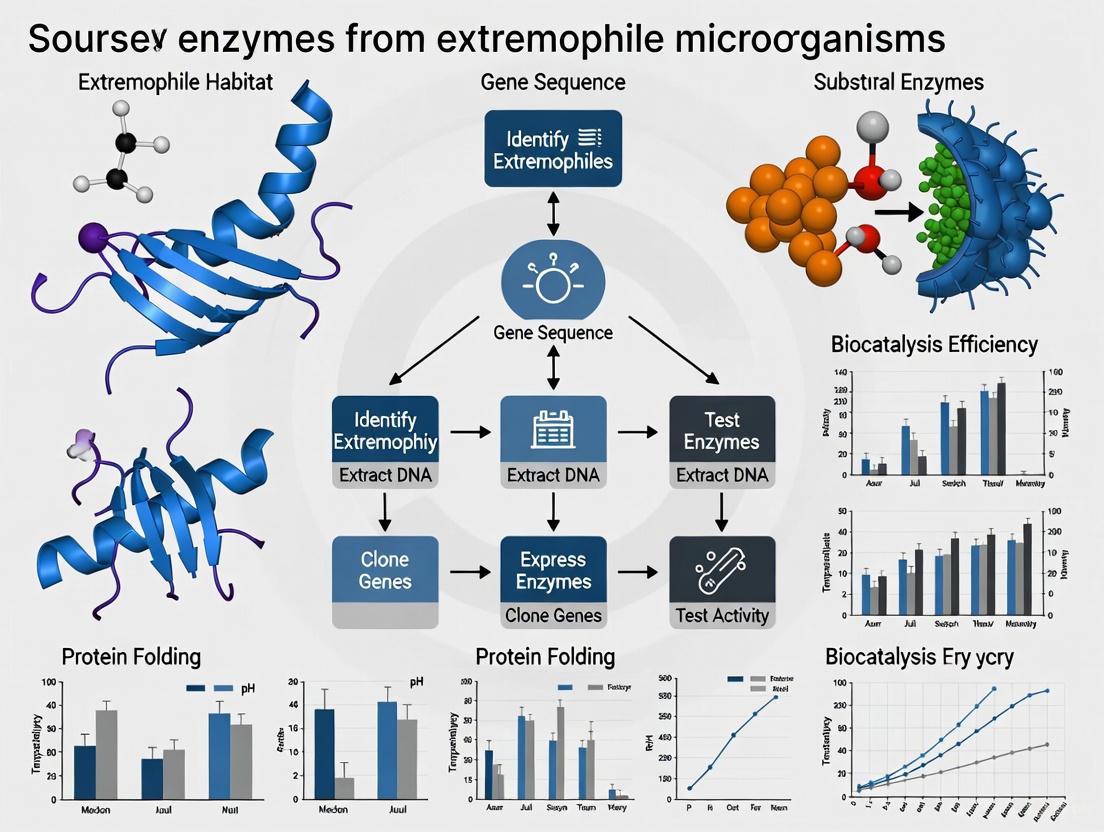
This article explores the burgeoning field of extremophile enzymology and its profound implications for biomedical research and drug development.
Extremozymes in Drug Discovery: Sourcing Next-Generation Biocatalysts from Nature's Extremes
Abstract
This article explores the burgeoning field of extremophile enzymology and its profound implications for biomedical research and drug development. It provides a comprehensive analysis of the unique structural and functional adaptations of extremozymes that enable their stability under extreme conditions, making them superior biocatalysts. The content details advanced discovery methodologies, including metagenomics and synthetic biology, for accessing this untapped enzymatic reservoir. It further addresses key challenges in bioprocessing and optimization, such as heterologous expression and yield improvement, while offering a comparative evaluation of extremozymes against conventional enzymes. Aimed at researchers and drug development professionals, this review synthesizes current breakthroughs and future trajectories, highlighting how extremozymes are poised to overcome persistent hurdles in pharmaceutical manufacturing, from creating novel therapeutics to enabling more efficient and sustainable industrial bioprocesses.
Life at the Edge: Understanding Extremophiles and Their Unique Enzymatic Toolkit
Extremophiles are organisms that not only survive but thrive in extreme environments—habitats characterized by physical and chemical conditions once considered incompatible with life [1] [2]. These limits include extreme temperature, pressure, radiation, salinity, and pH levels [2]. The term "extremophile," derived from Latin extremus meaning 'extreme' and Ancient Greek philía meaning 'love,' was coined by MacElroy in 1974 [3] [4]. The study of these organisms has fundamentally reshaped our understanding of life's boundaries, revealing that approximately 75% of our planet hosts conditions considered extreme by human standards [1].
From a biotechnological perspective, extremophiles represent a cornerstone for innovation, particularly in enzyme sourcing and application. Their unique biological mechanisms, refined through evolution under harsh conditions, offer robust tools for industrial processes, pharmaceuticals, and environmental management [5] [6]. The resilience of extremophile-derived biomolecules, especially extremozymes, provides significant advantages in catalysis under conditions where conventional proteins would denature and fail [4] [7]. This guide provides a comprehensive taxonomic and methodological framework for extremophiles, contextualized within the critical endeavor of sourcing novel enzymes from these resilient organisms.
A Detailed Taxonomic Classification of Extremophiles
Extremophiles are classified based on the specific environmental parameter to which they are primarily adapted. Many organisms fall under multiple categories and are classified as polyextremophiles, such as Thermococcus barophilus, which is both thermophilic and piezophilic [2]. The following taxonomy outlines the major categories, their defining conditions, and representative examples.
Table 1: Taxonomic Classification of Major Extremophile Types
| Extremophile Type | Defining Environment | Optimal Growth Conditions | Representative Organisms |
|---|---|---|---|
| Thermophile | High temperature | >45°C [2] | Thermus aquaticus [8], Pyrococcus furiosus [6] |
| Hyperthermophile | Very high temperature | >80°C [2] | Pyrolobus fumarii (106-113°C) [3], Methanopyrus kandleri (up to 122°C) [6] [3] |
| Psychrophile | Low temperature | ≤15°C [2] | Psychrobacter sp. [1] [6] |
| Halophile | High salinity | ≥50 g/L dissolved salts [2] | Halorubrum lacusprofundi [8], Dunaliella salina [1] |
| Acidophile | Low pH | pH ≤3.0 [2] | Picrophilus oshimae (pH 0.06) [3] [2] |
| Alkaliphile | High pH | pH ≥9.0 [2] | Natronobacterium [2] |
| Piezophile (Barophile) | High pressure | >10 MPa [2] | Pyrococcus sp. [2], Thermococcus barophilus [2] |
| Radioresistant | High ionizing/UV radiation | 1,500-6,000 Gy [2] | Deinococcus radiodurans [4] [8], Rubrobacter [2] |
| Xerophile | Low water availability | Water activity (a_w) <0.8 [2] | Chroococcidiopsis [2] |
The diversity of extremophiles spans across all three domains of life: Archaea, Bacteria, and Eukarya [1] [8]. While a large proportion, particularly the hyperthermophiles, belong to the Archaea, eukaryotic extremophiles such as the algae Dunaliella salina (halophile) and the fungus Thermomyces lanuginosus (thermophile) also exist [1] [3]. The cellular and molecular adaptations that enable this survival are the primary source of their biotechnological value.
Cellular and Molecular Adaptation Mechanisms
Extremophiles have evolved sophisticated biochemical, structural, and genomic adaptations to withstand environmental extremes. These mechanisms directly inform the search for stable enzymes, as they confer the robustness desired for industrial processes.
Thermal Adaptations
- Thermophiles and Hyperthermilles: Enhance protein stability through increased hydrophobic interactions, salt bridges, and disulfide bonds [6] [8]. Their proteins often feature shorter loops, more compact structures, and a higher proportion of charged and aromatic amino acids [6]. Genomically, they can display higher G+C content in tRNA and DNA, contributing to nucleic acid stability [6].
- Psychrophiles: Maintain protein flexibility and increased entropy at low temperatures by incorporating smaller, less bulky amino acid residues like glycine, reducing ion pairs and hydrophobic interactions [6] [8]. They produce antifreeze proteins (AFPs) that bind to ice crystals and inhibit their growth, preventing cellular damage [1] [8].
Osmotic and Ionic Stress Adaptations
- Halophiles utilize two primary strategies: they accumulate high internal concentrations of potassium ions to balance external osmotic pressure, or they synthesize and accumulate compatible solutes (e.g., glycerol, betaine) to protect cellular structures without interfering with enzymatic function [3] [8]. Their enzymes often have a high surface charge density of acidic amino acids to maintain solubility and function in high-salt conditions [7].
Pressure and Radiation Resistance
- Piezophiles produce an abundance of polyunsaturated fatty acids to maintain membrane fluidity at high pressure. They also accumulate piezolytes, such as trimethylamine oxide (TMAO), which stabilize cellular proteins against pressure-induced denaturation [8].
- Radioresistant organisms like Deinococcus radiodurans possess extremely efficient DNA repair mechanisms and express cellular detoxifying genes to mitigate oxidative damage. Some synthesize novel proteins that are intrinsically resistant to oxidative damage and small-molecule proteome shields [4] [8].
These adaptation mechanisms are encoded in the organism's genome. Recent machine learning analyses of over 700 extremophile genomes have revealed that adaptations to extreme temperature or pH imprint discernible patterns in their DNA. This "environmental genomic signature" can sometimes be stronger than the phylogenetic signal of ancestry, indicating a new dimension for discovering extremophilic traits [9].
Methodologies for Isolation, Screening, and Enzyme Characterization
The discovery of novel extremozymes requires a combination of traditional microbiological techniques and advanced molecular approaches. The following protocols provide a framework for the isolation and functional characterization of enzymes from extremophiles.
Sample Collection and Strain Isolation
- Source Environments: Target extreme habitats such as hot springs, deep-sea sediments, polar ice, hypersaline lakes, and acidic mines [5] [6]. For example, the Chilca salterns in Peru yielded a halotolerant Bacillus subtilis strain producing a novel L-asparaginase [5].
- In-Situ Conditions: Maintain in-situ conditions during sampling where possible. For deep-sea piezophiles, use pressure-retaining samplers. For anaerobes, use pre-reduced media and anaerobic chambers [6].
- Enrichment and Cultivation: Inoculate samples into selective media designed to mimic the physicochemical parameters of the source environment (e.g., temperature, pH, salinity, specific energy sources). Use serial dilutions and solid media to isolate pure colonies [6] [3]. Culture-dependent methods remain crucial for studying microbial physiology and metabolic pathways [6].
Functional Screening for Enzyme Activity
- Culture-Dependent Screening: Grow isolates on solid media containing substrate analogues to detect enzyme production. For example, screen for proteases on casein-containing media (clear zones indicate hydrolysis) or lipases on tributyrin agar [7]. A psychrophilic Psychrobacter sp. from Antarctica was isolated and found to produce cold-active lipases and proteases using such methods [7].
- Metagenomic Screening (Culture-Independent): Extract total DNA directly from environmental samples. Construct metagenomic libraries in bacterial hosts (e.g., Escherichia coli) and screen clones for desired enzymatic activities under challenging conditions (e.g., high temperature, extreme pH) [4] [7]. This approach allows access to the genetic potential of the vast majority of uncultured microbes [7].
Gene Identification and Heterologous Expression
- Sequence-Based Mining: Use known enzyme sequences as queries to search (meta)genomic databases for novel homologs. Machine learning techniques can predict enzymatic properties like optimal temperature and pH based on sequence features [7].
- Heterologous Expression: Clone the identified gene into an expression vector (e.g., pET series) and transform into a suitable host like E. coli or Komagataella pastoris for high-yield protein production [5] [7]. For example, the L-asparaginase from Bacillus subtilis CH11 was successfully expressed in E. coli [5].
Biochemical Characterization of Extremozymes
Once an enzyme is purified, a standard set of experiments determines its biotechnological potential:
- Optimal Temperature and Thermostability: Assay activity across a temperature gradient. Determine the half-life at the optimal temperature by incubating the enzyme and measuring residual activity over time. The L-asparaginase from B. subtilis CH11 had an optimum of 60°C and a half-life of nearly four hours at this temperature [5].
- Optimal pH and Stability: Assay activity across a pH range using different buffer systems.
- Effect of Additives: Test the influence of metal ions, detergents, chelating agents, and organic solvents on enzyme activity. The B. subtilis L-asparaginase was significantly enhanced by K⁺ and Ca²⁺ ions [5].
- Kinetic Parameters: Determine the Michaelis-Menten constants (Kₘ and Vₘₐₓ) to assess substrate affinity and catalytic efficiency.
Diagram 1: A generalized workflow for the discovery and development of novel enzymes from extremophiles, integrating both culture-dependent and culture-independent approaches.
Essential Research Reagents and Solutions for Extremophile Enzyme Research
The experimental pursuit of extremozymes requires specialized reagents and materials designed to maintain extreme conditions and assay functionality.
Table 2: Key Research Reagent Solutions for Extremophile Enzyme Workflows
| Reagent / Material | Function/Application | Specific Examples & Notes |
|---|---|---|
| Specialized Growth Media | To isolate and cultivate extremophiles by mimicking native physicochemical parameters. | Anaerobic media for piezophiles; high-salt media for halophiles (e.g., containing 50-250 g/L NaCl); low/high pH media for acidophiles/alkaliphiles [6] [3]. |
| Expression Vectors & Hosts | For heterologous expression and production of extremozymes. | Vectors: pET series for E. coli. Hosts: E. coli BL21(DE3) for general use; Halobacterium sp. NRC-1 for halophilic proteins [5] [7]. |
| Activity Assay Substrates | To detect and quantify enzymatic activity under various conditions. | p-Nitrophenyl derivatives (e.g., pNP-acetate for esterases); azocasein for proteases; chromogenic/fluorogenic substrates for specific hydrolases [7]. |
| Stability Enhancers | To maintain enzyme activity during purification and storage. | Reducing agents (e.g., DTT); metal ions (K⁺, Ca²⁺); compatible solutes (e.g., betaine, glycerol) [5]. |
| Detergents & Solvents | To test enzyme stability for industrial applications. | Ionic (SDS) and non-ionic (Tween) detergents; organic solvents (isopropanol, cyclohexane) [7]. |
Biotechnological Applications of Extremophiles and Extremozymes
The unique properties of extremophiles and their biomolecules have led to groundbreaking applications across multiple industries, with enzymes being the most significant commercial output.
Industrial and Pharmaceutical Enzymes
- Thermostable DNA Polymerases: The Taq polymerase from Thermus aquaticus revolutionized PCR technology, creating a market worth over $2 billion [3] [8]. Other thermostable polymerases like Pfu from Pyrococcus furiosus and Vent from Thermococcus litoralis offer higher fidelity [3].
- L-Asparaginase: A type II L-asparaginase from the halotolerant Bacillus subtilis CH11, isolated from the Chilca salterns in Peru, shows remarkable thermal stability (optimal activity at pH 9.0 and 60°C) and is used in cancer therapy and the food industry [5] [4].
- Detergent Enzymes: Proteases, lipases, and amylases from alkaliphiles and thermophiles are incorporated into detergents for their activity in high-pH and hot water conditions [4] [7]. A cold-active protease from Psychrobacter sp. is suitable for cold-washing products [7].
Bioremediation and Bioenergy
Extremophiles are deployed to degrade pollutants in environments where conventional microbes perish.
- Hydrocarbon Degradation: Thermophilic microbial communities possess enzymes capable of degrading hydrocarbons, indicating potential for remediating oil spills in various environments [6].
- Waste Processing: The enzyme proteolysin from Coprothermobacter proteolyticus operates in a wide pH and high-temperature range, making it suitable for remedying organic solid wastes [8].
- Biofuel Production: Extremophiles are exploited for biohydrogen and biobutanol production, leveraging their unique metabolic pathways that function under process-relevant extreme conditions [3].
Astrobiology and the Limits of Life
The study of extremophiles directly informs the search for extraterrestrial life. Organisms from environments analogous to those on other moons and planets serve as models for potential extraterrestrial life forms [5] [1]. For instance, thermophilic bacteria from Yellowstone are studied as analogs for potential life on Europa, and microbes from the hyper-arid Atacama Desert inform the search for life on Mars [6] [2]. Research has shown that certain extremophiles can survive the hyperacceleration of cosmic environments, the radiation levels on Mars, and the conditions of space, expanding the potential for habitability elsewhere in the universe [2].
Diagram 2: The logical relationship between environmental stress, the molecular adaptation mechanisms evolved in extremophiles, and the resulting enzyme properties that are valuable for biotechnological applications.
The taxonomy of extremophiles outlines a map of life's resilience, charting organisms that have evolved to occupy every conceivable niche on Earth. This systematic understanding is more than an academic exercise; it is a critical guide for sourcing novel enzymes with unparalleled stability and functionality. The continued exploration of extreme environments, coupled with advancements in genomics, metagenomics, and synthetic biology, promises to unlock a vast reservoir of untapped biocatalysts. These extremozymes hold the key to addressing pressing global challenges in sustainable industry, medicine, and environmental management, pushing the boundaries of biotechnology into ever more demanding and rewarding territories.
Extremozymes, the enzymes produced by extremophile microorganisms, exhibit remarkable structural stability and catalytic functionality under conditions that denature most proteins. These enzymes have evolved unique biochemical adaptations—including specific amino acid compositional biases, distinct structural flexibilities, and enhanced molecular bonding networks—that enable them to defy denaturation in extreme temperatures, pH levels, salinity, and pressure. The study of these survival strategies not only expands our understanding of protein biochemistry but also unlocks significant potential for biotechnological and pharmaceutical applications. This whitepaper examines the molecular mechanisms governing extremozyme resilience and provides technical guidance for their investigation and utilization within enzyme sourcing research.
Extremophiles are organisms that thrive in ecological niches previously considered incompatible with life, including scorching hydrothermal vents, highly acidic or alkaline lakes, hypersaline waters, and frozen deserts [4]. These remarkable microorganisms, primarily from the domains Archaea and Bacteria, have evolved specialized enzymes known as extremozymes that maintain stability and functionality under extreme physicochemical stresses [10]. The intrinsic properties of extremozymes have revolutionized our approach to industrial biocatalysis, particularly in pharmaceutical manufacturing where harsh process conditions often denature conventional enzymes.
From a commercial perspective, the global enzyme market is substantial and continues to grow, expected to reach approximately $7 billion, with extremophiles representing a significant untapped resource for novel biocatalysts [4] [11]. Landmark successes such as Taq polymerase from Thermus aquaticus have demonstrated the transformative potential of extremozymes in biotechnology [4] [10]. This whitepaper explores the biochemical strategies extremozymes employ to resist denaturation, framed within the broader context of sourcing enzymes from extremophile microorganisms for research and drug development.
Molecular Mechanisms of Stability and Activity
Extremozymes defy denaturation through sophisticated structural and chemical adaptations that vary significantly based on the environmental challenges they have evolved to withstand.
Thermal Adaptation Strategies
The thermal stability of extremozymes demonstrates a fundamental trade-off between activity and stability, with psychrophilic (cold-adapted) and thermophilic (heat-adapted) enzymes employing opposing strategies.
Table 1: Characteristic Temperature Parameters of Enzymes from Temperature-Adapted Organisms
| Organism Type | Mean Optimum Temperature (Topt) °C | Mean Melting Temperature (Tm) °C | Mean Temperature Gap (Tg) °C |
|---|---|---|---|
| Psychrophilic | 32.97 ± 2.16 | 55.02 ± 2.25 | 22.05 |
| Mesophilic | 55.03 ± 2.52 | 62.37 ± 2.02 | 7.34 |
| Thermophilic | 78.03 ± 2.25 | 86.77 ± 2.38 | 8.74 |
Data derived from meta-analysis of existing studies on temperature-adapted enzymes [12]
Psychrophilic enzymes exhibit a significantly larger gap between their optimum and melting temperatures (Tg) compared to mesophilic and thermophilic enzymes, suggesting their active sites are more thermolabile than the rest of the protein structure to maintain flexibility for catalysis at low temperatures [12]. This adaptation is achieved through:
- Decreased hydrophobic interactions and reduced proline and arginine content in rigid loop structures [13]
- Increased surface charge and decreased core hydrophobicity [11]
- Weakened intramolecular bonds including hydrogen bonds, salt bridges, and aromatic interactions [13]
In contrast, thermophilic enzymes enhance their rigidity through:
- Increased proline content in loops that restricts conformational freedom [13]
- Enhanced arginine content which forms multiple hydrogen bonds to backbone carbonyl oxygens [13]
- Extended networks of salt bridges and hydrogen bonds [13]
- Oligomerization and chaperone assistance for additional stability [13]
Structural Adaptations to Other Extremes
Beyond temperature, extremozymes exhibit specialized adaptations to other environmental challenges:
- Halophilic enzymes in high-salinity environments feature elevated acidic amino acid content on their surfaces, allowing coordinated binding of water molecules and ions to maintain solvation and functionality [4] [1]
- Acidophilic and alkaliphilic enzymes maintain internal pH neutrality through specialized proton pumps and feature surface architectures resistant to pH-induced denaturation [10] [1]
- Barophilic enzymes from high-pressure environments possess reduced void volumes and specialized structural folds that resist compression [4] [1]
Experimental Approaches for Extremozyme Research
The study of extremozymes requires specialized methodologies to overcome challenges in cultivation, characterization, and production.
Discovery and Isolation Workflow
Diagram 1: Extremozyme Discovery Workflow
Key Methodological Protocols
Metagenomic Mining of Unculturable Extremophiles
Many extremophiles resist laboratory cultivation, necessitating culture-independent approaches [4]. This protocol involves:
- Environmental DNA Extraction: Sample collection from extreme habitats followed by direct DNA extraction using commercial kits modified for difficult matrices [4] [5]
- Sequencing and Assembly: High-throughput sequencing (Illumina, PacBio) followed by bioinformatic assembly and annotation [4]
- Functional Screening: Construction of metagenomic expression libraries in suitable hosts (e.g., E. coli) followed by activity-based screening under simulated extreme conditions [4] [5]
- Sequence-Based Screening: Identification of candidate genes via homology to known extremozymes or conserved domains [4]
Biochemical Characterization of Stability Parameters
Comprehensive characterization of extremozyme stability requires multi-faceted approaches:
Thermal Stability Assay
- Monitor enzyme activity at various temperatures to determine Topt
- Use differential scanning calorimetry (DSC) or circular dichroism (CD) spectroscopy to determine Tm
- Calculate Tg (Tg = Tm - Topt) as a key stability-activity parameter [12]
Structural Analysis
Kinetic Parameter Determination
Essential Research Reagents and Tools
Table 2: Key Research Reagent Solutions for Extremozyme Investigation
| Reagent Category | Specific Examples | Function in Research | Application Notes |
|---|---|---|---|
| Expression Systems | E. coli BL21, Bacillus subtilis, Pichia pastoris | Heterologous production of extremozymes | Codon optimization often required for high yield [5] |
| Stability Assay Kits | Thermofluor, Differential Scanning Calorimetry | Protein stability measurement | Use with extreme pH/ionic strength buffers [12] |
| Chromatography Media | His-tag affinity, Ion exchange, Hydrophobic interaction | Protein purification | High-salt or extreme pH buffers maintain stability [5] |
| Activity Assays | Fluorogenic/Chromogenic substrates | Enzyme kinetics determination | Adapt for extreme conditions (temperature, pH) [12] |
| Bioinformatics Tools | Rosetta, HoTMuSiC, PoPMuSiC | Stability prediction and design | Predict ΔΔGf and ΔTm of mutations [12] [14] |
Technological Applications and Future Directions
The unique properties of extremozymes have enabled significant advances across multiple industries, particularly pharmaceuticals:
- Therapeutic Enzymes: L-asparaginase from halotolerant Bacillus subtilis exhibits remarkable thermal stability (optimal activity at pH 9.0 and 60°C with a half-life of nearly four hours) for cancer treatment [4] [5]
- Antibiotic Development: Novel antimicrobial peptides from deep-sea thermophiles disrupt bacterial membranes through pore-forming mechanisms, bypassing existing resistance pathways [4]
- Biocatalysis: Thermophilic and halophilic enzymes enable green chemistry approaches under industrial conditions that traditionally required organic solvents [4] [11]
Future research directions focus on leveraging synthetic biology and computational design to enhance extremozyme functionality:
Diagram 2: Enzyme Engineering Pipeline
The integration of computational design with directed evolution has yielded remarkable successes, such as the development of formolase enzymes for carbon fixation pathways and Diels-Alderases for stereoselective cycloadditions [14]. These approaches are particularly valuable for designing extremozymes with enhanced stability or novel functions not found in nature.
Extremozymes represent nature's solution to biochemical challenges once considered insurmountable. Their ability to defy denaturation stems from precise molecular adaptations that balance stability and flexibility, activity and resilience. As our understanding of these mechanisms deepens through advanced genomic, structural, and computational approaches, the potential for leveraging extremozymes in pharmaceutical research and industrial biotechnology expands exponentially. The continued exploration of Earth's extreme environments, coupled with innovative engineering strategies, promises to unlock new generations of biocatalysts that will drive sustainable drug development and manufacturing processes.
The pursuit of sustainable and efficient biocatalysts has positioned extremophiles—organisms thriving in extreme environments—as a cornerstone of modern biotechnology. This whitepaper frames the exploration of extremozymes within the broader thesis that the unique biochemical adaptations of extremophile microorganisms are an unparalleled resource for advancing biomedical science. Enzymes derived from these resilient organisms, known as extremozymes, exhibit exceptional stability and functionality under harsh conditions that would denature their mesophilic counterparts [15] [16]. Their intrinsic robustness translates directly into advantages for industrial and therapeutic applications, including longer shelf lives, the ability to function under non-standard process conditions, and novel catalytic activities [4] [17].
This guide provides an in-depth technical analysis of three major classes of biomedically-relevant extremozymes: polymerases, proteases, and L-asparaginases. It summarizes their unique biochemical properties, details experimental protocols for their discovery and characterization, and presents a curated toolkit for researchers, thereby offering a comprehensive resource for scientists and drug development professionals engaged in harnessing these powerful biological catalysts.
Extremophiles are classified based on the specific environmental challenges they overcome. Table 1 outlines the major categories of extremophiles and the corresponding adaptive strategies that inform the discovery of novel extremozymes [1] [4].
Table 1: Major Types of Extremophiles and Their Adaptive Strategies
| Type of Extremophile | Defining Environment | Key Adaptive Mechanisms | Relevant Extremozyme Classes |
|---|---|---|---|
| Thermophile | High temperatures (>45-80°C) [17] | Increased protein rigidity, charged surface residues, dense hydrophobic core [15] [16] | Polymerases, Proteases |
| Psychrophile | Low temperatures (<20°C) [17] | Enhanced protein flexibility, reduced hydrophobic interactions, surface loop modifications [1] [16] | L-Asparaginases, Proteases |
| Halophile | High salinity (>3.5% NaCl) [1] | Abundant acidic surface residues, production of compatible solutes [1] [4] | L-Asparaginases |
| Acidophile/Alkaliphile | Extreme pH (<5 or >9) [1] | Buffered active sites, specialized proton pumps, altered surface charge [1] [17] | Proteases |
| Piezophile | High pressure | Structural modifications to resist compression [1] [17] | Polymerases, Proteases |
The following diagram illustrates the logical workflow for the discovery and development of novel extremozymes, from initial sampling to a commercial enzyme product.
Major Classes of Biomedically-Relevant Extremozymes
Polymerases
DNA polymerases from extremophiles have revolutionized molecular biology. Taq polymerase from Thermus aquaticus is the paradigmatic example, enabling the automation of PCR due to its thermostability [4]. Current research focuses on discovering and engineering novel thermostable and salt-tolerant polymerases to advance diagnostic and sequencing technologies.
Representative Example: A study by Sun et al. combined droplet-based microfluidics with conventional site-directed mutagenesis to screen for polymerase mutants with enhanced salt tolerance [15]. The most promising variant, SZ_A, demonstrated not only improved salt tolerance but also increased processivity and exonuclease deficiency, making it particularly suitable for advanced nanopore sequencing applications [15].
Experimental Protocol for Salt-Tolerant Polymerase Engineering:
- Gene Library Construction: Create a library of polymerase mutant genes via site-directed mutagenesis, focusing on substituting regular sites with conserved amino acids [15].
- Microfluidic Compartmentalization: Encapsulate individual mutant genes and a fluorescent reporter assay for polymerase activity within water-in-oil droplets. This allows for high-throughput, single-cell analysis [15].
- High-Throughput Screening: Sort the droplets based on fluorescence intensity, which correlates with enzymatic activity under high-salt conditions, to identify lead variants [15].
- Characterization: Express, purify, and biochemically characterize the lead variant (e.g., SZ_A) to confirm improved salt tolerance, processivity, and fidelity [15].
Proteases
Extremophilic proteases are characterized by their stability and activity under harsh conditions such as high temperatures, extreme pH, and the presence of reducing agents. They are invaluable in industries ranging from detergents to pharmaceuticals.
Representative Example: Røyseth et al. characterized globupain, a novel C11 protease from uncultivated Archaeoglobales in the Soria Moria hydrothermal vent system [15]. This enzyme exhibits high thermostability and optimal activity under low pH and high reducing conditions, underscoring its potential for specialized biotechnological applications [15].
Experimental Protocol for Novel Protease Characterization:
- Gene Identification: Mine metagenomic databases (e.g., MEROPS-MPRO) to identify novel protease gene sequences from extreme environments [15].
- Recombinant Expression: Clone the gene into an expression vector (e.g., pET series) and express it recombinantly in E. coli [15] [18].
- Zymogen Activation: Generate and purify mutant variants to probe the function of the zymogen and the activation mechanism. For globupain, 13 mutant variants were evaluated [15].
- Biochemical Assay: Assess protease activity using specific substrates (e.g., casein or synthetic peptides) across a range of pH and temperatures. Measure kinetic parameters (KM, kcat) and stability under various denaturing conditions [15].
L-Asparaginases
L-Asparaginases (L-ASNase, EC 3.5.1.1) are a critical class of biomedical extremozymes. Their anti-leukemic action is based on hydrolyzing circulating L-asparagine in the blood, selectively starving malignant lymphoblastic cells that cannot synthesize this amino acid [19] [20]. Research focuses on finding isoforms with high substrate affinity, low glutaminase activity (to reduce side effects), and enhanced stability under physiological conditions [21] [20].
Representative Examples:
- Psychrophilic L-ASNase from Pseudomonas sp. PCH199: Isolated from Himalayan soil, this periplasmic enzyme is active over a wide pH range and is remarkably stable at 37°C, retaining 100% activity for over 200 minutes—a key pharmacological advantage. It demonstrated significant cytotoxicity against K562 blood cancer cells (IC50 0.309 U/mL) [19].
- Class 3 L-ASNases from Rhizobium etli: The ReAIV and ReAV isoforms represent a novel structural class. ReAIV is constitutive and thermostable (optimal activity at 45-55°C), while ReAV is inducible and thermolabile. Both are zinc-metalloenzymes, with Zn²⁺ boosting their activity by 32% and 56%, respectively [22].
Experimental Protocol for L-ASNase Cytotoxicity Assessment:
- Enzyme Production & Purification: Isolate the enzyme from the native host or produce it recombinantly. Optimize production using Response Surface Methodology. Purify using chromatographic techniques or an osmotic shock method for periplasmic extracts [19].
- Activity & Kinetic Assay: Measure L-ASNase activity spectrophotometrically by quantifying ammonia release with Nessler's reagent. Perform assays in optimal buffer (e.g., 50 mM Tris-HCl, pH 8.5) at 37°C to determine kinetic parameters (KM, Vmax) [19].
- Cell Culture Assay: Culture target cancer cell lines (e.g., K562 leukemic cells) and normal control cell lines (e.g., IEC-6) under standard conditions [19].
- Cytotoxicity & Apoptosis Assay: Incubate cells with purified L-ASNase for 24-48 hours. Determine the IC50 value using a cell viability assay (e.g., MTT). Assess apoptotic morphological changes in nuclei via DAPI staining [19].
Table 2: Biochemical Properties of Selected Biomedical Extremozymes
| Enzyme | Source Organism | Optimal Activity | Key Biochemical Properties | Biomedical Application |
|---|---|---|---|---|
| SZ_A Polymerase | Engineered variant | High Salt Conditions | Enhanced salt tolerance, processivity, exonuclease-deficient [15] | Nanopore sequencing, molecular diagnostics |
| Globupain (Protease) | Archaeoglobales (Archaea) | Low pH, High Reducing Conditions | High thermostability, C11 protease family [15] | Industrial catalysis under denaturing conditions |
| L-ASNase PCH199 | Pseudomonas sp. PCH199 | pH 8.5, 60°C | KM = 0.164 mM, Stable at 37°C, Cytotoxic (IC50 0.309 U/mL) [19] | Acute Lymphoblastic Leukemia (ALL) treatment |
| L-ASNase ReAIV | Rhizobium etli | 45-55°C | KM = 1.5 mM, kcat = 770 s⁻¹, Zinc-activated (KD = 1.2 μM) [22] | Potential ALL therapeutic, model for enzyme engineering |
The Scientist's Toolkit: Key Research Reagents and Solutions
The following table details essential materials and reagents used in the experimental workflows for extremozyme research, as cited in the literature.
Table 3: Key Research Reagent Solutions for Extremozyme R&D
| Reagent / Material | Function / Application | Example Usage in Context |
|---|---|---|
| pET Expression Vectors | Heterologous protein expression in E. coli with IPTG-inducible T5/T7 promoters [18] | Cloning and overexpression of recombinant catalase, laccase, and amine-transaminase [18]. |
| E. coli BL21(DE3) | Robust, genetically defined host for recombinant protein production [21] | Expression host for ten different recombinant L-ASNases for comparative study [21]. |
| Ni-NTA HisTrap Column | Affinity chromatography for purifying recombinant His-tagged proteins [21] | Purification of recombinant L-ASNases [21]. |
| Nessler's Reagent | Spectrophotometric detection of ammonia for L-ASNase activity assays [19] | Quantitative estimation of L-ASNase activity by measuring ammonia liberation from L-asparagine [19]. |
| Response Surface Methodology (RSM) | Statistical optimization of culture conditions for enhanced enzyme production [19] | Optimizing L-ASNase production from Pseudomonas sp. PCH199 at flask scale [19]. |
| Droplet-Based Microfluidics | High-throughput screening platform for enzyme variants [15] | Screening a library of polymerase mutants for enhanced salt tolerance [15]. |
Technical Considerations and Future Directions
While the potential of extremozymes is vast, their path from discovery to application presents challenges. A major hurdle is that an estimated 99% of microorganisms are unculturable using standard techniques, creating significant "microbial dark matter" [17]. Solutions include culture-independent metagenomic approaches and advanced bioinformatics to mine sequencing data for novel genes [18] [17].
Furthermore, producing extremozymes from their native hosts is often difficult due to low biomass yields and slow growth rates [17]. The primary solution is heterologous expression in mesophilic workhorses like E. coli. However, this can lead to issues such as improper folding, inclusion body formation, and an inability to incorporate essential metal cofactors [17]. Co-expression of molecular chaperones and refolding strategies are critical to overcoming these obstacles [17].
The future of the field lies in interdisciplinary strategies. Directed evolution and rational protein design are being used to enhance the stability and efficiency of existing extremozymes [15]. The integration of CRISPR-based pathway engineering and machine learning for predicting protein structure and function will further accelerate the discovery and optimization of these powerful biocatalysts [4] [20]. As these technologies mature, extremozymes will play an increasingly pivotal role in providing innovative, sustainable solutions to challenges in biomedicine and beyond.
Extremophiles represent nature's ultimate survivors, thriving in ecological niches previously considered incompatible with life, from scorching hydrothermal vents and highly acidic lakes to hypersaline waters and frozen Antarctic deserts [4] [5]. These remarkable organisms have evolved unique biochemical adaptations that enable their proteins to maintain structural integrity and functional activity under extreme conditions that would rapidly denature most conventional proteins [23] [24]. The study of extremophile adaptations provides invaluable insights into the fundamental determinants of protein stability, offering a blueprint for engineering robust enzymes for pharmaceutical applications, industrial processes, and sustainable technologies [25] [26].
The resilience of extremophile-derived proteins, known as extremozymes, stems from sophisticated evolutionary adaptations at molecular levels, including strategic amino acid substitutions, enhanced structural rigidity, and specialized stabilization mechanisms [24] [27]. Understanding these mechanisms is particularly valuable for drug development professionals seeking to create more stable therapeutic proteins, improve enzyme-based manufacturing processes, and develop novel biocatalysts for synthesizing pharmaceutical intermediates [4] [28]. This whitepaper examines the principal adaptations that confer exceptional stability to extremophile proteins, details methodologies for studying these remarkable molecules, and explores their growing impact on biotechnological and pharmaceutical applications.
Extremophile Diversity and Habitat Specificity
Extremophiles are classified based on the specific environmental challenges they have conquered, with each group exhibiting distinct adaptive strategies at the protein level [4] [10]. Thermophiles and hyperthermophiles thrive at elevated temperatures (45°C-122°C), with proteins engineered to resist thermal denaturation through strengthened molecular interactions [10] [28]. Psychrophiles inhabit permanently cold environments (-12°C to 10°C) and produce enzymes with enhanced structural flexibility to maintain catalytic efficiency at low temperatures [23] [10]. Halophiles require high salt concentrations (5-30%) for growth and possess predominantly acidic proteomes that remain soluble and functional under saline conditions [23] [27]. Acidophiles and alkaliphiles flourish at extreme pH values (0-3 or 9-12, respectively), with specialized mechanisms to maintain internal pH homeostasis while developing proteins that resist pH-induced denaturation [23] [10]. Additionally, poly-extremophiles can simultaneously withstand multiple environmental stresses, representing particularly valuable sources of robust enzymes for industrial applications [10].
Table 1: Classification of Extremophiles and Their Habitat Conditions
| Extremophile Type | Growth Conditions | Representative Species | Key Protein Adaptations |
|---|---|---|---|
| Thermophile | 45°C-80°C | Pyrococcus furiosus | Increased salt bridges, hydrophobic core packing |
| Hyperthermophile | >80°C (up to 122°C) | Methanopyrus kandleri | Enhanced ionic networks, oligomerization |
| Psychrophile | -12°C to 10°C | Psychromonas ingrahamii | Increased structural flexibility, reduced hydrophobic core |
| Halophile | 5-30% salt concentration | Halorhodospira halophila | Acidic surface residues, high surface hydration |
| Acidophile | pH 0-3 | Picrophilus oshimae | Dense surface charge networks, acid-resistant folds |
| Alkaliphile | pH 9-12 | Bacillus alkaliphilus | Strategic deamidation avoidance, surface charge shielding |
Molecular Mechanisms of Protein Stabilization in Extreme Environments
Amino Acid Composition and Structural Plasticity
Comparative genomic and structural analyses reveal that extremophilic proteins exhibit statistically significant differences in amino acid composition compared to their mesophilic counterparts [27]. Thermophilic proteins display a marked preference for small nonpolar amino acids (glycine, alanine, valine) that enable tighter core packing and reduce conformational entropy costs upon folding [24] [27]. Additionally, thermostable proteins show increased frequencies of charged residues (arginine, glutamic acid) that facilitate the formation of stabilizing salt bridges across protein domains [27]. Psychrophilic enzymes, in contrast, often contain higher proportions of neutral polar residues (asparagine, serine) and reduced arginine content, conferring the structural flexibility necessary for catalysis at low thermal energies [23] [27].
Halophilic proteins employ a distinct strategy characterized by a highly acidic surface with abundant aspartic and glutamic acid residues, creating a hydrated shield that prevents aggregation and precipitation at high ionic strength [23] [27]. This adaptation results in a significantly lower isoelectric point (pI) compared to non-halophilic orthologs, with statistical analysis showing a significant difference (p < 0.0091) in this parameter [27]. Alkaliphilic proteins, meanwhile, minimize labile residues such as asparagine and glutamine that are susceptible to deamidation at high pH, while incorporating strategic arginine residues that maintain positive surface charges under alkaline conditions [27].
Table 2: Amino Acid Composition Trends in Extremophile Proteins
| Amino Acid | Thermophiles | Psychrophiles | Halophiles | Acidophiles | Alkaliphiles |
|---|---|---|---|---|---|
| Alanine | ↑↑ | → | ↑ | ↑ | → |
| Glycine | ↑↑ | ↑ | ↑↑ | ↑ | → |
| Valine | ↑ | ↓ | ↑↑ | → | ↑ |
| Isoleucine | ↑ | ↑↑ | ↑↑ | ↑ | ↑ |
| Arginine | ↑↑ | ↓↓ | ↓ | → | ↑↑ |
| Lysine | ↓ | → | ↓↓ | ↓ | → |
| Aspartic Acid | → | ↓ | ↑↑ | ↑↑ | ↓ |
| Glutamic Acid | ↑ | ↓ | ↑↑ | ↑↑ | ↓ |
| Serine | ↓ | ↑↑ | ↓ | ↓ | → |
| Asparagine | ↓ | ↑ | ↓↓ | ↓ | ↓↓ |
| Cysteine | ↓ | → | ↓ | ↓ | → |
Key: ↑↑ = Strong increase; ↑ = Moderate increase; → = Neutral/no clear trend; ↓ = Moderate decrease; ↓↓ = Strong decrease
Structural and Physicochemical Determinants of Stability
The exceptional stability of extremophile proteins arises from a complex interplay of structural and physicochemical factors that have been fine-tuned through evolutionary selection. Salt bridges (ionic interactions between positively and negatively charged residues) play a particularly crucial role in thermostabilization, with hyperthermophilic proteins containing significantly more salt bridges than their mesophilic counterparts [24] [27]. These electrostatic networks provide enhanced rigidity without compromising functional flexibility, creating a "structural homeostasis" that resists thermal perturbation [27].
Hydrophobic core optimization represents another key stabilization strategy, particularly in thermophiles [24] [27]. Statistical analyses reveal that thermostable proteins exhibit approximately 45-59% hydrophobicity in their core regions, achieved through increased aliphatic residue content and enhanced packing density [27]. This compact interior minimizes solvent-accessible surface area and creates an energetically unfavorable environment for unfolding. Similarly, hydrogen bonding networks are often enhanced in extremophilic proteins, with thermostable enzymes frequently containing additional main-chain and side-chain hydrogen bonds that collectively contribute to thermal resistance [24].
Psychrophilic proteins have evolved opposite adaptations, with reduced hydrophobic interactions, fewer salt bridges, and increased surface flexibility that maintain activity at temperatures where excessive rigidity would impede necessary conformational changes for catalysis [23]. These structural modifications lower the activation energy required for enzymatic function in cold environments, demonstrating how protein stability mechanisms are precisely calibrated to environmental conditions [23] [27].
Experimental Methodologies for Studying Extremophile Proteins
Metagenomic Discovery Pipelines
Traditional cultivation-based approaches for studying extremophiles are often limited, as many resistant microorganisms cannot be grown under laboratory conditions [29] [28]. Metagenomic sequencing has revolutionized extremophile bioprospecting by enabling direct analysis of genetic material from environmental samples without the need for cultivation [5] [29] [28]. This approach involves extracting total DNA from extreme environments, sequencing the collective metagenome, and computationally identifying putative extremozyme genes through homology searching and functional prediction [29].
A recent advanced computational pipeline demonstrates the power of this approach for sustainable enzyme discovery [29]. This methodology integrates traditional bioinformatic techniques with modern structural prediction algorithms to identify novel enzymes from existing metagenomic datasets, minimizing the need for additional environmental sampling [29]. As a proof of concept, this pipeline identified 11 candidate β-galactosidases from deep-sea hydrothermal vent metagenomes, with 10 showing in vitro activity and one (βGal_UW07) exhibiting exceptional thermostability and pH resistance [29].
Structure-Function Characterization Techniques
Once identified, extremophile proteins undergo rigorous biochemical characterization to quantify their stability parameters and elucidate structure-function relationships. Thermal stability assays measure residual activity after incubation at elevated temperatures, with extremozymes like the hyperthermophilic 3-quinuclidinone reductase (SbQR) maintaining optimal activity at ≥95°C [28]. Spectroscopic techniques including circular dichroism (CD) and fluorescence spectroscopy monitor structural integrity under denaturing conditions, while X-ray crystallography provides atomic-resolution structures that reveal stabilization mechanisms such as salt bridge networks and hydrophobic core packing [24] [27].
Molecular dynamics (MD) simulations complement experimental approaches by modeling protein behavior at different temperatures, revealing how extremophile proteins maintain their folded state under conditions that destabilize mesophilic orthologs [28] [27]. These simulations have demonstrated that thermophilic proteins exhibit reduced structural fluctuation at high temperatures and more extensive hydrogen bonding networks compared to their mesophilic counterparts [27]. For halophilic proteins, MD simulations visualize how surface hydration and electrostatic interactions prevent aggregation in high-salt environments [27].
The Scientist's Toolkit: Essential Research Reagents and Methodologies
Table 3: Key Research Reagent Solutions for Extremophile Protein Studies
| Reagent/Resource | Function/Application | Example Use Case |
|---|---|---|
| Metagenomic Libraries | DNA resources from extreme environments | Gene discovery without cultivation [29] |
| Heterologous Expression Systems | Production of extremozymes in model hosts | E. coli BL21 for SbQR expression [28] |
| Specialized Vectors | Plasmid systems for protein production | pGEX-6p-1 GST-fusion system [28] |
| Thermostable Polymerases | PCR amplification of extremophile genes | Taq polymerase from Thermus aquaticus [23] [4] |
| Chromatography Media | Protein purification under various conditions | Immobilized metal affinity chromatography [28] |
| Extremophile Culture Collections | Reference organisms for comparative studies | DSMZ and ATCC extremophile strains [10] |
| Specialized Growth Media | Cultivation of extremophiles | High-salt or pH-adjusted media [10] |
Applications in Pharmaceutical and Industrial Biotechnology
The unique properties of extremophile-derived proteins have enabled significant advances across multiple biotechnological domains, particularly in pharmaceutical manufacturing and industrial biocatalysis. Thermostable DNA polymerases such as Taq polymerase from Thermus aquaticus have revolutionized molecular biology by enabling the polymerase chain reaction (PCR), with sales exceeding $1 billion annually [23] [4]. L-asparaginases from halotolerant Bacillus subtilis strains exhibit remarkable thermal stability (optimal activity at pH 9.0 and 60°C with a half-life of nearly four hours), making them valuable for cancer therapy and food processing applications [5].
Recent discoveries highlight the growing pharmaceutical relevance of extremozymes. The hyperthermophilic 3-quinuclidinone reductase (SbQR) from hot spring metagenomes represents the first known hyperthermophilic enzyme in its class, displaying strict stereoselectivity for producing (R)-3-quinuclidinol—a key intermediate in drugs for obstructive pulmonary disease, urinary incontinence, and Parkinson's disease [28]. Similarly, uricase from Thermoactinospora rubra (TrUox) exhibits high catalytic efficiency at neutral pH and remarkable thermostability, maintaining activity after 4 days at 50°C, making it a promising candidate for therapeutic applications in hyperuricemia treatment [25].
Beyond pharmaceuticals, extremozymes have significant applications in environmental bioremediation. Cadmium-resistant strains of Bacillus cereus capable of sequestering multiple heavy metals offer immediate potential for cleaning contaminated soils and waters [25]. The discovery of biosurfactants from thermophilic Pseudomonas aeruginosa strains, with antimicrobial activity enhanced under varying salt conditions, demonstrates how extreme environments modulate supramolecular structures and bioactivity for environmental and therapeutic applications [25].
The study of extremophile adaptations has fundamentally advanced our understanding of protein stability, revealing nature's sophisticated strategies for maintaining structural and functional integrity under environmental extremes. These insights are increasingly valuable for addressing contemporary challenges in pharmaceutical development, industrial biotechnology, and environmental sustainability. As genetic, computational, and bioprospecting tools continue to advance, the translation of extremophilic adaptations into practical applications is accelerating [25] [26].
Future research directions will likely focus on integrating multi-omics approaches with advanced cultivation methods to explore the ecological roles and biotechnological potential of newly discovered extremophiles [4]. The development of genetic tools for extremophilic archaea and bacteria will enable more sophisticated manipulation of these organisms and their pathways [26]. Additionally, computational pipelines that leverage existing metagenomic datasets will facilitate sustainable bioprospecting while minimizing environmental impact [29]. As these technologies mature, extremophiles will continue to provide innovative solutions to global challenges in health, industry, and environmental sustainability, while revealing fundamental truths about life's remarkable capacity to adapt and thrive at the very boundaries of existence.
From Discovery to Drug Development: Methodologies and Biomedical Applications of Extremozymes
Less than 1% of environmental microorganisms can be cultivated using standard laboratory techniques, creating a significant "cultivation barrier" that has historically limited our access to nature's enzymatic diversity [30]. This is particularly problematic in the context of extremophile microorganisms, which thrive under conditions of high temperature, salinity, pressure, or pH, and represent a unique source of robust enzymes (extremozymes) with exceptional stability and activity under harsh industrial conditions [31] [32]. Metagenomics, defined as the direct analysis of microbial genomes within environmental samples, bypasses this cultivation requirement by allowing researchers to access the genetic material of entire microbial communities regardless of their cultivability [30]. This technical guide examines integrated metagenomic and function-based pipelines specifically framed within enzyme discovery from extremophiles, providing researchers with advanced methodologies to unlock this untapped reservoir of biocatalytic potential for drug development and industrial applications.
Metagenomic Approaches: Core Methodologies and Workflows
Metagenomic enzyme discovery comprises two complementary approaches: sequence-based metagenomics (which identifies genes based on homology to known sequences) and function-based metagenomics (which identifies genes through expression and phenotypic detection of desired activities) [30]. The following sections detail the experimental protocols and computational workflows for implementing these methodologies.
Sequence-Based Metagenomics: A Computational Pipeline
Sequence-based metagenomics relies on the extraction, sequencing, and in silico analysis of environmental DNA to identify novel enzyme-encoding genes based on sequence similarity and conserved motifs.
Table 1: Key Steps in Sequence-Based Metagenomic Analysis
| Step | Protocol Description | Key Reagents/Tools | Application to Extremophiles |
|---|---|---|---|
| Sample Collection | Collect biomass from extreme environments (thermal vents, hypersaline lakes, acidic mines) using environment-specific sterilized samplers | RNAlater, liquid nitrogen, sterile containers | Target environments matching desired enzyme stability (e.g., thermophiles for heat-stable enzymes) |
| DNA Extraction | Use commercial kits with modifications for difficult-to-lyse cells (extended bead-beating, enzymatic lysis) | PowerSoil DNA Isolation Kit, lysozyme, proteinase K, SDS | Critical step for extremophiles with robust cell walls; requires optimization for different extremes |
| Library Construction & Sequencing | Fragment DNA, size-select, and prepare libraries for next-generation sequencing (NGS) | Illumina platforms, PacBio, fragmentation enzymes, adapters | High GC-content common in thermophiles requires specialized library prep protocols |
| Bioinformatic Analysis | Assemble contigs, predict genes, and perform homology searches against enzyme databases | QIIME 2, FastQC, Trimmomatic, BLAST+, HMMER | Use specialized databases (e.g., CAZy, MEROPS) with extremophile sequences |
| Gene Annotation | Identify open reading frames and annotate based on conserved domains and motifs | Pfam, InterPro, COG, KEGG | Focus on catalytic domains known for stability in extreme conditions |
The sequence-based workflow enables researchers to rapidly screen vast metagenomic datasets for potentially novel extremozymes. For example, this approach has successfully identified novel extremophilic lipases and esterases from metagenomic libraries of tidal flat sediments and other extreme environments [32]. These enzymes exhibit robust functional properties including thermostability, organic solvent resistance, and activity at extreme pH values—attributes highly desirable for industrial applications and drug development pipelines.
Function-Based Metagenomics: Activity-Driven Screening
Function-based metagenomics focuses on direct phenotypic detection of desired enzymatic activities following heterologous expression of metagenomic DNA, enabling discovery of completely novel enzymes without prior sequence knowledge.
Table 2: Function-Based Screening Approaches for Extremozyme Discovery
| Screening Method | Mechanism | Detection Principle | Advantages for Extremozymes |
|---|---|---|---|
| Substrate-Induced Gene Expression (SIGEX) | Catabolic genes activated by substrate presence induce GFP expression | FACS sorting of GFP-positive cells | High-throughput screening for metabolic pathways active in extreme conditions |
| Metabolite-Regulated Expression (METREX) | Detection of quorum-sensing molecules or metabolites | HPLC-MS, biosensor systems | Identifies enzymes producing or modifying signaling molecules in extremophiles |
| Activity-Based Probing | Molecular probes bind to enzymes performing specific functions | Fluorescently-labeled probes + cell sorting | Direct identification of lignocellulose-degrading microbes in complex communities [33] |
| Plate-Based Assays | Expression of metagenomic DNA in suitable host on selective media | Chromogenic/fluorogenic substrates, zone-of-clearing | Simple implementation for hydrolytic enzymes (lipases, proteases, cellulases) |
The function-based approach was successfully implemented in a recent pipeline developed at Pacific Northwest National Laboratory, where researchers combined molecular probes with cell isolation methods to identify lignocellulose-eating microbes within a complex community [33]. This pipeline enabled the identification of a specific population of cells that metabolize lignocellulose—a key plant-derived microbial food source—from among millions of cells, demonstrating how targeted function-based approaches can link individual microbes with specific activities.
Figure 1: Function-Based Metagenomic Discovery Workflow. This diagram illustrates the sequential process from environmental sample collection to industrial application of novel enzymes.
Advanced Bioinformatics and Computational Tools
The complexity of metagenomic data necessitates sophisticated bioinformatic tools for meaningful analysis. Recent advances have produced specialized workflows and algorithms specifically designed for enzyme discovery from complex microbial communities.
Cloud-Based Dockerized Workflows for Metagenomic Analysis
Modern bioinformatics approaches utilize containerized workflows to ensure reproducibility and accessibility. One such workflow, designed for biofilm metagenomics analysis, splits the analytical process into five submodules [34]:
- Concept Inventory and Workflow Introduction - Foundational knowledge and project setup
- Metagenome Data Preparation and QC - Quality control using FastQC, MultiQC, and Trimmomatic
- Microbiome Analysis - Taxonomic profiling with QIIME 2
- Biomarker Discovery - Functional potential prediction with PICRUSt2
- Microbiome Community Analysis - Advanced statistical analysis and visualization
This containerized approach allows researchers with minimal bioinformatics expertise to implement sophisticated analyses while maintaining reproducibility and adherence to FAIR (Findability, Accessibility, Interoperability, and Reusability) data principles [34].
Computational Inference of Enzyme Activity
Beyond identification of enzyme-encoding genes, computational tools can now infer enzyme activities from post-translational modification (PTM) profiling data. The JUMPsem program uses structural equation modeling (SEM) to infer enzyme activity from phosphoproteome, ubiquitinome, and acetylome data [35]. This approach:
- Estimates latent variables (enzyme activities) that cannot be directly measured
- Accounts for interactions among enzymes within biological systems
- Incorporates measurement errors in observed variables
- Can establish novel enzyme-substrate relationships through motif sequence searching
For extremophile research, such computational approaches enable researchers to predict enzyme functionality directly from sequencing data, prioritizing the most promising candidates for heterologous expression and characterization.
Figure 2: Computational Enzyme Activity Inference with JUMPsem. This diagram shows how the JUMPsem program integrates multiple data sources to infer enzyme activities and discover novel relationships.
The Scientist's Toolkit: Essential Reagents and Materials
Successful implementation of metagenomic discovery pipelines requires specific reagents and computational resources. The following table catalogs essential materials for establishing these workflows in a research setting.
Table 3: Research Reagent Solutions for Metagenomic Enzyme Discovery
| Category | Specific Product/Kit | Function in Workflow | Application Notes |
|---|---|---|---|
| DNA Extraction | PowerSoil DNA Isolation Kit | High-quality metagenomic DNA extraction from environmental samples | Optimal for soil and sediment samples; modified protocols for extreme environments |
| Library Construction | Illumina DNA Prep Kit | Preparation of sequencing libraries from metagenomic DNA | Compatible with low-input samples; essential for maximizing sequence coverage |
| Cloning Vectors | pCC1FOS, pET expression systems | Construction of metagenomic libraries and heterologous expression | Fosmid vectors for large insert sizes; expression vectors for functional screening |
| Expression Hosts | E. coli strains (BL21, Rosetta) | Heterologous expression of metagenomic DNA | Codon-optimized strains critical for extremozyme expression |
| Screening Substrates | Chromogenic/fluorogenic substrate analogs | Detection of enzymatic activity in functional screens | Estrogen substrates for lipases/esterases; AZCL-polysaccharides for glycosidases |
| Bioinformatics Tools | QIIME 2, Trimmomatic, BLAST+ | Data processing, taxonomic profiling, sequence analysis | Essential for sequence-based discovery; containerized versions ensure reproducibility |
| Cloud Platforms | Google Cloud Platform, AWS | Computational resources for data-intensive analyses | Enables scaling of bioinformatic analyses without local infrastructure |
Applications in Extremophile Enzyme Discovery
Metagenomic approaches have proven particularly valuable for discovering novel enzymes from extremophilic microorganisms, with significant implications for pharmaceutical development and industrial biotechnology.
Mining Extreme Environments
Extremophilic fungi and other microorganisms from harsh environments represent a promising source of novel enzymes for agricultural and pharmaceutical applications [31]. These extremotolerant and extremophilic fungi offer unique attributes including:
- Ubiquity across diverse extreme habitats
- Morphological diversity (filamentous, yeasts, polymorphic)
- Endurance in harsh environments (high salinity, temperature, pH)
- Enhanced plant growth promotion under stress conditions
Research has demonstrated the potential of extremophilic fungi in alleviating salinity, drought, and other abiotic stresses in crops, highlighting their dual application in agriculture and enzyme production [31].
Industrial and Therapeutic Applications
Enzymes discovered through metagenomic approaches from extremophiles have diverse applications:
- Thermostable polymer-degrading enzymes for biomass conversion
- Organic solvent-tolerant lipases and esterases for pharmaceutical synthesis
- Alkaline proteases for detergent formulations
- Cold-adapted enzymes for food processing and bioremediation
The robustness of extremozymes—specifically their stability at extreme temperatures, pH values, and salinity levels—makes them particularly attractive for industrial processes where conventional enzymes would rapidly denature [32]. Additionally, their novel structures and mechanisms provide insights for engineering improved biocatalysts for pharmaceutical applications.
Metagenomic and function-based discovery pipelines have fundamentally transformed our approach to enzyme discovery from extremophilic microorganisms. By breaking the cultivation barrier, these methodologies provide access to the vast functional potential of uncultured microbial diversity, enabling identification of novel biocatalysts with properties tailored for pharmaceutical development and industrial applications.
Future advancements in this field will likely focus on integration of multi-omics data (genomics, transcriptomics, proteomics, metabolomics) for more comprehensive functional insights, machine learning approaches for predictive enzyme discovery, and single-cell metagenomics to resolve complex community structures at higher resolution. Furthermore, the continued development of user-friendly, cloud-based bioinformatics platforms will democratize access to these powerful methodologies, enabling broader adoption across the research community.
As climate change and environmental sustainability concerns intensify, the demand for robust, efficient biocatalysts will continue to grow. Metagenomic approaches applied to extremophile communities represent a critical pathway for sustainable discovery of novel enzymes, aligning with United Nations Sustainable Development Goals and offering solutions for global challenges in food security, health, and environmental management.
The discovery of Taq DNA polymerase from the thermophilic bacterium Thermus aquaticus marked a pivotal moment in molecular biology, catalyzing the PCR revolution that transformed genetic research and diagnostic medicine. This whitepaper examines Taq polymerase's legacy as a paradigm for extremophile-derived enzyme utilization and explores the new generation of engineered DNA polymerases emerging from exotic microorganisms. We provide a technical analysis of how protein engineering is expanding polymerase functionality for advanced diagnostic applications, including quantitative multiplex reverse transcription-PCR, allele-specific detection, and next-generation DNA assembly. Within the broader context of extremophile enzyme research, we demonstrate how these biological adaptations continue to drive innovation in molecular diagnostics and therapeutic development.
Extremophiles—organisms thriving in extreme environments—have revolutionized biotechnology by providing enzymes with extraordinary stability and functionality under conditions that denature conventional proteins [4]. The classification of extremophiles includes thermophiles (high temperatures), psychrophiles (freezing temperatures), acidophiles/alkaliphiles (extreme pH), halophiles (high salinity), and piezophiles (high pressure) [4] [36] [10]. These organisms have evolved unique biochemical adaptations, producing specialized enzymes known as extremozymes that maintain activity under harsh conditions [36] [37].
The most successful example of an extremophile-derived enzyme is Taq DNA polymerase from Thermus aquaticus, isolated from Yellowstone National Park's hot springs [4] [10]. Its thermostability (withstanding temperatures up to 95°C) made automated PCR possible, fundamentally advancing molecular biology and diagnostics [38]. This established a paradigm for bioprospecting in extreme environments, which has yielded numerous commercially valuable enzymes with applications across pharmaceuticals, bioremediation, and bioenergy [4] [39].
The Taq Polymerase Legacy: From Basic Research to Molecular Diagnostics
Thermus aquaticus DNA polymerase I represents a foundational enzyme in molecular biology with a well-characterized structure-function relationship. The enzyme comprises three functional domains: an N-terminal 5'-3' exonuclease domain (residues 1-291), a 3'-5' exonuclease domain (residues 292-423), and a C-terminal polymerase domain that catalyzes DNA synthesis [40]. Unlike some bacterial polymerases, Taq lacks key motifs for proofreading activity, which explains its relatively lower fidelity compared to proofreading enzymes [40].
The intrinsic properties of Taq polymerase have driven its widespread adoption in research and diagnostics:
- Thermostability: Withstands repeated heating to 95°C during PCR cycling
- Processivity: Efficiently synthesizes DNA fragments under PCR conditions
- Reverse transcriptase activity: Demonstrated capability to catalyze RNA-to-DNA conversion under specific conditions [38]
- 5' nuclease activity: Enables hydrolysis probe-based detection methods like TaqMan assays [38]
These characteristics made Taq polymerase indispensable for real-time PCR, pathogen detection, genotyping, and gene expression analysis, forming the technical foundation for modern molecular diagnostics.
Engineering the Next Generation: Advanced DNA Polymerase Variants
Engineered Taq Variants with Enhanced Capabilities
Recent protein engineering approaches have substantially expanded Taq polymerase's functionality beyond its wild-type properties. The table below summarizes key engineered Taq variants and their enhanced characteristics:
Table 1: Engineered Taq Polymerase Variants and Their Applications
| Variant Name | Key Mutations | Enhanced Properties | Primary Applications |
|---|---|---|---|
| RT-Taq [38] | L459M, S515R, I638F, M747K | Reverse transcription activity, thermostability up to 95°C | Single-enzyme RT-PCR, multiplex RNA detection |
| TM-Taq [41] | E507K, R536K/L, R660V | Improved mismatch discrimination | Allele-specific PCR, ultra-sensitive mutation detection |
| Mut_RT [38] | N483K, E507K, K540Y, V586G, I614K | Enhanced reverse transcription efficiency | One-tube RT-PCR, molecular diagnostics |
These engineered variants address specific limitations of wild-type Taq polymerase. For instance, RT-Taq variants combine reverse transcription and DNA amplification capabilities in a single enzyme, eliminating the need for separate viral reverse transcriptases in RT-PCR applications [38]. The TM-Taq (triple mutant) variant exhibits significantly improved allele discrimination, enabling detection of mutant alleles with frequencies as low as 0.0001% in plasmid DNA and 0.01% in genomic DNA, crucial for cancer mutation detection and liquid biopsy applications [41].
Novel Polymerases from Diverse Extremophiles
Beyond Taq engineering, researchers are exploring DNA polymerases from other extremophiles with unique properties:
Table 2: Novel Extremophile-Derived DNA Polymerases
| Polymerase | Source Organism | Extremophile Type | Unique Properties | Applications |
|---|---|---|---|---|
| Neq2X7 [42] | Nanoarchaeum equitans | Hyperthermophile | High processivity, dUTP tolerance, fusion with Sso7d DNA-binding domain | USER cloning, long-range PCR, inhibitor-resistant diagnostics |
| PfuX7 [42] | Pyrococcus furiosus | Hyperthermophile | Proofreading (3'-5' exonuclease) activity, engineered uracil binding pocket | High-fidelity PCR, DNA assembly |
| L-asparaginase [5] | Bacillus subtilis CH11 | Halotolerant | Thermal stability (optimal at pH 9.0 and 60°C), 4-hour half-life at 60°C | Cancer therapy, food processing |
The Neq2X7 polymerase exemplifies how fusion strategies can enhance enzyme performance. By incorporating the Sso7d DNA-binding domain from Sulfolobus solfataricus, researchers created a polymerase with significantly increased processivity capable of amplifying long, GC-rich templates and functioning in the presence of PCR inhibitors [42]. This polymerase shows an eight-fold increase in activity compared to its non-fusion counterpart and can perform PCR with dramatically reduced extension times (15 seconds/kb versus 1 minute/kb for conventional polymerases) [42].
Experimental Protocols: Methodologies for Polymerase Engineering and Validation
Protein Engineering via Site-Directed Mutagenesis
The development of novel polymerase variants typically employs overlap extension PCR for site-directed mutagenesis [41]. The standard protocol involves:
- Primer Design: Create mutagenic primers containing desired nucleotide changes, flanked by 15-20 base pairs of homologous sequence
- Primary PCR: Generate overlapping DNA fragments using mutagenic primers and flanking primers
- Fragment Purification: Clean amplified products using gel electrophoresis or PCR purification kits
- Fusion PCR: Combine fragments in a second PCR reaction with external primers to generate full-length products
- Cloning: Insert amplified products into expression vectors (e.g., pET-28a(+) for E. coli expression)
- Sequence Verification: Confirm incorporation of desired mutations via Sanger sequencing [41]
For combinatorial library generation, as described for RT-active Taq variants, all possible mutation combinations are synthesized in equimolar amounts, cloned en masse, and transformed into expression hosts with oversampling (≥10× library size) to ensure >99% variant coverage [38].
High-Throughput Screening for RT-PCR Activity
Screening for reverse transcription-PCR activity employs:
- Cell Lysate Preparation: Direct use of heat-treated E. coli expression culture lysates
- Real-Time RT-PCR Assay: Implementation using previously established methods for SARS-CoV-2 RNA detection
- Activity Metrics: Evaluation based on amplification efficiency, Ct values, and endpoint fluorescence using intercalating dyes (SYBR Green I) or hydrolysis probes (TaqMan chemistry) [38]
Fidelity Assessment via Nucleotide Imbalance Assay
Polymerase error rates are quantified using:
- Magnification via Nucleotide Imbalance: Estimation of error rates through biased dNTP pools
- Sequence Verification: Comparison of amplified product sequences to original templates
- Calculation: Error rates expressed as mutations per base pair per duplication (e.g., Neq2X7: <2×10⁻⁵ bp⁻¹) [42]
Technical Workflow: Engineering DNA Polymerases
The following diagram illustrates the comprehensive workflow for engineering and validating novel DNA polymerase variants:
Research Reagent Solutions: Essential Materials for Polymerase Engineering
Table 3: Key Research Reagents for DNA Polymerase Engineering and Application
| Reagent/Category | Specific Examples | Function/Application |
|---|---|---|
| Expression Vectors | pET-28a(+), pGDR11 | Heterologous protein expression in E. coli |
| Host Strains | E. coli BL21(DE3), Rosetta2(DE3) | Recombinant protein production |
| Detection Chemistries | SYBR Green I, TaqMan probes (FAM/BHQ1) | Real-time monitoring of amplification |
| Selection Markers | Kanamycin, ampicillin resistance | Selective growth of transformants |
| Purification Systems | 6xHis-tag, nickel-NTA chromatography | Protein purification |
| Mutagenesis Kits | Overlap extension PCR reagents | Site-directed mutagenesis |
| Activity Assays | Fluorescence-based polymerase assays | Enzyme kinetics and characterization |
Current Applications and Future Perspectives in Molecular Diagnostics
Engineered DNA polymerases are revolutionizing molecular diagnostics through:
Advanced Diagnostic Applications
- Quantitative Multiplex RT-PCR: Novel Taq variants enable simultaneous detection of up to four RNA targets in a single reaction with a detection limit of 20 copies, eliminating need for separate reverse transcriptase enzymes [38]
- Ultra-Sensitive Mutation Detection: TM-Taq polymerase achieves detection of mutant allele frequencies as low as 0.01% in genomic DNA, enabling non-invasive cancer detection via liquid biopsy [41]
- Rapid Pathogen Detection: High-processivity enzymes like Neq2X7 reduce PCR extension times to 15 seconds/kb, enabling development of rapid diagnostics (<30 minute protocols) [42]
Integration with Emerging Technologies
The unique properties of engineered extremophile-derived polymerases facilitate their integration with cutting-edge diagnostic platforms:
- Point-of-Care Diagnostics: Thermostable enzymes maintain functionality under field conditions without cold chain requirements
- Next-Generation Sequencing: Specialized polymerases enable novel sequencing chemistries and improved read lengths
- CRISPR-Based Detection: Polymerases with enhanced reverse transcriptase activity improve RNA target conversion for CRISPR diagnostic systems
Future developments will likely focus on engineering polymerases with expanded substrate specificity for direct incorporation of modified nucleotides, enhanced resistance to clinical sample inhibitors, and programmable specificities for targeted amplification. The continued exploration of extreme environments will undoubtedly yield new polymerase scaffolds with novel properties, further advancing diagnostic capabilities.
The legacy of Taq polymerase extends far beyond its revolutionary impact on PCR technology. It established extremophiles as invaluable resources for biotechnology and demonstrated the power of protein engineering to enhance natural enzyme capabilities. The current generation of engineered DNA polymerases—with capabilities ranging from sophisticated multiplex pathogen detection to ultra-sensitive mutation identification—represents the maturation of this approach. As extremophile research continues to uncover novel biological adaptations, and protein engineering methodologies become increasingly sophisticated, the next revolution in molecular diagnostics will undoubtedly build upon this foundation of harnessing and enhancing nature's most resilient enzymes.
L-asparaginase (L-ASNase) has established itself as a cornerstone in the treatment of acute lymphoblastic leukemia (ALL), with its unique mechanism of selectively starving malignant cells of the exogenous asparagine they require for survival. This comprehensive review explores the emerging frontier of sourcing this therapeutic enzyme from extremophile microorganisms, which produce L-ASNases with inherently superior stability and catalytic efficiency. We provide an in-depth technical analysis of the biochemical properties that define a therapeutically optimal L-ASNase, detailed experimental protocols for its evaluation, and an overview of advanced protein engineering strategies designed to overcome the limitations of current commercial formulations. The integration of extremophilic enzymes into cancer therapeutics represents a promising convergence of enzymology and oncology, paving the way for next-generation treatments with enhanced efficacy and reduced side effects.
The antineoplastic application of L-asparaginase (L-ASNase, E.C. 3.5.1.1) represents a classic example of amino acid deprivation therapy. This approach exploits a fundamental metabolic vulnerability of many leukemic cells: their deficiency in the enzyme asparagine synthetase (ASNS) [43]. Unlike healthy cells that can synthesize L-asparagine endogenously, these malignant cells become auxotrophic for this amino acid and rely on its exogenous supply from the blood plasma [44]. Upon systemic administration, L-ASNase catalyzes the hydrolysis of circulating L-asparagine into aspartic acid and ammonia, depleting this crucial nutrient [19] [43]. This deprivation leads to the inhibition of protein synthesis, suppression of DNA and RNA synthesis, and ultimately, apoptotic cell death in the leukemic population, while sparing most normal cells [19].
Commercial L-ASNase formulations, derived primarily from Escherichia coli and Dickeya dadantii (formerly Erwinia chrysanthemi), have been instrumental in achieving >90% cure rates in pediatric ALL [19] [43]. However, their use is associated with significant clinical challenges, including hypersensitivity reactions, silent inactivation via antibody formation, short plasma half-lives, and serious toxicities such as pancreatitis, thrombosis, and hepatic dysfunction [19] [44]. These limitations are largely attributed to the suboptimal physicochemical and pharmacological properties of the native enzymes. The search for improved variants has thus expanded to unexplored environments, with extremophilic microorganisms serving as a rich source of robust enzymes, known as extremozymes.
Defining a Therapeutically Optimal L-Asparaginase: Key Kinetic and Biochemical Parameters
The declaration of a novel L-ASNase as "therapeutically promising" must be supported by a rigorous biochemical characterization. As reviewed by [44], at a minimum, the Michaelis constant (K~m~), turnover number (k~cat~), and maximal velocity (V~max~) should be established. These parameters provide unconditional insights into substrate affinity and catalytic efficiency, allowing for a meaningful comparison with existing commercial enzymes.
Table 1: Key Kinetic Parameters for Evaluating Therapeutic L-Asparaginase Potential
| Parameter | Therapeutic Significance | Desirable Profile | Commercial Benchmark (Range) |
|---|---|---|---|
| Michaelis Constant (K~m~) | Measures enzyme affinity for substrate; a lower value indicates higher affinity and more efficient activity at low substrate concentrations. | Low K~m~ (micromolar range) is crucial for depleting circulating L-asparagine (~50 µM). | ~0.05 mM [44] |
| Turnover Number (k~cat~) | The number of substrate molecules converted per enzyme unit per second. | High k~cat~ for rapid substrate depletion. | 200–560 s⁻¹ [44] |
| k~cat~/K~m~ | Specificity constant; measures catalytic efficiency. | A high value indicates high efficiency and specificity. | N/A |
| Optimal pH | The pH at which the enzyme exhibits maximum activity. | Should align with physiological pH (~7.4) for stability in the bloodstream. | Varies by formulation |
| Optimal Temperature | The temperature at which the enzyme exhibits maximum activity. | Stability at 37°C (body temperature) is essential. | Varies by formulation |
| Glutaminase Activity | Co-hydrolysis of L-glutamine, another amino acid. | The role is debated; may contribute to efficacy but also to neurotoxicity. | Varies by formulation |
The L-ASNase from Pseudomonas sp. PCH199, isolated from the soil of the Himalayan birch, serves as a prime example of an extremozyme with desirable properties. It has a low K~m~ of 0.164 mM, indicating high affinity for its substrate, and is stable at 37°C, retaining 100% activity for over 200 minutes [19]. Furthermore, it demonstrated significant cytotoxicity against the K562 blood cancer cell line with a low IC~50~ value of 0.309 U/mL, inducing apoptotic cell death [19].
Table 2: Comparison of Commercially Available L-Asparaginase Formulations
| Formulation | Source | Half-Life | Dosing Frequency | Key Features & Indications |
|---|---|---|---|---|
| Native E. coli (Elspar, Kidrolase) | E. coli | 8-30 hours (IV) [43] | 1-3 times/week [43] | The original formulation; high immunogenicity. |
| Pegaspargase (Oncaspar) | PEGylated E. coli | ~5.5 days [43] | Every 2 weeks [43] | Reduced immunogenicity, longer half-life. |
| Calaspargase Pegol (Asparlas) | PEGylated E. coli | ~16 days [43] | Every 3 weeks [43] | Different PEG linker for even longer half-life. |
| Erwinia (Native) (Erwinase) | Dickeya dadantii | 7.5-16 hours (IV/IM) [43] | 3 times/week [43] | For patients with hypersensitivity to E. coli enzymes. |
| Recombinant Erwinia (Rylaze) | Pseudomonas fluorescens (expressing Erwinia gene) | ~18 hours (IM) [43] | Every 48 hours [43] | Addresses supply chain issues of native Erwinia. |
Experimental Protocols for Sourcing and Characterizing Novel L-Asparaginases
Isolation and Screening from Extreme Environments
The initial discovery phase involves isolating microbes from extreme niches. The protocol for Pseudomonas sp. PCH199 is illustrative [19]:
- Sample Collection: Soil samples are collected from extreme environments (e.g., the Satrundi alpine zone at 3,368 m elevation).
- Enrichment and Isolation: One gram of soil is inoculated into 100 mL of enriched M9 minimal medium, containing L-asparagine as the sole nitrogen source, and incubated at 28°C for up to 72 hours. Serial dilutions are plated onto solid M9 medium to obtain pure colonies.
- Qualitative Screening: Isolates are spotted onto M9 agar supplemented with 0.003% phenol red. A color change from yellow (acidic) to red/pink (basic) indicates L-ASNase activity due to the release of ammonia.
- Identification: 16S rDNA sequencing and analysis using the NCBI BLAST and EzBioCloud servers are used for phylogenetic identification.
Quantitative Enzyme Assay and Kinetic Analysis
The most common method for quantifying L-ASNase activity is the Nesslerization technique [19].
- Reaction Setup: The assay is performed in a 1.0 mL reaction volume containing:
- 0.45 mL Tris-HCl buffer (50 mM, pH 8.5)
- 0.5 mL L-asparagine (10 mM in buffer) as substrate
- 0.05 mL of the enzyme solution (crude or purified)
- Incubation and Termination: The reaction mixture is incubated at 37°C for 15 minutes and terminated by adding 0.25 mL of 1.5 M trichloroacetic acid (TCA).
- Ammonia Detection: The terminated reaction is diluted as needed. An aliquot is mixed with Nessler's reagent, which forms a yellow-brown complex with the ammonia released from the reaction. The absorbance is measured at 480 nm.
- Unit Definition: One unit (U) of L-ASNase is defined as the amount of enzyme that liberates 1 μmol of ammonia per minute under the specified assay conditions. Specific activity is expressed as U/mg of protein, with protein concentration determined by the Bradford method.
Cytotoxicity Assessment
The therapeutic potential of a novel L-ASNase is validated through in vitro cytotoxicity assays [19].
- Cell Lines: The assay typically uses a cancer cell line (e.g., K562 human chronic myeloid leukemia cells) and, ideally, a normal cell line for comparison (e.g., IEC-6 rat small intestine cells).
- Treatment: Cells are treated with a range of enzyme concentrations for a set period (e.g., 24 hours).
- Viability Measurement: Cell viability is assessed using assays like MTT or WST-1, which measure metabolic activity.
- IC~50~ Calculation: The concentration of enzyme required to kill 50% of the cells (IC~50~) is calculated. A low IC~50~ value indicates high cytotoxic potency.
- Apoptosis Detection: Morphological changes characteristic of apoptosis, such as nuclear condensation and fragmentation, can be examined using fluorescent DNA-binding dyes like DAPI.
Diagram 1: Experimental workflow for discovering and characterizing a novel therapeutic L-asparaginase, from isolation to validation.
Advanced Research and Formulation Strategies
Protein Engineering for Enhanced Therapeutics
To overcome the limitations of native enzymes, sophisticated protein engineering strategies are being employed.
- PEGylation: The covalent conjugation of polyethylene glycol (PEG) to lysine residues on the enzyme surface (e.g., Oncaspar, Asparlas) significantly increases hydrodynamic radius, reduces renal clearance, and shields immunogenic epitopes, leading to a dramatically prolonged half-life and lower immunogenicity [44] [43].
- Fusion Proteins: Genetic fusion of L-ASNase to stimuli-responsive biopolymers is a cutting-edge approach. For instance, fusion with an Elastin-like Polypeptide (ELP) creates a thermally responsive fusion protein (ASNase-ELP) [45]. This allows for the formation of a sustained-release depot upon injection, providing zero-order release kinetics and ultra-long-acting activity from a single dose, which has shown promise in synergistic "starvation-immunotherapy" for metastatic solid tumors [45].
The Scientist's Toolkit: Essential Reagents and Materials
Table 3: Key Research Reagent Solutions for L-Asparaginase R&D
| Reagent / Material | Function / Application | Example from Literature |
|---|---|---|
| M9 Minimal Medium | Selective enrichment and culture of L-asparaginase-producing bacteria, using L-asparagine as a nitrogen source. | Used for isolation of Pseudomonas sp. PCH199 [19]. |
| Nessler's Reagent | Spectrophotometric quantification of enzyme activity by forming a colored complex with ammonia, the reaction product. | Standard assay for L-ASNase activity measurement [19]. |
| Response Surface Methodology (RSM) | A statistical technique for optimizing complex fermentation conditions (e.g., pH, temperature, substrate concentration) to maximize enzyme yield. | Used to enhance PCH199 L-ASNase production by 2.2-fold [19]. |
| K562 Cell Line | A human chronic myeloid leukemia cell line used as a standard in vitro model for evaluating the cytotoxic efficacy of L-ASNase. | Used to determine IC~50~ of PCH199 L-ASNase (0.309 U/mL) [19]. |
| DAPI (4',6-diamidino-2-phenylindole) | A fluorescent stain that binds strongly to DNA, used to visualize nuclear morphological changes indicative of apoptosis. | Used to confirm PCH199 L-ASNase induces apoptotic cell death [19]. |
| Elastin-like Polypeptide (ELP) | A biocompatible, thermoresponsive biopolymer used to create fusion proteins for improved pharmacokinetics and drug delivery. | Used to create ultra-long-acting ASNase-ELP depot [45]. |
Clinical Context and Future Perspectives
L-ASNase is a critical component of multi-agent chemotherapy regimens for ALL, particularly in pediatric and "pediatric-inspired" adult protocols. Therapeutic drug monitoring through Serum Asparaginase Activity (SAA) is crucial for ensuring efficacy and managing toxicities. A trough SAA level of ≥ 0.1 IU/mL is widely accepted as the minimum threshold for effective asparagine depletion [43].
The future of L-asparaginase therapy lies in the continued exploration of microbial diversity, particularly from extreme environments, to discover enzymes with intrinsically superior properties. Furthermore, rational protein design and advanced formulation strategies like the ELP fusion technology hold immense potential for expanding the application of L-ASNase beyond hematological cancers into the realm of solid tumors, ultimately improving patient outcomes across a wider spectrum of oncology.
Diagram 2: The mechanism of selective cancer cell starvation by L-asparaginase, highlighting the differential metabolic dependence on exogenous L-asparagine between malignant and normal cells.
Engineering Novel Biosynthetic Pathways for Pharmaceutical Production
The engineering of novel biosynthetic pathways in microbial hosts represents a paradigm shift in pharmaceutical production, moving from traditional plant extraction and chemical synthesis toward sustainable, microbial-based manufacturing. A critical frontier in this field is the strategic sourcing of enzymes from extremophile microorganisms—organisms that thrive in physically or geochemically extreme conditions. This technical guide details the methodology for leveraging extremophile-derived enzymes, or extremozymes, to construct robust and efficient biosynthetic pathways for pharmaceutical compounds. These enzymes provide a unique advantage due to their inherent thermostability, solvent tolerance, and acid/alkali resistance, which are highly desirable traits for industrial bioprocesses that often operate under harsh conditions [4] [46].
The foundational process of metabolic engineering follows an iterative Design-Build-Test (DBT) cycle [47]. The integration of extremophile enzymes enhances this cycle by providing a more diverse and resilient palette of biological parts. For instance, thermostable enzymes can withstand the elevated temperatures often used in industrial fermentations to improve reaction rates and reduce microbial contamination, while halotolerant enzymes allow for high-density fermentations in saline conditions [46]. This guide will provide an in-depth technical roadmap for harnessing these unique properties, from initial enzyme discovery and host engineering to the final implementation of a functional biosynthetic pathway.
Extremophile Diversity and Enzyme Properties
Extremophiles are classified based on the specific environmental conditions they inhabit. Their unique evolutionary pressures have resulted in enzymes and biochemical pathways with exceptional properties for industrial applications. The table below summarizes the primary categories of extremophiles and the key characteristics of their enzymes relevant to pharmaceutical biosynthesis.
Table 1: Classification of Extremophiles and Their Industrially Relevant Enzymes
| Extremophile Type | Natural Habitat | Key Enzyme Adaptations | Relevant Pharmaceutical Applications |
|---|---|---|---|
| Thermophiles | Hot springs, volcanic lakes | Thermostability, reduced misfolding at high T° | High-temperature bioconversions; e.g., Taq polymerase (from Thermus aquaticus) for molecular diagnostics [4] [46] |
| Psychrophiles | Deep sea, polar regions | High catalytic activity at low T°, flexible structures | Synthesis of heat-labile pharmaceutical intermediates [46] |
| Halophiles | Saline lakes, salt marshes | Function in high ionic strength, organic solvent tolerance | Open, non-sterile fermentation processes using seawater [4] [46] |
| Acidophiles | Acid mine drainage | Stability and activity at low pH | Oral drug delivery (stable in stomach acid) [4] |
| Alkaliphiles | Carbonate lakes, deserts | Stability and activity at high pH | Production of alkaline pharmaceutical precursors [46] |
Beyond individual enzyme properties, extremophiles are a rich source of novel bioactive compounds with direct therapeutic potential. These include antimicrobial peptides from deep-sea thermophiles, radiation-resistant pigments from Deinococcus species with potent antioxidant activity, and acid-stable antibiotics from Sulfolobus that can target drug-resistant pathogens [4]. Engineering the biosynthetic pathways for these compounds into manageable microbial hosts is a primary goal of modern synthetic biology.
Host Selection and Engineering Strategies
Choosing a Microbial Chassis
The selection of an appropriate host organism is the first critical step in pathway engineering. The choice often hinges on a trade-off between the host's genetic tractability, growth characteristics, and native metabolism, and its compatibility with the extremophile enzymes to be expressed.
- Escherichia coli: A well-established workhorse with a fast growth rate, high enzyme expression capability, and extensive synthetic biology toolkits. It is particularly suitable for expressing bacterial extremozymes and pathways that do not require eukaryotic post-translational modifications [47].
- Saccharomyces cerevisiae: This yeast is a eukaryotic host that contains organelles, such as the endoplasmic reticulum, which are essential for the proper function and anchoring of complex plant or fungal cytochrome P450 enzymes—a common feature in pharmaceutical biosynthesis. Its capacity for homologous recombination also simplifies genomic integration of pathways [47].
- Non-Model Extremophilic Chassis: A emerging trend is to use engineered extremophiles themselves as production hosts. For example, the halophile Halomonas bluephagenesis can be engineered for open, continuous fermentation in seawater, dramatically reducing contamination risks and operational costs [46]. This approach is known as Next-Generation Industrial Biotechnology [46].
Platform Strains and Precursor Engineering
To efficiently channel carbon flux toward the target pharmaceutical, the host's native metabolism must be engineered to overproduce key precursor metabolites. Utilizing existing platform strains can significantly accelerate this process. For example, platform strains that overproduce central metabolites like geranyl pyrophosphate (for terpenoids) or key branch-point intermediates like (S)-reticuline (for benzylisoquinoline alkaloids) provide a head start for pathway construction [47]. Subsequent metabolic engineering involves:
- Overexpression of rate-limiting enzymes in precursor supply pathways.
- Knockout of competing pathways that divert carbon away from the desired product.
- Transport engineering to improve substrate uptake or product secretion, for instance, by overexpressing specific uptake transporters like LysP in H. bluephagenesis to enhance cadaverine production [46].
Computational and AI-Driven Enzyme Discovery & Engineering
The discovery and optimization of extremozymes for non-native biosynthetic pathways have been revolutionized by computational tools.
Discovery via Genome Mining and Deep Learning
Advanced sequencing and bioinformatics allow researchers to mine the genomes of unculturable extremophiles from environmental samples (metagenomics) for novel enzymes [4]. This is complemented by deep learning models that predict enzyme function and kinetic parameters.
Table 2: Key Computational Tools for Enzyme Discovery and Engineering
| Tool/Method | Primary Function | Application in Pharmaceutical Pathway Engineering |
|---|---|---|
| CataPro [48] | Predicts enzyme kinetic parameters (kcat, Km) from sequence and substrate structure. | High-throughput screening and ranking of putative extremozymes for a specific reaction from genomic databases. |
| AlphaFold2 [48] | Predicts 3D protein structures from amino acid sequences. | Enables structure-based clustering and functional annotation of unknown extremophile proteins. |
| Molecular Docking & Simulations [49] | Models substrate binding and conformational dynamics. | Elucidates enzyme mechanism and identifies key residues for substrate selectivity and catalytic efficiency. |
| Protein Language Models (e.g., ProtT5) [48] | Generates informative numerical embeddings from protein sequences. | Serves as input for ML models to predict enzyme fitness and functional changes from sequence alone. |
These tools can be integrated into a powerful workflow for enzyme discovery, as visualized below.
Engineering Enzymes for Enhanced Performance
Wild-type extremozymes often require optimization for activity, stability, or substrate specificity in a heterologous pathway. Computational rational design is a key strategy to guide this process.
- Identifying Mutations: Tools like CataPro can predict the effects of single or multiple mutations on catalytic efficiency, allowing for in silico screening of mutant libraries before experimental testing [48].
- Understanding Mechanisms: Computational studies using hybrid quantum mechanical/molecular mechanical (QM/MM) methods are indispensable for characterizing reaction pathways, transition states, and the role of conformational dynamics in catalysis, providing a rational basis for design [49].
- Directing Evolution: Machine learning models trained on mutant activity data can identify non-obvious, beneficial mutations that can be combined to create superior enzyme variants [48].
Experimental Workflow for Pathway Construction and Optimization
Once suitable extremozymes have been identified and engineered, the experimental process of pathway construction begins. The following diagram and protocol outline the core Design-Build-Test-Learn (DBTL) cycle.
Protocol: Implementing a DBTL Cycle for an Extremophile Enzyme Pathway
Objective: Integrate a novel thermostable P450 enzyme from a thermophile into S. cerevisiae for the oxidation of a key pharmaceutical intermediate.
A. Design Phase
- Pathway Planning: Identify the target reaction and the extremophile gene sequence. Codon-optimize the gene for expression in S. cerevisiae.
- Vector Design: Design an expression vector containing:
- The codon-optimized extremozyme gene.
- A strong, inducible promoter (e.g., GAL1/GAL10 system).
- A selection marker (e.g., antibiotic resistance or auxotrophic marker).
- Targeting sequences to localize the enzyme to the endoplasmic reticulum, mimicking its native membrane environment [47].
B. Build Phase
- Gene Synthesis: Synthesize the codon-optimized gene fragment.
- Assembly: Use DNA assembly techniques (e.g., Gibson Assembly, Golden Gate) to clone the gene into the expression vector.
- Transformation: Introduce the constructed plasmid into the S. cerevisiae host strain via chemical transformation or electroporation.
- Strain Validation: Select for positive transformants on solid media and verify construct integrity by colony PCR and sequencing.
C. Test Phase
- Cultivation: Inoculate engineered yeast strains in deep-well plates or shake flasks with inducing media.
- Fermentation: Perform small-scale fermentations to produce the enzyme and its catalytic product.
- Analytical Chemistry:
- Sample Preparation: Centrifuge cultures to separate cells and supernatant. Lyse cells if the product is intracellular.
- Analysis: Use High-Performance Liquid Chromatography (HPLC) or Liquid Chromatography-Mass Spectrometry (LC-MS) to detect and quantify the target pharmaceutical intermediate. Compare against authentic standards.
- Enzyme Assay: Measure enzyme activity in cell lysates at different temperatures (e.g., 30°C, 50°C, 70°C) to confirm thermostability.
D. Learn Phase
- Omics Analysis: If the product titer is low, employ transcriptomics or proteomics to identify potential bottlenecks, such as poor expression of the extremozyme or metabolic imbalances.
- Data Integration: Feed the experimental data (e.g., enzyme activity, metabolite concentrations) into kinetic models [50]. These models can simulate metabolic fluxes and predict which pathway steps are rate-limiting, guiding the next round of engineering.
The Scientist's Toolkit: Essential Research Reagents and Solutions
The following table details key materials and reagents required for the experimental protocols described in this guide.
Table 3: Key Research Reagents for Biosynthetic Pathway Engineering
| Reagent/Material | Function/Application | Example(s) |
|---|---|---|
| Codon-Optimized Gene Fragments | Ensures high expression of heterologous extremophile genes in the host chassis. | Synthetic Thermus aquaticus Taq gene for E. coli expression. |
| Expression Vectors & Cloning Kits | Molecular tools for assembling and propagating genetic constructs. | Yeast episomal plasmids (YEps), E. coli T7 expression systems, Gibson Assembly master mix. |
| Specialized Growth Media | Supports growth of engineered hosts and induces pathway expression. | LB, Terrific Broth (for E. coli); YPD, SC dropout media, galactose-inducer (for yeast); high-salt media for halophiles. |
| Analytical Standards | Essential for calibrating equipment and quantifying pathway products. | Vanillin, (S)-reticuline, artemisinic acid, or other target pharmaceutical compounds. |
| Chromatography Reagents & Columns | Separation and analysis of complex metabolite mixtures from fermentation broths. | C18 reverse-phase HPLC columns, LC-MS grade solvents (acetonitrile, methanol), formic acid. |
The integration of extremophile-derived enzymes into synthetic biology frameworks is poised to redefine the landscape of pharmaceutical production. The unique stability and catalytic prowess of extremozymes directly address major bottlenecks in industrial bioprocessing, enabling more efficient, contamination-resistant, and sustainable manufacturing platforms. The convergence of advanced computational tools like deep learning models for enzyme prediction [48], sophisticated host engineering in both model and non-model extremophile organisms [46], and iterative DBTL cycles creates a powerful ecosystem for innovation.
Future advancements will be driven by the increased use of AI and machine learning to de novo design enzymes for non-natural reactions [48], the further development of extremophile chassis for open fermentation [46], and the application of multi-omics and kinetic modeling for holistic pathway optimization [51] [50]. By systematically leveraging the biochemical diversity of life's extremes, researchers and drug development professionals can accelerate the creation of novel biosynthetic pathways for the next generation of pharmaceuticals.
The global enzyme market, projected to reach $14.5 billion by 2027, reflects a growing industrial demand for efficient and sustainable biocatalysts [18]. Conventional mesophilic enzymes often perform poorly under the harsh conditions typical of industrial processes, including extreme temperatures, pH, and the presence of organic solvents. This limitation necessitates larger quantities of enzyme and increases the environmental footprint of manufacturing. Extremozymes, derived from microorganisms that thrive in extreme environments, present a powerful solution to this challenge [52] [18]. These enzymes have evolved to display exceptional activity, stability, and robustness under non-standard conditions where traditional catalysts fail, making them ideal for greener manufacturing processes that require fewer resources and generate less waste [4] [53].
The integration of extremozymes into industrial biocatalysis aligns with the principles of green chemistry, offering improved atom economy, reduced process mass intensity (PMI), and lower toxicity compared to chemical catalysts [54]. Their inherent stability also makes them a superior starting point for further protein engineering, accelerating the development of tailored biocatalysts for specific industrial needs [52]. This whitepaper explores the scientific foundation, current applications, and future outlook for extremozymes, providing researchers and drug development professionals with a technical guide to leveraging these robust biocatalysts.
Scientific Foundation of Extremozyme Robustness
Structural and Functional Classification of Extremophiles
Extremophiles are classified based on the specific environmental conditions they inhabit. Each class produces enzymes adapted to function optimally under these extremes, as summarized in Table 1.
Table 1: Classification of Extremophiles and Their Enzymatic Adaptations
| Extremophile Type | Optimal Growth Environment | Key Enzymatic Adaptations | Representative Genera |
|---|---|---|---|
| Thermophile | High temperatures (45-122°C) | Enhanced hydrophobic interactions; more salt bridges and disulfide bonds; shorter protein loops [37]. | Thermus aquaticus, Pyrococcus furiosus [37] |
| Psychrophile | Freezing temperatures (<15°C) | Increased protein flexibility; higher content of small amino acids (e.g., glycine); fewer salt bridges [37]. | Psychrobacter spp. [37] |
| Halophile | High salinity (2-5 M NaCl) | Acidic, hydrophilic protein surfaces to maintain hydration and solubility in high-salt milieus [4]. | Halotolerant Bacillus spp. [55] |
| Acidophile/Alkaliphile | Extreme pH (<4 or >9) | Buffered active sites; modified surface charge to maintain stability and function at non-neutral pH [4]. | Sulfolobus spp. (acidophile) [4] |
| Piezophile | High pressure (up to 110 MPa) | Pressure-resistant protein folding; adaptations in membrane fluidity [4]. | Methanopyrus kandleri [37] |
Molecular Mechanisms of Stability
The robustness of extremozymes stems from sophisticated molecular adaptations that have been fine-tuned through evolution. A comparative analysis of thermophilic and psychrophilic enzymes reveals distinct strategies:
- Thermophilic Proteins: Characterized by a higher proportion of charged and aromatic amino acids, which foster strong electrostatic networks and van der Waals interactions. Their structures are more compact, with shorter surface loops and a greater number of disulfide bridges, collectively conferring resistance to heat-induced unfolding and denaturation [37].
- Psychrophilic Proteins: Exhibit greater structural flexibility at low temperatures, achieved through a reduced number of bulky hydrophobic residues and salt bridges. This lower activation energy allows for high catalytic activity in the cold, though it often comes at the cost of reduced thermostability [37].
- Halophilic Proteins: Possess predominantly acidic, hydrophilic surfaces that bind water molecules effectively, preventing dehydration and aggregation in high-salt environments. This adaptation is crucial for maintaining solubility and function [4].
Genomic adaptations also contribute to survival under extremes. Thermophiles often display higher G+C content in their tRNA and DNA, which stabilizes nucleic acid structures. In contrast, psychrophiles may have a higher overall tRNA content to ensure efficient translation at low temperatures [37].
Current Applications and Case Studies in Industry
Pharmaceutical Synthesis and Fine Chemicals
The pharmaceutical industry is increasingly adopting extremozymes for the synthesis of complex molecules and active pharmaceutical ingredients (APIs), driven by the need for high selectivity and greener processes.
- Chiral Amine Synthesis: Imine reductases (IREDs) are used for the asymmetric reduction of cyclic imines to produce chiral amines, key intermediates in many pharmaceuticals. This biocatalytic route avoids the 50% yield cap inherent in traditional kinetic resolution methods and eliminates the need for stoichiometric, waste-generating resolving agents [56]. Both (R)- and (S)-selective IREDs from Streptomyces spp. have been heterologously expressed in E. coli, demonstrating broad substrate scope and high enantiomeric excess for five-, six-, and seven-membered imines [56].
- API and Fragrance Synthesis: The combination of enzyme immobilization and continuous flow reactors has been shown to boost the performance of biocatalytic reactions by up to 100-fold. This approach enhances the cost-efficiency and sustainability of processes for manufacturing antivirals, anticancer drugs, and fragrance molecules [57].
- L-Asparaginase Production: A novel type II L-asparaginase from a halotolerant Bacillus subtilis strain, isolated from Peruvian salt flats, exhibits remarkable thermal stability (optimal activity at pH 9.0 and 60°C, with a half-life of nearly four hours). This enzyme is critical in cancer treatment and food processing, and its stability under alkaline conditions makes it highly suitable for industrial applications [4] [55].
Textile Processing and Effluent Management
The textile industry utilizes a range of extremozymes to replace harsh chemicals in fabric processing and to treat hazardous effluent, significantly reducing its environmental impact [58] [53].
- Fabric Treatment: Thermo-alkaline lipases and cellulases are employed in bio-stoning of denim and biopolishing of fabrics, respectively. These enzymes operate effectively under the high-temperature and alkaline conditions of dye baths, improving fabric quality while minimizing water and energy consumption [58].
- Effluent Bioremediation: Laccases and peroxidases from extremophiles are deployed to degrade toxic and persistent pollutants in textile wastewater. For instance, the fungus Aspergillus sydowii, isolated from textile wastewater, produces laccases capable of significant discoloration of dyes like Remazol Brilliant Blue R, offering a green solution for effluent treatment [58].
Table 2: Industrially Relevant Extremozymes and Their Applications
| Enzyme | Source Extremophile | Industrial Application | Key Property |
|---|---|---|---|
| Lipase Lip7 [52] | Geobacillus sp. ID17 (Antarctic thermophile) | Organic synthesis; biodiesel production | Thermo-alkaline activity; 2.5-fold activation in 50% ethanol |
| Amine-transaminase [18] | Thermophile from Deception Island, Antarctica | Synthesis of chiral amines for pharmaceuticals | Thermophilic; stable in organic solvents |
| Laccase [18] | Thermoalkaliphile from a geothermal site | Biobleaching; dye decolorization; bioremediation | Thermoalkaliphilic (active at 50°C, pH 8.0+) |
| Catalase [18] | Psychrotolerant Antarctic microorganism | Textile bleaching (H₂O₂ removal); food processing | Cold-active; stable under high UV radiation |
| D-Lyxose Isomerase [53] | Extreme thermophile | Synthesis of rare sugars | Activity above 95°C; high solvent resistance |
Experimental Protocols for Extremozyme Discovery and Development
The pipeline for bringing a novel extremozyme from discovery to a commercial product involves a multi-stage process, outlined in the diagram below.
Diagram: Workflow for Extremozyme Discovery and Commercialization
Phase 1: Discovery of Novel Extremozymes
This phase focuses on the isolation of extremophilic microorganisms and the initial identification of promising enzyme activities.
- Sample Collection: Environmental samples are collected from extreme sites (e.g., Antarctic soils, deep-sea vents, hot springs, salt flats) based on the desired enzyme properties [18] [37].
- Enrichment and Selective Cultivation: Samples are inoculated in culture media designed to apply specific selection pressures (e.g., temperature, pH, high salt, specific substrate). For example:
- Psychrotolerant Catalase: Cultivate at 8°C and pH 6.5, then expose to UV-C radiation to enrich for microorganisms with robust antioxidant systems [18].
- Thermoalkaliphilic Laccase: Cultivate at 50°C and pH 8.0 in media supplemented with lignin or 0.5 mM guaiacol as an inducer and visual indicator (brown-colored colonies) [18].
- Thermophilic Amine-Transaminase: Cultivate at 50°C and pH 7.6 with α-methylbenzylamine (MBA) as an inducer [18].
- Functional Screening and Isolation: Cultures are screened for target enzyme activity using plate-based assays or specific substrates. Positive isolates are purified through serial dilution and streaking to obtain single colonies. A polyphasic approach (morphological, biochemical, genetic) is used for identification, often supported by whole-genome sequencing [18].
Phase 2: Development of Recombinant Extremozymes
To achieve viable production levels, the genes encoding the native extremozymes are cloned and expressed in suitable heterologous hosts.
- Gene Identification and Cloning: The enzyme-encoding gene is identified via bioinformatic analysis of the sequenced genome. The gene is PCR-amplified from genomic DNA or, if problematic, codon-optimized and synthesized de novo. It is then cloned into an expression vector (e.g., an IPTG-inducible vector for E. coli). Avoiding patented affinity tags or fusion partners is recommended for commercial freedom [18].
- Heterologous Expression and Characterization: The expression vector is transformed into a production host like E. coli. Expression is induced (e.g., with IPTG), and cells are harvested and lysed by sonication. Overexpression is confirmed via SDS-PAGE, and the soluble crude extract is assayed for activity [18]. A detailed biochemical characterization follows to determine optimal pH and temperature, kinetic parameters (Km, kcat), and stability against temperature, solvents, and salts.
The Scientist's Toolkit: Key Research Reagent Solutions
Table 3: Essential Reagents and Materials for Extremozyme R&D
| Reagent/Material | Function/Application | Example from Literature |
|---|---|---|
| MetXtra Discovery Engine [54] | Proprietary platform for high-throughput enzyme discovery from metagenomic libraries. | Used to rapidly screen unique metagenomic sequences for novel biocatalysts. |
| Plug & Produce Strain Libraries [54] | Pre-optimized microbial production strains for scalable fermentation. | Enables fast, low-risk progression from enzyme concept to commercial-scale manufacturing. |
| Heterologous Expression System | Production of recombinant extremozymes in a manageable host. | E. coli with IPTG-inducible T5 promoter vector for expressing catalases, laccases, and transaminases [18]. |
| Specific Activity Substrates | Functional screening and enzyme kinetics characterization. | p-Nitrophenyl laurate (lipase activity) [52]; Guaiacol (laccase activity) [18]; α-Methylbenzylamine (transaminase activity) [18]. |
Emerging Trends and Future Research Directions
The field of extremophile biocatalysis is being reshaped by several powerful technological trends that promise to accelerate discovery and application.
- Artificial Intelligence and Machine Learning: AI is gaining significant traction for predicting beneficial mutations in enzyme engineering. Large, curated datasets are used to train models that can shortcut traditional directed evolution, reducing development timelines. The industry is moving towards performing rounds of enzyme optimization within 7-14 days. A key insight is the importance of sharing standardized data, including negative results, to improve model accuracy [54].
- Advanced Discovery Technologies: Function-based metagenomics and sequence-based metagenomics allow researchers to access the vast majority of extremophilic diversity that is unculturable in the lab. These approaches, complemented by single amplified genomes and systems biology, are expanding the accessible pool of novel extremozymes beyond the limitations of traditional microbiology [53].
- Multi-Enzyme Cascades and Process Integration: There is growing industry demand for developing multi-enzyme cascade reactions to perform complex syntheses in a single pot. This is supported by advances in predictive modeling, co-expression strain engineering, and innovative process designs that combine enzyme immobilization with flow biocatalysis [54]. This trend is evident in the synthesis of nucleoside analogues and the late-stage functionalization of drug candidates using unspecific peroxygenases (UPOs) [54].
- Sustainability and Lifecycle Analysis: The drive to decarbonize pharmaceutical supply chains is making sustainability a commercially critical factor. Extremozymes contribute to this goal through improved atom economy and lower process mass intensity. Lifecycle analysis is increasingly used in the earliest project stages to guide the development of processes that are not only efficient but also genuinely greener [54].
Extremozymes represent a cornerstone for the future of industrial biocatalysis and green manufacturing. Their innate robustness, derived from billions of years of evolution in Earth's most challenging environments, provides unparalleled advantages under industrial process conditions. As outlined in this whitepaper, the systematic approach to their discovery, development, and scale-up—powered by modern tools in genomics, synthetic biology, and AI—is enabling their successful application across sectors from pharmaceuticals to textiles. For researchers and drug development professionals, leveraging these enzymes offers a clear path to developing manufacturing processes that are not only more efficient and cost-effective but also significantly more sustainable. The continued exploration of extreme environments and the refinement of engineering platforms will undoubtedly unlock further innovations, solidifying the role of extremozymes in the transition towards a sustainable, bio-based economy.
Overcoming Production Hurdles: Strategies for Optimizing Extremozyme Yield and Activity
The quest to harness the unique catalytic power of extremophile microorganisms—those thriving in extreme temperatures, salinity, or pH—is a rapidly advancing frontier in biotechnology [25] [4]. Their enzymes, known as extremozymes, possess unparalleled stability and functionality under harsh industrial conditions that would denature most proteins from mesophilic organisms [4]. This makes them ideal candidates for applications in pharmaceuticals, biofuels, and fine chemical synthesis. However, a significant bottleneck impedes their widespread application: the heterologous expression challenge. Cultivating extremophiles in their native states is often technologically demanding and economically unfeasible at an industrial scale [4]. Consequently, scientists turn to expressing extremophile genes in conventional, well-understood microbial workhorses like Escherichia coli.
This endeavor encounters two primary obstacles. First, the genetic code of extremophiles can exhibit a pronounced codon usage bias that differs from the expression host, leading to translational inefficiency, ribosomal stalling, and low protein yields [59]. Second, even if produced, the complex folding pathways and intrinsic instability of heterologous proteins in a non-native cytoplasmic environment often result in protein misfolding and aggregation into inactive inclusion bodies [60] [61]. This whitepaper provides an in-depth technical guide to two pivotal, synergistic strategies for overcoming these hurdles: codon optimization and chaperone co-expression, specifically framed within the context of sourcing enzymes from extremophiles.
Codon Optimization: Recoding for Expression Success
Codon optimization is a gene design engineering process that improves recombinant protein expression by modifying the coding sequence without altering the amino acid sequence [59]. The genetic code is degenerate, meaning most amino acids are encoded by multiple synonymous codons. Organisms exhibit a distinct bias in their preference for these codons, which co-evolves with the cellular pool of transfer RNAs (tRNAs) [59] [62]. An extremophile gene rich in codons that are rare in E. coli can suffer from inefficient translation, as the corresponding tRNAs may be present in low abundance [59].
Core Concepts and Key Metrics
- Codon Usage Bias: The non-random use of synonymous codons within an organism's genome. Analysis of this bias is crucial for predicting gene expressivity and for the design of heterologous genes [59].
- Codon Adaptation Index (CAI): A quantitative measure of the degree of codon bias in a gene, reflecting how similar its codon usage is to a reference set of highly expressed genes from the target host. A CAI value closer to 1.0 indicates a strong bias towards optimal codons and predicts high expression levels [62].
- tRNA Abundance: The concentration of specific tRNA isoacceptors in the cell. There is a strong correlation between codon usage in highly expressed genes and the abundance of their cognate tRNAs, ensuring efficient translation [59].
Optimization Strategies and Tool Selection
Different computational tools employ varied algorithms for optimization. A 2025 comparative analysis highlighted the variability in outputs and the importance of a multi-parameter approach [63]. The table below summarizes key design parameters and the performance of selected tools.
Table 1: Comparative Analysis of Codon Optimization Tools and Parameters
| Tool Name | Key Optimization Parameters | Reported Strengths | Considerations for Extremozymes |
|---|---|---|---|
| JCat | CAI, GC content | Strong alignment with highly expressed genes [63] | Relies on reference sets from standard hosts |
| OPTIMIZER | CAI, Individual Codon Usage (ICU) | User-defined reference sets [63] | Allows custom bias tables for specific hosts |
| ATGme | CAI, GC content, restriction sites | Good all-round performance [63] | Balances multiple criteria effectively |
| GeneOptimizer | CAI, mRNA structure, CpG content | Multi-parameter iterative algorithm [63] | Can address mRNA stability, crucial for GC-rich genes |
| TISIGNER | Translation initiation context | Focuses on start codon region efficiency [63] | Can improve initial ribosome binding |
Table 2: Host-Specific Recommendations for Key Optimization Parameters
| Host Organism | Optimal GC Content | Key mRNA Structural Consideration | Primary Codon Reference |
|---|---|---|---|
| E. coli | ~50-60% [63] | Avoid stable secondary structures near the start codon [59] | Highly expressed E. coli genes [62] |
| S. cerevisiae | A/T-rich codons preferred to minimize structure [63] | Overall minimal folding energy (ΔG) [63] | Top 10% of expressed yeast genes [63] |
| CHO Cells | Moderate GC content [63] | Balance between stability and translation efficiency [63] | Transcriptome data from high-producing cell lines [63] |
Experimental Protocol: A Standard Workflow for Codon Optimization
- Gene and Host Selection: Identify the extremozyme amino acid sequence and select the appropriate heterologous host (e.g., E. coli BL21(DE3) for speed and yield, yeast for disulfide bond formation).
- Codon Usage Analysis: Obtain the codon usage table for the highly expressed genes of your chosen host from databases like the Codon Usage Database.
- In Silico Optimization: Input the native nucleotide sequence into one or more optimization tools (e.g., JCat, ATGme). Set parameters to maximize CAI, adjust GC content to the host's optimal range, and avoid destabilizing mRNA secondary structures.
- Sequence Comparison and Selection: Compare outputs from different tools. Select the sequence with the highest CAI and most favorable other parameters. The gene is then synthesized de novo.
- Cloning and Expression: Clone the synthesized gene into an appropriate expression vector and transform into the host cell for protein production.
The following diagram illustrates the logical workflow and decision points in the codon optimization process.
Chaperone Co-expression: Assisting Proper Protein Folding
When a codon-optimized extremozyme gene is expressed at high levels, the host cell's protein folding machinery can become overwhelmed, leading to aggregation [60] [61]. Molecular chaperones are host proteins that assist in the folding, assembly, and stabilization of other proteins [64]. Co-expressing these chaperones alongside the target extremozyme is a powerful strategy to improve the yield of soluble, functional protein.
Major Chaperone Systems and Mechanisms
The two primary cytoplasmic chaperone systems in E. coli are:
- The DnaK/DnaJ/GrpE System (HSP70 System): DnaK (HSP70) binds to short hydrophobic stretches of nascent polypeptide chains, preventing premature folding and aggregation. Its activity is regulated by the co-chaperone DnaJ (HSP40), which stimulates ATP hydrolysis, and GrpE, a nucleotide exchange factor [60] [64]. This system is particularly effective for preventing the aggregation of newly synthesized proteins.
- The GroEL/GroES System (HSP60 System): GroEL forms a large barrel-shaped complex that provides a secluded, hydrophilic environment for a single protein molecule to fold unimpeded by external factors. The co-chaperone GroES acts as a lid for the barrel, encapsulating the folding protein [64]. This system is essential for the folding of a subset of proteins that are unable to fold spontaneously.
Experimental Protocol: Co-expression of Chaperones with an Anti-HER2 scFv
A 2022 study provides a detailed methodology for chaperone co-expression, demonstrating a four-fold increase in soluble yield of a single-chain variable fragment (scFv) antibody [60]. The following diagram and protocol outline this process.
Detailed Methodology [60]:
- Co-transformation: Electroporate the mixture of plasmids (e.g., pET22b containing the target gene and pKJE7 containing dnaK/dnaJ/grpE) into competent E. coli BL21(DE3) cells. Plate onto LB agar containing both ampicillin (100 µg/mL) and chloramphenicol (34 µg/mL).
- Culture and Induction:
- Inoculate a single positive colony into dual-antibiotic LB broth and grow at 37°C with shaking until the optical density at 600 nm (OD~600~) reaches approximately 0.5.
- First, induce the expression of molecular chaperones by adding L-arabinose to a final concentration of 0.5 mg/mL. Continue incubation for 30 minutes.
- Second, induce the expression of the target extremozyme by adding Isopropyl β-D-1-thiogalactopyranoside (IPTG). The study found that a lower concentration of 0.5 mM was optimal for soluble yield compared to higher concentrations [60].
- Low-Temperature Cultivation: Following induction, shift the culture to a lower temperature (23°C or 30°C) and extend the incubation time (e.g., 18 hours at 23°C). This synergistic combination with chaperone co-expression dramatically improves soluble protein production [60].
- Analysis and Purification: Harvest cells by centrifugation, lyse via sonication, and separate soluble and insoluble fractions by centrifugation. Analyze fractions by SDS-PAGE. Purify the soluble target protein using affinity chromatography (e.g., Ni-NTA for His-tagged proteins).
Quantitative Outcomes and Considerations
Table 3: Impact of Chaperone Co-expression and Culture Conditions on Soluble Protein Yield
| Experimental Condition | Target Protein | Effect on Soluble Yield | Key Finding |
|---|---|---|---|
| DnaK/DnaJ/GrpE Co-expression | Anti-HER2 scFv [60] | ~4-fold increase | Confirmed by SDS-PAGE and densitometry |
| Lower IPTG (0.5 mM vs 1.5 mM) | Anti-HER2 scFv [60] | Significant increase | Higher inducer concentrations reduced soluble yield |
| Lower Temperature (23°C vs 37°C) | Anti-HER2 scFv [60] | Significant increase | Synergistic effect with chaperone co-expression |
| DnaK/J Co-expression in Insect Cells | Reporter Proteins [61] | Enhanced yield and activity | Avoided proteolytic side-effects seen in E. coli |
It is crucial to note that chaperone co-expression is not a panacea. A significant side effect, particularly in bacterial systems, is chaperone-mediated proteolysis. Both the DnaK and GroEL systems can actively target proteins for degradation by proteases like Lon and ClpP, which can sometimes reduce the overall yield of the target protein even if solubility is improved [61]. This underscores the need for careful optimization and consideration of the host system.
Integrated Strategy for Extremophile Enzymes
For researchers sourcing enzymes from extremophiles, an integrated approach is paramount. Codon optimization and chaperone co-expression are not mutually exclusive but are highly complementary. The following table provides a essential toolkit for embarking on such a project.
Table 4: The Scientist's Toolkit for Heterologous Extremozyme Expression
| Research Reagent / Tool | Function / Application | Specific Examples / Notes |
|---|---|---|
| pET Expression Vectors | High-level, inducible protein expression in E. coli | pET-22b(+) used for scFv expression; provides T7 lac promoter [60] |
| Chaperone Plasmid Sets | Co-expression of folding modulators | pKJE7 (DnaK/DnaJ/GrpE); pGro7 (GroEL/GroES); Takara, Addgene [60] |
| Codon Optimization Tools | In silico gene design for high expression | JCat, OPTIMIZER, ATGme; use multi-parameter analysis [63] |
| E. coli BL21(DE3) | Robust, well-characterized protein expression host | Deficient in Lon and OmpT proteases, enhancing protein stability [60] |
| Ni-NTA Affinity Resin | Purification of recombinant polyhistidine-tagged proteins | Critical for efficient one-step purification of soluble target proteins [60] |
| L-Arabinose | Inducer for chaperone expression from pKJE7 and similar plasmids | Typically used at 0.5 mg/mL for 30 min prior to target gene induction [60] |
Recommended Workflow:
- Start with Codon Optimization: Begin by designing a codon-optimized gene sequence for your target extremozyme, tailored to your chosen expression host. Prioritize CAI and host-specific parameters like GC content. Synthesize this gene.
- Screen for Solubility: Express the optimized gene and assess the solubility of the product. If solubility is low, proceed to chaperone co-expression.
- Employ Chaperone Co-expression: Test different chaperone plasmids (e.g., DnaK/J/E and GroEL/ES, individually and in combination) to identify the system that best enhances solubility and activity for your specific enzyme.
- Optimize Process Parameters: Fine-tune induction conditions, including inducer concentration, temperature, and timing, to find the optimal balance between high yield and proper folding.
The path to successfully expressing extremophile enzymes in conventional hosts is paved with the dual challenges of genetic incompatibility and proteostatic failure. By systematically applying the strategies of codon optimization—leveraging modern computational tools to design genes that the host reads with high efficiency—and chaperone co-expression—harnessing the host's own folding machinery to guide correct protein conformation—researchers can dramatically increase the odds of obtaining high yields of soluble, active extremozymes. While challenges like chaperone-induced proteolysis require attention, the integrated use of these methods, as detailed in this guide, provides a robust framework for unlocking the immense industrial and pharmaceutical potential of nature's most resilient catalysts.
Preventing Misfolding and Inclusion Body Formation in Mesophilic Hosts
The production of recombinant proteins in mesophilic hosts like Escherichia coli represents a cornerstone of modern industrial and pharmaceutical biotechnology [65]. These systems are favored due to their fast growth rates, well-understood genetics, and cost-effective cultivation [65]. However, a significant challenge persists: the tendency of overexpressed heterologous proteins to misfold and aggregate into insoluble particles known as inclusion bodies (IBs) [65]. This misfolding phenomenon occurs when the rate of recombinant protein synthesis exceeds the host's capacity for proper folding, post-translational modification, and degradation, thereby disrupting cellular proteostasis [65]. Within the context of sourcing enzymes from extremophiles, this challenge is particularly acute. Extremozymes from thermophiles or other extremophiles often possess structural features that are inherently prone to misfolding when expressed in the moderate cellular environment of a mesophilic host [66]. Consequently, developing strategies to prevent IB formation is critical for leveraging the remarkable catalytic properties of extremophile enzymes in large-scale bioprocesses.
Mechanisms and Implications of Protein Misfolding
The Proteostasis Network and Its Failure
In all living cells, protein homeostasis (proteostasis) is maintained by a delicate balance between protein synthesis, folding, and degradation [65]. This network involves transcription, translation, molecular chaperones, and degradation machinery [67]. Inclusion body formation in E. coli is a direct consequence of an unbalanced equilibrium within this network, often triggered by the metabolic burden and cellular stress associated with high-level recombinant protein expression [65]. When the flux of newly synthesized polypeptide chains overwhelms the host's chaperone systems and protein quality control mechanisms, hydrophobic regions that are normally buried in the native structure become exposed, driving irreversible aggregation via hydrophobic interactions [65].
Structural and Environmental Factors Promoting Aggregation
Several key factors influence the propensity of a recombinant protein to form inclusion bodies:
- High Expression Rates: Strong promoters and high-copy-number plasmids often exceed the folding capacity of the host cell [65].
- Protein-Specific Properties: Proteins with high molecular weight, multiple domains, low-complexity regions, or contiguous hydrophobic stretches are more aggregation-prone [65]. This is highly relevant for many extremozymes, which may contain unique hydrophobic cores or oligomerization domains essential for stability in their native extreme environments [66].
- Lack of Post-Translational Modifications: E. coli lacks the machinery for complex eukaryotic PTMs such as glycosylation, which can be critical for the stability and solubility of heterologous proteins [65].
- Cultivation Conditions: Environmental parameters like temperature, pH, and medium composition significantly impact folding efficiency. For instance, heat stress at 45°C can induce aggregation of recombinant luciferase in E. coli [65].
Table 1: Key Factors Influencing Inclusion Body Formation in Mesophilic Hosts
| Factor Category | Specific Factor | Impact on IB Formation |
|---|---|---|
| Host Physiology | Metabolic burden | Depletes energy, reduces folding capacity |
| Chaperone availability | Insufficient capacity to handle high protein load | |
| Protein Properties | Multi-domain structure | Increases folding intermediates, raises aggregation risk |
| Hydrophobicity | Exposed hydrophobic patches drive aggregation | |
| Eukaryotic origin | Often requires PTMs unavailable in prokaryotes | |
| Expression Conditions | Strong promoters | Maximizes protein yield but can overwhelm quality control |
| High growth temperature | Can accelerate misfolding and aggregation kinetics | |
| Culture pH | Non-physiological pH can destabilize folding intermediates |
Strategic Approaches to Minimize Inclusion Body Formation
Modulation of Expression Conditions
Tailoring the physical and chemical parameters of the cultivation process is a primary and straightforward strategy to enhance soluble protein yield.
- Temperature Reduction: Lowering the cultivation temperature (e.g., to 25-30°C) is one of the most effective strategies. It slows down protein synthesis, allowing more time for proper folding and reducing hydrophobic interactions that drive aggregation [65].
- Inducer Concentration: Using lower concentrations of inducer molecules (e.g., IPTG) can reduce the instantaneous expression rate, thereby aligning it with the host's folding capacity [65].
- Promoter Strength: Selecting promoters with moderate strength, or using tunable systems, can prevent the overproduction that leads to proteostasis imbalance [65].
Genetic and Strain Engineering
Engineering the host organism and expression vector provides a powerful, targeted approach to combat aggregation.
- Codon Optimization: Replacing rare codons in the heterologous gene with ones that are frequently used by the host can prevent translational stalling, which is a known trigger for misfolding and co-aggregation with nascent chains [65].
- Co-expression of Chaperones and Foldases: Co-expressing host or heterologous molecular chaperones (e.g., GroEL/GroES, DnaK/DnaJ) and foldases (e.g., disulfide bond isomerases) can directly augment the folding machinery of the cell, escorting aggregation-prone polypeptides to their native state [65] [67].
- Use of Solubility-Enhancing Fusion Tags: Fusing the target protein to highly soluble partner proteins such as MBP, GST, or SUMO can dramatically improve solubility. These tags can act as chaperones, shielding hydrophobic patches and providing a soluble "handle" for the folding of the passenger protein [68].
- Secretion to the Periplasm: Targeting the recombinant protein to the oxidizing environment of the E. coli periplasm can facilitate disulfide bond formation and often results in higher solubility for proteins that require these bonds for stability [65].
Learning from Extremophiles: Engineering for Stability
The intrinsic stability of extremozymes offers valuable lessons for engineering proteins to resist misfolding in mesophilic hosts. Structural features that confer stability in extreme environments can be incorporated into target proteins through rational design or directed evolution [66].
- Ion-Pair Networks: Introducing strategic salt bridges on the protein surface can enhance thermostability and, consequently, resistance to aggregation [66].
- Core Packing and Helix Stabilization: Improving hydrophobic packing in the protein core and reducing the frequency of β-branched amino acids in α-helices can stabilize the native fold [66].
- Surface Loop Stabilization: Shortening and stabilizing flexible surface loops, for instance by introducing proline residues, can reduce entropy and increase global stability [66].
Table 2: Comparison of Key Strategies for Preventing Protein Misfolding
| Strategy | Key Mechanism | Typical Experimental Approach | Advantages | Limitations |
|---|---|---|---|---|
| Low-Temperature Cultivation | Slows translation, favors folding | Shaker flask or bioreactor runs at 20-30°C | Simple, cost-effective, scalable | May reduce overall volumetric productivity |
| Codon Optimization | Prevents ribosomal stalling | In silico gene design followed by synthesis | Directly addresses a root cause | Cost of gene synthesis; effect is protein-dependent |
| Chaperone Co-expression | Augments cellular folding capacity | Co-transformation with plasmid encoding chaperones | Can be applied generically to various targets | Metabolic burden from multiple plasmids |
| Fusion Tags | Provides soluble scaffold for folding | Cloning target gene into fusion expression vector | Often very effective, can aid purification | May require tag cleavage, affecting final yield |
| Directed Evolution | Selects for stable, soluble variants | Error-prone PCR & library screening at low temperature | No prior structural knowledge needed | High-throughput screening can be laborious |
Advanced Recovery and Solubilization Techniques
Despite best efforts, IB formation can still occur. A paradigm shift in the handling of IBs has revealed that they are not merely inactive debris but can contain substantial amounts of functional, correctly folded protein [69] [68] [70]. This has led to the development of milder, more efficient recovery protocols.
Non-Denaturing Solubilization
Traditional methods using harsh chaotropic agents like 8M urea or 6M guanidine-HCl fully denature the protein, requiring inefficient and often unsuccessful refolding steps [69]. Modern approaches favor milder conditions:
- Mild Detergents: Use of non-denaturing detergents like N-lauroylsarcosine (NLS) can solubilize IBs while preserving native structure and biological activity [69].
- Spontaneous Solubilization: Recent research demonstrates that simple incubation of purified IBs in an appropriate buffer (e.g., phosphate buffer, PBS, or dilute acid) at moderate temperatures (e.g., 37°C) for defined periods (16-48 hours) can release biologically active protein without any denaturing agents or detergents [69] [70]. The optimal conditions are protein-specific and should be determined by monitoring the activity of the solubilized fraction over time.
Experimental Protocol: Spontaneous Solubilization of Active Proteins from IBs
The following methodology, adapted from a 2024 study, provides a general workflow for recovering active protein from inclusion bodies without denaturants [69].
IB Isolation and Purification:
- Harvest bacterial cells via centrifugation (e.g., 5,000 x g, 20 min, 4°C).
- Resuspend the cell pellet in an appropriate lysis buffer (e.g., 50 mM Tris-HCl, pH 8.0, 1 mM EDTA, 100 mM NaCl).
- Lyse cells using a high-pressure homogenizer or sonication on ice.
- Centrifuge the lysate at high speed (e.g., 15,000 x g, 30 min, 4°C) to pellet the IBs.
- Wash the IB pellet multiple times with a buffer containing a mild detergent (e.g., 0.5% Triton X-100) to remove membrane and lipid contaminants, followed by a final wash with pure buffer.
Solubilization Screening Assay:
- Resuspend the purified IBs in the optimal activity buffer for the target protein (e.g., 10 mM KPi, PBS, or 0.01% acetic acid).
- Dispense the suspension into aliquots.
- Incubate the aliquots at different temperatures (e.g., 4°C, 25°C, 37°C) and for varying durations (e.g., 4 h, 16 h, 24 h, 48 h).
- After each time point, centrifuge the samples (e.g., 15,000 x g, 30 min) to remove any remaining insoluble material.
Activity Assessment and Condition Selection:
- Analyze the resulting supernatants for protein concentration and, crucially, biological activity using a specific, sensitive assay (e.g., antimicrobial assay, enzymatic activity, fluorescence measurement, or cell-based assay).
- Select the temperature and incubation time that yield the highest specific activity (activity per unit of protein) for large-scale solubilization.
The Scientist's Toolkit: Essential Reagents and Solutions
Table 3: Key Research Reagent Solutions for Managing Protein Misfolding
| Reagent / Material | Function / Application | Example Use in Protocols |
|---|---|---|
| pET Expression Vectors | High-level expression with T7/lac promoter | Cloning the gene of interest for controlled, high-yield expression [65]. |
| Chaperone Plasmid Sets | Co-expression of GroEL/GroES, DnaK/DnaJ, etc. | Co-transformation with expression plasmid to enhance folding capacity in vivo [65] [67]. |
| Solubility Tags (MBP, GST) | Fusion partners to enhance solubility | Cloning target gene as a fusion to improve initial solubility and aid purification [68]. |
| N-Lauroylsarcosine (NLS) | Mild, non-denaturing detergent | Solubilizing IBs under non-denaturing conditions to recover active protein [69]. |
| Urea & Guanidine HCl | Chaotropic denaturing agents | Traditional solubilization of IBs for refolding studies (harsh method) [69]. |
| Protease Inhibitor Cocktails | Prevent protein degradation during purification | Added to lysis and wash buffers during IB isolation to maintain integrity [69]. |
Connecting to Extremophile Research: A Forward Look
The pursuit of strategies to prevent misfolding in mesophilic hosts is intrinsically linked to the study of extremophiles. The remarkable stability of extremozymes is not just a trait to be harnessed directly but also a blueprint for engineering more robust proteins. Understanding the molecular determinants of stability in extremophiles—such as dense hydrophobic packing, extensive ion-pair networks, and superior conformational rigidity—informs rational design strategies to "mesophilize" these enzymes without compromising their functional integrity [66] [10]. Furthermore, the use of engineered or naturally competent thermophilic hosts presents an alternative pathway. Expressing a thermostable enzyme in a thermophilic bacterium can leverage a host whose proteostasis network is inherently adapted to folding and stabilizing proteins under conditions that would denature most mesophilic proteins [66]. This approach can circumvent the aggregation problems encountered in E. coli altogether, opening new avenues for the industrial production of valuable extremozymes for applications in biorefineries, biocatalysis, and biomedicine [25] [66] [10].
Structural-Guided Engineering to Enhance Activity and Specificity
The exploration of extremophilic microorganisms has unveiled a remarkable reservoir of enzymes, known as extremozymes, which function under severe environmental conditions such as extreme temperatures, pH, and salinity [36]. These enzymes, including amylases, lipases, proteases, and laccases from thermophiles, psychrophiles, acidophiles, alkaliphiles, and halophiles, demonstrate inherent structural robustness that makes them ideal starting points for biocatalytic applications [36]. However, their natural evolutionary optimization for survival often does not perfectly align with industrial requirements for specific substrate conversion, catalytic efficiency, or process stability. Structure-guided rational design has consequently evolved as a powerful methodology to bridge this gap, enabling the precise engineering of enzyme properties without compromising their intrinsic stability [71]. This approach leverages detailed three-dimensional structural information to make targeted mutations that enhance catalytic activity, refine substrate specificity, and improve other essential attributes for applications ranging from pharmaceutical synthesis to sustainable energy [72]. By drawing upon the stable scaffolds provided by extremophiles, researchers can create superior biocatalysts tailored for specific industrial needs, driving advancements in biotechnology through a combination of nature's ingenuity and human design.
Fundamental Principles of Enzyme Structure and Function
Architectural Basis of Catalysis and Specificity
Enzymes are globular proteins that catalyze biochemical reactions with remarkable potency and specificity. Their catalytic power is quantified by a turnover number (kcat), representing the maximum number of substrate molecules converted to product per enzyme molecule per unit time, which can range from single digits to hundreds of thousands per second [73]. This catalytic activity originates from a specific three-dimensional region known as the active site, typically comprising fewer than ten amino acid residues, where substrate binding and conversion occur [73]. The classical 'lock and key' hypothesis, proposed by Emil Fischer, suggested perfect complementary shape between substrate and active site. This has been refined by the 'induced-fit' model, where both enzyme and substrate adjust their conformations to achieve optimal binding and catalysis [73]. For many enzymes, catalytic efficiency depends on cofactors—non-protein components that can be organic molecules (coenzymes) or inorganic ions (e.g., Fe²⁺, Mn²⁺, Zn²⁺) [73]. The inactive protein without its cofactor is an apoenzyme, while the complete, functional complex is a holoenzyme [73].
Quantitative Measures of Enzyme Performance
Table 1: Key Performance Metrics in Enzyme Engineering
| Metric | Description | Significance in Engineering |
|---|---|---|
| Turnover Number (kcat) | Substrate molecules converted per enzyme molecule per second | Direct measure of catalytic efficiency; primary target for activity enhancement |
| Specificity Constant (kcat/Km) | Catalytic efficiency for a specific substrate under substrate-limiting conditions | Key indicator for specificity engineering; higher values indicate better discrimination between substrates |
| Thermal Stability (Tm) | Melting temperature at which 50% of enzyme is unfolded | Critical for industrial processes requiring high temperatures; often inherent in extremozymes |
| Solvent Stability | Retention of activity in organic co-solvents | Essential for non-aqueous biocatalysis in pharmaceutical synthesis |
| Enantioselectivity (E value) | Ratio of reaction rates for different enantiomers | Crucial for producing chiral pharmaceuticals and fine chemicals |
Methodological Framework for Structure-Guided Engineering
Computational and Structural Analysis Tools
The structure-guided engineering pipeline begins with comprehensive structural analysis to identify potential mutagenesis targets. When experimental structures are unavailable, homology modeling using tools like MODELLER can generate reliable protein models based on related structures [71]. Molecular docking simulations with programs such as AutoDock predict how substrates and transition state analogs interact with enzyme active sites, revealing key residues governing substrate orientation and catalytic efficiency [71]. Molecular dynamics (MD) simulations provide insights into enzyme flexibility, conformational changes, and the dynamic behavior of enzyme-substrate complexes, helping identify residues critical for catalysis and specificity [71]. For enzymes where structural data is limited, protein sequence alignment across homologous enzymes can reveal conserved residues potentially involved in catalytic activity or structural integrity [72].
Implementation of Rational Design Strategies
Table 2: Strategic Approaches in Structure-Guided Enzyme Engineering
| Strategy | Methodology | Application Example |
|---|---|---|
| Active Site Remodeling | Modifying substrate-binding pocket geometry through site-directed mutagenesis | Altering steric hindrance to accommodate non-native substrates or block unwanted binding poses |
| Interaction Network Engineering | Reconfiguring hydrogen bonding and electrostatic networks in the active site | Enhancing transition state stabilization or altering proton transfer pathways to improve catalytic rate |
| Loop Transplantation | Replacing flexible loop regions with sequences from other enzymes | Dramatically shifting properties like pH optimum, as demonstrated in pectate lyase engineering [72] |
| Surface Charge Optimization | Modifying surface residues to alter solvation and stability | Improving performance in organic solvents or extreme pH conditions relevant to industrial processes |
| Cofactor Engineering | Reprogramming cofactor specificity or binding affinity | Enabling catalysis with cheaper or more stable cofactor analogs |
Experimental Protocols for Enzyme Engineering
Workflow for Structure-Guided Engineering
The following diagram illustrates the comprehensive workflow for structure-guided enzyme engineering:
Protocol 1: Target Identification and Mutagenesis Design
Objective: Identify key residues for mutagenesis to enhance enzyme activity and specificity.
Materials:
- High-resolution crystal structure of the wild-type enzyme (from PDB database)
- Computational tools: MODELLER (homology modeling), AutoDock (molecular docking), GROMACS (molecular dynamics)
- Multiple sequence alignment software (e.g., Clustal Omega)
- Site-directed mutagenesis kit
Procedure:
- Structural Analysis: Obtain or generate a high-quality 3D structure of your target enzyme. For extremozymes, prioritize structures solved under conditions resembling their native extreme environments [71].
- Active Site Mapping: Identify catalytic residues, substrate-binding pockets, and cofactor coordination sites using structural visualization software (e.g., PyMOL).
- Molecular Docking: Perform docking simulations with native substrates and desired non-native substrates to identify:
- Steric clashes preventing optimal binding
- Opportunities for new hydrogen bonds or electrostatic interactions
- Sub-optimal orientation of reaction centers
- Conservation Analysis: Conduct multiple sequence alignment with homologous enzymes to distinguish highly conserved catalytic residues from variable substrate-recognition residues.
- Mutation Selection: Based on analysis, select residues for mutagenesis that:
- Line the substrate-binding pocket but are not directly involved in catalysis
- Can alter charge or hydrophobicity to improve substrate affinity
- Can relieve steric hindrance for bulkier substrates
- May improve transition state stabilization
- Library Design: Design focused mutagenesis libraries (e.g., single-site saturation mutagenesis, combinatorial mutagenesis) targeting the selected residues.
Protocol 2: Experimental Validation of Engineered Variants
Objective: Express, purify, and characterize engineered enzyme variants.
Materials:
- Expression vector with gene of interest
- Suitable expression host (E. coli, extremophilic host for difficult-to-express extremozymes)
- Chromatography system for protein purification (e.g., Ni-NTA for His-tagged proteins)
- Spectrophotometer or HPLC for activity assays
- Differential scanning calorimetry (DSC) for stability measurements
Procedure:
- Library Construction: Implement designed mutations using site-directed mutagenesis or gene synthesis.
- Protein Expression: Transform expression host with mutant libraries. For extremozymes requiring special folding conditions, consider using native extremophilic hosts or adjusting expression conditions [74].
- Protein Purification: Purify enzymes using affinity, ion-exchange, or size-exclusion chromatography. Confirm purity with SDS-PAGE.
- Activity Assays: Determine kinetic parameters (kcat, Km) for wild-type and mutant enzymes under standard conditions and extreme conditions relevant to application (high temperature, extreme pH, organic solvents).
- Specificity Profiling: Test enzyme activity against a panel of substrate analogs to quantify changes in specificity.
- Stability Assessment: Measure thermal stability (Tm) and solvent stability by incubating enzymes under extreme conditions and measuring residual activity.
- Structural Validation: For lead variants, attempt crystal structure determination to confirm predicted structural changes.
Case Studies in Extremozyme Engineering
Engineering Alkaline Tolerance in Pectate Lyase
A compelling example of structure-guided engineering involves improving the alkaline tolerance of pectate lyase from Bacillus RN.1 for papermaking applications [72]. Researchers replaced the 250-261 loop with the 268-279 loop from a homologous enzyme (Pel4-N) and introduced a R260S mutation. Molecular dynamics simulations revealed that the engineered loop region exhibited enhanced flexibility, particularly improving flexibility in the substrate-binding pocket. The resulting variant demonstrated a 4.4-fold increase in activity at pH 11.0 and 60°C, while maintaining stability across an exceptionally broad pH range (3.0-11.0). This case highlights how strategic loop replacement can dramatically alter pH optimum without compromising structural integrity.
Machine Learning-Enhanced Specificity Prediction
Recent advances integrate machine learning with structural data to predict substrate specificity. The EZSpecificity model, a cross-attention-empowered SE(3)-equivariant graph neural network, was trained on a comprehensive database of enzyme-substrate interactions [75]. When validated with eight halogenases and 78 substrates, EZSpecificity achieved 91.7% accuracy in identifying single potential reactive substrates, significantly outperforming previous state-of-the-art models (58.3% accuracy). This approach represents a general machine learning framework for accurate prediction of substrate specificity, combining structural information with sequence data to guide engineering efforts [75].
The Scientist's Toolkit: Essential Research Reagents
Table 3: Key Research Reagents for Structure-Guided Enzyme Engineering
| Reagent/Category | Specific Examples | Function in Research Process |
|---|---|---|
| Structural Biology Tools | X-ray crystallography systems, Cryo-EM, NMR spectrometers | Determine high-resolution 3D structures of enzyme-substrate complexes |
| Computational Software | MODELLER, AutoDock, GROMACS, Rosetta | Homology modeling, molecular docking, dynamics simulations, and enzyme design |
| Machine Learning Platforms | EZSpecificity, ProteInfer, ALDELE | Predict substrate specificity and guide mutagenesis design [75] |
| Expression Systems | E. coli BL21(DE3), P. pastoris, extremophilic hosts (Haloferax volcanii) | Recombinant expression of extremozymes with proper folding [74] |
| Mutagenesis Kits | Site-directed mutagenesis kits, Gibson assembly reagents | Introduce specific mutations into enzyme-encoding genes |
| Analytical Instruments | HPLC systems, spectrophotometers, calorimeters | Measure enzyme kinetics, stability, and substrate specificity profiles |
Future Perspectives and Concluding Remarks
The field of structure-guided enzyme engineering is rapidly evolving, with several emerging technologies poised to accelerate progress. Machine learning and artificial intelligence are increasingly integrated with structural data to predict mutation effects and guide library design [75] [72]. The combination of CRISPR-Cas systems with advanced screening methods enables more efficient generation and selection of improved variants [72]. As structural databases expand with contributions from extremophile research, and computational power continues to grow, the rational design of enzymes with tailor-made properties for specific industrial applications will become increasingly precise and efficient [71] [72].
The integration of structure-guided engineering with extremophile enzymology represents a powerful paradigm for developing robust biocatalysts. By understanding and manipulating the structural basis of enzyme function, researchers can overcome natural limitations and create engineered enzymes that meet the demanding requirements of industrial processes, from pharmaceutical manufacturing to environmental remediation. This approach harnesses the stability of extremozymes while conferring precisely engineered activities and specificities, paving the way for more sustainable and efficient biotechnological solutions.
The pursuit of enzymes from extremophile microorganisms represents a frontier in biotechnology, offering access to highly stable catalysts with unique operational capabilities for pharmaceutical and industrial applications. Enzymes derived from organisms thriving in extreme environments—such as thermophiles, psychrophiles, halophiles, and acidophiles—exhibit remarkable properties including thermostability, solvent resistance, and maintained activity under harsh conditions [6] [4]. These extremozymes have revolutionized processes across industries, with prime examples including Taq polymerase from Thermus aquaticus in PCR technology and novel antimicrobial peptides from deep-sea thermophiles [6] [4]. However, translating laboratory discoveries of these unique biocatalysts into economically viable industrial processes presents significant scale-up challenges that require sophisticated bioprocessing strategies.
The fundamental challenge in scaling extremophile fermentation lies in recreating extreme environments consistently across different bioreactor scales while maintaining process efficiency and economic feasibility. Research indicates that transitioning from laboratory to industrial scale can result in 10-30% reductions in yield, titer, or productivity, and in some cases, complete batch failures [76]. This technical guide addresses these challenges by providing a comprehensive framework for designing cost-effective fermentation strategies specifically tailored to the unique requirements of extremophile-derived enzyme production, with targeted methodologies for researchers, scientists, and drug development professionals engaged in bioprocess optimization.
Core Principles of Bioprocess Scale-Up
Defining Production Scales in Microbial Fermentation
Bioprocess development for extremophile fermentation typically progresses through four distinct scales, each with specific objectives and technical considerations [77]. Understanding these scales is fundamental to designing an effective scale-up strategy, as the parameters that optimize performance at one scale may not directly translate to another.
Table 1: Characteristics of Fermentation Production Scales
| Production Scale | Typical Volume Range | Primary Objectives | Key Technical Considerations |
|---|---|---|---|
| Laboratory Scale | 1-2 liters | Strain screening, media optimization, parameter validation | Shake flasks or small bioreactors; easy parameter control |
| Bench Scale | 5-50 liters | Process optimization, preliminary economic assessment | Improved monitoring and control capabilities |
| Pilot Scale | 100-1,000 liters | Process validation, technical feasibility for commercial production | Bridging study between bench and industrial scales |
| Industrial Scale | >1,000 liters | Commercial production with cost efficiency | Scalability, process stability, downstream processing integration |
Critical Scale-Up Parameters for Extremophile Fermentation
Successful scale-up of extremophile fermentation processes requires careful attention to key engineering parameters that significantly impact microbial growth and enzyme production. Based on analysis of successful scale-up initiatives, the following parameters prove most critical:
Dissolved Oxygen (DO) Control: Extremophiles, particularly aerobic thermophiles and barophiles, often have specific oxygen transfer requirements that change with scale. In a laccase production study with Ganoderma lucidum, dissolved oxygen was identified as a crucial factor for high enzyme yield, with optimal laccase activity of 214,185.2 U/L achieved through precise DO maintenance [78]. At industrial scales, oxygen transfer limitations become more pronounced due to increased broth heights and mixing inefficiencies.
Temperature Gradients: Thermophilic extremophiles require precise temperature maintenance throughout the reactor volume. Unlike laboratory-scale vessels where temperature uniformity is easily achieved, large-scale bioreactors develop significant temperature gradients that can impact enzyme production. Computational Fluid Dynamics (CFD) simulations reveal that industrial-scale bioreactors can develop temperature variations exceeding 2-3°C in different zones, potentially affecting the growth of temperature-sensitive extremophiles [76].
Agitation and Shear Forces: Agitation speed must balance efficient mixing and nutrient distribution against shear sensitivity of microbial cells. In the Ganoderma lucidum study, surprisingly, a reduction in agitation speed to 100 rpm significantly increased laccase activity, demonstrating that extremophiles may have different shear sensitivity profiles compared to conventional microorganisms [78].
pH Consistency: Acidophiles and alkaliphiles require strict pH maintenance within narrow ranges. At industrial scales, pH control becomes challenging due to mixing limitations and gradient formation. The laccase fermentation study observed a characteristic trend of decreasing pH followed by a mid-fermentation increase that correlated with dissolved oxygen levels and peak enzyme activity [78].
Techno-Economic Framework for Cost-Effective Scale-Up
Strategic Cost Optimization Approaches
Implementing a structured techno-economic analysis (TEA) framework early in process development is critical for achieving cost-effective production of extremozymes. Research indicates that systematic process optimization can reduce production costs by up to 60% through targeted improvements across multiple parameters [79]. The most significant cost reduction opportunities exist in three primary areas:
Table 2: Cost Reduction Strategies in Fermentation Scale-Up
| Strategy Category | Specific Interventions | Potential Cost Impact | Application to Extremophiles |
|---|---|---|---|
| Upstream Process Optimization | Enhanced fermentation conditions, improved strain performance, medium optimization | 20-30% reduction | Tailored growth conditions for specific extremophile classes |
| Downstream Processing Improvements | Efficient product recovery workflows, advanced purification technologies | 15-25% reduction | Specialized extraction methods for extremozymes |
| Co-product Valorization | Monetization of biomass and process by-products | 10-15% cost offset | High-value secondary metabolites from extremophiles |
Capital and Operational Expenditure Considerations
The high capital investment required for industrial-scale bioprocessing represents a significant barrier, particularly for small market players and emerging biotech startups [80]. Recent market analysis indicates the global large and small-scale bioprocessing market is projected to grow from USD 90.34 billion in 2025 to USD 248.12 billion by 2034, reflecting increased investment in bioprocessing infrastructure [80]. For extremophile fermentation specifically, several cost factors require special consideration:
Specialized Materials: Bioreactors for acidophiles or halophiles may require corrosion-resistant materials increasing capital costs by 15-25% compared to standard fermentation systems.
Energy Consumption: Thermophile fermentation maintained at elevated temperatures incurs significantly higher energy costs for heating, while psychrophile processes require substantial cooling expenditures.
Monitoring Systems: Advanced sensors capable of withstanding extreme conditions add 10-20% to instrumentation costs but are essential for process control.
Economic analyses indicate that despite higher initial investments, the superior productivity and downstream processing advantages of extremozymes can justify these costs, particularly in high-value pharmaceutical applications where purity and stability command premium pricing [4].
Advanced Methodologies for Scale-Up Optimization
Experimental Design for Process Optimization
Establishing robust experimental protocols is essential for determining optimal scale-up parameters for extremophile fermentation. The following methodology, adapted from a successful laccase scale-up study [78], provides a structured approach:
Phase 1: Significant Factor Identification (Plackett-Burman Design)
- Objective: Screen multiple factors to identify those with statistically significant effects on enzyme yield.
- Procedure: Select 7-9 potential influencing factors (temperature, pH, aeration, agitation, medium components, inoculum size, induction timing). Conduct 12-16 experimental runs with factors varied at two levels (high and low). Analyze results using statistical methods to identify 2-4 most significant factors.
- Extremophile Adaptation: For psychrophiles, include factors like cooling rate and cold-shock induction; for halophiles, include salinity ramp-up protocols.
Phase 2: Response Surface Optimization (Box-Behnken Design)
- Objective: Establish a mathematical model describing the relationship between significant factors and enzyme productivity.
- Procedure: For three significant factors identified in Phase 1, create experimental design with 15-17 runs varying factors at three levels. Fit data to quadratic model and validate with confirmation experiments.
- Case Example: In Ganoderma lucidum laccase production, this approach identified temperature (30°C), aeration ratio (0.66), and agitation speed (100 rpm) as optimal conditions, achieving maximum laccase activity of 214,185.2 U/L [78].
Phase 3: Scale-Down Validation
- Objective: Verify optimal parameters at small scale before pilot implementation.
- Procedure: Use laboratory-scale bioreactors (5-15L) with capability to simulate large-scale mixing and mass transfer conditions. Implement identified optimal parameters and validate model predictions.
Integrated Computational-Experimental Approaches
The emergence of Bioprocessing 4.0 technologies enables more sophisticated scale-up methodologies through integration of computational and experimental approaches [76]:
Computational Fluid Dynamics (CFD): Simulates physical environment inside bioreactors, revealing mixing inefficiencies, oxygen transfer limitations, and shear zones that impact extremophile growth and enzyme production.
Metabolic Modeling: Constraint-based approaches like flux balance analysis predict cellular metabolism responses to environmental perturbations, guiding media and strain optimization for extremophiles.
Hybrid Artificial Intelligence Models: Combine mechanistic understanding with data-driven insights to create digital twins of bioprocesses, enabling model-predictive control that outperforms traditional strategies.
Figure 1: Integrated Scale-Up Methodology for Extremophile Fermentation
Technological Innovations in Bioreactor Design
Advanced Bioreactor Systems for Precision Fermentation
The precision fermentation bioreactors market is evolving rapidly, projected to grow from USD 742.6 million in 2025 to USD 7.6 billion by 2034, representing a 29.5% compound annual growth rate [81]. This growth is driving innovations specifically beneficial for extremophile fermentation:
Single-Use Bioreactor Systems: Provide reduced contamination risk, faster turnaround between batches, and elimination of cleaning validation, particularly advantageous when switching between different extremophile species with specialized growth requirements.
Modular Scalable Designs: Enable flexible scaling from pilot to commercial production, allowing companies to match capacity to demand while minimizing initial capital outlay. These systems are particularly valuable for emerging extremozyme applications with uncertain market size.
Stirred-Tank Reactor Innovations: Despite being conventional technology, stirred-tank reactors continue to dominate with USD 346.7 million market value in 2024, incorporating improvements in impeller design, shear reduction, and mixing efficiency specifically beneficial for filamentous extremophiles [81].
Monitoring and Control Technologies
Implementing advanced sensor technologies and control systems is particularly critical for extremophile fermentation due to the narrow operating windows required for optimal enzyme production:
Real-Time Metabolite Monitoring: In-line sensors for key metabolites enable dynamic feeding strategies that prevent substrate inhibition while maximizing enzyme yield.
Multi-Parameter Control Systems: Integrated systems that simultaneously monitor and adjust dissolved oxygen, pH, temperature, and salinity with precision required for extremophile stability.
PAT (Process Analytical Technology): Framework for designing, analyzing, and controlling manufacturing through timely measurements of critical quality and performance attributes, now being adapted from pharmaceutical to industrial enzyme production [80].
Research Reagent Solutions for Extremophile Fermentation
Table 3: Essential Research Reagents and Materials for Extremophile Fermentation Studies
| Reagent/Material Category | Specific Examples | Function in Extremophile Fermentation | Special Considerations |
|---|---|---|---|
| Specialized Growth Media Components | Yeast extract, corn steep liquor, wheat bran, tobacco stem powder | Provides essential nutrients for extremophile growth and enzyme production | Must be optimized for specific extremophile class; halophiles require high-salt media |
| Inducers and Enhancers | Lignin derivatives, vanillic acid, metal ions (copper) | Stimulates extremozyme production through metabolic pathway activation | Concentration and timing critical; varies significantly between extremophile types |
| Buffer Systems | Phosphate buffers, Tris, specialty buffers for extreme pH | Maintains pH within optimal range for extremophile growth | Acidophiles require stable low-pH buffers; alkaliphiles need high-pH stability |
| Antifoaming Agents | Silicon-based antifoams, organic compounds | Controls foam formation during aeration and agitation | Must be compatible with downstream processing; can impact oxygen transfer |
| Trace Element Solutions | MgSO₄·7H₂O, KH₂PO₄, vitamin B1, specific metal salts | Supplies micronutrients essential for extremophile metabolism and extremozyme function | Specific requirements vary; thermophiles often need enhanced trace elements |
Implementation Roadmap and Future Perspectives
Strategic Scale-Up Implementation Framework
Successful implementation of extremophile fermentation at commercial scale requires a phased approach with clear decision points:
Phase 1: Laboratory Foundation (1-6 Months)
- Complete strain characterization and medium optimization
- Establish analytical methods for enzyme quantification
- Conduct initial economic modeling based on laboratory yields
Phase 2: Process Intensification (6-12 Months)
- Identify critical scale-up parameters through statistical design
- Optimize parameters using response surface methodology
- Validate at bench scale (5-50L) with scale-down studies
Phase 3: Pilot Demonstration (12-24 Months)
- Transfer process to pilot scale (100-1,000L)
- Refine economic model based on pilot performance
- Generate product for customer evaluation and regulatory testing
Phase 4: Commercial Implementation (24-36 Months)
- Design and construct commercial facility (>1,000L)
- Establish quality control protocols and regulatory compliance
- Implement continuous improvement program with AI integration
Emerging Trends and Future Outlook
The field of extremophile bioprocessing is evolving rapidly, with several emerging trends shaping future scale-up strategies:
Artificial Intelligence Integration: AI and machine learning algorithms are increasingly being deployed to optimize bioreactor performance, predict oxygen demand, and automatically adjust aeration and agitation parameters [80]. These technologies can reduce scale-up timelines by 30-40% through improved prediction accuracy.
Sustainable Bioprocessing: The shift toward sustainable biomanufacturing is driving innovation in extremophile fermentation, with emphasis on reduced energy consumption, waste minimization, and utilization of agricultural by-products as substrates [76]. The successful use of tobacco stem powder for laccase production demonstrates this trend [78].
Hybrid Modeling Approaches: Combining mechanistic models with data-driven machine learning creates digital twins that enable more accurate scale-up predictions and reduce commercial implementation risks [76].
The convergence of these advanced technologies with traditional scale-up methodologies promises to accelerate the commercial development of extremozymes, unlocking their significant potential for pharmaceutical applications, industrial catalysis, and sustainable biomanufacturing. As research continues to reveal new extremophile species with unique enzymatic capabilities, the strategic scale-up frameworks outlined in this guide will become increasingly essential for translating these biological discoveries into practical industrial solutions.
High-Throughput Screening Platforms for Identifying Optimal Enzyme Variants
The discovery and optimization of enzymes from extremophilic microorganisms represent a frontier in biotechnology, with applications spanning pharmaceutical development, industrial biocatalysis, and green chemistry. Extremophiles—organisms thriving in extreme temperatures, salinity, pH, or pressure—produce enzymes (extremozymes) with extraordinary stability and catalytic properties [36] [8]. These enzymes can perform functions under conditions that would denature most conventional proteins, making them invaluable for industrial processes requiring high temperatures, extreme pH, or the presence of organic solvents [82]. However, identifying optimal enzyme variants from the vast natural diversity of extremophiles, or from engineered libraries created through directed evolution, requires sophisticated screening methodologies capable of processing thousands to millions of candidates [83].
High-throughput screening (HTS) has emerged as an indispensable technology in this pursuit, enabling the rapid evaluation of enormous genetic libraries to find novel biocatalysts [84]. Modern HTS leverages robotics, miniaturized assays, sensitive detectors, and advanced data processing to conduct millions of chemical, genetic, or pharmacological tests in a single campaign [84]. When applied to extremozyme discovery, HTS allows researchers to quickly identify variants with desired properties such as enhanced thermostability, unique substrate specificity, or activity in non-aqueous environments [36] [83]. The integration of quantitative HTS (qHTS) paradigms, which generate full concentration-response curves for each compound, has further enhanced the efficiency and reliability of these campaigns by providing rich datasets for structure-activity relationship analysis directly from primary screens [85] [86].
This technical guide examines the core platforms, methodologies, and data analysis frameworks that constitute modern HTS pipelines for enzyme variant identification, with particular emphasis on their application within extremophile research. We will explore experimental protocols, key reagent solutions, and visualization approaches that enable researchers to navigate the complex landscape of enzyme optimization.
High-Throughput Screening Fundamentals and Extremophile Integration
Core Components of an HTS Platform
A functional HTS platform for enzyme screening integrates several interconnected components that work in concert to process and evaluate large libraries of enzyme variants. The specific configuration depends on the screening objectives, but all share fundamental elements:
Automated Robotics Systems: Integration robots transport assay microplates between dedicated stations for sample and reagent addition, mixing, incubation, and final detection [84]. Modern systems can test up to 100,000 compounds per day, with ultra-HTS (uHTS) pushing this capability even further [84]. Recent advances in low-cost liquid-handling robots (e.g., Opentrons OT-2) have democratized access to HTS capabilities, enabling laboratories to process hundreds of enzymes weekly with minimal human intervention [87].
Microplate Technologies: The microtiter plate serves as the fundamental testing vessel, with densities ranging from 96 to 6144 wells [84]. Assay plates are typically created from stock plates containing the enzyme variant library via nanoliter-volume pipetting. For extremozyme screening, plate design must account for extreme conditions—such as high temperature or unusual pH—that may require specialized plate materials or sealing technologies to prevent evaporation or degradation [84].
Detection and Analysis Systems: Sensitive detectors measure the output of enzymatic reactions across all plate wells. For enzyme activity screening, common detection methods include fluorescence resonance energy transfer (FRET), luminescence, absorbance, and fluorescence polarization [86]. These systems generate a grid of numeric values mapping to the enzymatic activity observed in each well, producing thousands of data points in minutes [84].
Data Processing Infrastructure: Bioinformatics pipelines and statistical analysis tools are essential for processing the massive datasets generated by HTS campaigns. These systems handle quality control, hit selection, and concentration-response modeling, transforming raw data into biologically significant findings [84] [88].
Quantitative High-Throughput Screening (qHTS) for Enzyme Profiling
Traditional HTS tests compounds at a single concentration, making it susceptible to false positives/negatives and limited in its ability to elucidate complex pharmacology [85]. Quantitative HTS (qHTS) addresses these limitations by screening compound libraries as titration series, generating concentration-response curves (CRCs) for each sample in a single experiment [85] [86].
The qHTS process involves preparing a chemical library as a titration series, typically using 5-10-fold dilutions across a concentration range spanning several orders of magnitude [85]. For enzyme screening, this approach enables simultaneous determination of key kinetic parameters—including half-maximal effective concentration (EC50), maximal response (efficacy), and Hill coefficient (nH)—directly from the primary screen [85]. This rich dataset facilitates the identification of enzyme variants with a wide spectrum of activities and potencies, enabling more nuanced structure-activity relationship analysis without requiring extensive follow-up testing.
Table 1: Concentration-Response Curve Classification in qHTS
| Curve Class | Description | Efficacy | Quality of Fit (r²) | Asymptotes | Interpretation |
|---|---|---|---|---|---|
| Class 1a | Complete response | >80% | ≥0.9 | Upper and lower | High-quality, fully efficacious curve |
| Class 1b | Complete but shallow response | 30-80% | ≥0.9 | Upper and lower | Fully efficacious but partial response |
| Class 2a | Incomplete response | >80% | ≥0.9 | One | Good fit but missing one asymptote |
| Class 2b | Incomplete, weak response | <80% | <0.9 | One | Weak response with poor fit |
| Class 3 | Only highest concentration active | >30% | N/A | None | Potential promiscuous inhibitor |
| Class 4 | Inactive | <30% | N/A | None | Inactive compound/variant |
Extremophiles represent a diverse source of novel enzymes with unique properties that can be leveraged in HTS campaigns. Different classes of extremophiles yield enzymes with distinct functional characteristics:
Thermophiles and Hyperthermophiles: Organisms such as Thermus aquaticus and Pyrococcus furiosus thrive at temperatures exceeding 60°C, producing enzymes with exceptional thermal stability [36] [8]. Their enzymes (thermozymes) feature structural adaptations including unique salt bridges, extensive hydrogen bonding, and hydrophobic interactions that confer stability at high temperatures [8].
Psychrophiles: Cold-adapted organisms like Lacinutrix algicola produce enzymes that remain catalytically active at temperatures as low as -20°C [36]. These enzymes achieve flexibility at low temperatures through reduced ion pairs, weakened subunit interactions, clustered glycine residues, and more accessible active sites [8].
Halophiles: Salt-loving organisms such as various Halobacterium species produce enzymes that function in high ionic strength environments where most proteins would aggregate or precipitate [82]. Halophilic enzymes possess increased surface charges that enhance solvation and maintain hydration shells even at low water activity [82].
Acidophiles and Alkaliphiles: These organisms thrive at extreme pH values and produce enzymes stable under conditions that would denature most proteins. Their adaptations include specialized buffer systems and surface charge modifications that maintain active site geometry and function [36].
Table 2: Extremophile Categories and Their Characteristic Enzymes
| Extremophile Category | Natural Habitat | Representative Organisms | Characteristic Enzymes | Biotechnological Applications |
|---|---|---|---|---|
| Thermophiles | Hot springs, hydrothermal vents | Thermus aquaticus, Geobacillus sp. | Taq polymerase, thermostable proteases | PCR, high-temperature bioprocessing |
| Psychrophiles | Polar regions, deep sea | Lacinutrix algicola, Colwellia sp. | Cold-active amylases, proteases | Food processing, low-temperature detergents |
| Halophiles | Salt lakes, saline soils | Halobacterium sp., Halorubrum sp. | Salt-tolerant dehydrogenases, nucleases | Biocatalysis in high-salt environments |
| Acidophiles | Acid mine drainage, volcanic springs | Sulfolobus solfataricus | Acid-stable cellulases, esterases | Bioleaching, food acidification |
| Alkaliphiles | Soda lakes, hydrothermal vents | Bacillus spp. | Alkaline proteases, cellulases | Detergent industry, leather processing |
Experimental Workflows and Methodologies
Integrated HTS Pipeline for Enzyme Discovery
The following workflow diagram illustrates a comprehensive HTS pipeline for identifying optimal enzyme variants from extremophile sources:
Quantitative HTS Protocol for Enzyme Inhibition Studies
The following protocol outlines a qHTS approach for identifying enzyme inhibitors, adapted from a study on Chikungunya nsP2 protease [86]:
Step 1: Assay Development and Optimization
- Express and purify the target enzyme (e.g., recombinant extremozyme)
- Select a fluorogenic peptide substrate encompassing the enzyme's natural cleavage site
- For cysteine proteases, use fluorophore/quencher pairs like 5-TAMRA/QSY7 to minimize compound interference
- Determine steady-state kinetic parameters (Km, Vmax) under proposed screening conditions
- Titrate enzyme concentration to achieve signal-to-background ratio ≥3:1
- Validate assay sensitivity to DMSO (common solvent for compound libraries)
Step 2: Library Preparation and Titration Series
- Prepare compound library as a titration series in 1536-well plate format
- Implement at least seven 5-fold dilutions spanning four orders of magnitude
- Include controls on each plate: positive control (known inhibitor/activator), negative control (vehicle only)
- Use pin tool transfer to deliver compounds to assay plates
Step 3: Screening Execution
- Dispense assay buffer, enzyme, and substrate using liquid handling robotics
- For the CHIKV nsP2 protease assay, conditions were:
- Enzyme concentration: 150 nM (truncated protease) or 80 nM (full-length)
- Substrate concentration: 5 μM
- Incubation time: Temperature and duration optimized for linear reaction rate
- Measure fluorescence intensity (excitation/emission appropriate for fluorophore)
Step 4: Data Processing and Curve Fitting
- Normalize raw data to positive and negative controls on each plate
- Fit concentration-response curves using four-parameter logistic equation:
- Response = Bottom + (Top - Bottom) / (1 + 10^((LogEC50 - Log(Concentration)) × HillSlope))
- Classify curves according to quality and completeness (see Table 1)
Step 5: Hit Selection and Validation
- Select hits based on efficacy, potency, and curve quality
- Prioritize compounds showing classical inhibition patterns (Class 1a, 1b)
- Confirm hits in secondary assays with alternative substrates
- Evaluate selectivity against related enzymes
Automated Enzyme Expression and Purification Protocol
For HTS campaigns requiring evaluation of hundreds to thousands of enzyme variants, automated protein production is essential. The following protocol enables high-throughput expression and purification of enzyme variants in a 96-well format [87]:
Transformation and Inoculation
- Use chemically competent E. coli cells (e.g., Zymo Mix & Go! kit) in 96-well format
- Combine cells with plasmid DNA encoding enzyme variants
- Incubate on ice, followed by outgrowth without heat shock
- Add antibiotic and grow for ~40 hours at 30°C to saturation
- Use saturated cultures to inoculate expression media directly, bypassing colony picking
Small-Scale Expression
- Use 24-deep-well plates with 2 mL culture volume for improved aeration
- Implement autoinduction media to eliminate need for monitoring cell density and manual induction
- Express enzymes with fusion tags (e.g., His-SUMO) for standardized purification
- Incubate with shaking at appropriate temperature for protein expression (18-37°C)
Robotic Purification
- Employ magnetic Ni-charged beads for affinity capture of His-tagged enzymes
- Use liquid-handling robot for all wash and elution steps
- Implement protease cleavage (e.g., SUMO protease) instead of imidazole elution to avoid buffer exchange
- Final purification yields up to 400 μg of enzyme with sufficient purity for activity and stability assays
The Scientist's Toolkit: Essential Research Reagents and Materials
Table 3: Key Research Reagent Solutions for Enzyme HTS Campaigns
| Reagent/Material | Function in HTS Workflow | Example Specifications | Application Notes |
|---|---|---|---|
| Microtiter Plates | Assay vessel for HTS | 96-1536-well formats, black walls with clear bottom for fluorescence assays | 1536-well plates maximize throughput while minimizing reagent consumption |
| Liquid Handling Robots | Automated reagent dispensing and plate manipulation | Opentrons OT-2, Hamilton, Tecan systems | Low-cost systems (e.g., OT-2) enable automation with minimal investment |
| Fluorescent Substrates | Enzyme activity detection | FRET peptides with fluorophore/quencher pairs (TAMRA/QSY7, EDANS/DABCYL) | Red-shifted fluorophores minimize compound interference |
| Affinity Purification Resins | High-throughput protein purification | Nickel-charged magnetic beads for His-tagged proteins | Enable parallel processing of 96+ variants with robotic systems |
| Compound Libraries | Source of chemical diversity for screening | Collections of 10,000-100,000+ small molecules, natural products, or FDA-approved drugs | Include known actives as validation controls |
| Extremophile Culture Collections | Source of novel enzyme genes | DSMZ, ATCC, or custom environmental isolates | Targeted isolation from extreme environments increases discovery likelihood |
| Cloning Systems | Standardized vector systems for enzyme expression | pET, pCDB179 (His-SUMO fusion) systems | Fusion tags facilitate purification and enhance solubility |
| qHTS Data Analysis Software | Curve fitting and hit identification | Custom R or Python scripts, commercial packages | Implement robust statistical methods for hit selection |
Data Analysis and Quality Control in Enzyme HTS
Quality Assessment Metrics
Robust quality control is essential for successful HTS campaigns, particularly when working with extremozymes that may exhibit non-standard behavior under screening conditions. Several statistical parameters have been developed to evaluate assay performance:
Z'-Factor: A standard measure of assay quality that accounts for both the dynamic range of the signal and the data variation associated with both positive and negative controls [85]. Values >0.5 indicate excellent assays suitable for HTS.
- Z' = 1 - (3×σpositive + 3×σnegative) / |μpositive - μnegative|
Signal-to-Background Ratio: The ratio between signals from positive and negative controls, with values ≥3:1 generally considered acceptable for screening [86].
Strictly Standardized Mean Difference (SSMD): A recently proposed metric for assessing data quality that measures the degree of differentiation between positive controls and negative references [84].
Hit Selection Strategies
The process of identifying true positives (hits) from primary screening data requires careful statistical analysis:
For screens without replicates: Z-score and SSMD methods are commonly employed, though they assume each compound has the same variability as the negative reference [84]. Robust methods like z*-score or B-score are less sensitive to outliers.
For screens with replicates: T-statistic and SSMD approaches directly estimate variability for each compound, providing more reliable hit identification [84]. SSMD is particularly valuable as it directly assesses effect size and is comparable across experiments.
False Discovery Rate (FDR) control: Methods like the Benjamini-Hochberg procedure adjust p-values to control the expected proportion of false positives among selected hits [88].
Concentration-Response Analysis in qHTS
In qHTS campaigns, concentration-response curves are classified based on quality of fit, efficacy, and the presence of asymptotes [85]. This classification enables prioritization of hits for follow-up studies:
- Class 1 curves exhibit clear upper and lower asymptotes with excellent fit (r² ≥ 0.9) and are prioritized for further characterization.
- Class 2 curves are incomplete, missing one asymptote, but may still represent valid hits worthy of retesting.
- Class 3 curves show activity only at the highest concentration tested and may represent promiscuous inhibitors or artifacts.
Emerging Technologies and Future Directions
The field of HTS for enzyme optimization continues to evolve, with several emerging technologies enhancing capabilities:
Droplet-Based Microfluidics: Recent advances have demonstrated HTS processes allowing 100 million reactions in 10 hours at one-millionth the cost of conventional techniques by using picoliter droplets separated by oil instead of microplate wells [84].
Cell-Based Proteolytic Assays: Novel cell-based screening approaches using split protein reporters (e.g., nanoluciferase) enable identification of cell-active inhibitors while accounting for membrane permeability and cellular context [86].
CRISPR-Enhanced Directed Evolution: Platforms like EvolvR, CRISPR-X, and CasPER integrate CRISPR with directed evolution to enable precise in vivo mutations, accelerating the creation of diverse enzyme variant libraries [83].
Machine Learning Integration: Artificial intelligence and machine learning approaches are increasingly being applied to HTS data to predict enzyme function from sequence, identify non-obvious structure-activity relationships, and guide library design for subsequent screening iterations [87] [83].
These technological advances, combined with the unique properties of extremophile-derived enzymes, promise to accelerate the discovery and optimization of novel biocatalysts for pharmaceutical, industrial, and research applications.
High-throughput screening platforms have revolutionized the identification of optimal enzyme variants from extremophile sources. The integration of qHTS methodologies, automated protein production, and robust data analysis frameworks enables researchers to efficiently navigate vast sequence and chemical spaces to discover enzymes with unique properties. As screening technologies continue to advance—becoming more accessible, higher in throughput, and more information-rich—they will undoubtedly unlock new possibilities in enzyme engineering and extremophile biotechnology. The protocols, reagents, and methodologies outlined in this technical guide provide a foundation for implementing these powerful approaches in both academic and industrial settings.
Benchmarking Extremozymes: A Comparative Analysis of Efficacy and Stability
Abstract The quest for robust biocatalysts has positioned extremozymes—enzymes derived from extremophilic microorganisms—as superior alternatives to traditional mesophilic enzymes in many industrial and pharmaceutical applications. This whitepaper provides a technical comparison of their performance metrics, detailing the structural basis for their stability, experimental protocols for their discovery and characterization, and their application within drug development and other high-value industries.
1. Introduction: Defining the Catalytic Players Enzymes are nature's biocatalysts, but their industrial application is often limited by the harsh conditions of manufacturing processes. Most commercially available enzymes are of mesophilic origin, meaning they are derived from organisms that thrive in moderate conditions (e.g., 20-45°C, neutral pH). These enzymes typically display optimal activity within narrow ranges and are prone to denaturation under non-standard conditions [18] [89].
In contrast, extremozymes are produced by extremophiles—microorganisms that inhabit environments considered inhospitable from an anthropogenic perspective. These environments include extremes of temperature, pH, salinity, and pressure [10] [37]. Extremozymes have evolved unique structural adaptations that confer exceptional stability and functionality under conditions that would inactivate their mesophilic counterparts, making them ideal candidates for industrial biocatalysis [16] [90].
2. Performance Metrics: A Quantitative Comparison The following tables summarize key performance differences between extremozymes and mesophilic enzymes across various physical and chemical parameters.
Table 1: Comparative Performance Under Physicochemical Extremes
| Parameter | Mesophilic Enzymes | Psychrophilic Enzymes | Thermophilic Enzymes | Halophilic Enzymes |
|---|---|---|---|---|
| Temperature Range | 20-45°C [89] | -20 to +10°C [16] | 50-122°C [10] [90] | Varies, stable at high temperatures |
| Thermostability | Low; denatures at high T | Thermolabile [16] | High; retains structure & function [37] | Varies with salt adaptation |
| Structural Adaptation to Temperature | Standard flexibility | Increased flexibility via fewer weak bonds, reduced hydrophobicity [16] | Increased rigidity via more salt bridges, hydrophobic cores, disulfide bonds [17] [37] | High surface acidity for hydration [82] |
| pH Stability | Neutral pH (∼6-8) | Varies with enzyme | Varies with enzyme | Stable at high salt (2-5 M) [82] |
| Activity in Organic Solvents | Low | Can be high due to cold-adapted flexibility [82] | Can be high due to inherent rigidity | High; evolved for low water activity [82] |
Table 2: Industrial Application and Economic Potential
| Metric | Mesophilic Enzymes | Extremozymes |
|---|---|---|
| Industrial Versatility | Limited to mild processes | High; functions in harsh processes (e.g., high T, extreme pH) [18] [90] |
| Process Efficiency | Often requires process cooling/heating, pH adjustment | Enables streamlined processes; e.g., high-T reactions reduce viscosity and contamination risk [90] |
| Catalytic Efficiency (kcat/Km) | Optimized for moderate conditions | Psychrophiles: High efficiency at low T [16]; Thermophiles: High efficiency at high T |
| Reusability & Lifespan | Low under harsh conditions | High; inherent stability allows for reuse and longer operational half-lives [91] |
| Global Enzyme Market | Dominant current market share | Projected high growth due to increasing demand for robust biocatalysts [89] [90] |
3. Structural and Functional Basis of Extreme Performance The remarkable stability of extremozymes is not due to a single universal mechanism but rather a suite of structural adaptations tailored to their specific environment.
- Thermophilic Enzymes achieve stability at high temperatures through a combination of factors that increase protein rigidity. These include a higher number of ionic interactions (salt bridges) and disulfide bridges, a more compact hydrophobic core, shorter surface loops, and an increased proportion of charged and aromatic amino acids [37] [90]. These features collectively reduce the entropy of the unfolded state, making denaturation energetically unfavorable.
- Psychrophilic Enzymes face the opposite challenge: maintaining flexibility and catalytic efficiency at low temperatures where molecular motion is reduced. Their adaptations include a reduced number of salt bridges and proline residues, a less compact hydrophobic core, and an increased surface exposure of hydrophobic groups. This results in a more flexible structure that allows for efficient substrate binding and catalysis with lower thermal energy input [16].
- Halophilic Enzymes must compete with high salt concentrations for hydration water. They are typically highly acidic, possessing an abundance of aspartic and glutamic acid residues on their surface. These acidic residues bind and organize a tight, multilayered hydration shell, preventing protein aggregation and precipitation. This dependence on hydration also allows many halophilic enzymes to function effectively in organic solvents [82].
The diagram below illustrates the divergent structural strategies employed by thermophilic and psychrophilic enzymes.
4. Experimental Protocols: From Discovery to Characterization The development of an extremozyme for research or industrial use follows a multi-stage pipeline. The following workflow and subsequent protocol detail this process.
Protocol: Functional Screening and Recombinant Production of a Novel Extremozyme
Phase 1: Discovery of Extremophiles and Target Enzymes
- Sample Collection: Environmental samples are collected from extreme sites (e.g., Antarctic ice, geothermal hot springs, hypersaline lakes) [18] [37].
- Selective Enrichment & Cultivation: Samples are inoculated into culture media that apply specific selective pressures (e.g., temperature, pH, salinity, presence of target substrate) to enrich microorganisms with desired traits [18] [89].
- Example for Psychrotolerant Catalase: Cultivate at 8°C and pH 6.5 for up to two weeks, then expose to UV-C radiation to enrich for microorganisms with robust antioxidant defense systems [18] [89].
- Example for Thermoalkaliphilic Laccase: Cultivate at 50°C and pH 8.0 in media supplemented with lignin as an enzyme inducer. Screen for activity on agar plates containing 0.5 mM guaiacol, which turns brown in the presence of laccase [18] [89].
- Isolation and Identification: Pure cultures are obtained through serial dilution and spread-plate techniques. Isolates are identified using a polyphasic approach (morphology, 16S rRNA sequencing, whole-genome sequencing) [18].
Phase 2: Development of Recombinant Extremozymes
- Gene Identification and Cloning: The target enzyme's coding gene is identified via bioinformatic analysis of the host genome. The gene is PCR-amplified (or codon-optimized and synthesized) and cloned into an expression vector (e.g., plasmid with IPTG-inducible T5 promoter) [18] [89]. To avoid intellectual property issues, it is recommended to use unpatented vectors and avoid affinity tags for commercial products [18].
- Heterologous Expression: The recombinant vector is transformed into a suitable mesophilic host, typically Escherichia coli. Cells are grown to mid-log phase (OD600 ~0.6-0.8) at 37°C, and expression is induced with IPTG (0.1-0.5 mM), followed by further incubation at a suitable temperature (e.g., 30°C for 6-12 hours) [18] [89].
- Cell Lysis and Crude Extract Preparation: Cells are harvested by centrifugation, resuspended in lysis buffer, and disrupted by sonication. The soluble crude extract containing the overexpressed enzyme is recovered by centrifugation [18].
Phase 3: Biochemical Characterization
- Activity Assays: Enzyme activity is measured under varying conditions to determine optimal pH, temperature, and ionic strength. For example, catalase activity is measured by monitoring the decomposition of H₂O₂ at 240 nm [18].
- Stability Profiling: The enzyme's half-life is determined by incubating it at different temperatures and pH values and measuring residual activity over time. Kinetic parameters (Km, kcat, Vmax) are determined using standard Michaelis-Menten plots [17] [16].
- Comparison to Commercial Standards: The performance of the novel extremozyme is directly compared to commercially available mesophilic or less robust enzymes to highlight its superior attributes under challenging conditions [18].
5. The Scientist's Toolkit: Essential Reagents and Solutions The following table outlines key reagents and materials essential for extremozyme research and development.
Table 3: Key Research Reagent Solutions for Extremozyme R&D
| Reagent/Material | Function/Application | Specific Examples & Notes |
|---|---|---|
| Selective Culture Media | Enrichment and isolation of extremophiles from environmental samples. | Media formulated to mimic extreme conditions (e.g., high salt for halophiles, specific pH for acidophiles/alkaliphiles) [18] [37]. |
| Expression Vectors & Hosts | Heterologous production of recombinant extremozymes. | Vectors with strong, inducible promoters (e.g., T5/lac, Parg). E. coli BL21 is a common host; specialized thermophilic hosts (e.g., Thermus thermophilus) are emerging for difficult-to-express proteins [18] [92]. |
| Chromogenic Substrates | High-throughput functional screening and activity assays. | Guaiacol for laccases [18] [89]; AZO-compounds or p-Nitrophenyl derivatives for various hydrolases (proteases, lipases, glycosidases). |
| Inducers | Control of recombinant protein expression. | Isopropyl β-D-1-thiogalactopyranoside (IPTG) is standard [18]. Other inducers like nitrate (for Pnar promoter in T. thermophilus) are used in specialized systems [92]. |
| Lysis Buffers & Purification Kits | Extraction and purification of native or recombinant enzymes. | Buffers containing lysozyme and detergents for cell lysis. Immobilized metal affinity chromatography (IMAC) kits if His-tags are used (though avoided in commercial products) [18]. |
6. Applications in Drug Development and Biocatalysis The unique properties of extremozymes open doors to innovative applications in pharmaceuticals and beyond.
- Chiral Synthesis of Pharmaceutical Intermediates: Extremophilic amine-transaminases and ketoreductases are highly valuable for the asymmetric synthesis of chiral amines and alcohols, key building blocks for Active Pharmaceutical Ingredients (APIs). Their stability in organic solvents enables reactions at high substrate concentrations and simplifies product recovery [17] [90].
- Novel Biocatalytic Routes: Thermostable enzymes allow processes to be run at elevated temperatures, increasing substrate solubility, reducing viscosity, and minimizing the risk of microbial contamination. This is particularly useful in the synthesis of complex drug molecules requiring multi-enzyme cascades [90].
- Cold-Active Enzymes for Bioprocessing: Psychrophilic enzymes can be used in heat-labile compound synthesis or for performing specific biotransformations at low temperatures where substrate or product degradation is a concern [16].
- Diagnostics and Molecular Biology: The most famous example is Taq polymerase from Thermus aquaticus, which revolutionized PCR and genetic diagnostics. Other thermostable DNA polymerases (e.g., Pfu from Pyrococcus furiosus) with high fidelity are now staples in molecular biology and genetic engineering [10] [90].
7. Conclusion The head-to-head comparison unequivocally demonstrates that extremozymes outperform mesophilic enzymes in maintaining structural integrity and catalytic efficiency under industrially relevant harsh conditions. Their inherent stability, often negating the need for extensive enzyme engineering, translates into more efficient, sustainable, and cost-effective bioprocesses. For researchers and drug development professionals, leveraging extremozymes is not merely an alternative but a strategic imperative to drive innovation in biocatalysis, green chemistry, and the synthesis of next-generation therapeutics. The continued bioprospecting in Earth's most extreme environments, coupled with advances in genomics and synthetic biology, promises a future pipeline of even more robust and novel extremozymes.
The pursuit of industrial biocatalysts that remain functional under harsh process conditions has intensified the focus on enzymes derived from extremophile microorganisms. These extremozymes, produced by organisms thriving in extreme environments, possess inherent structural robustness that translates into significant operational advantages for industrial applications [90] [4]. Among these properties, thermostability—the ability to withstand high temperatures—and solvent tolerance—resilience in the presence of organic solvents—are particularly valuable. These characteristics are not merely anecdotal; they provide quantifiable benefits that enhance process efficiency, economics, and sustainability [93] [94]. This whitepaper examines the core principles and quantitative metrics behind these advantages, framing the discussion within the broader context of extremophile enzyme research for drug development and industrial biotechnology.
Quantitative Advantages of Thermostable Enzymes
Thermostable enzymes, defined as those retaining structure and function at temperatures often above 50 °C, offer a suite of measurable benefits that directly address key industrial challenges [93]. The advantages extend beyond simple heat resistance to encompass broader process improvements.
Table 1: Quantitative Operational Advantages of Thermostable Enzymes
| Advantage | Underlying Mechanism | Quantitative Impact | Industrial Relevance |
|---|---|---|---|
| Increased Reaction Rate | Higher kinetic energy of molecules according to Arrhenius equation [95]. | Reaction rate typically doubles with every 10°C temperature increase. | Faster substrate conversion, reduced processing time, and higher throughput. |
| Reduced Microbial Contamination | Inactivation of mesophilic contaminants at elevated temperatures [93]. | Significant reduction in batch failure; enables longer, continuous operations. | Lower sterilization costs and higher product yield, especially in fermentations. |
| Improved Substrate Solubility & Transfer | Reduced viscosity and increased diffusion coefficients at high temperatures [93]. | Enhanced mass transfer rates, leading to more homogeneous reaction mixtures. | Higher conversion efficiencies for polymeric or viscous substrates like lignocellulose. |
| Enhanced Operational Flexibility | Intrinsic structural stability from extremophile adaptations (e.g., disulfide bridges, ionic interactions) [90]. | Allows operation across a wider temperature range without rapid denaturation. | Simplifies process control and integration in multi-step synthetic pathways. |
The foundational principle underpinning the first advantage is described by the Arrhenius equation (k = Ae^(-Ea/RT)), which defines the exponential relationship between temperature and the reaction rate constant, k [95]. Furthermore, thermostability is intrinsically linked to an enzyme's overall robustness. Adaptations such as a higher number of disulfide bridges, compact (β/α)8 barrel folding, and strengthened inner hydrophobic amino acid interactions work collectively to decrease the entropy of the unfolded state, thereby conferring resistance to denaturation [90].
Measuring and Quantifying Solvent Tolerance
While thermostability is often gauged by melting temperature (Tm), this parameter alone is insufficient for predicting enzyme performance in industrial reaction mixtures that frequently require water-miscible organic co-solvents to solubilize substrates [96]. A more relevant metric has emerged: the co-solvent concentration at 50% protein unfolding (cU50T). This parameter identifies the specific solvent concentration at which half of the enzyme population is unfolded at a given temperature, T [96].
The cU50T Methodology: A Superior Metric
Recent studies demonstrate a critical limitation of Tm: it does not correlate reliably with enzymatic activity in the presence of co-solvents [96]. An enzyme with a high Tm may experience a rapid decline in activity at low solvent concentrations, while another with a lower Tm might maintain significant activity at much higher solvent levels. The cU50T metric directly addresses this disconnect by linking solvent concentration to the loss of native structure, which more accurately predicts the point of operational failure.
The experimental protocol for determining cU50T involves a series of steps that can be visualized in the following workflow:
Figure 1: Experimental workflow for determining the cU50T of an enzyme.
- Prepare Enzyme Solutions: Purified enzyme is prepared in a suitable aqueous buffer.
- Introduce Organic Co-Solvent: The enzyme solution is mixed with a water-miscible organic solvent (e.g., DMSO, methanol, ethanol, n-propanol) across a concentration gradient (e.g., 5% to 30% v/v).
- Thermal Ramp Unfolding: For each solvent concentration, the enzyme sample is subjected to a controlled temperature increase.
- Monitor Unfolding State: The protein's folded state is monitored in real-time. Common methods include:
- Intrinsic Tryptophan Fluorescence: Measures the spectral shift as buried tryptophan residues become exposed upon unfolding.
- Dye-Based Assays: Uses fluorescent dyes (e.g., SYPRO Orange) that bind to hydrophobic patches exposed in unfolded proteins.
- Cofactor Fluorescence: For enzymes with fluorescent cofactors (e.g., FMN in ene reductases), the change in cofactor fluorescence is tracked.
- Determine cU50T: The data is processed to generate melting curves for each solvent concentration. The cU50T is defined as the solvent concentration at which a 50% reduction in the folded enzyme population is observed at a specified temperature T.
Table 2: Comparative Solvent Tolerance of Ene Reductase Enzymes (Illustrative Data)
| Enzyme | Tm in Buffer (°C) | cU50T for DMSO (v/v) | cU50T for n-Propanol (v/v) | Activity Retention at 15% DMSO |
|---|---|---|---|---|
| NerA | 40.7 ± 0.3 | ~28% | ~8% | < 20% |
| XenA | 49.0 ± 0.0 | ~32% | ~12% | ~40% |
| TsOYE | > 90.0 | > 35% | ~22% | > 80% |
Note: Data is representative of findings from a study on 13 ene reductases [96]. The table illustrates how Tm and cU50T provide different, complementary information for ranking enzyme suitability.
Experimental Protocol: Characterizing a Novel Thermostable Protease
The characterization of a novel enzyme involves a multi-faceted approach to quantify its stability and activity under various conditions. The following protocol, adapted from research on a thermostable protease from Bacillus subtilis BSP, provides a template for such evaluations [97].
Protease Activity Assay and Optimization
Objective: To determine the enzymatic activity and optimal production conditions. Materials: Microbial strain, basal salt medium, casein substrate, trichloroacetic acid (TCA), tyrosine standard. Method:
- Fermentation & Extraction: Inoculate the thermophilic B. subtilis BSP strain in a liquid basal medium. Incubate with shaking (150 rpm) at 37°C. Centrifuge the fermented broth to collect the cell-free supernatant containing the crude protease [97].
- Activity Assay:
- Pre-incubate the crude protease for 30 minutes at 50°C.
- Initiate the reaction by adding 1 mL of 1% (w/v) casein solution (in 50 mM Tris-HCl buffer, pH 9.0) to 1 mL of the enzyme solution.
- Incubate the reaction mixture for 20 minutes at 50°C.
- Terminate the reaction by adding 3 mL of 5% (w/v) Trichloroacetic Acid (TCA). Centrifuge to remove the precipitate.
- Measure the optical density of the supernatant at 660 nm.
- Quantify the released tyrosine using a standard curve (0-60 µg/mL). One unit of protease activity is defined as the amount of enzyme required to release 1 µg of tyrosine per minute under the specified assay conditions [97].
- Process Optimization: Employ a one-variable-at-a-time (OVAT) approach followed by Response Surface Methodology (RSM) using a Box-Behnken design. Key parameters to optimize include fermentation time, medium pH, casein concentration, and inoculum volume. This statistical approach models interactive effects between variables to maximize protease yield, which was increased from 184 U/mL to 295 U/mL in the cited study [97].
Biochemical Characterization for Stability
Objective: To evaluate the enzyme's stability against temperature, solvents, and detergents. Materials: Purified enzyme, metal chlorides (CaCl2, FeCl2, etc.), detergents (SDS, Tween), organic solvents. Method:
- Thermostability:
- Incubate the purified enzyme at various temperatures (e.g., 50°C, 60°C, 70°C) for a set duration.
- Withdraw aliquots at timed intervals and measure residual activity using the standard assay. Calculate the half-life at each temperature.
- Effect of Metal Ions:
- Pre-incubate the enzyme with various metal ions (e.g., Ca2+, Fe2+, Zn2+, Mg2+) at a defined concentration (e.g., 1-5 mM).
- Measure the residual activity. Ions like Ca2+ and Fe2+ have been shown to increase activity in certain proteases, while others like Zn2+ may act as inhibitors [97].
- Solvent and Detergent Tolerance:
- Incubate the enzyme with various organic solvents (e.g., benzene, ethanol, methanol), surfactants (Triton X-100, Tween-20/80), and oxidants (H2O2) at different concentrations.
- Measure the residual activity after a fixed incubation period. High tolerance to SDS and H2O2, for example, is a key indicator of potential application in detergent formulations [97].
- Inhibitor Profiling:
- Use class-specific inhibitors like Phenylmethylsulfonyl fluoride (PMSF) for serine proteases or Ethylenediaminetetracetic acid (EDTA) for metalloproteases. Strong inhibition by EDTA confirms the enzyme is a metalloprotease [97].
Advanced Engineering Strategies for Enhanced Stability
Overcoming the natural limitations of wild-type enzymes often requires advanced protein engineering. Current strategies leverage computational power and high-throughput screening to achieve synergistic improvements in both stability and activity, navigating the classic stability-activity trade-off [98] [95].
Figure 2: A hierarchy of modern protein engineering strategies for developing robust industrial enzymes.
One cutting-edge example is the machine learning-based iCASE (isothermal compressibility-assisted dynamic squeezing index perturbation engineering) strategy [98]. This method involves:
- Identifying Fluctuation Regions: Calculating the isothermal compressibility (βT) of an enzyme's structure to pinpoint regions with high dynamic fluctuation.
- Site Selection: Combining analysis of dynamic squeezing index (DSI) and free energy changes (ΔΔG) upon mutation to select candidate residues for engineering, focusing on regions that influence both stability and active site accessibility.
- Modeling and Prediction: Using a structure-based supervised ML model to predict enzyme function and fitness, effectively navigating epistatic interactions between mutations to balance stability and activity. This approach has been successfully validated on multiple enzymes, including xylanase and PET hydrolase, leading to variants with significantly improved specific activity and thermal stability [98].
The Scientist's Toolkit: Essential Research Reagents
The experimental workflows described rely on a suite of essential reagents and materials. The following table details key components for researchers embarking on the characterization and engineering of robust enzymes.
Table 3: Research Reagent Solutions for Enzyme Characterization & Engineering
| Reagent / Material | Function / Application | Specific Examples |
|---|---|---|
| Extremophile Sampling Kits | Collection and preservation of samples from extreme environments (thermal vents, hypersaline lakes). | Sterile containers, anaerobic jars, temperature-controlled transport systems. |
| Specialized Culture Media | Cultivation of fastidious extremophiles, mimicking native environmental conditions. | Media for thermophiles (high-temp stable), halophiles (high NaCl), alkaliphiles (elevated pH) [99]. |
| Chromatography Systems | Purification of recombinant and native extremozymes. | AKTA FPLC systems with affinity (Ni-NTA), ion-exchange, and size-exclusion columns. |
| Spectrophotometric Assay Kits | High-throughput measurement of enzyme activity and kinetics under various conditions. | Casein for proteases [97], AZO-xylan for xylanases, pNP-esters for lipases/esterases. |
| Fluorescent Dyes | Monitoring protein thermal unfolding and stability (Tm, cU50T) in thermal shift assays. | SYPRO Orange, internal tryptophan fluorescence, FMN cofactor fluorescence [96]. |
| Molecular Biology Kits | Gene cloning, site-directed mutagenesis, and library construction for protein engineering. | Q5 High-Fidelity DNA Polymerase, Gibson Assembly kits, restriction enzymes. |
| Heterologous Expression Hosts | High-yield production of target extremozymes. | E. coli BL21(DE3), Bacillus subtilis, Pichia pastoris [94]. |
| Bioinformatics Software | In silico analysis of sequences, structures, and dynamics for rational design. | Rosetta [98], PyMol, machine learning models for fitness prediction [98] [95]. |
The operational advantages conferred by thermostability and solvent tolerance are profound and quantifiable. Moving beyond traditional metrics like Tm to more predictive parameters such as cU50T allows for a more accurate selection and engineering of biocatalysts suited for industrial environments. As advanced protein engineering strategies, particularly those powered by machine learning, continue to mature, the gap between naturally occurring extremozymes and the demanding requirements of industrial processes will narrow further. The systematic quantification and enhancement of these properties are pivotal for developing the next generation of sustainable and efficient biotechnological applications, from pharmaceutical synthesis to biofuel production.
Comparative Transcriptomic and Proteomic Analyses of Stress Response
Understanding the molecular mechanisms of stress response is a cornerstone of modern biology, with significant implications for agriculture, medicine, and industrial biotechnology. Comparative transcriptomic and proteomic analyses provide powerful tools for deciphering these complex mechanisms by simultaneously quantifying gene expression (mRNA) and protein abundance. This dual approach reveals not only which genes are activated under stress but also how these transcriptional changes translate to functional protein levels, offering a systems-level perspective on cellular adaptation [100] [101].
This technical guide frames these analytical techniques within a broader thesis on sourcing enzymes from extremophile microorganisms. Extremophiles—organisms thriving in extreme environments of temperature, pH, salinity, or pressure—have evolved unique biochemical adaptations. Their stress-responsive enzymes, or extremozymes, exhibit remarkable stability and activity under harsh industrial conditions that would denature most proteins. By applying comparative transcriptomics and proteomics to extremophiles under stress, researchers can identify key molecular players in adaptation, which represent prime candidates for biotechnological exploitation [4] [46]. The genetic and metabolic diversity of extremophiles offers a largely untapped resource for developing more efficient, sustainable industrial processes, a field now known as Next-Generation Industrial Biotechnology [46].
Analytical Workflows and Methodologies
A robust integrated omics workflow requires careful experimental design, sample preparation, and a multi-stage bioinformatic pipeline. The following sections detail the standard protocols for conducting comparative transcriptomic and proteomic analyses.
Experimental Design and Sample Preparation
The initial phase involves subjecting biological replicates of control and stress-treated samples to the chosen stressor. For extremophile research, this could involve shifts in temperature, pH, salinity, or other relevant parameters. Tissues or cells are harvested at appropriate time points, flash-frozen in liquid nitrogen, and stored at -80°C to preserve biomolecular integrity [100] [102].
RNA Extraction and Library Preparation for Transcriptomics: Total RNA is extracted using commercial kits (e.g., RNAprep Pure Plant Kit). RNA quality and concentration are assessed using spectrophotometry (Nanodrop) and bioanalyzer systems (e.g., Agilent Bioanalyzer). Only high-quality RNA (RIN > 8.0) should be used for library construction. Sequencing libraries are typically prepared using kits that select for mRNA via poly-A enrichment or deplete ribosomal RNA, followed by cDNA synthesis and indexing. Libraries are then sequenced on platforms like Illumina NovaSeq or HiSeq to generate 150 bp paired-end reads [101] [102].
Protein Extraction and Preparation for Proteomics: Proteins are extracted from the same or parallel samples. For mass spectrometry-based proteomics, proteins are digested into peptides (typically with trypsin). Data-Independent Acquisition (DIA) mass spectrometry, such as that implemented with the DIA-NN software, is increasingly favored for its high reproducibility and depth of quantification [103].
Bioinformatics Data Processing Pipelines
Transcriptomic Data Analysis: The computational workflow for RNA-Seq data begins with raw FASTQ files [104].
- Quality Control: Use
FastQCto assess read quality. - Trimming and Filtering: Use
Trimmomaticto remove adapter sequences and low-quality reads. - Alignment: Map the cleaned reads to a reference genome using splice-aware aligners like
HISAT2orSTAR. - Quantification: Use tools like
featureCounts(from theSubreadpackage) to generate count data for each gene. - Differential Expression Analysis: Import count data into R and use packages like
DESeq2to identify statistically significant Differentially Expressed Genes (DEGs). Genes with an adjusted p-value < 0.05 and a fold change ≥ 2 are commonly classified as DEGs [104] [102].
Proteomic Data Analysis: The ProtPipe pipeline offers a comprehensive solution for proteomic data analysis [103].
- Data Import and Filtering: Import protein abundance data from search engines (e.g., DIA-NN, FragPipe). Filter out low-abundance proteins and assess sample correlations.
- Normalization: Apply normalization methods (e.g., "shift" or "scale") to account for technical variation.
- Differential Abundance Analysis: Perform statistical testing (e.g., t-test with multiple comparison correction) to identify Differentially Expressed Proteins (DEPs).
- Imputation: Handle missing values appropriately; for DIA data, missing values are often imputed as zero, assuming non-detectable abundance [103].
The following diagram visualizes this integrated multi-omics workflow:
Integrated Data Analysis and Validation
The true power of a multi-omics approach lies in the integration of transcriptomic and proteomic datasets.
- Correlation Analysis: A combined analysis identifies co-expressed genes and proteins. For instance, a study on sweetpotato under combined heat and drought stress identified 86 significantly co-expressed DEGs and DEPs, providing high-confidence targets [101].
- Functional Enrichment Analysis: DEG and DEP lists are subjected to Gene Ontology (GO) and Kyoto Encyclopedia of Genes and Genomes (KEGG) pathway analysis. This identifies over-represented biological processes, molecular functions, and pathways, revealing the systems-level response to stress [100] [101] [102].
- Protein-Protein Interaction (PPI) Networks: Tools like the
stringdbR package can construct PPI networks from DEPs. This analysis can reveal hub proteins and key functional modules critical for stress adaptation. For example, hypoxia-tolerant wild tomato was found to form more sophisticated multi-level regulatory networks compared to sensitive cultivated varieties [100] [103]. - Validation: Key findings, especially for candidates identified for extremophile enzyme sourcing, require validation via orthogonal methods such as quantitative RT-PCR (for transcripts) or Western Blotting (for proteins).
The conceptual framework for integrating these data types is illustrated below:
Key Research Findings and Data Synthesis
Comparative studies across diverse species consistently reveal that stress tolerance is associated with specific and coordinated molecular reprogramming. The tables below synthesize quantitative findings from key studies.
Table 1: Summary of Differential Expression from Selected Stress Studies
| Study Organism & Stress | Transcriptomic Changes (DEGs) | Proteomic Changes (DEPs) | Key Adaptive Pathways Identified |
|---|---|---|---|
| Tomato (Hypoxia) [100] | T178 (Wild): 2,351 DEGsFZZ (Cultivated): 2,931 DEGs | T178: 544 DEPsFZZ: 493 DEPs | Carbohydrate metabolism, Antioxidant response, Metabolic flexibility |
| Sweetpotato (Heat & Drought) [101] | HT: 536 DEGsDR: 389 DEGsDH: 907 DEGs | HT: 1,609 DEPsDR: 1,168 DEPsDH: 1,535 DEPs | Heat shock proteins, Phenylalanine metabolism, Starch/sucrose metabolism |
| Brewing Sorghum (Salinity) [102] | MY (Sensitive): 6,307 DEGsNY (Tolerant): 5,051 DEGs | Not Specified | MAPK signaling, Plant hormone signal transduction, ABC transporters |
Table 2: Extremophile-Derived Bioactive Compounds and Applications
| Extremophile Type | Example Bioactive Compound/Enzyme | Relevant Stress Response | Biotechnological Application |
|---|---|---|---|
| Thermophile | Taq DNA polymerase (from Thermus aquaticus) [4] | Heat stability | PCR technology |
| Halophile | Halocins (antimicrobial peptides) [4] | Osmotic stress | Fighting antibiotic resistance |
| Halophile | Ectoine (compatible solute) [46] | Osmotic stress | Biostabilizer in cosmetics & medicine |
| Radioresistant | Bacterioruberin (pigment) [4] | Oxidative stress | Antioxidant, Cancer treatment |
| Various | L-asparaginase (from halotolerant Bacillus) [4] | Multiple stresses | Food processing & Cancer treatment |
A critical insight from these studies is that molecular responses are often genotype-specific. The wild tomato accession T178, for instance, responded to hypoxia with more distinct and effective transcriptional and proteomic reprogramming than the cultivated variety, including the upregulation of genes for carbohydrate metabolism and possession of 1,289 positively selected genes linked to carbon and energy homeostasis [100]. Similarly, in sorghum, salt-tolerant and salt-sensitive genotypes exhibited distinct transcriptional profiles, with the tolerant line showing more precise regulation of key pathways like MAPK signaling and hormone transduction [102]. This underscores the value of studying extremophiles or stress-tolerant wild relatives as reservoirs of robust genetic and enzymatic parts.
The Scientist's Toolkit: Research Reagent Solutions
Table 3: Essential Reagents and Tools for Comparative Omics Studies
| Item/Category | Specific Examples | Function in Workflow |
|---|---|---|
| RNA Extraction & QC | RNAprep Pure Plant Kit, Agilent Bioanalyzer, NanoDrop | High-quality RNA isolation and integrity assessment for reliable sequencing. |
| Sequencing & Library Prep | Illumina NovaSeq/HiSeq, Hieff NGS Ultima mRNA Library Prep Kit | Generation of cDNA libraries and high-throughput sequencing. |
| Proteomics Database Search | DIA-NN, FragPipe, Spectronaut | Identification and quantification of peptides and proteins from MS data. |
| Bioinformatics Pipelines | ProtPipe, custom scripts with FastQC/Trimmomatic/HISAT2/DESeq2 | Automated and standardized data processing, quality control, and differential analysis. |
| Functional Analysis Software | clusterProfiler (R), StringDB | Performing GO and KEGG pathway enrichment analysis and protein-protein interaction network analysis. |
Comparative transcriptomic and proteomic analyses represent a powerful paradigm for deconstructing the molecular basis of stress response. The technical guidelines outlined herein—from experimental design and bioinformatic processing to integrated data interpretation—provide a roadmap for researchers to uncover key adaptive mechanisms. When applied to extremophiles, this approach directly serves the broader thesis of sourcing novel enzymes. The genotype-specific molecular strategies revealed, such as the sophisticated regulatory networks in wild tomato or the unique metabolic flexibility of halophiles, are not merely scientific curiosities. They are a rich source of candidate genes, proteins, and ultimately, extremozymes with unparalleled stability and activity. Leveraging these insights through synthetic biology and metabolic engineering in non-model extremophilic chassis holds the key to unlocking sustainable and efficient processes in next-generation industrial biotechnology [4] [46].
The search for robust and efficient biocatalysts has increasingly turned to extremophilic microorganisms, organisms that thrive under extreme conditions of temperature, pH, pressure, or salinity. Enzymes derived from these sources, known as extremozymes, exhibit remarkable stability and functionality under harsh industrial and clinical conditions that would deactivate their mesophilic counterparts [36]. Among these, halotolerant enzymes from organisms adapted to high-salt environments present particularly attractive properties, including inherent stability against denaturation, compatibility with organic solvents, and sustained activity at elevated temperatures [105]. This case study examines the evaluation of novel halotolerant L-asparaginases within the broader context of sourcing enzymes from extremophile microorganisms, focusing on their potential for industrial applications and cancer therapy.
L-asparaginase (L-asparagine amidohydrolase, EC 3.5.1.1) is an enzyme that catalyzes the hydrolysis of L-asparagine to L-aspartic acid and ammonia. Its significance spans two major fields: as a critical chemotherapeutic agent for acute lymphoblastic leukemia (ALL) and other hematopoietic malignancies, and as a processing aid in the food industry to reduce acrylamide formation in starch-rich foods cooked at high temperatures [106] [107]. The therapeutic action of L-asparaginase exploits a metabolic vulnerability of certain cancer cells: unlike healthy cells, many leukemic cells lack sufficient asparagine synthetase and cannot synthesize L-asparagine, making them dependent on extracellular supplies. Depletion of circulating L-asparagine by L-asparaginase selectively starves these malignant cells [108] [109].
However, the clinical application of currently available L-asparaginases (primarily from E. coli and Erwinia chrysanthemi) faces significant challenges, including immunogenic reactions, hypersensitivity, and side effects often linked to concomitant glutaminase activity that depletes glutamine pools [107] [109]. Similarly, industrial applications require enzymes that are stable under processing conditions. These limitations have driven the search for novel L-asparaginases from diverse microbial sources, particularly extremophiles, with improved efficacy and safety profiles.
Halotolerant L-Asparaginases: Source Organisms and Key Characteristics
Source Organisms and Ecological Niches
Halotolerant and halophilic bacteria isolated from saline environments have emerged as promising sources for novel L-asparaginases with unique biochemical properties. The following table summarizes key source organisms and their ecological origins:
Table 1: Source Organisms for Halotolerant L-Asparaginases
| Source Organism | Isolation Source | Halotolerance Classification | Reference |
|---|---|---|---|
| Bacillus subtilis CH11 | Chilca salterns, Peru | Halotolerant | [106] |
| Salinicola acroporae S4-41 | Rhizosphere soil of cogon grass, saline environments in Egypt | Halotolerant | [107] |
| Chryseomicrobium amylolyticum | Marine crab (Scylla serrata) | Marine origin (moderate halophile) | [109] |
| Bacillus licheniformis | Red seaweed (Gracilaria dura), Veravel coast, India | Marine origin | [110] |
| Halomonas spp. | Urmia Salt Lake, Iran; various hypersaline environments | Moderate halophiles | [108] [111] |
These organisms employ various adaptative strategies to survive in high-salt environments. Some, like Halomonas elongata, accumulate organic osmotic solutes (e.g., ectoine) to provide osmotic balance, while extreme halophiles often use a "salt-in" strategy, accumulating molar concentrations of KCl in the cytoplasm [105]. These adaptations result in enzymes with structural features that confer stability, such as a high density of negatively charged residues on the protein surface and reduced hydrophobic patches, which enhance surface hydration and flexibility in low-water conditions [105].
Biochemical and Kinetic Characterization
The biochemical profile of an L-asparaginase determines its suitability for clinical or industrial use. Clinically desirable features include high substrate affinity (low Km), absence of glutaminase activity, and stability at physiological pH and temperature. The following table compares the biochemical properties of several novel halotolerant L-asparaginases:
Table 2: Biochemical Properties of Halotolerant L-Asparaginases
| Parameter | B. subtilis CH11 L-ASNasaZP21 | S. acroporae S4-41 ASNase | C. amylolyticum CamASNase | B. licheniformis LA |
|---|---|---|---|---|
| Optimal pH | 9.0 | 8.0 | 6.6 | 7.0-7.3 (physiological) |
| Optimal Temperature | 60°C | 40°C | 30.5°C | 37°C |
| Kinetic Parameters | Km = 4.75 mMVmax = 145.2 µmol/mL/min | Km = 0.007271 mMVmax = 84.31 U/mL/min | Km = 6.364 µMVmax = 909.09 µM/min | Km = 0.014 mM |
| Glutaminase Activity | Not specified | Glutaminase-free | Glutaminase-free and urease-free | Glutaminase-free |
| Thermostability | Half-life of 3h 48min at 60°C; retains 50% activity for 24h at 37°C | Thermotolerant | Retains >75% activity for 24h | Stable at physiological temperature |
| Molecular Weight | ~155 kDa (homotetramer) | 65 kDa | Not specified | Not specified |
| Reference | [106] [112] | [107] | [109] | [110] |
Key observations from the biochemical data include:
- High Substrate Affinity: The enzymes from S. acroporae (Km = 0.007271 mM) and C. amylolyticum (Km = 6.364 µM) exhibit very high affinity for L-asparagine, which is crucial for therapeutic efficacy as blood concentrations of L-asparagine are in the micromolar range [107] [109].
- Glutaminase-Free Activity: Several of the novel enzymes, including those from S. acroporae, C. amylolyticum, and B. licheniformis, are reported to be glutaminase-free, a highly desirable trait to minimize side effects in cancer therapy [107] [109] [110].
- Alkaline pH Optimum: The B. subtilis CH11 enzyme operates best at pH 9.0, suggesting potential suitability for specific industrial applications, such as in detergents or specific food processing steps [106].
Experimental Protocols for Evaluation
Microbial Screening and Isolation
Objective: To isolate halotolerant bacteria producing L-asparaginase from extreme environments.
Protocol:
- Sample Collection: Collect soil and water samples from saline environments (e.g., salt lakes, salterns, marine sediments) using sterile containers [107] [111].
- Enrichment and Isolation: Inoculate samples into saline nutrient broth (e.g., containing 1.5-3.5 M NaCl) and incubate with agitation. Streak onto nutrient agar plates with identical NaCl concentrations to obtain pure colonies [107] [108].
- Primary Screening (Rapid Plate Assay): Spot cultures onto modified M9 agar medium containing L-asparagine as the sole nitrogen source and a pH indicator (phenol red or bromothymol blue). Incubate at 30-37°C for 24-48 hours [107] [108] [111].
- Principle: L-asparaginase activity releases ammonia, increasing the local pH and causing a color change around positive colonies (pink for phenol red).
- Secondary Screening (Quantitative Assay): Inoculate positive isolates into liquid medium. Prepare cell-free crude extracellular enzyme from culture supernatant by centrifugation. Prepare intracellular enzyme from cell pellets via sonication or chemical lysis. Assess L-asparaginase activity using the Nesslerization method [108] [111].
Enzyme Activity Assay (Nesslerization)
Objective: To quantitatively determine L-asparaginase activity.
Principle: The enzyme hydrolyzes L-asparagine, releasing ammonia. Nessler's reagent reacts with ammonia to form an orange-brown complex, which can be measured spectrophotometrically [108] [111].
Reagents:
- Tris-HCl buffer (50 mM, pH 8.5-8.6)
- L-Asparagine solution (94.5-189 mM)
- Trichloroacetic acid (TCA, 1.5 M)
- Nessler's reagent
Procedure:
- Reaction Mixture: Combine 100 µL of enzyme preparation, 400 µL of distilled water, 500 µL of Tris-HCl buffer, and 100 µL of L-asparagine solution [111].
- Incubation: Incubate at 37°C for 10-30 minutes [106] [111].
- Reaction Termination: Add 50 µL of TCA to stop the reaction.
- Ammonia Detection: Centrifuge to remove precipitated proteins. Take 100 µL of supernatant, add to 2150 µL of distilled water, and then add 250 µL of Nessler's reagent [111].
- Measurement: Measure absorbance at 436 nm (or 505 nm) against a reagent blank [106] [108].
- Calculation: One unit (U) of enzyme activity is defined as the amount of enzyme that produces 1 µmole of ammonia per minute under assay conditions. Calculate activity using a standard curve prepared with ammonium sulfate [108].
Cloning, Expression, and Purification of Recombinant L-Asparaginase
Objective: To produce high yields of purified recombinant L-asparaginase for characterization.
Protocol (as for B. subtilis CH11 L-ASNasaZP21):
- Gene Amplification: Amplify the target L-asparaginase gene (e.g., ansZP21, an N-terminally truncated ansZ gene without the signal peptide) from genomic DNA using gene-specific primers with incorporated restriction sites (e.g., NdeI and BamHI) [106] [112].
- Cloning: Ligate the purified PCR product into an expression vector (e.g., pET-15b). Transform into a cloning host (e.g., E. coli DH5α). Confirm positive clones by sequencing [106].
- Heterologous Expression: Transform the confirmed plasmid into an expression host (e.g., E. coli BL21(DE3)pLysS). Grow culture to mid-log phase (OD600 ~0.6) and induce expression with Isopropyl β-D-thiogalactopyranoside (IPTG, e.g., 0.5 mM). Incubate post-induction for 14-16 hours at 22°C for soluble protein production [106] [112].
- Purification: Lyse cells using a reagent like BugBuster Master Mix. Purify the 6xHis-tagged recombinant protein from the clarified lysate by Immobilized Metal Affinity Chromatography (IMAC) using a HisTrap column on an FPLC system. Elute with an imidazole gradient (up to 500 mM) [106] [112].
- Desalting and Storage: Desalt the purified enzyme into an appropriate storage buffer (e.g., Tris-HCl pH 8.5) and store at 4°C for immediate use or at -80°C for long-term storage [106].
Visualization of Workflows and Mechanisms
Therapeutic Mechanism of L-Asparaginase
The following diagram illustrates the differential effect of L-asparaginase on leukemic cells versus healthy cells, which forms the basis for its use in cancer therapy.
Research Workflow for Enzyme Evaluation
The diagram below outlines a comprehensive research workflow for the discovery, production, and evaluation of a novel halotolerant L-asparaginase.
The Scientist's Toolkit: Essential Research Reagents and Materials
The following table details key reagents, kits, and instruments essential for conducting research on halotolerant L-asparaginases, as cited in the referenced studies.
Table 3: Research Reagent Solutions for L-Asparaginase Evaluation
| Reagent/Kit/Instrument | Specific Examples / Models | Function in Research Process | Reference |
|---|---|---|---|
| Bacterial Strains | E. coli BL21(DE3)pLysS, E. coli DH5α | Heterologous expression and cloning hosts | [106] [112] |
| Expression Vector | pET-15b | Plasmid for controlled (IPTG-inducible) expression of recombinant protein with His-tag | [106] [112] |
| PCR Enzymes | Phusion DNA Polymerase | High-fidelity amplification of target L-asparaginase gene | [106] [112] |
| Restriction Enzymes | NdeI, BamHI (New England Biolabs) | Enzymes for directional cloning of gene into expression vector | [106] |
| Cell Lysis Reagent | BugBuster Master Mix | Reagent for efficient bacterial cell lysis and protein extraction | [106] [112] |
| Chromatography System | ÄKTA start FPLC (GE Healthcare) | Purification system for Immobilized Metal Affinity Chromatography (IMAC) | [106] [112] |
| Chromatography Column | HisTrap FF column (GE Healthcare) | Nickel-charged column for purifying His-tagged recombinant protein | [106] |
| Size Exclusion Column | HiPrep 16/60 Sephacryl S-200 HR | Column for determining native molecular weight and oligomeric state | [112] |
| Enzyme Assay Reagents | L-Asparagine, Nessler's Reagent (Sigma-Aldrich) | Substrate and detection reagent for quantitative enzyme activity assay | [106] [108] [111] |
| Protein Assay Kit | Bicinchoninic Acid (BCA) Kit (Sigma-Aldrich) | For determining protein concentration in purified samples | [106] [112] |
The exploration of halotolerant microorganisms for novel L-asparaginases represents a promising frontier within extremophile enzyme research. The case studies examined here demonstrate that enzymes from sources such as Bacillus subtilis CH11, Salinicola acroporae S4-41, and Chryseomicrobium amylolyticum exhibit a combination of high affinity, glutaminase-free activity, and remarkable stability under physiological and industrial conditions [106] [107] [109]. These properties underscore the potential of halotolerant L-asparaginases to overcome the limitations of current commercial preparations.
Future work should focus on:
- In-depth in vivo studies to thoroughly validate the efficacy and safety profiles of the most promising candidates.
- Protein engineering to further enhance desirable traits such as half-life, substrate specificity, and reduced immunogenicity.
- Development of efficient scale-up production processes to translate laboratory findings into commercially viable therapeutics and industrial biocatalysts.
The integration of extremophile microbiology with modern molecular biology and bioprocess engineering holds the key to unlocking the full potential of these unique biocatalysts, offering new hope for improved cancer therapies and more efficient industrial processes.
This whitepaper provides a comprehensive technical examination of the life-cycle assessment (LCA) framework for evaluating the environmental and economic dimensions of sourcing enzymes from extremophile microorganisms. As the biotechnological industry increasingly turns to extremozymes for their stability and efficiency under harsh industrial conditions, understanding their complete sustainability profile becomes paramount. This guide details standardized LCA methodologies, presents quantitative environmental impact data from enzyme production, outlines experimental protocols for extremophile enzyme discovery and characterization, and identifies critical research reagents essential for researchers and drug development professionals working in this advancing field.
Life-Cycle Assessment (LCA) is a standardized methodology for evaluating the environmental impacts associated with a product, process, or service throughout its entire life cycle, from raw material extraction to end-of-life disposal [113] [114]. For researchers and drug development professionals, LCA provides a structured, data-driven framework to move beyond simplistic assessments and make informed decisions that balance enzymatic performance with sustainability goals. The International Organization for Standardization (ISO) provides standards for LCA in ISO 14040 and 14044, ensuring methodological rigor and transparency [114].
When applied to enzymes derived from extremophiles—organisms thriving in extreme temperatures, pH, or salinity—LCA helps quantify the often-overlooked environmental footprint of biocatalyst production [36] [4]. While these extremozymes offer significant advantages in industrial processes, including reduced energy consumption due to their operation under mild conditions, their own production phases can be resource-intensive [115]. A holistic LCA is therefore indispensable for accurately assessing the net environmental benefit and economic viability of integrating these powerful biocatalysts into pharmaceutical and industrial applications.
LCA Methodology Framework
The LCA methodology is structured into four interlinked phases, as defined by ISO standards 14040 and 14044. This framework ensures a comprehensive and systematic assessment [113] [114].
The Four Phases of LCA
- Goal and Scope Definition: This initial phase establishes the LCA's purpose, the product system to be studied, and the system boundaries. It defines the functional unit, which provides a reference to which all inputs and outputs are normalized, enabling fair comparisons. For an extremozyme, this could be "1 kg of purified enzyme." Critical decisions made here include which life cycle stages to include (e.g., cradle-to-gate or cradle-to-grave) and which impact categories (e.g., global warming, water consumption) will be the focus of the study [113] [114].
- Life Cycle Inventory (LCI) Analysis: This is a data-collection phase where all relevant energy and material inputs and environmental releases (emissions to air, water, and soil) across the defined system boundaries are quantified. For extremozyme production, this involves compiling data on cell culture media, water, energy for fermentation and downstream processing, and waste streams [114] [115].
- Life Cycle Impact Assessment (LCIA): In this phase, the inventory data is translated into potential environmental impacts. The LCI flows are classified and characterized into selected impact categories (e.g., kg of CO₂-equivalent for climate change). This step provides the basis for understanding the magnitude and significance of the product's environmental impacts [114].
- Interpretation: The final phase involves evaluating the results from the LCIA and LCI in relation to the goal and scope. This includes identifying significant issues, evaluating the completeness and sensitivity of the data, and drawing conclusions and recommendations in a transparent manner [113] [114].
Life Cycle Models and Scopes
Depending on the goal of the study, different life cycle models can be applied, which define the stages included in the assessment [113]:
- Cradle-to-Gate: Assesses the product from raw material extraction (cradle) up to the factory gate, excluding the use and disposal phases. This is commonly used for business-to-business environmental product declarations (EPDs) [113].
- Cradle-to-Grave: Encompasses the entire life cycle from raw material extraction through production, use, and final disposal [113].
- Cradle-to-Cradle: A variation of cradle-to-grave, but the end-of-life disposal stage is replaced by a recycling process that makes the product's materials reusable for a new product, "closing the loop" [113].
LCA is an iterative process where interpretation feeds back into refining the goal and scope.
Extremophiles and Their Biotechnological Significance
Extremophiles are organisms that thrive in conditions considered extreme, such as high temperatures (thermophiles), freezing temperatures (psychrophiles), high salinity (halophiles), or extreme pH (acidophiles/alkaliphiles) [36] [4]. To survive, they produce robust enzymes known as extremozymes. These enzymes retain activity and stability under industrial conditions that would denature most conventional enzymes, making them highly valuable for biotechnology [36] [7].
The global enzyme market is valued at over $7,000 million and is projected to keep growing, driven in part by the unique properties of extremozymes [7]. Their applications span numerous sectors:
- Food Industry: Used to produce lactose-free, gluten-free, or lower acrylamide foods; enhance nutrient bioavailability; and improve sensory properties [36].
- Pharmaceuticals: Enzymes like L-asparaginase are used in cancer therapy, while novel extremozymes are explored for drug synthesis and diagnostics [5] [4].
- Detergents: Cold-active proteases and lipases from psychrophiles are effective in low-temperature washing, reducing energy consumption [7].
- Bioremediation: Breaking down pollutants in extreme environments where conventional microbes fail [4].
Table 1: Types of Extremophiles and Their Enzymatic Applications
| Extremophile Type | Habitat | Example Enzymes | Industrial Applications |
|---|---|---|---|
| Thermophiles | Hot springs, hydrothermal vents | Proteases, amylases, lipases, DNA polymerases (e.g., Taq polymerase) | PCR, biofuel production, food processing [36] [4] |
| Psychrophiles | Polar regions, deep ocean | Cold-active proteases, lipases | Cold-washing detergents, food processing, bioremediation [36] [7] |
| Halophiles | Salt lakes, salted fields | Halostable proteases, nucleases | Biocatalysis in high-salt environments, food fermentation [36] [4] |
| Acidophiles/Alkaliphiles | Acid mine drainage, soda lakes | Acidic/alkaline cellulases, xylanases | Bioleaching, pulp and paper processing, food processing [36] |
Quantitative Environmental Impact of Enzyme Production
While biocatalysis is often considered "green chemistry," a life-cycle perspective reveals that the production phase of the enzyme itself can be resource-intensive. A study quantifying the environmental footprint for the production of 10 grams of a model enzyme (human nucleotidyltransferase cGAS) provides critical data for sustainability assessments [115].
The study considered the entire production chain: expression in E. coli, cell harvesting, disruption, and purification via affinity chromatography. The results highlight that the fermentation and expression phase is the most significant contributor to the total resource consumption [115].
Table 2: Resource Consumption for the Production of 10 g of Purified Enzyme [115]
| Process Stage | Chemicals (kg) | Water (L) | Key Contributing Materials |
|---|---|---|---|
| Seed Train | 0.93 | 30 | Tryptone, Yeast Extract, NaCl |
| Expression/Fermentation | 7.64 | 245 | Tryptone, Yeast Extract, NaCl, IPTG |
| Purification | 0.81 | 91 | Imidazole, Tris-HCl, HEPES, Ethanol |
| Total | 9.39 kg | 366 L |
The complete E factor (mass of waste per mass of product) for this process, including water, was calculated to be 37,835 gwaste / genzyme, underscoring the substantial waste generation linked to enzyme synthesis [115]. This data is vital for performing a life-cycle inventory and pinpoints the fermentation stage as the primary target for optimization to enhance overall sustainability.
Experimental Protocols for Extremophile Enzyme Research
Discovery and Screening of Extremozymes
Traditional culture-dependent methods are often insufficient for discovering extremozymes, as many source microorganisms cannot be cultivated in the lab. Modern, culture-independent techniques are therefore essential [36].
- Metagenomic Sequencing: DNA is extracted directly from environmental samples (e.g., deep-sea sediment, hot spring water). The collective genomic DNA is sequenced using high-throughput platforms [36] [92].
- Gene Mining and Functional Screening:
- Sequence-Based Approach: The sequenced DNA is analyzed bioinformatically to identify genes with homology to known enzymes. Candidate genes are synthesized de novo or cloned and expressed in a suitable host (e.g., E. coli) for characterization [36].
- Function-Based Approach: Metagenomic DNA is cloned into expression libraries hosted in model microorganisms (e.g., E. coli). These libraries are then screened on agar plates containing chromogenic substrates (e.g., starch for amylases, which can be detected with iodine) to identify clones expressing the desired enzymatic activity [36] [92].
Characterization of Novel Extremozymes
Once a candidate enzyme is identified and expressed, a standard characterization protocol is followed to determine its biotechnological potential.
- Optimal Temperature and Thermostability: Enzyme activity is measured across a temperature gradient (e.g., 20°C to 100°C) to determine the optimum. For thermostability, the enzyme is incubated at elevated temperatures, and residual activity is measured over time to determine its half-life [7].
- Optimal pH and Stability: Activity is measured across a pH range using different buffer systems. pH stability is assessed by incubating the enzyme at different pH values before measuring residual activity under optimal conditions [5] [7].
- Effect of Additives: The impact of metal ions (e.g., Ca²⁺, K⁺), detergents, and solvents on enzyme activity and stability is tested to determine compatibility with industrial processes [5] [7].
- Kinetic Analysis: The enzyme's kinetic parameters (Michaelis constant, Kₘ; turnover number, k_cat) are determined by measuring reaction rates at varying substrate concentrations. This provides information on its catalytic efficiency and substrate affinity [5].
General workflow for the discovery and development of novel extremozymes from environmental samples to application testing.
The Scientist's Toolkit: Key Research Reagents and Solutions
Successful research and development in extremophile enzymology rely on a suite of specialized reagents and materials. The following table details essential items for a lab working in this field.
Table 3: Essential Research Reagents and Materials for Extremozyme R&D
| Reagent/Material | Function/Application | Example in Context |
|---|---|---|
| Complex Media Components | Provide nutrients for microbial growth in fermentation. | Tryptone and Yeast Extract are used in 2xYT medium for E. coli expression [115]. |
| Affinity Chromatography Resins | Purify recombinant proteins based on a fused tag. | Ni Sepharose 6 Fast Flow resin binds to polyhistidine (His₆)-tagged enzymes for purification [115]. |
| Inducers of Gene Expression | Trigger the expression of a target gene in a recombinant system. | Isopropyl β-D-1-thiogalactopyranoside (IPTG) is used to induce expression in E. coli systems [115]. |
| Metagenomic Library Kits | Tools for cloning environmental DNA for functional screening. | Used to create fosmid or cosmid libraries from extremophile habitat DNA to discover novel genes [36] [92]. |
| Halotolerant/Piezophilic Growth Media | Cultivate extremophiles under their native conditions of high salinity or pressure. | Specific media with high NaCl concentrations or pressurized bioreactors are needed for growing halophiles or barophiles [4]. |
The integration of Life-Cycle Assessment is critical for holistically evaluating the promise of extremophile-derived enzymes. While extremozymes offer tremendous potential for more efficient and sustainable industrial and pharmaceutical processes, their own production carries a significant environmental footprint, primarily in the fermentation stage. Advancing the economic viability and net environmental benefit of this technology requires a multi-faceted approach: leveraging advanced discovery methods like metagenomics, optimizing fermentation to achieve high cell densities, implementing efficient downstream processing, and continually applying the rigorous, iterative framework of LCA. By systematically addressing these challenges, researchers and drug developers can fully harness the power of extremophiles to drive innovation in white biotechnology and green chemistry.
Conclusion
The exploration of extremophiles has transitioned from a scientific curiosity to a cornerstone of innovative biotechnology, offering a robust and versatile enzymatic toolkit for drug discovery and development. The unique properties of extremozymes—their unparalleled stability, novel mechanisms of action, and operational efficiency under harsh conditions—provide tangible solutions to long-standing challenges in pharmaceutical manufacturing, including the need for thermostable reagents, novel anticancer agents, and sustainable biocatalytic processes. As outlined, overcoming production bottlenecks through advanced genetic engineering and bioprocessing is key to unlocking their full potential. Future directions will be shaped by deeper integration of AI and machine learning for enzyme prediction and design, the continued exploration of Earth's most remote environments for novel extremophile diversity, and the application of synthetic biology to create tailor-made enzymatic solutions for specific clinical and industrial needs. For researchers and drug development professionals, the systematic harnessing of extremozymes promises not only to accelerate biomedical innovation but also to pave the way for a new era of efficient, cost-effective, and environmentally friendly biomanufacturing.
References
- 1. The Extremophiles: Adaptation Mechanisms and ... [https://pmc.ncbi.nlm.nih.gov/articles/PMC12024854/]
- 2. Extremophile [https://en.wikipedia.org/wiki/Extremophile]
- 3. Extremophiles: the species that evolve and survive under ... [https://pmc.ncbi.nlm.nih.gov/articles/PMC10457277/]
- 4. Extremophiles: Unlocking biomedical and industrial ... [https://www.cas.org/resources/cas-insights/extremophiles-biomedical-industrial-innovations]
- 5. Extremophiles Breakthrough: Hot Topics and Current ... [https://www.mdpi.com/2075-1729/15/3/434]
- 6. Advances in Extremophile Research: Biotechnological ... [https://pmc.ncbi.nlm.nih.gov/articles/PMC11433292/]
- 7. Editorial: Mining, Designing, Mechanisms and Applications ... [https://www.frontiersin.org/journals/microbiology/articles/10.3389/fmicb.2021.709377/full]
- 8. How Extremophiles Push the Limits of Life [https://asm.org/articles/2023/march/how-extremophiles-push-the-limits-of-life]
- 9. New Dimensions Of Extremophile Genomes Discovered [https://astrobiology.com/2024/01/new-dimensions-of-extremophile-genomes-discovered.html]
- 10. Biotechnological Potential of Extremophiles: Environmental ... [https://pmc.ncbi.nlm.nih.gov/articles/PMC12292952/]
- 11. Cold and Hot Extremozymes: Industrial Relevance and ... [https://pmc.ncbi.nlm.nih.gov/articles/PMC4611823/]
- 12. A meta-analysis of the activity, stability, and mutational ... [https://pmc.ncbi.nlm.nih.gov/articles/PMC8150157/]
- 13. Thermophiles vs. Psychrophiles: Cues from Microbes for ... [https://link.springer.com/chapter/10.1007%2F978-981-10-7284-0_13]
- 14. Strategies for designing biocatalysts with new functions [https://pmc.ncbi.nlm.nih.gov/articles/PMC10946311/]
- 15. Editorial: Extremozymes: characteristics, structure, protein ... [https://pmc.ncbi.nlm.nih.gov/articles/PMC11109424/]
- 16. Frontiers | Cold and Hot Extremozymes: Industrial ... [https://www.frontiersin.org/journals/bioengineering-and-biotechnology/articles/10.3389/fbioe.2015.00148/full]
- 17. Extremozymes: Challenges and opportunities on the road ... [https://www.sciencedirect.com/science/article/abs/pii/S1359511324001314]
- 18. From the Discovery of Extremozymes to an Enzymatic ... [https://pmc.ncbi.nlm.nih.gov/articles/PMC8790482/]
- 19. Biochemical characterization of extremozyme L-asparaginase ... [https://pmc.ncbi.nlm.nih.gov/articles/PMC9958223/]
- 20. Current state of molecular and metabolic strategies for the ... [https://pmc.ncbi.nlm.nih.gov/articles/PMC10323146/]
- 21. Comparative structural and kinetic study for development of ... [https://www.sciencedirect.com/science/article/abs/pii/S1369703X23000013]
- 22. Biochemical characterization of L-asparaginase isoforms ... [https://www.frontiersin.org/journals/chemistry/articles/10.3389/fchem.2024.1373312/full]
- 23. Proteins from extremophiles as stable tools for advanced ... [https://pmc.ncbi.nlm.nih.gov/articles/PMC2359841/]
- 24. The stability of proteins in extreme environments [https://www.sciencedirect.com/science/article/abs/pii/S0959440X98800948]
- 25. Editorial: Industrial Application of Extreme Microbes ... [https://www.frontiersin.org/journals/microbiology/articles/10.3389/fmicb.2025.1697504/abstract]
- 26. Extremophiles in a changing world - PMC [https://pmc.ncbi.nlm.nih.gov/articles/PMC11058618/]
- 27. Protein stability governed by its structural plasticity is ... [https://www.nature.com/articles/s41598-020-58825-7]
- 28. Discovery and characterization of the first ... [https://www.sciencedirect.com/science/article/abs/pii/S0141813025022573]
- 29. Computational pipeline for sustainable enzyme discovery ... [https://pubmed.ncbi.nlm.nih.gov/40252419/]
- 30. A brief account on enzyme mining using metagenomic ... [https://www.frontiersin.org/journals/systems-biology/articles/10.3389/fsysb.2022.1046230/full]
- 31. Fungi beyond limits: The agricultural promise of extremophiles [https://pmc.ncbi.nlm.nih.gov/articles/PMC10936741/]
- 32. New extremophilic lipases and esterases from metagenomics [https://pubmed.ncbi.nlm.nih.gov/24588890/]
- 33. A Pipeline for Identifying and Isolating Microbes Based on ... [https://www.pnnl.gov/publications/pipeline-identifying-and-isolating-microbes-based-function]
- 34. Biofilm marker discovery with cloud-based dockerized ... [https://pmc.ncbi.nlm.nih.gov/articles/PMC11392556/]
- 35. A computational tool to infer enzyme activity using post- ... [https://www.nature.com/articles/s42003-025-07548-4]
- 36. Extremophilic Microorganisms as a Source of Emerging ... [https://pmc.ncbi.nlm.nih.gov/articles/PMC11716999/]
- 37. Advances in Extremophile Research: Biotechnological ... [https://www.mdpi.com/2075-1729/14/9/1205]
- 38. Engineering of novel DNA polymerase variants for single ... [https://www.nature.com/articles/s41598-025-10211-x]
- 39. Industrial Application of Extreme Microbes: Harnessing the ... [https://www.frontiersin.org/research-topics/66752/industrial-application-of-extreme-microbes-harnessing-the-power-of-natures-extremophiles/magazine]
- 40. 5' Exonuclease Activity of Taq DNA Polymerase by Protein ... [https://www.sciencedirect.com/science/article/pii/S1016847823133152]
- 41. Modified Taq DNA Polymerase for Allele-Specific Ultra ... [https://pmc.ncbi.nlm.nih.gov/articles/PMC9746316/]
- 42. Neq2X7: a multi-purpose and open-source fusion DNA ... [https://bmcbiotechnol.biomedcentral.com/articles/10.1186/s12896-024-00844-7]
- 43. Asparaginase in the Treatment of Acute Lymphoblastic ... [https://pmc.ncbi.nlm.nih.gov/articles/PMC9166408/]
- 44. Desirable L-asparaginases for treating cancer and current ... [https://www.frontiersin.org/journals/microbiology/articles/10.3389/fmicb.2024.1269282/full]
- 45. An ultra-long-acting L-asparaginase synergizes with ... [https://www.sciencedirect.com/science/article/abs/pii/S0142961224002746]
- 46. Next-generation biotechnology inspired by extremes [https://pmc.ncbi.nlm.nih.gov/articles/PMC11893800/]
- 47. Synthetic biology strategies for microbial biosynthesis of ... [https://www.nature.com/articles/s41467-019-09848-w]
- 48. Robust enzyme discovery and engineering with deep ... [https://www.nature.com/articles/s41467-025-58038-4]
- 49. Perspectives on Computational Enzyme Modeling [https://pmc.ncbi.nlm.nih.gov/articles/PMC10883025/]
- 50. Kinetic models in industrial biotechnology – Improving cell ... [https://www.sciencedirect.com/science/article/pii/S109671761400041X]
- 51. Systems and synthetic biology for plant natural product ... [https://www.sciencedirect.com/science/article/pii/S2211124725004863]
- 52. Extremozymes for Industrial Biocatalysis and Green ... [https://www.mdpi.com/journal/ijms/special_issues/18NILL0816]
- 53. Editorial: Enzymes From Extreme Environments, Volume II [https://www.frontiersin.org/journals/bioengineering-and-biotechnology/articles/10.3389/fbioe.2021.799426/full]
- 54. Reflections from Biotrans 2025: Charting the Future of… [https://www.biocatalysts.com/media-resources/biotrans-biocatalysis-future-trends]
- 55. Extremophiles Breakthrough: Hot Topics and Current Issues in ... [https://pmc.ncbi.nlm.nih.gov/articles/PMC11944117/]
- 56. Biocatalysis: Case Studies [https://learning.acsgcipr.org/synthetic-toolbox/biocatalysis/biocatalysis-case-studies/]
- 57. Towards Greener and More Cost-efficient Biosynthesis of ... [https://pubmed.ncbi.nlm.nih.gov/38676613/]
- 58. Recent Advances in Microbial Enzyme Applications for ... [https://www.mdpi.com/2413-4155/7/2/46]
- 59. Strategies of codon optimization for high-level ... [https://www.sciencedirect.com/science/article/abs/pii/S2452014417300614]
- 60. Co-Expression of Chaperones for Improvement of Soluble ... [https://pmc.ncbi.nlm.nih.gov/articles/PMC9926028/]
- 61. Side effects of chaperone gene co-expression in recombinant ... [https://microbialcellfactories.biomedcentral.com/articles/10.1186/1475-2859-9-64]
- 62. The codon Adaptation Index--a measure of directional ... [https://pmc.ncbi.nlm.nih.gov/articles/PMC340524/]
- 63. Comparative Analysis of Codon Optimization Tools [https://pmc.ncbi.nlm.nih.gov/articles/PMC12010093/]
- 64. Microbial molecular chaperones [https://pubmed.ncbi.nlm.nih.gov/11407116/]
- 65. Challenges Associated With the Formation of Recombinant ... [https://www.frontiersin.org/journals/bioengineering-and-biotechnology/articles/10.3389/fbioe.2021.630551/full]
- 66. Potential and utilization of thermophiles and thermostable ... [https://pmc.ncbi.nlm.nih.gov/articles/PMC1851020/]
- 67. Protein Misfolding and Aggregation in Proteinopathies [https://pmc.ncbi.nlm.nih.gov/articles/PMC9944956/]
- 68. Perspectives of inclusion bodies for bio-based products [https://pmc.ncbi.nlm.nih.gov/articles/PMC6394472/]
- 69. Time to consider ruling out inclusion bodies denaturing ... [https://www.nature.com/articles/s41598-024-77899-1]
- 70. Time to consider ruling out inclusion bodies denaturing ... [https://pubmed.ncbi.nlm.nih.gov/39472505/]
- 71. Structure-guided rational design of the substrate specificity ... [https://www.sciencedirect.com/science/article/abs/pii/S0076687920301786]
- 72. Editorial: Enzyme design methodologies to enhance ... [https://pmc.ncbi.nlm.nih.gov/articles/PMC10497971/]
- 73. Enzymes: principles and biotechnological applications - PMC [https://pmc.ncbi.nlm.nih.gov/articles/PMC4692135/]
- 74. Review Biocatalysis in organic media using enzymes from ... [https://www.sciencedirect.com/science/article/abs/pii/S0141022999000757]
- 75. Enzyme specificity prediction using cross-attention graph ... [https://www.nature.com/articles/s41586-025-09697-2]
- 76. Towards bioprocessing 4.0: Scaling sustainable innovation ... [https://japsonline.com/abstract.php?article_id=4699&sts=2]
- 77. Bioprocess Development, Optimization & Scale-up [https://evologic.at/fermentation-101-bioprocess-development-optimization-scale-up/]
- 78. Optimization of the scale-up production process for high- ... [https://www.frontiersin.org/journals/bioengineering-and-biotechnology/articles/10.3389/fbioe.2025.1631687/full]
- 79. Scaling Bioprocesses Strategically: Unlocking Efficiency ... [https://lee-enterprises.com/scaling-bioprocesses-strategically-unlocking-efficiency-and-sustainability/]
- 80. Large And Small-scale Bioprocessing Market Size 2024 To ... [https://www.novaoneadvisor.com/report/large-small-scale-bioprocessing-biopharmaceutical-manufacturing-market]
- 81. Precision Fermentation Bioreactors Market, 2025 – 2034 [https://www.gminsights.com/industry-analysis/precision-fermentation-bioreactors-market]
- 82. Function and biotechnology of extremophilic enzymes in low ... [https://pmc.ncbi.nlm.nih.gov/articles/PMC3310334/]
- 83. Enzyme Engineering: Performance Optimization, Novel ... [https://pmc.ncbi.nlm.nih.gov/articles/PMC11639928/]
- 84. - High - Wikipedia throughput screening [https://en.wikipedia.org/wiki/High-throughput_screening]
- 85. Quantitative high-throughput screening: A titration-based ... [https://pmc.ncbi.nlm.nih.gov/articles/PMC1518803/]
- 86. A quantitative high-throughput screening pipeline to ... [https://www.nature.com/articles/s41598-025-14697-3]
- 87. Enabling high-throughput enzyme discovery and ... [https://www.nature.com/articles/s41598-024-64938-0]
- 88. - High | SpringerLink Throughput Screening Data Analysis [https://link.springer.com/chapter/10.1007/978-3-319-23558-5_5]
- 89. From the Discovery of Extremozymes to an Enzymatic ... [https://www.frontiersin.org/journals/bioengineering-and-biotechnology/articles/10.3389/fbioe.2021.752281/full]
- 90. Industrial Biotechnology Based on Enzymes From Extreme ... [https://pmc.ncbi.nlm.nih.gov/articles/PMC9036996/]
- 91. Enzyme Engineering: Performance Optimization, Novel ... [https://www.mdpi.com/2304-8158/13/23/3846]
- 92. Extremophiles in a changing world [https://link.springer.com/article/10.1007/s00792-024-01341-7]
- 93. Thermostable enzyme research advances: a bibliometric ... [https://www.sciencedirect.com/science/article/pii/S1687157X23010855]
- 94. Review: Engineering of thermostable enzymes for industrial ... [https://pmc.ncbi.nlm.nih.gov/articles/PMC6481699/]
- 95. Protein Engineering for Industrial Biocatalysis: Principles ... [https://www.mdpi.com/2073-4344/15/2/147]
- 96. Solvent concentration at 50% protein unfolding may reform ... [https://pmc.ncbi.nlm.nih.gov/articles/PMC11208486/]
- 97. Characterization of a thermostable protease from Bacillus ... [https://bmcbiotechnol.biomedcentral.com/articles/10.1186/s12896-024-00870-5]
- 98. Tailoring industrial enzymes for thermostability and activity ... [https://www.nature.com/articles/s41467-025-55944-5]
- 99. Application of extremophile cell factories in industrial ... [https://www.sciencedirect.com/science/article/abs/pii/S0141022924000140]
- 100. Comparative transcriptomic and proteomic analyses of ... [https://bmcgenomics.biomedcentral.com/articles/10.1186/s12864-025-11653-3]
- 101. Comparative transcriptomic and proteomic analysis reveals ... [https://www.frontiersin.org/journals/plant-science/articles/10.3389/fpls.2022.1081948/full]
- 102. Comparative transcriptome and metabolome analysis ... [https://www.nature.com/articles/s41598-025-87100-w]
- 103. ProtPipe: A Multifunctional Data Analysis Pipeline for ... [https://pmc.ncbi.nlm.nih.gov/articles/PMC11842048/]
- 104. A Guide to Basic RNA Sequencing Data Processing and ... [https://pmc.ncbi.nlm.nih.gov/articles/PMC12067304/]
- 105. Halomonas elongata: a microbial source of highly stable ... [https://link.springer.com/article/10.1007/s00253-023-12510-7]
- 106. Characterization of a Type II L-Asparaginase from the ... [https://pmc.ncbi.nlm.nih.gov/articles/PMC10672034/]
- 107. Characterization and bioactivities of glutaminase-free L- ... [https://pmc.ncbi.nlm.nih.gov/articles/PMC12616905/]
- 108. The potential of halophilic and halotolerant bacteria for the ... [https://pmc.ncbi.nlm.nih.gov/articles/PMC4908666/]
- 109. Tapping the untapped: type II L-asparaginase from marine ... [https://www.nature.com/articles/s41598-025-08962-8]
- 110. Glutaminase free L-asparaginase from seaweed ... [https://link.springer.com/article/10.1007/s44289-025-00089-y]
- 111. L-Asparaginase Activity in Cell Lysates and Culture Media ... [https://brieflands.com/journals/ijpr/articles/125156]
- 112. A Novel Type II L-Asparaginase from the Halotolerant ... [https://www.preprints.org/manuscript/202309.2166]
- 113. Life Cycle Assessment (LCA) – Everything you need to know [https://ecochain.com/blog/life-cycle-assessment-lca-guide/]
- 114. Life Cycle Assessment (LCA) explained [https://pre-sustainability.com/articles/life-cycle-assessment-lca-basics/]
- 115. Environmental Assessment of Enzyme Production and ... [https://pmc.ncbi.nlm.nih.gov/articles/PMC7865607/]