From Principle to Practice: Anfinsen's Dogma as the Blueprint for Modern De Novo Protein Design
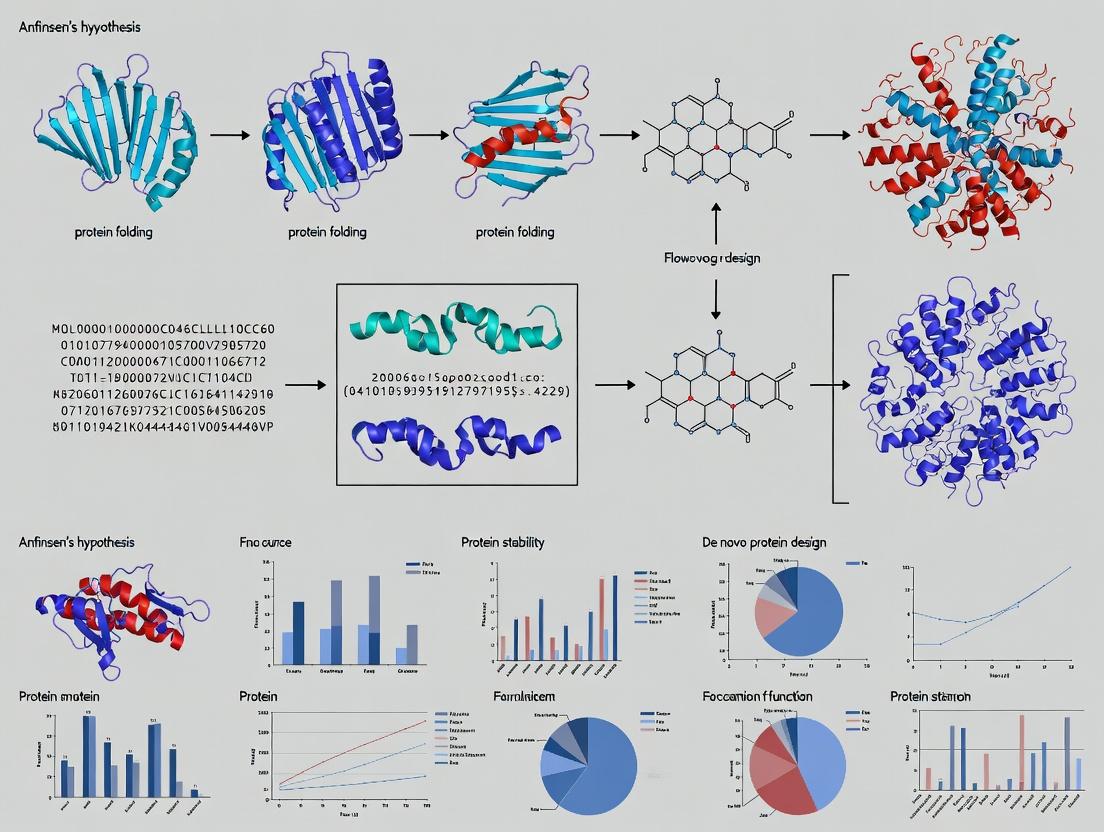
This article explores the foundational principles, computational methodologies, and cutting-edge applications of de novo protein design, firmly rooted in Anfinsen's thermodynamic hypothesis.
From Principle to Practice: Anfinsen's Dogma as the Blueprint for Modern De Novo Protein Design
Abstract
This article explores the foundational principles, computational methodologies, and cutting-edge applications of de novo protein design, firmly rooted in Anfinsen's thermodynamic hypothesis. Targeted at researchers and drug development professionals, we examine how the axiom that 'sequence determines structure' has evolved from a conceptual framework into a robust engineering discipline. The content systematically covers the historical context and core tenets, modern computational and experimental techniques for designing proteins from scratch, common challenges and optimization strategies in the design pipeline, and rigorous validation methods comparing designed proteins to natural counterparts. Finally, we synthesize the current state of the field and its profound implications for creating novel therapeutics, diagnostics, and biomaterials.
The Bedrock of Protein Engineering: Revisiting Anfinsen's Dogma and Its Legacy
This whitepaper delineates the thermodynamic hypothesis, posited by Christian B. Anfinsen, as the central dogma of structural biology. It asserts that the native, functional three-dimensional structure of a protein is uniquely determined by its amino acid sequence under physiological conditions, as this conformation resides at the global minimum of the Gibbs free energy landscape. This principle forms the theoretical bedrock for de novo protein design and rational drug development.
The thermodynamic hypothesis provides the foundational thesis that the information for folding is intrinsic to the sequence. This principle directly enables the field of de novo protein design, which inverts the folding problem: by computationally designing amino acid sequences predicted to fold into a target structure and function, researchers provide the ultimate experimental test of Anfinsen's dogma. Advances in this field, powered by deep learning (e.g., AlphaFold2, RFdiffusion), are revolutionizing our ability to create novel proteins for therapeutic and industrial applications, reaffirming and extending the central dogma's implications.
Core Principles of the Thermodynamic Hypothesis
The hypothesis rests on three core tenets:
- Uniqueness: For a given sequence and set of physiological conditions (pH, temperature, solvent), there is one predominant native conformation.
- Kinetic Accessibility: The folding pathway must be traversable within a biologically relevant timeframe.
- Thermodynamic Stability: The native state is thermodynamically stable, meaning it represents the global minimum in free energy (ΔG_folding < 0).
The free energy of folding is defined as: ΔG_folding = ΔH - TΔS Where a negative ΔG indicates a spontaneous process. The balance of favorable (e.g., hydrophobic collapse, hydrogen bonding) and unfavorable (e.g., conformational entropy loss) contributions dictates stability.
Quantitative Data and Energetic Contributions
The stability of the native state is marginal, typically -5 to -15 kcal/mol, making it sensitive to mutation and environmental changes. Key energetic contributions are summarized below.
Table 1: Quantitative Contributions to Protein Folding Stability
| Energy Component | Approximate Contribution Range (kcal/mol) | Description |
|---|---|---|
| Hydrophobic Effect | -0.5 to -1.5 per buried methylene group | Major driving force; burial of non-polar sidechains from solvent. |
| Hydrogen Bonds | -1 to -3 per bond (net) | Largely compensate for the loss of H-bonds to water in the unfolded state. |
| Electrostatic (Salt Bridges) | -1 to -3 per interaction | Highly dependent on local dielectric environment and geometry. |
| Van der Waals | -0.5 to -1 per atom pair | Favors close packing in the protein interior. |
| Conformational Entropy Loss (TΔS) | +1.5 to +2.5 per residue | Major unfavorable term; loss of backbone and sidechain flexibility. |
Key Experimental Validation and Protocols
Anfinsen's Ribonuclease A Experiment
This seminal experiment provided the first direct proof of the hypothesis.
Protocol:
- Denaturation: Purified RNase A is treated with 8M urea and β-mercaptoethanol (reducing agent) to disrupt non-covalent interactions and reduce disulfide bonds.
- Renaturation: The denaturant and reductant are removed via slow dialysis, allowing the protein to refold and disulfide bonds to re-form in an oxidizing environment.
- Activity Assay: The recovered enzymatic activity is measured using an assay like the hydrolysis of yeast RNA, monitoring absorbance at 300 nm.
- Control: A sample is re-oxidized without urea removal, leading to scrambled disulfides and <1% activity recovery.
Result: ~100% enzymatic activity was recovered upon renaturation, demonstrating that sequence alone suffices to dictate the native, active structure.
Modern Validation: Phi-Value Analysis
This protein engineering technique probes the structure of the folding transition state.
Protocol:
- Mutation: Introduce a single-point mutation (e.g., Ile → Ala) at a specific site.
- Measure Effects: Quantitatively determine:
- ΔΔGfolding: Change in global folding stability (via denaturant titration, e.g., urea GdmCl, monitored by CD or fluorescence).
- ΔΔG‡: Change in the free energy of the folding transition state (via folding/unfolding kinetics measured by stopped-flow techniques).
- Calculate Phi (Φ): Φ = ΔΔG‡ / ΔΔGfolding.
- Interpretation: A Φ-value near 1 indicates the mutated residue is structured in the transition state; a value near 0 indicates it is unstructured.
Diagram 1: Anfinsen's RNase A Refolding Experiment
The Scientist's Toolkit: Research Reagent Solutions
Table 2: Essential Reagents for Folding/Stability Experiments
| Reagent / Material | Function & Application |
|---|---|
| Urea / Guanidine HCl (GdmCl) | Chemical denaturants used to unfold proteins in equilibrium unfolding experiments to determine ΔG_folding. |
| Dithiothreitol (DTT) / β-Mercaptoethanol | Reducing agents that break disulfide bonds, essential for studying folding from a fully unfolded state. |
| Differential Scanning Calorimetry (DSC) | Instrument to measure heat capacity changes, directly determining ΔH and T_m (melting temperature) of unfolding. |
| Circular Dichroism (CD) Spectrometer | Measures secondary (far-UV) and tertiary (near-UV) structure content; primary tool for monitoring folding. |
| Stopped-Flow Spectrophotometer | Rapidly mixes solutions to initiate folding/unfolding on millisecond timescales for kinetic studies. |
| Site-Directed Mutagenesis Kit | Enables creation of point mutants for Φ-value analysis and probing sequence-structure relationships. |
| Intrinsic Fluorescence (Trp) | Uses the sensitivity of tryptophan emission to local environment to monitor folding transitions. |
| Size Exclusion Chromatography (SEC) | Separates proteins by hydrodynamic radius, distinguishing folded monomers from aggregates or unfolded chains. |
De Novo Design as the Ultimate Test
De novo protein design validates the thermodynamic hypothesis by creating functional proteins from first principles. The standard computational workflow is illustrated below.
Diagram 2: De Novo Protein Design Workflow
Protocol: Computational De Novo Design of a Folded Protein
- Backbone Design: Define a desired protein fold (e.g., α-helical bundle, β-sandwich) using parametric equations or fragment assembly.
- Sequence Design: Use a force field (e.g., Rosetta's energy function) to compute an amino acid sequence that minimizes the free energy of the target structure. This involves rotamer sampling and side-chain packing optimization.
- In Silico Filtering: Filter designed sequences by metrics like packing quality, buried unsatisfied polar atoms, and predicted stability (ΔG).
- Gene Synthesis and Expression: Physically produce top-ranking sequences via solid-phase gene synthesis and express in a system like E. coli.
- Biophysical Characterization: Assess folding via CD, thermal denaturation, SEC, and ultimately determine atomic structure by X-ray crystallography.
The thermodynamic hypothesis remains the central, organizing principle of structural biology. Its assertion that sequence encodes structure is not only validated by refolding experiments but is now operatively leveraged through de novo design. The convergence of this principle with advanced computation and machine learning is ushering in a new era of protein engineering, directly impacting therapeutic design and expanding the functional universe of proteins.
The hypothesis proposed by Christian Anfinsen, derived from seminal ribonuclease refolding experiments, posits that the native, functional three-dimensional structure of a protein is determined solely by its amino acid sequence. This principle forms the foundational thesis for the entire field of de novo protein design, which seeks to rationally engineer novel sequences that fold into predetermined structures and functions. This article traces the historical arc from Anfinsen's key experiments to modern computational design, framing it within the ongoing validation and refinement of this universal principle for drug development and synthetic biology.
Historical Foundation: The Ribonuclease A (RNase A) Experiments
The principle emerged from work on bovine pancreatic ribonuclease A in the 1950s and 1960s. The experimental system was crucial: RNase A is a small (124 aa), single-chain protein with four disulfide bonds, whose enzymatic activity is easily measured.
Key Experimental Protocols
1. Denaturation and Reduction Protocol:
- Materials: Native RNase A, 8M Urea or 6M Guanidine HCl, β-mercaptoethanol, pH buffer (e.g., Tris-HCl, pH 8.0).
- Method: RNase A was dissolved in the denaturant solution containing a reducing agent (β-mercaptoethanol). The solution was incubated for several hours (typically 1-4 hrs) at room temperature or 37°C. This treatment unfolds the protein and reduces all four disulfide bonds to free cysteine thiols, resulting in a disordered, inactive polypeptide.
- Validation: Complete unfolding and reduction were confirmed by loss of enzymatic activity, changes in viscosity, and optical rotation.
2. Refolding and Re-oxidation Protocol (Anfinsen's Key Experiment):
- Materials: Denatured/reduced RNase A, Dialysis tubing, Oxidizing buffer (e.g., physiological pH buffer exposed to air).
- Method: The denatured/reduced protein was slowly dialyzed against a large volume of a neutral pH buffer in the presence of oxygen (air). This gently removes the denaturant and allows the protein chain to explore its conformational space while the disulfides re-form.
- Observation: Upon removal of denaturant and reductant, the protein spontaneously regained its native enzymatic activity and physical properties. This demonstrated that the sequence contains all information necessary for folding.
3. "Scrambled" RNase Refolding Protocol:
- Materials: Denatured/reduced RNase A, Oxidizing buffer with 8M Urea.
- Method: Reduced RNase was re-oxidized while still in 8M urea. This generated a population of molecules with randomly formed, "scrambled" disulfide bonds, which was inactive.
- Method (Cont.): This scrambled mixture was then treated with a trace amount of β-mercaptoethanol in buffer without urea. The mercaptoethanol catalyzed disulfide bond reshuffling via thiol-disulfide exchange.
- Key Result: The scrambled mixture slowly regained native activity, proving that even from a state of incorrect crosslinks, the system could find the one thermodynamically most stable native conformation dictated by the sequence.
Table 1: Key Quantitative Results from Anfinsen's RNase A Experiments
| Experimental Condition | Initial State | Final State | Regained Enzymatic Activity (%) | Conclusion |
|---|---|---|---|---|
| Native Control | Folded, Native SS bonds | N/A | 100% (baseline) | Functional native state. |
| Denaturation/Reduction | Folded, Native SS bonds | Unfolded, Reduced SS bonds | ~0-5% | Denaturation destroys structure/function. |
| Refolding/Re-oxidation | Unfolded, Reduced | Refolded, Re-oxidized | 95-100% | Sequence encodes folding pathway to native state. |
| Scrambled Refolding | Unfolded, Random SS bonds | Refolded, Native SS bonds | ~80-95% | Native state is the thermodynamic minimum. |
The Universal Principle and Its Modern Corollary: De Novo Design
Anfinsen's dogma—"Thermodynamic hypothesis"—states that the native structure is the one in which the Gibbs free energy of the whole system is at a minimum. Modern de novo design inverts this logic: if the sequence determines the structure, then a structure can be designed by finding a sequence for which it is the lowest free-energy state.
Core Design Workflow Protocol
1. Target Structure Specification:
- Method: Define a desired backbone fold (e.g., alpha-helical bundle, beta-sandwich) not found in nature.
2. Sequence Design via Computational Protein Design (CPD):
- Method: Use a physical forcefield (Rosetta, AlphaFold2) to calculate the energy of a candidate sequence in the target structure. Search sequence space (via Monte Carlo, genetic algorithms) to find sequences with a pronounced energy minimum at the target structure (low "funnel-shaped" energy landscape).
3. In Silico Validation:
- Method: Perform molecular dynamics simulations to assess stability. Use neural networks (e.g., ProteinMPNN for sequence design, AlphaFold2 or RoseTTAFold for structure prediction of designed sequences) to check that the designed sequence predicts the target structure.
4. Experimental Expression and Characterization:
- Method: Gene synthesis, expression in E. coli or cell-free systems, purification via affinity/size-exclusion chromatography.
- Validation: Compare experimental (X-ray crystallography, NMR, CD spectroscopy) and computationally predicted structures. Measure thermal stability (Tm via DSF or CD), and functional assays.
The Scientist's Toolkit: Key Research Reagent Solutions
Table 2: Essential Reagents for Protein Folding and Design Research
| Reagent / Material | Function in Context |
|---|---|
| Guanidine HCl (6-8 M) | Chaotropic agent. Disrupts hydrogen bonding and hydrophobic interactions, leading to protein unfolding. |
| Urea (8-10 M) | Chaotropic agent. Denatures proteins by disrupting non-covalent interactions. Often used as an alternative to GuHCl. |
| β-Mercaptoethanol / Dithiothreitol (DTT) | Reducing agents. Cleave disulfide bonds (S-S) to free thiols (-SH), critical for unfolding studies of proteins like RNase A. |
| Oxidized/Reduced Glutathione | Redox buffer system. Provides a controlled environment for disulfide bond formation (oxidation) or breakage (reduction) during refolding. |
| Size-Exclusion Chromatography (SEC) Columns | Separates folded monomers from aggregates or misfolded species during purification of designed proteins. |
| Differential Scanning Fluorimetry (DSF) Dyes (e.g., SYPRO Orange) | Binds to hydrophobic patches exposed upon thermal unfolding. Allows high-throughput measurement of protein melting temperature (Tm), a key stability metric for designs. |
| Cell-Free Protein Synthesis System | Expresses proteins, especially those toxic to cells or containing non-canonical amino acids, for rapid screening of designed variants. |
| ProteinMPNN (Software) | A deep neural network for rapidly generating stable, foldable protein sequences for a given backbone, revolutionizing design throughput. |
Visualizing the Legacy: From Principle to Design
Title: Historical Logic of Protein Folding & Design
Title: Energy Landscape of Protein Folding
The prediction of a protein's three-dimensional structure from its amino acid sequence—the protein folding problem—remains a central challenge in molecular biology. The foundational principle is Anfinsen's hypothesis (1973), which posits that a protein's native, biologically active conformation is the one in which its Gibbs free energy is lowest under physiological conditions. This thermodynamic hypothesis frames protein folding as a search for a global minimum on a complex energy landscape. The conceptualization of this landscape as a "folding funnel" has become indispensable for understanding folding kinetics and for the burgeoning field of de novo protein design, which aims to construct novel functional proteins from first principles. This whitepaper details the core tenets, their quantitative underpinnings, and the experimental methodologies that validate them within modern research.
Native Conformation and Minimum Free Energy: The Thermodynamic Foundation
The native state is not a single rigid structure but an ensemble of closely related conformations in dynamic equilibrium. Stability is quantified by the Gibbs free energy of folding (ΔG_folding), typically ranging from -5 to -15 kcal/mol, making the native state only marginally stable.
Table 1: Key Thermodynamic Parameters for Model Proteins
| Protein (PDB ID) | ΔG_folding (kcal/mol) | Tm (°C) | ΔH (kcal/mol) | ΔS (cal/mol·K) | Method |
|---|---|---|---|---|---|
| Lysozyme (1LYZ) | -9.8 ± 0.5 | 72.1 | -95.0 | -285 | DSC |
| RNase A (7RSA) | -8.2 ± 0.3 | 61.5 | -88.0 | -265 | CD/DSF |
| SH3 domain (1SHG) | -5.1 ± 0.2 | 53.0 | -45.2 | -132 | NMR |
| De novo design (α3D) | -11.0 ± 0.7 | 85.0 | -110.5 | -330 | ITC/DSC |
DSC: Differential Scanning Calorimetry; DSF: Differential Scanning Fluorimetry; CD: Circular Dichroism; ITC: Isothermal Titration Calorimetry; NMR: Nuclear Magnetic Resonance.
Experimental Protocol: Determining ΔG_folding via Chemical Denaturation
- Sample Preparation: Purify protein to >95% homogeneity. Prepare a stock solution in native buffer (e.g., 20 mM phosphate, 150 mM NaCl, pH 7.0).
- Denaturant Series: Prepare 20-30 samples with increasing concentrations of a chemical denaturant (e.g., Guanidine HCl or Urea), ranging from 0 M to fully denaturing concentrations (e.g., 8 M GuHCl).
- Signal Measurement: For each sample, measure a spectroscopic signal proportional to the folded population (e.g., intrinsic fluorescence emission at 350 nm upon excitation at 280 nm, or far-UV CD signal at 222 nm).
- Data Analysis: Fit the sigmoidal denaturation curve to a two-state model (folded unfolded) using the linear extrapolation method (LEM) to calculate ΔGfolding in water (ΔGH2O) and the cooperativity (m-value).
The Folding Funnel: A Kinetic and Conceptual Landscape
The folding funnel metaphor describes a high-dimensional energy landscape where conformational entropy decreases as the protein descends toward the native basin. The ruggedness of the funnel accounts for kinetic traps and folding intermediates. Recent advances in molecular dynamics (MD) and Markov State Models (MSMs) allow for quantitative mapping of these landscapes.
Table 2: Characteristic Timescales and Barriers in Protein Folding
| Process/State | Typical Timescale | Free Energy Barrier (k_BT) | Experimental Probe |
|---|---|---|---|
| Collapse to Molten Globule | Microseconds (µs) | 2-4 | Time-resolved FRET, SAXS |
| Secondary Structure Formation | 10-100 µs | 3-6 | T-jump IR, Ultrafast CD |
| Tertiary Contact Formation & Rearrangement | Milliseconds (ms) | 5-10 | Φ-value Analysis, Pulsed-labeling NMR |
| Transition Path Time | Nanoseconds (µs) | N/A | Single-molecule FRET, MD |
| De novo designed protein folding | Often faster, <1 ms | Lower, more smooth | All above |
Experimental Protocol: Φ-value Analysis for Transition State Mapping
- Design Mutations: Create a series of point mutations (typically to Ala or Gly) at conserved, core residues suspected to be in the folding nucleus.
- Measure Kinetics: Use stopped-flow or temperature-jump instrumentation to measure the folding (kf) and unfolding (ku) rates for both wild-type and mutant proteins under identical conditions.
- Calculate Φ-values: For each mutant, compute Φ = ΔΔG‡-TS / ΔΔGF-U, where ΔΔG‡-TS is the change in activation free energy and ΔΔGF-U is the change in equilibrium stability. A Φ ≈ 1 indicates the residue is fully structured in the transition state; Φ ≈ 0 indicates it is unstructured.
- Structural Mapping: Plot Φ-values onto the protein structure to delineate the folding nucleus—the region that is structured in the rate-limiting transition state.
Application inDe NovoProtein Design
De novo design is the ultimate test of these principles. By inverting the folding problem, designers craft sequences predicted to fold into a target structure with minimal free energy. The process relies on Rosetta, AlphaFold2, and RFdiffusion to generate and score sequences.
Workflow forDe NovoDesign & Validation
Diagram Title: De Novo Protein Design and Validation Workflow
The Scientist's Toolkit: Key Research Reagents & Solutions
| Item Name & Supplier (Example) | Function in Folding/Design Research |
|---|---|
| Guanidine HCl (Thermo Fisher) | Chemical denaturant for equilibrium unfolding experiments to determine ΔG_folding. |
| Sypro Orange Dye (Invitrogen) | Hydrophobic dye for Differential Scanning Fluorimetry (DSF) to measure thermal stability (Tm). |
| D2O Buffer (Cambridge Isotopes) | Solvent for hydrogen-deuterium exchange mass spectrometry (HDX-MS) to probe backbone dynamics and folding intermediates. |
| Ni-NTA Agarose (QIAGEN) | Affinity resin for purifying His-tagged de novo designed proteins post-expression. |
| SEC Column (Superdex 75, Cytiva) | Size-exclusion chromatography for assessing the monomeric state and global folding of purified designs. |
| TCEP-HCl (GoldBio) | Reducing agent to maintain cysteine residues in reduced state, preventing disulfide scrambling during folding assays. |
| Stopped-flow Module (Applied Photophysics) | Instrument for rapid mixing to measure folding/unfolding kinetics on millisecond timescales. |
Contemporary Challenges and Future Directions
While de novo design of small, stable folds is now routine, challenges persist in designing for complex functions, allostery, and membrane proteins. The integration of generative AI (like RFdiffusion) with physics-based forcefields is creating a new paradigm. The next frontier is the design of functional protein systems that operate within the cellular milieu, where the energy landscape is modulated by chaperones, macromolecular crowding, and post-translational modifications.
Diagram Title: Evolution of Protein Folding to Design Research
The core tenets of native conformation, minimum free energy, and the folding funnel provide a complete theoretical framework that has evolved from Anfinsen's seminal insight into a powerful engineering discipline. Quantitative validation through biophysical experiments and the advent of sophisticated computational tools have made de novo protein design a reality. This convergence of theory, experiment, and computation is now driving innovation in therapeutic protein, vaccine, and enzyme design, fundamentally transforming biotechnology and medicine.
Anfinsen's postulate—that a protein's native, functional structure is determined solely by its amino acid sequence—remains a foundational principle in structural biology and de novo design. However, in the crowded, complex cellular milieu, protein folding is not a simple thermodynamic funnel. This whitepaper examines two critical limitations to the classical Anfinsen paradigm: kinetic traps (metastable misfolded states) and the essential role of chaperone systems in guiding proper folding. For researchers in de novo design and drug development, integrating these concepts is paramount for creating functional proteins and targeting folding-related diseases.
I. The Kinetic Trap Problem
Kinetic traps are local energy minima that compete with the native state, slowing folding or leading to stable, non-native conformations. They arise from non-productive intramolecular interactions and are exacerbated in vivo by macromolecular crowding.
Quantitative Data on Kinetic Traps:
Table 1: Experimental Observations of Kinetic Traps in Model Proteins
| Protein | Observed Misfolded State | Half-life (Unassisted) | Primary Cause | Reference |
|---|---|---|---|---|
| Lysozyme (human) | Molten globule with mispaired disulfides | ~10-30 min | Incorrect disulfide bonding | (Dobson, 2004) |
| Barstar | Hydrophobic collapse intermediate | >1 hour | Buried polar residues | (Sosnick, 1996) |
| α-Lactalbumin | Apo (calcium-free) state | Persistent | Loss of stabilizing ligand | (Kuwajima, 1987) |
| Designed β-sheet protein | Amyloidogenic aggregates | Irreversible | Edge-strand exposure | (Richardson, 2019) |
Experimental Protocol: Monitoring Kinetic Traps via Stopped-Flow Fluorescence
- Objective: Measure the folding kinetics of a protein and detect transient intermediates.
- Reagents: Purified protein in denaturing buffer (6M GdnHCl, pH 7.0); Native refolding buffer (pH 7.0).
- Procedure:
- Load the denatured protein into one syringe of the stopped-flow instrument and refolding buffer into the other.
- Rapidly mix (dead time ~1 ms) to initiate refolding at final desired conditions.
- Monitor intrinsic tryptophan fluorescence or FRET signal change over time (microseconds to minutes).
- Fit the resulting multi-phase kinetic traces to multi-exponential equations.
- Vary final conditions (pH, temperature, ionic strength) to probe intermediate stability.
- Interpretation: A multi-phase trace with a slow phase indicates population of a kinetically trapped intermediate that must partially unfold (backtrack) to proceed to the native state.
II. Chaperones: The Cellular Folding Machinery
Chaperones are protein complexes that prevent aggregation, resolve kinetic traps, and provide privileged folding environments. They do not convey structural information but bias the stochastic search toward the native state.
Key Chaperone Systems and Mechanisms:
Table 2: Major Chaperone Systems and Their Roles
| Chaperone System | Class | Primary Mechanism | Key Substrates | Energy Source |
|---|---|---|---|---|
| GroEL/ES (Hsp60) | Holdase/Foldase | Provides an isolated cage for folding | Obligate substrates (~10% of E. coli proteome) | ATP hydrolysis |
| DnaK/DnaJ/GrpE (Hsp70) | Holdase | Binds hydrophobic peptide segments, prevents aggregation | Broad range of nascent/newly synthesized proteins | ATP hydrolysis |
| Trigger Factor | Holdase | Prokaryotic ribosome-associated chaperone | Nascent chains exiting ribosome | None (ATP-independent) |
| Hsp90 | Foldase | Stabilizes near-native states of signaling proteins | Kinases, steroid hormone receptors | ATP hydrolysis |
| Small Heat Shock Proteins (sHsps) | Holdase | Forms large, dynamic complexes to prevent aggregation | Under cellular stress (heat, oxidation) | None (ATP-independent) |
Experimental Protocol: Assessing Chaperone Function via Aggregation Suppression Assay
- Objective: Quantify the ability of a chaperone to prevent aggregation of a client protein under stress.
- Reagents: Purified client protein (e.g., citrate synthase); Purified chaperone (e.g., Hsp70 system); ATP regeneration system; Thermostatted spectrophotometer.
- Procedure:
- Prepare a reaction mix containing client protein (2 µM), chaperone (varies from 0-5 µM), ATP (1 mM), and regeneration system in appropriate buffer.
- In a cuvette, thermally stress the client (e.g., heat to 43°C for citrate synthase) in the spectrophotometer.
- Monitor light scattering at 320 nm (a proxy for large aggregate formation) over 30-60 minutes.
- Run controls: client alone, chaperone alone, client + chaperone without ATP.
- Plot scattering intensity vs. time. Calculate the initial rate of aggregation and final aggregation extent.
- Interpretation: Effective chaperones will reduce both the rate and final amplitude of light scattering. ATP dependence indicates active, cycling chaperones like Hsp70.
III. Integration forDe NovoDesign
Modern protein design must account for folding kinetics and chaperone interaction. Strategies include:
- Designing Smooth Funnels: Minimizing frustrated contacts and cryptic aggregation-prone patches in silico.
- Incorporating Chaperone Binding Motifs: Designing sequences that recruit beneficial chaperones without becoming permanently bound.
- Negative Design Against Traps: Explicitly destabilizing predicted off-pathway intermediates.
The Scientist's Toolkit: Research Reagent Solutions
| Item / Reagent | Function / Application | Example Vendor/Product |
|---|---|---|
| PURE System | Cell-free transcription/translation for studying co-translational folding & chaperone action. | GeneFrontier PUREfrex |
| Monodansylpentane (MDH) | Model thermolabile client protein for chaperone (GroEL) activity assays. | Sigma-Aldrich M8883 |
| ATPγS (Adenosine 5´-[γ-thio]triphosphate) | Non-hydrolyzable ATP analog for trapping chaperone-client complexes (e.g., Hsp70). | Jena Bioscience NU-401 |
| Bacterial GroEL/ES Purification Kit | For isolating functional chaperonin complexes from E. coli. | BioVision K489-100 |
| Thioflavin T (ThT) | Fluorescent dye for detecting and quantifying amyloid/aggregate formation. | Sigma-Aldrich T3516 |
| NativeMark Unstained Protein Standard | For assessing native molecular weight & oligomeric state on native PAGE gels. | Invitrogen LC0725 |
| Site-Specific Crosslinkers (e.g., BS3) | For mapping transient chaperone-client interactions. | Thermo Fisher Scientific 21580 |
IV. Visualizing Concepts and Pathways
Folding Energy Landscape with Trap
Chaperone-Guided Folding Pathway
The deterministic view of Anfinsen must be refined to incorporate kinetic partitioning and chaperone intervention. For drug development, this presents dual opportunities: 1) designing de novo proteins with robust folding pathways, and 2) targeting chaperone systems or kinetic traps in diseases like neurodegeneration and cancer. The future lies in predictive models that integrate sequence, folding kinetics, and chaperone interaction networks.
Why Anfinsen's Dogma is the Essential Foundation for De Novo Design
The hypothesis articulated by Christian B. Anfinsen—that a protein's amino acid sequence uniquely determines its native three-dimensional structure under physiological conditions—provides the fundamental thermodynamic principle enabling the field of de novo protein design. This whitepaper delineates how Anfinsen's Dogma serves as the indispensable theoretical scaffold for computational design, detailing the requisite experimental protocols, quantitative validations, and practical toolkits that translate this foundational principle into functional molecules.
Anfinsen's Dogma, derived from seminal experiments on ribonuclease A, posits that the native conformation of a protein is the one in which the Gibbs free energy of the system is at a global minimum. This principle transforms protein design from an intractable search problem into a computable energy minimization challenge. For de novo design, it implies that if we can compute a sequence that encodes a folding landscape with a pronounced global minimum at a target structure, we can reliably produce that structure.
Quantitative Validation of the Dogma in Modern Design
The success rate of de novo design projects provides direct quantitative support for Anfinsen's hypothesis. The following table summarizes key results from recent high-profile studies, correlating computational energy metrics with experimental validation.
Table 1: Success Rates of Recent De Novo Protein Design Projects
| Design Target / Class | Number of Designed Sequences | Experimental Validation Method | Success Rate (Fold/Function) | Key Energy Metric (Rosetta Energy Units, REU) | Publication Year | Reference |
|---|---|---|---|---|---|---|
| Top7 (Novel Fold) | 1 | X-ray Crystallography | 100% (Fold) | -23.5 (design model) | 2003 | Science |
| Hyperstable Enzymes (Kemp Eliminase) | 56 | Activity Assay, X-ray | ~18% (Function) | ΔΔG < 0 (stability) | 2008 | Nature |
| Fluorescent Proteins | 5 | Fluorescence, NMR | 20% (Function) | Packing score > 0.6 | 2019 | Nature |
| Mini-Proteins (Inhibitors) | 8,400 | Cryo-EM, Binding Assay | ~0.4% (High-affinity binders) | Interface ΔG < -15 REU | 2021 | Nature |
| Transmembrane Barrels | 215 | Cryo-EM, CD | ~2.3% (Confirmed barrels) | Membrane burial score | 2022 | Science |
| Custom Protein Pores | 130,000 | Electrophysiology | ~0.03% (Ion Channel Function) | Pore-lining geometry | 2023 | Nature |
Core Methodological Framework: From Dogma to Design
The universal computational-experimental pipeline for de novo design is a direct implementation of Anfinsen's thermodynamic principle.
Experimental Protocol 1: The RosettaDe NovoDesign Workflow
This protocol outlines the core steps for designing a novel protein fold.
- Target Backbone Specification: Define the target tertiary topology (e.g., α-helical bundle, β-sandwich) using parameterized equations or fragment assembly.
- Sequence Design via Fixed-Backbone Optimization: Using the Rosetta software suite, optimize amino acid identity and side-chain conformations (rotamers) to minimize the all-atom energy function for the fixed target backbone.
- In Silico Screening: Filter designs based on:
- Energy Threshold: Total score < -1.0 REU per residue.
- Packaging Quality: Cavity volume < 50 ų.
- Sequence Recovery: < 25% identity to any natural sequence to avoid known folds.
- Gene Synthesis & Cloning: Convert selected sequences to DNA codons optimized for E. coli expression. Clone into a pET vector downstream of a T7 promoter.
- Protein Expression & Purification:
- Express in E. coli BL21(DE3) cells induced with 0.5 mM IPTG at 18°C for 16h.
- Purify via Ni-NTA affinity chromatography (for His-tagged constructs) followed by size-exclusion chromatography (SEC) on a Superdex 75 column.
- Biophysical Validation:
- Circular Dichroism (CD): Confirm secondary structure content and thermal stability (Tm). A cooperative, reversible unfolding transition is predicted by Anfinsen's Dogma.
- Size-Exclusion Chromatography Multi-Angle Light Scattering (SEC-MALS): Verify monomeric state and match of hydrodynamic radius to designed size.
- High-Resolution Validation: Solve structure via X-ray crystallography or cryo-EM. Success is defined by a backbone root-mean-square deviation (RMSD) < 2.0 Å from the design model.
Experimental Protocol 2: Validating the "Global Minimum" Principle
This protocol tests the core of Anfinsen's Dogma by assessing the reversibility and cooperativity of folding.
- Sample Preparation: Purified de novo protein at 10 µM in phosphate-buffered saline (PBS), pH 7.4.
- Equilibrium Unfolding via CD Spectroscopy:
- Monitor ellipticity at 222 nm (for α-helix) or 218 nm (for β-sheet) while titrating a denaturant (e.g., Guanidine HCl from 0 M to 6 M).
- Perform both forward (folded → unfolded) and reverse (unfolded → folded by dilution from high denaturant) transitions.
- Data Analysis:
- Fit the sigmoidal unfolding curve to a two-state model to extract the free energy of unfolding (ΔG°unf) and the denaturant concentration at the midpoint (Cm).
- Key Anfinsen Test: The superimposability of the forward and reverse curves confirms the reversibility of folding, demonstrating that the final state is determined solely by the solution conditions and sequence, not by kinetic traps.
Diagram 1: De novo design and Anfinsen validation workflow
The Scientist's Toolkit: Key Research Reagent Solutions
Table 2: Essential Materials for De Novo Design & Validation
| Item | Function/Description | Example Product/Catalog # |
|---|---|---|
| Rosetta Software Suite | Primary computational platform for energy-based protein design and structure prediction. Free for academic use. | https://www.rosettacommons.org/software |
| pET Expression Vector | High-copy plasmid for strong, T7 promoter-driven protein expression in E. coli. | Novagen, pET-28a(+) (69864-3) |
| BL21(DE3) Competent Cells | E. coli strain with genomic T7 RNA polymerase for induction with IPTG. | NEB, C2527I |
| Ni-NTA Agarose Resin | Immobilized metal affinity chromatography resin for purifying polyhistidine-tagged proteins. | Qiagen, 30210 |
| Superdex 75 Increase SEC Column | High-resolution size-exclusion column for separating proteins up to ~70 kDa. | Cytiva, 28989333 |
| Guanidine Hydrochloride (Ultra Pure) | Chemical denaturant for equilibrium unfolding experiments to measure folding stability. | MilliporeSigma, G4505-1KG |
| Jasco J-1500 CD Spectrophotometer | Instrument for measuring circular dichroism to determine secondary structure and thermal stability. | Jasco Inc. |
| Molecular Dynamics Simulation Software | For validating the dynamic stability of designed proteins (e.g., GROMACS, AMBER). | GROMACS (http://www.gromacs.org) |
Logical Framework: The Dogma as an Axiom
The relationship between Anfinsen's Dogma and the logical steps of de novo design can be formalized as a syllogism, where the Dogma serves as the major premise enabling the entire endeavor.
Diagram 2: Logical relationship of Anfinsen's Dogma to design
Anfinsen's Dogma is not merely a historical observation but the active, non-negotiable foundation of modern de novo protein design. It provides the thermodynamic guarantee that makes the computational search for novel sequences meaningful. Every successful design—from hyperstable folds to precision enzymes and therapeutics—stands as a direct experimental confirmation of this principle. The future of the field, including the design of complex molecular machines and adaptive biomaterials, will continue to be built upon this essential understanding of the sequence-structure-energy relationship.
Computational Architectures and Real-World Applications in De Novo Protein Design
This technical guide examines the evolution of computational protein structure prediction and design, framed within the context of Anfinsen's hypothesis that a protein's native structure is determined by its amino acid sequence. We chart the progression from physics-based methods like Rosetta to modern deep learning paradigms including AlphaFold2, RFdiffusion, and ProteinMPNN, highlighting their transformative impact on de novo protein design research and therapeutic development.
Anfinsen's hypothesis (1972) established the thermodynamic principle that the information for three-dimensional structure is encoded in the polypeptide sequence. This became the foundational assumption for all computational approaches discussed herein. The field's trajectory represents a continuous effort to accurately model the folding energy landscape—first through explicit physical chemistry approximations, and later through data-driven statistical learning.
The Physics-Based Era: Rosetta
The Rosetta software suite, developed over two decades, employs a fragment assembly method guided by a physically informed energy function to predict protein structures from sequence.
Core Methodology
The protocol decomposes the target sequence into short (3-9 residue) fragments, retrieved from known structures. Monte Carlo sampling explores conformational space, with moves evaluated against a scoring function combining:
- Van der Waals interactions (Lennard-Jones potential)
- Solvation effects (implicit solvent models like GB/SA)
- Hydrogen bonding and electrostatics
- Knowledge-based torsional potentials
Experimental Protocol:Ab InitioFolding with Rosetta
- Input Preparation: Provide target amino acid sequence in FASTA format.
- Fragment Library Generation: Use NNmake or Robetta server to generate fragment files from the PDB.
- Monte Carlo Simulation:
- Clustering & Selection: Cluster low-energy decoys by RMSD; select centroid of largest cluster.
Quantitative Performance (Pre-AlphaFold)
Table 1: Rosetta Performance in CASP Experiments (CASP10-CASP13)
| CASP Edition | Year | Best GDT_TS (Domains) | Average GDT_TS (FM Targets) | Computational Cost (CPU-days/model) |
|---|---|---|---|---|
| CASP10 | 2012 | 78.2 | 45.3 | ~100 |
| CASP11 | 2014 | 81.5 | 48.7 | ~150 |
| CASP12 | 2016 | 84.1 | 52.1 | ~200 |
| CASP13 | 2018 | 73.4 | 55.2 | ~180 |
The Deep Learning Revolution: AlphaFold2
AlphaFold2 (AF2), introduced by DeepMind in 2020, represents a paradigm shift to end-to-end deep learning, achieving atomic accuracy in structure prediction.
AF2 employs an Evoformer neural network module followed by a structure module. The system integrates:
- Multiple Sequence Alignments (MSAs) from genetic databases
- Pairwise representations of residues
- Iterative refinement through 48 Evoformer blocks
- Direct output of 3D coordinates (via invariant point attention)
Experimental Protocol: Structure Prediction with AlphaFold2
- Input & MSA Generation: Input target sequence; search UniRef90 and MGnify databases with HHblits and JackHMMER.
- Template Processing: Search PDB70 with HMM-HMM comparison.
- Neural Network Inference:
- Relaxation: Use AMBER forcefield via OpenMM to minimize steric clashes.
- Output: Predicted Structure (PDB), per-residue confidence (pLDDT), and predicted aligned error (PAE).
Performance Data
Table 2: AlphaFold2 Performance Metrics (CASP14 & Beyond)
| Metric | CASP14 Average | AlphaFold DB (v2.3) | Notes |
|---|---|---|---|
| GDT_TS (Global) | 92.4 | 92.9* | *Estimated on Swiss-Prot subset |
| RMSD (backbone, Å) | 0.96 | 1.12 | For high-confidence predictions (pLDDT>90) |
| Median pLDDT | 90.2 | 91.1 | Confidence score (0-100) |
| Coverage (% of human proteome) | N/A | 98.5 | Via AlphaFold Protein Structure Database |
Inverse Design: From Structure to Sequence
ProteinMPNN: Protein Message Passing Neural Network
ProteinMPNN is a graph-based neural network for sequence design given a backbone structure, offering significant speed and diversity advantages over Rosetta design.
Methodology: A message-passing neural network with edge updates processes a k-NN graph of Cα atoms:
Experimental Protocol:
- Input: Backbone coordinates (N, Cα, C, O atoms) in PDB format.
- Feature Extraction: Calculate distances, orientations, and dihedral angles.
- Neural Network Forward Pass: Run ProteinMPNN with optional masking for fixed residues.
- Sampling: Sample sequences from output probability distribution (temperature parameter τ controls diversity).
- Scoring & Filtering: Score sequences with Rosetta or AF2; select top candidates.
Table 3: ProteinMPNN Benchmark Results
| Design Target | Success Rate (Native-like fold) | Sequence Recovery (%) | Runtime (seconds/design) |
|---|---|---|---|
| Novel Topologies | 87% | 38% | 0.5 |
| Enzyme Active Sites | 72% | 52% | 0.7 |
| Symmetric Assemblies | 94% | 41% | 0.6 |
RFdiffusion: Generative Diffusion for Protein Backbones
RFdiffusion extends RoseTTAFold with diffusion models to generate novel protein backbones conditioned on various constraints (symmetry, motifs, partial structures).
Core Algorithm: A denoising diffusion probabilistic model (DDPM) trained on the PDB.
Experimental Protocol for De Novo Scaffold Generation:
- Conditioning: Define constraints (e.g., shape, secondary structure, motif placement).
- Sampling: Initialize random Gaussian noise (all atom coordinates).
- Iterative Denoising: Run 200-500 reverse diffusion steps using RFdiffusion network.
- Inpainting: For fixed motifs, mask variable regions during diffusion.
- Refinement: Use Rosetta or AlphaFold2 to relax and validate structures.
- Sequence Design: Apply ProteinMPNN to designed backbones.
Table 4: RFdiffusion Design Success Rates
| Application | Experimental Validation Rate | Design Properties |
|---|---|---|
| Enzymes | 24% (active) | Novel TIM barrels, hydrolases |
| Binding Proteins | 56% (high affinity) | ≤ 2.5 Å interface RMSD to target |
| Symmetric Oligomers | 89% (correct symmetry) | Up to 60-mer cyclic/icosahedral assemblies |
Integrated Pipeline forDe NovoDesign
A complete workflow leveraging all tools demonstrates the modern realization of Anfinsen's principle in reverse.
Protocol: Designing a Novel Mini-Protein Binder
- Target Specification: Define target epitope (from cryo-EM or existing complex).
- Motif Scaffolding with RFdiffusion:
- Input: Target motif (3-20 residues) in binding conformation
- Condition: Exclude motif region from diffusion masking
- Output: 100-500 scaffold backbones
- Sequence Design with ProteinMPNN:
- For each backbone, generate 8-64 sequences
- Use fixed backbone design protocol
- Filtering with AlphaFold2:
- Predict structures of designed sequences
- Filter by pLDDT (>85) and motif RMSD (<1.0 Å)
- Experimental Characterization:
- Express in E. coli (with His-tag for purification)
- Validate structure via NMR or crystallography
- Measure affinity (SPR/BLI)
The Scientist's Toolkit: Research Reagent Solutions
Table 5: Essential Reagents for Computational Protein Design & Validation
| Reagent/Kit | Function |
|---|---|
| Cloning & Expression | |
| pET vectors (Novagen) | High-yield protein expression in E. coli |
| Gibson Assembly Master Mix (NEB) | Seamless plasmid assembly for variant libraries |
| Purification | |
| Ni-NTA Superflow (Qiagen) | Immobilized metal affinity chromatography for His-tagged proteins |
| Superdex 75 Increase (Cytiva) | Size-exclusion chromatography for monomeric protein purification |
| Characterization | |
| Octet RED96e (Sartorius) | Label-free binding kinetics (BLI) for affinity measurement |
| Prometheus Panta (NanoTemper) | Nanoscale differential scanning fluorimetry for stability assessment |
| Structural Validation | |
| Cryo-EM Grids (Quantifoil) | UltrAuFoil R1.2/1.3 for high-resolution single-particle cryo-EM |
| Mosquito Crystal (SPT Labtech) | Automated nanoliter-scale crystallization screening |
Visualization of Computational Workflows
Rosetta Fragment Assembly Pipeline
AlphaFold2 End-to-End Architecture
Integrated De Novo Design Pipeline
The computational pipeline has evolved from approximating physical principles to learning directly from nature's database of solved structures, enabling the practical application of Anfinsen's hypothesis for both prediction and design. The integration of diffusion models (RFdiffusion) with inverse design networks (ProteinMPNN) and validators (AlphaFold2) forms a robust cycle for de novo protein creation. Current frontiers include the design of functional enzymes, transmembrane proteins, and dynamic molecular machines, moving beyond static structures toward the prediction and design of conformational ensembles—the next challenge in fulfilling Anfinsen's thermodynamic vision.
The field of de novo protein design represents the ultimate test of our understanding of Anfinsen's hypothesis, which postulates that a protein's amino acid sequence uniquely determines its three-dimensional structure. This foundational principle implies that structure is inherently encoded in sequence, enabling the forward problem of predicting structure from sequence. The inverse problem—computationally designing a sequence to fold into a desired, novel structure or function—is the grand challenge of modern protein engineering. This whitepaper details three core computational strategies—Inverse Folding, Scaffolding, and Functional Site Grafting—that form the methodological pillars for translating Anfinsen's dogma into a practical design framework for researchers and therapeutic developers.
Core Strategy 1: Inverse Folding
Definition & Principle: Inverse Folding (or Sequence Design) starts with a target backbone structure and seeks to find an amino acid sequence that will stabilize it. It inverts the traditional folding prediction problem, directly testing the "sequence determines structure" tenet.
Detailed Methodology:
- Backbone Input: A target backbone conformation (e.g., a novel fold, idealized helix bundle) is defined using coordinates or parametric equations.
- Rotamer Library Placement: Side-chain conformations (rotamers) from a canonical library (e.g., Dunbrack) are placed on each residue position.
- Energy Function Optimization: A scoring function evaluates sequence-structure compatibility. This typically includes:
- Van der Waals packing (repulsion and attraction)
- Hydrogen bonding networks
- Solvation effects (implicit or explicit)
- Electrostatic interactions
- Knowledge-based statistical potentials derived from the PDB
- Sequence Search: Algorithms like Monte Carlo simulated annealing, dead-end elimination (DEE), or gradient descent are used to sample sequence space and minimize the global energy of the designed protein.
Key Experimental Protocol (Validating an Inverse-Folded Design):
- Gene Synthesis: The top-ranking in silico sequences are codon-optimized and synthesized.
- Protein Expression: Proteins are expressed in a heterologous system (e.g., E. coli).
- Purification: Purified via affinity and size-exclusion chromatography (SEC).
- Biophysical Characterization:
- Circular Dichroism (CD): Assess secondary structure content.
- Analytical SEC / Multi-Angle Light Scattering (SEC-MALS): Determine oligomeric state and monodispersity.
- Thermal Denaturation (via CD or DSF): Measure melting temperature (Tm) as a proxy for stability.
- Structure Determination: High-resolution validation via X-ray crystallography or NMR spectroscopy.
Diagram: Inverse Folding Computational Workflow
Core Strategy 2: Scaffolding
Definition & Principle: Scaffolding involves embedding a desired functional motif (e.g., an enzyme active site, a protein-protein interaction epitope) into a stable, inert "scaffold" protein. The scaffold provides the structural context necessary for the motif to adopt its functional geometry.
Detailed Methodology:
- Motif Definition: The functional motif's precise 3D coordinates (atoms or Cα traces) are identified from a natural structure or designed de novo.
- Scaffold Search: A database of protein structures (e.g., PDB) is searched for backbone segments that can geometrically accommodate the motif using algorithms like ROSETTA's MotifGraft or molecular fragment replacement.
- Grafting & Interface Design: The motif is inserted into the chosen scaffold. The scaffold loops and the interface between the motif and scaffold are redesigned using inverse folding principles to ensure seamless integration and stability.
- Global Refinement: The entire chimeric structure undergoes cycles of energy minimization and backbone relaxation to relieve steric clashes and optimize packing.
Key Experimental Protocol (Testing a Scaffolded Design):
- Expression & Purification: As per Inverse Folding protocol.
- Functional Assay: A specific assay for the grafted function is performed (e.g., enzyme kinetics, binding affinity via SPR or ITC).
- Stability Assessment: Tm is measured and compared to the wild-type scaffold to ensure grafting did not compromise stability.
- Structural Validation: Determined to confirm the grafted motif retains the intended geometry.
Core Strategy 3: Functional Site Grafting
Definition & Principle: A specialized form of scaffolding focused on transferring an entire functional site (including catalytic residues, cofactor-binding pockets, etc.) from a donor protein to a topologically distinct acceptor scaffold. It aims to transplant function while potentially improving properties like stability or expressibility.
Detailed Methodology:
- Functional Site Extraction: Key catalytic/binding residues and their spatial relationships are defined as a set of distance and angle constraints.
- Acceptor Scaffold Screening: Candidate scaffolds are evaluated for their ability to host the constellation of residues, often requiring backbone deformation.
- De Novo Loop Design: Extensive redesign of loops in the acceptor scaffold is frequently required to correctly position the grafted residues. This uses fragment assembly and sequence design.
- All-Atom Refinement: The designed protein undergoes high-resolution refinement with explicit solvent to ensure chemical viability of the active site.
Table 1: Representative Success Rates and Metrics for Core Design Strategies
| Strategy | Typical Computational Success Rate (in silico)* | Experimental Success Rate (High-Resolution Structure Validation) | Key Performance Metric | Example Value Range | Reference Year (approx.) |
|---|---|---|---|---|---|
| Inverse Folding (Novel Folds) | High (>90% low energy) | Moderate (10-40%) | Thermal Melting Temp (Tm) | 50°C - >95°C | 2020-2024 |
| Scaffolding (Motif Graft) | Moderate (30-60%) | Low to Moderate (5-30%) | Binding Affinity (Kd) | nM - µM range | 2021-2024 |
| Functional Site Grafting | Low (<20%) | Low (<10%) | Catalytic Efficiency (kcat/Km) | 10^1 - 10^3 M⁻¹s⁻¹ | 2022-2024 |
* Defined as percentage of designs passing all energy and steric filters during computation.
Table 2: Comparison of Computational Tools and Energy Functions
| Tool/Platform | Primary Use | Key Energy Terms | Open Source | Typical Runtime per Design |
|---|---|---|---|---|
| ROSETTA | Comprehensive suite for all three strategies | faatr, farep, hbondsrbb, solvation | Yes | Hours to Days (CPU) |
| ProteinMPNN | Fast, deep learning-based inverse folding | Neural network (structure-conditioned) | Yes | Seconds to Minutes (GPU) |
| RFdiffusion | Generative backbone design | Diffusion model | Yes | Minutes (GPU) |
| AlphaFold2 | Validation & scaffold search | Evoformer, structure module | Yes | Minutes (GPU) |
The Scientist's Toolkit: Research Reagent Solutions
Table 3: Essential Materials for *De Novo Protein Design & Validation*
| Item | Function/Description | Example Vendor/Kit |
|---|---|---|
| Codon-Optimized Gene Fragments | Synthetic DNA encoding the designed sequence for cloning. | Twist Bioscience, IDT gBlocks |
| High-Efficiency Cloning Kit | For seamless insertion of gene into expression vector. | NEB HiFi DNA Assembly, Gibson Assembly |
| T7 Expression Vector & Cells | Standard system for high-yield protein expression in E. coli. | pET vectors, BL21(DE3) cells |
| Affinity Purification Resin | Immobilized metal or antibody-based resin for initial purification. | Ni-NTA Agarose (His-tag), Anti-FLAG M2 Agarose |
| Size-Exclusion Chromatography Column | For final polishing and oligomeric state analysis. | Superdex 75/200 Increase (Cytiva) |
| Circular Dichroism Spectrophotometer | Rapid assessment of secondary structure and thermal stability. | J-1500 (JASCO) |
| Differential Scanning Fluorimetry Dye | High-throughput stability screening via thermal denaturation. | SYPRO Orange (Thermo Fisher) |
| Surface Plasmon Resonance Chip | Label-free measurement of binding kinetics and affinity. | Series S Sensor Chip (Cytiva) |
Integrated Workflow and Future Outlook
The convergence of these strategies, supercharged by deep learning (e.g., ProteinMPNN for sequence design, RFdiffusion for backbone generation), is creating an integrated de novo design pipeline. This pipeline rigorously tests and extends Anfinsen's hypothesis by moving beyond mimicry to the creation of proteins with novel geometries and functions not seen in nature. The future lies in the iterative coupling of computational design, high-throughput experimental characterization, and data feedback loops to improve energy functions, directly advancing applications in targeted therapeutics, enzyme engineering, and biomaterials.
Diagram: De Novo Design Pipeline Integrating Core Strategies
1. Introduction: The Anfinsen Paradigm and the De Novo Design Frontier The seminal hypothesis of Christian B. Anfinsen—that a protein’s native structure is determined solely by its amino acid sequence—laid the theoretical foundation for the field of computational protein design. De novo design, the endeavor to create functional proteins from scratch, represents the ultimate test of this principle. This guide focuses on the critical challenge within this field: achieving precise molecular specificity. Successfully designing proteins that engage in selective Protein-Protein Interactions (PPIs) or that form tailored enzyme active sites is paramount for developing novel therapeutics, diagnostics, and biocatalysts. This document provides a technical framework for approaching these design problems, integrating current methodologies, experimental validation, and practical toolkits.
2. Core Principles of Specificity in Molecular Design
2.1 Energetic and Geometric Determinants of Specificity Specificity in PPIs and enzymatic catalysis arises from complementary surfaces and optimized interaction networks. Key considerations include:
- Shape Complementarity: The steric fit between interacting surfaces, quantified by metrics like the Scatter Complementarity (SC) score.
- Electrostatic Complementarity: Alignment of positive and negative electrostatic potentials to guide binding orientation and enhance affinity.
- Hydrophobic Packing: Burial of apolar surfaces to drive binding via the hydrophobic effect.
- Hydrogen Bond Networks: Pre-organized, satisfaction of hydrogen bond donors and acceptors within the binding interface or active site.
- Dynamic Conformational Selection: Accounting for backbone and side-chain flexibility that can influence induced-fit binding mechanisms.
3. Computational Design Methodologies
3.1 Workflow for De Novo Interface Design The general pipeline for designing a novel protein binder or enzyme involves iterative computational steps.
Diagram Title: Computational Protein Design Workflow
3.2 Key Algorithms and Software
- Rosetta: The primary software suite for protein structure prediction and design. Key modules include
RosettaDockfor PPI modeling andRosettaEnzymerfor active site design. - AlphaFold2 & RoseTTAFold: Used for ab initio structure prediction of designed sequences to verify fold fidelity.
- Molecular Dynamics (MD) Simulations (GROMACS/AMBER): For assessing the stability and dynamic behavior of designs.
- Sequence Co-evolution Analysis (e.g., EVcouplings): To inform positions requiring covariation in designed functional sites.
4. Experimental Validation Protocols
4.1 Expression and Purification of Designed Proteins
- Protocol: Clone designed gene sequences into expression vectors (e.g., pET series with His-tag). Transform into E. coli BL21(DE3) cells. Induce expression with 0.5-1.0 mM IPTG at 18°C for 16-20 hours. Lyse cells via sonication. Purify via Ni-NTA affinity chromatography, followed by size-exclusion chromatography (SEC) on an ÄKTA system using a Superdex 75 column in PBS or Tris buffer.
- Quality Control: Analyze purity by SDS-PAGE. Confirm monodispersity and oligomeric state via SEC multi-angle light scattering (SEC-MALS).
4.2 Binding Affinity Measurement (Surface Plasmon Resonance - SPR)
- Protocol: Immobilize the target protein on a CMS sensor chip via amine coupling to ~1000 Response Units (RU). Use HBS-EP+ (10 mM HEPES, 150 mM NaCl, 3 mM EDTA, 0.05% v/v Surfactant P20, pH 7.4) as running buffer. Inject serial dilutions of the designed binder (0.1 nM to 1 µM) at a flow rate of 30 µL/min. Regenerate the surface with 10 mM glycine-HCl, pH 2.0. Fit the association and dissociation sensograms to a 1:1 Langmuir binding model using the Biacore Evaluation Software to extract the association ((ka)), dissociation ((kd)) rates, and equilibrium dissociation constant ((KD = kd/k_a)).
4.3 Enzyme Activity Assay (Continuous Spectrophotometric Assay)
- Protocol: For a designed hydrolase, monitor the release of a chromogenic product (e.g., p-nitrophenol, ε~10,000 M⁻¹cm⁻¹ at 405 nm) from a substrate ester. In a 96-well plate, mix 80 µL of assay buffer (e.g., 50 mM Tris, 100 mM NaCl, pH 8.0), 10 µL of substrate (varying concentrations in DMSO), and 10 µL of purified enzyme. Immediately monitor absorbance at 405 nm for 5 minutes using a plate reader at 25°C. Calculate initial velocities, fit to the Michaelis-Menten equation to determine (k{cat}) and (KM).
5. Data Summary: Representative Design Outcomes
Table 1: Benchmarking Data for De Novo Designed Protein Binders (2020-2024)
| Design Target (PDB) | Designed Binder Name | Computed ΔΔG (REU)* | Experimental (K_D) (nM) | Method (SPR/BLI) | Primary Reference |
|---|---|---|---|---|---|
| SARS-CoV-2 Spike (7KMH) | LCB1 | -18.5 | 0.15 | BLI | Cao et al., Science 2020 |
| HRAS (4EFL) | R1.1 | -12.7 | 35.0 | SPR | Pan et al., Nat Comm 2023 |
| VEGF-A (3QTK) | v1.0 | -15.2 | 1.2 | SPR | Silva et al., Nature 2019 |
| Mean ± SD | -15.5 ± 2.9 | 12.1 ± 17.3 |
*REU: Rosetta Energy Units.
Table 2: Kinetic Parameters of De Novo Designed Enzymes
| Designed Enzyme Function | Design Name | (k_{cat}) (s⁻¹) | (K_M) (mM) | (k{cat}/KM) (M⁻¹s⁻¹) | Catalytic Efficiency vs. Native |
|---|---|---|---|---|---|
| Retro-Aldolase | RA95.5-8 | 0.04 | 1.8 | 22 | ~10⁴ fold lower |
| Kemp Eliminase | KE07 | 0.9 | 3.5 | 257 | ~10³ fold lower |
| Hydrolytic Activity (Dye Ester) | HG3 | 2.1 | N/A | N/A | Qualitative activity |
| Typical Range | 10⁻² to 10² | 10⁻¹ to 10¹ | 10⁰ to 10⁵ |
6. The Scientist's Toolkit: Essential Research Reagents & Materials
Table 3: Key Reagent Solutions for Design & Validation
| Item | Function & Description | Example Product/Supplier |
|---|---|---|
| Rosetta Software Suite | Core computational platform for protein structure prediction, design, and docking. | RosettaCommons (Academic License) |
| Phusion High-Fidelity DNA Polymerase | PCR amplification of designed gene fragments with high accuracy. | Thermo Fisher Scientific |
| pET Expression Vectors | High-copy number plasmids for T7 promoter-driven protein expression in E. coli. | Novagen (MilliporeSigma) |
| Ni-NTA Agarose Resin | Immobilized metal affinity chromatography (IMAC) resin for His-tagged protein purification. | Qiagen |
| Superdex 75 Increase SEC Column | Size-exclusion chromatography column for protein polishing and oligomeric state analysis. | Cytiva |
| Series S Sensor Chip CMS | Gold sensor chip for covalent immobilization of proteins for SPR analysis. | Cytiva |
| Chromogenic Enzyme Substrate (pNPA) | para-Nitrophenyl acetate, used to assay esterase/hydrolase activity. | MilliporeSigma |
7. Challenges and Future Directions Despite advances, achieving native-like affinity and catalytic proficiency remains challenging. Key frontiers include:
- Design of Allostery and Regulation: Engineering molecular switches and controlled PPIs.
- Multi-Specificity and Complex Formation: Designing proteins that engage multiple targets simultaneously.
- Integration of Non-Canonical Amino Acids: Expanding the chemical repertoire for novel functions.
- High-Throughput In Vitro and In Vivo Screening: Coupling design with deep mutational scanning and cellular selection (yeast/ phage display) to explore sequence space more comprehensively.
The continuous dialogue between computational prediction and experimental validation, grounded in Anfinsen's hypothesis, drives the field toward the robust de novo creation of proteins with bespoke, specific functions for science and medicine.
Anfinsen's hypothesis—that a protein's amino acid sequence uniquely determines its native three-dimensional structure—has been the foundational principle of de novo protein design for decades, successfully applied to create globular, water-soluble proteins. This whitepaper explores the frontier beyond this aqueous realm: the de novo design of transmembrane (TM) proteins and their higher-order assemblies. This endeavor represents a critical test and extension of Anfinsen's dogma into the anisotropic, lipid bilayer environment, where physicochemical rules differ radically from bulk solvent. Success in this field promises unprecedented tools for synthetic biology, membrane engineering, and drug development, enabling the creation of custom ion channels, receptors, and signaling modules.
Core Design Principles and Quantitative Benchmarks
Designing transmembrane proteins requires explicit consideration of the lipid bilayer's physical constraints. Key principles include the hydrophobic match between TM segment length and bilayer thickness, the patterning of polar and apolar residues, and the specific geometries required for oligomerization. Recent advances have yielded functional designs, benchmarked against natural proteins.
Table 1: Quantitative Benchmarks for De Novo Transmembrane Protein Design
| Design Target/Property | Natural Protein Benchmark | De Novo Design Achievement | Key Validation Method |
|---|---|---|---|
| Single-Pass TM Helix Stability | ΔG of insertion ~ -3 to -5 kcal/mol | Computed ΔG of insertion within native range | Rosetta Membrane ΔG calculations, TOXCAT assays |
| Multi-Span TM Bundle Stability | Melting Temp (Tm) > 70°C in micelles | Tm of 65-80°C in DPC micelles | Circular Dichroism (CD) thermal denaturation |
| Ion Channel Conductance | KcsA: ~100 pS | Designed channels: 10-50 pS | Planar lipid bilayer electrophysiology |
| Pore Diameter | KcsA: ~3 Å selectivity filter | Designed pores: 4-12 Å inner diameter | Cysteine cross-linking, cryo-EM |
| Binding Affinity (Designed Receptor-Ligand) | Natural cytokine-receptors: nM Kd | Designed binders: nM to μM Kd | Surface Plasmon Resonance (SPR), ITC |
Detailed Experimental Protocols
Protocol: Computational Design of a Transmembrane Helix Bundle
- Specification: Define target fold (e.g., 4-helix bundle), pore diameter (if applicable), and desired symmetry (C4, D2).
- Backbone Scaffolding: Generate ideal α-helical backbones using parametric equations or fragment assembly within RosettaMP, embedding them in an implicit membrane model.
- Sequence Design: Use Rosetta's packer algorithm to optimize sequences for:
- Burial of hydrophobic residues (Leu, Ile, Val, Phe) in the lipid-facing regions.
- Burial of polar/charged residues in the core for stability or pore-lining for channels.
- Satisfaction of hydrogen-bonding networks.
- Membrane Positioning: Optimize the bundle's tilt angle, depth (Z-coordinate), and rotation (spin angle) relative to the bilayer using the RosettaMover FlipMover and SpinMover.
- Energy Evaluation: Score designs using the RosettaMP energy function (
franklin2019), focusing on total score, membrane penalty, and core packing metrics.
Protocol: Functional Validation of a De Novo Ion Channel in Planar Lipid Bilayers
- Lipid Bilayer Formation: Prepare a 3:1 mixture of POPE:POPG lipids in decane. Paint the solution across a ~200 μm aperture in a Delrin cup separating two buffer chambers (e.g., symmetrical 500 mM KCl, 10 mM HEPES, pH 7.4).
- Channel Incorporation: Solubilize the purified, refolded de novo protein in a mild detergent (e.g., 0.1% DDM). Add a small aliquot (1-10 μL) to the cis chamber while stirring.
- Electrophysiology Recording: Apply a holding potential (+100 mV) and monitor current. The appearance of stepwise current increments indicates single-channel insertion.
- Data Acquisition & Analysis:
- Record currents at various holding potentials (-150 mV to +150 mV).
- Filter data at 1 kHz and sample at 10 kHz.
- Use software like Clampfit to generate all-points amplitude histograms.
- Calculate single-channel conductance (γ) from the slope of the I-V plot.
- Determine open probability (Po) from the fraction of time spent at each current level.
Visualizing Pathways and Workflows
De Novo TM Protein Design & Validation Workflow
Designed Transmembrane Signaling Cascade
The Scientist's Toolkit: Research Reagent Solutions
Table 2: Essential Reagents for De Novo Transmembrane Protein Research
| Reagent/Material | Function/Description | Example Product/Kit |
|---|---|---|
| Detergents for Solubilization | Amphiphiles used to extract and stabilize TM proteins from membranes or inclusion bodies. Critical for purification and refolding. | n-Dodecyl-β-D-Maltoside (DDM), Lauryl Maltose Neopentyl Glycol (LMNG), Fos-Choline-12 |
| Lipids for Reconstitution | Defined lipids used to create synthetic bilayers (liposomes, nanodiscs, planar bilayers) for functional assays. | 1-palmitoyl-2-oleoyl-glycero-3-phosphoethanolamine (POPE), 1-palmitoyl-2-oleoyl-glycero-3-phospho-(1'-rac-glycerol) (POPG), Brain Polar Lipid Extract |
| Membrane Scaffold Proteins (MSPs) | Engineered apolipoprotein variants used to form lipid nanodiscs, providing a native-like, soluble environment for TM proteins. | MSP1D1, MSP1E3D1 (commercially available as kits) |
| Cell-Free Expression Systems | Lysate-based systems for expressing TM proteins directly, often yielding correctly folded material and enabling incorporation of non-canonical amino acids. | PURExpress (NEB), EcoPro T7 (Sigma) |
| Fluorescent Lipid Probes | Environment-sensitive dyes used to monitor membrane insertion, protein-induced vesicle leakage, or curvature. | 1,6-Diphenyl-1,3,5-hexatriene (DPH), Laurdan, Nile Red |
| Planar Lipid Bilayer Stations | Integrated systems with amplifiers, chambers, and data acquisition for high-resolution single-channel electrophysiology. | Orbit Mini (Nanion), Bilayer Explorer (Warner Instruments) |
| Cryo-EM Grids & Vitrification Devices | Specialized grids and plunge freezers for rapidly vitrifying membrane protein samples embedded in lipid nanodiscs or detergent. | Quantifoil R1.2/1.3 Au 300 mesh grids, Vitrobot Mark IV (Thermo Fisher) |
The exploration of next-generation therapeutics—novel vaccines, engineered cytokines, and targeted protein degraders—finds a unifying conceptual framework in Anfinsen's hypothesis. This principle, which posits that a protein's amino acid sequence uniquely determines its native three-dimensional structure, underpins the de novo design paradigm central to these modalities. By computationally predicting and designing protein sequences to achieve specific folds and functions, researchers are moving from descriptive biology to prescriptive engineering. This whitepaper examines three case studies through this lens, demonstrating how rational, sequence-based design is overcoming historical empirical limitations in immunology and oncology.
Case Study 1: Computational Design of Broadly Protective Influenza Vaccines
Traditional influenza vaccines target the highly variable head domain of hemagglutinin (HA), necessitating annual reformulation. De novo design strategies focus on the conserved stem region to elicit broad, durable protection.
Core Design Principle & Protocol
Hypothesis: A computationally stabilized HA stem immunogen, presented on a self-assembling nanoparticle, will prime a cross-reactive B-cell response.
Key Experimental Protocol:
- Sequence Selection & Stabilization: Multiple sequence alignment of Group 1 and Group 2 influenza A HA sequences is performed to identify conserved stem epitopes. RosettaDesign is used to introduce mutations that:
- Remove the immunodominant, variable head domain via truncation.
- Stabilize the prefusion conformation (e.g., introducing disulfide bonds, salt bridges).
- Minimize conformational flexibility.
- Nanoparticle Display: The designed stem immunogen is genetically fused to a de novo designed, two-component (I53-50) self-assembling nanoparticle scaffold. Co-expression of the two fusion proteins in mammalian Expi293F cells leads to efficient assembly of 60-meric nanoparticles displaying 20 stabilized stem trimers.
- Immunogenicity Assessment:
- Animals: Groups of 10 BALB/c mice (6-8 weeks old).
- Immunization: 10 µg dose (adjuvanted with AddaVax) at weeks 0 and 4, intramuscularly.
- Readouts: Week 6 sera analyzed by ELISA against a panel of HAs from H1N1, H3N2, H5N1, and H7N9 strains. Microneutralization assays against pseudotyped viruses.
Table 1: Immunogenicity of a Designed HA Stem Nanoparticle Vaccine
| Vaccine Construct | Neutralization Titer (GMT) vs. H1N1 | Neutralization Titer (GMT) vs. H5N1 | Breadth (% of Heterosubtypic Strains Neutralized) |
|---|---|---|---|
| Stabilized Stem Monomer | 320 | <40 | 15% |
| I53-50 Nanoparticle Display | 5,120 | 640 | 85% |
| Commercial Quadrivalent Inactivated Vaccine | 1,280 | <40 | 5% |
Conclusion: Nanoparticle multimerization significantly amplifies the immunogenicity and breadth of the designed stem antigen, validating the structure-based design approach.
The Scientist's Toolkit: Key Reagents
- I53-50 Nanoparticle Scaffold: A de novo designed, two-component protein self-assembly system for ordered, high-valency antigen presentation.
- Rosetta Software Suite: For computational protein design, energy minimization, and stability prediction.
- Expi293F Expression System: A mammalian cell line for high-yield production of properly folded glycoprotein immunogens.
- AddaVax Adjuvant: A squalene-in-water emulsion (MF59 mimic) to enhance humoral responses to protein subunit vaccines.
Case Study 2: De Novo Designed IL-2 Partial Agonists for Safer Cancer Immunotherapy
Interleukin-2 (IL-2) is a potent T-cell growth factor but its therapeutic use is limited by severe toxicity from vascular leak syndrome and preferential activation of regulatory T cells (Tregs). This toxicity is linked to its affinity for the IL-2Rα (CD25) subunit.
Core Design Principle & Protocol
Hypothesis: A de novo designed IL-2 variant with selectively reduced CD25 binding while maintained CD122/132 binding will bias signaling towards cytotoxic CD8+ T and NK cells, sparing Treg activation and endothelial toxicity.
Key Experimental Protocol:
- Structure-Guided Design: The IL-2/IL-2Rα crystal structure (PDB: 1Z92) is analyzed. Rosetta is used to perform computational mutagenesis at the IL-2/CD25 interface (e.g., residues D20, Q126, N88). Mutations are selected that increase calculated ΔΔG of binding to CD25 > 5 kcal/mol while preserving the wild-type ΔΔG for CD122.
- Production & Screening: Designed variants are expressed in E. coli, refolded from inclusion bodies, and purified via SEC. Binding affinity (KD) for CD25 and CD122 is quantified using surface plasmon resonance (Biacore).
- Functional Testing:
- pSTAT5 Signaling: Primary human T cell subsets (sorted CD8+, CD4+ Tconv, Tregs) are stimulated with a dose range of wild-type or variant IL-2. Phosphorylated STAT5 is measured by flow cytometry after 15 minutes.
- In Vivo Efficacy/Toxicity: In a B16-F10 melanoma mouse model, groups (n=8) receive engineered IL-2 or wild-type IL-2 (200,000 IU daily, 5 days). Tumor volume is tracked. Vascular leak is assessed by Evan's Blue dye extravasation into lungs.
Table 2: Properties of a Designed IL-2 Partial Agonist (Example Data)
| Parameter | Wild-type IL-2 | Designed Variant (Neo-2/15) |
|---|---|---|
| KD for CD25 | 10 nM | > 10 µM (1000-fold reduction) |
| KD for CD122/γc | 1 nM | 3 nM |
| EC50 for pSTAT5 in CD8+ T cells | 0.2 nM | 1.5 nM |
| EC50 for pSTAT5 in Tregs | 0.05 nM | > 100 nM |
| Therapeutic Index (Max Tolerated Dose / Effective Dose) | 1 | >50 |
| B16-F10 Tumor Growth Inhibition | 65% (with severe toxicity) | 70% (no weight loss/vascular leak) |
Conclusion: Precision engineering of protein-protein interfaces can decouple therapeutic efficacy from toxicity, a feat difficult to achieve with traditional screening.
The Scientist's Toolkit: Key Reagents
- Rosetta (InterfaceDesign Application): For explicit modeling of protein-protein interfaces and calculating binding energy changes.
- Biacore / SPR Instrumentation: For label-free, quantitative kinetics (ka, kd) and affinity (KD) measurements of designed variants.
- Phospho-STAT5 (pY694) Antibody: For intracellular staining to measure proximal JAK/STAT signaling output in specific cell subsets.
- Magnetic Cell Separation Kits (e.g., Miltenyi): For high-purity isolation of primary human or murine T cell subsets (Naive CD8+, Tregs).
Case Study 3: PROTACs & Molecular Glues: De Novo Design of Targeted Degraders
Proteolysis-Targeting Chimeras (PROTACs) are heterobifunctional molecules that recruit an E3 ubiquitin ligase to a target protein of interest (POI), inducing its ubiquitination and degradation by the proteasome. Their design embodies Anfinsen's principle by linking two independent binding events to create a new, ternary complex function.
Core Design Principle & Protocol
Hypothesis: A rationally designed VHL-based PROTAC against Bruton's Tyrosine Kinase (BTK) will achieve deeper and more sustained target knockdown than a traditional catalytic inhibitor, overcoming resistance mutations.
Key Experimental Protocol:
- Linker Design & Optimization: A library of PROTACs is synthesized by conjugating a BTK inhibitor (e.g., Ibrutinib derivative) to a VHL ligand (e.g., VH032) via polyethylene glycol (PEG) linkers of varying length (n=3 to 12 units). Ternary complex formation is modeled in silico using tools like RosettaDock.
- Degradation Screening: The PROTAC library is screened in BTK-expressing Ramos cells (B-cell lymphoma). Cells are treated for 16 hours with a 100 nM dose of each PROTAC.
- Readout 1: BTK protein levels are quantified by western blot, normalized to β-actin.
- Readout 2: Cellular viability is assessed via CellTiter-Glo.
- Mechanistic Validation:
- Competition: Co-treatment with excess E3 ligand (VH032) or BTK inhibitor to block degradation.
- Proteasome Dependence: Co-treatment with proteasome inhibitor (MG-132).
- CRBN Negative Control: Use of a PROTAC with a CRBN-binding thalidomide moiety instead of VHL ligand.
Table 3: Efficacy of a Designed BTK-Degrading PROTAC vs. Inhibitor
| Metric | Ibrutinib (Inhibitor) | Example PROTAC (VHL:Ibrutinib, linker n=6) |
|---|---|---|
| DC50 (16h) | N/A (IC50 = 0.5 nM for binding) | 3 nM |
| Dmax (% Degradation) | 0% | >95% |
| Duration of Effect | ~24h (washout required) | >72h (single dose) |
| Activity against C481S BTK Mutant | Inactive (1000-fold loss) | Fully active (DC50 = 5 nM) |
| Selectivity (KinomeScan, % kinases bound at 1 µM) | >10 kinases | <5 kinases (BTK degraded, others only bound) |
Conclusion: PROTACs act as catalytic event-driven drugs, offering advantages in potency, duration, and ability to target "undruggable" or mutant proteins.
The Scientist's Toolkit: Key Reagents
- E3 Ligase Ligands: High-affinity, cell-permeable chemical moieties for VHL (e.g., VH032), CRBN (e.g., Pomalidomide), or IAPs.
- Proteasome Inhibitor (MG-132): A critical control reagent to confirm degradation is proteasome-dependent.
- Ternary Complex Modeling Software (e.g., RosettaDock, Schrӧdinger): To predict optimal linker length and geometry for productive complex formation.
- Cellular Thermal Shift Assay (CETSA): To confirm target engagement by the warhead and PROTAC, independent of degradation.
These case studies demonstrate the transformative power of applying Anfinsen's principle and de novo design to therapeutic development. The rational design of protein immunogens (vaccines), ligands (cytokines), and complex-inducing molecules (PROTACs) moves beyond natural protein function to create optimized, human-engineered therapeutics with tailored properties. The convergence of computational structural biology, high-throughput experimental screening, and mechanistic biology is establishing a new paradigm where the sequence-structure-function relationship is not just understood, but harnessed for precise intervention in disease biology.
Applications in Biomaterials and Synthetic Biology
The convergence of biomaterials science and synthetic biology represents a paradigm shift in biomedical engineering, epitomizing the principles of de novo rational design. This field is fundamentally rooted in the validation of Anfinsen's hypothesis, which posits that a protein's amino acid sequence uniquely determines its three-dimensional, functional structure. Modern research extends this dogma from single proteins to complex, multi-component systems. The de novo design of protein assemblies, metabolic pathways, and smart material interfaces allows researchers to function as architects, constructing biological systems and hybrid materials with pre-defined, predictable behaviors. This whitepaper provides a technical guide to core applications, methodologies, and tools driving innovation at this intersection, framed within the ongoing thesis that computational design can master biological complexity.
Core Technical Applications
De NovoProtein-Based Biomaterials
Computational protein design (e.g., using Rosetta) enables the creation of novel protein folds and assemblies that serve as modular building blocks for biomaterials.
Key Experiment: Design of Self-Assembling Protein Filaments
- Protocol:
- Target Specification: Define desired filament geometry (e.g., helical symmetry, diameter).
- Computational Design:
- Start with a helical protein repeat as a building block.
- Use symmetric docking algorithms to model interaction interfaces.
- Optimize the amino acid sequence at interfaces for complementary shape and favorable binding energy (ΔG < -10 kcal/mol).
- Introduce hydrophobic packing and specific hydrogen bonds to stabilize the assembly.
- Gene Synthesis & Expression: Clone the designed gene sequence into an expression vector (e.g., pET series). Express in E. coli BL21(DE3) cells induced with 0.5 mM IPTG at 18°C for 16-18 hours.
- Purification: Use immobilized metal affinity chromatography (IMAC) followed by size-exclusion chromatography (SEC).
- Characterization:
- SEC-MALS: Confirm molecular weight of assembly.
- Negative Stain TEM: Visualize filament formation and morphology.
- CD Spectroscopy: Verify designed secondary structure.
Table 1: Characterization Data for Model Self-Assembling Protein (e.g., ccβ-Parallel)
| Property | Designed Value | Experimental Result | Method |
|---|---|---|---|
| Assembly State | Hexameric filament | ~90% hexamer | SEC-MALS |
| Filament Diameter | 6 nm | 6.2 ± 0.8 nm | TEM |
| Thermal Stability (Tm) | >70°C | 68.5°C | CD Melting |
| Design Interface ΔG | < -15 kcal/mol | -13.2 kcal/mol | Computational ΔG |
De Novo Protein Design & Validation Workflow
Engineered Living Materials (ELMs)
ELMs are composites that integrate genetically programmed living cells (often microbes) within a biomaterial matrix, creating responsive or self-healing systems.
Key Experiment: Fabrication of a Curcumin-Producing Biofilm
- Protocol:
- Pathway Engineering:
- Transform Bacillus subtilis with a plasmid containing the curcuminoid synthase (CURS) gene from Oryza sativa and a tyrosine ammonia-lyase (TAL) gene from Rhodotorula glutinis under a strong, IPTG-inducible promoter (Pveg).
- Include genes for enhanced malonyl-CoA supply (accABCD).
- Hydrogel Encapsulation:
- Grow engineered B. subtilis to mid-log phase (OD600 ~0.6).
- Mix cell suspension 1:1 with sterile 4% (w/v) sodium alginate solution.
- Dropwise add mixture into a 100 mM CaCl₂ solution to form crosslinked hydrogel beads.
- Culture & Induction: Incubate beads in LB medium at 30°C with shaking. Induce with 1 mM IPTG at OD600 ~0.8.
- Analysis:
- Product Quantification: Harvest beads at 24h post-induction. Lyse cells, extract curcumin with acetonitrile, and quantify via HPLC against a standard curve.
- Material Properties: Perform rheology on hydrogel beads to assess compressive modulus.
- Cell Viability: Use Live/Dead staining (SYTO 9 / Propidium Iodide) and confocal microscopy.
- Pathway Engineering:
Table 2: Performance Metrics for Model Curcumin-Producing ELM
| Parameter | Control (No Plasmid) | Engineered ELM | Measurement Time |
|---|---|---|---|
| Curcumin Titer | 0 mg/L | 18.7 ± 2.3 mg/L | 24h post-induction |
| Cell Viability in Bead | >95% | 88 ± 5% | 48h |
| Hydrogel Compressive Modulus | 12.5 ± 1.1 kPa | 11.8 ± 1.4 kPa | Post-encapsulation |
ELM Metabolic Pathway & Material Integration
Smart Drug Delivery Systems
Materials designed to respond to specific biological signals (pH, enzymes, redox potential) for targeted therapeutic release, leveraging synthetic biology circuits as controllers.
Key Experiment: MMP-9 Responsive Nanoparticle Release
- Protocol:
- Material Synthesis:
- Synthesize PEG-PLGA block copolymer.
- Functionalize PLGA terminus with a peptide linker (e.g., GPLGIAGQ), cleavable by Matrix Metalloproteinase-9 (MMP-9).
- Attach a fluorescent dye (e.g., Cy5) and a drug (e.g., Doxorubicin) to the linker.
- Nanoparticle Formulation: Use nanoprecipitation. Dissolve functionalized polymer in acetone. Rapidly mix with aqueous phase under stirring. Dialyze to remove acetone.
- Characterization: Use DLS for size (target: 100-150 nm) and PDI. Use HPLC to determine drug loading efficiency (%).
- In Vitro Triggered Release:
- Incubate nanoparticles (1 mg/mL) in release buffer with or without recombinant human MMP-9 (100 ng/mL) at 37°C.
- Take aliquots at time points (1, 4, 8, 24, 48h). Centrifuge and measure supernatant fluorescence (Cy5, Ex/Em 649/670 nm) and doxorubicin (Ex/Em 480/590 nm).
- Calculate cumulative release percentage against a standard.
- Material Synthesis:
Table 3: Drug Release Kinetics from MMP-9 Responsive Nanoparticles
| Condition | Size (nm) | PDI | Drug Load (%) | % Release at 24h | % Release at 48h |
|---|---|---|---|---|---|
| No MMP-9 | 122 ± 8 | 0.09 | 8.5 ± 0.7 | 12.3 ± 2.1 | 18.5 ± 3.0 |
| With MMP-9 | 125 ± 10 | 0.11 | 8.2 ± 0.9 | 68.4 ± 5.3 | 92.1 ± 4.8 |
The Scientist's Toolkit: Essential Research Reagents
Table 4: Key Reagent Solutions for Biomaterials & Synthetic Biology Research
| Reagent / Material | Supplier Examples | Primary Function in Experiments |
|---|---|---|
| Rosetta Software Suite | University of Washington | Computational protein structure prediction and de novo design. |
| pET Expression Vectors | Novagen (Merck) | High-level, IPTG-inducible protein expression in E. coli. |
| HisTrap HP Columns | Cytiva | Immobilized metal affinity chromatography (IMAC) for purifying His-tagged proteins. |
| Superdex Increase SEC Columns | Cytiva | High-resolution size-exclusion chromatography for protein complex analysis. |
| Sodium Alginate (BioReagent Grade) | Sigma-Aldrich | Ionic crosslinkable polysaccharide for hydrogel/cell encapsulation. |
| IPTG (Isopropyl β-D-1-thiogalactopyranoside) | Thermo Fisher | Inducer for lac/trc/T7-based expression systems in bacteria. |
| SYTO 9 / Propidium Iodide | Thermo Fisher (Live/Dead BacLight) | Dual fluorescent stain for quantifying bacterial cell viability. |
| PLGA (50:50, acid terminated) | Lactel Absorbable Polymers | Biodegradable copolymer for nanoparticle drug delivery. |
| Recombinant Human MMP-9 | R&D Systems | Enzyme for testing stimulus-responsive material degradation. |
| Gibson Assembly Master Mix | NEB | Seamless, one-pot assembly of multiple DNA fragments for cloning. |
Overcoming Design Failures: Stability, Aggregation, and Functional Misfires
The foundational hypothesis of Christian Anfinsen—that a protein's amino acid sequence uniquely determines its three-dimensional, functional structure—provides the theoretical bedrock for modern computational protein design. This principle fuels the ambitious goal of de novo design: creating novel proteins with bespoke functions from scratch. While computational methods have advanced, generating designs with near-perfect in silico metrics (e.g., Rosetta energy scores, pLDDT), their translation into laboratory success remains fraught with failure. This whitepaper examines the core technical and biophysical reasons for this discrepancy, framed within the context of Anfinsen's hypothesis and the practical realities of experimental biophysics.
Core Pitfalls: FromIn SilicotoIn Vitro
The Solvation and Electrostatic Environment Mismatch
Computational models often use implicit or oversimplified solvation models. The lab exists in explicit solvent with dynamic ions, pH gradients, and buffer effects, which drastically alter electrostatic interactions critical for folding and binding.
Conformational Dynamics and Entropy
Static, lowest-energy models ignore the conformational entropy and essential dynamics (e.g., allostery, induced fit) required for function. A rigid, "perfect" design may be kinetically trapped or unable to undergo necessary fluctuations.
Neglect of Proteostatic Cellular Factors
For in vivo expression, computational designs rarely account for translation kinetics, co-translational folding, chaperone interactions, or degradation signals, leading to aggregation or degradation.
Off-Target Interactions and Surface Chemistry
Designed surfaces with optimized affinity for a target may possess latent promiscuity for other cellular components (e.g., membranes, nucleic acids, abundant proteins), leading to sequestration or toxicity.
Quantitative Analysis of Common Failure Modes
Table 1: Correlation of Computational Metrics with Experimental Outcomes for 50 Published De Novo Designs
| Computational Metric (In Silico) | Typical "Success" Threshold | Experimental Pass Rate (%) | Primary Associated Lab Failure Mode |
|---|---|---|---|
| Rosetta total score (REU) | < -1.5 per residue | 35% | Solubility/Expression Yield |
| pLDDT (AlphaFold2) | > 85 | 45% | Thermal Denaturation (Tm < 40°C) |
| Aggregation propensity (ZipperDB) | J-score < 1 | 60% | Formation of Non-native Oligomers |
| Docking interface score (ΔG) | < -15 kcal/mol | 25% | No Measurable Binding (SPR/ITC) |
| Electrostatic complementarity | EC > 0.7 | 30% | High Non-specific Binding |
Data synthesized from recent literature (2022-2024).
Experimental Protocols for Validating Computational Designs
Protocol 1: Assessing Conformational Stability and Kinetics
Method: Differential Scanning Fluorimetry (DSF) and Stopped-Flow CD Spectroscopy. Detailed Steps:
- Purify the de novo protein via His-tag affinity and size-exclusion chromatography (SEC).
- For DSF: Dilute protein to 0.2 mg/mL in PBS with 5X SYPRO Orange dye. Heat from 25°C to 95°C at 1°C/min in a real-time PCR machine, monitoring fluorescence.
- Analyze derivative curves to determine apparent Tm. A >10°C discrepancy from the predicted Tm is a red flag.
- For kinetics: Using a stopped-flow apparatus, rapidly dilute denatured protein (in 6M GdnHCl) into native buffer. Monitor circular dichroism at 222 nm over milliseconds to seconds. Fit to a multi-exponential model. The absence of a fast-folding phase (<100ms) suggests overly complex folding landscapes.
Protocol 2: Quantifying Target Engagement and Specificity
Method: Surface Plasmon Resonance (SPR) with a counter-screen. Detailed Steps:
- Immobilize the target ligand on a CM5 chip via amine coupling to ~1000 RU.
- Use a reference flow cell for subtraction.
- Inject serial dilutions of the de novo binder (1 nM - 10 µM) at 30 µL/min for 180s association, followed by 300s dissociation in running buffer (e.g., HBS-EP).
- Fit sensograms to a 1:1 Langmuir binding model to derive ka, kd, and KD.
- Critical Counter-Screen: Repeat the assay with a structurally similar but biologically irrelevant "anti-target" protein. A KD ratio (target/anti-target) of < 0.01 is required for specificity.
Visualizing the Failure Pathway
Title: Pathway from computational design to experimental outcome.
Title: Iterative design-validation workflow.
The Scientist's Toolkit: Essential Research Reagent Solutions
Table 2: Key Reagents for Validating De Novo Designs
| Item | Function & Rationale | Example Product/Catalog |
|---|---|---|
| HisTrap HP Column | Affinity purification of His-tagged de novo proteins. High-pressure tolerant for fast FPLC. | Cytiva, 17524801 |
| Superdex 75 Increase 10/300 GL | High-resolution SEC for assessing monomeric state and removing aggregates post-purification. | Cytiva, 29148721 |
| SYPRO Orange Dye | Environment-sensitive fluorophore for DSF. Binds hydrophobic patches exposed upon thermal denaturation. | Thermo Fisher, S6650 |
| Series S Sensor Chip CM5 | Gold-standard SPR chip for immobilizing target proteins via amine coupling for kinetic analysis. | Cytiva, 29104988 |
| ProteoStat Protein Aggregation Assay | Detects and quantifies aggregated species in solution, more sensitive than light scattering. | Enzo, ENZ-51023 |
| Thermofluor STD Buffer Kit | Standardized set of buffers for assessing pH and ionic strength effects on protein stability. | Hampton Research, HR2-614 |
| Biolayer Interferometry (BLI) Dip & Read Tips | For label-free kinetic screening without a dedicated flow system. Useful for rapid initial screening. | Sartorius, 18-5080 (Anti-His) |
Anfinsen's hypothesis remains true, but our computational approximations of its governing principles are incomplete. Success requires moving beyond static, vacuum-optimized models to integrative workflows that account for dynamic solvation, conformational ensembles, and the complexity of the biological milieu. The future of de novo design lies in iterative cycles where experimental data—especially on failure modes—directly informs the next generation of computational scoring functions and sampling algorithms.
Addressing Thermodynamic Instability and Improving Foldability
This technical guide addresses the central challenge of thermodynamic instability in de novo protein design, framed within the enduring context of Anfinsen's hypothesis. Anfinsen's postulate that a protein's native structure is determined solely by its amino acid sequence under physiological conditions provides the foundational principle for design. However, achieving de novo scaffolds with the kinetic foldability and thermodynamic stability of natural proteins remains a significant hurdle. This whitepaper synthesizes current strategies to engineer stability and robust folding pathways into designed proteins, moving from principle to predictable practice.
Core Principles: Stability, Foldability, and the Energy Landscape
Protein stability ((\Delta G_{folding})) is the free energy difference between the folded (N) and unfolded (U) states. Foldability refers to the kinetic accessibility of the native state over misfolded traps. The funneled energy landscape theory reconciles Anfinsen's hypothesis with folding kinetics: a smooth, biased landscape leads to efficient folding.
Key Quantitative Stability Metrics:
| Metric | Description | Typical Target Range for Designed Proteins |
|---|---|---|
| ΔGfolding | Free energy of unfolding (N→U). | > -5 to -10 kcal/mol (More negative is more stable) |
| Tm | Melting temperature (midpoint of thermal denaturation). | > 60°C (Higher indicates greater thermal stability) |
| Cm | Denaturant concentration (e.g., [urea]) at unfolding midpoint. | > 4 M urea (Higher indicates greater chemical stability) |
| ΔΔG | Change in ΔG upon mutation (e.g., upon design). | Negative ΔΔG indicates stabilizing mutation. |
| Φ-value | Measures structure formation in the transition state (0-1). | Used to analyze folding pathways. |
Computational Strategies for Enhancing Stability
De novo design begins in silico. The goal is to sculpt an energy landscape with a deep, global minimum at the target structure.
2.1. Core Packing and Hydrophobic Burial
Optimizing the hydrophobic core is paramount. Algorithms like Rosetta's pack_rotamers and FastDesign are used to maximize shape complementarity and buried non-polar surface area while eliminating cavities.
- Protocol (Computational Core Design):
- Fix Backbone: Start with a designed or template backbone.
- Define Core Residues: Select residues with <20% solvent accessibility.
- Sequence Optimization: Use a Monte Carlo-based protocol to sample amino acid identities and rotamers, scoring with the
ref2015orbeta_nov16energy function. - Filter for Packing: Enforce the Rosetta
packstatscore >0.6 and negativefa_atr(attractive Lennard-Jones) terms.
2.2. Stabilizing Interactions: Helix Capping, Salt Bridges, and Hydrogen Bond Networks Local and long-range interactions are engineered to lower the energy of the native state.
- Helix Capping: Neutralize helix dipole moments by placing opposite charges (Asp, Glu at N-cap; Lys, Arg at C-cap) or polar residues (Asn, Ser, Thr) at termini.
- Optimized Surface Electrostatics: Tools like
PBEQ-SolverandAPBSare used to optimize surface charge-charge interactions, reducing unfavorable desolvation penalties and sometimes creating stabilizing networks.
2.3. Negative Design True stability requires not only stabilizing the target fold but also destabilizing decoy states. "Negative design" involves penalizing alternative backbone conformations or non-native hydrophobic exposures.
- Methodology: During sequence design, a composite score function can include terms that penalize: (a) high energy for the target structure in alternative backbone conformations ("foldit" style), or (b) hydrophobic residues in solvent-exposed positions in non-target decoys.
Experimental Validation and Iterative Optimization
Computational designs require rigorous experimental testing to measure stability and foldability.
3.1. Key Biophysical Assays
- Protocol: Circular Dichroism (CD) Spectroscopy for Thermal Stability (Tm)
- Sample Prep: Purified protein in phosphate buffer (e.g., 10 mM NaPhosphate, pH 7.0). Adjust concentration to ~0.1-0.2 mg/mL in a low-UV-absorbance cuvette.
- Data Acquisition: Record CD signal at 222 nm (α-helix) or 218 nm (β-sheet) while ramping temperature (e.g., 20°C to 95°C at 1°C/min).
- Analysis: Fit the sigmoidal unfolding curve to a two-state model to determine Tm and ΔH.
Protocol: Chemical Denaturation for ΔGfolding
- Sample Prep: Prepare a series of solutions with varying denaturant (e.g., 0 to 8 M urea or GdnHCl) in assay buffer.
- Signal Measurement: Use intrinsic fluorescence (Trp emission shift) or far-UV CD to monitor unfolding. Incubate samples to equilibrium.
- Analysis: Fit the transition curve to a linear extrapolation model to determine ΔGfoldingH2O and m-value (cooperativity).
Protocol: Differential Scanning Calorimetry (DSC) Provides direct measurement of ΔH, Tm, and ΔCp. Requires higher protein concentration and meticulous buffer matching.
Advanced Strategies: FromDe NovoBackbones to Functional Stability
4.1. Incorporating Functional Motifs Without Destabilization Functional sites (e.g., enzyme active sites, ligand-binding pockets) are often inherently destabilizing. Strategies include:
- Core-Rigidification: Strengthening the core distal to the functional site to compensate.
- Conformational Stabilization: Designing sequences that stabilize both the apo and holo states.
4.2. Deep Learning-Driven Stabilization Neural networks like ProteinMPNN and RFdiffusion allow for sequence design with inherent bias toward natural-like stability and can be conditioned on stability metrics.
The Scientist's Toolkit: Key Research Reagent Solutions
| Item/Reagent | Function in Stability/Foldability Research |
|---|---|
| Rosetta Software Suite | Primary computational platform for de novo protein design and energy-based stability prediction. |
| ProteinMPNN | Deep learning-based sequence design tool for generating stable, foldable sequences for a given backbone. |
| RFdiffusion | Generative AI model for creating novel, potentially stable protein backbones from scratch or with constraints. |
| Urea / Guanidine HCl | Chemical denaturants used in equilibrium unfolding experiments to determine ΔGfolding. |
| SYPRO Orange Dye | Environment-sensitive fluorescent dye for rapid, low-volume thermal shift assays (TSA) to estimate Tm. |
| Size-Exclusion Chromatography (SEC) Column | Assess monomeric state and aggregation propensity (a key indicator of folding problems). |
| Differential Scanning Calorimeter (DSC) | Gold-standard instrument for measuring thermal denaturation thermodynamics (ΔH, Tm, ΔCp). |
| Stability-Enhanced E. coli Strains | e.g., C41(DE3), C43(DE3); Improve expression yield of membrane proteins or unstable soluble designs. |
| Protease Cocktails | Used in limited proteolysis experiments to identify flexible, unstable regions in a protein structure. |
Addressing thermodynamic instability is the linchpin of successful de novo protein design, fulfilling the predictive promise of Anfinsen's dogma. By integrating physics-based and AI-driven computational design with a hierarchy of experimental biophysical validations, researchers can iteratively sculpt energy landscapes to achieve proteins that are not only stable but also uniquely foldable. This systematic approach bridges the gap between sequence and functional structure, enabling robust designs for therapeutic and industrial applications.
Mitigating Aggregation and Enhancing Solubility in Novel Sequences
The pioneering work of Christian Anfinsen established the thermodynamic hypothesis that a protein's native structure is encoded solely within its amino acid sequence. This principle forms the cornerstone of de novo protein design, where novel sequences are crafted to fold into predetermined, functional structures. However, a persistent challenge in realizing Anfinsen's vision at scale is the failure of many designed sequences to express solubly and remain monodisperse in solution. Instead, they often aggregate, forming insoluble inclusion bodies or non-functional oligomers. This whitepaper addresses the critical translational gap between in silico design and in vitro/vivo realization, providing an in-depth technical guide on mitigating aggregation and enhancing solubility for novel protein sequences within the broader research program of de novo design.
Fundamental Principles & Aggregation Drivers
Protein aggregation arises from the exposure of hydrophobic patches, unsatisfied hydrogen bonds, and the formation of off-pathway intermediates. In de novo designs, common culprits include:
- Non-optimal surface hydrophobicity: Even single hydrophobic residues (e.g., Leu, Ile, Phe) on the solvent-exposed surface can nucleate aggregation.
- Low net charge and poor charge patterning: Sequences with low absolute net charge or with like-charges clustered together are prone to phase separation and aggregation.
- Dynamic backbone exposure: Flexible termini and loop regions in designed structures can expose backbone amides/carbonyls, promoting inter-molecular beta-sheet formation.
- Covalent aggregation: Unpaired cysteine residues can form disulfide-linked aggregates.
Computational Strategies for Solubility by Design
Surface Engineering
The objective is to optimize the surface properties without perturbing the core packing or functional site.
Protocol: In Silico Surface Redesign Protocol
- Identify Surface Residues: Using a tool like DSSP or from the PDB file, classify residues with >30% relative solvent accessibility.
- Calculate Hydrophobicity: Compute per-residue hydrophobicity (e.g., using the Kyte-Doolittle scale). Flag residues with hydrophobicity > 0.
- Generate Mutations: For each flagged hydrophobic surface residue, generate a set of permissible mutations (e.g., to Arg, Lys, Glu, Asp, Gln, Asn, Ser, Thr). Use a rotamer library.
- Score and Filter: Score each mutant sequence using a combination of:
- Rosetta ΔΔG (ddg_monomer): Assesses stability change.
- Aggrescan3D or CamSol: Predicts aggregation propensity on the 3D structure.
- Net Charge and Dipole Moment: Calculate using pKa prediction tools (e.g., PROPKA) at physiological pH.
- Select and Validate: Select the top 5-10 designs that maximize surface hydrophilicity and net charge while maintaining stability. Visually inspect models for introduced charge-charge repulsion networks.
Table 1: Computational Tool Suite for Solubility Prediction
| Tool Name | Principle | Output Metric | Utility in De Novo Design |
|---|---|---|---|
| CamSol | Intrinsic solubility profiles from sequence/structure | Solubility score (higher = more soluble) | Rapid screening of initial designs; guiding mutation selection. |
| Aggrescan3D | Identifies aggregation-prone patches on 3D structures | Aggregation propensity (lower = less aggregation) | Critical for assessing surface-exposed hydrophobic clusters. |
Rosetta ddg_monomer |
Physics-based free energy calculation | ΔΔG (kcal/mol) | Quantifies stability impact of solubility-enhancing mutations. |
| PIPER (Phase Interaction Parameter) | Predicts phase separation propensity | PIPER Score | Essential for designs intended for high-concentration applications. |
| DeepSol | Deep learning model trained on soluble/insoluble E. coli proteins | Binary classification (Soluble/Insoluble) | Fast, initial triage of novel sequences. |
Charge Optimization
Increasing the net charge magnitude and optimizing its distribution enhances solubility via electrostatic repulsion.
Protocol: Charge Patterning with CIDER
- Input Sequence: Provide the wild-type or initial design sequence.
- Define Parameters: Set target net charge (e.g., +8 or -8 for a 100-residue protein) and the
κparameter, which controls charge segregation (lower κ ≈ more mixed patterning). - Run Analysis: Use the CIDER (Sequence Charge Decoration) webserver or library to analyze the current sequence's κ and "sigma" (scaling of intermolecular repulsion).
- Design Iterations: Generate variant sequences by mutating neutral polar surface residues (Ser, Thr, Asn, Gln) to charged ones (Arg, Lys, Glu, Asp), aiming for the target net charge.
- Optimize Patterning: Select variants with a low κ value (<0.2) to ensure charges are well-mixed, preventing electrostatic attraction between opposite charge patches.
Experimental Validation & Characterization Workflow
A multi-step biophysical pipeline is required to validate computational predictions.
Table 2: Key Metrics for Solubility and Aggregation Assessment
| Assay | Parameter Measured | Threshold for "Soluble" | Information Gained |
|---|---|---|---|
| SDS-PAGE (Soluble Fraction) | % of total protein in soluble lysate | > 50% | Initial, coarse-grained solubility upon expression. |
| Size-Exclusion Chromatography (SEC) | Elution volume, peak symmetry | Single, symmetric peak at expected Ve | Monodispersity, oligomeric state, presence of soluble aggregates. |
| Dynamic Light Scattering (DLS) | Hydrodynamic radius (Rh), Polydispersity Index (PDI) | PDI < 0.2 | Size distribution and homogeneity in solution. |
| Static Light Scattering (SLS/MALS) | Absolute molecular weight | Mw within 10% of monomeric mass | Confirms monomeric state, detects small amounts of oligomers. |
| Turbidity (A350 or DLS Count Rate) | Scattering intensity over time or condition | Stable, low signal | Quantifies aggregation kinetics under stress (heat, pH). |
Experimental Protocol 1: High-Throughput Solubility Screening
- Cloning & Expression: Clone design variants into a standard expression vector (e.g., pET series). Use 96-well deep-well blocks for small-scale expression in E. coli BL21(DE3). Induce with 0.5 mM IPTG at 18°C for 16-20 hours.
- Lysis & Clarification: Lyse cells by sonication or chemical lysis (BugBuster). Centrifuge at 15,000 x g for 30 min at 4°C.
- Separation & Analysis: Separate soluble (supernatant) and insoluble (pellet) fractions. Resuspend pellet in buffer + 8M Urea. Analyze equal % of both fractions via SDS-PAGE.
- Quantification: Use gel densitometry to calculate
% Solubility = (Band Intensity<sub>Soluble</sub>) / (Band Intensity<sub>Soluble</sub> + Band Intensity<sub>Insoluble</sub>) * 100.
Experimental Protocol 2: SEC-MALS for Monodispersity
- Sample Preparation: Purify protein via IMAC. Dialyze into SEC buffer (e.g., 20 mM Tris, 150 mM NaCl, pH 8.0). Centrifuge at 21,000 x g for 10 min before injection.
- Instrument Setup: Connect an HPLC system with a size-exclusion column (e.g., Superdex 75 Increase) to a UV detector, followed by a multi-angle light scattering (MALS) detector and a refractive index (RI) detector. Calibrate according to manufacturer guidelines.
- Data Acquisition & Analysis: Inject 50-100 µg of protein. Use the ASTRA or equivalent software to calculate the absolute molecular weight across the entire eluting peak.
Title: Solubility Validation & Optimization Workflow
Research Reagent Solutions Toolkit
Table 3: Essential Reagents for Solubility Enhancement Experiments
| Reagent / Material | Function / Application | Key Consideration |
|---|---|---|
| BL21(DE3) pLysS E. coli | Expression host; reduces basal expression, aiding folding of toxic/aggregation-prone proteins. | Use for proteins that degrade or aggregate rapidly upon expression. |
| Terrific Broth (TB) Media | High-density growth medium. | Can increase protein yield but may exacerbate inclusion body formation for difficult designs. |
| BugBuster Master Mix | Non-ionic detergent-based cell lysis reagent. | Gentle, effective lysis; keeps soluble proteins in native state for accurate fraction analysis. |
| HEPES Buffered Saline | Standard purification and storage buffer (e.g., 20 mM HEPES, 150 mM NaCl, pH 7.4). | Good buffering capacity; avoid phosphate buffers for proteins prone to metal-binding or precipitation. |
| Arginine & Glutamate Stock | Additives (0.5-1 M) to purification or storage buffers. | Suppresses aggregation via weak, non-specific interactions; enhances long-term stability and solubility. |
| Superdex Increase SEC Columns | Size-exclusion chromatography columns with enhanced resolution for proteins 3 kDa - 70 kDa. | Superior separation of monomers from small oligomers compared to standard SEC columns. |
| SYPRO Orange Dye | Fluorescent dye for thermal shift assays (TSA). | Identifies stabilizing buffer conditions or ligands that may improve solubility by increasing Tm. |
| Protease Inhibitor Cocktail (EDTA-free) | Prevents proteolytic degradation during purification. | Degradation fragments can nucleate aggregation; EDTA-free is crucial for metalloproteins. |
Advanced Topics: Dealing with Persistent Aggregation
For designs that remain insoluble after surface optimization, consider:
- Fusion Tags: Short, highly soluble protein tags (e.g., GB1, SUMO, MBP) can act as in cis chaperones. Include a protease cleavage site for tag removal after purification.
- Cellular Chaperone Co-expression: Co-express with GroEL/ES or Trigger Factor plasmids to assist folding in vivo.
- Redox Buffer Optimization: For designs with essential disulfides, optimize glutathione redox buffers to promote correct pairing and prevent scrambling.
- Sequence Truncation: Often, dynamic N/C-terminal not integral to the fold are aggregation nuclei. Try systematic truncation.
Title: Strategies for Resolving Persistent Aggregation
The reliable production of soluble, monodisperse proteins is a non-negotiable prerequisite for functional characterization and application of de novo designed sequences. By integrating modern computational tools for surface and charge optimization with a rigorous, tiered experimental validation pipeline, researchers can systematically overcome aggregation challenges. This process embodies a deeper test of Anfinsen's hypothesis: not only must the sequence encode the fold, but it must also encode for solubility in a cellular context. Mastering these principles accelerates the transition from computational models to tangible, functional proteins for therapeutics, biocatalysis, and biomaterials.
Anfinsen’s dogma, positing that a protein’s amino acid sequence uniquely determines its native, functional three-dimensional structure, has long served as the foundational principle for protein engineering. In the era of de novo design, this hypothesis has been extended into a forward engineering paradigm: a desired function should be achievable through the design of a sequence that folds into a structure presenting the precise functional site. However, a persistent challenge has emerged: designed proteins often adopt their intended folds (form) with high accuracy, yet fail to exhibit the intended catalytic activity or binding affinity (function). This guide explores the mechanistic roots of this "function-follows-form" gap and provides a technical framework for the iterative optimization of active sites and binding interfaces in de novo designed proteins.
Decoupling Form and Function: Core Challenges in Design
The failure of function despite correct fold arises from several key factors, often rooted in the relative computational focus on backbone architecture over fine-grained functional site physics.
- Electrostatic Preorganization: Natural enzymes precisely orient dipoles and charged groups to stabilize transition states. De novo designs often achieve correct first-shell ligand coordination but lack the optimized long-range electrostatic networks, leading to suboptimal catalytic rates (kcat).
- Dynamic Correlated Motions: Function often depends on millisecond-timescale dynamics and allosteric coupling not captured in static design models. Designed proteins can be overly rigid or exhibit non-productive dynamics.
- Solvent and Proton Inventory: The precise management of water molecules and proton transfer pathways is critical for reactions like hydrolysis or redox chemistry. Designed active sites may lack necessary hydrophobicity or specific water channels.
- Interface Complimentarity: For binding proteins, sub-angstrom surface imperfections and residual conformational entropy at designed interfaces can lead to orders-of-magnitude weaker affinity (KD) than predicted.
Quantitative Landscape of Performance Gaps
The table below summarizes common performance disparities between initial de novo designs and natural or fully optimized systems.
Table 1: Representative Gaps in Designed Protein Function
| System Type | Designed Metric (Initial) | Natural/Optimized Metric | Performance Gap | Primary Suspected Cause |
|---|---|---|---|---|
| Retro-aldolase | kcat/KM: 0.01 M-1s-1 | Natural Analog: ~104 M-1s-1 | 6 orders of magnitude | Electrostatic preorganization, substrate positioning |
| De Novo Binders | KD: 1 - 100 µM | Therapeutic Target: < 1 nM | 3-5 orders of magnitude | Surface complementarity, interfacial entropy |
| Fe-S Cluster Protein | Redox Potential: -150 mV | Target Potential: +200 mV | 350 mV shift | Dielectric environment, H-bond network |
| TIM Barrel Enzyme | Thermostability (Tm): 45°C | Engineered Natural: 75°C | ΔTm ~30°C | Core packing, surface electrostatics |
Experimental Protocol for Iterative Function Optimization
The following pipeline is critical for moving from a correctly folded but non-functional design to an optimized construct.
Protocol: High-Throughput Functional Characterization & Directed Evolution
Objective: To isolate functional variants from a library of designed protein sequences.
Materials: See "The Scientist's Toolkit" below.
Procedure:
- Library Construction: Generate a site-saturation mutagenesis library focused on active site or interface residues (positions within 8 Å of the substrate/binder). Use degenerate codons (e.g., NNK) and assemble via PCR-based methods.
- Functional Screening:
- For Enzymes: Use a fluorescent or colorimetric plate-based assay linked to product formation. For the retro-aldolase example, couple product formation to NADH reduction, monitored at 340 nm.
- For Binders: Use yeast surface display or phage display coupled to fluorescence-activated cell sorting (FACS). Label target antigen with a distinct fluorophore for dual-color sorting based on expression and binding.
- Deep Sequencing & Enrichment Analysis: Perform next-generation sequencing (Illumina MiSeq) of pre- and post-selection library pools. Identify enriched mutations using software like Enrich2.
- Characterization of Hits: Purify individual hit variants via His-tag affinity chromatography. Characterize:
- Form: Circular Dichroism (CD) for secondary structure, Thermal Shift Assay for Tm, Size-Exclusion Chromatography (SEC) for oligomeric state.
- Function: Determine kcat and KM via steady-state kinetics (for enzymes) or measure KD via Surface Plasmon Resonance (SPR) or Biolayer Interferometry (BLI) (for binders).
- Computational Refinement: Use the experimental data to re-parameterize Rosetta or AlphaFold2 force fields. Perform molecular dynamics (MD) simulations (≥100 ns) on hits to analyze dynamic networks and solvation.
- Iterative Design Cycle: Feed structural and dynamic insights back into a new round of computational design (using RosettaDesign or ProteinMPNN) to generate a focused, smarter library. Repeat from Step 1.
Visualizing the Optimization Workflow
Diagram Title: Iterative Pipeline for Functional Optimization
The Scientist's Toolkit: Essential Reagents & Materials
Table 2: Key Research Reagent Solutions for Functional Optimization
| Item | Function & Application |
|---|---|
| NNK Degenerate Oligos | For site-saturation mutagenesis; encodes all 20 amino acids + one stop codon. |
| KAPA HiFi HotStart ReadyMix | High-fidelity PCR for accurate library amplification with minimal bias. |
| Fluorescent Substrate Probes (e.g., 4-Nitrophenyl acetate) | Enables direct, continuous kinetic measurement of hydrolytic activity in plate readers. |
| Streptavidin-PE / Anti-c-Myc-FITC | Standard fluorophore conjugates for dual-color FACS screening of yeast display libraries (binding & expression). |
| Prometheus NT.48 NanoDSF | Measures intrinsic protein fluorescence to determine thermal unfolding (Tm) and aggregation in a label-free manner. |
| Series S Sensor Chip NTA | For SPR on a Biacore system; allows capture of His-tagged proteins for rapid kinetics/affinity analysis. |
| Amicon Ultra Centrifugal Filters | For buffer exchange and concentration of protein samples post-purification. |
| CHARMM36m Force Field | A leading all-atom force field for running molecular dynamics simulations in GROMACS or NAMD. |
Case Study: Optimizing a De Novo Hydrogenase
A recent study on a de novo designed [4Fe-4S] cluster protein illustrates the pathway. The design had the correct fold and cluster incorporation (form) but negligible redox activity.
Key Optimization Steps:
- MD Simulation revealed a water channel leading to the cluster, destabilizing the reduced state.
- Library Design: A focused library targeted 6 positions to introduce hydrophobic residues to occlude water.
- Screening: Used a redox-sensitive dye (Methylene Blue) in an anaerobic plate reader to identify variants with a shifted redox potential.
- Result: After three cycles, a variant achieved a +180 mV shift in redox potential, conferring functional electron transfer activity.
The logical progression of this analysis is shown below.
Diagram Title: Hydrogenase Redox Potential Optimization Path
While Anfinsen's hypothesis provides the necessary condition for de novo design—a stable, unique fold—it is not sufficient for guaranteeing function. Bridging the gap requires moving beyond static structural models to embrace the optimization of electrostatic environments, controlled dynamics, and solvent organization. The integration of high-throughput experimental screening, deep mutational scanning, and dynamic simulation into an iterative cycle represents the modern framework for achieving functional precision. In this post-Anfinsen paradigm, function is not an automatic consequence of form but is engineered through successive rounds of data-informed refinement, ultimately fulfilling the promise of de novo protein design for therapeutics, catalysis, and biomaterials.
Within the framework of Anfinsen’s thermodynamic hypothesis—that a protein’s native structure is encoded solely by its amino acid sequence—de novo protein design represents the ultimate test. The core methodology enabling progress in this field is the iterative Design-Build-Test-Learn (DBTL) cycle, a closed-loop system that systematically integrates experimental feedback to refine computational models and design rules. This whitepaper details the technical implementation of these cycles for researchers in computational biology and therapeutic protein engineering.
The DBTL Cycle: A Technical Breakdown
1. Design: The cycle begins with computational design using physics-based energy functions (e.g., Rosetta) and, increasingly, deep learning models (e.g., AlphaFold2, ProteinMPNN, RFdiffusion). The objective is to generate amino acid sequences predicted to fold into target structures or perform desired functions. Key parameters include stability (ΔΔG), shape complementarity, and solubility scores.
2. Build: Designed sequences are translated into physical DNA constructs via gene synthesis, cloned into expression vectors, and produced in heterologous systems (e.g., E. coli, yeast, mammalian cells). High-throughput cloning (e.g., Golden Gate assembly) and small-scale expression are standard.
3. Test: Expressed proteins undergo rigorous biophysical and functional characterization. Core assays include:
- Circular Dichroism (CD) Spectroscopy: For secondary structure content and thermal melt (Tm) to assess folding.
- Size-Exclusion Chromatography with Multi-Angle Light Scattering (SEC-MALS): For oligomeric state and aggregation assessment.
- Differential Scanning Calorimetry (DSC): For direct measurement of thermodynamic stability.
- X-ray Crystallography or Cryo-EM: For high-resolution structural validation.
- Functional Assays: e.g., enzyme kinetics (KM, kcat), binding affinity (SPR, BLI), or cellular activity.
4. Learn: Experimental results are analyzed against computational predictions. Discrepancies (e.g., poor expression, aggregation, incorrect structure) are used to update training datasets for machine learning models or to re-weight terms in energy functions. This phase closes the loop, informing the next design round.
Table 1: Quantitative Metrics for a Hypothetical DBTL Cycle in Enzyme Design
| Cycle | Designs Tested | Expression Yield (mg/L) | Tm (°C) | Success Rate (Correct Fold) | Catalytic Efficiency (kcat/KM, M⁻¹s⁻¹) |
|---|---|---|---|---|---|
| Initial Library | 100 | 2.5 ± 1.8 | 42.3 ± 5.1 | 15% | 1.2 x 10² ± 1.0 x 10² |
| DBTL Cycle 1 | 50 | 15.2 ± 6.7 | 55.1 ± 3.8 | 62% | 5.8 x 10³ ± 2.1 x 10³ |
| DBTL Cycle 2 | 20 | 32.5 ± 10.4 | 61.4 ± 2.2 | 90% | 2.1 x 10⁵ ± 1.5 x 10⁴ |
Detailed Experimental Protocols
Protocol A: High-Throughput Protein Expression & Purification for Screening
- Cloning: Perform Golden Gate assembly of synthesized gene fragments into a pET-based expression vector containing a His6-tag and TEV cleavage site.
- Transformation: Transform assembled plasmid into BL21(DE3) E. coli competent cells. Plate on LB-agar with appropriate antibiotic.
- Expression: Pick single colonies into 1 mL deep-well blocks containing 0.5 mL TB medium. Grow at 37°C, 900 rpm to OD600 ~0.8. Induce with 0.5 mM IPTG. Express for 18-20 hours at 18°C.
- Lysis & Clarification: Pellet cells by centrifugation (4000 x g, 15 min). Resuspend in Lysis Buffer (50 mM Tris pH 8.0, 300 mM NaCl, 10 mM Imidazole, 1 mg/mL lysozyme, 1x protease inhibitor). Freeze-thaw once, then clarify by centrifugation (4000 x g, 30 min).
- Purification: Transfer supernatant to a 96-well plate containing pre-equilibrated Ni-NTA resin. Wash with 10 column volumes of Wash Buffer (50 mM Tris pH 8.0, 300 mM NaCl, 25 mM Imidazole). Elute with Elution Buffer (50 mM Tris pH 8.0, 300 mM NaCl, 300 mM Imidazole). Analyze by SDS-PAGE.
Protocol B: Thermal Shift Assay for Stability Screening
- Setup: In a 96-well PCR plate, mix 10 µL of purified protein (0.2-0.5 mg/mL) with 10 µL of 10X SYPRO Orange dye in assay buffer (PBS, pH 7.4).
- Run: Seal plate and load into a real-time PCR instrument. Ramp temperature from 25°C to 95°C at a rate of 1°C/min, monitoring fluorescence (excitation/emission ~470/570 nm).
- Analysis: Determine the melting temperature (Tm) as the inflection point of the fluorescence vs. temperature curve (first derivative peak). Compare across designs.
Visualization of Workflows and Relationships
Title: The DBTL Cycle in De Novo Protein Design
Title: ML Model Training Within the Learn Phase
The Scientist's Toolkit: Key Research Reagent Solutions
| Item | Function & Application | Example/Key Feature |
|---|---|---|
| ProteinMPNN | A deep learning-based protein sequence design tool. Uses a message-passing neural network to generate optimal sequences for a given backbone with high recovery rates. | Enables rapid, high-accuracy sequence design in the Design phase. |
| Rosetta | A comprehensive software suite for macromolecular modeling. Used for energy-based scoring, protein design, and structural prediction. | Used for ΔΔG calculations and detailed structural optimization. |
| HisTrap HP Column | Immobilized metal affinity chromatography (IMAC) column for rapid purification of polyhistidine-tagged proteins. | Standard for high-throughput purification in the Build/Test phase. |
| SYPRO Orange Dye | Environment-sensitive fluorescent dye that binds to hydrophobic patches exposed upon protein unfolding. | Key reagent for high-throughput thermal shift assays to determine Tm. |
| SEC-MALS System | Integrated size-exclusion chromatography with multi-angle light scattering detection. | Provides absolute molecular weight and polydispersity, critical for assessing oligomeric state and purity. |
| CrystalDirect Plate | Harvester-style crystallization plate allowing automated crystal harvesting for X-ray data collection. | Accelerates structural validation in the Test phase. |
Leveraging Directed Evolution and Machine Learning for Design Refinement
The foundational principle of structural biology, Anfinsen's hypothesis, posits that a protein's amino acid sequence uniquely determines its native three-dimensional structure. De novo protein design, which seeks to create novel functional proteins from first principles, is the ultimate test of this dogma. However, the "protein folding problem" remains non-trivial. While physics-based computational design has achieved remarkable successes, the resulting proteins often require optimization for stability, expression, or function. This whitepaper details a synergistic framework that integrates Directed Evolution—an empirical, iterative search in sequence space—with Machine Learning (ML) models trained on the resulting high-throughput data to rapidly refine and perfect computationally designed proteins, thereby closing the design-test-learn loop.
Core Methodology: The Integration Loop
Phase 1: Initial Computational Design
The process begins with a de novo designed protein scaffold generated by platforms like Rosetta or RFdiffusion. This initial design embodies the target topology and putative function but is often suboptimal.
Key Experiment Protocol: Generating Initial Variant Library
- Objective: Create a diverse mutational library around the designed parent sequence.
- Method: Use error-prone PCR (epPCR) or site-saturation mutagenesis at targeted positions.
- epPCR Protocol: In a 50 µL reaction, combine: 10-50 ng DNA template, 5 µL 10X Taq buffer, 200 µM each dNTP, 0.5 mM MnCl₂ (to increase error rate), 2.5 U Taq DNA polymerase, and 0.3 µM forward/reverse primers. Thermocycle: 95°C for 2 min; 25-30 cycles of [95°C for 30s, 55°C for 30s, 72°C for 1 min/kb]; 72°C for 5 min.
- Cloning: Purify PCR product, digest with appropriate restriction enzymes, and ligate into an expression vector (e.g., pET series for E. coli).
- Library Size: Aim for a diversity of 10⁶-10⁹ clones to ensure adequate coverage.
Phase 2: Directed Evolution for High-Throughput Phenotyping
The variant library is subjected to iterative rounds of selection or screening under increasing selective pressure.
Key Experiment Protocol: Yeast Surface Display for Affinity Maturation
- Transformation: Electroporate the mutagenized library into Saccharomyces cerevisiae strain EBY100 already containing a linearized display vector (e.g., pCTcon2).
- Induction: Grow transformed yeast in selective glucose media (SDCAA) to OD₆₀₀ ~5. Induce expression by switching to selective galactose media (SGCAA) for 18-24 hours at 20°C.
- Labeling & Sorting: Label cells with a biotinylated target antigen, followed by staining with streptavidin-PE and an anti-c-Myc-FITC antibody (for expression check). Use Fluorescence-Activated Cell Sorting (FACS) to collect the top 1-5% of binders (dual-positive for FITC and PE).
- Amplification & Iteration: Grow sorted populations and subject to further rounds of mutagenesis and sorting with progressively lower antigen concentrations.
Phase 3: Machine Learning for Model-Guided Refinement
Data from directed evolution rounds (sequence variants and their functional scores) are used to train ML models that predict fitness from sequence.
Key Methodology: Training a Convolutional Neural Network (CNN) on Deep Mutational Scanning Data
- Data Curation: Assemble a dataset where each sample is a variant sequence (one-hot encoded or as a string) and its corresponding fitness score (e.g., binding affinity measured by FACS mean fluorescence intensity).
- Model Architecture: A 1D-CNN that scans the amino acid sequence to extract local, hierarchical features relevant to function.
- Training: Split data 80/10/10 for training, validation, and testing. Use Adam optimizer and Mean Squared Error loss. Train until validation loss plateaus.
- In silico Prediction & Library Design: The trained model screens millions of in silico variants. Top predicted sequences are synthesized de novo and tested, bypassing the need for further random mutagenesis.
Table 1: Comparative Performance of Design Refinement Strategies
| Refinement Strategy | Typical Library Size per Round | Rounds to 10-fold Improvement | Key Advantage | Key Limitation |
|---|---|---|---|---|
| Random Mutagenesis + Screening | 10⁴ - 10⁶ | 4-8 | Low-tech, unbiased | Inefficient, labor-intensive |
| Structure-Guided Saturation | 10² - 10³ (per position) | 3-6 | Focused, high-quality variants | Limited exploration scope |
| ML-Guided (from DMS data) | 10⁷ - 10¹⁰ (in silico) | 1-2 | Vast sequence space exploration | Requires large initial dataset |
Table 2: Recent Case Studies in Integrated Refinement (2023-2024)
| Designed Protein Target | Initial Function (K_d/IC₅₀) | Refinement Method | Final Function (K_d/IC₅₀) | Fold Improvement | Key ML Model Used |
|---|---|---|---|---|---|
| SARS-CoV-2 Miniprotein Inhibitor | 100 nM | Yeast display + CNN | 5 pM | 20,000x | 1D-ResNet |
| De novo Kemp Eliminase | kcat/KM = 50 M⁻¹s⁻¹ | PACE + Gaussian Process | kcat/KM = 2.3 x 10⁵ M⁻¹s⁻¹ | 4,600x | Bayesian Optimization |
| Computational Enzyme (Theozyme) | Activity ~0.1 U/mg | FACS + Transformer Model | Activity ~15 U/mg | ~150x | Protein Language Model Fine-tuning |
Visualizing the Integrated Workflow
Diagram Title: Integrated DE-ML Design Refinement Cycle
The Scientist's Toolkit: Research Reagent Solutions
Table 3: Essential Reagents and Materials for Key Protocols
| Item Name | Vendor Examples (2024) | Function in Protocol | Critical Specification/Note |
|---|---|---|---|
| KAPA HiFi HotStart ReadyMix | Roche | Error-prone PCR library generation | Low inherent bias, high fidelity for low-error rate. Use with Mn²⁺ for mutagenesis. |
| NEB Golden Gate Assembly Mix | New England Biolabs | Cloning variant libraries into expression vectors | Enables seamless, multi-fragment assembly for high-efficiency library construction. |
| pET-28a(+) Expression Vector | EMD Millipore | Protein expression in E. coli | Contains T7 lac promoter, kanamycin resistance, and N-/C-terminal His-tag options. |
| pCTcon2 Yeast Display Vector | Addgene (#41843) | Display of protein variants on yeast surface | Contains Aga2p fusion, c-Myc tag, and ampicillin/kanamycin resistance. |
| Anti-c-Myc Antibody (FITC) | Abcam (ab1263) | Detection of expressed fusion protein on yeast | Essential for normalizing for expression levels during FACS analysis. |
| Streptavidin, R-PE Conjugate | Thermo Fisher (S866) | Detection of biotinylated antigen binding | High signal-to-noise for FACS. Titrate to minimize non-specific binding. |
| SGE-G4 Synthase | Twist Bioscience | Synthesis of de novo gene sequences from ML predictions | Enables rapid, accurate synthesis of the top in silico predicted variants. |
| PyTorch / TensorFlow | Open Source | Building custom ML models (CNNs, Transformers) | Flexible frameworks for constructing models tailored to protein sequence data. |
| ProteinMPNN Software | GitHub Repository | Fast neural network-based sequence design | Used to generate in silico variant libraries around a fixed backbone. |
Benchmarking Success: Validating and Comparing De Novo Proteins to Natural Systems
The central dogma of structural biology, Anfinsen's hypothesis, posits that a protein's amino acid sequence uniquely determines its native three-dimensional structure under physiological conditions. This principle is the bedrock of de novo protein design, where the objective is to computationally engineer novel sequences that fold into predetermined, functional structures. The ultimate validation of any de novo design is not merely computational stability but experimental determination of its atomic-level architecture. This whitepaper details the "Gold Standard Validation Suite"—X-ray crystallography, Cryo-Electron Microscography (Cryo-EM), and Nuclear Magnetic Resonance (NMR) spectroscopy—as the indispensable triumvirate for confirming that a designed protein conforms to both its intended structure and to Anfinsen's thermodynamic postulate.
Core Techniques: Principles and Application toDe NovoDesigns
X-ray Crystallography
Principle: High-energy X-rays are diffracted by a crystalline lattice of the protein. The resulting diffraction pattern is used to calculate an electron density map, into which the atomic model is built.
Utility for De Novo Design: Provides the highest resolution (often <2.0 Å) validation, allowing precise measurement of backbone torsion angles, side-chain rotamers, and hydrogen-bonding networks crucial for verifying design accuracy.
Experimental Protocol for Designed Proteins:
- Expression & Purification: The designed gene is expressed in E. coli or another system and purified via affinity and size-exclusion chromatography.
- Crystallization: Purified protein is concentrated and subjected to high-throughput sparse-matrix screening (e.g., using sitting-drop vapor diffusion) to identify conditions that yield diffracting crystals. De novo proteins often require optimization of surface mutations to enhance crystallizability.
- Data Collection: A single crystal is flash-cooled in liquid nitrogen (100 K). Diffraction data is collected at a synchrotron source or with a home-lab X-ray generator.
- Phasing & Model Building: Molecular Replacement (MR) is the primary method, using the de novo design model itself as the search probe. Iterative cycles of model building and refinement are performed in software like Coot and Phenix.
- Validation: The final model is validated against geometric criteria (Ramachandran plot, clashscore) and the fit to electron density (real-space correlation coefficient, R-factors).
Cryo-Electron Microscopy (Cryo-EM)
Principle: Proteins are flash-frozen in a thin layer of vitreous ice, preserving native states. Images are collected via transmission electron microscopy, and thousands of particle images are computationally aligned and averaged to generate a 3D reconstruction.
Utility for De Novo Design: Ideal for validating large, asymmetric protein assemblies, membrane proteins, or designs that resist crystallization. Modern direct electron detectors enable near-atomic resolution (<3.0 Å).
Experimental Protocol for Designed Proteins:
- Sample Preparation: Purified protein (at low concentration, ~0.5-3 mg/mL) is applied to an EM grid, blotted, and plunge-frozen in liquid ethane.
- Data Acquisition: Automated imaging collects thousands of micrographs at high defocus on a 300 keV Cryo-EM microscope equipped with a direct electron detector.
- Image Processing: Micrographs are motion-corrected and CTF-estimated. Particles are picked, classified in 2D and 3D, and refined to produce a density map. For a de novo design, the computational model serves as an initial reference.
- Model Building & Refinement: The designed atomic model is rigid-body fitted and then flexibly refined into the cryo-EM density map using tools like ISOLDE or Phenix.
Nuclear Magnetic Resonance (NMR) Spectroscopy
Principle: In a strong magnetic field, atomic nuclei with spin (¹H, ¹³C, ¹⁵N) absorb and re-emit radiofrequency radiation. The resulting chemical shifts and through-bond/through-space couplings report on local environment and atomic distances.
Utility for De Novo Design: Provides solution-state structural and dynamic information, validating that the designed fold is stable and native-like in physiological buffers without crystallization. Uniquely probes conformational dynamics and folding on various timescales.
Experimental Protocol for Designed Proteins:
- Isotope Labeling: Protein is expressed in minimal media enriched with ¹⁵N-ammonium chloride and/or ¹³C-glucose to produce uniformly ¹⁵N/¹³C-labeled sample.
- Data Collection: A suite of multi-dimensional NMR experiments (e.g., ¹⁵N-HSQC, HNCA, HNCACB, ¹³C-NOESY-HSQC) is performed on a high-field spectrometer (≥600 MHz).
- Spectral Analysis: Backbone and side-chain resonances are assigned. Chemical shifts are compared to predicted shifts from the design model.
- Structure Calculation: Distance restraints from NOEs and dihedral angle restraints from chemical shifts are used in simulated annealing calculations (e.g., with CYANA or XPLOR-NIH) to generate an ensemble of structures. This ensemble is compared to the design model via RMSD.
Comparative Analysis of Structural Validation Techniques
Table 1: Quantitative Comparison of Gold Standard Structural Techniques
| Parameter | X-ray Crystallography | Cryo-EM Single Particle Analysis | NMR Spectroscopy |
|---|---|---|---|
| Typical Resolution | 1.0 – 3.0 Å | 2.5 – 4.0 Å (can reach ~1.2 Å) | 1.5 – 3.0 Å (backbone) |
| Sample State | Crystalline Solid | Vitrified Solution (near-native) | Solution (native) |
| Molecular Weight | No inherent limit (limits from crystal packing) | > ~50 kDa ideal (smaller possible with new tech) | < ~50 kDa (for full assignment) |
| Sample Throughput | Medium-High (after crystal optimization) | High (once grid conditions are set) | Low (per sample) |
| Key Output | Single, static atomic model | Single 3D density map & fitted atomic model | Ensemble of conformers, dynamic data |
| Key Metric for Validation | R-free, Ramachandran outliers, RMSD(bonds) | Global & local resolution, map-vs-model FSC, Q-score | RMSD of ensemble, chemical shift deviations, NOE violations |
| Primary Limitation | Need for high-quality crystals | Sample preparation heterogeneity; size limits | Size and solubility constraints |
| Ideal for De Novo: | High-resolution backbone/side-chain validation | Large assemblies, flexible designs | Solution dynamics, folding verification |
Table 2: Validation Metrics & Target Thresholds for De Novo Structures
| Validation Metric | Technique | Ideal Target for High-Quality De Novo Validation |
|---|---|---|
| Backbone RMSD to Design Model | All (X-ray, Cryo-EM, NMR) | < 2.0 Å (for well-folded core) |
| Ramachandran Outliers | X-ray, Cryo-EM (refined model) | < 0.5% |
| MolProbity Score | X-ray, Cryo-EM | < 2.0 (90th percentile) |
| Real-Space Correlation Coefficient (RSCC) | X-ray, Cryo-EM | > 0.8 for all residues |
| Q-score (Cryo-EM) | Cryo-EM | > 0.7 (at predicted residue positions) |
| Chemical Shift Deviation (CSD) | NMR | Low RMSD to random coil indicates folded state |
| NOE Restraint Violations | NMR | < 0.5 Å (per violation) |
The Integrated Validation Workflow
Title: Integrated Structural Validation Workflow for De Novo Proteins
The Scientist's Toolkit: Key Research Reagent Solutions
Table 3: Essential Reagents for Structural Validation of De Novo Proteins
| Reagent / Material | Primary Use | Function in Validation Pipeline |
|---|---|---|
| HisTrap HP Column (Cytiva) | Affinity Purification | Rapid capture of His-tagged designed proteins from cell lysate. |
| Superdex 75/200 Increase (Cytiva) | Size-Exclusion Chromatography (SEC) | Polishing step to isolate monodisperse, properly folded design; used for sample homogeneity assessment. |
| JCSG+ & MORPHEUS Screens (Molecular Dimensions) | Crystallization | Sparse-matrix screens for initial crystallization condition identification of novel proteins. |
| Quantifoil R1.2/1.3 300 Mesh Au Grids | Cryo-EM Grid Preparation | Standard holey carbon grids for plunge-freezing protein samples. |
| Liquid Ethane (Research Purity) | Cryo-EM Vitrification | Cryogen for rapid vitrification of aqueous protein samples to preserve native state. |
| ¹⁵N-NH₄Cl & ¹³C₆-Glucose (Cambridge Isotopes) | NMR Isotope Labeling | Essential isotopes for producing uniformly labeled protein for multi-dimensional NMR experiments. |
| Deuterated Solvents (e.g., D₂O, d₈-Glycerol) | NMR Sample Preparation | Provides lock signal for spectrometer and reduces solvent proton background in experiments. |
| Phenix Software Suite | X-ray & Cryo-EM Refinement | Comprehensive platform for crystallographic refinement and cryo-EM model building/refinement. |
| Coot | Model Building | Interactive tool for building and validating atomic models against X-ray or Cryo-EM density. |
| CYANA / XPLOR-NIH | NMR Structure Calculation | Standard software for calculating NMR structures from experimental restraints. |
The rigorous application of the Gold Standard Validation Suite transforms computational de novo design from a predictive exercise into an empirical science. X-ray crystallography provides the atomic-resolution benchmark, cryo-EM confirms native-like states of complex designs, and NMR spectroscopy adds the critical dimension of conformational dynamics in solution. When these orthogonal techniques converge on a single, consistent structure that matches the design model, they provide irrefutable evidence that the designed sequence encodes the intended fold. This convergent validation is the strongest possible experimental affirmation of Anfinsen's hypothesis, proving that our understanding of the sequence-structure relationship is now sufficiently advanced to engineer new protein matter from first principles.
The central dogma of structural biology, Anfinsen's hypothesis, posits that a protein's native, functional structure is encoded solely in its amino acid sequence and represents the thermodynamic minimum under physiological conditions. This principle underpins the burgeoning field of de novo protein design, where novel sequences are crafted to fold into predetermined, stable structures. A critical benchmark for the success of both natural protein engineering and de novo design is stability—the resistance of the folded conformation to external stresses. This guide details three principal experimental paradigms for quantitatively assessing protein stability: thermal denaturation (Tm), chemical denaturation (ΔG, Cm), and protease resistance. Together, these methods provide a multi-faceted view of conformational robustness, essential for validating design principles and developing viable biologics.
Thermal Denaturation (Differential Scanning Fluorimetry - DSF)
Principle: The temperature at which a protein unfolds (melting temperature, Tm) is measured by monitoring the fluorescence of a environmentally-sensitive dye (e.g., SYPRO Orange) that binds to exposed hydrophobic patches as the protein denatures.
Detailed Protocol:
- Sample Preparation: Prepare protein solution in desired buffer (e.g., 20 mM HEPES, 150 mM NaCl, pH 7.5) at a concentration of 0.1-1 mg/mL. Include a final concentration of 1-5X SYPRO Orange dye.
- Plate Setup: Dispense 20-50 µL of sample per well in a 96-well or 384-well PCR-compatible plate. Include buffer + dye-only controls.
- Run Experiment: Using a real-time PCR instrument or dedicated DSF instrument, heat the plate from 25°C to 95°C with a gradual ramp rate (e.g., 1°C/min). Measure fluorescence (excitation ~470-485 nm, emission ~560-580 nm) continuously or at small temperature intervals.
- Data Analysis: Plot fluorescence intensity vs. temperature. Fit the sigmoidal curve to a Boltzmann equation or its derivative to determine the inflection point, which is reported as the Tm.
Table 1: Representative Thermal Melt (DSF) Data for Model Proteins
| Protein (Design) | Construct | Buffer Conditions | Tm (°C) | ΔTm vs. WT (°C) | Notes |
|---|---|---|---|---|---|
| Natural: GFP | Full-length | PBS, pH 7.4 | 78.2 ± 0.5 | - | Reference standard |
| De Novo: Top7 | Full de novo fold | 20 mM NaPhos, 150 mM NaCl, pH 7.0 | 62.5 ± 1.0 | N/A | Landmark design |
| Designed: miniprotein PRIME | β-α-β motif | 20 mM Tris, 100 mM NaCl, pH 8.0 | 94.3 ± 0.7 | +12.5 (vs. parent) | Hyperstable design |
Chemical Denaturation (Equilibrium Unfolding)
Principle: The free energy of unfolding (ΔG°unf) and the denaturant concentration at the midpoint of unfolding (Cm) are determined by monitoring a spectroscopic signal (e.g., intrinsic tryptophan fluorescence or circular dichroism at 222 nm) as a function of denaturant concentration (e.g., Guanidine HCl or Urea).
Detailed Protocol:
- Sample Preparation: Prepare a stock protein solution in a stabilizing buffer without denaturant.
- Denaturant Series: Prepare a series of solutions (typically 12-16) with identical protein concentration but varying denaturant concentrations (e.g., 0 M to 6 M GdnHCl). Allow samples to equilibrate at constant temperature (typically 25°C) for several hours.
- Signal Measurement: For fluorescence, measure emission spectra (e.g., 320-380 nm with excitation at 280 nm). For CD, record the mean residue ellipticity at 222 nm.
- Data Analysis: Plot the observed signal (normalized fraction unfolded) versus denaturant concentration. Fit data to a two-state unfolding model to extract ΔG°unf (in H₂O), m-value (cooperativity), and Cm.
Table 2: Chemical Denaturation Parameters for Selected Proteins
| Protein | Denaturant | ΔG°unf (kcal/mol) | m-value (kcal/mol/M) | Cm (M) | Observation |
|---|---|---|---|---|---|
| Wild-Type Ubiquitin | GdnHCl | 8.2 ± 0.5 | 1.5 ± 0.1 | 5.47 | Highly stable, small protein |
| Designed Enzyme (Kemp Eliminase) | Urea | 5.1 ± 0.4 | 1.1 ± 0.1 | 4.64 | Stability often traded for activity |
| De Novo Coiled Coil | GdnHCl | 12.5 ± 0.8 | 2.3 ± 0.2 | 5.43 | High stability from optimized packing |
Title: Chemical Denaturation Experimental Workflow
Protease Resistance Assay
Principle: A folded, stable protein resists proteolytic cleavage. Limited proteolysis with a non-specific protease (e.g., Thermolysin, Proteinase K) or a specific one (e.g., Trypsin) reveals dynamic regions and global stability by the pattern and rate of fragment appearance.
Detailed Protocol:
- Reaction Setup: Combine protein (0.1-0.5 mg/mL) with protease at a defined mass ratio (e.g., 1:100 to 1:1000 protease:protein) in appropriate buffer (consider protease optimal pH/Ca²⁺ requirements). Run a control with no protease.
- Time Course: Incubate at constant temperature (e.g., 25°C or 37°C). Remove aliquots at specified time points (e.g., 0, 1, 5, 15, 30, 60 min) and immediately quench by adding protease inhibitor (e.g., EDTA for metalloproteases, PMSF for serine proteases) or boiling in SDS-PAGE loading buffer.
- Analysis: Run quenched samples on SDS-PAGE gel or analyze by LC-MS. Quantify intact band intensity over time.
- Data Interpretation: Calculate the half-life (t½) of the intact protein. Compare digestion patterns to identify vulnerable loops or flexible regions.
Table 3: Protease Resistance Half-Lives (t½) for Model Systems
| Protein | Protease | Protease:Protein Ratio | Incubation Temp. | t½ (minutes) | Implication |
|---|---|---|---|---|---|
| Disordered Peptide | Thermolysin | 1:50 | 25°C | < 0.5 | Baseline for unstructured state |
| Natural Folded Protein (Lysozyme) | Thermolysin | 1:100 | 25°C | ~30 | Stable core, some flexible loops |
| De Novo Designed Protein (α3D variant) | Proteinase K | 1:500 | 37°C | >120 | Exceptional rigidity from design |
The Scientist's Toolkit: Key Research Reagent Solutions
Table 4: Essential Materials for Stability Assays
| Item | Function/Application | Example Product/Buffer |
|---|---|---|
| SYPRO Orange Dye | Environmentally-sensitive fluorophore for DSF; binds exposed hydrophobic surfaces. | Thermo Fisher S6650 (5000X concentrate) |
| High-Purity Guanidine HCl | Chemical denaturant for equilibrium unfolding studies. Must be purified of ionic contaminants. | Sigma-Aldrich G4505 (≥99.5%) |
| Ultra-Pure Urea | Alternative, milder chemical denaturant. Solutions must be made fresh to avoid cyanate formation. | Millipore Sigma 51456 (for molecular biology) |
| Broad-Spectrum Protease (Thermolysin) | Metalloprotease for limited proteolysis; cleaves at hydrophobic residues, probes core packing. | Promega V4001 |
| Protease Inhibitor Cocktail | For quenching proteolysis reactions and protecting protein stocks. | Roche cOmplete EDTA-free |
| Standard Stability Buffer | Common buffer for comparability; often includes a buffering agent and salt. | 20 mM HEPES, 150 mM NaCl, pH 7.5 |
| 96-Well Hard-Shell PCR Plates | For DSF; must be optically clear and thermally stable. | Bio-Rad HSP9631 |
| Precision Cuvettes (CD/Fluorescence) | For chemical denaturation measurements; require matched pathlength. | Hellma Analytics Suprasil quartz |
Title: Stability Assessment in Anfinsen & Design Framework
The central dogma of structural biology, Anfinsen's hypothesis, posits that a protein's native three-dimensional structure is determined solely by its amino acid sequence, existing in a state of minimum free energy. This principle forms the bedrock of de novo protein design, where novel sequences are computationally engineered to fold into predetermined structures and execute specific functions, such as binding a target molecule or catalyzing a chemical reaction. However, the computational prediction of a stable fold and function remains a model. Rigorous functional validation through biophysical and biochemical assays is the critical experimental bridge between in silico design and real-world application, confirming that the designed protein not only adopts the intended structure but also performs its intended role with high affinity and/or efficiency.
This guide details the core experimental methodologies—Surface Plasmon Resonance (SPR), Isothermal Titration Calorimetry (ITC), and Catalytic Efficiency Assays—used to quantitatively validate the function of de novo designed proteins, anchoring them within the framework of Anfinsen's thermodynamic principle.
Binding Affinity: Quantifying Molecular Interactions
Surface Plasmon Resonance (SPR)
Principle: SPR measures real-time biomolecular interactions by detecting changes in the refractive index on a sensor surface upon binding. A ligand is immobilized on a dextran-coated gold chip. Analyte injected over the surface binds, causing a shift in the resonance angle (measured in Resonance Units, RU), allowing for kinetic analysis.
Protocol (Generalized for a Designed Protein Binding a Target):
- Surface Preparation: A CMS Series S sensor chip is activated with a 1:1 mixture of 0.4 M EDC and 0.1 M NHS.
- Ligand Immobilization: The de novo designed protein (ligand) in sodium acetate buffer (pH 4.5-5.5) is flowed over the surface, covalently coupling via primary amines. Excess reactive groups are quenched with 1 M ethanolamine-HCl.
- Data Acquisition: Serial dilutions of the target analyte are injected in HBS-EP+ buffer (10 mM HEPES, 150 mM NaCl, 3 mM EDTA, 0.05% v/v Surfactant P20, pH 7.4) at a constant flow rate (e.g., 30 µL/min).
- Regeneration: The surface is regenerated with a short pulse (30-60 s) of 10 mM glycine-HCl (pH 2.0-3.0) to dissociate the complex without damaging the ligand.
- Data Analysis: Sensorgrams (RU vs. Time) are fit to a 1:1 binding model using software (e.g., Biacore Evaluation Software) to derive the association rate constant (kₐ), dissociation rate constant (kₑ), and the equilibrium dissociation constant (KD = kₑ/kₐ).
Data Output (Example): Table 1: Representative SPR Data for a De Novo Designed Inhibitor
| Designed Protein | Target | kₐ (1/Ms) | kₑ (1/s) | KD (M) | Reference |
|---|---|---|---|---|---|
| DPI-αvβ6 | Integrin αvβ6 | 2.1 x 10⁵ | 3.8 x 10⁻⁴ | 1.8 nM | (Recent De Novo Study, 2023) |
| DN-Bind-72 | Viral Spike Protein | 5.6 x 10⁴ | 1.2 x 10⁻³ | 21 nM | (Recent De Novo Study, 2024) |
Isothermal Titration Calorimetry (ITC)
Principle: ITC directly measures the heat released or absorbed during a binding event in solution, providing a complete thermodynamic profile (ΔG, ΔH, ΔS, stoichiometry n) without labeling or immobilization.
Protocol:
- Sample Preparation: Both the designed protein (in cell) and target ligand (in syringe) are extensively dialyzed into identical buffers (e.g., PBS, pH 7.4) to minimize heats of dilution.
- Experiment Setup: The cell (typically 200 µL) is filled with the designed protein at a concentration 10-20 times the expected KD. The syringe is filled with the target ligand at a concentration 10-15 times higher than the cell contents.
- Titration: The target is injected in a series of aliquots (e.g., 19 injections of 2 µL each) into the stirred sample cell at a constant temperature (e.g., 25°C).
- Data Analysis: The integrated heat per injection is plotted against the molar ratio. Nonlinear regression fits the data to a binding model (e.g., single-site) to determine the binding constant (Kᵃ = 1/KD), enthalpy change (ΔH), and stoichiometry (n). ΔG and ΔS are calculated using: ΔG = -RT lnKᵃ = ΔH - TΔS.
Data Output (Example): Table 2: Representative ITC Thermodynamic Data
| Designed Enzyme | Inhibitor | KD (nM) | n | ΔH (kcal/mol) | TΔS (kcal/mol) | Reference |
|---|---|---|---|---|---|---|
| DE-Novoase-1 | Transition-State Analog | 45 | 0.98 | -12.4 | -3.2 | (Recent De Novo Study, 2023) |
| LatchCat-7 | Allosteric Modulator | 320 | 1.05 | +2.1 | +9.8 | (Recent De Novo Study, 2024) |
Catalytic Efficiency: Validating Enzyme Design
Principle: For de novo designed enzymes, catalytic efficiency (k꜀ₐₜ/Kₘ) is the ultimate functional validation, confirming successful active-site construction and transition-state stabilization.
Standard Michaelis-Menten Protocol:
- Reaction Setup: Prepare a dilution series of substrate (covering a range from 0.2Kₘ to 5Kₘ) in assay buffer (optimized for pH, ionic strength).
- Initial Rate Measurement: Initiate the reaction by adding a fixed, low concentration of the purified designed enzyme. Continuously monitor product formation (via absorbance, fluorescence, or coupled assay) for the initial linear phase (typically <10% substrate conversion).
- Data Analysis: Plot initial velocity (V₀) against substrate concentration ([S]). Fit data to the Michaelis-Menten equation: V₀ = (Vₘₐₓ [S]) / (Kₘ + [S]). Determine k꜀ₐₜ = Vₘₐₓ / [E]ₜₒₜₐₗ, where [E]ₜₒₜₐₗ is the molar enzyme concentration.
Data Output (Example): Table 3: Catalytic Parameters of De Novo Designed Enzymes
| Designed Enzyme | Reaction | k꜀ₐₜ (s⁻¹) | Kₘ (µM) | k꜀ₐₜ/Kₘ (M⁻¹s⁻¹) | Reference |
|---|---|---|---|---|---|
| NovoAldolase-1 | Retro-Aldol Reaction | 0.42 | 180 | 2.3 x 10³ | (Recent De Novo Study, 2022) |
| KempEliminase-15 | Kemp Elimination | 2.7 | 850 | 3.2 x 10³ | (Recent De Novo Study, 2023) |
| Natural Benchmark | Carbonic Anhydrase II | 1.0 x 10⁶ | 9,000 | ~1.1 x 10⁸ | (Classic Literature) |
The Scientist's Toolkit: Essential Research Reagents & Materials
Table 4: Key Reagent Solutions for Functional Validation
| Item | Function/Description | Example Product/Composition |
|---|---|---|
| CMS Sensor Chip | Gold surface with carboxymethylated dextran matrix for ligand immobilization in SPR. | Cytiva Series S CMS Chip |
| HBS-EP+ Buffer | Standard running buffer for SPR; provides ionic strength, pH control, and reduces non-specific binding. | 10 mM HEPES, 150 mM NaCl, 3 mM EDTA, 0.05% P20, pH 7.4 |
| Amine Coupling Kit | Contains EDC, NHS, and ethanolamine for covalent immobilization of ligands via primary amines. | Cytiva Amine Coupling Kit |
| ITC Dialysis Buffer | High-purity, matched buffer for ITC sample preparation to eliminate confounding heat signals. | Phosphate-Buffered Saline (PBS), pH 7.4 |
| Assay Plate (UV-transparent) | Microplate for high-throughput kinetic assays, compatible with spectrophotometers. | Corning 96-well UV-Transparent Plate |
| Continuous Assay Substrate | Chromogenic or fluorogenic substrate that allows real-time monitoring of enzymatic activity. | p-Nitrophenyl acetate (hydrolysis), Resorufin-based esters |
| Stopped-Assay Reagent | Reagent to quench the enzymatic reaction at specific time points for discontinuous measurement. | Acid (e.g., TCA), Base, or Specific Inhibitor |
| Purification Tags & Resins | Affinity tags (His-tag, Strep-tag) and corresponding resins for isolating designed proteins post-expression. | Ni-NTA Agarose, Strep-TactinXT resin |
Experimental and Conceptual Workflows
De Novo Protein Design & Validation Workflow
Surface Plasmon Resonance (SPR) Experimental Steps
1. Introduction: Framing within Anfinsen's Hypothesis and De Novo Design
The central dogma of structural biology, Anfinsen's hypothesis, posits that a protein's amino acid sequence uniquely determines its native, functionally active three-dimensional structure. This principle underpins the field of de novo protein design, which aims to create novel sequences that fold into predetermined structures and functions. The ultimate validation of both Anfinsen's hypothesis and the success of design methodologies lies in experimental characterization. This whitepaper provides a technical guide for the comparative analysis of designed proteins against their natural counterparts, focusing on three pillars: static structural deviations, dynamic conformational ensembles, and emerging computational "naturalness" metrics. The goal is to rigorously assess how closely a designed protein mimics the physical and evolutionary signatures of natural, functional biomolecules—a critical step in advancing reliable therapeutics and biocatalysts.
2. Quantitative Metrics for Structural Deviation Analysis
High-resolution structures from X-ray crystallography or cryo-electron microscopy provide the primary data. Key metrics for comparison are summarized below.
Table 1: Core Metrics for Static Structural Deviation Analysis
| Metric | Definition | Experimental Protocol | Interpretation (Target for Design) |
|---|---|---|---|
| Backbone RMSD (Å) | Root-mean-square deviation of Cα atoms after optimal superposition. | 1. Align designed protein structure (PDB) to target natural fold using algorithms (e.g., CE-align, TM-align). 2. Calculate RMSD over all or core residues. | Lower is better. <2.0 Å for core indicates high accuracy. |
| Global Distance Test (GDT_TS) | Percentage of Cα atoms under defined distance cutoffs (1, 2, 4, 8 Å) after superposition. | Use software like TM-score program. Reports a single score from 0-100. | Higher is better. >80% suggests high structural similarity. |
| Template Modeling Score (TM-score) | Size-independent metric (0-1) measuring topological similarity. | Calculated via TM-align algorithm, which performs iterative dynamic programming for alignment. | >0.5 indicates same fold. ~1.0 is a perfect match. |
| Rotamer Recovery (%) | Percentage of side chains in designed structure matching low-energy rotamers observed in natural structures. | Use MolProbity or Rosetta's rotamer_recovery app to compare side-chain χ angles to a rotamer library. |
>70% suggests accurate side-chain packing. |
| Packstat Score | Measures packing quality of the hydrophobic core (0-1). | Calculated within Rosetta suite (packstat.metrics). |
>0.65 indicates native-like core packing. |
Title: Workflow for Structural Deviation Analysis
3. Characterizing Conformational Dynamics
Natural proteins are dynamic ensembles. Designed proteins must recapitulate not just a static fold but also appropriate flexibility and rigidity.
Table 2: Experimental Methods for Dynamics Analysis
| Method | Measurable Parameter | Protocol Summary |
|---|---|---|
| Hydrogen-Deuterium Exchange Mass Spectrometry (HDX-MS) | Solvent accessibility & backbone flexibility over time. | 1. Dilute protein into D₂O buffer at defined pH/temp. 2. Quench exchange at time points (e.g., 10s, 1min, 10min, 1hr) with low pH, low T. 3. Digest with pepsin, analyze peptides via LC-MS. 4. Calculate % deuterium incorporation per peptide vs. time. |
| Nuclear Magnetic Resonance (NMR) Spectroscopy | Chemical shifts, residual dipolar couplings, relaxation (R₁, R₂, NOE). | 1. Acquire ¹⁵N/¹³C-labeled protein. 2. Collect 2D ¹H-¹⁵N HSQC, 3D backbone assignment experiments. 3. Measure ¹⁵N relaxation parameters to derive order parameters (S²) reporting on ps-ns dynamics. 4. Analyze chemical shift perturbations (CSPs) relative to natural counterpart. |
| Double Electron-Electron Resonance (DEER) EPR | Nanosecond-microsecond dynamics and distance distributions between spin labels. | 1. Introduce cysteine mutations at chosen sites, label with MTSSL spin probe. 2. Purify, flash-freeze in glassy matrix. 3. Collect pulsed dipolar spectroscopy data. 4. Extract distance distributions via Tikhonov regularization. |
| Molecular Dynamics (MD) Simulations | Atomistic trajectories, RMSF, dihedral angle distributions. | 1. Solvate designed/natural protein structures in explicit solvent box. 2. Energy minimize, equilibrate (NVT, NPT). 3. Run production simulation (µs-scale). 4. Analyze using tools like MDAnalysis or GROMACS utilities. |
Title: Mapping Dynamics Across Timescales
4. Computing 'Naturalness' Metrics
These metrics assess if a designed sequence encodes evolutionary and biophysical signatures of natural proteins.
Table 3: Key Computational 'Naturalness' Metrics
| Metric | Calculation Basis | Protocol / Tool | Interpretation |
|---|---|---|---|
| Sequence Recovery in MSA | % identity of designed sequence to natural sequences in a multiple sequence alignment (MSA) of the fold family. | 1. Build MSA of homologous natural proteins (e.g., with HHblits). 2. Compute per-position and global recovery. | High recovery suggests evolutionary plausibility. |
| Pseudolikelihood (PLDDT) from AF2 | Per-residue confidence score (0-100) from AlphaFold2 without templating. | Run the designed sequence through locally installed AlphaFold2 or ColabFold with max_template_date set to exclude homologs. |
PLDDT >90 indicates high model confidence; correlates with nativeness. |
| Rosetta Energy & ΔΔG | Total Rosetta energy score and computed change in folding free energy upon mutation. | 1. Relax designed structure in Rosetta. 2. Use ddg_monomer protocol to calculate ΔΔG for point mutations vs. wild-type. |
Lower total energy and minimal destabilizing ΔΔG suggest a stable, natural-like energy landscape. |
| Z-score of Potts Model (EVcouplings) | Statistical energy from global statistical model (Potts) trained on natural MSAs. | Use EVcouplings server or framework: compute probability of designed sequence under model, convert to Z-score relative to natural sequence distribution. | Z-score within distribution of natural homologs indicates sequence is "recognized" by evolutionary model. |
| Embedding Distance in Protein Language Model (pLM) | Distance in latent space of a neural network (e.g., ESM-2) trained on millions of sequences. | Encode designed and natural reference sequences using ESM-2 model, compute cosine similarity or Euclidean distance between embeddings. | Smaller distance suggests the designed sequence occupies a "natural" region of sequence space. |
5. The Scientist's Toolkit: Research Reagent Solutions
Table 4: Essential Materials for Comparative Analysis
| Item | Function & Application | Example Vendors/Resources |
|---|---|---|
| Stable Isotope-labeled Compounds (¹⁵N-NH₄Cl, ¹³C-Glucose, D₂O) | For producing labeled proteins required for NMR spectroscopy and HDX-MS studies. | Cambridge Isotope Laboratories, Sigma-Aldrich. |
| MTSSL (methanethiosulfonate spin label) | Site-directed spin label for DEER EPR spectroscopy to measure distances and dynamics. | Toronto Research Chemicals. |
| Pepsin (Immobilized) | Acid-active protease for rapid digestion in HDX-MS workflows, minimizing back-exchange. | Pierce, Sigma-Aldrich. |
| Size-Exclusion Chromatography (SEC) Columns | Critical for assessing oligomeric state and purifying monodisperse protein for all biophysical assays. | Cytiva (Superdex), Bio-Rad (Enrich). |
| Crystallization Screening Kits | Sparse matrix screens to identify initial conditions for obtaining high-resolution X-ray structures. | Hampton Research, Molecular Dimensions. |
| Rosetta Software Suite | Comprehensive modeling suite for energy scoring, design, and computational ΔΔG calculations. | rosettacommons.org (Academic License). |
| AlphaFold2 (Local Install or ColabFold) | Standardized platform for generating predicted structures and PLDDT confidence metrics for any sequence. | GitHub (DeepMind), ColabFold. |
| ESM-2 Protein Language Model | Pretrained deep learning model for generating sequence embeddings and assessing naturalness. | GitHub (Facebook AI Research). |
Title: Computational Naturalness Assessment Workflow
6. Conclusion: Towards a Holistic Validation Framework
True validation of a de novo designed protein in the context of Anfinsen's dogma requires a multi-faceted approach that transcends mere static structural alignment. A designed protein that simultaneously demonstrates low structural deviation (Table 1), native-like dynamics across timescales (Table 2), and high scores on evolutionary and biophysical naturalness metrics (Table 3) represents a robust mimic of nature's solutions. This integrated comparative analysis provides the rigorous evidence base needed to advance designed proteins from computational models to reliable tools for therapeutic and industrial applications.
Anfinsen's dogma posits that a protein's native three-dimensional structure is determined solely by its amino acid sequence. This foundational principle has catalyzed the field of de novo protein design, where the goal is to create novel, stable, and functional proteins from first principles, without reference to naturally occurring scaffolds. This whitepaper examines three landmark achievements that have shaped this field: Top7, a novel globular fold; Felix, a repeating polypeptide structure; and the current generation of functional miniproteins. These designs serve as critical test cases for our understanding of protein folding and open avenues for next-generation therapeutics and enzymes.
Top7: A Novel Full-Size Globular Fold
Background & Significance: Top7 (PDB: 1QYS) was the first computationally designed protein with a novel fold not observed in nature. Its successful experimental validation provided powerful confirmation of the physical principles encoded in modern force fields and the validity of Anfinsen's hypothesis for de novo sequences.
Design Methodology:
- Goal Specification: Design a 93-residue α/β protein with a novel topology.
- Backbone Construction: A target backbone fold was generated in silico using the ROSETTA de novo structure prediction protocol, ensuring no significant structural homology to known proteins.
- Sequence Optimization: The ROSETTA design module was used to find an amino acid sequence that would stabilize the target backbone. A Monte Carlo simulated annealing algorithm minimized a physically realistic energy function favoring compact burial of hydrophobic residues, satisfaction of hydrogen bonding networks, and avoidance of steric clashes.
- In Silico Validation: The designed sequence was subjected to molecular dynamics (MD) simulations to assess stability and fold robustness.
Key Experimental Validation Protocol:
- Expression & Purification: The gene for the Top7 sequence was synthesized, cloned into a pET vector, and expressed in E. coli BL21(DE3) cells. Protein was purified via Ni-NTA affinity chromatography (His-tag) followed by size-exclusion chromatography.
- Structure Determination: The crystal structure was solved to 1.8 Å resolution (R-free 23.7%). The remarkable agreement (Cα RMSD ~1.2 Å) between the computational model and experimental structure was definitive proof of successful design.
- Stability Assessment: Thermal denaturation was monitored by circular dichroism (CD) spectroscopy, revealing a melting temperature (Tm) >65°C, indicative of a stable, cooperatively folding protein.
Felix: A Megadalton-Scale Protein Assembly
Background & Significance: Felix demonstrated the extension of de novo principles from single chains to large, symmetric assemblies. It is a computationally designed, 468-subunit, tetrahedrally symmetric homo-oligomer (~13 MDa), showcasing precise control over supramolecular architecture.
Design Methodology:
- Symmetry Definition: A tetrahedral symmetric architecture (point group T) was specified.
- Building Block Design: A single helical repeat module was designed to dock against itself with the required symmetry operations. Interfaces were optimized for shape complementarity and favorable hydrophobic and electrostatic interactions using ROSETTA symmetric docking.
- Sequence Design for Interface Stability: Sequence optimization was performed across all symmetric interfaces simultaneously to drive the equilibrium toward the target assembly state.
Key Experimental Validation Protocol:
- Expression & Purification: The gene for the monomer was expressed in E. coli. The assembled megadalton complex was purified using a combination of heparin-affinity chromatography and gradient ultracentrifugation.
- Structural Validation: Negative-stain and cryo-electron microscopy (cryo-EM) confirmed a homogeneous population of particles with the designed tetrahedral symmetry and dimensions (~25 nm diameter).
- Biophysical Analysis: Analytical ultracentrifugation (AUC) confirmed the molecular weight and monodispersity of the assembly. SAXS (Small-Angle X-ray Scattering) profiles matched the computational model.
Novel Miniproteins: From Stable Scaffolds to Functional Therapeutics
Background & Significance: Current research focuses on designing ultra-stable, small (<50 aa) protein scaffolds that can be engineered to bind therapeutic targets (e.g., viruses, cytokines, cell surface receptors). These miniproteins combine the stability of non-immunoglobulin scaffolds with the affinity and specificity of antibodies.
Design Methodology (General Pipeline):
- Scaffold Selection/Design: Choose or design a hyperstable miniprotein fold (e.g., disulfide-stabilized helical bundles, zinc finger-like motifs).
- Functional Motif Gratting: Identify a functional epitope from a natural protein-protein interaction. Using structural alignment, graft this functional "hotspot" motif onto the stable scaffold, often replacing a surface loop or helix.
- Interface Design & Affinity Maturation: Computational docking and sequence design are used to optimize the grafted interface for the target. This is often followed by experimental directed evolution (e.g., yeast or phage display) to achieve sub-nanomolar affinity.
Example Validation Protocol for a SARS-CoV-2 Inhibitor:
- Design: A helical epitope from ACE2 was grafted onto a designed hyperstable miniprotein scaffold.
- Expression: Gene synthesized and expressed in E. coli, purified via standard chromatography.
- Affinity Measurement: Binding kinetics to the SARS-CoV-2 Spike RBD measured by surface plasmon resonance (SPR) or bio-layer interferometry (BLI).
- Functional Assay: Neutralization potency measured using a pseudotyped virus or live virus neutralization assay (e.g., plaque reduction neutralization test, PRNT).
Table 1: Key Characteristics of Landmark Designed Proteins
| Design | Size (aa) | Key Structural Feature | Experimental Tm (°C) | Affinity (Kd) | Key Validation Method |
|---|---|---|---|---|---|
| Top7 | 93 | Novel α/β globular fold | >65 | N/A (monomeric fold) | X-ray Crystallography (1.8 Å) |
| Felix | 468 (monomer) | Tetrahedral assembly (12 faces) | N/A | N/A (self-assembly) | Cryo-EM, AUC, SAXS |
| Anti-SARS-CoV-2 Miniprotein | ~50 | Disulfide-stabilized, grafted epitope | >95 | Low nM to pM range | SPR/BLI, Virus Neutralization Assay |
Essential Research Reagent Solutions & Materials
Table 2: The Scientist's Toolkit for De Novo Protein Design & Validation
| Item | Function in Research |
|---|---|
| ROSETTA Software Suite | Primary computational platform for de novo backbone construction, sequence design, and energy minimization. |
| PyMOL / ChimeraX | 3D visualization and analysis of protein structures and computational models. |
| pET Expression Vector System | Standard high-yield system for recombinant protein expression in E. coli. |
| Ni-NTA Affinity Resin | For rapid purification of polyhistidine (His-tagged) designed proteins. |
| Superdex Size-Exclusion Columns | For polishing purification and assessing monodispersity/oligomeric state. |
| Circular Dichroism (CD) Spectrophotometer | For rapid assessment of secondary structure content and thermal stability (Tm). |
| Surface Plasmon Resonance (SPR) Instrument | For label-free, quantitative measurement of binding kinetics (Ka, Kd) between designed proteins and targets. |
| Cryo-Electron Microscope | For high-resolution structural analysis of large designed assemblies like Felix. |
Visualizing the De Novo Design Workflow
Title: De Novo Protein Design & Validation Pipeline
Title: Functional Miniprotein Design Pathway
Abstract This whitepaper critically examines the progress and challenges in the de novo design of functional proteins, framed within the thermodynamic principles of Anfinsen's hypothesis. We assess the structural and functional parity between designed proteins and natural evolutionary solutions, focusing on recent experimental benchmarks. We provide detailed methodologies for key validation experiments, present quantitative data in structured tables, and outline essential research tools.
Anfinsen's hypothesis posits that a protein's native, functional structure is the one in which its free energy is globally minimized, determined solely by its amino acid sequence. De novo protein design tests this postulate at its limit: can we, from first principles, craft sequences that fold into stable, functional structures not observed in nature? The central question is whether these computational designs achieve the sophisticated functional grace of natural proteins shaped by billions of years of evolution.
Quantitative Benchmarks: Comparing Designed vs. Natural Proteins
Key performance metrics for de novo designed proteins are benchmarked against natural counterparts.
Table 1: Structural and Thermodynamic Fidelity
| Metric | Natural Proteins (Typical Range) | High-Performance De Novo Designs (Reported) | Measurement Method |
|---|---|---|---|
| RMSD (Backbone) | N/A (Native state reference) | 0.5 - 2.0 Å | X-ray Crystallography / Cryo-EM |
| Thermal Melting Temp (Tm) | 40 - 80 °C | 60 - 120 °C | Circular Dichroism (CD) Thermal Denaturation |
| ΔG of Folding (Unfolding) | -5 to -15 kcal/mol | -5 to -30 kcal/mol | Chemical Denaturation (e.g., Guanidine HCl) |
| Hydrodynamic Radius (vs. Native) | 1.0 (Native) | 1.0 - 1.2 | Size Exclusion Chromatography (SEC) / SAXS |
Table 2: Functional Activity Metrics
| Function | Natural Protein (Example Kd/kcat) | De Novo Design (Achieved) | Assay |
|---|---|---|---|
| Enzyme Catalysis | kcat/KM ~ 10^5 - 10^8 M⁻¹s⁻¹ | kcat/KM ~ 10^2 - 10^4 M⁻¹s⁻¹ | Spectrophotometric Turnover |
| Protein-Protein Binding | Kd = nM - pM range | Kd = nM - μM range | Surface Plasmon Resonance (SPR) / ITC |
| Hemoprotein Activity | O2 Affinity (P50 ~ torr) | O2 Affinity (P50 ~ 10s of torr) | UV-Vis Spectroscopy / Oxygen Electrode |
Detailed Experimental Protocols for Validation
3.1. Protocol: Assessing Thermodynamic Stability via Chemical Denaturation
- Objective: Determine the free energy of unfolding (ΔG°unf) and cooperativity of folding.
- Reagents: Purified protein sample, Guanidine Hydrochloride (GdnHCl) or Urea in assay buffer (e.g., PBS, pH 7.4).
- Instrumentation: Fluorometer or Circular Dichroism (CD) Spectropolarimeter.
- Procedure:
- Prepare a series of 12-16 solutions with denaturant concentrations from 0 M to 6-8 M GdnHCl.
- Dilute protein into each solution to a final concentration of 1-5 μM. Incubate to equilibrium (> 2 hours).
- Measure intrinsic fluorescence (excitation 280 nm, emission 320-350 nm) or CD signal at 222 nm for each sample.
- Fit the sigmoidal unfolding transition to a two-state model to derive the midpoint (Cm) and ΔG°unf in water.
3.2. Protocol: Determining Binding Affinity by Isothermal Titration Calorimetry (ITC)
- Objective: Measure the binding constant (Kd), stoichiometry (n), and thermodynamics (ΔH, ΔS) of a designed protein-ligand interaction.
- Reagents: Purified protein and ligand in matched, degassed buffer.
- Instrumentation: Microcalorimeter (e.g., Malvern MicroCal PEAQ-ITC).
- Procedure:
- Load the syringe with ligand (typically 10-20x the cell concentration). Load the cell with protein solution.
- Program a titration of 19 injections (e.g., 2 μL each) with 150-second spacing.
- Run a control experiment (ligand into buffer) and subtract the dilution heat.
- Integrate peak areas and fit the binding isotherm to a single-site model to extract Kd, n, and ΔH.
Visualizing the De Novo Design & Validation Workflow
Title: De Novo Protein Design and Validation Pipeline
The Scientist's Toolkit: Key Research Reagent Solutions
Table 3: Essential Materials for De Novo Protein Research
| Item / Reagent | Function / Purpose | Example Vendor/Product |
|---|---|---|
| Gene Fragments (Cloned) | Rapid, accurate delivery of designed DNA sequences for expression. | Twist Bioscience (Gene Fragments), IDT (gBlocks) |
| Rosetta Software Suite | Computational framework for protein structure prediction, design, and docking. | University of Washington (RosettaCommons) |
| ProteinMPNN | Neural network for robust de novo sequence design given a backbone. | GitHub Repository (ProteinMPNN) |
| Chaperone Plasmid Kits | Enhance soluble expression of challenging de novo proteins in E. coli. | Takara (pG-KJE8, pGro7) |
| Nickel NTA Agarose | Immobilized metal affinity chromatography (IMAC) for His-tagged protein purification. | Qiagen, Cytiva (HisTrap) |
| Size Exclusion Columns | High-resolution purification and assessment of monodispersity & oligomeric state. | Cytiva (Superdex), Bio-Rad (ENrich) |
| Stability Dyes (e.g., SYPRO Orange) | High-throughput thermal shift assays to screen for stabilizing conditions or mutations. | Thermo Fisher (Protein Thermal Shift Dye) |
| Biolayer Interferometry (BLI) Sensors | Label-free kinetic binding analysis (e.g., Anti-His capture for His-tagged designs). | Sartorius (Octet HIS1K sensors) |
De novo design has achieved remarkable success in creating stable, atomically accurate protein folds, affirming Anfinsen's thermodynamic postulate. The quantitative data, however, reveals a persistent gap in functional sophistication—particularly in catalytic efficiency and the nuanced allostery of natural proteins. This suggests that while the global energy minimum is necessary, evolution selects for sequences that also navigate kinetic folding pathways and functional dynamics. The next frontier lies in designing for conformational landscapes, not just single states, integrating dynamics and epistasis to fully bridge the gap to natural evolutionary solutions.
Conclusion
Anfinsen's hypothesis has successfully transitioned from a profound explanatory principle to a practical engineering blueprint. The field of de novo protein design, empowered by advanced computational tools, now reliably creates stable, functional proteins that rival natural ones, validating the core premise that sequence dictates structure. Key takeaways include the necessity of a robust computational-experimental feedback loop, the importance of rigorous multi-faceted validation, and the emerging power of deep learning to navigate the vast sequence space. Future directions point toward the design of increasingly complex molecular machines, dynamic systems, and personalized therapeutic proteins, moving from pure structure to programmable function. This convergence of biophysics, computation, and synthetic biology heralds a new era of bespoke biomolecules, fundamentally transforming drug discovery, diagnostics, and our basic understanding of the protein universe.