From Single Carbons to Complex Molecules: Engineering Multi-Enzyme Cascades for C1 to C2/C4 Biosynthesis
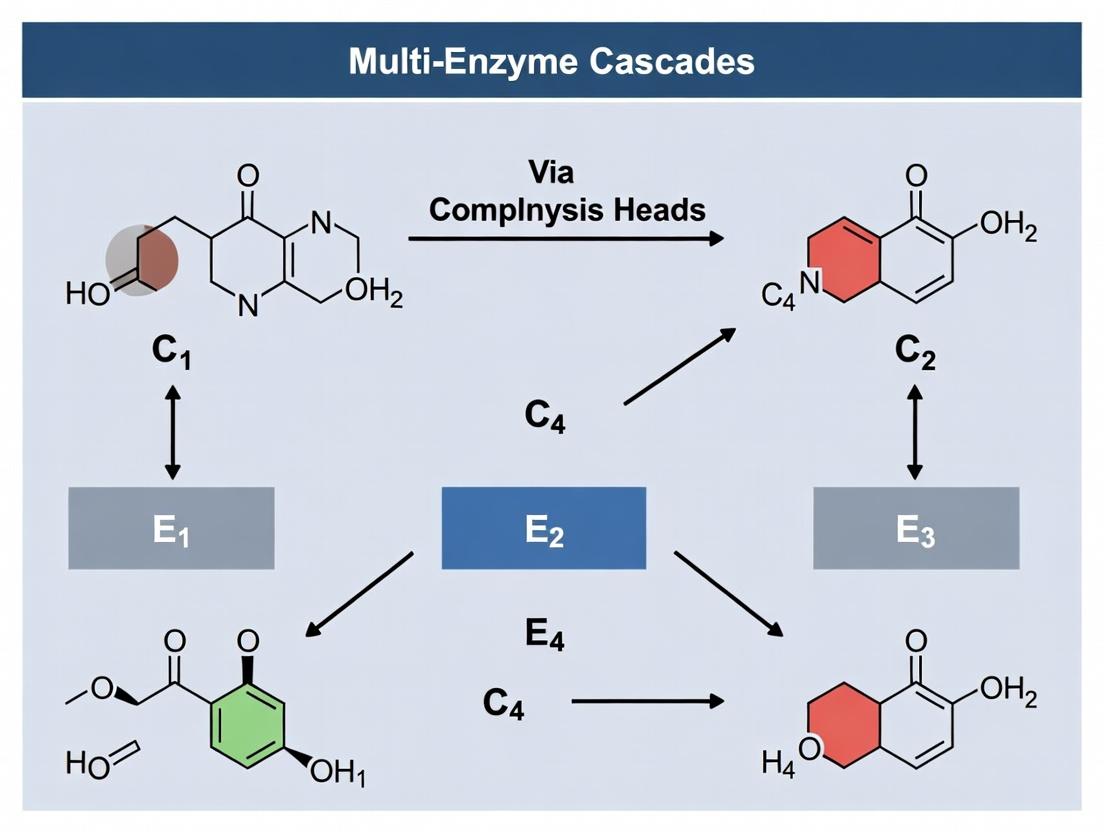
This article provides a comprehensive review of the design, application, and optimization of multi-enzyme cascades for converting single-carbon (C1) compounds like CO2, formate, and methanol into valuable C2 and C4...
From Single Carbons to Complex Molecules: Engineering Multi-Enzyme Cascades for C1 to C2/C4 Biosynthesis
Abstract
This article provides a comprehensive review of the design, application, and optimization of multi-enzyme cascades for converting single-carbon (C1) compounds like CO2, formate, and methanol into valuable C2 and C4 building blocks (e.g., glycolate, acetate, succinate). Tailored for researchers and bioprocess engineers, it explores foundational metabolic pathways, practical cascade construction methods, common troubleshooting strategies, and comparative validation of different system architectures (cell-free vs. whole-cell). The synthesis highlights the transformative potential of these cascades for sustainable chemical synthesis and advanced drug precursor manufacturing, outlining future challenges and clinical research implications.
The Metabolic Blueprint: Foundational Pathways for C1 Assimilation and Elongation
Application Notes: C1 Feedstock Characteristics and Utilization
C1 feedstocks represent one-carbon molecules that serve as entry points for biocatalytic conversion into higher-value compounds. In the context of research on C1 to C2/C4 compound conversion via multi-enzyme cascades, these feedstocks offer distinct thermodynamic, kinetic, and practical advantages and challenges. The table below summarizes their key properties and roles in enzyme cascades.
Table 1: Comparative Analysis of C1 Feedstocks for Biocatalysis
| Feedstock | Oxidation State | Key Enzymes for Initial Activation | Energy Input/ Co-factor Requirement | Solubility in Aqueous Buffer | Primary Advantage | Primary Challenge |
|---|---|---|---|---|---|---|
| CO₂ | +4 | Formate dehydrogenase (FDH), Carboxylases (RuBisCO, PEPC) | High (NAD(P)H, ATP) | Low (gas-liquid transfer) | Ultimate sustainable source | High reduction energy; low solubility & kinetics |
| Formate (HCOO⁻) | +2 | Formate dehydrogenase (FDH), Formyltransferase | Moderate (NAD⁺) | High | Excellent electron donor; good solubility | Requires dehydrogenation to release reducing power |
| Methanol (CH₃OH) | -2 | Methanol dehydrogenase (MDH), Alcohol oxidase (AOX) | Low to Moderate (PQQ, NAD⁺) | High (fully miscible) | Reduced state; liquid at STP; high energy density | C-H bond activation; formaldehyde toxicity |
| Methylamines (e.g., CH₃NH₂) | -2 | Methylamine dehydrogenase (MADH), Amine dehydrogenases | Moderate | High | Nitrogen-containing; direct route to N-functionalized C2+ products | Limited substrate scope; enzyme availability |
Core Application Context: In multi-enzyme cascades, these feedstocks are typically funneled through central metabolites like formaldehyde, formyl-CoA, or acetyl-CoA. For instance, CO₂ and formate are often reduced to formaldehyde or condensed directly, while methanol and methylamines are oxidized to formaldehyde. The formaldehyde is then fixed via carboligases (e.g., glycolate synthase, 3-hexulose-6-phosphate synthase) or condensed with glycine by serine hydroxymethyltransferase (SHMT) to yield C2 (glycolate, serine) and subsequently C3/C4 compounds.
Experimental Protocols
Protocol 2.1: In Vitro Multi-Enzyme Cascade for Glycolate Production from Formate Objective: To convert formate into glycolate using a four-enzyme cascade mimicking the synthetic reductive glycine pathway. Reagents: Sodium formate, NAD⁺, Tetrahydrofolate (THF), MgCl₂, Glycine, Purified enzymes: Formate dehydrogenase (FDH), Methylene-THF dehydrogenase (MTHFD), Serine hydroxymethyltransferase (SHMT), Glycolate oxidase (GOX) or engineered Glycolate synthase. Procedure:
- Reaction Setup: Prepare a 1 mL reaction mixture in a spectrophotometric cuvette containing: 100 mM HEPES buffer (pH 7.5), 10 mM sodium formate, 5 mM glycine, 1 mM NAD⁺, 0.2 mM THF, 5 mM MgCl₂.
- Enzyme Addition: Add the following enzymes sequentially: 5 U FDH, 2 U MTHFD, 5 U SHMT, 5 U GOX (or glycolate synthase). Mix gently.
- Monitoring: Place the cuvette in a spectrophotometer thermostatted at 30°C. Monitor the increase in absorbance at 340 nm (for NADH production from FDH/MTHFD steps) and/or at 500 nm using a colorimetric glycolate assay kit (e.g., with phenylhydrazine).
- Termination & Analysis: After 2 hours, stop the reaction by heat inactivation (75°C for 10 min). Remove precipitate by centrifugation. Analyze glycolate yield via HPLC (Aminex HPX-87H column, 5 mM H₂SO₄ mobile phase, RI detection) against a standard curve.
Protocol 2.2: Assessing Methanol Toxicity and Conversion in Whole-Cell Biocatalysts Objective: To evaluate the tolerance and conversion efficiency of engineered E. coli expressing methanol dehydrogenase (MDH) and formaldehyde fixation pathways. Reagents: M9 minimal media, Methanol (0.1-1% v/v), IPTG, Purified MDH activity assay kit, Formaldehyde detection reagent (Nash reagent: 2M ammonium acetate, 0.05M acetic acid, 0.02M acetylacetone). Procedure:
- Culture Induction: Inoculate engineered E. coli strain (e.g., expressing B. methanolicus MDH and B. subtilis SHMT) in M9+0.5% glycerol. Grow to mid-log phase (OD₆₀₀ ~0.6). Induce with 0.5 mM IPTG. Add methanol at varying concentrations (0.1%, 0.5%, 1%).
- Growth Monitoring: Measure OD₆₀₀ every hour for 12 hours to generate growth curves. Calculate specific growth rates.
- Cell Lysate Preparation: Harvest cells (5 mL culture) by centrifugation after 8 hours induction. Resuspend in lysis buffer, sonicate, and clarify by centrifugation.
- Enzyme Activity Assay: Use commercial MDH activity assay (monitoring NADH formation at 340 nm) on clarified lysate to confirm functional expression.
- Metabolite Analysis: Filter culture supernatant (0.22 μm). Detect residual formaldehyde using Nash reagent: mix 250 μL supernatant with 250 μL Nash reagent, incubate at 37°C for 40 min, measure A₄₁₂. Quantify via formaldehyde standard curve. Analyze for C2 products (e.g., serine, ethylene glycol) via LC-MS.
Diagrams and Visualization
Diagram Title: C1 Feedstock Assimilation Pathways to C2-C4 Products
Diagram Title: Workflow for Developing C1 Conversion Enzyme Cascades
The Scientist's Toolkit: Key Research Reagent Solutions
Table 2: Essential Materials for C1 Biocatalysis Research
| Reagent/Material | Supplier Examples | Function in C1 Research |
|---|---|---|
| Recombinant C1 Enzymes (FDH, MDH, SHMT) | Sigma-Aldrich, Novoprotein, In-house expression | Core biocatalysts for constructing in vitro cascades; require high specific activity and purity. |
| Cofactor Regeneration Systems | Biomol, Toyobo | NAD(P)H/NAD(P)⁺ recycling systems (e.g., glucose dehydrogenase + glucose) crucial for sustaining redox-balanced cascades. |
| Stable Isotope C1 Feedstocks | Cambridge Isotopes, Sigma-Aldrich | ¹³C-CO₂, ¹³C-Formate, D₄-Methanol for tracing carbon flux and verifying product origin via GC/MS or NMR. |
| Formaldehyde Detection Kits | Abcam, Sigma-Aldrich (Nash Reagent) | Critical for monitoring toxic intermediate levels in whole-cell systems and cascade kinetics. |
| HPLC Columns for Metabolites | Bio-Rad (Aminex), Thermo Fisher | HPX-87H column for organic acids (glycolate, malate); ZIC-pHILIC for polar metabolites (serine, glycine). |
| Engineered Strains (ΔadhE, ΔfrmA) | CGSC, Addgene | E. coli knockout strains with reduced background metabolism of formaldehyde/alcohols for cleaner chassis. |
| Methylotrophic Yeast (P. pastoris) | ATCC | Native methanol utilizer; host for heterologous pathway expression and toxicity studies. |
| C1 Minimal Media Supplements | Formate salts, Methanol, Methylamine HCl | Defined media components for selective pressure and growth assays of engineered organisms. |
Application Notes: C1 to C2/C4 Conversion via Multi-Enzyme Cascades
Within the pursuit of sustainable biomanufacturing, the conversion of one-carbon (C1) compounds (e.g., CO₂, formate, methanol) to multi-carbon (C2/C4) building blocks is paramount. Three core natural pathways—the Reductive Glycine Pathway (rGlyP), the Serine Cycle, and the Reductive Acetyl-CoA Pathway (rAcCoA or Wood-Ljungdahl Pathway)—serve as biological blueprints for engineering efficient multi-enzyme cascades. These pathways represent distinct strategies for C1 assimilation, fixation, and elongation, offering unique advantages and challenges for synthetic biology and metabolic engineering applications aimed at producing chemicals and pharmaceuticals.
Reductive Glycine Pathway (rGlyP): An oxygen-sensitive pathway increasingly engineered in microbial hosts like E. coli and C. autoethanogenum for formate and CO₂ assimilation. It efficiently condenses CO₂ and a methyl group (from formate via tetrahydrofolate) to generate glycine, which can be further converted to serine and pyruvate (C3), serving as a precursor for C2/C4 compounds.
Serine Cycle: Found in methylotrophic bacteria, this cycle assimilates formaldehyde (from methanol or methane) into central metabolism. It uses glycine as a C2 acceptor for formaldehyde to form serine, which is subsequently processed through multiple steps to yield acetyl-CoA and malate (C4), enabling net carbon gain.
Reductive Acetyl-CoA Pathway (Wood-Ljungdahl Pathway): The most energy-efficient natural CO₂ fixation pathway, operating in acetogenic and methanogenic microbes. It directly reduces two CO₂ molecules to methyl and carbonyl groups, combining them to form acetyl-CoA (C2), the central precursor for a vast array of biochemicals.
Comparative Quantitative Analysis
Table 1: Comparative Metrics of Core C1 Assimilation Pathways
| Parameter | Reductive Glycine Pathway | Serine Cycle | Reductive Acetyl-CoA Pathway |
|---|---|---|---|
| Primary C1 Substrate(s) | CO₂, Formate | Methanol, Formaldehyde | CO₂, CO |
| Key Product | Glycine (C2) → Pyruvate (C3) | Acetyl-CoA (C2), Malate (C4) | Acetyl-CoA (C2) |
| ATP Required (per acetyl-CoA) | ~2-3 ATP | ~3-5 ATP | ~1 ATP (or energy equivalent) |
| Reducing Equivalents | High (NADH) | Moderate (NADH) | Very High (H₂ typically) |
| Oxygen Sensitivity | High | Variable (some steps aerobic) | Strictly Anaerobic |
| Theoretical Carbon Efficiency | >80% | ~75% | 100% (no loss as CO₂) |
| Typical Host Organisms | Engineered E. coli, C. autoethanogenum | Methylobacterium extorquens | Clostridium ljungdahlii, Acetobacterium woodii |
Table 2: Key Enzyme Classes in Multi-Enzyme Cascades for C1→C2/C4 Conversion
| Enzyme Class | Example Enzyme | Function in Cascade | Pathway(s) |
|---|---|---|---|
| Formate Dehydrogenase | FdsABG (NAD⁺-dependent) | Reduces CO₂ to formate; provides reducing equivalents | rGlyP, rAcCoA |
| Glycine Cleavage System | GcvT, GcvH, GcvP, LpdA | Reversible; cleaves or synthesizes glycine | rGlyP, Serine Cycle |
| Serine Hydroxymethyltransferase | GlyA | Transforms glycine & C1 unit to serine | rGlyP, Serine Cycle |
| Carbon Monoxide Dehydrogenase | CODH (ACS/CODH complex) | Reduces CO₂ to CO; acetyl-CoA synthase activity | rAcCoA |
| Malyl-CoA Lyase | Mcl | Cleaves malyl-CoA to acetyl-CoA and glyoxylate | Serine Cycle |
| Methyltransferase | MetF, AcsE | Transfers methyl groups from C1 carriers to Co/CoA | rGlyP, rAcCoA |
Experimental Protocols
Protocol 1: In Vitro Reconstitution of a Reductive Glycine Pathway Module for Formate to Glycine Conversion
Objective: To demonstrate the enzymatic conversion of formate and bicarbonate to glycine using a purified multi-enzyme system.
Materials:
- Purified enzymes: Formate dehydrogenase (FDH), FolD (methylene-THF dehydrogenase/cyclohydrolase), GcvT (Glycine cleavage system T-protein), GcvH (H-protein), GcvP (P-protein), LpdA (Lipoamide dehydrogenase).
- Substrates: Sodium formate, Sodium bicarbonate, Ammonium chloride, NAD⁺, Tetrahydrofolic acid (THF), ATP, Coenzyme A.
- Buffers: 100 mM HEPES-KOH (pH 7.5), 50 mM KCl, 10 mM MgCl₂.
- Equipment: Anaerobic chamber (Coy Lab type), HPLC system with UV/FLD detector, ZIC-HILIC column.
Procedure:
- Anaerobic Setup: Prepare all buffers and substrates inside an anaerobic chamber (O₂ < 1 ppm). Degas buffers by sparging with N₂/Ar for 30 minutes prior to chamber transfer.
- Reaction Assembly: In a 1.5 mL anaerobic vial, combine the following on ice:
- 100 mM HEPES-KOH (pH 7.5): 50 μL
- 50 mM KCl: 20 μL
- 10 mM MgCl₂: 10 μL
- 100 mM Sodium formate: 5 μL
- 200 mM Sodium bicarbonate: 5 μL
- 500 mM Ammonium chloride: 2 μL
- 10 mM ATP: 2 μL
- 5 mM THF: 10 μL
- 2 mM NAD⁺: 5 μL
- Enzyme mix (FDH, FolD, GcvT/H/P, LpdA; 5-10 μg each): 20 μL
- Nuclease-free water to final volume 100 μL.
- Initiation & Incubation: Seal the vial with a butyl rubber stopper, remove from chamber, and incubate at 37°C with shaking at 300 rpm for 2 hours.
- Termination & Analysis: Quench the reaction by adding 10 μL of 2 M HCl. Centrifuge at 16,000 x g for 10 min. Analyze the supernatant via HILIC-HPLC (Mobile phase: 20 mM ammonium acetate in water (A) and acetonitrile (B); Gradient: 80% B to 50% B over 20 min; Flow: 0.4 mL/min). Detect glycine by fluorescence after o-phthaldialdehyde (OPA) derivatization (Ex: 340 nm, Em: 455 nm).
- Quantification: Quantify glycine yield by comparing peak areas to a standard curve of pure glycine (0-5 mM).
Protocol 2: Measuring Acetyl-CoA Output from the Reductive Acetyl-CoA Pathway in Cell-Free Extracts
Objective: To quantify the rate of acetyl-CoA synthesis from CO₂/CO using cell-free extracts of an acetogen.
Materials:
- Cell-free extract from Clostridium autoethanogenum (prepared anaerobically).
- Substrate gas mixture: 20% CO₂, 20% CO, 60% N₂ (v/v).
- Assay buffer: 100 mM MOPS (pH 6.8), 5 mM DTT, 2 mM methyl viologen, 1 mM Coenzyme A.
- Stopping solution: 6% (v/v) Perchloric acid.
- Malate Dehydrogenase/Citrate Synthase (MDH/CS) coupling assay kit.
- Equipment: Anaerobic serum bottles (125 mL), rubber stoppers, aluminum crimps, gas manifold, spectrophotometer.
Procedure:
- Extract Preparation: Grow C. autoethanogenum on CO₂/CO gas mix to mid-exponential phase. Harvest cells anaerobically, wash, and disrupt via French press or bead-beating under N₂ atmosphere. Clarify by centrifugation (15,000 x g, 20 min, 4°C). Determine protein concentration (Bradford assay).
- Reaction Setup: In a 10 mL anaerobic serum bottle, add 1.8 mL of assay buffer. Seal with a butyl rubber stopper and crimp. Evacuate and flush the headspace with N₂ three times. Finally, pressurize to 1 atm with the substrate gas mixture (CO₂/CO/N₂).
- Initiation: Using a gas-tight syringe, inject 200 μL of cell-free extract (10-20 mg/mL total protein) through the stopper into the assay buffer. Place the bottle in a 37°C water bath with magnetic stirring.
- Time-Course Sampling: At intervals (0, 15, 30, 60 min), withdraw 200 μL aliquots using a gas-tight syringe and immediately inject into 40 μL of ice-cold perchloric acid stopping solution on ice. Vortex and incubate on ice for 10 min. Centrifuge at 16,000 x g for 5 min. Neutralize the supernatant with 20 μL of 3 M K₂CO₃, recentrifuge, and collect the neutralized supernatant.
- Acetyl-CoA Quantification: Use an enzymatic coupling assay. For each sample, mix in a cuvette: 50 mM Tris-HCl (pH 8.0), 0.2 mM NADH, 5 U Malate Dehydrogenase, 2 U Citrate Synthase, 5 mM Oxaloacetate, and neutralized sample. Monitor the decrease in absorbance at 340 nm (ε₃₄₀ = 6220 M⁻¹cm⁻¹) for 10 min. The amount of acetyl-CoA is stoichiometric to NADH oxidation.
- Calculation: Calculate acetyl-CoA production rate as nmol/min/mg total protein.
Visualizations
Title: Reductive Glycine Pathway (rGlyP) from C1 to C3
Title: Serine Cycle for C1 Assimilation to C4
Title: Reductive Acetyl-CoA Pathway (Wood-Ljungdahl)
Title: Experimental Workflow for C1 Cascade Research
The Scientist's Toolkit: Research Reagent Solutions
Table 3: Essential Reagents and Materials for C1 Pathway Research
| Item Name | Supplier Examples | Function & Application |
|---|---|---|
| Anaerobic Chamber Glove Box | Coy Lab, Vinyl Tech | Provides O₂-free atmosphere (<1 ppm) for handling oxygen-sensitive enzymes and pathways (rAcCoA, rGlyP). |
| Tetrahydrofolic Acid (THF) | Sigma-Aldrich, Cayman Chemical | Essential C1 carrier cofactor for methyltransferase reactions in rGlyP and methyl branch of rAcCoA. |
| Methyl Viologen (Dithionite Reduced) | Thermo Fisher | Artificial low-potential electron donor for in vitro assays of reductases (e.g., CODH, FDH). |
| Cofactor Cocktail (ATP, NAD⁺, CoA) | Hampton Research, Roche | Provides essential cofactors for multi-enzyme cascade reactions in cell-free systems. |
| ZIC-HILIC HPLC Column | Merck Millipore | Chromatographic separation of polar, hydrophilic metabolites (glycine, serine, formate). |
| Gas Mixture (CO/CO₂/N₂/H₂) | Airgas, Linde | Defined substrate gases for culturing acetogens or feeding in vitro rAcCoA assays. |
| Enzymatic Acetyl-CoA Assay Kit | Sigma-Aldrich (MAK039) | Coupled enzyme assay for sensitive, specific quantification of acetyl-CoA production. |
| O-Phthaldialdehyde (OPA) Derivatization Reagent | Thermo Fisher | Fluorescent tagging of primary amines (e.g., glycine, serine) for sensitive HPLC-FLD detection. |
| Recombinant Enzyme Kits (FDH, Gcv) | BioVision, ATCC | Pre-purified enzyme sets for rapid in vitro pathway assembly and troubleshooting. |
Application Notes
The enzymatic conversion of C1 compounds (e.g., CO₂, formate) into higher-value C2 and C4 building blocks is a cornerstone of synthetic biochemistry and metabolic engineering. Formate dehydrogenases (FDHs), carboxylases, and aldolases operate in sequence within multi-enzyme cascades to effect these transformations. FDHs catalyze the reversible oxidation of formate to CO₂, providing a critical C1 unit or redox equivalent. Carboxylases (e.g., Pyruvate carboxylase, Phosphoenolpyruvate (PEP) carboxylase) then fix this or other CO₂ into an organic acceptor (C2 or C3), forming a new C-C bond and yielding a C3 or C4 compound. Aldolases subsequently catalyze stereoselective aldol addition reactions, combining these products into larger (C4-C7) chiral molecules essential for pharmaceutical and fine chemical synthesis. Integrating these classes into in vitro pathways enables the sustainable synthesis of compounds like oxaloacetate, malate, and various sugars from CO₂.
Table 1: Key Kinetic Parameters of Featured Enzyme Classes
| Enzyme Class | Example Enzyme | Typical Substrate(s) | kcat (s⁻¹) | KM (mM) | Common Cofactor/ Cofactor Requirement |
|---|---|---|---|---|---|
| Formate Dehydrogenase | Candida boidinii FDH | Formate / CO₂ | 10 - 30 | 1 - 10 (Formate) | NAD⁺ / NADH |
| Carboxylase | Phosphoenolpyruvate Carboxylase (PEPC) | PEP / HCO₃⁻ | 50 - 150 | 0.05 - 0.5 (PEP) | Mg²⁺ |
| Aldolase | Fructose-1,6-bisphosphate Aldolase (Class I) | Dihydroxyacetone phosphate (DHAP) / Glyceraldehyde-3-phosphate | 10 - 50 | 0.1 - 1 (DHAP) | None (Schiff base) |
Table 2: Representative Cascade Outputs for C1 to C2/C4 Conversion
| Cascade Sequence | Initial C1 Source | Key Intermediate(s) | Final Product(s) | Typical Yield (%)* | TON (Enzyme) |
|---|---|---|---|---|---|
| FDH → PEPC | Sodium Formate / CO₂ | Oxaloacetate | L-Malate (with MDH) | 70-85 | >10⁵ |
| FDH → RuBisCO → Aldolase (Transketolase) | CO₂ | Ribulose-1,5-bisphosphate | Fructose-6-phosphate / Erythrose-4-phosphate | 40-60 | 10³-10⁴ |
*Yields are mole-percent based on C1 substrate and are highly dependent on cascade conditions and downstream modules.
Experimental Protocols
Protocol 1: Coupled FDH-PEPC Cascade for Oxaloacetate Synthesis from Formate
Objective: To synthesize oxaloacetate from formate via a one-pot, two-enzyme cascade employing NAD⁺-dependent FDH and PEP carboxylase.
Materials:
- Reagents: 100 mM Sodium formate, 10 mM Phosphoenolpyruvate (PEP), 1 mM NAD⁺, 50 mM HEPES buffer (pH 7.5), 10 mM MgCl₂, 50 mM NaHCO₃.
- Enzymes: Recombinant Candida boidinii FDH (≥5 U/mg), Recombinant E. coli PEP Carboxylase (≥20 U/mg).
- Equipment: UV-Vis spectrophotometer, Thermostatted cuvette holder, Microcentrifuge tubes.
Method:
- Reaction Setup: In a 1 mL quartz cuvette, combine:
- 850 µL of 50 mM HEPES buffer (pH 7.5)
- 50 µL of 100 mM sodium formate (final 5 mM)
- 20 µL of 10 mM PEP (final 0.2 mM)
- 10 µL of 1 mM NAD⁺ (final 0.01 mM)
- 20 µL of 10 mM MgCl₂ (final 0.2 mM)
- 50 µL of 50 mM NaHCO₃ (final 2.5 mM)
- Enzyme Addition: Add 2 µL of FDH stock (0.1 U) and 2 µL of PEPC stock (0.4 U) to the cuvette. Mix gently by inversion.
- Kinetic Assay: Immediately place the cuvette in a spectrophotometer thermostatted at 30°C. Monitor the increase in absorbance at 340 nm (A₃₄₀) for 10-15 minutes. The increase corresponds to the reduction of NAD⁺ to NADH by FDH, which is coupled to the consumption of CO₂ and PEP by PEPC.
- Calculation: The initial rate of oxaloacetate formation (V) is proportional to the rate of NADH formation: V = (ΔA₃₄₀/min) / (ε * l), where ε (molar extinction coefficient of NADH) = 6220 M⁻¹cm⁻¹, and l (path length) = 1 cm.
Protocol 2: Aldolase-Catalyzed C-C Bond Formation for D-Fructose-1,6-bisphosphate Synthesis
Objective: To demonstrate stereospecific aldol addition using Fructose-1,6-bisphosphate aldolase (FBPA, Class I) to condense DHAP and Glyceraldehyde-3-phosphate (GAP).
Materials:
- Reagents: 10 mM Dihydroxyacetone phosphate (DHAP, lithium salt), 10 mM D-Glyceraldehyde-3-phosphate (GAP), 50 mM Tris-HCl buffer (pH 7.6).
- Enzymes: Rabbit muscle Fructose-1,6-bisphosphate aldolase (Class I, ≥10 U/mg).
- Equipment: Microcentrifuge tubes, Heating block or water bath (37°C), HPLC system with UV detector or coupled enzyme assay kit for fructose-1,6-bisphosphate.
Method:
- Reaction Setup: In a 1.5 mL microcentrifuge tube, combine:
- 80 µL of 50 mM Tris-HCl (pH 7.6)
- 10 µL of 10 mM DHAP (final 1 mM)
- 10 µL of 10 mM GAP (final 1 mM)
- Initiation: Pre-incubate the mixture at 37°C for 2 minutes. Initiate the reaction by adding 5 µL of FBPA stock solution (0.05 U). Mix thoroughly by vortexing briefly.
- Incubation: Incubate the reaction at 37°C for 30 minutes.
- Termination & Analysis: Stop the reaction by heating at 95°C for 5 minutes. Centrifuge at 14,000 x g for 5 minutes to pellet denatured protein.
- Analysis A (HPLC): Analyze the supernatant via ion-exchange or HILIC-HPLC to quantify fructose-1,6-bisphosphate formation (retention time ~8-10 min, monitored at 210 nm).
- Analysis B (Coupled Assay): Use the supernatant in a commercial fructose-1,6-bisphosphate assay kit, which typically couples its cleavage to NADH oxidation, measuring decrease in A₃₄₀.
Diagrams
Diagram 1: Multi-enzyme cascade for C1 to C4/C6 conversion
Diagram 2: General workflow for cascade characterization
The Scientist's Toolkit
Table 3: Essential Research Reagent Solutions for C1-C4 Cascade Assembly
| Item | Function in Cascade | Example Product / Specification |
|---|---|---|
| NAD⁺ / NADH Cofactors | Essential redox cofactors for FDH and many downstream enzymes (e.g., malate dehydrogenase). | β-Nicotinamide adenine dinucleotide, sodium salt, ≥98% (HPLC). |
| MgCl₂ Solution (100 mM) | Divalent cation cofactor for most carboxylases and kinase/phosphatase enzymes in cascades. | Magnesium chloride, anhydrous, 99.99% trace metals basis. |
| HEPES or Tris Buffer (1 M, pH 7.5-8.0) | Provides stable, non-interfering pH environment for multi-enzyme reactions. | 1M HEPES, pH 7.5, RNase-free, sterile-filtered. |
| Phosphoenolpyruvate (PEP) | Key C3 carboxylase acceptor substrate for oxaloacetate synthesis. | Phosphoenolpyruvic acid monopotassium salt, ≥97% (HPLC). |
| Dihydroxyacetone Phosphate (DHAP) | Essential ketone donor substrate for aldolase reactions. | DHAP lithium salt, solution, ≥90% (enzymatic). |
| Recombinant Enzyme Kits | Provide high-purity, characterized enzymes (FDH, PEPC, Aldolase) for reproducible cascade assembly. | Pyruvate Carboxylase Activity Assay Kit (contains enzyme, substrates, coupling enzymes). |
| Cofactor Regeneration System | Regenerates expensive cofactors (e.g., NADH→NAD⁺) to drive cascades to completion. | Glucose-6-phosphate / Glucose-6-phosphate dehydrogenase system for NADPH regeneration. |
Thermodynamic and Kinetic Challenges in C1 Activation and Elongation
Application Notes
The efficient conversion of single-carbon (C1) molecules (e.g., CO₂, CO, formate, methanol) into central C2/C4 metabolites (e.g., acetyl-CoA, oxaloacetate, butyryl-CoA) presents a formidable challenge. These pathways must overcome significant thermodynamic barriers and manage reactive, toxic intermediates, all while achieving sufficient flux for practical application. Multi-enzyme cascades offer a promising solution by coupling energetically favorable and unfavorable reactions, isolating intermediates, and leveraging enzyme proximity effects. The following notes detail the core challenges and strategic solutions.
1. Thermodynamic Bottlenecks in Key Activation Steps The initial activation of inert C1 substrates is often endergonic. For example, the direct ATP-dependent carboxylation of acetyl-CoA to pyruvate or the reduction of CO₂ to formate requires substantial energy input. Cascades circumvent this by coupling these steps to highly exergonic reactions, such as the decarboxylation of a helper molecule or oxidation of a strong reductant.
2. Kinetic Traps and Intermediate Toxicity Reactive intermediates like formaldehyde can cause nonspecific protein cross-linking, while formyl-CoA is hydrolysis-prone. Engineered cascades address this through substrate channeling—spatially organizing enzymes to pass intermediates directly—and by ensuring rapid consumption by the subsequent enzyme to minimize free concentration.
3. C–C Bond Formation Strategies The core elongation step requires specialized enzymes. Key candidates include:
- Pyruvate Synthase / Pyruvate:Ferredoxin Oxidoreductase (PFOR): Catalyzes the reductive carboxylation of acetyl-CoA to pyruvate, a critical C1+C2→C3 step.
- Crotonyl-CoA / Ethylmalonyl-CoA Pathways: Utilize carboxylases and aldolases for C–C coupling, often in a cyclic fashion to build longer chains.
4. Cofactor and Energy Balancing C1 reduction and elongation are typically reducing-power intensive. Successful cascade design must incorporate efficient cofactor regeneration systems (e.g., NADH/NADPH recycling via linked dehydrogenase reactions) and optimize ATP stoichiometry.
Quantitative Data Summary: Key Enzymes for C1 to C2/C4 Conversion
| Enzyme / System | Natural C1 Substrate | Key Product(s) | ΔG'° (kJ/mol) Approx. | Turnover Number (min⁻¹) Range | Primary Cofactor Requirements |
|---|---|---|---|---|---|
| Formate Dehydrogenase (FDH) | CO₂ | Formate | +16 to +18 | 10² - 10³ | NADH |
| Formaldehyde Dehydrogenase (FaldDH) | Formaldehyde | Formate | -10 to -15 | 10³ - 10⁴ | NAD(P)+ |
| Formyl-CoA Synthetase (FCS) | Formate | Formyl-CoA | +5 to +10 (coupled) | 10² - 10³ | ATP |
| Glycyl Radical Enzyme (e.g., PFL) | Pyruvate / Formate | Acetyl-CoA + Formate | N/A | 10³ - 10⁴ | Pyruvate, CoA |
| Pyruvate:Ferredoxin Oxidoreductase (PFOR) | CO₂, Pyruvate | Acetyl-CoA | Variable | 10² - 10³ | Reduced Ferredoxin, CoA |
| Phosphoketolase (Xu5P-dependent) | Formyl-CoA / Xu5P | Acetyl-P, Erythrose-4-P | -20 to -30 | 10³ - 10⁴ | Inorganic Phosphate |
| Crotonyl-CoA Carboxylase/Reductase | CO₂, Crotonyl-CoA | Ethylmalonyl-CoA | N/A | 10² - 10³ | NADPH, ATP |
Experimental Protocols
Protocol 1: In Vitro Reconstitution of a Formaldehyde-Fixing CETCH Cycle Variant
Objective: To assay the function and flux of a synthetic enzymatic cascade converting formaldehyde and CO₂ to glyoxylate (C2).
Research Reagent Solutions
| Reagent/Solution | Function in Protocol |
|---|---|
| HEPES-KOH Buffer (pH 7.5) | Maintains physiological pH for optimal enzyme activity. |
| MgCl₂ Solution (100 mM) | Essential cofactor for many kinases and ATP-dependent enzymes. |
| ATP/NADPH Regeneration System | Regenerates consumed ATP (via PEP/Pyruvate Kinase) and NADPH (via Glucose-6-P/Glucose-6-P DH). |
| Purified Enzyme Cocktail (FaldDH, FCS, etc.) | Contains all cascade enzymes, expressed and purified individually. |
| Formaldehyde (controlled concentration) | C1 substrate. Must be prepared fresh and quantified. |
| NaH¹⁴CO₃ (radiolabeled) | Allows tracking of CO₂ fixation into acid-stable products via scintillation counting. |
| Quenching Solution (6M HCl) | Stops all enzymatic reactions rapidly. |
Procedure:
- Cascade Assembly: In a 100 µL reaction volume, combine 50 mM HEPES-KOH (pH 7.5), 10 mM MgCl₂, 1 mM ATP, 0.5 mM NADP⁺, 5 mM phosphoenolpyruvate (PEP), 10 mM glucose-6-phosphate, an ATP/NADPH regeneration system (2 U/mL pyruvate kinase, 2 U/mL glucose-6-phosphate dehydrogenase), 10 mM sodium bicarbonate (NaHCO₃), and 2 µCi NaH¹⁴CO₃.
- Substrate Introduction: Initiate the reaction by adding the formaldehyde solution (final concentration 1 mM) and the purified enzyme cocktail (each enzyme at 0.1-0.5 µM final concentration).
- Incubation: Incubate the reaction at 30°C with gentle agitation.
- Time-Point Sampling: At t=0, 5, 15, 30, and 60 minutes, remove 20 µL aliquots and immediately quench in 100 µL of 6M HCl in a scintillation vial.
- Product Analysis: Evaporate the quenched samples to dryness at 95°C for 60 min to remove unincorporated ¹⁴CO₂. Reconstitute in 200 µL water, add 2 mL scintillation fluid, and quantify acid-stable ¹⁴C incorporation via liquid scintillation counting.
- Data Processing: Calculate total fixed carbon (nmol) and plot flux over time. Identify rate-limiting steps by varying individual enzyme concentrations.
Protocol 2: Measuring Intermediate Channeling Efficiency via Isotope Dilution
Objective: To determine if an intermediate (e.g., formyl-CoA) is channeled between two enzymes or diffuses freely into the bulk solution.
Procedure:
- Design Reactions:
- Experimental: Contains both upstream (Enzyme A, producing the intermediate) and downstream (Enzyme B, consuming it) enzymes.
- Control 1: Contains only Enzyme A.
- Control 2: Contains only Enzyme B.
- Add Competitor: To all reactions, add a vast molar excess of an unlabeled "scavenger" molecule that chemically traps the free intermediate (e.g., hydroxylamine for formyl-CoA) the moment it diffuses into solution.
- Initiate and Quantify: Start the reaction in the Experimental mix. If the final product yield is severely reduced compared to a reaction without the scavenger, it indicates that the intermediate diffuses freely and is trapped. If product formation is largely unaffected, it suggests direct channeling between Enzyme A and Enzyme B, protecting the intermediate from the scavenger.
Visualizations
Diagram 1: Core C1 to C2/C4 Elongation Pathways
Diagram 2: Workflow for Cascade Assembly & Analysis
Application Notes
The conversion of C1 compounds (e.g., CO₂, methanol, formate) to higher-value C2/C4 compounds (e.g., glycolate, butanediol) presents significant challenges. Single-step enzymatic reactions often face thermodynamic barriers (energetic hurdles) and suffer from the diversion of intermediates into competing native metabolic pathways (metabolic cross-talk). Multi-enzyme cascades address these issues by coupling energetically unfavorable reactions with favorable ones in situ, channeling intermediates to prevent loss, and optimizing the local concentration of reactive species.
Key Rationales:
- Overcoming Energetic Hurdles: A prime example is the fixation of CO₂. The direct, single-enzyme carboxylation of a target molecule is often endergonic. Cascades integrate this step with exergonic reactions, such as ATP hydrolysis or cofactor regeneration, making the overall pathway thermodynamically favorable.
- Mitigating Metabolic Cross-Talk: In cellular or complex in vitro systems, intermediates (e.g., acetyl-CoA, pyruvate) are susceptible to degradation or side-reactions. Enzyme cascades create synthetic, spatially organized channels that physically and kinetically isolate the synthetic pathway from background metabolism, drastically improving yield and specificity.
- Improving Atom Economy & Reducing Byproducts: Cascades minimize the release of reactive intermediates, leading to cleaner reaction profiles and simplifying downstream purification.
Recent advances have demonstrated cascades combining formate dehydrogenases, glycolaldehyde synthases, and aldolases to convert CO₂ to glycolate, and systems using engineered methanol oxidation pathways coupled with carboligases for C-C bond formation to generate C4 skeletons from methanol.
Protocols
Protocol 1:In VitroCascade for Formate to Glycolate Conversion
Objective: Convert formate (C1) to glycolate (C2) via a three-enzyme cascade.
Materials:
- Purified enzymes: Formate dehydrogenase (FDH), Glycolaldehyde synthase (GAS), Aldolase (ALD, e.g., KDPGal aldolase variant).
- Substrates: Sodium formate, Tetrahydrofolate (THF).
- Cofactors: NAD⁺, Mg²⁺.
- Buffer: 50 mM HEPES-KOH, pH 7.5.
- Equipment: UV-Vis spectrophotometer, Thermostatted reaction block.
Procedure:
- Reaction Setup: In a 1 mL cuvette, combine:
- HEPES buffer: 875 µL
- 100 mM Sodium formate: 50 µL
- 10 mM NAD⁺: 10 µL
- 10 mM THF: 10 µL
- 100 mM MgCl₂: 5 µL
- FDH (5 U/µL): 10 µL
- GAS (2 U/µL): 20 µL
- ALD (1 U/µL): 20 µL
- Kinetic Monitoring: Immediately place the cuvette in a spectrophotometer pre-warmed to 30°C.
- Data Collection: Monitor the increase in absorbance at 340 nm (for NADH production from FDH) for 30 minutes to confirm cascade initiation. Quantify glycolate formation by a coupled enzymatic assay (glycolate oxidase) or via HPLC with refractive index detection.
- Control: Run parallel reactions omitting each enzyme individually to confirm the cascade dependency.
Protocol 2: Co-localized Cascade for Methanol to 2,3-Butanediol Precursor
Objective: Enhance flux by minimizing cross-talk via enzyme co-localization on synthetic scaffolds.
Materials:
- Enzymes: Methanol dehydrogenase (MDH), Pyruvate decarboxylase (PDC), Acetolactate synthase (ALS).
- Scaffold: Synthetic protein scaffold with matching peptide tags (e.g., SpyTag/SpyCatcher system).
- Substrates: Methanol, Pyruvate.
- Cofactors: PQQ (for MDH), Thiamine pyrophosphate (TPP).
- Buffer: 50 mM Tris-HCl, pH 8.0.
Procedure:
- Enzyme Scaffolding:
- Pre-mix scaffold protein (10 µM) with equimolar amounts of SpyTag-fused MDH, PDC, and ALS in assembly buffer. Incubate at 25°C for 1 hour.
- Cascade Reaction:
- In a 500 µL reaction, combine:
- Tris buffer
- 100 mM Methanol
- 50 mM Pyruvate
- 1 mM PQQ
- 2 mM TPP
- Assembled enzyme-scaffold complex (final total enzyme concentration 1 µM).
- In a 500 µL reaction, combine:
- Incubation: Incubate at 30°C with mild agitation for 2 hours.
- Analysis: Quench the reaction with 0.1% (v/v) formic acid. Analyze for acetoin (precursor to 2,3-butanediol) using gas chromatography-mass spectrometry (GC-MS). Compare yield against a non-scaffolded, free enzyme control.
Data Tables
Table 1: Comparison of C1-to-C2/C4 Cascade Performance Metrics
| Cascade System | Substrate | Product | Yield (%) | Productivity (mM/h/g protein) | Key Overcome Hurdle |
|---|---|---|---|---|---|
| FDH-GAS-ALD (Free in solution) | Formate | Glycolate | 45 | 12.5 | Thermodynamic (ΔG of C-C bond formation) |
| FDH-GAS-ALD (Co-immobilized on beads) | Formate | Glycolate | 78 | 45.2 | Intermediate diffusion & stability |
| MDH-PDC-ALS (Free enzymes) | Methanol | Acetoin | 22 | 8.1 | Metabolic cross-talk & cofactor depletion |
| MDH-PDC-ALS (Scaffolded) | Methanol | Acetoin | 65 | 32.7 | Channeling, reduced cross-talk |
| CO₂ reductase + aldehyde ferredoxin oxidoreductase | CO₂ | Glycolate | 15* | 1.5* | Extreme thermodynamic barrier |
*Current state-of-the-art, low yield reflects significant energetic hurdles.
Table 2: Research Reagent Solutions Toolkit
| Item | Function / Explanation |
|---|---|
| Polyphosphate Kinase (PPK) | Regenerates ATP from ADP using polyphosphate, crucial for driving ATP-dependent carboxylation steps. |
| Phosphite Dehydrogenase (PTDH) | Regenerates NAD(P)H from NAD(P)+ using phosphite, a cheap and irreversible donor. |
| SpyTag/SpyCatcher Protein Pair | Enables irreversible, specific covalent conjugation for enzyme co-localization on scaffolds. |
| Carboxysome-inspired Protein Shell | Provides a semi-permeable compartment to concentrate substrates/CO₂ and segregate pathways. |
| Thermostable Aldolase Variants (e.g., KDPGal) | Engineered for broader substrate specificity and stability under cascade conditions. |
| Methylotrophic Enzyme Cocktails (e.g., Mdh, MxaF) | Optimized sets for efficient methanol oxidation to formaldehyde and beyond. |
Visualizations
Cascade Overcoming Energetic and Cross-Talk Hurdles
Free vs. Scaffolded Enzyme Cascade Architecture
Cascade Design and Optimization Workflow
Building the Cascade: Design Principles, Compartmentalization, and Drug Precursor Synthesis
This Application Note is framed within a broader thesis focused on constructing efficient multi-enzyme cascades for converting single-carbon (C1) feedstocks (e.g., CO₂, methanol, formate) into fundamental C2 (e.g., glycolate, oxalate, acetate) and C4 (e.g., succinate, malate, butyrate) building blocks. These compounds serve as critical precursors for pharmaceuticals, agrochemicals, and biomaterials. Retrosynthetic design—a concept borrowed from organic chemistry—is applied here to deconstruct a target C2/C4 molecule into plausible biochemical precursors and, ultimately, to identify the enzyme sequences capable of catalyzing its synthesis from C1 units. This approach systematically maps molecular targets to genetic sequences, accelerating the design of synthetic metabolic pathways.
Core Principles & Data Framework
The retrosynthetic logic proceeds backwards from the target molecule, identifying key C–C bond-forming reactions. Primary enzymatic mechanisms for C1 assimilation and elongation include:
- Glycine Radical Systems: e.g., Pyruvate formate-lyase (PFL) activating C2 units.
- Thiamine Diphosphate (ThDP)-Mediated Carboligations: Central to decarboxylation and C–C bond formation (e.g., pyruvate dehydrogenase, 2-acetoacetate synthase).
- Aldol Additions: Catalyzed by aldolases (e.g., KDPG aldolase for C4 formation).
- CO₂ Fixation via Reductive TCA Pathways: Utilizing enzymes like phosphoenolpyruvate carboxylase (PEPC).
Quantitative data on key enzyme candidates for C1→C2/C4 conversion are summarized below.
Table 1: Key Enzyme Candidates for C-C Bond Formation from C1/C2 Precursors
| Enzyme (EC Number) | Catalytic Mechanism | Primary Substrate(s) | Product(s) | Typical Turnover Number (kcat, min⁻¹)* | Pathway Role |
|---|---|---|---|---|---|
| Pyruvate Formate-Lyase (PFL, 2.3.1.54) | Glycyl radical | Pyruvate + CoA | Acetyl-CoA + Formate | 600 - 1200 | C2 activation, reversible |
| Pyruvate:ferredoxin Oxidoreductase (PFOR, 1.2.7.1) | ThDP, [4Fe-4S] clusters | Pyruvate + CoA + 2Fdₒₓ | Acetyl-CoA + CO₂ + 2Fdᵣₑd | 1800 - 3000 | Oxidative decarboxylation |
| Phosphoenolpyruvate Carboxylase (PEPC, 4.1.1.31) | Metal-ion dependent | PEP + HCO₃⁻ | Oxaloacetate + Pi | 2000 - 5000 | C3 → C4 carboxylation |
| Malate Synthase (MS, 2.3.3.9) | Aldol condensation | Glyoxylate + Acetyl-CoA | Malate + CoA | 800 - 2000 | Glyoxylate cycle, C2+C2=C4 |
| 2-Dehydro-3-deoxyphosphogluconate Aldolase (KDPG Aldolase, 4.1.2.14) | Class I Aldolase | Pyruvate + G3P | 2-Dehydro-3-deoxy-D-gluconate 6-phosphate | 4000 - 8000 | Linear C3+C3=C6 formation |
*kcat values are approximate ranges from literature and depend on organism and conditions.
Detailed Experimental Protocols
Protocol 1:In SilicoRetrosynthetic Pathway Enumeration Using RetroBioCat
Objective: To computationally generate all plausible enzymatic pathways from designated C1 donors (e.g., formate) to a target C4 molecule (e.g., succinate).
Materials:
- RetroBioCat web server or local installation.
- BRENDA or SABIO-RK database API access.
- Target molecule in SMILES format (e.g., "OC(CC(=O)O)C(=O)O" for succinate).
Methodology:
- Target Input & Rule Selection: Input the target SMILES. Select biochemical reaction rules encompassing "C-C bond formation," "carboxylation," "reduction," and "isomerization."
- Precursor Definition: Set allowed starting substrates (e.g., formate, CO₂, methanol, pyruvate).
- Pathway Enumeration: Run the algorithm to generate pathway graphs. Apply filters based on thermodynamic feasibility (estimated ΔG'°) and known enzyme existence in desired host organisms (e.g., E. coli).
- Ranking & Output: Rank pathways by minimal number of steps, predicted thermodynamic yield, and enzyme availability. Export the top 3-5 pathways as SBML or JSON files for further analysis.
Protocol 2:In VitroValidation of a Candidate Two-Enzyme Cascade (Formate to Glyoxylate)
Objective: To experimentally test a short cascade converting formate (C1) to glyoxylate (C2) via formyl-CoA transferase (Frc) and glyoxylate dehydrogenase (GlcDEF).
Materials & Reagent Solutions:
Table 2: Research Reagent Solutions for In Vitro Cascade Validation
| Reagent / Solution | Function / Explanation | Storage Conditions |
|---|---|---|
| Potassium Formate (1M stock) | C1 substrate source. | -20°C |
| Coenzyme A (CoASH, 100mM stock) | Acyl group carrier, essential cofactor. | -80°C (lyophilized or in buffer) |
| ATP (100mM stock) | Energy currency for formate activation. | -20°C |
| MgCl₂ (1M stock) | Divalent cation, essential for ATP-dependent enzymes. | RT |
| Purified Frc Enzyme (from O. formigenes) | Catalyzes: Formate + ATP + CoA → Formyl-CoA + ADP + Pi. | -80°C in 20mM Tris-HCl, pH 7.5, 10% glycerol |
| Purified GlcDEF Complex (from E. coli) | Catalyzes: Formyl-CoA + H₂O + NAD⁺ → Glyoxylate + CoA + NADH. | -80°C in 20mM Tris-HCl, pH 7.5, 10% glycerol |
| NAD⁺ (50mM stock) | Electron acceptor for oxidation step. | -20°C |
| HPLC Standards (Glyoxylic Acid) | For quantification of reaction product. | 4°C |
Methodology:
- Reaction Assembly: In a 500 µL reaction volume, combine: 100mM Tris-HCl (pH 8.0), 10mMgCl₂, 50mM potassium formate, 2mM ATP, 0.5mM CoASH, 2mM NAD⁺, 0.5 µM Frc, and 1.0 µM GlcDEF.
- Kinetic Monitoring: Incubate at 30°C. Monitor NADH formation by absorbance at 340 nm (ε₃₄₀ = 6220 M⁻¹cm⁻¹) every 30 seconds for 10 minutes using a plate reader or spectrophotometer.
- Endpoint Quantification: After 60 minutes, quench 100 µL of reaction with 10 µL of 6M HCl. Centrifuge and analyze supernatant by HPLC (Aminex HPX-87H column, 5mM H₂SO₄ mobile phase, flow rate 0.6 mL/min, detection at 210 nm) to quantify glyoxylate production against standards.
- Control Reactions: Run parallel reactions omitting either enzyme, formate, or ATP/CoASH to confirm cascade dependency.
Visualization of Workflow & Pathways
Diagram 1: Retrosynthetic Design Workflow for Enzyme Cascade Discovery
Diagram 2: Example Retrosynthetic Route from C1/C3 to Succinate
This application note, framed within a research thesis on C1 (e.g., CO₂, methanol, formate) to C2/C4 (e.g., glycolate, succinate, butanol) compound conversion via multi-enzyme cascades, provides a comparative analysis and protocols for selecting and implementing cell-free and whole-cell systems.
Table 1: Key Characteristics of Chassis Systems for C1→C2/C4 Conversion
| Parameter | Cell-Free Systems (CFS) | Engineered Whole-Cell Factories (WCF) |
|---|---|---|
| Max Theoretical Yield (%) | >95% (elimination of competing pathways) | 70-90% (limited by cell maintenance & native metabolism) |
| Reaction Rate (µmol/min/mg protein) | High (10-100), substrate/product diffusion not limited | Moderate (0.1-10), limited by membrane transport |
| Toxic Product Tolerance | Very High (>500 mM for many organics) | Low to Moderate (often <100 mM, triggers stress response) |
| System Complexity | Defined (known enzyme concentrations, cofactors) | Complex (living system with global regulation) |
| Pathway Construction Time | Fast (days-weeks, in vitro assembly) | Slow (weeks-months, in vivo genetic manipulation) |
| Scale-up Potential (Current) | Lab to Pilot (challenges in cost & continuous supply) | Industrial (mature fermentation technology) |
| Cofactor Regeneration Requirement | Mandatory (must be designed into cascade) | Intrinsic (leveraged from central metabolism) |
| Typical Operational Window | Hours to days (enzyme inactivation) | Days to weeks (continuous cultivation possible) |
II. Experimental Protocols
Protocol A: Constructing a C1→Glycolate Cascade in a Cell-Free System
Objective: Convert formate (C1) to glycolate (C2) using a 4-enzyme cascade.
Research Reagent Solutions:
| Reagent | Function |
|---|---|
| Polyphosphate Kinase (PPK) | Regenerates ATP from polyphosphate. |
| Formate Dehydrogenase (FDH) | Oxidizes formate to CO₂, reduces NAD⁺ to NADH. |
| Ribulose-1,5-bisphosphate Carboxylase/Oxygenase (RuBisCO) | Fixes CO₂ to Ribulose-1,5-bisphosphate (RuBP). |
| Phosphoribulokinase (PRK) | Regenerates RuBP using ATP. |
| 2-Phosphoglycolate Phosphatase (2-PGLP) | Converts 2-phosphoglycolate (byproduct of RuBisCO oxygenase) to glycolate. |
| Polyphosphate (e.g., (NaPO₃)₁₅) | Low-cost phosphate donor for ATP regeneration. |
| NAD⁺ & ATP | Essential soluble cofactors. |
| HEPES-KOH buffer (pH 7.5) | Maintains optimal enzymatic pH. |
| MgCl₂ | Essential divalent cation cofactor. |
Procedure:
- Reaction Setup: In a 100 µL final volume, combine 50 mM HEPES-KOH (pH 7.5), 20 mM MgCl₂, 50 mM sodium formate, 2 mM ATP, 1 mM NAD⁺, 10 mM polyphosphate, 20 mM Ribulose-5-phosphate.
- Enzyme Addition: Add purified enzymes to final concentrations: FDH (0.5 µM), PRK (1 µM), RuBisCO (5 µM), 2-PGLP (1 µM), PPK (0.2 µM).
- Incubation: React at 30°C for 4 hours with gentle agitation.
- Termination & Analysis: Heat to 95°C for 5 min to denature proteins. Clarify by centrifugation. Analyze glycolate yield via HPLC (Aminex HPX-87H column, 5 mM H₂SO₄ mobile phase, RI detection).
Protocol B: Engineering E. coli for Methanol (C1) to Succinate (C4) Conversion
Objective: Implement the ribulose monophosphate (RuMP) cycle and synthetic succinate production pathway.
Research Reagent Solutions:
| Reagent | Function |
|---|---|
| pETDuet-1 or pCDFDuet Vectors | Express 2-4 heterologous enzymes (e.g., methanol dehydrogenase, hexulose-6-phosphate synthase). |
| CRISPR-Cas9 Kit | Knock out native genes (e.g., ldhA, pflB, pta-ackA) to reduce byproducts. |
| Methylotrophic Yeast Genomic DNA | Source of genes for methanol utilization (mdh, hps, phi). |
| Antibiotics (Kanamycin, Spectinomycin) | Selection pressure for plasmid maintenance. |
| M9 Minimal Medium | Defined medium with methanol as sole carbon source. |
| Inducer (IPTG) | Induces expression from T7/lac promoters. |
| GC-MS System | Quantifies methanol uptake and succinate titers. |
Procedure:
- Strain Engineering: Use CRISPR-Cas9 to delete lactate and acetate formation genes in E. coli BW25113.
- Pathway Assembly: Clone mdh (methanol dehydrogenase), hps (hexulose-6-phosphate synthase), and phi (phosphohexulose isomerase) into an expression vector. Co-transform with a second vector expressing enzymes from the RuMP cycle's cleavage module and a reductive TCA branch to succinate.
- Cultivation: Grow engineered strain in M9 medium with 0.5% glucose overnight. Harvest cells, wash, and resuspend in M9 with 100 mM methanol and IPTG inducer.
- Bioconversion: Incubate at 30°C, 250 rpm for 48-72 hours under micro-aerobic conditions.
- Analysis: Measure cell density (OD₆₀₀). Quantify extracellular succinate via HPLC and methanol via GC-MS (headspace analysis).
III. Visualized Pathways and Workflows
Title: C1 Conversion Pathways in CFS vs. WCF
Title: Decision Workflow for Chassis Selection
Application Notes: Spatial Optimization in C1 to C2/C4 Conversion Cascades
Rationale & Strategic Context
The conversion of single-carbon (C1) compounds like CO₂, formate, or methanol into higher-value C2 (e.g., glycolate, acetate) and C4 (e.g., succinate, malate) compounds is a cornerstone of modern biomanufacturing and sustainable chemistry. The efficiency of these multi-enzyme cascades is critically limited by diffusion, intermediate loss, and thermodynamic bottlenecks. Spatial optimization strategies—encompassing natural substrate channeling, engineered synthetic scaffolds, and targeted organelle engineering—address these limitations by controlling the nanometer-scale proximity and compartmentalization of sequential enzymes. This approach directly enhances cascade flux, reduces competitive inhibition, and minimizes the degradation of unstable intermediates, thereby increasing titers, yields, and productivities essential for industrial and pharmaceutical applications.
Comparative Analysis of Spatial Optimization Strategies
Table 1: Key Performance Metrics of Spatial Optimization Strategies in Model C1 → C2/C4 Systems
| Strategy | Model Cascade | Key Performance Improvement | Reported Fold-Increase | Primary Advantage | Key Limitation |
|---|---|---|---|---|---|
| Natural Substrate Channeling | Formaldehyde → Dihydroxyacetone phosphate (Glycolate/ RuMP cycle enzymes) | Intermediate transfer efficiency | 5-10x flux increase | Zero metabolic burden; high fidelity | Limited to naturally occurring enzyme pairs |
| Synthetic Protein Scaffolds | Methanol → 2,3-Butanediol (Methanol → Pyruvate → 2,3-BD) | Product titer & yield | 8x titer increase (up to 12 g/L) | Modular, tunable stoichiometry | Scaffold expression burden; potential misfolding |
| DNA/RNA Origami Scaffolds | CO₂ → Formate → Oxalate (Formate dehydrogenase + Oxalyl-CoA synthetase) | Local enzyme concentration | ~15x higher initial rate | Nanometer-precise positioning | Sensitivity to cellular nucleases & pH |
| Bacterial Microcompartment (BMC) Engineering | Ethanolamine → Acetaldehyde → Acetyl-CoA (Metabolosome) | Toxic intermediate sequestration | 200% increase in cell growth | Complete pathway isolation; toxicity shielding | Complex shell protein engineering |
| Peroxisome/Zymogen Granule Engineering | Glyoxylate → Malate (C4) | Pathway substrate pool availability | 3.5x higher product yield | Access to native organelle transporters | Limited lumen space; import machinery constraints |
| Synthetic Protein Condensates (LLPS) | Formate → Glycine → Serine | Cascade efficiency via coacervation | ~7x flux enhancement | Dynamic, reagent-responsive assembly | Potential off-target cellular effects |
Research Reagent Solutions Toolkit
Table 2: Essential Reagents and Materials for Spatial Optimization Experiments
| Item/Category | Example Product/Description | Function in Experimental Workflow |
|---|---|---|
| Scaffold Assembly Components | SH3, PDZ, GBD peptide ligands & receptors; SpyTag/SpyCatcher pairs | Enable specific, covalent/non-covalent enzyme co-localization on synthetic scaffolds. |
| Organelle Targeting Tags | PTS1 (SKL), PTS2, mitochondrial presequences, nuclear localization signals (NLS) | Direct heterologous enzymes to specific subcellular compartments (e.g., peroxisomes). |
| Crosslinkers (for validation) | DSS (Disuccinimidyl suberate), BS³ (Bis(sulfosuccinimidyl)suberate) | Chemically fix protein-protein proximities for pull-down assays and channeling verification. |
| Metabolite Sensors | FRET-based biosensors for glycolate, malate, acetyl-CoA | Real-time, in vivo tracking of intermediate transfer and local concentration. |
| Membrane Permeabilization Agents | Digitonin (selective), Triton X-100 (non-selective) | Isolate organelle contents or selectively permeabilize cellular membranes for assay access. |
| BMC Shell Proteins | Hexameric (BMC-H) and pentameric (BMC-T) proteins (e.g., EutS, PduA) | Building blocks for engineering synthetic bacterial microcompartments. |
| Phase-Separation Inducers | Elastin-like polypeptides (ELPs), intrinsically disordered regions (IDRs) | Drive formation of synthetic biomolecular condensates for pathway sequestration. |
| Isotopically Labeled Substrates | ¹³C-Methanol, ¹³C-Formate, D-Formaldehyde | Trace carbon flux through channeled pathways via GC/MS or NMR metabolomics. |
Detailed Experimental Protocols
Protocol: Validating Substrate Channeling via Isotopic Dilution Assay
Aim: To distinguish direct metabolite channeling from free diffusion in a proposed enzyme pair (e.g., Formate Dehydrogenase (FDH) and Glyoxylate Carboligase (GCL)).
Materials:
- Purified enzymes FDH and GCL.
- ¹³C-labeled substrate (Sodium [¹³C]-formate).
- Unlabeled, chemically identical intermediate (Cold sodium glyoxylate).
- Reaction buffer (e.g., 50 mM HEPES, pH 7.4, 10 mM MgCl₂).
- NAD⁺ cofactor.
- Quenching solution (2 M HCl).
- GC-MS system for metabolomic analysis.
Procedure:
- Set up parallel reactions:
- Channeling Test Reaction: Combine 10 µM FDH, 10 µM GCL, 5 mM [¹³C]-formate, 2 mM NAD⁺ in 100 µL buffer.
- Diffusion Control Reaction: Combine 10 µM FDH, 10 µM GCL, 5 mM [¹³C]-formate, 2 mM NAD⁺, AND add a 10-fold molar excess (50 mM) of unlabeled glyoxylate.
- Incubate both reactions at 30°C for 5 minutes.
- Quench reactions with 10 µL of 2 M HCl.
- Derivatize metabolites and analyze by GC-MS.
- Data Interpretation: Calculate the incorporation of ¹³C into the final product (e.g., tartronate semialdehyde). A significantly higher ¹³C enrichment in the Test Reaction compared to the Control indicates channeling, as the large pool of unlabeled intermediate in the control cannot efficiently compete with the channeled transfer.
Diagram Title: Isotopic Dilution Assay for Channeling Validation
Protocol: Assembling a Synthetic Metabolic Scaffold Using Peptide-Protein Interactions
Aim: To co-localize a three-enzyme cascade (Enz1, Enz2, Enz3) on a modular scaffold to enhance methanol conversion to a C4 compound.
Materials:
- Plasmids encoding enzymes fused to orthogonal peptide tags: Enz1-SH3lig, Enz2-PDZlig, Enz3-GBDlig.
- Plasmid encoding the scaffold protein with corresponding receptor domains: Scaffold-SH3rec-PDZrec-GBDrec.
- E. coli expression host (e.g., BL21(DE3)).
- IPTG for induction.
- Lysis buffer (50 mM Tris-HCl pH 8.0, 150 mM NaCl, 1 mg/mL lysozyme, protease inhibitors).
- Ni-NTA resin (if scaffold is His-tagged).
- Analytical size-exclusion chromatography (SEC) column.
Procedure:
- Co-express the scaffold plasmid and the three enzyme-plasmid constructs in E. coli.
- Induce with 0.5 mM IPTG at OD600 ~0.6 and grow at 18°C for 16h.
- Harvest and lyse cells. Clarify lysate by centrifugation.
- Affinity Purify the scaffold complex using Ni-NTA chromatography.
- Validate Assembly: Analyze the eluate via SEC coupled with multi-angle light scattering (SEC-MALS). A single, high-molecular-weight peak confirms successful complex formation.
- In vitro Activity Assay: Compare the production rate of the final C4 product from methanol for the scaffolded complex versus an equimolar mixture of free, unfused enzymes.
Diagram Title: Synthetic Peptide Scaffold Assembly for Enzyme Co-localization
Protocol: Engineering Peroxisomes for a Glyoxylate → Malate (C4) Pathway
Aim: To reconstitute a two-step C4 synthesis pathway (glyoxylate aminotransferase → malate dehydrogenase) inside yeast peroxisomes.
Materials:
- S. cerevisiae strain with deleted native malate synthase (to prevent side reactions).
- Plasmids for expression of:
- P1: Heterologous glyoxylate aminotransferase (GAT) fused to a strong PTS1 signal (e.g., -SKL).
- P2: Native or engineered malate dehydrogenase (MDH) fused to PTS1.
- Selective media (e.g., SD -Ura -Leu).
- Oleic acid medium (to induce peroxisome proliferation).
- Differential centrifugation kits for organelle isolation.
- Antibodies against peroxisomal marker (e.g., Pex14p) and your enzymes for Western blot.
Procedure:
- Strain Transformation: Co-transform yeast with plasmids P1 and P2.
- Peroxisome Induction: Grow transformants in oleic acid medium for 12-16 hours.
- Subcellular Fractionation:
- Lyse cells with enzymatic digestion and gentle homogenization.
- Perform differential centrifugation to obtain a crude organellar pellet.
- Fractionate on a sucrose density gradient (20%-60%).
- Localization Validation: Analyze gradient fractions via Western blot. Co-localization of GAT and MDH with the peroxisomal marker (Pex14p) confirms targeting.
- Functional Assay: Incubate isolated peroxisomes with glyoxylate and NADH. Measure malate production spectrophotometrically (NADH oxidation at 340 nm) and compare activity to cytosolic fractions.
Diagram Title: Organelle Engineering for Pathway Compartmentalization
Within the research on C1 to C2/C4 compound conversion via multi-enzyme cascades, efficient cofactor recycling is paramount for sustainable and economically viable biocatalysis. This application note details strategies and protocols for the simultaneous regeneration of three critical cofactors: the redox carriers NAD(P)H, the energy currency ATP, and the C1 carrier tetrahydrofolate (THF). Imbalances in these cofactor pools are a major bottleneck in extended cascade reactions, limiting yield and total turnover numbers (TTNs).
Core Cofactor Recycling Systems: Quantitative Comparison
Table 1: Common Cofactor Recycling Systems: Enzymes and Performance Metrics
| Cofactor | Recycling Enzyme / System | Substrate/Cost | Typical TTN | Key Advantage | Key Limitation |
|---|---|---|---|---|---|
| NAD(P)H | Formate Dehydrogenase (FDH) | Formate, CO₂ | 10⁵ - 10⁶ | Irreversible, cheap substrate | Narrow specificity (often NAD⁺ only) |
| Phosphite Dehydrogenase (PTDH) | Phosphite, Phosphate | >10⁶ | Very high TTN, broad pH tolerance | Substrate cost, phosphate accumulation | |
| Glucose Dehydrogenase (GDH) | Glucose, Gluconolactone | 10⁴ - 10⁵ | Broad cofactor specificity (NAD⁺/P⁺) | pH shift, side-product inhibition | |
| ATP | Polyphosphate Kinase (PPK) | Polyphosphate (PolyPₙ), ADP | >10⁴ | Very cheap phosphoryl donor | Variable polyP chain length effects |
| Acetate Kinase (ACK) | Acetyl Phosphate, Acetate | 10³ - 10⁴ | High activity, well-characterized | Unstable substrate, byproduct inhibition | |
| Pyruvate Kinase (PK) | Phosphoenolpyruvate (PEP), Pyruvate | 10³ | High thermodynamic driving force | Expensive substrate (PEP) | |
| THF | Dihydrofolate Reductase (DHFR) | NADPH, Dihydrofolate (DHF) | 10² - 10³ | Essential for de novo recycling | Requires tight coupling to NADPH recycling |
| Chemical Reductants (e.g., DTT) | Dithiothreitol | N/A | Simple, no enzyme required | Non-catalytic, stoichiometric consumption |
Table 2: Integrated Multi-Cofactor Recycling in Model C1 Conversion Cascades
| Cascade Target | Key Cofactor Demands | Integrated Recycling Strategy Reported | Max TTN (NADPH/ATP/THF) | Overall Yield (%) | Ref. (Year) |
|---|---|---|---|---|---|
| Formate to Methylene-THF | NADPH, THF | FDH (for NADPH) coupled to DHFR | 800 / N/A / 50 | 92 | (2022) |
| CO₂ to Glyoxylate | ATP, NADPH | PPK (ATP) & PTDH (NADPH) | >5000 / >10000 / N/A | 85 | (2023) |
| Methanol to 2,3-BDO | ATP, NADH | ACK (ATP) & GDH (NADH) | 3000 / 500 / N/A | 78 | (2021) |
Detailed Experimental Protocols
Protocol 1: Coupled NADPH and THF Recycling for Formate Assimilation
Objective: To maintain steady-state concentrations of NADPH and THF in a cascade converting formate to methylene-THF.
Materials:
- Enzymes: Formate dehydrogenase (FDH, Candida boidinii), Dihydrofolate reductase (DHFR, E. coli).
- Cofactors: NADP⁺ (0.2 mM initial), Folate (0.1 mM initial).
- Substrates: Sodium formate (100 mM).
- Buffer: Tris-HCl (100 mM, pH 7.5, containing 10 mM MgCl₂).
- Equipment: UV-Vis spectrophotometer, anaerobic cuvette (if needed).
Procedure:
- Prepare 1 mL of reaction mix in buffer: NADP⁺ (0.2 mM), Folate (0.1 mM), Sodium formate (100 mM).
- Initiate the reaction by adding FDH (2 U) and DHFR (5 U).
- Immediately transfer to a spectrophotometer cuvette.
- Monitor the reaction at 340 nm (for NADPH formation) and 298 nm (for THF formation) for 60 minutes.
- Calculate TTNs using endpoint measurements and known extinction coefficients (ε₃₄₀ NADPH = 6220 M⁻¹cm⁻¹; ε₂₉₈ THF = 23,000 M⁻¹cm⁻¹).
Protocol 2: ATP and NADPH Regeneration forin vitroCarbon Fixation Cascades
Objective: To drive ATP-dependent carboxylation and NADPH-dependent reduction steps simultaneously.
Materials:
- Enzymes: Polyphosphate kinase (PPK, E. coli), Phosphite dehydrogenase (PTDH, Pseudomonas stutzeri).
- Cofactors: ADP (0.5 mM initial), NADP⁺ (0.3 mM initial).
- Substrates: Polyphosphate-65 (PolyP, 10 mM Pᵢ equivalent), Sodium phosphite (20 mM).
- Buffer: HEPES-KOH (50 mM, pH 7.4, containing 20 mM KCl, 10 mM MgCl₂).
- Equipment: HPLC system for ATP/ADP/NADPH analysis.
Procedure:
- Prepare 500 µL of recycling mix: ADP (0.5 mM), NADP⁺ (0.3 mM), PolyP (10 mM), Sodium phosphite (20 mM) in buffer.
- Add PPK (1 U) and PTDH (2 U).
- Incubate at 30°C.
- At time points (0, 5, 15, 30, 60 min), quench 50 µL aliquots in 450 µL of 0.1 M HCl (on ice).
- Neutralize with 50 µL of 1 M Tris base, centrifuge, and analyze supernatant via HPLC (e.g., anion-exchange column) to quantify ATP/ADP/NADPH.
- Plot cofactor concentrations over time to assess recycling kinetics and stability.
Visualizations
Title: Cofactor Recycling in C1 to C2/C4 Enzyme Cascades
Title: Workflow for Designing Integrated Cofactor Recycling Systems
The Scientist's Toolkit: Research Reagent Solutions
Table 3: Essential Materials for Cofactor Recycling Research
| Item | Function / Role in Research | Example Supplier / Catalog Consideration |
|---|---|---|
| Recombinant Dehydrogenases (FDH, GDH, PTDH) | Core enzymes for NAD(P)H recycling. Select for specificity (NAD⁺ vs NADP⁺) and substrate cost. | Sigma-Aldrich, Codexis, Thermo Fisher Scientific |
| Kinases for ATP Recycling (PPK, ACK) | Core enzymes for ATP regeneration from cheap phosphoryl donors. | NEB, Sigma-Aldrich, in-house expression |
| Dihydrofolate Reductase (DHFR) | Essential enzyme for catalytic recycling of THF from DHF. | Sigma-Aldrich, Merck |
| Cofactor Analogs (e.g., NADP⁺, NAD⁺, ATP, Folate) | High-purity cofactors for initial reaction setup and standard curves. | Roche, Sigma-Aldrich, Carbosynth |
| Low-Cost Substrates (Formate, Phosphite, Polyphosphate) | Driving substrates for recycling systems. Purity and consistency are critical. | Sigma-Aldrich, Thermo Fisher Scientific |
| Cofactor Buffers (NAD⁺/NADH, ATP/ADP Regeneration Systems) | Pre-formulated enzyme mixes for specific cofactor recycling; useful for rapid prototyping. | Sigma-Aldrich (e.g., NADH Regeneration System) |
| Enzyme Immobilization Kits (e.g., on MagBeads) | For enzyme reuse, stabilization, and simplification of complex cascade separation. | Thermo Fisher Scientific, Cube Biotech |
| HPLC Columns for Nucleotide/Solubile Cofactor Analysis | Essential for accurate quantification of cofactor ratios and TTN calculations. | Waters (Atlantis T3), Thermo Fisher (DNAPac) |
Application Notes
The enzymatic conversion of single-carbon (C1) substrates like methanol or formate into C2 (glycolate, acetate) and C4 (succinate) compounds represents a paradigm shift in sustainable pharmaceutical intermediate synthesis. This approach leverages multi-enzyme cascades, often co-immobilized in engineered cells or cell-free systems, to achieve high atom efficiency and bypass traditional petrochemical routes. These biosynthetic pathways are central to a broader thesis on C1 valorization, offering a green chemistry framework for producing high-value chemical building blocks.
Key Advantages:
- Stereoselectivity: Enzymatic cascades provide unmatched chiral specificity for stereochemically complex pharmaceutical precursors.
- Sustainability: Utilizes renewable C1 feedstocks (e.g., from industrial off-gases) under mild aqueous conditions.
- Tunability: Pathway flux can be optimized via metabolic engineering, enzyme evolution, and cofactor regeneration systems.
Table 1: Performance Metrics of Representative C1 to C2/C4 Biosynthetic Pathways
| Target Compound | Primary C1 Substrate | Key Enzymatic Cascade(s) | Max Reported Titer (g/L) | Yield (mol/mol) | System & Year (Ref.) |
|---|---|---|---|---|---|
| Glycolate | Formaldehyde / Methanol | DHA synthase / Glycerate pathway | 12.8 | 0.85 | Engineered E. coli, 2022 |
| Acetate | CO₂ / Formate | rGly pathway / Acetyl-CoA synthase | 5.4 | 0.92 | In vitro enzymatic cascade, 2023 |
| Succinate | CO / Formate | Crotonyl-CoA / EHB pathway | 18.6 | 0.78 | Engineered C. autoethanogenum, 2021 |
Table 2: Comparison of Host Systems for C1 Cascade Implementation
| System Type | Typical Productivity | Key Advantage | Main Challenge | Best Suited For |
|---|---|---|---|---|
| Engineered Bacteria (e.g., E. coli) | High | Robust growth, extensive genetic tools | C1 substrate toxicity, complex regulation | Glycolate, Succinate |
| Engineered Anaerobes (e.g., Clostridium) | Medium-High | Native C1 utilization (Wood-Ljungdahl) | Strict anaerobiosis, slow growth | Acetate, Succinate from syngas |
| Cell-Free Enzymatic | Low-Medium | Precise control, no cell walls | Cofactor cost, enzyme stability | Proof-of-concept, Acetate |
Experimental Protocols
Protocol 1: Biosynthesis of Glycolate from Methanol in EngineeredE. coli
Objective: To produce glycolate via a formaldehyde-dihydroxyacetone (DHA)-glycerate pathway.
Materials:
- Strain: E. coli BL21(DE3) expressing optimized DHA synthase, dihydroxyacetone kinase, glycerate dehydrogenase, and glyoxylate reductase.
- Medium: M9 minimal medium supplemented with 0.5% (v/v) methanol and appropriate antibiotics.
- Inducer: 0.1 mM IPTG (for T7 promoter system).
Methodology:
- Inoculate a single colony into 5 mL LB with antibiotics, grow overnight at 37°C, 220 rpm.
- Subculture 1:100 into 50 mL of M9 medium in a 250 mL baffled flask. Grow at 37°C to OD600 ~0.6.
- Add IPTG to 0.1 mM and methanol to 0.5% (v/v). Reduce temperature to 30°C.
- Induce expression and conduct bioconversion for 48-72 hours. Maintain methanol concentration by periodic feeding (0.2% every 12h).
- Sampling & Analysis: Centrifuge 1 mL culture at 13,000 rpm for 5 min. Filter supernatant (0.22 µm). Analyze glycolate via HPLC (Aminex HPX-87H column, 5 mM H₂SO₄ mobile phase, 0.6 mL/min, 50°C, RI detection).
Protocol 2:In VitroEnzymatic Synthesis of Acetate from Formate
Objective: To convert formate to acetate via a cell-free enzymatic cascade involving formate dehydrogenase (FDH) and the reversed glycine synthase (rGly) pathway.
Materials:
- Enzymes: Purified FDH, serine hydroxymethyltransferase (SHMT), serine deaminase, pyruvate dehydrogenase (PDH), acetyl-CoA synthetase (ACS).
- Cofactors: NAD⁺ (1 mM), Tetrahydrofolate (THF, 0.2 mM), CoA (0.5 mM), ATP (2 mM).
- Buffer: 100 mM Tris-HCl, pH 8.0, containing 10 mM MgCl₂.
- Substrate: Sodium formate (100 mM).
Methodology:
- Prepare a 1 mL reaction mix in the Tris-HCl buffer containing: 100 mM sodium formate, 1 mM NAD⁺, 0.2 mM THF, 0.5 mM CoA, 2 mM ATP, 10 mM MgCl₂.
- Initiate the reaction by adding the enzyme cocktail: FDH (5 U), SHMT (2 U), serine deaminase (3 U), PDH (2 U), ACS (3 U).
- Incubate at 37°C with mild agitation (300 rpm) for 6 hours.
- Quenching & Analysis: Stop the reaction by heating at 95°C for 5 min, then centrifuge. Analyze acetate concentration using a commercial enzymatic assay kit or GC-MS after derivatization.
Protocol 3: Anaerobic Biosynthesis of Succinate from CO using a RecombinantClostridium
Objective: To produce succinate via the crotonyl-CoA / ethylmalonyl-CoA hydroxbutyryl (EHB) pathway from carbon monoxide.
Materials:
- Strain: Clostridium autoethanogenum Δack Δpta strain overexpressing key EHB pathway genes (cat1, cat2, crt, ech).
- Medium: Modified PETC medium, strictly anoxic conditions.
- Gas Substrate: CO:CO₂:N₂ (50:10:40) gas mix at 2 bar overpressure.
Methodology:
- Grow the strain anaerobically in 10 mL PETC medium with 5 g/L fructose as a starter. Use serum bottles with butyl rubber stoppers.
- Transfer 10% inoculum to 50 mL fresh PETC medium without fructose in a 250 mL pressurized bioreactor bottle.
- Purge the culture with N₂ for 15 min to ensure anaerobiosis.
- Charge the bottle with the CO:CO₂:N₂ gas mix to a final pressure of 2 bar absolute.
- Incubate at 37°C with shaking at 150 rpm. Monitor pressure drop as an indicator of gas uptake.
- Sampling & Analysis: Use a gas-tight syringe to sample culture broth. Centrifuge, filter, and analyze succinate via HPLC (as in Protocol 1) or LC-MS.
Visualizations
Title: Core Metabolic Pathways for C1 to C2/C4 Biosynthesis
Title: Standard Workflow for Developing C1 Bioconversion
The Scientist's Toolkit: Research Reagent Solutions
Table 3: Essential Materials for C1 Cascade Experiments
| Item | Function / Relevance | Example Product/Catalog |
|---|---|---|
| C1 Substrates | Core feedstocks for enzymatic conversion. | Sodium formate (≥99%), Methanol (HPLC grade), CO/CO₂ gas cylinders. |
| Cofactor Regeneration Systems | Maintains NAD(P)H/ATP pools for sustained cascade activity. | Formate Dehydrogenase (FDH) + formate for NADH; Polyphosphate kinases for ATP. |
| Enzyme Immobilization Resins | Enhances enzyme stability and reusability in cell-free systems. | EziG carriers (amine, epoxy), Chitosan beads, Magnetic nanoparticles. |
| Anaerobic Chamber/Workstation | Essential for working with obligate anaerobes (e.g., Clostridium) or oxygen-sensitive enzymes. | Coy Laboratory Products, Plas-Labs. |
| Specialized HPLC Columns | Separation and quantification of polar organic acids (glycolate, succinate, acetate). | Bio-Rad Aminex HPX-87H (for organic acids), Rezex ROA-Organic Acid. |
| Metabolomics Standards | For accurate quantification via LC-MS/GC-MS. | Succinic-¹³C₄ acid, Sodium acetate-¹³C₂, Glycolic acid-d₄ (isotopically labeled). |
| Phusion High-Fidelity DNA Polymerase | For error-free assembly of long, multi-gene constructs for pathway engineering. | Thermo Scientific, NEB. |
| Enzymatic Assay Kits (Acetate, Succinate) | Rapid, specific quantification in high-throughput screens. | Megazyme K-ACET, K-SUCC. |
Troubleshooting Cascade Efficiency: Solving Bottlenecks and Boosting Yield
Within the broader research on converting C1 (e.g., CO₂, formate, methanol) to valuable C2/C4 compounds (e.g., glycolate, malate, butyrate) via engineered multi-enzyme cascades, diagnosing kinetic and thermodynamic bottlenecks is paramount. The efficiency of these cascades is governed by the flux through each enzymatic step and the accumulation of inhibitory intermediates. This application note details analytical tools and protocols for profiling metabolite concentrations and calculating in vivo reaction fluxes to identify and validate rate-limiting steps, thereby guiding protein engineering and pathway optimization.
The following table summarizes core quantitative techniques for flux and metabolite analysis, their key outputs, and relevance to C1→Cx cascade research.
Table 1: Analytical Tools for Flux and Metabolite Profiling
| Technique | Primary Measured Output | Key Quantitative Parameters | Application in C1→Cx Cascades | Typical Time/Throughput |
|---|---|---|---|---|
| LC-MS/MS (Targeted) | Absolute concentration of specific metabolites | Concentration (µM/mM); Limit of Detection (LOD: ~0.1-10 nM); Coefficient of Variation (CV: <15%) | Quantify central metabolites (e.g., acetyl-CoA, glyoxylate, 2-oxoglutarate) and toxic intermediates. | 10-20 min/sample |
| GC-TOF-MS (Untargeted) | Relative abundance of broad metabolite classes | Peak area/height; Retention Index; Mass accuracy (<5 ppm) | Discover unanticipated intermediate pools or byproducts in novel cascades. | 15-30 min/sample |
| 13C-Metabolic Flux Analysis (13C-MFA) | Intracellular metabolic flux map (in vivo rates) | Net flux (mmol/gDCW/h); Flux confidence intervals (<10-20% relative error) | Quantify carbon routing from 13C-labeled C1 substrates (e.g., 13C-methanol) through bifurcated pathways. | Days (steady-state labeling) |
| Enzyme Activity Assays (in vitro) | Maximum catalytic rate (Vmax) & Michaelis constant (Km) | Vmax (U/mg); Km (mM); kcat (s-1) | Compare inherent enzyme capacity versus in vivo flux to identify kinetic bottlenecks. | 1-2 hrs/assay |
| Real-time NAD(P)H Fluorescence | Relative redox cofactor turnover | Fluorescence intensity (A.U.); Rate of change (A.U./s) | Monitor cofactor imbalance (e.g., NADH/NAD+) in real-time during cascade operation. | Seconds resolution |
Experimental Protocols
Protocol 3.1: Quenching and Extraction for Intracellular Metabolite Profiling from C1-fed Biocatalysts
Objective: Rapidly halt metabolism and extract polar/ionic intermediates for accurate LC-MS/MS quantification.
Materials:
- Biocatalyst (e.g., whole cells or enzymatically active lysate) actively converting C1 substrate.
- Quenching Solution: 60% methanol (v/v) in water, pre-chilled to -40°C.
- Extraction Solution: 40% acetonitrile, 40% methanol, 20% water (v/v/v), with 0.1 M formic acid, -20°C.
- Internal Standard Mix: Stable isotope-labeled analogs of target metabolites (e.g., 13C3-lactate, D4-succinate).
Procedure:
- Sampling: At defined time points, rapidly transfer 1 mL of biocatalyst suspension into 4 mL of cold quenching solution. Vortex immediately for 10 seconds.
- Quenching: Incubate mixture at -40°C for 15 minutes to fully arrest metabolic activity.
- Centrifugation: Pellet cells/enzymes at 4,500 x g for 10 minutes at -9°C.
- Wash & Re-pellet: Decant supernatant. Resuspend pellet in 1 mL cold PBS (-9°C), centrifuge again (4,500 x g, 5 min, -9°C).
- Metabolite Extraction: Add 1 mL of cold extraction solution and 20 µL of internal standard mix to the pellet. Vortex vigorously for 30 seconds.
- Incubate: Place on a shaker at 4°C for 15 minutes.
- Clarify: Centrifuge at 16,000 x g for 15 minutes at 4°C.
- Collection: Transfer the clear supernatant to a fresh vial. Dry under a gentle nitrogen stream.
- Reconstitution: Reconstitute dried metabolites in 100 µL of LC-MS compatible solvent (e.g., 5% acetonitrile, 95% water).
- Analysis: Proceed to LC-MS/MS analysis using a HILIC or reversed-phase column with MRM detection.
Protocol 3.2: 13C-Flux Analysis for a Methanol to 2-Oxoglutarate Cascade
Objective: Determine absolute in vivo fluxes in an engineered E. coli strain expressing a methanol dehydrogenase (MDH) and serine cycle enzymes.
Materials:
- Engineered E. coli strain.
- M9 Minimal Medium with 100 mM 13C-Methanol (99 atom% 13C) as sole carbon source.
- Bio-reactor or controlled fermentation system.
- LC-MS or GC-MS for isotopomer analysis.
Procedure:
- Steady-State Cultivation: Grow the strain in the 13C-methanol medium in a bioreactor. Maintain steady-state growth (constant OD600) via continuous feeding for at least 5 generation times.
- Harvest: Rapidly sample and quench culture (as in Protocol 3.1) at steady-state.
- Extract Hydrolyzed Biomass: Hydrolyze protein and lipid fractions from a separate cell pellet to analyze labeling in amino acids (e.g., alanine, glutamate) and fatty acids.
- MS Data Acquisition: Analyze mass isotopomer distributions (MIDs) of proteinogenic amino acids and central metabolites (e.g., malate, succinate) via GC-MS.
- Network Model & Flux Estimation:
- Construct a stoichiometric model of the core metabolism + the synthetic C1 cascade.
- Input the measured MIDs, substrate uptake rate, and growth rate.
- Use computational software (e.g., INCA, 13CFLUX2) to perform least-squares regression, iteratively fitting flux values until the simulated MIDs match the experimental data.
- Obtain net flux distribution with statistical confidence intervals. A low-flux step with high enzyme expression indicates a thermodynamic or kinetic bottleneck.
Visualizing Pathways and Workflows
Title: Identifying a Bottleneck Enzyme in a C1 Conversion Cascade
Title: Integrated Workflow for Diagnosing Rate-Limiting Steps
The Scientist's Toolkit: Research Reagent Solutions
Table 2: Essential Reagents and Materials for Profiling
| Item Name | Supplier Examples | Function in Diagnosis |
|---|---|---|
| 13C-Labeled C1 Substrates (13C-Methanol, 13C-Formate, 13C-Bicarbonate) | Cambridge Isotope Laboratories, Sigma-Aldrich Isotopes | Essential tracer for 13C-MFA to quantify absolute in vivo fluxes through native and synthetic pathways. |
| Stable Isotope-Labeled Internal Standards (SIL-IS) for Metabolomics | Silantes, IsoSciences, Sigma-Aldrich | Enables precise, matrix-effect corrected quantification of target metabolites in complex cell lysates via LC-MS/MS. |
| HILIC & Reversed-Phase LC Columns (e.g., ZIC-pHILIC, BEH C18) | MilliporeSigma (SeQuant), Waters, Thermo Fisher | Critical separation technology for polar (organic acids, phosphorylated sugars) and non-polar metabolites prior to MS detection. |
| Cofactor Enzymatic Assay Kits (NAD/NADH, ATP, Acetyl-CoA) | Sigma-Aldrich, Promega, Abcam | Provides quick, colorimetric/fluorimetric readout of key energy and redox cofactor pools, indicating thermodynamic driving forces. |
| Recombinant Enzyme(s) for in vitro Assays (e.g., His-tagged) | Purified in-house or from vendors like ATUM, NZYTech | Allows direct measurement of Vmax and Km to compare inherent enzyme kinetics with observed in vivo flux. |
| Metabolic Flux Analysis Software (INCA, 13CFLUX2, OpenFLUX) | Open source or licensed (INCA from mTORC) | Computational platform required to statistically integrate labeling data and calculate the most likely flux distribution map. |
Application Notes
Within the context of a thesis on C1 to C2/C4 compound conversion via multi-enzyme cascades, engineering individual enzyme components is critical for overall system efficiency. Key performance metrics include catalytic turnover (kcat), substrate affinity (KM), thermostability (Tm or half-life at target temperature), and altered cofactor dependency (e.g., from NADPH to NADH). Recent advancements in directed evolution, rational design, and computational tools have enabled the creation of tailored enzymes for synthetic pathways, such as those converting methanol or CO2 into higher-value compounds like butanol or ethylene glycol.
Table 1: Engineered Enzyme Performance Metrics for C1 Conversion Cascades
| Enzyme & Origin | Engineering Goal | Method | Key Result (Quantitative) | Impact on Cascade |
|---|---|---|---|---|
| Formolase (FLS) | Improved kinetics for C-C bond formation from formaldehyde | Directed Evolution | kcat increased from 0.02 to 0.15 s-1; KM for dihydroxyacetone decreased by 50%. | Increased flux through central carbon-fixing step. |
| Methanol Dehydrogenase (MDH) | Shift cofactor specificity from NAD+ to NADP+ | Structure-Guided Mutagenesis | Specificity factor (kcat/KM for NADP+ vs. NAD+) improved by 105. | Enables cofactor balancing with downstream NADPH-dependent reductases. |
| Enoyl-CoA Reductase (TER) | Improve thermostability for industrial conditions | FRESCO Computational Design | Tm increased by 12°C; half-life at 50°C extended from 2 to 48 hours. | Allows integration into cascades operating at elevated temperatures. |
| Formate Dehydrogenase (FDH) | Increase activity for CO2 reduction | Ancestral Sequence Reconstruction | Catalytic efficiency (kcat/KM) for CO2 increased by 4-fold. | Enhances initial step of CO2-to-formaldehyde conversion pathways. |
Experimental Protocols
Protocol 1: Site-Saturation Mutagenesis for Cofactor Specificity Switching
Objective: To alter the cofactor preference of a dehydrogenase from NADPH to NADH.
- Target Selection: Using structural data (PDB ID), identify 3-5 residues in the cofactor binding pocket that interact with the 2'-phosphate of NADPH.
- Library Construction: For each residue, design NNK codon primers (encoding all 20 amino acids) and perform PCR on the plasmid template. Assemble libraries using Gibson Assembly.
- High-Throughput Screening: Transform library into E. coli BL21(DE3). Plate on LB-agar with antibiotic. Pick colonies into 96-well deep plates containing TB medium. Induce with IPTG.
- Activity Assay: Lyse cells chemically. In a 384-well plate, mix lysate with reaction buffer (50 mM Tris-HCl pH 8.0, 100 µM substrate). Initiate reaction by adding either NADH or NADPH (final 1 mM). Monitor NAD(P)H consumption at 340 nm (ε = 6220 M-1cm-1) for 5 minutes. Calculate ratio of initial velocities (NADH/NADPH).
- Hit Validation: Sequence hits with the highest NADH/NADPH activity ratio. Purify variants via His-tag affinity chromatography and characterize full kinetics.
Protocol 2: Thermal Stability Assessment via Differential Scanning Fluorimetry (DSF)
Objective: Determine the melting temperature (Tm) of engineered enzyme variants.
- Sample Preparation: Purify wild-type and variant enzymes to >95% homogeneity. Dialyze into a non-absorbing buffer (e.g., 50 mM HEPES, pH 7.5, 150 mM NaCl).
- Dye Addition: Prepare a 25X stock of SYPRO Orange dye in DMSO. Mix 20 µL of 2 µM protein solution with 5 µL of 5X dye solution in a PCR tube (final dye concentration: 5X).
- Run DSF: Use a real-time PCR instrument with a FRET filter set. Ramp temperature from 25°C to 95°C at a rate of 1°C per minute, measuring fluorescence continuously.
- Data Analysis: Plot fluorescence (F) vs. temperature (T). Fit the sigmoidal curve to calculate the inflection point (Tm). A higher Tm indicates greater thermal stability.
Diagrams
Enzyme Engineering and Cascade Integration Workflow
Engineered Enzymes in a C1 to C2/C4 Conversion Pathway
The Scientist's Toolkit
Table 2: Key Research Reagent Solutions for Enzyme Engineering
| Item | Function in Research |
|---|---|
| NNK Degenerate Codon Primers | Encodes all 20 amino acids plus a stop codon during saturation mutagenesis for comprehensive library generation. |
| SYPRO Orange Dye | Environmentally sensitive fluorescent dye used in DSF to measure protein thermal unfolding and determine Tm. |
| NADH/NADPH Cofactor Mixes | Essential for assaying dehydrogenase activity and quantifying cofactor specificity shifts in kinetic assays. |
| HisTrap HP Affinity Columns | For rapid, standardized purification of His-tagged enzyme variants following library screening. |
| Rosetta Computational Software Suite | Enables in silico protein design, stability prediction, and identification of beneficial mutations. |
| Microplate Reader with Kinetic Capability | Allows high-throughput measurement of absorbance/fluorescence for enzyme activity screening in 96- or 384-well format. |
This document details protocols for managing toxicity in multi-enzyme cascade reactions converting C1 compounds (e.g., methanol, formate) to valuable C2/C4 products (e.g., glycolate, butanediol). The accumulation of reactive intermediates (e.g., formaldehyde, glycolaldehyde) and aldehyde byproducts poses a critical bottleneck, inhibiting enzyme activity and reducing yield. These application notes provide practical strategies for in situ detoxification and process optimization, directly supporting the broader thesis goal of developing efficient, continuous bio-catalytic systems for carbon chain elongation.
Table 1: Inhibitory Concentrations of Common Aldehyde Byproducts on Key Cascade Enzymes
| Aldehyde Byproduct | Target Enzyme (in Cascade) | IC₅₀ (mM) | Reported Yield Loss at IC₅₀ |
|---|---|---|---|
| Formaldehyde | Methanol dehydrogenase | 2.1 | 45% |
| Formaldehyde | Dihydroxyacid dehydratase | 5.5 | 28% |
| Glycolaldehyde | Transketolase | 8.2 | 60% |
| Acetaldehyde | Aldolase | 12.4 | 35% |
| Butyraldehyde | Whole-cell cascade system | 3.7 | 72% |
Table 2: Performance of In Situ Scavenging Systems
| Scavenging Strategy | Target Aldehyde | Required Cofactor/Agent | Reduction in Aldehyde Pool | Resultant Cascade Yield Increase |
|---|---|---|---|---|
| Recombinant FrmA (Formaldehyde dehydrogenase) | Formaldehyde | NAD⁺ | 89% | 210% |
| Cysteine co-addition | Glycolaldehyde, Acetaldehyde | L-Cysteine (5 mM) | 74% | 155% |
| Aldehyde reductase (YqhD) overexpression | C2-C4 aldehydes | NADPH | 68% | 125% |
| Alginate bead encapsulation with scavenger enzymes | Formaldehyde | NAD⁺ within beads | 92% | 190% (operational stability +300%) |
Detailed Experimental Protocols
Protocol 3.1:In SituFormaldehyde Scavenging using Engineered FrmA
Objective: To dynamically remove formaldehyde generated during methanol oxidation in a C1→C2 cascade. Materials:
- Purified Methanol Dehydrogenase (MDH)
- Purified Engineered Formaldehyde Dehydrogenase (FrmA, Kᵐ improved)
- Reaction Buffer: 50 mM HEPES-KOH, pH 7.5, 10 mM MgCl₂
- Cofactor Solution: 2 mM NAD⁺, 1 mM NADH
- Substrate: 100 mM Methanol
- HPLC system for formaldehyde quantification (DNPH derivatization)
Procedure:
- Set up the primary cascade reaction in a 1 mL volume: Add 800 µL reaction buffer, 100 µL methanol, 5 U MDH, and 0.5 mM NAD⁺.
- Initiate reaction at 30°C with agitation (300 rpm).
- At t=5 minutes, add the scavenging system: 10 U of engineered FrmA and an additional 1 mM NAD⁺.
- Monitor formaldehyde concentration every 10 minutes for 1 hour via HPLC.
- Control: Run an identical cascade without FrmA addition.
- Calculate formaldehyde removal efficiency: [1-(Cᵢ/C꜀)] * 100, where Cᵢ is [aldehyde] in test, C꜀ is [aldehyde] in control.
Protocol 3.2: Cysteine-Mediated Aldehyde Trapping and Product Recovery
Objective: To trap multiple reactive aldehydes as stable thiazolidine derivatives, protecting enzyme activity. Materials:
- Multi-enzyme cocktail (e.g., for formate to glycolate conversion)
- 1 M L-Cysteine stock (in reaction buffer, pH adjusted to 7.0)
- 200 mM Sodium Formate
- Centrifugal filters (10 kDa MWCO)
- LC-MS for thiazolidine adduct identification
Procedure:
- Prepare the main cascade reaction mixture as per standard conditions.
- Add L-Cysteine to a final concentration of 5 mM from the stock solution.
- Initiate the reaction with substrate addition.
- Incubate at desired temperature. Sample at 0, 30, 60, 120 mins.
- Quench samples with an equal volume of cold methanol for LC-MS analysis of adducts.
- For enzyme activity recovery assessment, remove aldehyde-cysteine adducts via centrifugal filtration (10 kDa MWCO) after 2 hours and assay the remaining enzyme activities versus a no-cysteine control.
Protocol 3.3: Immobilized Scavenger System for Continuous Flow Reactor
Objective: To implement a packed-bed scavenger module for continuous aldehyde removal in a flow reactor. Materials:
- Chitosan-coated alginate beads
- Purified Aldehyde Reductase (YqhD)
- Glutaraldehyde (2% v/v) for cross-linking
- NADPH-regeneration system (Glucose-6-phosphate, G6PDH)
- Peristaltic pump, tubing, column housing
Immobilization:
- Mix YqhD enzyme (10 mg/mL) with 4% sodium alginate solution.
- Drop mixture into 0.1 M CaCl₂ solution using a syringe pump to form beads (~2 mm diameter).
- Incubate beads in 2% glutaraldehyde for 1 hour to cross-link.
- Wash beads extensively with storage buffer (50 mM Tris-HCl, pH 7.4).
Flow Setup & Testing:
- Pack the prepared beads into a temperature-controlled column (5 mL bed volume).
- Connect the column in-line after the main cascade reactor module.
- Pump a continuous stream of 0.5 mM NADPH cofactor through the scavenger column.
- Measure aldehyde concentration in the effluent versus the influent over 24h to determine scavenger column efficiency.
Visualization: Workflows and Pathways
Diagram Title: Multi-Enzyme Cascade with Integrated Aldehyde Scavenging Pathways
Diagram Title: Integrated Process Flow for Toxicity Mitigation
The Scientist's Toolkit: Research Reagent Solutions
Table 3: Essential Materials for Toxicity Mitigation Experiments
| Item | Function & Role in Protocol | Key Consideration for Use |
|---|---|---|
| Engineered FrmA (Formaldehyde Dehydrogenase) | High-activity, high-affinity scavenger for in situ formaldehyde removal. | Use NAD⁺-regeneration system for cost-effective long-term operation. |
| L-Cysteine (Cell Culture Grade) | Nucleophilic trapping agent for a broad range of aldehydes, forming stable, less-toxic adducts. | Must be prepared fresh; pH of stock critical to avoid precipitation. |
| Aldehyde Reductase (YqhD) from E. coli | Broad-substrate reductase for converting C2-C4 aldehydes to less toxic alcohols. | Requires efficient NADPH regeneration; consider co-immobilizing with G6PDH. |
| Chitosan-Alginate Composite Beads | Robust, biocompatible matrix for enzyme co-immobilization (cascade + scavenger). | Pore size can be tuned by alginate concentration to control diffusion. |
| NAD⁺/NADPH Regeneration Systems | Sustain cofactor-dependent scavenger enzymes. | Phosphite dehydrogenase (PTDH) for NAD⁺; Glucose-6-phosphate/G6PDH for NADPH. |
| Formaldehyde Dehydrogenase Activity Assay Kit | Rapid quantification of formaldehyde concentrations in complex mixtures. | Essential for real-time monitoring of scavenger efficacy. |
| 10 kDa MWCO Centrifugal Filters | Separation of enzyme proteins from small molecule aldehyde adducts after trapping. | Allows for enzyme activity recovery assessment post-detoxification. |
| HPLC with DNPH Derivatization | Gold-standard quantitative analysis of specific aldehyde species. | Requires calibration for each target aldehyde; sample quenching is critical. |
Within a thesis exploring C1 to C2/C4 compound conversion via multi-enzyme cascades, optimizing reaction conditions is paramount. Cascades utilizing enzymes such as formate dehydrogenase (FDH), formaldehyde dehydrogenase (FALDH), glycolaldehyde synthase, and aldolases are highly sensitive to pH, temperature, and the availability of reduced cofactors (NAD(P)H). This document provides detailed application notes and protocols for systematically optimizing these parameters and implementing efficient cofactor regeneration systems to maximize carbon conversion efficiency and product yield.
Optimizing pH and Temperature
Application Notes
The activity and stability of each enzyme in a cascade have distinct pH and temperature optima. A compromise must be found that supports the overall cascade flux. For C1 conversion cascades, pH often affects the equilibrium of aldehyde intermediates, while temperature impacts both reaction rates and enzyme denaturation. Recent studies highlight the use of broad-range buffers and thermostable enzyme variants to widen the optimal operational window.
Table 1: Typical pH and Temperature Optima for Key C1 Cascade Enzymes
| Enzyme (EC Number) | Typical pH Optimum | Typical Temperature Optimum (°C) | Notes for Cascade Integration |
|---|---|---|---|
| Formate Dehydrogenase (1.17.1.9) | 7.0 - 8.5 | 30 - 37 | NAD⁺ regeneration; sensitive to product inhibition. |
| Formaldehyde Dehydrogenase (1.2.1.46) | 7.5 - 9.0 | 25 - 35 | Requires glutathione (GSH); pH affects GSH stability. |
| Glycolaldehyde Synthase | ~8.0 | 30 - 40 | Thermostable engineered variants available. |
| Fructose-6-Phosphate Aldolase (4.1.2.-) | 6.5 - 7.5 | 25 - 30 | Optimal for C-C bond formation; narrow pH range. |
| Thermostable Alcohol Dehydrogenase (1.1.1.1) | 7.0 - 8.0 | 50 - 70 | Useful for cofactor regeneration at elevated temps. |
Experimental Protocol: Determining Cascade pH Profile
Objective: To identify the optimal pH for overall product formation in a formate-to-glycolate model cascade.
Materials:
- Purified enzymes: FDH, FALDH, Glycolaldehyde Synthase, Aldolase.
- Substrate: Sodium formate (100 mM stock).
- Cofactors: NAD⁺ (1 mM), Glutathione (GSH, 5 mM).
- Buffer System (100 mM each): Bis-Tris (pH 6.0-7.0), HEPES (pH 7.0-8.0), Tris-HCl (pH 8.0-9.0), CHES (pH 9.0-10.0).
- Analytical tools: HPLC with refractive index/UV detector or enzymatic assay kits for glycolate.
Procedure:
- Prepare 10 reaction mixtures (1 mL final volume) spanning pH 6.0 to 10.0 in 0.5 pH unit increments using the appropriate buffer.
- To each mixture, add: 50 mM sodium formate, 0.5 mM NAD⁺, 2 mM GSH, and stoichiometric amounts of all four enzymes.
- Incubate reactions at 30°C with mild agitation for 60 minutes.
- Quench reactions by heating to 95°C for 5 minutes. Centrifuge to remove precipitates.
- Analyze supernatant for glycolate concentration via HPLC or a commercial enzymatic assay.
- Plot product yield vs. pH. The pH yielding maximum product is the operational optimum for the cascade.
Cofactor Regeneration Systems
Application Notes
Sustainable C1 cascades require efficient in situ regeneration of expensive NAD(P)H. Two primary strategies exist: Enzymatic and Photochemical. Enzymatic regeneration (e.g., using FDH or Glucose Dehydrogenase, GDH) is robust and scalable. Photochemical regeneration using photosensitizers (e.g., [Ru(bpy)₃]²⁺) and an electron donor is emerging for spatially controlled regeneration but faces scalability challenges. The choice depends on cascade compatibility, cost, and desired throughput.
Table 2: Comparison of NAD(P)H Regeneration Systems
| System | Regeneration Enzyme/Agent | Electron Donor | Turnover Number (Typical) | Advantages | Disadvantages |
|---|---|---|---|---|---|
| Formate-Driven | Formate Dehydrogenase (FDH) | Sodium Formate | >10,000 | Cheap donor, O₂ insensitive, drives C1 oxidation. | Equilibrium favors NADH; can inhibit FDH. |
| Glucose-Driven | Glucose Dehydrogenase (GDH) | D-Glucose | >50,000 | Highly favorable equilibrium, high TOF. | Produces gluconic acid (pH control needed). |
| Phosphite-Driven | Phosphite Dehydrogenase (PTDH) | Sodium Phosphite | >20,000 | Irreversible, minimal side products. | Donor cost, potential phosphate inhibition. |
| Photochemical | [Ru(bpy)₃]²⁺ / Rh complex | Triethanolamine (TEOA) | 100 - 1,000 | Spatiotemporal control, no additional enzyme. | Low efficiency, photosensitizer degradation, side reactions. |
Experimental Protocol: Coupling a Formate-Driven Cofactor Regeneration Loop
Objective: To implement and assess the efficiency of an FDH-based NADH regeneration system coupled to a formaldehyde-fixing aldolase cascade.
Materials:
- Target NADH-dependent enzyme (e.g., FALDH).
- Regeneration enzyme: Candida boidinii FDH.
- Substrates: Sodium formate (for regeneration), formaldehyde (for FALDH).
- Cofactor: NAD⁺.
- Buffer: 100 mM HEPES, pH 8.0.
- Stopped-assay reagents for NADH quantification.
Procedure:
- Prepare a master mix containing 100 mM HEPES (pH 8.0), 0.2 mM NAD⁺, 50 mM sodium formate, and 10 U/mL FDH.
- Aliquot the master mix into two reaction vials. To the test vial, add the target substrate (e.g., 10 mM formaldehyde) and 5 U/mL FALDH. The control vial receives no FALDH/substrate.
- Incubate both vials at 30°C. At time points (0, 1, 5, 10, 30, 60 min), withdraw aliquots.
- Immediately dilute aliquots 1:10 in ice-cold buffer and measure NADH concentration spectrophotometrically at 340 nm or using a stopped assay.
- In the control, NADH will accumulate and eventually plateau. In the test vial, NADH is consumed by FALDH, and the steady-state concentration reflects the regeneration system's ability to meet demand. Calculate the regeneration rate from the initial slope in the control.
The Scientist's Toolkit
Table 3: Key Research Reagent Solutions for C1 Cascade Optimization
| Item / Reagent | Function / Explanation |
|---|---|
| HEPES Buffer (1M stock, pH 7.5-8.5) | Good buffering capacity in physiological range, minimal metal ion chelation. |
| NAD⁺ / NADH (100 mM stock) | Essential redox cofactor. Store aliquots at -80°C, avoid freeze-thaw cycles. |
| Reduced Glutathione (GSH, 500 mM stock) | Cofactor for formaldehyde dehydrogenase; maintain fresh, anaerobic stocks. |
| Sodium Formate (1M stock) | C1 substrate and electron donor for FDH-based cofactor regeneration. |
| Enzymatic Glycolate Assay Kit | For specific, sensitive quantification of cascade end-product. |
| Thermostable Alcohol Dehydrogenase (ADH) | From Thermoanaerobacter brockii; for high-temperature compatible NADPH regeneration. |
| [Ru(bpy)₃]Cl₂ Photosensitizer | For establishing photochemical cofactor regeneration proof-of-concept systems. |
Visualizations
Title: Integrated Formate-Driven Cofactor Regeneration in C1 Cascade
Title: Reaction Condition Optimization Decision Workflow
Within the broader thesis on optimizing C1 (e.g., CO₂, formate, methanol) to C2/C4 (e.g., glycolate, 3-hydroxybutyrate) compound conversion via engineered multi-enzyme cascades, computational modeling is indispensable. Kinetic models capture detailed enzyme mechanisms and dynamics, while constraint-based models like Flux Balance Analysis (FBA) predict optimal metabolic flux distributions. Integrating both approaches provides a powerful framework to identify rate-limiting steps, predict the effects of enzyme engineering, and guide the construction of efficient in vitro or cellular cascades for sustainable biochemical production.
Application Notes: Model Integration for Pathway Design
Kinetic Modeling for Enzyme Cascade Characterization
Kinetic models, built using ordinary differential equations (ODEs), simulate the time-dependent concentrations of metabolites within a cascade. For a C1-assimilating pathway like the CETCH cycle or synthetic glycolate pathways, this requires precise kinetic parameters (kcat, KM, Ki) for each enzyme.
Table 1: Example Kinetic Parameters for Key Enzymes in a Synthetic Formate to Glycolate Cascade
| Enzyme (EC Number) | Substrate | kcat (s⁻¹) | KM (mM) | Ki (Inhibitor) | Parameter Source |
|---|---|---|---|---|---|
| Formate dehydrogenase (1.17.1.9) | Formate | 12.5 | 0.15 | NADH (1.2 mM) | Purified enzyme assay |
| Formyl-CoA transferase (2.8.3.-) | Formyl-phosphate | 8.7 | 0.08 | CoA (2.5 mM) | Literature mining |
| Glyoxylate/hydroxypyruvate reductase (1.1.1.79) | Glyoxylate | 65.0 | 0.25 | NADPH (N/A) | Database (BRENDA) |
Application: Sensitivity analysis of the ODE model identifies "bottleneck" enzymes where a small change in activity yields a large increase in overall glycolate productivity. This directly prioritizes targets for directed evolution or expression tuning.
Constraint-Based Modeling for Host and In Vitro System Optimization
Constraint-Based Reconstruction and Analysis (COBRA) models the metabolic network of a host organism (e.g., E. coli) engineered to express the C1-conversion cascade. The model is defined by the stoichiometric matrix S, flux vector v, and constraints: S·v = 0, and lb ≤ v ≤ ub.
Table 2: Key Constraints for FBA of an E. coli Host Producing 3-Hydroxybutyrate from CO₂ (via Formate)
| Reaction ID | Reaction Name | Lower Bound (mmol/gDW/h) | Upper Bound (mmol/gDW/h) | Optimization Variable |
|---|---|---|---|---|
| EXformatee | Formate uptake | -10.0 | 0.0 | Fixed uptake rate |
| FDH | Formate dehydrogenase | 0.0 | 1000.0 | Unconstrained |
| ACCOAC | Acetyl-CoA carboxylase | 0.0 | 20.0 | Experimentally measured |
| THIL | 3-Hydroxybutyryl-CoA synthase | 0.0 | 1000.0 | Unconstrained |
| BIOMASS | Biomass production | 0.1 | 1000.0 | Maintenance requirement |
| EX3hbe | 3-Hydroxybutyrate export | 0.0 | 1000.0 | Objective: Maximize |
Application: FBA with the objective to maximize EX_3hb_e predicts necessary cofactor (NADPH, ATP) regeneration rates and can suggest gene knockouts (by setting reaction bounds to zero) to redirect flux toward the product.
Integrated Modeling Workflow
The synergistic integration involves using kinetic models to derive realistic enzyme turnover constraints for the larger-scale COBRA model, which in turn assesses metabolic burden and cofactor availability in a cellular context.
Title: Integrated Kinetic and Constraint-Based Modeling Workflow
Experimental Protocols
Protocol: Parameterization of Enzyme Kinetics for ODE Models
Objective: Determine kcat and KM for a novel formate dehydrogenase (FDH) variant.
Materials: See "Scientist's Toolkit" below. Procedure:
- Enzyme Purification: Express His-tagged FDH in E. coli BL21(DE3). Purify via Ni-NTA affinity chromatography. Confirm purity (>95%) by SDS-PAGE. Concentrate and store in storage buffer at -80°C.
- Initial Rate Assay:
- Prepare 200 µL reaction mixtures in assay buffer with varying sodium formate concentrations (e.g., 0.05, 0.1, 0.2, 0.5, 1.0, 2.0 mM). Hold NAD⁺ concentration at a saturating 2 mM.
- Pre-incubate plates at 30°C for 5 min.
- Initiate reactions by adding 20 µL of diluted enzyme (to achieve linear progress curves for ≥2 min).
- Immediately monitor NADH formation at 340 nm (ε340 = 6220 M⁻¹cm⁻¹) in a plate reader for 3 minutes.
- Data Analysis: Calculate initial velocity (v0) in µmol NADH/min/mL. Fit v0 vs. [Formate] data to the Michaelis-Menten equation (v0 = (Vmax * [S]) / (KM + [S])) using non-linear regression (e.g., in Prism, Python). kcat = Vmax / [Enzyme], where [Enzyme] is in µmol.
Protocol: Implementing FBA to Guide Strain Engineering
Objective: Use FBA to identify gene deletion targets for enhancing 3-hydroxybutyrate (3HB) yield from formate in E. coli.
Materials: COBRA Toolbox (MATLAB) or cobrapy (Python), genome-scale model (e.g., iML1515), computing environment. Procedure:
- Model Curation: Load the E. coli model. Add reactions for the heterologous formate assimilation and 3HB synthesis pathway, ensuring correct stoichiometry and compartmentalization.
- Set Constraints: Define the growth medium (e.g., M9 + formate). Set formate uptake rate (
EX_formate_e) to -5 mmol/gDW/h. Set lower bound for biomass reaction (BIOMASS_Ec_iML1515_core_75p37M) to 0.05 h⁻¹ for maintenance. - Run Simulations:
- First, perform FBA with the objective to maximize biomass. This simulates wild-type growth.
- Second, change the objective to maximize the 3HB exchange reaction (
EX_3hb_e). Record the maximum theoretical yield.
- Knockout Prediction: Use OptKnock or similar algorithm (built into COBRA tools) to predict simultaneous gene knockouts that couple biomass formation to 3HB production. The algorithm searches for reactions to delete to force flux through product synthesis.
- Validation: Construct candidate knockout strains and measure 3HB titers in bioreactor experiments.
The Scientist's Toolkit: Research Reagent Solutions
Table 3: Essential Reagents and Tools for Modeling-Guided Optimization
| Item | Function/Description | Example Product/Catalog # |
|---|---|---|
| HisTrap HP Column | Affinity purification of His-tagged enzymes for kinetic assays. | Cytiva, 17524801 |
| NAD⁺/NADH Cofactors | Essential substrates/products for dehydrogenase assays; require high purity. | Sigma-Aldrich, N4505 & N8129 |
| Microplate Reader | High-throughput absorbance/fluorescence detection for kinetic parameterization. | BioTek Synergy H1 |
| COBRA Toolbox | MATLAB suite for constraint-based modeling and simulation. | opencobra.github.io |
| cobrapy Library | Python package for COBRA methods, enabling scriptable FBA. | https://opencobra.github.io/cobrapy/ |
| Tellurium Notebook | Python environment for kinetic (ODE) model building and simulation. | http://tellurium.analogmachine.org/ |
| BRENDA Database | Comprehensive enzyme kinetic parameter repository for model initialization. | https://www.brenda-enzymes.org/ |
| Genome-Scale Model | Curated metabolic network for host organism (e.g., iML1515 for E. coli). | https://github.com/SBRG/iML1515 |
Visualization of a Core Metabolic Pathway
Title: Example C1 to C4 Pathway: Formate to 3-Hydroxybutyrate
Benchmarking Performance: Validating and Comparing Cascade Architectures and Outcomes
In the research thesis focused on the biocatalytic conversion of C1 compounds (e.g., CO₂, methanol, formate) to higher-value C2/C4 compounds (e.g., glycolate, butanediol, succinate) via multi-enzyme cascades, quantifying performance is paramount. Four core Key Performance Indicators (KPIs) provide a holistic framework for evaluating the efficiency, sustainability, and economic viability of these cascade systems: Titer, Yield, Productivity, and Atom Economy. These metrics are critical for benchmarking against industrial thresholds and guiding the optimization of pathway design, enzyme engineering, and bioprocess parameters.
KPI Definitions & Quantitative Benchmarks
The table below defines each KPI, provides its standard calculation formula, and lists current industry-relevant benchmarks for C1-to-C2/C4 bioconversion pathways based on recent literature.
Table 1: Core KPI Definitions, Formulas, and Benchmarks for C1 Conversion Cascades
| KPI | Definition | Formula | Typical Benchmark (C1 to C2/C4) | Importance in Thesis Context |
|---|---|---|---|---|
| Titer | Final concentration of the target product in the fermentation broth or reaction mixture. | [Product] (g/L or mM) at process end | > 50 g/L for bulk chemicals; > 10 g/L for fine chemicals | Indicates process intensity and downstream processing cost. High titer is essential for industrial scale-up. |
| Yield | Efficiency of substrate conversion to the desired product. | Mass Yield: (Mass of product / Mass of substrate) x 100% Molar Yield: (Moles of product / Moles of substrate) x 100% | > 80% of theoretical maximum (carbon mol%) | Reflects pathway specificity and carbon conservation. Critical for minimizing waste from expensive C1 feedstocks. |
| Productivity | Rate of product formation, indicating the speed of the process. | Volumetric: Titer / Process Time (g/L/h) Specific: (Product formed / biocatalyst mass) / Time (g/gcat/h) | > 1.0 g/L/h for continuous/ fed-batch processes | Determines reactor throughput and capital cost. Low productivity is a major bottleneck in enzymatic CO₂ fixation. |
| Atom Economy | Fraction of atoms from the reactants incorporated into the final desired product. | (Mol. Wt. of Product / Σ Mol. Wt. of All Reactants) x 100% | Ideally 100% for cascade reactions with minimal co-substrates | Measures inherent "green chemistry" efficiency. High atom economy is a key advantage of enzyme cascades over chemocatalysis. |
Detailed Experimental Protocols for KPI Determination
Protocol 3.1: Fed-Batch Bioreactor Run for Titer and Volumetric Productivity Measurement
Objective: To determine the final product titer and volumetric productivity of a multi-enzyme cascade converting methanol (C1) to 2,3-butanediol (C4).
Materials:
- Bioreactor System: 1-L stirred-tank bioreactor with pH, temperature, and dissolved oxygen (DO) control.
- Biocatalyst: Whole cells expressing the recombinant multi-enzyme cascade or immobilized enzymes on solid support.
- Basal Medium: Defined mineral salts medium.
- Feed Solution: 50% (v/v) methanol in water.
- Analytical: HPLC with refractive index (RI) or UV detector, GC-MS, appropriate standards.
Procedure:
- Inoculate the bioreactor containing 0.6 L of basal medium with biocatalyst to an initial OD₆₀₀ of 5.
- Set and maintain conditions: T = 30°C, pH = 7.0 (controlled with 2 M NaOH/ HCl), DO = 30% air saturation (via agitation/ aeration cascade).
- Initiate fed-batch operation. Start a continuous feed of the methanol solution at a rate of 0.5 mL/h once the initial methanol is depleted (monitored via off-gas analysis).
- Collect samples (2 mL) every 2 hours for 24 hours.
- Immediately centrifuge samples (13,000 x g, 5 min) and filter supernatant (0.2 µm) for HPLC analysis.
- Quantify methanol, 2,3-butanediol, and major by-products (acetate, ethanol) using calibrated standard curves.
- Calculation:
- Titer (g/L): Concentration of 2,3-butanediol from the final time point sample.
- Volumetric Productivity (g/L/h): [Final Titer (g/L)] / [Total Process Time (h)].
Protocol 3.2: Quantifying Yield and Atom Economy in a Cell-Free Enzyme Cascade
Objective: To calculate the molar yield and atom economy for the conversion of formate (C1) to glycolate (C2) via a purified 4-enzyme cascade.
Materials:
- Enzymes: Purified enzymes: Formate dehydrogenase, formaldehyde activator, glycolate synthase, and required cofactor regenerase.
- Reaction Mix: 100 mM potassium phosphate buffer (pH 7.5), 20 mM sodium formate, 2 mM NAD⁺, 5 mM ATP, 10 mM MgCl₂.
- Analytical: Enzymatic assay kits for formate and glycolate; NMR for definitive product ID.
Procedure:
- In a 2 mL reaction tube, combine buffer, cofactors (NAD⁺, ATP, Mg²⁺), and sodium formate.
- Initiate the reaction by adding the balanced mixture of four enzymes (total protein load: 2 mg/mL).
- Incubate at 30°C with gentle shaking for 6 hours.
- Quench the reaction by heating at 95°C for 5 min, then centrifuge to pellet denatured protein.
- Analyze the supernatant for remaining formate and produced glycolate using commercial enzymatic assay kits, following manufacturer instructions.
- Verify product identity and absence of major by-products via ¹H-NMR.
- Calculations:
- Molar Yield (%): (Moles of glycolate produced / Moles of formate input) x 100%.
- Atom Economy (%): Calculate using the balanced theoretical equation. For the simplified net reaction:
2 HCOO⁻ + ATP + NAD⁺ → C₂H₃O₃⁻ (glycolate) + ADP + NADH + CO₂?[Note: Actual stoichiometry is pathway-dependent.]- Atom Economy = (MW of Glycolate) / (2*MW of HCOO⁻ + MW of ATP + MW of NAD⁺) x 100%. This highlights the impact of co-substrates.
Visualization of KPI Relationships and Workflow
Title: KPIs in C1 Cascade Bioconversion Workflow
Title: Interdependencies Among Core KPIs
The Scientist's Toolkit: Key Research Reagent Solutions
Table 2: Essential Materials for C1 Cascade KPI Analysis
| Item / Reagent Solution | Function in Research | Specific Application Example |
|---|---|---|
| C1 Substrate Analogs (¹³C-labeled) | Enables precise tracking of carbon fate through complex cascades via NMR or MS. | Quantifying yield from CO₂ to succinate and identifying branching losses. |
| High-Activity Immobilized Enzyme Kits | Enhances biocatalyst reusability and stability, directly impacting productivity calculations. | Testing packed-bed reactor productivity for methanol-to-glycolate conversion over 10 cycles. |
| Cofactor Regeneration Systems (e.g., NADH/NAD⁺) | Drives thermodynamically challenging steps; essential for sustaining cascade activity and achieving high titer. | Coupling formate oxidation (C1) with aldehyde reduction in a cyclic pathway. |
| Metabolite-Specific Enzymatic Assay Kits | Provides rapid, specific quantification of substrates and products for accurate yield/titer determination. | Measuring formate depletion and glycolate formation in cell-free lysates. |
| Specialized Microbial Growth Media | Supports methylotrophic or autotrophic growth of chassis organisms for in vivo cascade testing. | Culturing Methylobacterium expressing synthetic pathways for C2 production. |
| Reaction Quenching & Metabolite Extraction Buffers | Ensures accurate "snapshot" of metabolic state at sampling time for reliable productivity rates. | Stopping enzymatic reactions in time-course experiments for HPLC analysis. |
Application Notes
Within the broader research on C1 to C2/C4 conversion via multi-enzyme cascades, the choice between cell-free (CF) and whole-cell (WC) systems is critical. CF systems offer precise control over reaction conditions, cofactor regeneration, and the avoidance of cellular regulation, enabling rapid prototyping of synthetic pathways. Conversely, WC systems provide inherent cofactor regeneration, enzyme stability, and scalability, but suffer from mass transfer limitations and competing metabolic pathways.
This analysis focuses on the conversion of methanol (C1) to value-added compounds like ethanol/acetaldehyde (C2) or butanol (C4) via engineered enzymatic cascades, a cornerstone for sustainable chemical production.
Quantitative Performance Comparison
Table 1: Key Performance Indicators for C1 to C2/C4 Conversion Systems
| Parameter | Cell-Free System | Whole-Cell System |
|---|---|---|
| Typical Pathway Titer (e.g., Methanol to Butanol) | 5-20 mM (Experimental) | 50-500 mM (Engineered Strains) |
| Maximum Reported Productivity (g/L/h) | 0.5 - 2.0 (for C2) | 0.1 - 1.5 (for C4, butanol) |
| Cofactor Regeneration Efficiency (NAD(P)H turnover) | High (>1000), but externally supplied | Moderate, linked to cell metabolism |
| System Longevity (Half-life) | 4 - 24 hours | 24 - 100+ hours |
| Pathway Assembly Time | Days (in vitro reconstitution) | Weeks/Months (Genetic engineering) |
| Methanol Tolerance | High (can exceed 500 mM) | Low to Moderate (often <200 mM, toxic) |
| Oxygen Requirement | Optional, can be anaerobic | Often required for growth/regeneration |
| Byproduct Formation | Low, controllable | Significant (biomass, side metabolites) |
Table 2: Key Research Reagent Solutions
| Reagent/Material | Function in C1 Conversion |
|---|---|
| Methanol Dehydrogenase (MDH) | Oxidizes methanol to formaldehyde, often NAD+-dependent. |
| Formaldehyde Activating Enzyme (Fae) or Dihydroxyacetone Synthase | Key for formaldehyde fixation into central metabolites (e.g., DHA). |
| Engineered Aldolases (e.g., from glycolysis) | Catalyzes C-C bond formation (e.g., from C3 to C6 sugars). |
| Butanol Pathway Enzymes (Thl, Hbd, Crt, Ter) | Converts acetyl-CoA to butanol (in C4-targeting cascades). |
| Cofactor Regeneration System (e.g., GDH/Glucose for NADH) | Essential for sustaining redox reactions in CF systems. |
| Permeabilization Agents (e.g., CTAB, Toluene) | Used to make WC systems more porous for substrate uptake. |
| Methylotrophic Chassis (e.g., P. pastoris, B. methanolicus) | WC host with native or engineered methanol utilization pathways. |
| Enzyme Immobilization Supports (e.g., magnetic beads) | Enhances enzyme stability and reusability in CF systems. |
Experimental Protocols
Protocol 1: Cell-Free System for Methanol to 2,3-Butanediol (C4) Precursor Synthesis
Objective: To reconstitute a multi-enzyme cascade converting methanol to acetoin (a C4 precursor) in vitro.
Materials:
- Purified enzymes: MDH, Fae, SBPase, Fuculose-1-P aldolase, AlsS (acetolactate synthase), Butanediol dehydrogenase (optional).
- Reaction Buffer: 50 mM HEPES-KOH (pH 7.5), 10 mM MgCl₂.
- Substrates/Cofactors: 100 mM Methanol, 2 mM NAD⁺, 5 mM ATP, 10 mM Dithiothreitol (DTT).
- Regeneration System: 20 mM Glucose, 2 U/mL Glucose Dehydrogenase (GDH).
- Equipment: Thermo-shaker, HPLC system.
Procedure:
- Prepare a master mix on ice containing Reaction Buffer, NAD⁺, ATP, DTT, Glucose, and GDH.
- Add purified enzymes sequentially to final concentrations: MDH (0.1 mg/mL), Fae (0.05 mg/mL), AlsS (0.2 mg/mL).
- Initiate the reaction by adding methanol to a final concentration of 50 mM.
- Incubate at 30°C with mild shaking (300 rpm) for 6 hours.
- Take 50 µL aliquots at 0, 1, 2, 4, 6 hours. Quench immediately with 10 µL of 2 M HCl and incubate on ice for 10 min.
- Neutralize with 10 µL of 2 M NaOH, centrifuge (15,000 x g, 5 min), and analyze supernatant via HPLC for methanol, formaldehyde, and acetoin/2,3-butanediol.
Protocol 2: Whole-Cell Biocatalysis Using Permeabilized Engineered E. coli for Methanol Assimilation
Objective: To assess C1 conversion efficiency in whole cells with enhanced substrate permeability.
Materials:
- Engineered E. coli strain expressing MDH, Fae, and RuBisCO variants.
- M9 minimal media with 0.5% succinate as initial carbon source.
- Permeabilization Agent: 0.2% (w/v) Cetyltrimethylammonium bromide (CTAB) in 100 mM Tris-HCl (pH 8.0).
- Biocatalysis Buffer: 100 mM Potassium Phosphate (pH 7.4), 1 mM MgCl₂.
- 500 mM Methanol stock.
- Equipment: Spectrophotometer, centrifuge, GC-MS.
Procedure:
- Grow the engineered strain in M9+succinate at 37°C to mid-log phase (OD600 ~0.6-0.8).
- Induce pathway expression with appropriate inducer (e.g., 0.5 mM IPTG) for 6-8 hours at 30°C.
- Harvest cells by centrifugation (4,000 x g, 10 min, 4°C). Wash twice with cold Biocatalysis Buffer.
- Resuspend cell pellet in Biocatalysis Buffer containing 0.2% CTAB to an OD600 of ~20. Incubate at 30°C for 20 min with gentle mixing.
- Wash the permeabilized cells twice with excess Biocatalysis Buffer to remove CTAB.
- Resuspend final cell pellet in Biocatalysis Buffer to OD600 of 10. Add methanol to a final concentration of 100 mM.
- Incubate at 30°C with shaking. Take samples periodically (0, 2, 4, 8, 24 h).
- Centrifuge samples immediately (13,000 x g, 2 min). Analyze supernatant via GC-MS for substrate consumption and product formation (e.g., glycolate, sugars).
Visualizations
Title: Decision Flow: Cell-Free vs. Whole-Cell System Selection
Title: Cell-Free Enzymatic Cascade from C1 to C4
Title: Whole-Cell C1 Conversion with Competing Pathways
This application note details a comparative analysis of synthetic enzymatic pathway variants for the conversion of formate (C1) to succinate (C4). The work is situated within a broader thesis on constructing efficient multi-enzyme cascades for the sustainable synthesis of value-added chemicals from one-carbon feedstocks. The primary objective is to evaluate the thermodynamic feasibility, kinetic efficiency, and practical yield of different in vitro pathway designs under standardized conditions.
Three distinct enzymatic pathways were designed, each with unique intermediate steps and cofactor requirements.
Diagram 1: Pathway Variants Overview
Table 1: Pathway Variant Stoichiometry and Cofactor Balance (Per Succinate Molecule)
| Pathway Variant | Key Enzymatic Steps | Net Formate Consumed | ATP Required | NAD(P)H Required | Theoretical Yield (mol succinate / mol formate) |
|---|---|---|---|---|---|
| A: Glyoxylate | FDH, GCL, TCR/S | 4 | 0 | 3 | 0.25 |
| B: Pyruvate | FDH, PFL, PC | 2 | 1 | 2 | 0.50 |
| C: PEP Carboxylation | FDH, PEPC, PK | 4 | 2 | 2 | 0.25 |
Experimental Protocol: Comparative Activity Assay
Objective: To measure the initial rate of succinate production for each reconstituted pathway variant under optimized conditions.
Materials:
- Purified enzymes for each pathway (see Toolkit).
- Reaction Buffer: 50 mM HEPES-KOH (pH 7.5), 100 mM KCl, 10 mM MgCl₂.
- Substrate/Cofactor Mix: 200 mM Sodium Formate, 2 mM ATP, 0.5 mM CoA, 2 mM NADH, 2 mM NADPH.
- Stopping Solution: 0.5 M HCl.
- HPLC system with UV/RI detector.
Procedure:
- Master Mix Preparation: For each 1 mL reaction, combine 800 µL of Reaction Buffer with the Substrate/Cofactor Mix. Equilibrate at 37°C in a water bath.
- Enzyme Addition: Initiate the reaction by adding the pre-mixed, specific enzyme cocktail for the pathway variant under test (final total protein concentration: 0.2 mg/mL). Vortex briefly.
- Time-Course Sampling: At t = 0, 2, 5, 10, 20, 30, 60 minutes, withdraw 100 µL aliquots and immediately quench with 20 µL of Stopping Solution. Keep samples on ice.
- Analysis: Centrifuge quenched samples (15,000 x g, 10 min). Analyze 50 µL of supernatant via HPLC (Aminex HPX-87H column, 5 mM H₂SO₄ mobile phase, 0.6 mL/min, 45°C). Quantify succinate against a standard curve.
- Calculation: Plot succinate concentration vs. time. The linear slope from the first 10 minutes is reported as the initial rate (µM/min).
Results and Quantitative Comparison
Table 2: Experimental Performance Metrics of Pathway Variants
| Performance Metric | Variant A | Variant B | Variant C |
|---|---|---|---|
| Initial Rate (µM/min) | 1.2 ± 0.3 | 8.5 ± 1.1 | 3.7 ± 0.6 |
| Final Titer at 24h (mM) | 4.1 ± 0.5 | 28.3 ± 2.8 | 12.9 ± 1.7 |
| Carbon Yield (%) | 21% | 48% | 26% |
| Cofactor Regeneration Required? | Yes (NADPH) | Yes (NADH, ATP) | Yes (ATP) |
| Key Identified Limitation | TCR/S enzyme kinetics | PFL oxygen sensitivity | ATP drain & PEPC Km |
Diagram 2: Experimental Workflow for Comparative Analysis
The Scientist's Toolkit: Key Research Reagent Solutions
Table 3: Essential Materials for Pathway Construction and Analysis
| Reagent / Material | Function in Experiment | Key Consideration / Note |
|---|---|---|
| Recombinant Enzymes (FDH, GCL, PFL, PC, PEPC, etc.) | Catalytic elements of the designed pathways. Purity and specific activity are critical. | Express in E. coli with His-tag for IMAC purification. Assay individually before cascade use. |
| NADH / NADPH Regeneration System | Maintains reducing power for reductive steps (e.g., in Variants A & B). | Can use glucose/GDH (for NADPH) or formate/FDH (for NADH) to lower cost. |
| ATP Regeneration System | Drives thermodynamically unfavorable carboxylations (Variants B & C). | Phosphoenolpyruvate (PEP) & pyruvate kinase is a common, efficient system. |
| Anaerobic Chamber / Sealed Vials | Essential for oxygen-sensitive enzymes (e.g., PFL in Variant B). | Maintains <1 ppm O₂. Critical for assessing true pathway potential. |
| HEPES or TRIS Buffer (pH 7.0-7.5) | Provides stable pH environment for multi-enzyme activity. | Avoid phosphate buffers if PEP or ATP systems are used to prevent interference. |
| HPLC with Refractive Index (RI) Detector | Quantifies non-UV absorbing compounds like formate, succinate, and C4 acids. | Aminex HPX-87H column is standard for organic acid separation. |
| Centrifugal Filters (10-30 kDa MWCO) | For buffer exchange and enzyme concentration post-purification. | Ensizes compatibility of final storage buffers across all enzymes in a cascade. |
Within the context of advancing C1 to C2/C4 compound conversion via multi-enzyme cascades, rigorous analytical validation is paramount. Precise quantification of product purity and verification of isotopic labeling patterns are essential for elucidating pathway kinetics, identifying bottlenecks, and scaling bio-catalytic production of valuable precursors for pharmaceuticals and fine chemicals. This protocol details integrated techniques for confirming these critical parameters.
Research Reagent Solutions Toolkit
| Item | Function |
|---|---|
| Deuterated Solvents (e.g., D₂O, CD₃OD) | NMR solvent providing a lock signal; avoids interference with sample proton signals. |
| Internal Standards (e.g., DSS, TSP for NMR; ¹³C-acetate for MS) | Provides a reference peak for chemical shift calibration (NMR) or quantitative isotopic enrichment (MS). |
| Stable Isotope-Labeled Substrates (e.g., ¹³C-CO₂, ¹³C-formate, D-glucose) | Tracing atom incorporation into products in enzymatic cascades. |
| Derivatization Agents (e.g., BSTFA, MBTSTFA for GC-MS) | Volatilizes polar compounds for gas chromatography analysis. |
| HPLC-MS Grade Solvents | Ensures low background noise and high sensitivity in LC-MS analyses. |
| Certified Reference Standards (Pure unlabeled & labeled products) | Critical for calibrating instruments and constructing quantitative calibration curves. |
Protocols & Application Notes
Protocol 1: Quantitative NMR (qNMR) for Product Purity and Isotopic Enrichment
Principle: qNMR uses the proportionality between signal intensity and molar concentration. ¹H NMR quantifies product purity against a certified internal standard, while ¹³C NMR and 2D experiments (e.g., HSQC) identify sites of isotopic enrichment.
Methodology:
- Sample Preparation: Accurately weigh ~10-20 mg of your enzymatically synthesized product into an NMR tube. Add a precisely known mass (e.g., 1.0 mg) of a certified internal standard (e.g., 1,4-Bis(trimethylsilyl)benzene or maleic acid). Dissolve in 0.6 mL of appropriate deuterated solvent.
- Data Acquisition: Acquire ¹H NMR spectrum with optimized parameters:
- Pulse delay (d1): ≥ 5 * T1 of the slowest relaxing signal (typically 25-40 seconds).
- Number of scans (ns): 16-32.
- Use a 90° pulse and ensure full signal relaxation.
- Data Analysis:
- Identify a resolved, non-overlapping signal from your product and the internal standard.
- Integrate the peaks.
- Calculate purity:
Product Purity (%) = (I_p / N_p) / (I_std / N_std) * (W_std / W_sample) * P_std * 100I= Integral,N= Number of protons giving rise to signal,W= Weight,P_std= Purity of standard.
Protocol 2: LC-HRMS/MS for Purity, Labeling Efficiency, and Pathway Intermediates
Principle: Liquid Chromatography coupled to High-Resolution Mass Spectrometry separates compounds and provides exact mass. This identifies products, quantifies isotopic labeling distribution, and traces low-abundance intermediates.
Methodology:
- Chromatography:
- Column: Reversed-phase C18 (2.1 x 100 mm, 1.7-1.8 μm).
- Mobile Phase: (A) 0.1% Formic acid in H₂O; (B) 0.1% Formic acid in Acetonitrile.
- Gradient: 2% B to 98% B over 12 minutes, hold 2 min.
- Flow Rate: 0.3 mL/min.
- Mass Spectrometry:
- Ionization: Heated Electrospray Ionization (HESI), positive/negative mode switching.
- Resolution: ≥ 70,000 (at m/z 200).
- Scan Range: m/z 70-1000.
- Data-Dependent MS/MS on top 5 ions.
- Data Analysis:
- Use exact mass (< 5 ppm error) to identify target compounds.
- For isotopic distribution, extract the chromatographic peak of the product and analyze the isotopic cluster (e.g., M0, M+1, M+2...). Compare theoretical and observed patterns to calculate percent enrichment.
Protocol 3: GC-MS Analysis of Volatile Products and Derivatized Metabolites
Principle: Ideal for volatile C1-C4 compounds (e.g., ethanol, butanol, acetate) or silylated polar intermediates. Provides excellent separation and fragmentation libraries for identity confirmation.
Methodology:
- Derivatization (if needed): Dry 50 μL of sample under N₂. Add 50 μL of pyridine and 100 μL of BSTFA (with 1% TMCS). Incubate at 70°C for 30 min.
- GC-MS Conditions:
- Column: Mid-polarity stationary phase (e.g., DB-35MS, 30m x 0.25mm x 0.25μm).
- Oven Program: 50°C (2 min) → 10°C/min → 300°C (5 min).
- Carrier Gas: Helium, constant flow 1.2 mL/min.
- MS: Electron Impact (EI) at 70 eV, scan m/z 50-650.
- Data Analysis: Identify compounds by comparing retention times and mass spectra to authentic standards and NIST library.
Table 1: Typical Analytical Figures of Merit for Featured Techniques
| Technique | Key Metric | Typical Performance | Application in C1 Conversion |
|---|---|---|---|
| qNMR (¹H) | Purity Accuracy | ± 1-2% absolute | Absolute purity of final C2/C4 product without need for identical standard. |
| LC-HRMS | Mass Accuracy | < 5 ppm | Confirms molecular formula of novel intermediates. |
| LC-HRMS | Isotopic Enrichment Precision | ± 0.5% (for >10% enrichment) | Quantifies ¹³C-incorporation from ¹³C-CO₂ into succinate. |
| GC-MS | Detection Limit (for acetate) | ~1 μM | Sensitive detection of volatile/derivatized pathway metabolites. |
| Multi-Technique | Labeling Position Confidence | > 99% (combined NMR/MS) | Maps exact ¹³C atoms in product (e.g., [1,2-¹³C]-acetate from ¹³CO₂). |
Table 2: Example Isotopic Distribution Data from LC-HRMS Analysis of [U-¹³C]-Butyrate
| Isotopologue (M+X) | Theoretical m/z (Exact) | Observed m/z | Relative Abundance (Theo.) | Relative Abundance (Obs.) | Enrichment |
|---|---|---|---|---|---|
| M+0 (All ¹²C) | 87.04516 | 87.04520 | 100% | 2.5% | - |
| M+4 (All ¹³C) | 91.06504 | 91.06501 | 1.1% (natural) | 97.2% | 96.1% |
Experimental Workflow & Pathway Diagrams
Workflow for Enzyme Cascade Product Analysis
Analytical Validation Decision Workflow
Application Notes: TEA & LCA for C1 to C2/C4 Bioconversion Platforms
This document provides a framework for integrating Techno-Economic Assessment (TEA) and Lifecycle Assessment (LCA) to evaluate the scalability and sustainability of enzymatic C1 (e.g., CO₂, methanol, formate) to C2/C4 (e.g., glycolate, butanediol) conversion cascades. The analysis is crucial for transitioning from lab-scale proof-of-concept to industrially viable and environmentally sustainable bioprocesses.
Key Performance Indicators (KPIs) for Scalability Assessment
The following KPIs must be calculated from experimental data and process modeling to gauge commercial potential.
Table 1: Core Techno-Economic and Sustainability KPIs
| KPI Category | Specific Metric | Target for Scalability (Benchmark) | Data Source / Calculation Method |
|---|---|---|---|
| Economic | Production Cost ($/kg product) | < $5.00/kg for bulk chemicals | TEA model: Raw materials, enzyme production, utilities, capital depreciation. |
| Economic | Enzyme Cost Contribution (%) | < 20% of total production cost | Cost of immobilized enzyme per kg product / total cost per kg product. |
| Process | Product Titer (g/L) | > 50 g/L | Fed-batch reactor measurement at 24h. |
| Process | Space-Time Yield (g/L/h) | > 2.0 g/L/h | (Final Titer) / (Process Time). |
| Process | C1 Substrate Conversion (%) | > 90% | GC/MS or HPLC analysis of substrate depletion. |
| Sustainability | Global Warming Potential (kg CO₂-eq/kg product) | Lower than petro-based route | LCA: Cradle-to-gate, includes enzyme production, substrate sourcing, energy. |
| Sustainability | Non-Renewable Energy Use (MJ/kg product) | Minimized; < 50 MJ/kg | LCA model energy inventory. |
| Sustainability | E-factor (kg waste/kg product) | < 10 | Total mass of waste streams (excluding water) / mass of product. |
Integrated TEA-LCA Workflow Protocol
Protocol 1: Integrated Scalability and Sustainability Assessment Workflow
- Objective: To provide a step-by-step methodology for concurrent TEA and LCA from lab-scale data.
- Pre-requisites: Established lab-scale multi-enzyme cascade with measured titer, yield, reaction rate, and enzyme loadings.
Part A: Process Modeling and Scale-up
- Data Collection: Compile experimental data into Table 1. Key parameters include: enzyme kinetics (kcat, Km), optimal pH/T, stability (half-life), cofactor recycling efficiency, final titer, and yield.
- Process Flow Diagram (PFD) Generation: Develop a PFD for a conceptual commercial-scale plant (e.g., 10,000 tonnes/year capacity). Include: substrate preparation, bioreactor (e.g., immobilized enzyme packed-bed), product separation (e.g., membrane filtration), and purification units.
- Mass & Energy Balance: Using simulation software (e.g., SuperPro Designer, Aspen Plus), perform mass and energy balances based on the PFD and lab data. Scale reaction rates using engineering principles (e.g., maintaining catalyst productivity).
Part B: Techno-Economic Analysis
- Capital Expenditure (CAPEX) Estimation: Size major equipment from mass/energy balances. Use cost correlations and vendor quotes. Calculate total installed cost.
- Operating Expenditure (OPEX) Estimation:
- Raw Materials: Price C1 substrate (e.g., captured CO₂), cofactors, buffer components.
- Enzyme Cost: Model cost of enzyme production (fermentation, purification, immobilization) or use commercial quotes.
- Utilities: Cost of electricity, steam, cooling water from energy balance.
- Financial Analysis: Calculate minimum product selling price (MSP) using discounted cash flow analysis over a 20-year plant life with a defined internal rate of return (e.g., 10%).
Part C: Lifecycle Assessment
- Goal & Scope: Define as "cradle-to-gate" assessment of 1 kg of purified C2/C4 product. System boundaries MUST include enzyme production, chemical inputs, and energy for bioconversion.
- Lifecycle Inventory (LCI): Use mass/energy balances from Part A to compile all material/energy inputs and emissions outputs. Use background databases (e.g., Ecoinvent, GREET) for upstream impacts of electricity, chemicals, and substrate.
- Impact Assessment: Calculate environmental impacts using a method like TRACI 2.1 or ReCiPe. Focus on Global Warming Potential, Fossil Resource Scarcity, and Terrestrial Acidification.
- Interpretation & Hotspot Analysis: Identify process steps with the largest environmental burden (e.g., enzyme fermentation, product distillation). Feed results back into catalyst and process engineering to guide sustainable design.
TEA-LCA Integration Workflow for Bioconversion Process Development
Protocol for Critical Lab-Scale Sustainability Metrics
Protocol 2: Experimental Determination of Process Mass Intensity (PMI) and E-factor
- Objective: To quantify waste generation and material efficiency at the bench scale, informing early sustainability.
- Materials: Reaction mixture, quenching agent, centrifuge, lyophilizer, analytical balance, HPLC/GC.
Procedure:
- Mass Tracking: Precisely weigh (mg accuracy) all inputs for a standard reaction: substrates, buffer salts, enzymes, cofactors, and water.
- Reaction Execution: Run the multi-enzyme cascade to completion under optimal conditions.
- Product Isolation: Quench the reaction. Use a standard separation protocol (e.g., centrifugation, filtration, followed by liquid-liquid extraction or simple precipitation).
- Drying: Lyophilize or dry the purified product to constant weight.
- Calculation:
- Total Input Mass (g) = Σ Masses of all reagents, solvents, catalysts.
- Mass of Product (g) = Dry weight of isolated, purified product.
- Process Mass Intensity (PMI) = (Total Input Mass) / (Mass of Product). Unit: g/g
- E-factor = (Total Input Mass - Mass of Product) / (Mass of Product) = PMI - 1. Unit: g waste/g product
- Reporting: Report PMI and E-factor alongside yield and titer. This data forms the core of the LCI for the reaction stage.
The Scientist's Toolkit: Key Research Reagent Solutions
Table 2: Essential Materials for C1 to C2/C4 Cascade Development & Analysis
| Item / Reagent | Function & Relevance | Example Vendor / Specification |
|---|---|---|
| C1 Substrates | Function: Primary feedstocks. Relevance: Cost and purity directly impact TEA and LCA. | Sodium formate (Sigma, >99%), Methanol (Fisher, HPLC grade), Gaseous CO₂/Formate cylinders. |
| Thermostable Enzymes | Function: Catalyze C1 activation and C-C bond formation. Relevance: Stability reduces operational costs and enzyme replacement frequency in TEA. | Pyruvate carboxylase, Formate dehydrogenase, engineered transketolases (e.g., from MetaGene). |
| Immobilization Supports | Function: Enzyme carrier for reusability. Relevance: Critical for reducing enzyme cost contribution; enables continuous processing. | EziG carriers (EnginZyme), Chitosan beads, epoxy-functionalized resins. |
| Cofactor Regeneration Systems | Function: Recycle NAD(P)H or ATP in situ. Relevance: Eliminates stoichiometric cofactor addition, major cost and waste driver. | NADH oxidase, Glucose dehydrogenase with glucose, Phosphite dehydrogenase. |
| HPLC with RI/UV Detector | Function: Quantify substrate depletion and product formation. Relevance: Generates primary data for yield, conversion, and titer KPIs. | Agilent 1260 Infinity II, Bio-Rad Aminex HPX-87H column for acids/sugars. |
| GC-MS System | Function: Identify and quantify volatile products (e.g., alcohols, diols) and gaseous substrates. Relevance: Essential for precise mass balances in LCI. | Thermo Scientific TRACE 1300 with ISQ MS. |
| Process Modeling Software | Function: Scale-up simulation, mass/energy balance, cost estimation. Relevance: Core tool for TEA and generating LCI data. | SuperPro Designer, Aspen Plus, openLCA. |
Conclusion
The development of efficient multi-enzyme cascades for C1 to C2/C4 conversion represents a frontier in sustainable biocatalysis, merging metabolic engineering with systems biology. From foundational pathway exploration to rigorous comparative validation, this synthesis demonstrates that success hinges on integrated design—addressing thermodynamic constraints, spatial organization, and cofactor balance. While whole-cell systems offer robust cofactor regeneration, cell-free architectures provide unparalleled control and reduced metabolic cross-talk. For biomedical research, these cascades promise a new, fermentative route to high-purity drug precursors and isotopically labeled compounds for diagnostics. Future directions must focus on improving enzyme stability under process conditions, integrating artificial enzymes and novel C-C bond-forming reactions, and scaling production to meet clinical-grade demands. Ultimately, mastering these cascades will be pivotal for establishing a circular bioeconomy and innovating next-generation biomanufacturing platforms for the pharmaceutical industry.