From Wild-Type to New Target: A Modern Guide to Enzyme Substrate Specificity Switching for Drug Discovery
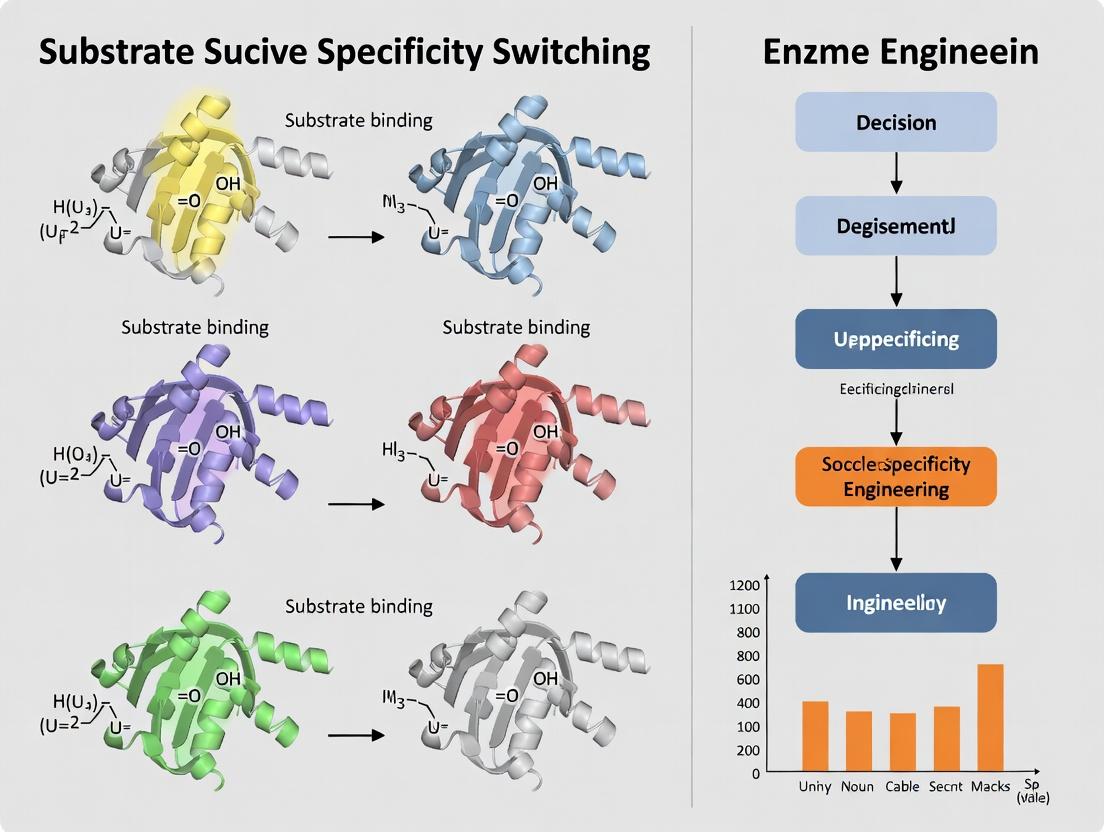
This article provides a comprehensive framework for researchers and drug development professionals aiming to re-engineer enzyme substrate specificity.
From Wild-Type to New Target: A Modern Guide to Enzyme Substrate Specificity Switching for Drug Discovery
Abstract
This article provides a comprehensive framework for researchers and drug development professionals aiming to re-engineer enzyme substrate specificity. We first explore the foundational principles of enzyme-substrate recognition, including active site architecture and molecular determinants of binding. Next, we detail state-of-the-art methodological approaches, from rational design and directed evolution to cutting-edge computational tools like AlphaFold2 and machine learning. The guide then addresses common challenges in engineering efforts, offering troubleshooting strategies for issues like activity trade-offs and stability loss. Finally, we present validation frameworks and comparative analyses of leading techniques, evaluating their success rates and applications in creating novel biocatalysts and therapeutic enzymes. This synthesis aims to equip scientists with a clear roadmap for successful specificity switching projects with direct implications for biomedical innovation.
Decoding the Blueprint: Understanding the Molecular Basis of Enzyme Substrate Specificity
Troubleshooting Guides & FAQs
FAQ: General Concepts & Experimental Design
Q1: How do the 'Lock-and-Key' and 'Induced Fit' models practically influence my experimental design for studying substrate specificity? A1: The chosen model dictates your approach. Lock-and-Key (rigid complementarity) suggests using static structural analysis (X-ray crystallography) with substrate analogues. Induced Fit (conformational change) requires techniques capturing dynamics, like stopped-flow kinetics, NMR, or time-resolved FRET. For modern engineering, assume Induced Fit or conformational selection as the starting point.
Q2: What are the primary computational tools used to predict substrate specificity? A2: Tools range from homology modeling (SWISS-MODEL, MODELLER) and molecular docking (AutoDock Vina, Glide) to molecular dynamics simulations (GROMACS, AMBER) and machine learning predictors (DeepEC, DEEPre). The choice depends on the availability of a template structure and the need for dynamic analysis.
Q3: When engineering an enzyme to switch substrate specificity, what are the critical failure points? A3: Key failure points include: 1) Loss of catalytic activity despite improved binding, 2) Destabilization of the protein fold, 3) Unpredicted promiscuity leading to off-target reactions, and 4) Neglecting the role of remote second-shell residues in long-range effects.
Troubleshooting Guide: Common Experimental Issues
Issue: Poor or No Activity with Intended New Substrate After Engineering
- Check 1: Protein Folding & Stability. Use circular dichroism (CD) spectroscopy or differential scanning fluorimetry (thermal shift assay) to confirm the mutant is properly folded and has a melting temperature (Tm) comparable to the wild-type (>10°C drop is concerning).
- Check 2: Binding vs. Catalysis. Perform isothermal titration calorimetry (ITC) or surface plasmon resonance (SPR) to verify the substrate actually binds. No binding suggests a failed active site design. Binding with no catalysis implicates misalignment of catalytic residues or transition state.
- Check 3: Reaction Conditions. Re-optimize pH, temperature, and cofactor concentration for the new substrate. The engineered enzyme's optimal conditions may have shifted.
Issue: High Unwanted Promiscuity or Side Reactions
- Check 1: Active Site Rigidity. Molecular dynamics simulations can reveal if mutations have created a overly flexible or cavernous active site, allowing alternative substrates entry.
- Check 2: Screening Assay Specificity. Ensure your high-throughput screening assay (e.g., fluorescence-based) is specific for the desired product and not triggered by side products. Validate hits with a secondary method like HPLC/MS.
- Check 3: Reverse Engineering. Revert specific mutations to identify which one introduced the promiscuity. Often, a single residue change can have broad effects.
Issue: Inconsistent Results Between Computational Prediction and Experimental Validation
- Check 1: Force Field & Solvation Model. The computational model may be inaccurate. For MD simulations, ensure the force field is appropriate for your system (e.g., includes cofactors) and uses an explicit solvent model.
- Check 2: Protonation States. The predicted activity highly depends on the correct protonation states of active site residues at the experimental pH. Use tools like PropKa to verify.
- Check 3: Sampling Adequacy. Simulation times may be too short to observe the relevant conformational change. Consider enhanced sampling techniques (e.g., metadynamics) for rare events.
Table 1: Comparison of Key Techniques for Analyzing Substrate Specificity
| Technique | Primary Information Gained | Throughput | Typical Time Scale | Key Quantitative Outputs |
|---|---|---|---|---|
| Isothermal Titration Calorimetry (ITC) | Binding affinity, stoichiometry, thermodynamics (ΔH, ΔS) | Low | Minutes to hours | Kd, ΔH, ΔG, n (binding sites) |
| Surface Plasmon Resonance (SPR) | Binding kinetics (on/off rates), affinity | Medium | Minutes | ka (association rate), kd (dissociation rate), KD (equilibrium constant) |
| Stopped-Flow Spectroscopy | Catalytic rate constants, pre-steady-state kinetics | Medium | Milliseconds to seconds | kcat, burst phase kinetics, transient intermediates |
| Molecular Dynamics (MD) Simulation | Atomic-level dynamics, conformational changes, free energy | Low (Comp. Intensive) | Nanoseconds to microseconds | RMSD, RMSF, binding free energy (ΔG), hydrogen bond occupancy |
| Deep Mutational Scanning | Functional impact of thousands of variants | Very High | Days to weeks | Fitness score for each mutation, epistatic interactions |
Table 2: Common Metrics for Evaluating Substrate Specificity Switching
| Metric | Formula / Description | Interpretation in Engineering |
|---|---|---|
| Catalytic Efficiency (kcat/KM) | kcat / KM |
The primary measure of specificity. A successful switch increases this for the new substrate and decreases it for the native one. |
| Specificity Constant Ratio | (kcat/KM)_New / (kcat/KM)_Native |
A direct measure of specificity reversal. Goal is >>1. |
| Activity Retention | (Activity_Mutant_Native_Substrate) / (Activity_WT_Native_Substrate) |
Assesses collateral damage to original function. Often unavoidable but should be minimized. |
| Thermal Shift (ΔTm) | Tm_Mutant - Tm_WT |
Indicator of structural destabilization. ΔTm < -10°C is a red flag for folding/aggregation. |
Experimental Protocols
Protocol 1: Rapid Specificity Screening Using Coupled Enzyme Assays
Purpose: High-throughput quantification of activity towards new substrate candidates. Reagents: Purified enzyme variant, target substrate, coupling enzyme(s), cofactors (NAD(P)H/NAD(P)+), detection buffer. Procedure:
- In a 96-well plate, add 80 µL of assay buffer (optimal pH, ionic strength).
- Add 10 µL of substrate solution (varying concentrations, prepared in buffer).
- Initiate reaction by adding 10 µL of purified enzyme variant.
- Immediately monitor the linear decrease/increase in absorbance (e.g., 340 nm for NADH) for 1-5 minutes using a plate reader.
- Calculate initial velocity (Vo) from the linear slope. Fit Vo vs. [S] data to the Michaelis-Menten equation to derive kcat and KM.
Protocol 2: Assessing Binding & Conformational Change via Differential Scanning Fluorimetry (Thermal Shift)
Purpose: Evaluate the impact of substrate binding on protein stability and infer induced fit. Reagents: Purified protein (2-5 µM), SYPRO Orange dye, substrate/inhibitor, compatible buffer. Procedure:
- Prepare a master mix of protein, dye, and buffer. Aliquot into PCR tubes.
- Add varying concentrations of substrate or an inactive analogue to individual tubes. Include a no-ligand control.
- Run a thermal ramp (e.g., 25°C to 95°C at 1°C/min) in a real-time PCR machine, monitoring fluorescence of the dye (which binds exposed hydrophobic patches).
- Plot fluorescence derivative vs. temperature. The inflection point is the melting temperature (Tm).
- A positive ΔTm (increase) upon ligand addition indicates binding and often stabilization of a specific conformation (induced fit).
Visualizations
Diagram Title: Enzyme Specificity Switching Research Workflow
Diagram Title: Evolution of Substrate Recognition Models
The Scientist's Toolkit: Research Reagent Solutions
Table 3: Essential Reagents for Substrate Specificity Engineering
| Item | Function in Research | Example/Notes |
|---|---|---|
| Site-Directed Mutagenesis Kit | Creates precise single or multiple amino acid changes in the gene of interest. | NEB Q5 Site-Directed Mutagenesis Kit, Agilent QuikChange. |
| Deep Mutational Scanning Library | Pre-made libraries for comprehensively exploring sequence-function space. | Twist Bioscience synthetic libraries, Trinity College Dublin "hotspot" libraries. |
| Thermofluor Dye (e.g., SYPRO Orange) | Binds hydrophobic patches exposed during protein denaturation for thermal shift assays. | Used in DSF to measure protein stability (Tm). |
| Coupled Enzyme System | Links the primary enzymatic reaction to a detectable signal (e.g., NADH oxidation). | Enables continuous, high-throughput kinetic assays. |
| Isotopically Labeled Substrates | Allows tracking of reaction products and detailed mechanistic studies via NMR or MS. | 13C, 15N, or 2H (Deuterium) labeled compounds. |
| Surface Plasmon Resonance (SPR) Chip | Immobilizes ligand (substrate/analogue) for real-time, label-free binding kinetics measurement. | CM5 sensor chip (carboxylated dextran matrix). |
| Molecular Dynamics Software License | Performs atomic-level simulations of enzyme-ligand dynamics. | GROMACS (open-source), AMBER, CHARMM (licensed). |
| Crystallization Screen Kits | Identifies conditions for growing protein crystals for X-ray structure determination. | Hampton Research Index, JCSG Core suites. |
Technical Support Center: Troubleshooting Specificity Switching in Enzyme Engineering
This support center provides targeted guidance for common experimental challenges encountered when engineering enzymes to switch substrate specificity, with a focus on manipulating active site architecture, binding pockets, and transition state stabilization.
Frequently Asked Questions & Troubleshooting Guides
Q1: After introducing active site mutations, my engineered enzyme shows no activity for the new target substrate. What are the primary troubleshooting steps? A: This typically indicates a failure in substrate binding or a critical disruption of the catalytic machinery. Follow this diagnostic workflow:
- Verify Binding: Perform isothermal titration calorimetry (ITC) or surface plasmon resonance (SPR) to confirm the new substrate physically binds. No binding suggests issues with the engineered binding pocket architecture.
- Check Catalytic Residues: Ensure mutations have not misaligned essential catalytic acids/bases or cofactor-binding sites. Use molecular dynamics (MD) simulations to analyze residue positioning.
- Assess Transition State (TS) Complementarity: Even if binding occurs, the active site may no longer stabilize the TS. Analyze TS analog binding via kinetics or crystallography.
Q2: My enzyme successfully binds the new substrate but catalytic rate (kcat) is severely reduced. How can I diagnose transition state stabilization failures? A: A severe kcat drop with intact binding points to poor TS stabilization. Key actions:
- Perform Kinetic Isotope Effects (KIEs) Analysis: Compare heavy vs. light atom substrates. Altered KIEs indicate changes in the rate-limiting step and TS structure.
- Compute Theoretical TS Models: Use quantum mechanics/molecular mechanics (QM/MM) to model the new TS geometry and identify residues that need re-engineering for optimal stabilization (e.g., introducing new H-bond donors/acceptors).
- Test TS Analog Inhibition: Determine if inhibition constants (Ki) for designed TS analogs have weakened relative to the wild-type enzyme.
Q3: Engineered enzyme shows increased activity for the non-target (original) substrate, compromising specificity. How do I suppress off-target activity? A: This is a common issue where the active site has been enlarged or made more flexible. Strategies include:
- Introduce Steric Hindrance: Add bulky side chains near the substrate scissile bond to selectively clash with the original substrate.
- Alter Electrostatic Steering: Modify residues in the substrate access channel to repel the original substrate based on charge.
- "Dual-Substrate" Simulation: Run MD simulations with both substrates present to identify which mutations differentially affect binding and catalysis.
Q4: How can I quantitatively compare the success of different engineering strategies in switching specificity? A: Use the following metrics, summarized in a comparative table.
Table 1: Key Quantitative Metrics for Specificity Switching Success
| Metric | Formula / Method | Ideal Outcome for Successful Switch | Interpretation |
|---|---|---|---|
| Specificity Constant Ratio | (kcat/Km)NewSubstrate / (kcat/Km)OriginalSubstrate | Value >> 1 (e.g., >10^3) | Measures overall catalytic preference. |
| ΔΔG‡ (Change in Activation Energy) | -RT * ln[(kcat/Km)New / (kcat/Km)Old] | Large negative value | Favors the new reaction pathway. |
| Binding Affinity Shift (ΔΔG) | ΔGBind,New - ΔGBind,Old (from ITC) | Positive value for old substrate | Weakened binding for the original substrate. |
| Transition State Analog Ki Ratio | Ki,Old / Ki,New | Value > 1 | Improved TS analog binding for the new substrate. |
Detailed Experimental Protocols
Protocol 1: Computational Saturation Mutagenesis & In Silico Screening
- Objective: Identify mutation hotspots for altering specificity.
- Methodology:
- Use a crystal structure or high-quality homology model of your enzyme.
- Define the active site radius (e.g., 8Å around the catalytic residue or bound ligand).
- Perform in silico saturation mutagenesis on all residues within this radius using a tool like Rosetta ddgmonomer or FoldX.
- Dock both the target and non-target substrates (and their TS analogs) into each mutant model.
- Rank mutants by the calculated binding energy difference (ΔΔGbind) between the desired and undesired substrates. Prioritize mutants with favorable ΔΔG for the target and unfavorable for the non-target.
Protocol 2: Experimental Determination of Specificity Constant (kcat/Km)
- Objective: Accurately measure the key metric for enzymatic specificity.
- Methodology:
- Enzyme Purification: Purify wild-type and mutant enzymes via affinity chromatography (e.g., His-tag) to >95% homogeneity. Confirm concentration via absorbance (A280) or Bradford assay.
- Initial Rate Kinetics: For each substrate (new and original), perform assays under saturating and non-saturating conditions.
- Data Analysis: Measure initial velocities (v0) at varying substrate concentrations [S]. Fit data to the Michaelis-Menten equation (v0 = (kcat * [E] * [S]) / (Km + [S])) using non-linear regression (e.g., GraphPad Prism) to extract kcat and Km.
- Calculate Specificity Constant: Compute kcat/Km for each enzyme-substrate pair. Compare ratios as in Table 1.
Visualization: Engineering Workflow & Concepts
Diagram Title: Enzyme Specificity Switching Engineering Workflow
Diagram Title: Binding Pocket & Transition State Engineering Goal
The Scientist's Toolkit: Key Research Reagent Solutions
Table 2: Essential Reagents for Specificity Switching Experiments
| Reagent / Material | Function & Role in Specificity Analysis | Example / Notes |
|---|---|---|
| Transition State Analog Inhibitors | High-affinity mimics of the reaction TS; used in crystallography to snapshot optimal interactions and in kinetics to measure TS stabilization strength. | Purine nucleoside phosphorylase inhibitors (Immucillins), protease phosphonate inhibitors. |
| Isotopically Labeled Substrates (^2H, ^13C, ^15N, ^18O) | Enable Kinetic Isotope Effect (KIE) studies to probe changes in the rate-limiting step and TS geometry upon engineering. | Critical for diagnosing TS stabilization failures. |
| Surface Plasmon Resonance (SPR) Chips (e.g., NTA, CM5) | Immobilize enzyme or substrate to measure real-time binding kinetics (ka, kd, KD) for wild-type vs. mutant enzymes with different ligands. | Provides direct binding affinity data (ΔG). |
| Site-Directed Mutagenesis Kit (e.g., Q5, KLD) | Enables precise introduction of point mutations in plasmids encoding the enzyme, based on computational design. | Foundation for rational engineering loops. |
| Comprehensive Mutant Library Generation Kit (e.g., for CASTing) | Creates focused mutant libraries around the active site for high-throughput screening when rational design is insufficient. | Used in directed evolution approaches. |
| Crystallography Plates & Cryo-Protectants | For obtaining high-resolution structures of enzyme-ligand complexes (with substrates, products, TS analogs). | Essential for visualizing atomic-level architectural changes. |
| Stable QM/MM Software Suite (e.g., Gaussian/Amber) | Performs hybrid quantum mechanical/molecular mechanical calculations to model the electronic structure of the TS in the enzyme environment. | Gold standard for in silico TS analysis. |
The Role of Non-Catalytic Residues and Remote Interactions in Substrate Selection.
Technical Support Center: Troubleshooting Substrate Specificity Issues
This support center is designed for researchers engineering enzyme substrate specificity. A core thesis in this field is that modifying non-catalytic residues and exploiting long-range, allosteric interactions is a more effective strategy for predictable substrate switching than solely targeting the active site. The following guides address common experimental hurdles.
FAQ & Troubleshooting Guide
Q1: My engineered enzyme shows the desired new substrate activity in a purified assay, but fails in the whole-cell or lysate context. What could be happening? A: This is a classic issue of overlooked remote interactions. Non-catalytic residues you modified may be involved in protein-protein interactions or post-translational modifications in the cellular environment.
- Troubleshooting Steps:
- Check for Oligomerization: Run size-exclusion chromatography or native PAGE on your enzyme extracted from the cell. Your mutation may have disrupted or created new oligomerization interfaces, altering dynamics.
- Analyze Proximity Interactions: Use a technique like BioID or APEX tagging to identify proteins that interact with your wild-type vs. engineered enzyme in vivo. A new interacting partner could be inhibiting function.
- Verify Stability: Measure the thermal shift (Tm) of your enzyme in cell lysate vs. buffer. Remote mutations can destabilize the protein, making it more susceptible to cellular proteases.
Q2: After saturation mutagenesis of a predicted "specificity-determining" remote residue, I see no improvement in switching selectivity. Was the hypothesis wrong? A: Not necessarily. The effect of a single remote residue is often context-dependent and modulated by its interaction network.
- Troubleshooting Steps:
- Expand the Mutagenesis Radius: Perform combinatorial mutagenesis on a cluster of 3-5 residues within a 10-Å radius of your original target. Use statistical coupling analysis (SCA) or co-evolution data to guide cluster selection.
- Assay for Dynamics, Not Just Structure: Implement hydrogen-deuterium exchange mass spectrometry (HDX-MS). Compare dynamics between wild-type and your best single mutant. You may find propagated rigidification or flexibility that negates the beneficial effect, guiding your next double-mutant design.
Q3: How can I systematically identify which non-catalytic residues are responsible for an observed substrate selectivity profile? A: A combined computational and experimental alanine-scanning approach is recommended.
- Experimental Protocol: Computational Pre-Screening & Alanine Scan
- Generate a Shortlist: Use a computational tool like Rosetta or FoldX to calculate the energetic contribution of each residue to the stability of the enzyme-substrate complex. Filter for residues that are (a) non-catalytic, (b) within 15 Å of the substrate, and (c) have a predicted ΔΔG > 2 kcal/mol.
- Library Construction: For each shortlisted residue (e.g., 20 positions), create a single-point alanine (or glycine) mutation via site-directed mutagenesis.
- High-Throughput Screening: Express and purify mutants in a 96-well format. Use a coupled assay that can distinguish between your target substrates (e.g., different fluorescent or chromogenic products).
- Data Analysis: Calculate the ratio of activity on Substrate A vs. Substrate B for each mutant. Residues where mutation causes a >5-fold change in this selectivity ratio are key remote determinants.
Quantitative Data from Representative Studies:
Table 1: Impact of Remote Mutations on Kinetic Parameters for Engineered Substrate Switching
| Enzyme (Engineered) | Targeted Remote Region | kcat (s⁻¹) New Substrate | KM (mM) New Substrate | Selectivity Switch (Fold Change vs. WT) | Primary Method |
|---|---|---|---|---|---|
| Cytochrome P450 BM3 | Substrate access channel (F87A/A328G) | 15.7 | 0.21 | ~1000x increased for alkanes | Saturation Mutagenesis |
| Alpha-Amylase (mesophilic → thermophilic) | Surface loop clusters | 4,200 (at 70°C) | 1.05 | 3x improved thermostability, maintained activity | SCHEMA Recombination |
| Aspartate Aminotransferase | Distal hinge/ dimer interface (N145L) | 180 (for Valine) | 12.5 | 10⁶ switch from Aspartate to Branched-chain amino acids | Rational Design + MD |
Key Experimental Protocols
Protocol: Hydrogen-Deuterium Exchange Mass Spectrometry (HDX-MS) to Probe Allosteric Effects Purpose: To detect changes in protein dynamics and solvent accessibility induced by remote mutations or substrate binding. Methodology:
- Sample Preparation: Prepare wild-type and mutant enzyme (10 µM) in identical phosphate buffer (pH 7.4). For ligand-bound states, pre-incubate with 5x molar excess of substrate/inhibitor.
- Deuterium Labeling: Dilute protein 1:10 into D₂O-based labeling buffer. Allow exchange to proceed for five time points (e.g., 10s, 1min, 10min, 1h, 4h) at 25°C.
- Quenching: At each time point, mix labeling reaction 1:1 with pre-chilled quench buffer (low pH, e.g., 0.1% formic acid, 4°C) to drop pH to 2.5 and reduce temperature to 0°C.
- Digestion & Analysis: Inject quenched sample onto an immobilized pepsin column for rapid online digestion (~1 min). Separate resulting peptides via UPLC coupled directly to a high-resolution mass spectrometer.
- Data Processing: Use specialized software (e.g., HDExaminer) to identify peptides and calculate deuterium uptake for each time point. Significant differences (>0.5 Da, statistically validated) between mutant/WT or +/- ligand indicate allosteric communication pathways.
Protocol: Deep Mutational Scanning (DMS) of a Remote Loop Purpose: To comprehensively map the functional tolerance and substrate selectivity contributions of every residue in a non-catalytic region. Methodology:
- Library Design: Design oligonucleotides to randomize codons for all residues in your target loop (e.g., 10-15 amino acids). Use NNK or other degenerate codons for full coverage.
- Library Construction: Clone the mutagenic cassette into your expression plasmid via Gibson Assembly or Golden Gate cloning. Aim for >10x coverage of theoretical diversity (e.g., 20¹⁰ variants requires massive coverage; consider sub-libraries).
- Functional Selection: Transform the library into your host cells. Grow under selective pressure that requires activity on your new desired substrate (e.g., complementation of an auxotrophy, antibiotic resistance linked to reaction product).
- Next-Generation Sequencing (NGS): Isolate plasmid DNA from the pre-selection library and the post-selection population. Perform NGS on the target region.
- Enrichment Score Calculation: For each variant, calculate an enrichment score as log₂[(countpost-selection / totalpost) / (countpre-selection / totalpre)]. Positive scores indicate mutations favorable for the new substrate selectivity.
Visualizations
Diagram 1: Allosteric Network in Substrate Selection
Diagram 2: Workflow for Engineering Remote Interactions
The Scientist's Toolkit: Research Reagent Solutions
Table 2: Essential Reagents for Studying Remote Interactions in Enzymes
| Reagent / Material | Function & Rationale |
|---|---|
| Site-Directed Mutagenesis Kit (e.g., Q5 or KLD) | For precise, high-efficiency introduction of point mutations in predicted remote residue positions. Essential for constructing single and double mutants. |
| Non-natural Amino Acid (e.g., p-Azido-L-phenylalanine) | Enables incorporation of chemical probes via orthogonal tRNA/synthetase systems. Allows crosslinking or fluorescent labeling at specific remote sites to study interactions. |
| Stable Isotope-labeled Amino Acids (¹⁵N, ¹³C) | Required for NMR spectroscopy to obtain residue-level information on structural and dynamic changes caused by remote mutations upon substrate binding. |
| Fluorescence-Based Thermal Shift Dye (e.g., SYPRO Orange) | Quickly assesses protein stability (Tm) in a 96/384-well format. Remote mutations often affect stability, which must be optimized alongside activity. |
| Coupled Enzyme Assay Substrate Panels | Kits containing diverse, specific chromogenic/fluorogenic substrates for enzyme classes (e.g., phosphatases, kinases, proteases). Critical for high-throughput selectivity profiling of mutant libraries. |
| Immobilized Pepsin Column | Key component for HDX-MS workflows. Enables fast, reproducible, and low-pH digestion of labeled protein to analyze deuterium incorporation at peptide level. |
| Allosteric Modulator/Inhibitor (Positive Control) | A known small molecule that binds away from the active site. Serves as a essential control to validate your experimental setup's ability to detect allosteric effects. |
Technical Support Center: Troubleshooting Enzyme Specificity Analysis
Frequently Asked Questions (FAQs)
Q1: During sequence alignment of a natural enzyme family (e.g., cytochrome P450s), I observe high homology but my chimeric constructs consistently lose all activity. What could be the cause? A: This is a common issue when non-conserved, distal residues critical for structural integrity are swapped. High sequence homology does not guarantee fold stability. Troubleshooting Steps: 1) Verify the chimeric protein expression level via Western blot—low yields indicate folding/aggregation issues. 2) Perform a thermal shift assay to compare the melting temperature (Tm) of the chimera versus wild-type enzymes. A drop >5°C suggests destabilization. 3) Review your alignment: use a tool like ConSurf to identify evolutionarily conserved structural residues, and ensure your domain boundaries do not cut through these clusters.
Q2: My directed evolution library for substrate specificity switching shows no functional variants in primary screens, despite high library coverage. How can I improve the screening strategy? A: The primary screen may be too stringent or may not report on the desired new activity. Troubleshooting Steps: 1) Implement a dual- or tandem-selection: first, counterselect against the native substrate to remove wild-type activity, then screen for the new activity. 2) Use a biosensor or transcription factor-based assay that responds specifically to the new product, reducing background from the native reaction. 3) Employ a fluorescence-activated droplet sorting (FADS) platform to screen ultra-high-throughput libraries based on product formation directly.
Q3: When analyzing enzyme kinetics after introducing specificity mutations, the kcat for the new substrate remains extremely low. What are potential fixes? A: Low kcat often indicates suboptimal transition state stabilization or inefficient product release for the new substrate. Troubleshooting Steps: 1) Perform molecular dynamics simulations focusing on the product exit pathways; mutations near the active site portal may be required. 2) Check for compensatory mutations that restore active site dynamics. Review natural enzyme family phylogenies for correlated mutation pairs using tools like EVcouplings. 3) Consider introducing second-sphere mutations that alter active site electrostatics or flexibility to better pre-organize the new substrate.
Q4: How do I handle poor solubility and aggregation of engineered enzyme variants designed based on natural family analysis? A: Aggregation often arises from exposed hydrophobic patches introduced by mutations. Troubleshooting Steps: 1) Add a solubility tag (e.g., MBP, GST) for expression and testing, then attempt removal. 2) Incorporate a consensus surface residue analysis from your enzyme family alignment; revert exposed mutant residues to the family consensus to improve solubility. 3) Use buffers with moderate concentrations of kosmotropic salts (e.g., 100-200 mM NaCl, (NH4)2SO4) or non-denaturing chaotropes (e.g., 100-200 mM arginine) during purification.
Key Experimental Protocols
Protocol 1: Phylogenetic Analysis to Identify Specificity-Determining Positions (SDPs) Objective: Identify residues that correlate with substrate specificity across a natural enzyme family. Steps:
- Sequence Collection: Use UniProt to gather full-length sequences for the enzyme family (e.g., serine proteases). Apply a filter for reviewed (Swiss-Prot) entries and manually curate to ensure functional annotation.
- Alignment & Tree Building: Align sequences using MUSCLE or ClustalOmega. Construct a phylogenetic tree with IQ-TREE (model finder: ModelFinder) using 1000 ultrafast bootstrap replicates.
- Ancestral State Reconstruction: Use the implemented method in IQ-TREE or a tool like PAML to infer ancestral sequences at key nodes.
- Correlated Mutation Analysis: Input the alignment into the EVcouplings server to identify statistically coupled residue pairs. Residues coupled to known active site positions are candidate SDPs.
- Mapping: Visualize SDPs on a representative crystal structure (from PDB) using PyMOL.
Protocol 2: High-Throughput Screening for Substrate Promiscuity Objective: Quantitatively assess the ability of natural enzyme family members to accept non-native substrates. Steps:
- Plate Setup: Express and purify (or lyse) 10-20 representative enzymes from the family in a 96-well format.
- Reaction Mix: In a black, clear-bottom 384-well plate, combine: 50 µL of enzyme, 100 µM test substrate, and 1 mM necessary cofactor (e.g., NADPH) in assay buffer. Include negative controls (no enzyme, heat-inactivated enzyme).
- Kinetic Readout: Use a plate reader to monitor fluorescence/absorbance change specific to product formation every 30 seconds for 30 minutes at relevant temperature.
- Data Analysis: Calculate initial velocity (V0) for each enzyme-substrate pair. Normalize to the activity of the enzyme's native substrate. Use hierarchical clustering to group enzymes by substrate preference profiles.
Research Reagent Solutions Table
| Reagent / Material | Function in Specificity Analysis |
|---|---|
| Phusion High-Fidelity DNA Polymerase | Error-free amplification of enzyme genes for library construction and chimera generation. |
| TEV Protease | Cleavage of His-tags or other solubility tags after purification to obtain native enzyme for accurate kinetic studies. |
| NADPH Regeneration System | Maintains constant cofactor levels for prolonged kinetic assays of oxidoreductases (e.g., P450s, dehydrogenases). |
| AlphaFold2 Colab Notebook | Predicts 3D structures of designed enzyme variants to check for folding anomalies before synthesis. |
| Cytiva HisTrap FF Crude Column | Rapid, one-step immobilised metal affinity chromatography (IMAC) purification of His-tagged enzyme variants. |
| Promega NanoGlo Luciferase Assay | Ultra-sensitive, bioluminescent reporter for detecting low levels of product in high-throughput screens. |
| Microfluidic Droplet Generator Chip | Encapsulates single enzyme variants with substrate in picoliter droplets for ultra-high-throughput FADS screening. |
Table 1: Representative Kinetic Parameters of Engineered vs. Natural Cytochrome P450 Variants
| Enzyme Variant | Native Substrate (kcat/Km, M⁻¹s⁻¹) | Target New Substrate (kcat/Km, M⁻¹s⁻¹) | Fold Change (New/Native) | Thermostability (Tm, °C) |
|---|---|---|---|---|
| P450BM3 Wild-Type | 4.5 x 10⁵ (Fatty Acid) | 1.2 x 10¹ (Propane) | 2.7 x 10⁻⁵ | 58.5 |
| P450BM3 Heuristic Design | 9.8 x 10⁴ | 3.3 x 10³ | 0.034 | 51.2 |
| P450CAM (Natural) | 1.1 x 10⁶ (Camphor) | 8.7 x 10⁴ (Ethylbenzene) | 0.079 | 62.1 |
| P450BM3 SDP-Swap Chimera | 1.7 x 10⁵ | 5.6 x 10⁴ | 0.33 | 56.7 |
Table 2: Analysis of Successful Specificity-Switching Mutations from Literature
| Enzyme Family | Avg. # Mutations Introduced | Avg. Distance from Active Site (Å) | Success Rate* (%) | Primary Method of Identification |
|---|---|---|---|---|
| Serine Proteases | 8.5 | 12.4 | 22 | Phylogenetic SDP Analysis |
| Acyltransferases | 6.2 | 8.7 | 31 | SCHEMA Rosetta Chimeragenesis |
| Glycosyltransferases | 10.1 | 15.2 | 15 | Correlated Mutation Networks |
| Success Rate: Defined as achieving >10% of the native enzyme's kcat/Km for the new substrate. |
Visualizations
Diagram 1: Workflow for identifying specificity-switching residues
Diagram 2: Enzyme substrate specificity switch logic
Welcome to the Specificity Switching Technical Support Center. This resource is designed for researchers and professionals navigating the complex challenges of engineering enzymes with altered substrate specificity, a core objective in modern enzyme engineering and drug development.
Frequently Asked Questions & Troubleshooting Guides
Q1: Our computational model predicted high affinity for a new target substrate, but the engineered enzyme shows no detectable activity in vitro. What are the primary reasons for this discrepancy?
A: This is a common failure point. The discrepancy often stems from overlooking one or more of these factors:
- Dynamic Motion Ignored: Your model may have used static docking, failing to account for necessary enzyme backbone or side-chain dynamics for catalysis post-binding.
- Transition State vs. Ground State: The design focused on optimizing ground-state substrate binding rather than stabilizing the higher-energy transition state structure.
- Solvation/Desolvation Penalty: The computational energy function underestimated the thermodynamic cost of stripping water molecules from the substrate or active site residues.
- Unproductive Binding Pose: The substrate binds in a pose that is geometrically incompatible with catalysis, often due to subtle torsional strains not captured.
Troubleshooting Protocol:
- Perform Molecular Dynamics (MD) Simulations: Run short (50-100 ns) MD simulations of the enzyme-ligand complex to check for binding pose stability and necessary conformational changes.
- Analyze the Catalytic Network: Use QM/MM (Quantum Mechanics/Molecular Mechanics) calculations on the docked pose to probe the energy barrier of the proposed catalytic mechanism.
- Test Binding Experimentally: Use Isothermal Titration Calorimetry (ITC) or Surface Plasmon Resonance (SPR) to confirm the predicted binding affinity is physically real.
Q2: We successfully switched primary activity from Substrate A to Substrate B, but the enzyme's activity on the original substrate is still unacceptably high. How can we more effectively suppress ancestral activity?
A: Incomplete specificity switching indicates insufficient optimization of the "negative design" principle—excluding unwanted substrates.
Troubleshooting Protocol:
- Introduce Steric Hindrance: Identify residues that form favorable van der Waals contacts with Substrate A. Mutate to larger side chains (e.g., Val to Phe, Leu to Tyr) to create clashes.
- Disrupt Electrostatic Complementarity: If Substrate A has a charged group, introduce like charges in the active site or neutralize complementary charges.
- Alter H-bonding Patterns: Systematically mutate residues forming specific H-bonds with Substrate A to residues that cannot donate/accept in the same geometry.
- Iterative Saturation Mutagenesis: Apply it to the second-shell residues around the active site to rigidify the architecture exclusively around Substrate B.
Q3: Our engineered variant shows the desired new specificity in purified enzyme assays, but loses all function in cellular or physiological environments. What could be causing this?
A: This highlights the challenge of environmental context. Cellular failure can arise from:
- Post-Translational Modifications (PTMs): The new sequence may introduce sites for phosphorylation, ubiquitination, or cleavage.
- Protein-Protein Interactions (PPIs): The mutations may disrupt essential PPIs for proper localization or allosteric regulation.
- Oxidative/Reductive Instability: The new active site configuration might be sensitive to cellular redox state.
- Suboptimal Expression/Folding: The variant may misfold or aggregate at physiological expression levels.
Troubleshooting Protocol:
- Check for PTMs: Use mass spectrometry on the protein expressed in the relevant cell line.
- Conduct a Pull-Down Assay: Compare interaction partners of the wild-type and engineered enzyme using tagged constructs.
- Assess Stability: Perform cellular thermal shift assays (CETSA) to compare thermal stability in cellulo.
Experimental Protocol: A Standard Workflow for Computational Specificity Switching
This protocol outlines a standard structure-guided approach for altering enzyme substrate specificity.
Objective: To engineer Enzyme X to preferentially catalyze a reaction with non-native Substrate B over native Substrate A.
Materials & Key Reagents:
- Target Enzyme: Purified wild-type Enzyme X.
- Structures: High-resolution crystal or cryo-EM structures of Enzyme X, ideally with Substrate A or analogs bound (PDB ID required).
- Software Suite: Molecular docking suite (e.g., Rosetta, AutoDock Vina, Schrödinger), MD simulation package (e.g., GROMACS, AMBER), visualization tool (PyMOL, ChimeraX).
- Substrates: Purified Substrate A and target Substrate B.
- Assay Kit: Relevant activity assay (e.g., fluorogenic, colorimetric) compatible with both substrates.
Method:
- Active Site Analysis & Feature Mapping:
- Using the wild-type structure, map all residues within 8Å of the bound ligand.
- Categorize each residue's role: catalytic, binding, structural.
- Create a "chemical feature map" of the active site (H-bond donors/acceptors, hydrophobic patches, charged regions).
Computational Design of Mutations:
- Docking: Dock Substrate B into the active site, generating multiple plausible poses.
- Sequence Design: Using a protein design algorithm (e.g., RosettaDesign), allow residues within the defined zone to mutate to all other amino acids. The energy function is biased to favor complementary interactions with the target pose of Substrate B.
- Negative Design: Optionally, include Substrate A in the simulation with a repulsive weight to penalize designs that still favorably interact with it.
- Filtering: Filter the top 100-500 designs based on total energy, shape complementarity, and conservation of critical catalytic residues.
In Silico Screening:
- Subject the top 50 designs to short MD simulations (20 ns) to assess stability and binding pose retention.
- Re-rank designs based on simulation metrics (RMSD of ligand, H-bond persistence).
- Select 5-10 final variants for experimental testing based on computational stability and diversity of mutation patterns.
Experimental Validation:
- Clone, express, and purify the selected variants.
- Kinetic Characterization: Determine kcat and KM for both Substrate A and Substrate B for each variant.
- Calculate the Specificity Switch Ratio (SSR): (kcat/KM}))Substrate B / (kcat/KM}))Substrate A for each variant vs. wild-type.
Data Presentation: Kinetic Parameters of Designed Variants
| Variant | Mutations | For Substrate A (Native) | For Substrate B (Target) | Specificity Switch Ratio (SSR) | ||||
|---|---|---|---|---|---|---|---|---|
| KM (µM) | kcat (s-1) | kcat/KM (µM-1s-1) | KM (µM) | kcat (s-1) | kcat/KM (µM-1s-1) | (vs. Wild-Type) | ||
| Wild-Type | - | 10.2 ± 1.1 | 5.0 ± 0.2 | 0.49 | 1250 ± 150 | 0.05 ± 0.01 | 4.0 x 10⁻⁵ | 1.0 (Reference) |
| Variant 3 | L78F, V121R | 85.5 ± 8.7 | 0.15 ± 0.02 | 0.0018 | 22.4 ± 3.1 | 2.8 ± 0.3 | 0.125 | ~2,800 |
| Variant 7 | L78Y, T114K, V121E | >500 (ND)* | <0.01 (ND)* | N/A | 12.5 ± 1.8 | 1.1 ± 0.1 | 0.088 | >10,000 |
*ND: Not determinable due to negligible activity.
The Scientist's Toolkit: Key Research Reagent Solutions
| Reagent / Material | Primary Function in Specificity Switching Research |
|---|---|
| Site-Directed Mutagenesis Kit (e.g., Q5, KLD) | Rapid, high-fidelity generation of plasmid DNA encoding designed single or combinatorial point mutations. |
| High-Throughput Cloning System (e.g., Golden Gate, Gibson Assembly) | Enables efficient assembly of libraries containing diverse mutation combinations for screening. |
| Fluorogenic/Chromogenic Substrate Analogs | Allows for continuous, high-sensitivity kinetic assays of enzyme activity, essential for screening libraries and determining kinetic parameters. |
| Surface Plasmon Resonance (SPR) Chip & Buffer Kit | For label-free, quantitative measurement of binding affinity (KD) between enzyme variants and target substrates. |
| Stable Isotope-Labeled Substrates | Used in NMR or mass spectrometry-based assays to track atom-specific chemistry and confirm catalytic mechanism on new substrates. |
| Thermal Shift Dye (e.g., SYPRO Orange) | Used in thermal shift assays (DSF) to quickly assess the impact of mutations on protein thermal stability, a key factor for functional expression. |
| Analytical Size-Exclusion Chromatography (SEC) Column | Critical step in purification to assess the monomeric state and aggregation propensity of engineered variants. |
Visualization: Specificity Switching Design & Validation Workflow
Title: Workflow for Engineering Substrate Specificity Switch
Visualization: Multi-Factor Complexity in Specificity Prediction
Title: Key Factors Complicating Specificity Switch Prediction
The Engineer's Toolkit: Strategies and Techniques for Reprogramming Enzyme Specificity
Troubleshooting Guides and FAQs
Q1: During phylogenetic tree construction for hotspot identification, my multiple sequence alignment (MSA) is too gappy, leading to poor tree resolution. How can I improve this?
A: This is common when sequences are highly divergent.
- Primary Solution: Adjust your alignment parameters. Use a more appropriate substitution matrix (e.g., BLOSUM62 for medium divergence, BLOSUM45 for high divergence) and increase gap open penalty.
- Alternative: Trim the alignment using a tool like TrimAl (
-automated1flag) or Gblocks to remove poorly aligned positions. - Check: Ensure your initial sequence dataset is curated. Remove sequences that are fragments or outliers in length before alignment.
Q2: The computational prediction of hotspot residues from the protein structure yields an overwhelmingly large list of potential targets. How do I prioritize them for experimental validation?
A: Filter and rank using a consensus approach.
| Prioritization Criteria | Description | Recommended Tool/Action |
|---|---|---|
| Evolutionary Conservation | Residues with high conservation scores are critical for function. | Rank using scores from ConSurf or ScoreCons. |
| Structural Stability (ΔΔG) | Residues where mutation is predicted to significantly destabilize the fold. | Filter using FoldX, RosettaDDG, or DeepDDG. |
| Functional Site Proximity | Residues within 5-10 Å of the active site or known substrate-binding region. | Measure in PyMOL or ChimeraX. |
| Consensus Across Methods | Residues identified by multiple prediction algorithms. | Compare outputs from HotSpot Wizard, DrugScorePPI, and KFC. |
Q3: After introducing mutations at predicted hotspot residues, my enzyme shows complete loss of activity. How do I diagnose if this is due to misfolding or a direct functional impact?
A: Perform the following characterization cascade:
- Check Protein Expression & Solubility: Compare yield and soluble fraction via SDS-PAGE to the wild-type.
- Assess Structural Integrity:
- Circular Dichroism (CD) Spectroscopy: Compare far-UV spectra for secondary structure.
- Thermal Shift Assay (Differential Scanning Fluorimetry): Measure melting temperature (Tm). A significant drop (>5°C) suggests destabilization.
- Size-Exclusion Chromatography (SEC): Check for aggregation or abnormal oligomeric state.
- If structure is intact, then the mutation likely directly interferes with substrate binding or catalysis. Proceed with detailed kinetic analysis (Km, kcat).
Q4: My substrate specificity switching experiment was successful in computational simulations (docking, MD), but the engineered enzyme shows no activity towards the new substrate in vitro. What are the key gaps to investigate?
A: This often stems from differences between static/computational models and dynamic reality.
- Re-evaluate Dynamics: Perform longer Molecular Dynamics (MD) simulations to see if the intended binding pose is stable or if side-chain rearrangements block access.
- Check Transition State: Specificity is often governed by transition-state stabilization. Ensure your design accounts for this, not just ground-state binding.
- Test Alternative Protonation States: The protonation state of catalytic residues in the simulation may not match your assay conditions (pH).
- Verify Experimental Conditions: Ensure your assay buffer, pH, and cofactor concentrations are optimal for the new substrate activity, which may differ from the native enzyme.
Q5: How can I validate that a predicted hotspot residue is part of a functional allosteric network and not just a structurally important site?
A: Use a combination of computational and experimental approaches.
- Computational Analysis: Run methods like Dynamical Network Analysis (MD-based) or SCA (statistical coupling analysis) to map residue-residue correlations and identify connected networks.
- Experimental Probe: Design a double mutant cycle analysis.
- Mutate the predicted hotspot (A) and a known active site residue (B), individually and together.
- Measure activity for all variants. A non-additive effect (i.e., ΔΔGAB ≠ ΔΔGA + ΔΔG_B) indicates energetic coupling, suggesting they are part of the same functional network.
Experimental Protocol: Integrated Hotspot Identification and Validation
Title: Integrated Protocol for Identifying and Validating Specificity-Switching Hotspot Residues
Objective: To combine phylogenetic and structural data to rationally design and test enzyme variants with altered substrate specificity.
Part A: Computational Identification of Hotspot Residues
Phylogenetic Analysis:
- Gather Sequences: Retrieve homologous sequences from UniRef90 using the target enzyme as query. Curate to remove fragments (<80% length of query).
- Multiple Sequence Alignment: Perform MSA using MAFFT (L-INS-i algorithm). Manually inspect and trim ambiguous regions.
- Calculate Conservation: Input the MSA into ConSurf Server to compute evolutionary conservation scores for each residue. Classify residues as variable, average, or conserved.
Structural Analysis:
- Obtain Structure: Use PDB ID of target enzyme or generate a high-quality homology model.
- Identify Energetic Hotspots: Use the FoldX plugin in YASARA or Rosetta's ddg_monomer application. Perform in silico alanine scanning on all residues within 15Å of the substrate. Calculate predicted ΔΔG of folding.
- Map Binding Site Networks: Use Arpeggio (PDB) or PyMOL to list all residues making van der Waals or hydrogen-bond contacts with the native substrate.
Data Integration & Selection:
- Create a master table. Prioritize residues that are: a) Low-to-medium conservation (variable/average from ConSurf), b) Predicted to be structurally tolerated (ΔΔG < 2 kcal/mol from FoldX), c) Located in the binding site or a connected network.
Part B: Saturation Mutagenesis & Library Screening
Library Construction:
- For each selected hotspot residue, design primers for NNK codon saturation mutagenesis (covers all 20 amino acids).
- Perform site-directed mutagenesis via PCR using a high-fidelity polymerase (e.g., Q5). Transform into expression host (e.g., E. coli BL21(DE3)).
High-Throughput Activity Screening:
- Pick colonies into 96-deep well plates. Induce expression with IPTG.
- Primary Screen: Use a colorimetric or fluorometric assay specific for the desired new substrate activity. Identify positive hits (absorbance/fluorescence > 3x background).
- Counter-Screen: Lysates from positive hits are also assayed for native substrate activity. Select variants showing a favorable activity ratio (New/Native).
Part C: Characterization of Lead Variants
- Protein Purification: Purify wild-type and lead variant enzymes using His-tag affinity chromatography.
- Kinetic Analysis: Determine steady-state kinetic parameters (Km, kcat) for both the native and new substrates in a minimum of triplicate measurements. Calculate specificity constant (kcat/Km).
- Structural Validation: If possible, solve the crystal structure of the top variant or perform HDX-MS to confirm predicted conformational changes.
Diagrams
Diagram 1: Hotspot Identification & Validation Workflow
Diagram 2: Hotspot Residue Prioritization Logic
Research Reagent Solutions
| Item | Function in Experiment | Example/Supplier |
|---|---|---|
| High-Fidelity DNA Polymerase | Accurate amplification for site-directed mutagenesis without introducing unwanted mutations. | Q5 Hot Start (NEB), KAPA HiFi |
| NNK Degenerate Codon Primers | Encodes all 20 amino acids + a stop codon, used in saturation mutagenesis to create comprehensive library. | Custom ordered from IDT, Sigma. |
| Chromogenic/Fluorogenic Substrate Analog | Enables high-throughput screening of enzyme activity in cell lysates (96/384-well plates). | e.g., p-Nitrophenyl esters, Methylumbelliferyl derivatives. |
| His-Tag Purification Resin | Rapid, standardized affinity purification of recombinant wild-type and variant enzymes for kinetic analysis. | Ni-NTA Agarose (QIAGEN), HisPur Cobalt Resin (Thermo). |
| Thermal Shift Dye | Used in Differential Scanning Fluorimetry to assess protein folding stability upon mutation. | SYPRO Orange Protein Gel Stain (Thermo). |
| Homology Modeling Software | Generates a reliable 3D structural model if a crystal structure is unavailable for analysis. | SWISS-MODEL, MODELLER, AlphaFold2. |
| ΔΔG Prediction Server | Computes the change in folding free energy upon mutation to prioritize structurally stable mutations. | FoldX Suite, Rosetta ddg_monomer, mCSM. |
Troubleshooting Guides and FAQs
FAQ 1: During the construction of a mutant library for altering substrate specificity, I am observing very low transformation efficiency. What could be the cause and how can I resolve it?
- Answer: Low transformation efficiency is commonly caused by impure or degraded plasmid DNA, inappropriate electrocompetent cell quality, or excessive DNA amount during transformation. Ensure plasmid DNA is purified via a high-quality kit (e.g., spin column). Use freshly prepared or commercially sourced high-efficiency electrocompetent cells (e.g., >10^9 cfu/µg). For a standard 50 µL aliquot of competent cells, use 1-10 ng of ligated plasmid DNA. An excessive heat-shock duration or incorrect voltage during electroporation can also be culprits. Follow the manufacturer's protocol precisely for your specific cell type.
FAQ 2: My high-throughput fluorescence-activated cell sorting (FACS) screen shows poor separation between positive (active) and negative (inactive) populations. What steps should I take to optimize the signal-to-noise ratio?
- Answer: Poor separation often stems from a weak fluorescent signal or high background. First, optimize your fluorogenic substrate concentration by performing a kinetic assay to determine the KM and use a concentration at or above KM for screening. Include a protease inhibitor cocktail in your cell lysis or staining buffer to prevent non-specific cleavage of the substrate. Implement stringent washing steps post-reaction but prior to sorting to remove unprocessed fluorescent dye. Always run control populations (wild-type enzyme and a known inactive mutant) in parallel to set your gating boundaries accurately.
FAQ 3: I am using microtiter plate-based screening, and my Z'-factor is consistently below 0.5, indicating an unreliable assay. How can I improve the robustness of my screen?
- Answer: A low Z'-factor suggests high signal variability or a small dynamic range. To improve it:
- Assay Volume: Increase reaction volumes to minimize pipetting error.
- Cell Lysis: Implement a uniform lysis method (e.g., chemical lysis with lysozyme or a single freeze-thaw cycle) across all wells.
- Temperature Control: Use a thermostated plate reader to maintain consistent reaction temperature.
- Reagent Dispensing: Use a multichannel pipette or automated liquid handler for adding substrates.
- Positive/Negative Controls: Include multiple replicates of high (wild-type with native substrate) and low (no enzyme or inactive mutant) controls on every plate.
- Substrate Stability: Prepare substrate stocks fresh or confirm stability in your buffer system.
FAQ 4: After several rounds of directed evolution for substrate switching, activity on the new substrate plateaus, and activity on the original substrate re-emerges. How can I break this fitness trade-off?
- Answer: This is a common challenge in specificity switching due to epistatic interactions. Consider these strategies:
- Altered Selection Pressure: Introduce counter-selection against the original substrate activity by including a competitive inhibitor in your screening assay or using a toxic analog of the original substrate that must not be processed.
- Focused Saturation Mutagenesis: Perform saturation mutagenesis on hotspot residues identified in previous rounds, but screen directly for the new substrate specificity while monitoring the loss of original function.
- DNA Shuffling: Recombine beneficial mutations from different lineages to discover new, synergistic combinations that enhance new specificity while fully ablating the old one.
Key Experimental Protocols
Protocol 1: Construction of a Saturation Mutagenesis Library for Active Site Residues
- Primer Design: Design forward and reverse primers containing the NNK degenerate codon (N = A/T/G/C; K = G/T) at the target codon(s). Ensure primers have 15-20 bp of homologous sequence flanking the mutation site.
- PCR Amplification: Set up a PCR reaction using a high-fidelity DNA polymerase (e.g., Q5) with your template plasmid (50 ng) and degenerate primers (0.5 µM each). Use a cycling protocol with an annealing temperature based on the primer's Tm.
- DpnI Digestion: Add 1 µL of DpnI restriction enzyme directly to the PCR product and incubate at 37°C for 1 hour to digest the methylated template DNA.
- Purification: Purify the digested PCR product using a PCR cleanup kit.
- In-Fusion Cloning: Mix 50 ng of purified PCR fragment with 100 ng of linearized vector backbone (prepared by inverse PCR or restriction digest) using a commercial In-Fusion or Gibson Assembly mix. Incubate at 50°C for 15-60 minutes.
- Transformation: Transform 2 µL of the assembly reaction into 50 µL of high-efficiency competent cells. Plate onto selective agar plates to obtain the mutant library.
Protocol 2: High-Throughput Microtiter Plate Screening of Hydrolytic Enzyme Variants
- Culture Growth: Inoculate 96- or 384-well deep-well plates containing selective media with individual library clones. Grow overnight at 37°C with shaking.
- Induction & Lysis: Add inducer (e.g., IPTG) at mid-log phase. After expression, pellet cells by centrifugation. Lyse cells by adding 50 µL of B-PER II or a similar lysis buffer supplemented with lysozyme (1 mg/mL). Agitate for 15 minutes.
- Reaction Setup: In a new clear-bottom assay plate, combine 20 µL of clarified lysate (or supernatant) with 80 µL of reaction buffer containing your fluorogenic or chromogenic substrate (at a final concentration of ~2x KM).
- Kinetic Measurement: Immediately place the plate in a plate reader pre-warmed to the assay temperature. Measure absorbance or fluorescence every 30 seconds for 10-30 minutes.
- Data Analysis: Calculate the initial velocity (V0) for each well from the linear slope of the signal vs. time curve. Normalize values to the positive and negative controls on each plate. Select hits with activity >3 standard deviations above the negative control mean.
Table 1: Comparison of High-Throughput Screening Methodologies for Directed Evolution
| Method | Typical Throughput (variants/day) | Cost per Variant | Key Advantage | Key Limitation | Typical Z'-Factor Range |
|---|---|---|---|---|---|
| Microtiter Plate (Absorbance/Fluorescence) | 10^3 - 10^4 | Low - Medium | Quantitative, accessible instrumentation, versatile | Low spatial density, moderate throughput | 0.5 - 0.7 |
| Fluorescence-Activated Cell Sorting (FACS) | 10^7 - 10^9 | Very Low (post-setup) | Ultra-high throughput, single-cell resolution | Requires fluorescent substrate/product, complex setup | N/A (Gating-based) |
| Microfluidic Droplet Sorting | 10^7 - 10^8 | Medium - High | Ultra-high throughput, compartmentalization, low cross-talk | Specialized equipment, complex microfluidics setup | N/A (Gating-based) |
| Colony-Based Imaging (Agar Plates) | 10^4 - 10^5 | Very Low | Simple, no cell lysis needed, visual identification | Semi-quantitative, diffusion can blur signals | 0.3 - 0.6 |
Table 2: Common Metrics for Directed Evolution Campaigns Targeting Substrate Specificity Switching
| Metric | Formula/Description | Target Value for Success |
|---|---|---|
| Library Diversity | Number of unique transformants screened. | >10x theoretical diversity of the library. |
| Specificity Switch Factor (kcat/KM) | (kcat/KM)newsubstrate / (kcat/KM)originalsubstrate | Aim for >100-fold increase; final goal often >10^3 to 10^4. |
| Activity Retention | (kcat/KM)newsubstratemutant / (kcat/KM)newsubstratewt | >1 (improved activity on new substrate). |
| Z'-Factor (Assay Quality) | 1 - [ (3σpos + 3σneg) / |µpos - µneg| ] | >0.5 (excellent assay). 0.5 to 0 = marginal. |
| Enrichment Factor (FACS/Selection) | (Ratio of positives post-sort) / (Ratio of positives pre-sort) | >100 per round. |
Visualizations
Directed Evolution Workflow for Specificity Switching
Enzyme Substrate Specificity Switching Concept
The Scientist's Toolkit: Research Reagent Solutions
Table 3: Essential Materials for Directed Evolution Campaigns
| Item | Function & Rationale | Example Product/Type |
|---|---|---|
| High-Fidelity Mutagenic Polymerase | Generates mutant libraries with minimal bias and error rate outside the targeted region. Essential for site-saturation mutagenesis. | Q5 Hot-Start DNA Polymerase, KAPA HiFi |
| NNK Degenerate Oligonucleotides | Primers containing the NNK codon for saturation mutagenesis. NNK covers all 20 amino acids with only 32 codons, reducing library redundancy. | Custom-synthesized primers from IDT, Sigma. |
| Electrocompetent E. coli Cells | For high-efficiency transformation of mutagenesis library DNA. Crucial for achieving sufficient library coverage. | Lucigen 10G cells, NEB 10-beta Electrocompetent cells. |
| Fluorogenic/Chromogenic Substrate | A molecule that releases a detectable signal (fluorescence/color) upon enzyme cleavage. Enables high-throughput activity screening. | 4-Nitrophenyl esters (chromogenic), 7-Amino-4-methylcoumarin (AMC) derivatives (fluorescent). |
| Microtiter Plates (Assay Optimized) | Black-walled, clear-bottom plates minimize cross-talk for fluorescence assays. Essential for reliable plate reader data. | Corning 384-well black polystyrene plates. |
| Cell Lysis Reagent | Rapidly lyses bacterial cells in a high-throughput format to release expressed enzymes for screening. | B-PER II, PopCulture Reagent (MilliporeSigma). |
| Liquid Handling System | Automates reagent dispensing into 384- or 1536-well plates, dramatically improving consistency and throughput. | Beckman Coulter Biomek, Integra Viaflo. |
| FACS Machine | Sorts single cells based on fluorescence intensity, enabling ultra-high-throughput screening of live-cell displays (e.g., yeast, bacterial surface display). | BD FACSAria, Sony SH800. |
Technical Support Center: Troubleshooting & FAQs for Enzyme Specificity Switching Experiments
FAQ 1: Computational Phase
- Q: My RosettaFold2/AlphaFold2 model shows high confidence (pLDDT > 90) but the predicted active site geometry contradicts known catalytic mechanisms. Which model should I trust?
- A: Prioritize mechanistic knowledge. Computational models are structural predictors, not functional validators. Use the high-confidence model as a scaffold, but manually align the catalytic residues to the known mechanism from literature or a trusted template. Proceed to MD simulations to assess the stability of this manually corrected pose.
- Q: During Rosetta ddg_monomer calculations for mutation screening, the ΔΔG values are overwhelmingly positive (> +10 kcal/mol). Does this mean no beneficial mutations exist?
- A: Not necessarily. Highly positive ΔΔG often indicates backbone strain. Broaden your search:
- Filter Less Stringently: Consider mutations with ΔΔG < +5 kcal/mol for experimental testing, as force fields have error margins.
- Explore Coupled Mutations: Use Cartesian_ddg to evaluate double mutants where a destabilizing active-site mutation is compensated by a stabilizing second-site mutation.
- Check Relaxation: Ensure the protocol includes sufficient backbone relaxation around the mutation site.
- A: Not necessarily. Highly positive ΔΔG often indicates backbone strain. Broaden your search:
FAQ 2: Laboratory Evolution Phase
- Q: My initial library, built from computational hits, shows no detectable activity on the desired new substrate in the primary high-throughput screen. What are the first steps?
- A: Implement a tiered screening strategy:
- Confirm Protein Expression: Run an SDS-PAGE or use a His-tag ELISA on randomly picked clones to ensure folded protein is present.
- Assay Sensitivity: Spike a known amount of wild-type enzyme into your assay to verify the detection limit can capture low activity.
- Employ a Surrogate Screen: If direct activity is undetectable, design a screen for a related property (e.g., binding via FACS using a fluorescently labeled substrate analog, or thermal stability underligand) to enrich for properly folded variants with potential for activity.
- A: Implement a tiered screening strategy:
- Q: During directed evolution (e.g., error-prone PCR rounds), variants lose catalytic activity on the native substrate but also fail to improve on the new target. How can I maintain a functional scaffold?
- A: You are likely accumulating destabilizing mutations. Integrate a positive counter-selection step:
- Protocol: Include your native substrate (or a conservative analog) in the screening process using a different detectable output (e.g., colorimetric vs. fluorescent). Apply a gate that selects variants showing any activity on the new target while retaining minimal activity on the native one. This preserves fold integrity. Alternatively, employ bloom hybridization where only clones passing a stability check (e.g., thermal challenge assay) proceed to the activity screen.
- A: You are likely accumulating destabilizing mutations. Integrate a positive counter-selection step:
FAQ 3: Data Integration & Validation
- Q: How do I rigorously quantify the "switch" in specificity from my kinetic data?
- A: Calculate the Specificity Switch Factor (SSF). This requires measuring apparent kcat and Km for both the native (N) and new (T) substrates for the wild-type and final evolved variant.
- Formula: SSF = ( (kcat/Km)T,evolved / (kcat/Km)N,evolved ) / ( (kcat/Km)T,wild-type / (kcat/Km)N,wild-type )
- Interpretation: An SSF > 1 indicates a successful switch toward the new substrate. Present this data in a consolidated table.
- A: Calculate the Specificity Switch Factor (SSF). This requires measuring apparent kcat and Km for both the native (N) and new (T) substrates for the wild-type and final evolved variant.
Table 1: Kinetic Parameters for Specificity Switch Analysis
| Enzyme Variant | Substrate (N) | kcat (s⁻¹) | Km (mM) | kcat/Km (s⁻¹M⁻¹) | Substrate (T) | kcat (s⁻¹) | Km (mM) | kcat/Km (s⁻¹M⁻¹) | Specificity Switch Factor (SSF) |
|---|---|---|---|---|---|---|---|---|---|
| Wild-type | Native | 100 ± 5 | 0.10 ± 0.02 | 1.0 x 10⁶ | New Target | 0.1 ± 0.02 | 5.0 ± 1.0 | 20 | (Reference = 1) |
| Evolved V6 | Native | 12 ± 1 | 0.15 ± 0.03 | 8.0 x 10⁴ | New Target | 15 ± 2 | 0.8 ± 0.1 | 1.88 x 10⁴ | ~118 |
Experimental Protocol: Coupled Computational Saturation Scan & Library Construction Objective: Generate a focused combinatorial library based on computational stability and energy calculations.
- In Silico Saturation Scanning: Using the Rosetta fixbb application, perform saturation mutagenesis at 3-5 pre-selected active site/access channel positions on your AF2 model.
- Filtering: Discard any variant where the calculated ΔΔG > +8 kcal/mol or where the mutation disrupts a known catalytic interaction.
- Ranking: For each position, rank remaining amino acids by ΔΔG (lowest to highest).
- Library Design: From the top 3-5 amino acids per position, design all possible combinations (e.g., 3 positions x 4 aa each = 64 combinations).
- DNA Synthesis: Encode the filtered combination set into oligonucleotides for gene synthesis or assembly via Slonomics/Golden Gate assembly.
- Cloning & Transformation: Clone the pooled library into your expression vector and transform into the expression host (e.g., E. coli BL21). Aim for >10x library coverage.
Diagram: Hybrid Enzyme Engineering Workflow
Hybrid Enzyme Engineering Workflow
The Scientist's Toolkit: Key Research Reagent Solutions
| Item | Function in Specificity Switching |
|---|---|
| Structure Prediction Server (e.g., AlphaFold2, RosettaFold2) | Generates accurate 3D models of wild-type and mutant enzymes for computational analysis. |
| Molecular Dynamics Software (e.g., GROMACS, AMBER) | Simulates substrate binding and dynamics to predict poses and stability of designed variants. |
| ΔΔG Calculation Suite (e.g., Rosetta ddg_monomer, FoldX) | Computes the change in folding free energy for mutations to pre-filter destabilizing changes. |
| High-Fidelity DNA Polymerase Mix (e.g., for site-directed mutagenesis) | Precisely introduces designed point mutations from computational predictions. |
| Error-Prone PCR Kit | Generates random mutation diversity around computationally identified regions for exploration. |
| Fluorescent/Chromogenic Substrate Analog | Enables high-throughput screening for binding or catalytic activity on the new target substrate. |
| Microfluidic Droplet Sorter | Allows ultra-high-throughput screening (10⁷-10⁹) of library variants based on activity. |
| Surface Plasmon Resonance (SPR) Chip | Immobilizes substrate to quantitatively measure binding kinetics (KD) of purified variants. |
Leveraging AI and Machine Learning for Predicting Mutational Effects and Designing Libraries
Technical Support Center
Troubleshooting Guides & FAQs
Q1: Our trained model for predicting mutational effects shows excellent training accuracy but poor performance on our novel, unseen enzyme family. What could be the issue? A: This is a classic case of overfitting to the training data distribution. The model has likely learned features specific to your training set and fails to generalize. First, ensure your training data encompasses diverse protein folds and functional classes. Implement techniques like Dropout (e.g., rate=0.5) and L2 regularization (lambda=0.001) during training. Consider using a pre-trained protein language model (e.g., ESM-2) and fine-tune it on your specific data, as these models capture general evolutionary constraints. Always hold out a completely distinct enzyme family as a validation set.
Q2: When generating a focused mutagenesis library using AI, the experimental screening results show no improved variants, unlike the in-silico predictions. How should we proceed? A: This indicates a discrepancy between the AI's fitness landscape and the experimental reality. Follow this diagnostic protocol:
- Validate Assay Linkage: Confirm your high-throughput screening assay accurately reflects the desired substrate specificity switch. Run controls with known positive/negative variants.
- Quantify Prediction Uncertainty: Use models that provide uncertainty estimates (e.g., Bayesian Neural Networks, ensemble variance). Filter designs where uncertainty is high (>1.0 in normalized log fitness space).
- Check Training Data Relevance: Was your model trained on stability data but applied for activity? Re-train with functional data relevant to your engineering goal.
- Implement an Adaptive Loop: Start with a smaller, diverse library (e.g., 100 variants) based on top predictions, screen them, and use the experimental data to re-train or fine-tune the model for the next design cycle.
Q3: The computational cost for scanning all possible single mutants in a 300-residue enzyme is prohibitive. What are the efficient sampling strategies? A: Exhaustive scanning (20^300 possibilities) is impossible. Use these focused sampling protocols:
Protocol: AI-Guided Library Design Workflow
- Conservation Analysis: Use tools like
plmcorEVcouplingsto compute positional entropy. Focus on positions with moderate entropy (suggesting evolvability). Exclude highly conserved catalytic residues. - Rosetta or FoldX Pre-scan: Perform a quick energy-based pre-screen of all single mutants (20*300 = 6000) using
Rosetta ddG_monomerorFoldX. This takes ~1-2 days on a small cluster. - Train a Surrogate Model: Use the computed ∆∆G values and sequence features (e.g., BLOSUM62 score, residue volume change) to train a fast regression model (Gradient Boosting, Random Forest).
- AI-Powered Sampling: Use the surrogate model to score a massive in-silico library (e.g., 10^6 combinations) and select the top 1,000-10,000 for more accurate evaluation with your primary, slower AI model (e.g., a fine-tuned ESM-1v).
Q4: How do we integrate structural data (e.g., from molecular dynamics simulations) with sequence-based ML models for improved prediction? A: Create a hybrid feature vector. Follow this methodology:
- Run MD Simulations: For the wild-type and a representative subset of mutants (e.g., 50), run 100ns simulations using GROMACS.
- Extract Features: Calculate per-residue dynamics: RMSF (Root Mean Square Fluctuation), SASA (Solvent Accessible Surface Area), and distance fluctuations between key atoms.
- Feature Engineering: For each mutant, compute the difference in these metrics (mutant - WT) for the mutated site and its neighbors (within 10Å).
- Model Integration: Concatenate these structural perturbation features (e.g., ∆RMSF, ∆SASA) with the sequence-based embeddings from a model like ESM-2. Train a final predictor (e.g., a fully connected network) on this combined feature set.
Data Presentation
Table 1: Performance Comparison of Key ML Models for Predicting Mutational Effects on Enzyme Stability (ΔΔG)
| Model Name | Architecture | Training Data (Size) | Mean Absolute Error (MAE) (kcal/mol) | Spearman's ρ (Rank Correlation) | Best Use Case |
|---|---|---|---|---|---|
| DeepSequence (2018) | Variational Autoencoder | Multiple Sequence Alignments (Large, variable) | 1.0 - 1.5 | 0.4 - 0.6 | Capturing co-evolutionary constraints for natural sequences. |
| ESM-1v (2021) | Transformer (Masked LM) | UniRef90 (98M sequences) | ~1.2 | 0.38 | Zero-shot prediction of variant effects across diverse proteins. |
| ProteinMPNN (2022) | Graph Neural Network | PDB structures (~20k) | N/A (Design-focused) | N/A | Fast sequence design for a given backbone; not a direct ΔΔG predictor. |
| Tranception (2022) | Transformer (Autoregressive) | UniRef100 (250M seqs) | 0.89 | 0.61 | State-of-the-art accuracy, especially with retrieval-augmentation. |
| RaSP (2022) | Random Forest + Rosetta | PDB structures + Rosetta energies | 0.7 - 1.0 | 0.6 - 0.7 | Excellent for stability prediction when a structure is available. |
Table 2: Recommended Tools for Different Stages of a Specificity-Switching Project
| Stage | Task | Recommended Tool(s) | Key Input | Output |
|---|---|---|---|---|
| 1. Input Prep | Generate MSA | jackhmmer, HHblits |
Wild-type Sequence | Multiple Sequence Alignment (MSA) |
| 2. Prediction | Single Mutant Effect | ESM-1v, Tranception, RaSP |
Sequence or Structure | ΔΔG or Fitness Score |
| 3. Design | Focused Library | ProteinMPNN, AF2-Multimer |
Structure + Positions | List of Candidate Sequences |
| 4. Validation | Structure Evaluation | AlphaFold2, RosettaFold |
Candidate Sequence | Predicted Structure & Confidence (pLDDT) |
| 5. Screening | Virtual Screening (MD) | GROMACS, OpenMM |
Predicted Structures | Dynamics & Binding Metrics |
Experimental Protocols
Protocol: High-Throughput Validation of AI-Designed Libraries for Substrate Specificity Objective: Experimentally screen a computationally designed library for altered substrate specificity. Materials: AI-designed plasmid library, Expression host (E. coli BL21), Target substrate A (native), Target substrate B (desired new substrate), Fluorescent or colorimetric assay reagents for both substrates. Method:
- Library Transformation: Transform the designed plasmid library into the expression host via electroporation to ensure high efficiency. Aim for >10x library coverage.
- Colony Picking & Cultivation: Pick individual colonies into 384-well deep-well plates containing auto-induction media. Grow at 30°C for 48 hours with shaking.
- Lysate Preparation: Centrifuge plates and lyse cells chemically (e.g., B-PER II) or via freeze-thaw. Clarify lysates by centrifugation.
- Dual-Substrate Screening: Using a liquid handler, transfer lysates to two assay plates:
- Plate A (Native Substrate): Contains substrate A. Measures baseline/wild-type activity.
- Plate B (New Substrate): Contains substrate B. Measures new specificity.
- Data Acquisition: Read plates using a plate reader (fluorescence/absorbance). Normalize signals to total protein concentration (e.g., Bradford assay).
- Hit Identification: Calculate the specificity ratio (SignalB / SignalA). Variants with a ratio >3x the wild-type ratio are primary hits. Also flag variants with high absolute activity on substrate B.
- Hit Validation: Isolate hit plasmids, re-sequence, and re-test in biological triplicates for confirmation.
Mandatory Visualization
Title: AI-Driven Enzyme Engineering Workflow for Specificity Switching
Title: Hybrid ML Model Architecture for Mutational Effect Prediction
The Scientist's Toolkit
Table 3: Research Reagent & Software Solutions for AI-Enhanced Enzyme Engineering
| Item | Category | Function/Benefit |
|---|---|---|
| NEB Turbo Competent E. coli | Biological Reagent | High-efficiency transformation for large, diverse plasmid libraries, ensuring full coverage. |
| B-PER II Bacterial Protein Extraction Reagent | Assay Reagent | Rapid, gentle chemical lysis for high-throughput protein extraction in 384-well format. |
| Fluorogenic/Chromogenic Substrate Probes | Assay Reagent | Enable direct, sensitive, and parallel activity screens on native vs. target substrates. |
| PyTorch / TensorFlow | Software Framework | Flexible ecosystems for building, training, and deploying custom deep learning models. |
HuggingFace transformers |
Software Library | Provides easy access to pre-trained protein language models (ESM-2) for fine-tuning. |
| Rosetta3 Suite | Software Suite | Physics-based modeling for energy calculations (ddG_monomer) and protein design. |
| AlphaFold2 (ColabFold) | Software Tool | Rapid, accurate protein structure prediction from sequence for designed variants. |
| GROMACS | Software Suite | Open-source molecular dynamics simulation to assess structural dynamics and binding. |
Technical Support Center: Troubleshooting Engineered Enzyme Experiments
FAQs & Troubleshooting Guides
Q1: Our engineered allosteric kinase shows constitutive activity in cellular assays, contrary to in vitro data. What could be the cause? A: This is a common issue often stemming from cellular context. Potential causes and solutions:
- Cause 1: Off-target phosphorylation by endogenous kinases with overlapping specificity.
- Troubleshoot: Use a orthogonal ATP analogue system (e.g., ASKA) or a kinase-dead (D166A) control construct. Perform phosphoproteomics to identify true substrates.
- Cause 2: Cellular post-translational modifications (e.g., phosphorylation, acetylation) altering engineered allosteric control.
- Troubleshoot: Mutate potential modification sites (e.g., Ser→Ala) identified via motif scanning. Use a phosphatase inhibitor panel to test sensitivity.
- Protocol - Orthogonal Kinase Validation: Transfert cells with your engineered kinase and a kinase-dead mutant. Label cells with γ-[³²P]-ATP or use a non-hydrolyzable ATP analogue (N6-benzyl-ATPγS) for 2 hours. Lyse cells, immunoprecipitate the kinase, and analyze incorporation via autoradiography or thiophosphate esterification and sequencing.
Q2: Engineered protease shows high activity on fluorogenic substrate but fails to cleave the intended therapeutic target protein in trans. A: This indicates a substrate specificity switching failure. The fluorogenic substrate is typically small and may not reflect the structural context of the natural target.
- Cause: Insufficient engineering of exosite interactions or failure to account for conformational dynamics of the full-length target.
- Troubleshoot:
- Perform a Deep Mutational Scan (DMS) on the substrate recognition loop of your protease library against the natural target sequence.
- Use Hydrogen-Deuterium Exchange Mass Spectrometry (HDX-MS) to map the binding interface between your engineered protease and the full-length target protein.
- Ensure your construct includes necessary prodomain or ancillary domains for correct folding and localization.
- Troubleshoot:
- Protocol - Interface HDX-MS: Incubate 1 µM engineered protease with 5 µM target protein fragment for 10 min at 25°C. Dilute 10-fold into D₂O buffer, quench at sequential time points (3s to 1hr) with cold low-pH buffer. Digest with immobilized pepsin, analyze via LC-MS/MS. Decreased deuterium uptake in regions indicates binding.
Q3: Our computationally designed transferase shows poor catalytic turnover (kcat) despite high substrate binding affinity (low Km). A: This suggests the active site is correctly formed for binding but the transition state geometry or proton transfer network is suboptimal.
- Cause: Rigid backbone design may have compromised necessary conformational flexibility for catalysis (the "catalytic preorganization" dilemma).
- Troubleshoot:
- Perform Molecular Dynamics (MD) simulations to analyze active site solvation and side-chain rotamer dynamics in the Michaelis complex.
- Introduce backbone flexibility via Gly or loop grafting from a natural homolog with higher kcat.
- Check the pKa of catalytic residues using a pH-rate profile experiment; consider mutations to shift pKa (e.g., Asp→Glu for longer reach).
- Troubleshoot:
- Protocol - pH-Rate Profiling: Assay activity from pH 4.0 to 10.0 using a universal buffer (e.g., Bis-Tris/HEPES/CHES). Maintain constant ionic strength with KCl. Plot log(kcat) vs. pH. Inflection points reveal the pKa of essential catalytic residues.
Data Presentation: Key Performance Metrics in Enzyme Engineering
Table 1: Comparative Metrics for Engineered Enzyme Classes in Therapeutic Development
| Enzyme Class | Typical Target | Engineering Challenge (Specificity Switching) | Key Metric (In Vitro) | Key Metric (Cellular) | Success Rate (Leads to IND)* |
|---|---|---|---|---|---|
| Protease | Viral entry (SARS-CoV-2 TMPRSS2), Fibrosis | Achieving >10⁴-fold selectivity over related proteases | Specificity Constant (kcat/Km) Ratio | Cleavage efficiency in complex serum (>80% target processing) | ~15% |
| Kinase | Oncology (BTK, EGFR), Inflammation (JAK) | Eliminating wild-type promiscuity, gaining allosteric control | Phosphotransfer Efficiency & Off-target score (from kinome screens) | Pathway modulation IC₅₀ vs. phenotypic EC₅₀ (<2-fold difference) | ~22% |
| Transferase | Immuno-oncology (STING), CNS (Histone Methyltransferases) | Redirecting co-factor (e.g., SAM) or acceptor (e.g., protein) specificity | Catalytic Efficiency (kcat/Km) on new substrate | Cellular product yield (e.g., methylated histones) with minimal endogenous disturbance | ~12% |
*Estimated success rate from preclinical engineering to Investigational New Drug (IND) application.
Experimental Protocols
Protocol 1: High-Throughput Screening for Protease Substrate Specificity Switching Objective: Identify protease variants with switched specificity from substrate A to substrate B. Materials: Phage-displayed protease library, biotinylated target substrate B, streptavidin magnetic beads, negative control substrate A. Method:
- Panning: Incubate 10¹² pfu of phage library with 100 nM biotinylated substrate B in TBS/0.1% Tween-20 for 1 hr.
- Capture: Add streptavidin beads, incubate 15 min, wash 10x with TBST.
- Elution: Elute bound phage with 100 mM Glycine-HCl (pH 2.2), neutralize.
- Counter-Selection: Pre-clear amplified phage from Round 1 against immobilized substrate A for 30 min, discard bound phage.
- Repeat: Perform 3-4 rounds of selection with increasing stringency (decreased substrate B concentration, increased wash steps).
- Analysis: Sequence individual clones and characterize kinetics.
Protocol 2: Determining Kinase Kinome-Wide Selectivity (ProFIL Assay) Objective: Quantify off-target phosphorylation by an engineered kinase. Materials: Engineered kinase (active), ³³P-γ-ATP, human proteome microarray (e.g., ~9,000 proteins), autoradiography film/scanner. Method:
- Reaction: Dilute kinase to 50 nM in kinase buffer (50 mM HEPES pH 7.5, 10 mM MgCl₂, 1 mM DTT). Add to microarray slide.
- Phosphorylation: Initiate reaction with 1 µM ATP + 10 µCi ³³P-γ-ATP. Incubate in humid chamber for 1 hr at 30°C.
- Wash: Stop reaction by submerging slide in 1% SDS solution, wash 3x with ddH₂O.
- Detection: Expose slide to phosphorimager screen overnight. Scan.
- Analysis: Identify spots with signal >3 SD above global background. Compare pattern to wild-type kinase profile to identify new off-targets.
Visualization: Pathways and Workflows
Diagram Title: Workflow for Protease Substrate Specificity Switching
Diagram Title: Engineered Enzyme Intervention in a Disease Pathway
The Scientist's Toolkit: Research Reagent Solutions
Table 2: Essential Reagents for Specificity-Switching Enzyme Engineering
| Reagent/Material | Function in Research | Key Consideration for Specificity Switching |
|---|---|---|
| Phage/Yeast Display Library | Presents enzyme variants for high-throughput binding/activity screening. | Use a low-diversity, focused library based on structural hotspots to maintain stability while exploring specificity. |
| Orthogonal Cofactor Analogues (e.g., N⁶-benzyl-ATPγS, Se-adenosylselenocysteine) | Enables selective tracking or activation of engineered kinases/transferases in complex lysates. | Critical for validating switched co-factor dependence and reducing background in cellular assays. |
| Proteome/Peptide Microarrays | Provides a broad, unbiased platform for profiling substrate specificity and off-target interactions. | Essential for defining the new specificity profile and calculating selectivity ratios post-engineering. |
| Hydrogen-Deuterium Exchange (HDX) Mass Spectrometry | Maps protein-protein interaction interfaces and conformational dynamics upon binding. | Identifies if engineered mutations successfully created new exosite interactions for substrate switching. |
| Cryo-Electron Microscopy Grids (e.g., Quantifoil R1.2/1.3 Au 300 mesh) | For high-resolution structure determination of engineered enzyme-substrate complexes. | Necessary to confirm designed binding mode and guide iterative engineering cycles. |
| Thermal Shift Dye (e.g., SYPRO Orange) | Monitors protein thermal stability (Tm) in a high-throughput format. | Ensures that mutations introduced for new specificity do not compromise overall enzyme folding and stability. |
Navigating the Pitfalls: Solving Common Problems in Specificity Engineering Projects
Technical Support Center: Troubleshooting Substrate Specificity Switching in Enzyme Engineering
FAQs & Troubleshooting Guides
Q1: After engineering my enzyme for a new substrate, I have completely lost catalytic activity for the native substrate. What are the primary causes? A: This is a classic manifestation of the trade-off dilemma. Primary causes include:
- Over-optimization of the Active Site: Mutations that perfectly fit the new substrate may sterically hinder or electrostatically repel the native one.
- Disruption of Catalytic Triad/Residues: Essential proton donors/acceptors may have been mutated or their geometry altered.
- Loss of Conformational Dynamics: The native activity may rely on specific enzyme motions (induced fit) that have been constrained by new stabilizing mutations.
- Protocol - Activity Rescue Scan: To diagnose, perform a saturation mutagenesis back-screen at the mutated positions. Clone and express single-point revertants and double mutants at each modified residue. Assay against both native and new substrates. This identifies which mutation is the primary culprit for native activity loss.
Q2: My engineered enzyme shows the desired new function but with very low catalytic efficiency (kcat/KM). How can I improve it without further compromising the remaining native activity? A: Focus on second-shell and remote mutations.
- Cause: The initial mutations may have correctly oriented the new substrate but impaired optimal transition state stabilization or product release.
- Protocol - Directed Evolution for Efficiency: Use error-prone PCR or site-saturation mutagenesis on regions outside the active site pocket (e.g., loops, hinge regions). Screen libraries first for maintained new function, then rank hits by kcat/KM. Follow with DNA shuffling of beneficial mutations. This often improves dynamics and efficiency without directly altering the primary substrate-binding interface.
Q3: How can I quantitatively assess the trade-off between native and new activity? A: You must measure a full set of kinetic parameters for both substrates, for both the wild-type and engineered enzyme.
Table 1: Kinetic Parameter Comparison for Wild-type vs. Engineered Enzyme
| Enzyme Variant | Substrate | KM (µM) | kcat (s⁻¹) | kcat/KM (M⁻¹s⁻¹) | Relative Efficiency (%) |
|---|---|---|---|---|---|
| Wild-type | Native | 50.2 ± 5.1 | 210 ± 12 | 4.18 x 10⁶ | 100 |
| Engineered | Native | 1250 ± 180 | 0.8 ± 0.1 | 6.4 x 10² | 0.015 |
| Wild-type | New | N/A (No activity) | N/A | N/A | 0 |
| Engineered | New | 85.5 ± 9.3 | 1.5 ± 0.2 | 1.75 x 10⁴ | 0.42 |
Calculation: Relative Efficiency = [(kcat/KM)_variant / (kcat/KM)_WT-native] * 100%. This table clearly visualizes the trade-off: a >10,000-fold loss in native efficiency for a gain of new function at ~0.4% of the native's efficiency.
Q4: What computational tools can predict mutations that minimize native function loss? A: Use tools that analyze evolutionary couplings and stability.
- Rosetta (ddG calculation): Predicts the change in folding free energy (ΔΔG) and binding energy. Filter mutations that cause large destabilization (ΔΔG > 2 kcal/mol).
- FireProt & FRESCO: Integrate evolutionary and energy-based calculations to recommend "smart" libraries of stability- and function-preserving mutations.
- Protocol - In silico Pre-screening: Generate a list of candidate mutations for new function. Run through Rosetta to calculate ΔΔG for folding and substrate binding (for the native substrate). Prioritize mutations with neutral or stabilizing ΔΔGfolding and the smallest increase in ΔΔGbinding_native.
Q5: Are there strategies to completely avoid the trade-off and create a true generalist enzyme? A: This is highly challenging but not impossible. Strategies include:
- Alternate-Acceptor Site Engineering: Design a spatially distinct binding pocket for the new substrate, leaving the native site intact.
- Loop Grafting: Replace a flexible loop near the active site with one from an enzyme that acts on your target substrate, potentially creating a separate access channel or binding region.
- Cause of Failure: Most attempts create steric clashes or alter the electrostatic landscape, indirectly affecting the native site. Success requires extensive structural analysis and dynamics simulations (e.g., MD simulations) pre-engineering.
Experimental Workflow for Managing the Trade-off
Title: Enzyme Engineering Trade-off Management Workflow
The Scientist's Toolkit: Key Research Reagent Solutions
Table 2: Essential Reagents for Specificity Switching Experiments
| Reagent / Material | Function in Experiment |
|---|---|
| Site-Directed Mutagenesis Kit (e.g., Q5, KAPA) | Creates precise point mutations for active site engineering. |
| Saturation Mutagenesis Kit (e.g., NNK codon libraries) | Generates diverse mutant libraries at targeted residues. |
| Purified Native & New Substrates | Essential for kinetic assays and determining KM, kcat values. |
| Fluorescent or Chromogenic Probe Substrate (New) | Enables high-throughput screening of mutant libraries for new function. |
| Chromogenic Probe Substrate (Native) | Allows rapid counter-screening to check for loss of native activity. |
| Thermostability Dye (e.g., SYPRO Orange) | Assesses if mutations causing trade-off also destabilize protein fold (DSF assay). |
| Analytical Size-Exclusion Chromatography Column | Checks for aggregation or oligomeric state changes post-engineering. |
| Crystallization Screen Kits | For obtaining structures of engineered enzymes to rationalize trade-offs. |
Avoiding and Correcting Stability Collapse in Engineered Variants
Troubleshooting & FAQs
Q1: After introducing mutations to alter substrate specificity, my engineered enzyme shows a >80% loss in soluble expression. What are the primary causes and immediate corrective steps?
A: This is a classic symptom of stability collapse. Primary causes include:
- Disruption of core hydrophobic packing.
- Introduction of charged residues in the protein core.
- Loss of critical backbone hydrogen bonds. The immediate step is to perform a thermal shift assay (protocol below) to quantify the ΔTm (melting temperature change) versus the wild-type. A ΔTm < -10°C confirms major destabilization.
Corrective Actions:
- Site-Directed Mutagenesis: Revert mutations with the highest predicted destabilization energy (using tools like FoldX or Rosetta ddG).
- Ancestral Sequence Reconstruction: Incorporate stabilizing mutations inferred from consensus or ancestral sequences.
- Directed Evolution: Perform low-stringency selection (e.g., growth at 30°C) for function to passively select for stabilizing mutations.
Q2: How can I predict which specificity-switching mutations are most likely to cause stability collapse before experimental testing?
A: Use a combined computational pipeline. The table below summarizes key predictive metrics and their stability correlation thresholds.
| Computational Tool | Metric | Threshold Indicative of Risk | Typical Run Time |
|---|---|---|---|
| FoldX | ΔΔG (kcal/mol) | > +2.0 | 5 min/structure |
| Rosetta ddG | ΔΔG (kcal/mol) | > +3.0 | 30-60 min/structure |
| DeepDDG | ΔΔG (kcal/mol) | > +2.5 | 1 min/structure |
| CAMEO | Predicted Local Distance Difference Test (pLDDT) | < 70 | 10 min/sequence |
Protocol: In-Silico Stability Prediction with FoldX
- Input your wild-type and mutant PDB structures (relaxed in solution).
- Use the
BuildModelcommand to generate 5 models of the mutant. - Run the
Stabilitycommand on wild-type and mutant models. - Calculate the average ΔΔG across models. Values > +2.0 kcal/mol indicate high destabilization risk.
Q3: My variant has the desired new specificity but aggregates during purification. What experimental strategies can recover soluble, stable protein?
A: Aggregation indicates folding failure due to stability collapse. Implement a stability rescue protocol:
- Screen for Solubility-Enhancing Conditions:
- Use a matrix of buffers (pH 6.0-8.5), salts (NaCl, KCl 0-500 mM), and additives (10% glycerol, 0.5M arginine, 5mM DTT).
- Express variant in E. coli BL21(DE3) pLysS at 18°C for 24 hours.
- Fusion Tags: Clone the variant gene C-terminal to a highly soluble fusion tag (e.g., MBP, SUMO). Purify via the tag, then cleave.
- Limited Proteolysis: Digest the variant with a broad protease (e.g., subtilisin, 1:1000 w/w, 15 min on ice). Isolate the resistant core fragment, which may be folded and active. Sequence via MS to identify stable domains.
Q4: Which signaling or quality control pathways in the expression host are most relevant to handling destabilized variants, and how can I manipulate them?
A: The cellular heat shock response (HSR) and unfolded protein response (UPR) are critical. Overexpression of chaperone systems can rescue some aggregation-prone variants.
Diagram Title: Cellular Pathways for Destabilized Variant Fate (Width: 760px)
Experimental Protocol: Chaperone Co-Expression
- Plasmids: Use chaperone plasmids like pGro7 (GroEL/ES), pKJE7 (DnaK/J-GrpE), or pG-Tf2 (GroEL/ES + TF).
- Method: Co-transform your variant expression plasmid with a chaperone plasmid. Induce chaperone expression with L-arabinose (0.5 mg/mL) 1 hour prior to inducing variant expression with IPTG. Express at 25°C for 18h.
The Scientist's Toolkit: Key Research Reagent Solutions
| Reagent / Material | Primary Function in Stability Correction |
|---|---|
| Thermofluor Dye (e.g., SYPRO Orange) | Binds hydrophobic patches exposed upon unfolding; used in thermal shift assays to determine Tm. |
| Chaperone Plasmid Sets (Takara) | Provides in-vivo folding support during expression to prevent aggregation of variants. |
| His-SUMO or His-MBP Fusion Vectors | Enhances solubility of fused target proteins and allows cleavage to yield native sequence. |
| Size-Exclusion Chromatography (SEC) Column (e.g., Superdex 75 Increase) | Separates monomeric, soluble protein from aggregates during purification. |
| Deep Sequencing Kit (Illumina) | For analyzing populations in directed evolution campaigns to identify stabilizing mutations. |
| Stabilization Buffer Screen Kit (Hampton Research) | Pre-formulated matrix of additives for empirical screening of stabilizing conditions. |
| FoldX Software Suite | Computes free energy changes (ΔΔG) of mutations to predict destabilizing substitutions. |
| Protease Inhibitor Cocktail (without EDTA) | Prevents degradation of destabilized variants during cell lysis and purification. |
Q5: During directed evolution for new specificity, how do I design screening to avoid enriching destabilized, aggregation-prone variants?
A: Implement a tandem stability filter. The workflow below ensures functional screening is only performed on variants that pass a basic stability threshold.
Diagram Title: Stability-First Screening Workflow for Directed Evolution (Width: 760px)
Protocol: Crude Lysate Thermostability Pre-Screen (CETSA-based)
- Express variant library in a 96-well plate. Lysate cells with lysozyme/pop-permeabilization buffer.
- Aliquot lysate into two PCR plates. Heat one plate at a challenging temperature (e.g., 50°C for 30 min), keep the other at 4°C.
- Centrifuge to remove aggregates. Transfer supernatant to a fresh plate.
- Use a generic activity assay (e.g., fluorescence of a coupled reaction) on both heated and unheated samples.
- Calculate residual activity after heating. Only variants with >60% residual activity (indicating higher stability) advance to the primary, more specific activity screen.
Dealing with Promiscuity and Unintended Side Activities
Troubleshooting Guides & FAQs
Q1: During directed evolution for a new substrate, my engineered enzyme has lost significant activity for its native substrate. What went wrong? A: This is a classic case of specificity switching where selective pressure has overly favored the new activity. Troubleshoot by:
- Check Screening Stringency: Your screening or selection protocol may have been too stringent for the new substrate, inadvertently punishing variants that retain dual functionality.
- Sequence Analysis: Perform sequencing on your top variants. Look for mutations in active site residues known for broad-specificity (often hydrophobic or flexible). Revert these residues individually via site-saturation mutagenesis to probe their role.
- Characterize Kinetic Parameters: Determine kcat and KM for both native and new substrates. The table below summarizes diagnostic interpretations:
| Kinetic Parameter Shift (vs. Wild-Type) | Possible Interpretation | |
|---|---|---|
| kcat (new) ↑, KM (new) ↓ | kcat (native) ↓↓, KM (native) ↑↑ | Successful specificity switch; active site remodeled. |
| kcat (new) ↑, KM (new) ~ | kcat (native) ↓, KM (native) ~ | Trade-off: Enhanced new activity at cost of native turnover. |
| kcat (new) ↑↑, KM (new) ↑↑ | kcat (native) ↓↓, KM (native) ~ | Possible "catalytic promiscuity" enhancement via reactive intermediate stabilization, not binding. |
Protocol: Rapid Kinetic Triaging via Coupled Assays
- Objective: Simultaneously quantify activity loss/gain for native and new substrates.
- Method:
- Express and purify wild-type and variant enzymes.
- For hydrolytic enzymes: Use para-nitrophenol (pNP) ester derivatives of native and new substrates. Run parallel reactions in a plate reader (405 nm for pNP release). Include a control with no enzyme.
- For oxidoreductases: Use a universal coupling system (e.g., NADH/NADPH oxidation monitored at 340 nm) with saturating concentrations of each substrate separately.
- Calculate initial velocities (v0) for each enzyme-substrate pair. A variant with >80% loss of native v0 and >5-fold increase in new v0 indicates a strong specificity switch.
Q2: My high-throughput screening (HTS) data shows high activity for the desired reaction, but HPLC/MS reveals multiple unwanted side products. How do I identify and suppress this off-target activity? A: Your enzyme's promiscuity is generating unintended side activities. Follow this workflow:
- Identify the Side Product: Use analytical-scale reactions, isolate the major side product via prep-HPLC, and characterize it using NMR and HR-MS to determine its chemical structure.
- Map the Promiscuous Reaction: Determine if the side activity is due to:
- Alternative Reactivity: The same substrate is being acted upon via a different mechanistic route (e.g., aldolase acting as a phosphatase).
- Cross-Reactivity: The enzyme is acting on an impurity or a minor component in the reaction mixture.
- Engineer for Suppression: Once the unwanted pathway is known, introduce mutations that sterically hinder the transition state of the promiscuous reaction while maintaining the desired active site geometry. Focus on residues lining the substrate access channel.
Diagram Title: Workflow for Troubleshooting Unintended Side Activities
Q3: When introducing mutations to broaden substrate scope, my enzyme becomes unstable and aggregates. How can I improve stability while maintaining new function? A: Mutations that open the active site often compromise structural integrity. Implement a stability-activity trade-off screening.
- Protocol: Combining Thermofluor (DSF) with Activity Screening
- Generate your mutant library.
- Use a 96-well format. In each well, combine purified variant, a fluorescent dye (e.g., SYPRO Orange), and assay buffer.
- Run a thermal melt ramp (e.g., 25°C to 95°C) in a real-time PCR machine, monitoring fluorescence.
- Record the melting temperature (Tm) for each variant.
- Immediately after, using the same plate, add substrate and measure initial activity at your standard assay temperature (e.g., 30°C).
- Select variants that show both a Tm shift of ≤ -2°C (acceptable stability loss) and maintain ≥70% of the desired activity increase.
The Scientist's Toolkit: Key Research Reagent Solutions
| Reagent / Material | Primary Function in Addressing Promiscuity |
|---|---|
| Para-Nitrophenol (pNP) Ester Libraries | Fast, colorimetric substrates for high-throughput kinetic screening of esterase/lipase/protease activity against diverse acyl chains. |
| Chiral Stationary Phase HPLC Columns (e.g., Chiralpak) | Critical for separating and quantifying enantiomers produced by promiscuous catalytic activity on non-native substrates. |
| Site-Saturation Mutagenesis Kits (e.g., NNK codon libraries) | Enables systematic probing of individual active site residues to dissect contributions to specificity and promiscuity. |
| Thermofluor Dyes (SYPRO Orange) | Monitors protein thermal unfolding (Tm) to quickly assess stability trade-offs of engineered variants. |
| Cofactor Analogues (e.g., NADPH vs. NADH) | Used to probe and engineer cofactor specificity shifts common in dehydrogenase/reductase engineering. |
| Cross-Linking Reagents (e.g., Glutaraldehyde) | Can be used to stabilize multimeric enzymes that may dissociate due to destabilizing active site mutations. |
Diagram Title: Enzyme Promiscuity Pathways and Product Outcomes
Technical Support Center
Troubleshooting Guide & FAQs
Q1: My engineered enzyme shows high activity in lysate assays but is completely inactive after purification. What could cause this? A: This typically indicates a loss of essential cofactors or chaperones during purification, or incorrect folding post-isolation.
- Troubleshooting Steps:
- Check Cofactor Addition: Verify if your enzyme requires a specific cofactor (e.g., Mg²⁺, NADH, heme). Supplement the assay buffer with suspected cofactors.
- Analyze Purification Buffer: Ensure the purification buffer contains stabilizing agents (e.g., 10% glycerol, 1-2 mM DTT) and has a pH within the enzyme's stable range.
- Test for Chaperone Dependence: Co-express with common chaperone plasmids (e.g., GroEL/ES, DnaK-DnaJ-GrpE) in E. coli and compare activity.
- Assess Oligomeric State: Use size-exclusion chromatography to check if the active oligomeric state is maintained after purification.
Q2: I have successfully switched substrate specificity via mutation, but total soluble expression in E. coli has dropped by over 80%. How can I recover solubility? A: Mutations that alter the active site can destabilize the protein core. Implement a multi-pronged solubility optimization strategy.
- Troubleshooting Steps:
- Lower Expression Temperature: Induce protein expression at 18-25°C instead of 37°C to slow aggregation and favor proper folding.
- Fusion Tags: Clone your gene downstream of a solubility-enhancing fusion tag (e.g., MBP, GST, SUMO). Include a protease cleavage site for tag removal if needed.
- Screen Expression Conditions: Use a fractional factorial design to screen variables: induction OD600 (0.4-0.8), IPTG concentration (0.01-1 mM), and rich vs. auto-induction media.
- Employ Solubility Enhancers: Include compatible solutes like 0.5 M L-arginine or 0.4 M sucrose in the lysis and purification buffers.
Q3: My enzyme's new specificity for the target substrate is confirmed, but catalytic efficiency (kcat/Km) is 100-fold lower than desired. How can I improve activity? A: This is common in early-stage specificity switching. Focus on second-shell and dynamics optimization.
- Troubleshooting Steps:
- Saturation Mutagenesis: Perform focused saturation mutagenesis on residues within 5-10 Å of the mutated active site to fine-tune the pocket.
- Back-to-Consensus Mutations: Identify positions where your sequence diverges from a consensus of homologous enzymes and revert to consensus residues to improve stability/activity.
- Molecular Dynamics (MD) Simulations: Run short MD simulations to identify flexible loops or subdomains that may be obstructing the new substrate's binding or product release. Design rigidity mutations (e.g., introduce prolines, disulfide bonds).
- Directed Evolution: If rational designs fail, initiate low-throughput, high-quality screening (e.g., using LC-MS) of a small, smart library based on your structural insights.
Q4: During high-throughput screening of mutant libraries, I encounter high false-positive rates due to host enzyme background activity. How do I mitigate this? A: Background activity is a major hurdle. Implement stringent controls and engineered host systems.
- Troubleshooting Steps:
- Use ΔHost Strain: Employ E. coli strains with deletions of endogenous enzymes that could interfere (e.g., for phosphatases, use ΔphoA strains).
- Implement a Dual-Tag Purification: Use a two-step affinity purification (e.g., His-tag followed by Strep-tag) specifically for the library members to minimize co-purification of host proteins.
- Establish a Baseline: Run a vector-only control and a wild-type enzyme control in every screening plate. Subtract the average background signal from all readings.
- Employ Orthogonal Assays: Confirm primary screening hits from a colorimetric/fluorescence assay with a secondary, orthogonal method (e.g., HPLC, mass spectrometry).
Experimental Protocols
Protocol 1: High-Throughput Solubility Screening Using Fractional Factorial Design Objective: Systematically identify optimal conditions for soluble expression of a poorly expressed enzyme variant. Method:
- Clone gene of interest into an expression vector (e.g., pET series).
- Transform into an expression host (e.g., BL21(DE3) E. coli).
- Design a 4-factor, 2-level matrix (1/2 fractional factorial) testing:
- Factor A: Temperature (Levels: 18°C, 37°C)
- Factor B: Induction OD600 (Levels: 0.5, 0.8)
- Factor C: IPTG concentration (Levels: 0.1 mM, 1.0 mM)
- Factor D: Media (Levels: LB, TB Autoinduction)
- Grow 8 cultures (one per condition combination) in deep-well blocks to 5 mL scale.
- Induce according to matrix, harvest cells by centrifugation after 18-20 hours.
- Lyse cells via chemical lysis (BugBuster Master Mix) or sonication.
- Separate soluble and insoluble fractions by centrifugation at 15,000 x g for 20 min.
- Analyze by loading equal volume equivalents of total lysate (T), soluble (S), and pellet (P) fractions on SDS-PAGE gels. Stain with Coomassie Blue.
- Quantify band intensity of the target protein in the soluble fraction relative to total.
Protocol 2: Determining Catalytic Efficiency (kcat/Km) for New Substrate Specificity Objective: Accurately measure the kinetic parameters of an engineered enzyme for a novel target substrate. Method:
- Purify enzyme to >95% homogeneity (verified by SDS-PAGE).
- Prepare a substrate stock solution in assay-compatible buffer. Ensure substrate is soluble and stable.
- Perform Initial Rate Determination:
- Set up reactions with a fixed, limiting concentration of enzyme (e.g., 10 nM) in a 96-well plate or cuvette.
- Vary substrate concentration across at least 8 points, spanning an estimated range of 0.2Km to 5Km.
- Initiate reactions by enzyme addition, monitor product formation continuously (e.g., absorbance, fluorescence) for the initial linear phase (<5% substrate conversion).
- Data Analysis:
- Plot initial velocity (v0) vs. substrate concentration [S].
- Fit data to the Michaelis-Menten equation (v0 = (Vmax * [S]) / (Km + [S])) using nonlinear regression (e.g., GraphPad Prism).
- Calculate kcat = Vmax / [total enzyme].
- Report kcat/Km as the specificity constant in M⁻¹s⁻¹.
Data Presentation
Table 1: Solubility Screen Results for Engineered Hydrolase Variant H12
| Condition | Temp (°C) | Induction OD600 | IPTG (mM) | Media | Soluble Yield (mg/L) | Relative Solubility (%) |
|---|---|---|---|---|---|---|
| 1 | 18 | 0.5 | 0.1 | TB Auto | 45.2 | 100 |
| 2 | 37 | 0.5 | 1.0 | LB | 2.1 | 4.6 |
| 3 | 18 | 0.8 | 1.0 | LB | 32.8 | 72.6 |
| 4 | 37 | 0.8 | 0.1 | TB Auto | 15.5 | 34.3 |
| 5 | 18 | 0.5 | 1.0 | TB Auto | 40.1 | 88.7 |
| 6 | 37 | 0.5 | 0.1 | LB | 1.8 | 4.0 |
| 7 | 18 | 0.8 | 0.1 | LB | 28.4 | 62.8 |
| 8 | 37 | 0.8 | 1.0 | TB Auto | 8.9 | 19.7 |
Table 2: Kinetic Parameters of Parent vs. Engineered Enzyme for Target Substrate X
| Enzyme Variant | Km (μM) | kcat (s⁻¹) | kcat/Km (M⁻¹s⁻¹) | Specificity Switch (Fold-Change vs. Parent) |
|---|---|---|---|---|
| Wild-Type (Parent) | 1500 ± 120 | 0.05 ± 0.002 | 33 ± 3 | 1 (Reference) |
| Engineered Mutant M3 | 85 ± 10 | 1.2 ± 0.05 | 14,100 ± 1500 | 427 |
| Engineered Mutant M7 | 12 ± 2 | 0.4 ± 0.02 | 33,300 ± 4000 | 1009 |
Mandatory Visualizations
Title: Enzyme Substrate Specificity Switching Research Workflow
Title: Solubility Issue Troubleshooting Decision Tree
The Scientist's Toolkit: Research Reagent Solutions
| Item | Function & Application in Specificity Switching |
|---|---|
| pET Series Vectors (e.g., pET-28a, pET-22b) | High-copy number T7 expression vectors for controlled, high-level protein expression in E. coli. Essential for producing mutant libraries. |
| Rosetta 2 (DE3) E. coli Cells | Expression host supplying rare tRNAs for genes with codons rarely used in E. coli, preventing translational stalling for heterologous/enhanced enzymes. |
| Chaperone Plasmid Sets (e.g., pGro7, pTf16) | Plasmids for co-expression of molecular chaperones (GroEL/ES, TF) to assist proper folding of aggregation-prone engineered variants. |
| MBP (Maltose-Binding Protein) Fusion Tag | A large, highly soluble fusion partner used to enhance solubility of target proteins. Can be cleaved with TEV or Factor Xa protease. |
| HisTrap HP Column | Immobilized metal affinity chromatography (IMAC) column for rapid, one-step purification of polyhistidine (6xHis)-tagged proteins. |
| BugBuster HT Protein Extraction Reagent | A ready-to-use, non-denaturing detergent formulation for chemical lysis of E. coli, enabling high-throughput soluble fraction extraction in 96-well format. |
| ENLYFQG (TEV Protease) Site | A highly specific protease recognition sequence used in fusion protein constructs for removing solubility/affinity tags after purification. |
| Substrate Analogue Libraries (e.g., fluorogenic, chromogenic) | Collections of chemically diverse substrates used in high-throughput screens to rapidly identify mutants with altered or broadened specificity. |
| ThermoFluor (Differential Scanning Fluorimetry) Kits | Dye-based kits for measuring protein thermal stability (Tm) in a 96/384-well format, critical for assessing mutational impact on enzyme stability. |
| Site-Directed Mutagenesis Kits (e.g., Q5) | High-fidelity PCR-based kits for creating precise point mutations, deletions, or insertions to construct targeted variant libraries. |
Technical Support Center: Troubleshooting & FAQs
Frequently Asked Questions (FAQs)
Q1: During a directed evolution campaign for substrate specificity switching, my initial library shows a high rate of non-functional or aggregated protein. What is the most likely cause and how can I address it? A: This typically indicates a library design that prioritizes diversity over foldability. Excessive mutations, especially in the protein core or at structurally critical positions, compromise stability. To address this:
- Action: Re-design the library using a coupled approach. First, use a computational tool like Rosetta or FoldX to calculate the ΔΔG of proposed single-point mutants. Filter out mutations predicted to be highly destabilizing (e.g., ΔΔG > 2-3 kcal/mol). Second, employ a consensus or statistical coupling analysis (SCA) to identify positions where evolutionary diversity is tolerated. Focus combinatorial diversity at these "safe" sites.
Q2: My saturation mutagenesis library at the active site yields very few active clones, even though I aimed for broad diversity. What went wrong? A: You may have saturated with the full 20 amino acids at positions that are chemically intolerant. A "small but smart" alphabet often yields higher hit rates.
- Action: Implement an "informed saturation mutagenesis" strategy. Instead of NNK codons, use tailored degenerate codons. For a position involved in polar interactions, use a codon biased toward polar residues (e.g., NAY for Tyr/His/Asn). Use structure-based design to curate a subset of 3-5 chemically diverse but structurally plausible amino acids per position.
Q3: How can I experimentally validate that my designed library maintains foldability before moving to high-throughput screening? A: Implement a primary, selection-based foldability screen.
- Protocol: Coupled Transcription/Translation with Protease Challenge.
- Use a cell-free transcription/translation (TXTL) system to express library variants.
- Incorporate a C-terminal or N-terminal tag (e.g., His-tag) for capture.
- Post-expression, subject the mixture to a mild, non-specific protease (e.g., Proteinase K at low concentration) for a limited time.
- Quickly halt proteolysis and capture folded proteins (which protect the tag) on affinity resin.
- Elute and sequence the DNA associated with the protease-resistant population. This enriches for properly folded variants.
Q4: When designing a combinatorial library, how do I balance the number of variable positions with library coverage? A: This is a statistical challenge. The key is to avoid "the curse of dimensionality" where covering all combinations becomes impossible.
- Action: Use a Quality-Diversity (QD) algorithm like MAP-Elite during the in silico design phase. This algorithm explores the sequence space not just for high fitness (e.g., predicted binding) but also for diverse structural features (e.g., pocket volume, charge distribution). It outputs a set of sequences that are high-performing and structurally diverse, allowing you to sample a wider functional space with fewer clones.
Q5: What are the best computational filters to apply pre-library synthesis to enhance foldability? A: A multi-stage computational pipeline is recommended.
- Workflow:
- ΔΔG Filter: Use FoldX or Rosetta ddg_monomer to remove mutations predicted to severely destabilize.
- Consensus Filter: For each position, check against a multiple sequence alignment (MSA) of homologous enzymes. Allow only amino acids that appear above a threshold frequency (e.g., 5%) in the MSA.
- Structural Clash Filter: Use Rosetta's
packstator a simple steric clash check (e.g., using BioPython) to remove sequences with atomic overlaps.
Experimental Protocols
Protocol 1: Deep Mutational Scanning Pre-Screen for Tolerant Positions Objective: Identify amino acid positions in your enzyme that are permissive to mutation without losing core function, ideal for focusing diversity. Method:
- Create a single-site saturation mutagenesis library covering your region of interest (e.g., the active site and second shell residues).
- Clone this library into a plasmid vector that links expression to a selectable reporter (e.g., antibiotic resistance, essential metabolic enzyme complementation) in your host organism.
- Grow the library under selective conditions. Variants that are folded and maintain minimal core activity will survive.
- Harvest plasmid DNA from the surviving population and perform high-throughput sequencing (NGS).
- Calculate an "enrichment score" for each mutation (log2(frequencypost-selection / frequencypre-selection)). Positions that accept many different amino acids with high enrichment scores are optimal for combinatorial library design.
Protocol 2: Thermofluor (Differential Scanning Fluorimetry) Assay for Library Stability Assessment Objective: Rapidly assess the thermal stability of individual clones or pooled library fractions. Method:
- Express and purify a subset of library variants (e.g., 96 random clones).
- Prepare a master mix containing 1x SYPRO Orange dye and your assay buffer.
- Mix 10 µL of purified protein (0.2-0.5 mg/mL) with 10 µL of the dye master mix in a 96-well PCR plate.
- Run the plate in a real-time PCR instrument with a temperature gradient (e.g., 25°C to 95°C, ramping at 1°C/min).
- Monitor fluorescence (excitation/emission ~470/570 nm). The inflection point (Tm) of the fluorescence curve indicates the protein's melting temperature.
- Compare the Tm distribution of your library variants to the wild-type. A narrow distribution near or above the wild-type Tm indicates successful foldability design.
Data Presentation
Table 1: Comparison of Library Design Strategies for Substrate Specificity Switching
| Strategy | Theoretical Diversity | Typical Foldable Fraction | Best Use Case | Key Risk |
|---|---|---|---|---|
| Full Saturation (NNK) | 32 codons, 20 AA | <10% | Exploring completely novel chemistries at 1-2 key positions. | Very high rate of non-functional protein. |
| Informed Saturation (Tailored Codons) | 4-12 codons, 3-8 AA | 30-60% | Introducing controlled diversity at active site positions. | May miss non-canonical solutions. |
| SCA/Consensus-Guided Combinatorial | 10^4 - 10^6 variants | 50-80% | Redesigning substrate-binding loops or surfaces. | Requires high-quality MSA and structural data. |
| ΔΔG Filtered Combinatorial | 10^3 - 10^5 variants | 60-90% | Engineering second-shell or allosteric sites while maintaining stability. | Over-reliance on computational predictions. |
Table 2: Essential Research Reagent Solutions Toolkit
| Reagent/Tool | Function | Example/Supplier |
|---|---|---|
| Structure Prediction Software | Predicts ΔΔG of mutation and identifies stabilizing mutations. | Rosetta, FoldX, AlphaFold2 |
| Degenerate Codon Mixes | Enables tailored saturation mutagenesis. | Trimucleotide phosphoramidites (Trimer Blocks), custom oligo synthesis. |
| Cell-Free TXTL System | For rapid, in vitro expression and foldability screening. | PURExpress (NEB), Reconstituted E. coli systems. |
| Thermal Shift Dye | Detects protein unfolding in high-throughput stability screens. | SYPRO Orange, Prometheus NT.48 nanoDSF grade capillaries. |
| Next-Generation Sequencing (NGS) | For deep mutational scanning and library quality control. | Illumina MiSeq, Oxford Nanopore. |
| Quality-Diversity Algorithm | Computationally designs libraries balancing fitness and diversity. | MAP-Elites, Pyribs (Python implementation). |
Mandatory Visualizations
Diagram Title: Computational Library Design and Filtering Workflow
Diagram Title: Primary Screen for Library Foldability Enrichment
Proof and Performance: Validating Success and Comparing Engineering Platforms
Technical Support Center
Troubleshooting Guides & FAQs
Q1: During continuous enzyme assay setup for kcat and KM determination, my initial velocity data is highly erratic, preventing reliable Michaelis-Menten curve fitting. What could be wrong? A: Erratic initial velocities often stem from improper reaction initiation or mixing. First, ensure your instrument (plate reader or spectrophotometer) is thermally equilibrated. Prematurely adding enzyme to a substrate mixture in the cuvette/well can cause significant reaction progress before measurement. Standardize by loading all components except the enzyme, allowing temperature equilibration for 3-5 minutes, then initiate by rapid, thorough pipette mixing of the enzyme. For multi-well plates, use a multichannel pipette with a mixing function. If the problem persists, verify enzyme stability by checking activity over time in a control reaction.
Q2: When performing ITC for binding affinity (KD) measurements between my engineered enzyme and a novel substrate analog, I get a featureless, flat thermogram with no clear binding peaks. What steps should I take? A: A flat ITC thermogram indicates no measurable heat change. First, confirm that binding is expected under your buffer conditions (pH, ionic strength); even minor changes can abolish interaction. Crucially, check the c-value (c = [Macromolecule] * KD). For reliable fitting, 'c' should be between 1 and 1000. Your protein concentration may be too low relative to the expected KD. For tight binding (low nM KD), use higher protein concentration (e.g., 50-100 µM). For weak binding (high µM KD), you may need even higher concentrations, but be mindful of solubility and heats of dilution. Always run a control injection of ligand into buffer to subtract dilution heat.
Q3: In Surface Plasmon Resonance (SPR) analysis, my sensorgram shows an abnormally high dissociation rate, making steady-state binding levels for KD calculation unreachable. How can I adapt the protocol? A: A very fast "off-rate" complicates steady-state analysis. Switch to a kinetic fitting approach. Ensure your flow rate is high enough (e.g., 50-100 µL/min) to minimize mass transport limitation. Use a range of ligand densities on the sensor chip; a lower density often provides more accurate kinetics for fast-dissociating interactions. Double-check your regeneration conditions: overly harsh regeneration (low pH, chaotropic agents) can damage the immobilized enzyme, altering its kinetics. Use the mildest effective regeneration buffer (e.g., mild acid or base, or increased ionic strength) for your specific enzyme-ligand pair.
Q4: For substrate specificity switching studies, how do I accurately measure kcat/KM for a poor, non-canonical substrate where the signal change is minimal? A: Measuring low-efficiency substrates requires signal amplification and extended assay times. Consider these adjustments: 1) Increase enzyme concentration (if solubility allows) to amplify signal, ensuring initial velocity conditions still hold (<5% substrate conversion). 2) Use a coupled assay where the product of your reaction is the substrate for a second, high-activity enzyme that generates a detectable signal (e.g., NADH oxidation/reduction). 3) Extend measurement time and use highly sensitive detection methods (fluorescence, luminescence). 4) Employ radiometric or LC-MS/MS-based assays for direct product quantification, which are highly sensitive and specific.
Q5: My stopped-flow fluorescence data for binding kinetics shows poor signal-to-noise, obscuring the exponential fits for kon and koff. How can I improve data quality? A: Poor signal-to-noise in stopped-flow is common with low quantum yield fluorophores. Average a minimum of 5-8 individual traces per condition. Increase the concentration of the fluorescent component (either enzyme or ligand) to the limit of the instrument's detection and your sample availability, but ensure pseudo-first-order conditions. Check for photobleaching by running control shots without mixing. If using intrinsic tryptophan fluorescence, ensure all buffers are degassed and free of fluorescent quenchers like imidazole or dithiothreitol. Consider using a covalently attached external probe with a higher extinction coefficient.
Table 1: Typical Parameter Ranges for Enzyme Kinetic & Binding Assays
| Assay Type | Parameter Measured | Typical Range | Key Instrumentation | Common Challenges |
|---|---|---|---|---|
| Continuous Spectrophotometric | KM, kcat, kcat/KM | KM: µM to mM; kcat: 0.01 - 106 s-1 | Plate reader, UV-Vis spectrophotometer | Substrate inhibition, low signal, inner filter effect |
| Isothermal Titration Calorimetry (ITC) | KD, ΔH, ΔS, stoichiometry (n) | KD: nM to mM | MicroCalorimeter | Low c-value, high heats of dilution, low binding enthalpy |
| Surface Plasmon Resonance (SPR) | KD, kon, koff | KD: pM to mM | Biacore, ProteOn XPR36 | Non-specific binding, mass transport limitation, regeneration |
| Stopped-Flow Kinetics | kobs, kon, koff | kon: 103 - 108 M-1s-1; koff: 0.1 - 104 s-1 | Stopped-flow spectrofluorimeter | Dead time limitations, mixing artifacts, signal noise |
Table 2: Decision Matrix for Binding Assay Selection in Specificity Switching
| Research Goal | Recommended Primary Assay | Complementary Assays | Throughput | Sample Consumption |
|---|---|---|---|---|
| Full thermodynamic profile of mutant binding | ITC | Thermal Shift (DSF/DSC) | Low | High (mg) |
| Kinetics of binding (kon/ koff) | SPR or Stopped-Flow | BLI (Octet) | Medium (SPR) to Low (SF) | Medium |
| High-throughput screening of mutant libraries | Microscale Thermophoresis (MST) or BLI | Activity-based fluorescence screening | High | Very Low (µg) |
| Confirm binding in solution without immobilization | ITC or MST | Analytical Ultracentrifugation (AUC) | Low | Medium-High |
Experimental Protocols
Protocol 1: Determination ofkcatandKMvia Continuous UV-Vis Assay
Objective: To determine the Michaelis constant (KM) and catalytic turnover number (kcat) for an engineered enzyme with a new substrate. Materials: Purified enzyme, substrate, assay buffer, UV-transparent plate or cuvettes, plate reader/spectrophotometer. Procedure:
- Prepare a master mix of assay buffer. Prepare serial dilutions of substrate across a range typically from 0.2KM to 5KM (a pilot experiment may be needed).
- Dispense substrate solutions into wells/cuvettes. Include a blank with no substrate.
- Equilibrate the plate reader/spectrometer to the assay temperature (e.g., 25°C or 37°C).
- Prepare a dilute enzyme solution in assay buffer on ice.
- Initiate reactions by adding a fixed volume of enzyme to each well/cuvette and mix immediately.
- Record the change in absorbance at the appropriate wavelength (e.g., 340 nm for NADH) for 1-5 minutes.
- Calculate initial velocity (v0) from the linear slope of the progress curve for each [S].
- Fit v0 vs. [S] data to the Michaelis-Menten equation (v0 = (Vmax[S])/(KM+[S])) using non-linear regression software (e.g., GraphPad Prism).
- Calculate kcat = Vmax / [E]total, where [E]total is the molar concentration of active enzyme.
Protocol 2: Measuring Binding Affinity (KD) by Isothermal Titration Calorimetry (ITC)
Objective: To determine the dissociation constant (KD), enthalpy (ΔH), and stoichiometry (n) of an enzyme-inhibitor complex. Materials: Purified enzyme and ligand, dialysis buffer, ITC instrument (e.g., Malvern MicroCal PEAQ-ITC), degassing station. Procedure:
- Buffer Matching: Dialyze both enzyme and ligand extensively against the same large volume of assay buffer. Use the final dialysis buffer for all sample preparations and as the reference in the ITC cell.
- Sample Preparation: Centrifuge dialyzed samples to remove particulates. Determine precise concentrations via absorbance or other methods.
- Loading: Fill the sample cell with enzyme solution (typically 10-100 µM, depending on expected KD). Fill the syringe with ligand solution at a concentration 10-20 times that of the enzyme.
- Instrument Setup: Set the target temperature, reference power, stirring speed (750 rpm), and titration parameters. A typical protocol: 1 initial 0.4 µL injection (discarded), followed by 18 injections of 2 µL each, with 150s spacing.
- Data Collection: Run the titration. Perform a control titration of ligand into buffer under identical conditions.
- Data Analysis: Subtract the control data from the experimental data. Fit the integrated heat data to a single-site binding model using the instrument's software to obtain KD ( = 1/Ka), n, ΔH, and ΔS.
Experimental & Conceptual Diagrams
The Scientist's Toolkit: Research Reagent Solutions
Table 3: Essential Reagents for Kinetic & Binding Assays
| Item | Function in Experiments | Key Considerations for Specificity Switching Studies |
|---|---|---|
| High-Purity, Well-Characterized Enzyme | The engineered protein of interest; basis for all measurements. | Confirm purity (>95% SDS-PAGE), concentration (A280 or active site titration), and stability (activity over assay time). |
| Synthetic Substrate Analogs | Molecules representing the canonical and desired new substrate chemistries. | Require high chemical purity. Solubility in aqueous assay buffer is critical. May need stock solutions in DMSO; keep final [DMSO] low (<1-2%). |
| Coupled Assay Enzymes & Cofactors (e.g., Lactate Dehydrogenase, NADH) | Enable detection of non-chromogenic reactions by linking to a detectable signal. | Must be in excess and not rate-limiting. Ensure no side-reactivity with your enzyme or substrates. |
| Immobilization Reagents (for SPR/BLI: CMS chips, amine-coupling kit) | Covalently attach enzyme to biosensor surface for label-free binding studies. | Optimization required to achieve appropriate ligand density and maintain enzyme activity post-immobilization. |
| Reference Buffer for ITC | Exact buffer for dialysis and measurements; ensures no artifactual heats from mismatch. | Must be identical for protein and ligand. Low/no surfactant. Degas thoroughly to prevent bubbles in the ITC cell. |
| Stopped-Flow Syringe Buffer | Buffer for rapid mixing experiments; often requires degassing. | Must be free of fluorescent contaminants. Include reducing agents (e.g., TCEP) if needed for cysteine stability. |
Troubleshooting Guide & FAQs
Q1: Our designed enzyme variant expresses and purifies well but consistently fails to crystallize for X-ray analysis. What are the first steps to troubleshoot?
A: Poor crystallization is common when engineering for altered substrate specificity, as surface properties may change.
- Check Sample Homogeneity & Conformation: Use size-exclusion chromatography (SEC) with multi-angle light scattering (MALS) to confirm monodispersity. Aggregation or conformational heterogeneity is a primary culprit.
- Modify Surface Residues: Introduce surface entropy reduction (SER) mutations (e.g., Lys→Ala, Glu→Ala) in non-active site regions to promote crystal contacts.
- Screen More Broadly: Use commercial sparse-matrix screens optimized for membrane proteins or difficult proteins, as they contain diverse precipitant conditions. Consider lipidic cubic phase (LCP) crystallization if the enzyme is membrane-associated.
Q2: We have a Cryo-EM map of our engineered enzyme at ~3.5 Å resolution, but the density for the flexible active site loop is poor. How can we improve local resolution?
A: Focused classification and refinement can rescue flexible regions.
- Procedure: After standard 3D classification and refinement, perform a signal subtraction step to isolate the region of interest (e.g., the active site subvolume). Then, run 3D classification without alignment on this masked region to sort particles based on conformational states of the loop. Refine promising classes separately.
- Considerations: Ensure you have a sufficient particle dataset (>500k particles). Using a tighter mask during final localized reconstruction can also improve density for the flexible loop.
Q3: The X-ray structure of our designed enzyme shows unexpected electron density in the active site after co-crystallization with the new target substrate. How do we determine if it's the substrate or an artifact?
A: Systematic difference map analysis is required.
- Protocol:
- Solve the structure of the apo enzyme (without substrate).
- Solve the structure from the co-crystallization experiment.
- Generate an mFo-DFc difference map (where mFo is the observed structure factor amplitude from the co-crystal dataset and DFc is the calculated amplitude from the apo model). Positive density (contoured at +3σ) reveals where the apo model does not explain the co-crystal data.
- Build the proposed substrate into the positive density and refine. A drop in the R-factors and a clean mFo-DFc map (no major positive/negative features) supports the assignment.
- Validate the ligand geometry and fit using real-space correlation coefficients (RSCC) and the PDB's Ligand Validation tools.
Q4: When aligning our Cryo-EM structure of a designed enzyme complex with the original X-ray structure, we notice a global conformational shift. How do we quantify and validate if this is biologically relevant versus an artifact of sample preparation or resolution?
A: Use ensemble analysis and cross-validation metrics.
- Quantify the Shift: Calculate the root-mean-square deviation (RMSD) of Cα atoms after alignment. A shift > 1.5 Å for a rigid body may be significant.
- Validate with Gold-Standard FSC: Ensure your Cryo-EM map is not over-refined. The reported resolution from the 0.143 Fourier Shell Correlation (FSC) curve should be consistent with the detail you observe.
- Check for Sample Bias: Prepare a negative stain EM sample of the complex as a quick check for prevalent conformations. Analyze using 2D class averages.
- Use Orthogonal Validation: If the shift suggests a more "open" or "closed" state, perform small-angle X-ray scattering (SAXS) in solution. The experimental SAXS profile should better fit the Cryo-EM model than the X-ray model if the shift is real.
Key Experimental Protocols
Protocol 1: High-Throughput Crystallization Screening for Engineered Enzyme Variants
- Protein Prep: Purify enzyme to >95% homogeneity. Concentrate to 10-20 mg/mL in low-salt buffer (e.g., 20 mM HEPES pH 7.5, 50 mM NaCl). Centrifuge at 20,000 x g for 10 min at 4°C to remove aggregates.
- Initial Screening: Use an automated liquid handler to set up 96-well sitting-drop plates. Mix 100 nL of protein with 100 nL of reservoir solution from commercial screens (e.g., JCSG+, Morpheus, MemGold). Incubate at 4°C and 20°C.
- Imaging: Use an automated imager to check for crystal hits daily for the first week, then weekly for up to 4 weeks.
- Optimization: For hits, set up manual hanging-drop trays around the hit condition. Vary pH, precipitant concentration, and protein:precipitant ratio (from 1:1 to 3:1).
Protocol 2: Cryo-EM Grid Preparation of an Engineered Enzyme-Substrate Complex
- Vitrification: Use Quantifoil R1.2/1.3 Au 300 mesh grids, glow-discharged for 30 seconds. Apply 3 μL of sample (1-2 mg/mL enzyme + 2 mM substrate analog) to the grid.
- Blotting & Plunging: Blot for 3-4 seconds at 4°C and 95% humidity in the vitrobot, then plunge freeze into liquid ethane.
- Screening: Assess grid quality on a screening microscope for ice thickness and particle distribution.
- High-Resolution Data Collection: Collect a dataset of ~5,000 movies (40 frames/movie) at a physical pixel size of 0.83 Å on a 300 keV microscope with a K3 direct electron detector. Use a defocus range of -1.0 to -2.5 μm.
Data Presentation
Table 1: Comparison of Structural Validation Techniques for Enzyme Engineering
| Feature | X-ray Crystallography | Cryo-Electron Microscopy |
|---|---|---|
| Typical Resolution | 1.0 - 3.0 Å | 1.8 - 4.0 Å (for single particles) |
| Sample Requirement | High concentration, crystals | Low concentration (~0.05-1 mg/mL) |
| Specimen State | Crystal (packed, static) | Vitreous ice (solution-like) |
| Informable Size Range | ~10 - 2000 kDa | ~50 kDa - >1 MDa |
| Key Advantage for Specificity Switching | Atomic detail of precise ligand pose, bond lengths/angles. | Ability to capture multiple conformational states of flexible, engineered loops. |
| Primary Limitation | Crystal packing may bias conformation; difficult for flexible targets. | Lower signal-to-noise; map interpretation can be ambiguous at lower resolutions. |
| Typical Data Collection Time | Minutes to hours per dataset. | 1-3 days per dataset. |
Table 2: Common Refinement and Validation Statistics
| Metric | Target Value (X-ray) | Target Value (Cryo-EM) | Significance for Validating Designed Conformations |
|---|---|---|---|
| Resolution (Å) | As high as possible | Reported at FSC=0.143 | Determines confidence in placing side chains and ligands. |
| R-work / R-free | <0.25 / ~0.05 diff | Not Applicable | Measures model fit to experimental data; guards against overfitting. |
| Map-to-Model FSC | Not Applicable | Curve should closely match gold-standard FSC | Ensures model does not contain features not supported by the map. |
| Ramachandran Outliers | <0.5% | <1% | Validates protein backbone geometry. |
| Rotamer Outliers | <2% | <3% | Validates side-chain conformations. |
| Clashscore | <5 | <10 | Measures steric overlaps; high scores may indicate incorrect fitting. |
| Ligand RSCC | >0.85 | >0.80 | Validates the fit and occupancy of engineered substrates/inhibitors. |
Visualizations
Title: Workflow for Validating Engineered Enzyme Conformations
Title: Analyzing Specificity Switch Structural Determinants
The Scientist's Toolkit: Research Reagent Solutions
| Item | Function in Structural Validation |
|---|---|
| SEC-MALS Columns (e.g., Superdex 200 Increase, TSKgel) | Purifies protein by size and assesses absolute molecular weight and monodispersity, critical for sample quality before crystallization or Cryo-EM. |
| Crystallization Screens (e.g., JCSG+, MemGold, Morpheus) | Pre-formulated sparse-matrix solutions to empirically identify initial crystallization conditions for novel protein variants. |
| Lipid Cubic Phase (LCP) Materials (e.g., Monoolein) | Matrix for crystallizing membrane proteins or membrane-associated enzymes, often crucial for studying substrate binding. |
| Cryo-EM Grids (e.g., Quantifoil R1.2/1.3 Au, UltrauFoil) | Perforated carbon films on gold grids that support the thin vitreous ice layer required for high-resolution single-particle imaging. |
| Cryoprotectants (e.g., Glycerol, Ethylene Glycol) | Added to crystallization drops to prevent ice crystal formation during cryo-cooling for X-ray data collection. |
| Substrate Analogs/Inhibitors (e.g., transition-state analogs, non-hydrolyzable analogs) | Used for co-crystallization or trapping to visualize the enzyme in a specific functional state relevant to the engineered specificity. |
| Negative Stain Reagents (e.g., Uranyl Acetate, Nano-W) | Provides rapid, low-resolution assessment of particle homogeneity and complex formation for Cryo-EM sample optimization. |
| Software: Phenix, Coot, CryoSPARC, RELION | Integrated software suites for X-ray/Cryo-EM data processing, model building, refinement, and validation. |
Technical Support Center: Troubleshooting Substrate Specificity Switching Experiments
FAQs & Troubleshooting Guides
Q1: In rational design, our site-saturation mutagenesis (SSM) library shows no active variants. What are the primary causes? A: This is typically caused by targeting residues critical for structural stability or catalysis.
- Diagnosis: Run a computational stability prediction (e.g., using FoldX or Rosetta) on your single-point mutants. Check if your chosen positions are in the catalytic triad or core hydrophobic packing.
- Solution: Re-evaluate your chosen residues using both sequence alignment (conservation) and 3D structural analysis. Prioritize positions within 8Å of the substrate binding pocket but not directly involved in the catalytic mechanism. Consider double or triple mutant libraries to allow for cooperative effects.
Q2: Our directed evolution (DE) campaign is stuck in a local fitness peak. How can we escape it to find variants with truly switched specificity? A: This is a common plateau where incremental improvements cease.
- Protocol (Staggered Extension Process - StEP):
- Template Prep: Purify plasmid DNA from your best hits from the current round.
- PCR Recombination: Set up a PCR with mixed templates (2-5 variants) without forward/reverse primers. Use a short denaturation time (95°C, 30s) and a very short annealing/extension time (55°C, 5s) for 80-100 cycles with a non-proofreading polymerase.
- Final Amplification: Add outer primers to the product and run a standard PCR to amplify the recombined library.
- Clone and screen using your high-stringency assay for the new desired substrate.
Q3: The training data for our AI model (e.g., for a Variational Autoencoder) is limited to one enzyme family. How does this impact predictions for specificity switching? A: Limited data leads to poor generalizability and high epistemic uncertainty.
- Diagnosis: Use the model's confidence metrics (if available) and perform in silico saturation mutagenesis on a known positive control. Does the model rank the known beneficial mutation highly?
- Solution: Incorporate transfer learning. Start with a model pre-trained on a large, diverse protein sequence database (e.g., UniRef). Fine-tune the final layers on your specific enzyme family data. Augment your data with predicted structures from AlphaFold2.
Q4: When validating AI-predicted enzyme variants, the experimental activity is orders of magnitude lower than predicted. What went wrong? A: This discrepancy often arises from the training objective of the AI model not matching the experimental condition.
- Checklist:
- Assay Alignment: Was the AI model trained on kcat/KM data, but you are measuring endpoint absorbance? Ensure your assay directly reflects the model's output parameter.
- Expression & Solubility: Verify variant expression levels via SDS-PAGE and solubility via cleared lysate analysis. An insoluble variant shows no activity.
- Condition Mismatch: The model may be trained on data from pH 7.0, 25°C, but your assay runs at pH 8.5, 37°C. Re-run predictions with adjusted physicochemical property inputs if possible.
Quantitative Success Rate Comparison
Table 1: Summary of Method Performance Metrics in Substrate Specificity Switching (Representative Data)
| Method | Typical Library Size | Experimental Cycle Time (Weeks) | Reported Success Rate* | Key Efficiency Metric |
|---|---|---|---|---|
| Rational Design | 10² - 10³ | 3-5 | 5-15% | Hits per designed variant |
| Directed Evolution | 10⁵ - 10⁹ | 6-12 per round | 10-30% (after screening) | Functional diversity per screened clone |
| AI-Driven Design | 10¹ - 10² | 4-8 (incl. training) | 15-50% | Prediction-to-Validation Ratio |
Success Rate: Defined as the percentage of tested variants showing a statistically significant shift in activity from the native to the desired new substrate. *Highly dependent on quality and quantity of training data.*
Detailed Experimental Protocols
Protocol A: Rational Design via FRESCO Pipeline
- Input: High-resolution crystal structure (PDB file) of wild-type enzyme.
- Computational Scanning: Use FoldX or Rosetta to perform in silico alanine scanning on all binding pocket residues. Identify positions where mutation destabilizes binding of native substrate (ΔΔG > 2 kcal/mol).
- Design: For selected positions, use SCWRL4 or RosettaDesign to model and score all 20 amino acids in the context of the new target substrate (docked into the pocket). Select top 20-50 combinations.
- Experimental Testing: Order genes for top designs, express in E. coli, purify via His-tag, and assay against both native and new substrates.
Protocol B: Directed Evolution via Yeast Surface Display
- Library Construction: Clone mutant library into yeast display vector (e.g., pYD1) via homologous recombination in S. cerevisiae.
- Selection: Induce expression. Label cells with biotinylated new target substrate (or a close analog). Perform 2-3 rounds of Magnetic-Activated Cell Sorting (MACS) to enrich binders, followed by 1 round of Fluorescence-Activated Cell Sorting (FACS) for high-affinity binders.
- Recovery & Screening: Isolate plasmid DNA from sorted yeast populations, transform into E. coli, and sequence individual clones. Express soluble variants and characterize kinetics.
Protocol C: AI-Driven Design with ProteinMPNN & AlphaFold2
- Data Curation: Compile a multiple sequence alignment (MSA) of the enzyme family and a list of known functional mutations.
- Fine-Tuning: Fine-tune a pre-trained ProteinMPNN model on your enzyme family to bias its sequence generation towards stable, foldable proteins.
- Sequence Generation: Fix the backbone of your enzyme structure. Use the fine-tuned ProteinMPNN to generate 500-1000 sequences predicted to bind the new substrate (defined by a motif or a partial sequence constraint).
- Filtration: Filter generated sequences through AlphaFold2. Discard any with low pLDDT (<70) in the active site region or with backbone RMSD >2.0Å from the original scaffold.
- Experimental Validation: Synthesize and test the top 20 filtered sequences.
Signaling & Workflow Diagrams
Title: Rational Design Workflow for Enzyme Engineering
Title: Directed Evolution Iterative Cycle
The Scientist's Toolkit: Key Research Reagent Solutions
Table 2: Essential Materials for Specificity Switching Experiments
| Item | Function & Rationale |
|---|---|
| Biotinylated Substrate Analogs | Enables linkage of substrate binding to a detectable signal (fluorescence, magnetic bead capture) for high-throughput screening in display technologies. |
| Non-natural Amino Acid Kits | Allows incorporation of chemical moieties beyond the 20 standard AAs via orthogonal tRNA/synthetase pairs, expanding functional diversity in rational & DE libraries. |
| Cytiva HiTrap Immobilized Metal Affinity Chromatography (IMAC) Columns | Standardized, rapid purification of His-tagged variant proteins for consistent kinetic assay preparation. |
| Deep-Block 96-Well or 384-Well Plates | Essential for high-throughput expression and microplate-based kinetic assays to screen libraries from AI predictions or early DE rounds. |
| Next-Generation Sequencing (NGS) Service | Critical for analyzing library diversity in DE, identifying enriched mutations, and detecting biases in AI-generated sequence pools. |
| Thermostable Polymerase for Error-Prone PCR (e.g., Mutazyme II) | Provides controlled, tunable mutation rates during library generation for directed evolution. |
| Structure Prediction Server License (e.g., Rosetta, Schrodinger) | Enables computational stability and binding energy calculations, a cornerstone of rational design and AI training data generation. |
Technical Support Center
FAQs and Troubleshooting
Q1: When using Rosetta for enzyme design, my models show excellent predicted binding energy (ddG) for the new substrate but fail experimentally. What could be wrong? A: High ddG alone is insufficient. This often indicates over-stabilization of a single, non-productive binding pose. Troubleshoot using:
- Ensemble Docking: Run RosettaDock with backbone flexibility on your top 10 designs, not just the single lowest-energy model. A productive binding mode should be populated in multiple low-energy states.
- Catalytic Geometry Check: Use the
matchapplication to ensure catalytic residues (e.g., oxyanion hole, proton donors) are within 1.0 Å RMSD and correct angular geometry relative to the wild-type enzyme with its native substrate. - Explicit Water Analysis: Run
Hybridizewith explicit water (-include_waters true). Missing a key structural water can completely disrupt hydrogen-bond networks critical for transition state stabilization.
Q2: AlphaFold2 predicts high confidence (pLDDT >90) for my designed enzyme variant, but the structure looks nearly identical to the wild-type. Does this mean my design didn't work? A: Not necessarily. AlphaFold2 is trained on natural sequences and strongly biased toward predicting wild-type-like structures from single sequences. It is not a reliable predictor of de novo designed conformational changes.
- Action: Use AlphaFold2's structure prediction as a sanity check for folding, not for assessing active site geometry changes. Instead, perform Molecular Dynamics (MD) simulations (≥100 ns) starting from your Rosetta model to see if the designed conformation is stable or collapses to the wild-type fold. Use MM-GBSA calculations on MD snapshots to estimate substrate binding affinity.
Q3: In Foldit, how can I avoid getting stuck in a local energy minimum when designing for substrate specificity? A: The Foldit energy function approximates Rosetta's. Use these strategies:
- Use "Rebuild" Tool: Select the active site loop region and use "Rebuild" to perform a fragment-based monte carlo search for alternative backbone conformations.
- Adjust "Rubber Bands": To gently guide the substrate into a desired orientation without forcing it, add weak rubber bands (strength ~0.3) between key protein atoms and substrate atoms. This allows exploration.
- "Shake" and "Wiggle" Cycles: After any major change, run "Shake" (sidechains) followed by "Global Wiggle" (backbone and sidechains) to locally minimize the structure and escape shallow minima.
Q4: When using an emerging Protein Language Model (PLM) for generating specificity variants, how do I filter the thousands of generated sequences? A: A consensus multi-tool filtering pipeline is recommended.
- Step 1 (Folding): Filter all generated sequences through ESMFold (fast) or AlphaFold2 (slower, more accurate). Discard any with pLDDT < 85 or with poor predicted TM-score to your target scaffold.
- Step 2 (Docking): For sequences passing Step 1, use a fast docking tool like DiffDock to predict the substrate pose. Discard designs where the substrate is not positioned in the active site.
- Step 3 (Energy Evaluation): For the remaining ~100 designs, perform rigorous Rosetta FlexddG or FoldX calculations to estimate binding energy change (ΔΔG) for the new vs. old substrate.
- Step 4 (Conservation): Run PROSS for stability optimization on the top 10 designs to ensure robustness.
Experimental Protocol: Validating Specificity Switch with Kinetics Title: Kinetic Assay for Specificity Switch Determination. Objective: Quantitatively measure the shift in catalytic efficiency (kcat/KM) between native and target substrates for designed enzyme variants. Materials: See "Research Reagent Solutions" table. Procedure:
- Protein Expression & Purification: Express His-tagged variants in E. coli BL21(DE3). Purify via Ni-NTA affinity chromatography, followed by size-exclusion chromatography (Superdex 75) in assay buffer (e.g., 50 mM Tris-HCl, 150 mM NaCl, pH 8.0).
- Continuous Kinetic Assay: Set up reactions in a 96-well plate with a final volume of 100 µL. Use a substrate concentration range from 0.2x KM to 5x KM (estimated from initial tests).
- Data Acquisition: Initiate reactions by adding enzyme to a final concentration of 10-100 nM. Monitor product formation spectrophotometrically or fluorometrically every 10 seconds for 5 minutes using a plate reader.
- Analysis: Fit the initial linear velocity (v0) versus substrate concentration [S] data to the Michaelis-Menten equation (v0 = (kcat * [E] * [S]) / (KM + [S])) using non-linear regression (e.g., Prism, GraphPad). Calculate specificity switch as ( (kcat/KM)targetsubstrate / (kcat/KM)nativesubstrate ).
Data Presentation
Table 1: Benchmarking of Computational Tools for Specificity Design
| Tool | Primary Strength | Key Limitation for Specificity | Typical Runtime (CPU/GPU) | Key Metric |
|---|---|---|---|---|
| Rosetta | High-resolution energy minimization, flexible backbone docking. | Sampling depth; energy function approximations. | Hours to days (CPU) | ΔΔG (kcal/mol), catalytic geometry RMSD (Å) |
| Foldit | Human intuition-guided exploration, visual problem-solving. | Qualitative; relies on user expertise. | Human-hours | Puzzle Score (Rosetta Energy Units) |
| AlphaFold2 | Highly accurate ab initio structure prediction from sequence. | Cannot predict de novo conformational changes induced by design. | Minutes to hours (GPU) | pLDDT (0-100), predicted TM-score |
| ProteinLM (e.g., ESM-2) | Generative sequence design, captures evolutionary constraints. | No explicit structural or energy evaluation. | Seconds (GPU) | Perplexity, sequence recovery rate (%) |
| DiffDock | Fast, blind diffusion-based ligand docking. | No protein flexibility during docking. | Seconds (GPU) | Confidence Score (0-1), RMSD to crystal (Å) |
Table 2: Research Reagent Solutions for Specificity Validation
| Reagent / Material | Function in Experiment | Example Product / Specification |
|---|---|---|
| Nickel-NTA Agarose | Affinity purification of His-tagged enzyme variants. | Qiagen Ni-NTA Superflow, 5 mL column. |
| Size-Exclusion Chromatography Column | Buffer exchange and removal of aggregates for pure, monodisperse protein. | Cytiva HiLoad 16/600 Superdex 75 pg. |
| UV-Transparent Microplate | Housing reactions for high-throughput kinetic measurements. | Corning 96-well, Flat Bottom, Half-Area Plate. |
| Multichannel Pipette | Ensuring rapid, simultaneous initiation of kinetic reactions across a plate. | Eppendorf Research plus, 10-100 µL. |
| Plate Reader with Kinetic Mode | Measuring absorbance/fluorescence changes over time for multiple reactions. | BioTek Synergy H1, equipped with temperature control. |
Mandatory Visualizations
Multi-Tool Workflow for Specificity Design
Kinetic Assay Protocol Workflow
Technical Support Center: Troubleshooting & FAQs
FAQ Context: This technical support content is designed for researchers engaged in enzyme engineering, specifically those attempting to switch enzyme substrate specificity and validate these changes across computational, cellular, and whole-organism models.
Troubleshooting Guide: Common Experimental Issues
Q1: My in silico-designed enzyme variant shows excellent predicted binding affinity for the new substrate, but demonstrates no activity in the initial cell-free kinetic assay. What are the primary causes?
A: This discrepancy is common. Focus on these areas:
- Solvation & Electrostatics: The in silico simulation may not have adequately modeled the solvation shell or ionic strength of your assay buffer. Re-run simulations with explicit solvent and correct ionic conditions.
- Conformational Dynamics: In silico docking often uses rigid or semi-flexible backbones. The mutation may have introduced unfavorable dynamics or allosteric effects not captured in the short simulation. Consider molecular dynamics (MD) simulations to assess flexibility.
- Protonation States: The catalytic residues' protonation states at your assay pH may differ from the simulation's default settings. Verify and adjust.
- Expression & Folding: The variant may be misfolded or aggregated. Check protein purity and oligomeric state via SDS-PAGE and size-exclusion chromatography.
Experimental Protocol: Cell-Free Kinetic Assay for Engineered Enzymes
- Cloning & Expression: Express His-tagged enzyme variant in E. coli BL21(DE3). Induce with 0.5 mM IPTG at 16°C for 18h.
- Purification: Lyse cells via sonication. Purify protein using Ni-NTA affinity chromatography. Elute with 250 mM imidazole. Dialyze into assay buffer (e.g., 50 mM Tris-HCl, 150 mM NaCl, pH 7.5).
- Assay Setup: In a 96-well plate, mix: 50 µL of substrate (at Km concentration, determined preliminarily) in assay buffer, 25 µL of assay buffer, and 25 µL of purified enzyme (final concentration 10-100 nM). Use a plate reader to monitor product formation (e.g., absorbance, fluorescence) every 30 seconds for 10 minutes.
- Analysis: Calculate initial velocity (V0). Plot V0 vs. [Substrate] to determine kcat and Km.
Q2: During cellular validation (in cellulo), my engineered enzyme localizes incorrectly, failing to encounter its intended substrate. How can I resolve this?
A: Subcellular localization is critical for in vivo function.
- Cause: The engineering process may have exposed or altered a cryptic localization signal.
- Solution: Fuse the enzyme to a fluorescent protein (e.g., GFP) and co-stain with organelle-specific dyes. Quantify co-localization using Manders' coefficients.
- Alternative: Re-engineer by adding a well-defined N- or C-terminal localization signal (e.g., nuclear localization sequence, mitochondrial targeting signal) appropriate for your substrate's compartment.
Q3: In my mouse model, the enzyme variant with switched specificity shows the intended biochemical activity in tissue homogenates but produces an unexpected off-target physiological phenotype. How should I investigate this?
A: This points to system-level integration issues.
- Hypothesis 1: Metabolite Cross-Talk. The new reaction product may enter an endogenous metabolic pathway, causing a cascade.
- Investigation: Perform untargeted metabolomics on wild-type vs. transgenic tissue. Look for accumulation of unexpected metabolites.
- Hypothesis 2: Altered Protein-Protein Interactions. The mutations have created a novel interaction partner.
- Investigation: Perform co-immunoprecipitation (Co-IP) followed by mass spectrometry to identify differential binding partners versus the wild-type enzyme.
Experimental Protocol: Co-Immunoprecipitation for Identifying Novel Protein Partners
- Lysate Preparation: Lyse transgenic mouse tissue or engineered cells in a non-denaturing IP lysis buffer (e.g., 25 mM Tris, 150 mM NaCl, 1% NP-40, pH 7.4) with protease inhibitors.
- Pre-Clearance: Incubate lysate with control IgG and protein A/G beads for 1h at 4°C. Centrifuge to discard beads.
- Immunoprecipitation: Incubate pre-cleared lysate with antibody against your enzyme tag/variant (or control IgG) overnight at 4°C. Add protein A/G beads and incubate for 2h.
- Wash & Elution: Wash beads 5x with cold lysis buffer. Elute bound proteins with 2X Laemmli buffer at 95°C for 5 min.
- Analysis: Analyze eluates by SDS-PAGE and silver stain, followed by liquid chromatography-tandem mass spectrometry (LC-MS/MS) for protein identification.
Table 1: Comparison of Validation Metrics Across Experimental Tiers
| Validation Tier | Key Readout | Typical Assay Time | Success Rate* | Cost Estimate (USD) |
|---|---|---|---|---|
| In Silico | ΔΔG (kcal/mol), RMSD (Å) | Days - Weeks | 10-30% | $100 - $5,000 (compute) |
| In Vitro | kcat (s⁻¹), Km (µM), Specificity Constant (kcat/Km) | Weeks | 5-15% | $1,000 - $10,000 |
| In Cellulo | Localization Coefficient, Cellular Viability, Metabolite Level Change | 1-2 Months | 3-10% | $5,000 - $50,000 |
| In Vivo | Organism Viability, Physiological Phenotype, Toxicity Markers | 6-24 Months | 1-5% | $50,000 - $500,000+ |
*Estimated percentage of designed variants that pass from one tier to the next in a typical substrate-switching project.
Table 2: Common Reagent Kits for Cross-Tier Validation
| Kit Name | Vendor Examples | Primary Use | Tier |
|---|---|---|---|
| Site-Directed Mutagenesis Kit | NEB, Agilent | Introducing point mutations from in silico designs | In Vitro |
| Rapid Protein Purification Kit | Cytiva, Qiagen, Thermo | Purifying engineered variants for kinetic assays | In Vitro |
| Substrate Fluorescence/Absorbance Assay Kits | Sigma, Cayman Chemical, Abcam | Measuring enzymatic activity in purified form or lysates | In Vitro / In Cellulo |
| Live-Cell Organelle Stains | Thermo Fisher, Abcam | Verifying subcellular localization | In Cellulo |
| LC-MS Metabolomics Service | Metabolon, Creative Proteomics | Profiling metabolic changes in cells or tissues | In Cellulo / In Vivo |
The Scientist's Toolkit: Research Reagent Solutions
| Item | Function in Substrate Specificity Switching |
|---|---|
| Directed Evolution Library Kit | Generates diverse variant libraries for screening after initial in silico designs fail. |
| Thermal Shift Dye (e.g., SYPRO Orange) | Assesses protein folding stability of variants; poor stability often correlates with loss of function. |
| Membrane-Permeant Substrate Analogue | Allows tracking of enzyme activity within live cells when the natural substrate is impermeant. |
| Cre-Lox or CRISPR/Cas9 System | Enables tissue-specific or inducible expression of the engineered enzyme in animal models. |
| Activity-Based Protein Profiling (ABPP) Probe | A chemical probe that binds the active site, used to monitor enzyme engagement and occupancy in vivo. |
Experimental Workflow & Pathway Diagrams
Diagram 1: Iterative multi-tier validation workflow.
Diagram 2: Potential metabolic cross-talk causing in vivo off-target effects.
Conclusion
Successfully switching enzyme substrate specificity requires a multi-faceted strategy that integrates deep foundational knowledge with advanced methodological tools. As this guide illustrates, moving from understanding molecular blueprints to applying hybrid rational/directed evolution approaches, while proactively troubleshooting stability and activity trade-offs, is critical. The validation phase confirms not just catalytic efficiency but also practical utility in complex systems. Looking forward, the convergence of AI-powered protein design, ultra-high-throughput screening, and better predictive models for distal effects will dramatically accelerate the creation of bespoke enzymes. For biomedical research, this progress translates directly into novel biocatalysts for drug synthesis, engineered therapeutic enzymes with new targeting capabilities, and powerful tools for probing disease pathways, ultimately opening new frontiers in precision medicine and biotechnology.