Optimizing Multi-Enzyme Cascades: A Comprehensive Design of Experiments (DoE) Guide for Biomedical Researchers
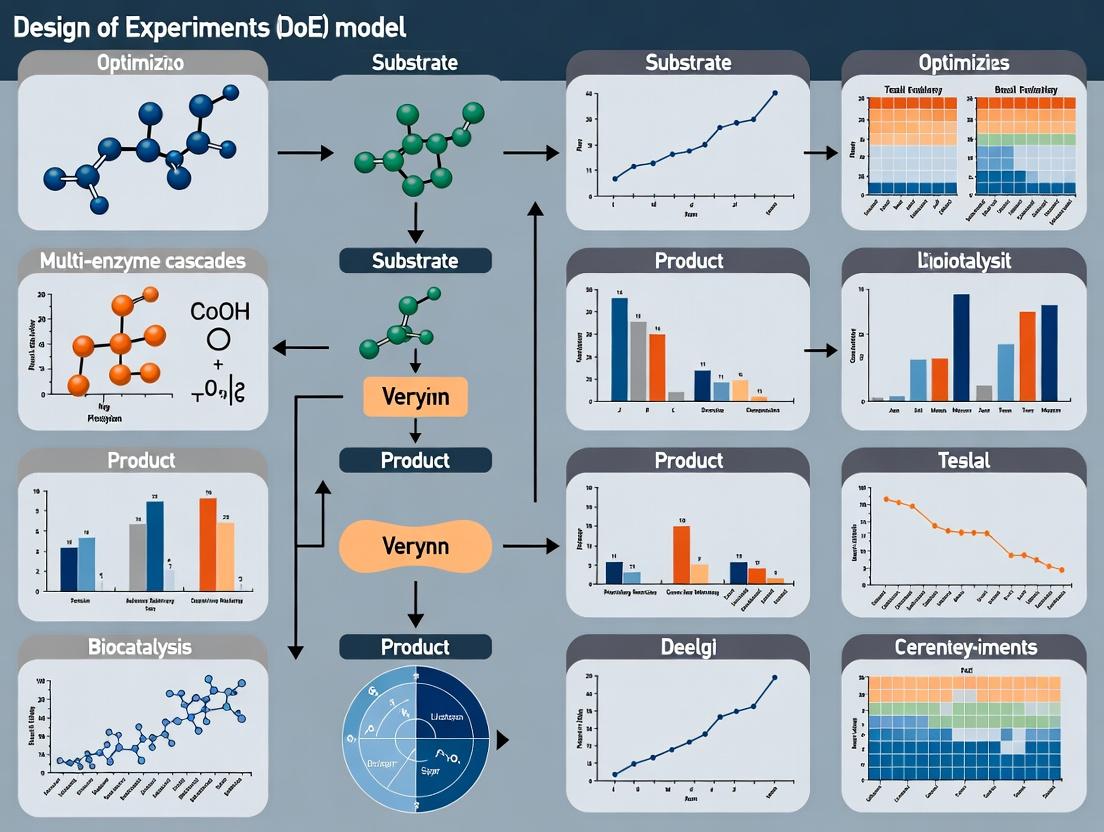
This article provides a complete roadmap for applying Design of Experiments (DoE) to optimize complex multi-enzyme cascade reactions, critical for biocatalysis and pharmaceutical synthesis.
Optimizing Multi-Enzyme Cascades: A Comprehensive Design of Experiments (DoE) Guide for Biomedical Researchers
Abstract
This article provides a complete roadmap for applying Design of Experiments (DoE) to optimize complex multi-enzyme cascade reactions, critical for biocatalysis and pharmaceutical synthesis. We cover foundational principles, strategic experimental design for multi-factor systems, troubleshooting common pitfalls, and robust methods for validation. Tailored for researchers and drug development professionals, this guide bridges statistical methodology with practical application to accelerate the development of efficient, scalable enzymatic processes.
The Why and What: Understanding DoE Fundamentals for Complex Enzyme Systems
Application Notes: The Case for DoE in Cascade Optimization
Multi-enzyme cascades mimic natural metabolic pathways for sustainable synthesis of complex molecules, including pharmaceutical intermediates. However, their development is hampered by multidimensional optimization challenges. Traditional One-Variable-at-a-Time (OVAT) approaches are inefficient and fail to capture critical factor interactions, leading to suboptimal performance and missed synergies.
Table 1: Key Optimization Variables & Their Interactions in a Model Cascade (e.g., Cell-Free NADPH Regeneration)
| Variable Category | Specific Factor | Typical Range Studied | Observed Interaction with Enzyme Ratio (Example) |
|---|---|---|---|
| Physical-Chemical | pH | 6.5 - 8.5 | Strong interaction with cofactor stability and enzyme kinetics. |
| Chemical | Mg²⁺ Concentration | 1 - 10 mM | Interacts with ATP concentration and kinase activity. |
| Enzyme-Related | Enzyme A : Enzyme B Ratio | 1:5 to 5:1 | Central driver of flux; interacts with substrate loading. |
| Process | Temperature | 25 - 37 °C | Interacts with pH and enzyme half-life. |
| Substrate/Cofactor | Initial ATP Load | 0.1 - 2.0 mM | Interacts with Mg²⁺ and impacts feedback inhibition. |
Table 2: OVAT vs. DoE Approach Outcomes for a 3-Enzyme Cascade
| Optimization Metric | OVAT Method Result | Structured DoE (Fractional Factorial) Result | % Improvement |
|---|---|---|---|
| Final Product Titer (mM) | 4.8 ± 0.3 | 8.1 ± 0.2 | +68.8% |
| Total Reaction Time (hrs) | 6.0 | 3.5 | -41.7% |
| Cofactor Turnover Number (TON) | 120 | 450 | +275% |
| Number of Experiments Required | 45 | 16 | -64.4% |
Protocol: Design of Experiments (DoE) for Initial Cascade Screening
Objective: To efficiently screen the main effects and two-factor interactions of four critical variables (pH, [Mg²⁺], Enzyme Ratio, Temperature) on product yield and reaction rate using a fractional factorial design.
Materials & Reagent Solutions:
- Research Reagent Solutions:
- Immobilized Enzyme Cocktail: Lyophilized or co-immobilized enzymes (e.g., kinase, dehydrogenase, synthase). Function: Central biocatalysts; immobilization can enhance stability and reusability.
- Regenerated Cofactor System (e.g., NADP⁺/NADPH): Includes sacrificial substrate and regenerating enzyme (e.g., glucose dehydrogenase). Function: Maintains cofactor homeostasis cost-effectively.
- Broad-Range Buffer System (e.g., HEPES or Tris): 1.0 M stock, pH adjustable. Function: Maintains pH across the experimental design space.
- High-Purity Substrate/Precursor: >98% purity in DMSO or buffer stock. Function: Ensures reproducible initial reaction conditions.
- Stopping/Quenching Agent: e.g., 2M HCl or acetonitrile with internal standard. Function: Precisely halts reaction for analysis.
Procedure:
- Experimental Design: Generate a 2⁴⁻¹ fractional factorial design (Resolution IV) using statistical software (e.g., JMP, Minitab, R). This creates 8 unique experimental runs, plus 3 center point replicates (total n=11).
- Factor Level Preparation:
- Prepare master reaction mix containing all common components (substrate, cofactor, regenerating system).
- Aliquot master mix into 11 reaction vials.
- Independently adjust each vial to specified levels of pH (using buffer stock), [Mg²⁺] (from a MgCl₂ stock), and Temperature (using a thermocycler or water baths).
- Reaction Initiation: Start reactions by adding the predetermined Enzyme Ratio (varied by volume of separate enzyme stock solutions) to each vial. Vortex briefly.
- Kinetic Monitoring: Immediately transfer an aliquot to a pre-equilibrated microplate. Monitor initial reaction rate (V₀) spectrophotometrically (e.g., NADPH absorbance at 340 nm) for 5 minutes.
- Endpoint Analysis: Quench remaining main reaction at t=60 minutes with stopping agent. Analyze product formation via HPLC or LC-MS using a validated method.
- Data Analysis: Input Yield (mM) and V₀ (mM/min) as responses into the DoE software. Perform ANOVA to identify significant main effects and interactions. Generate response surface and contour plots.
Visualizations
(Title: OVAT vs DoE in Cascade Development)
(Title: Structured DoE Workflow for Cascade Optimization)
The Scientist's Toolkit: Key Research Reagent Solutions
| Item | Function in Multi-Enzyme Cascade Optimization |
|---|---|
| Stabilized Cofactor Pools | Engineered cofactors (e.g., polyethylene glycol (PEG)-NAD⁺) with enhanced stability and membrane permeability for in vitro or whole-cell systems. |
| Broad-Specificity Assay Kits | Coupled enzymatic/colorimetric assays for rapid, high-throughput quantification of common functional groups (amines, aldehydes, phosphates). |
| Cross-Linking Enzyme Aggregates (CLEAs) | Immobilized enzyme preparations offering enhanced stability, easy recovery, and tunable enzyme ratios in a single carrier-free particle. |
| Oxygen-Scavenging/Control Systems | Enzyme-based (e.g., glucose oxidase/catalase) or chemical systems to precisely control dissolved O₂, critical for oxidoreductases. |
| Time-Sampled Quenching Devices | Automated microfluidic or handheld devices for precise, reproducible quenching of reactions at millisecond intervals for accurate kinetics. |
Application Notes: DoE for Multi-Enzyme Cascade Optimization
Design of Experiments (DoE) is a systematic, statistical approach for planning and conducting experiments to efficiently optimize processes. In multi-enzyme cascade research—a cornerstone of modern biocatalysis for drug intermediate synthesis—DoE is indispensable for navigating complex variable landscapes. Unlike one-factor-at-a-time (OFAT) approaches, DoE identifies not just main effects but also critical interaction effects between factors such as pH, temperature, cofactor concentrations, and enzyme ratios, which are pivotal for cascade efficiency and yield.
Key Principles in a Biocatalytic Context
- Factors: The independent variables deliberately varied. These are categorized as:
- Controllable: (e.g., Temperature (°C), pH, Enzyme A:B Ratio, Substrate Influx Rate, Cofactor [Mg²⁺]).
- Uncontrollable (Noise): (e.g., batch-to-batch enzyme activity variation, minor impurity profiles in substrates).
- Responses: The measured outcomes or dependent variables. For an enzyme cascade, primary responses include:
- Final Product Yield (%)
- Total Turnover Number (TTN)
- Reaction Rate (mM/min)
- By-product Formation (%)
- Process Mass Intensity (PMI)
- Interactions: Occur when the effect of one factor depends on the level of another. For example, the optimal temperature for maximal yield may shift depending on the pH of the buffer. DoE models these interactions (e.g., Temp*pH), which are often the key to robust process understanding.
Table 1: Typical Factor Ranges and Effects on Cascade Yield (Response)
| Factor | Low Level (-1) | High Level (+1) | Main Effect on Yield (Typical) | Key Interaction (Example) |
|---|---|---|---|---|
| Temperature | 25°C | 37°C | Positive (to an optimum) | Temp * pH: High temp may be deleterious at low pH. |
| pH | 7.0 | 8.5 | Curvilinear | pH * [Cofactor]: Cofactor stability often pH-dependent. |
| [Enzyme A] | 0.5 mg/mL | 2.0 mg/mL | Positive, subject to saturation | [Enz A] * [Enz B]: Optimal ratio is critical for flux. |
| [Cofactor] | 1.0 mM | 5.0 mM | Positive, then plateau | [Cofactor] * Temp: May affect binding kinetics. |
Table 2: Example Full Factorial DoE (2^3 Design) for Screening
| Run | Temp | pH | [Cofactor] | Yield (%) |
|---|---|---|---|---|
| 1 | -1 (25°C) | -1 (7.0) | -1 (1 mM) | 45 |
| 2 | +1 (37°C) | -1 | -1 | 58 |
| 3 | -1 | +1 (8.5) | -1 | 62 |
| 4 | +1 | +1 | -1 | 71 |
| 5 | -1 | -1 | +1 (5 mM) | 52 |
| 6 | +1 | -1 | +1 | 65 |
| 7 | -1 | +1 | +1 | 75 |
| 8 | +1 | +1 | +1 | 82 |
Experimental Protocols
Protocol 1: Screening Experiments Using a 2-Level Full Factorial Design
Objective: Identify significant factors (Temperature, pH, Enzyme Ratio) influencing final product yield in a 3-enzyme cascade.
Materials: See "The Scientist's Toolkit" below.
Method:
- Experimental Design: Generate a 2³ full factorial design matrix (8 experiments + 3 center points for curvature check) using statistical software (e.g., JMP, Minitab, Design-Expert).
- Reaction Setup:
- Prepare a master mix of buffer (e.g., 50 mM Tris) and primary substrate.
- Aliquot the master mix into 24-well micro-reactor plates according to the design matrix.
- Adjust pH of each well to target levels (±0.05) using dilute HCl or NaOH.
- Place the plate on a thermostated microplate shaker set to the specified temperatures (±0.5°C).
- Initiation & Quenching:
- Start reactions by adding an enzyme cocktail (Enzymes A, B, C) at the specified ratios via a multichannel pipette.
- Allow reactions to proceed for a fixed time (e.g., 60 min).
- Quench reactions instantly by adding 50 µL of 1M HCl (or appropriate quenching agent) to each well.
- Analysis:
- Centrifuge plates (3000 x g, 5 min) to remove precipitates.
- Dilute supernatants appropriately with mobile phase.
- Analyze product concentration via calibrated UPLC-UV/MS.
- Data Analysis:
- Input yield data into the DoE software.
- Fit a first-order linear model with interaction terms:
Yield = β₀ + β₁(Temp) + β₂(pH) + β₃(Ratio) + β₁₂(Temp*pH) + β₁₃(Temp*Ratio) + β₂₃(pH*Ratio). - Use ANOVA (p<0.05) and Pareto charts to identify significant factors/interactions.
Protocol 2: Response Surface Methodology (RSM) for Optimization
Objective: Find the optimal levels of two critical factors (identified in Screening) to maximize yield.
Method:
- Design: Employ a Central Composite Design (CCD) around the suspected optimum (e.g., 5 levels for each of the two key factors, 13 runs total).
- Execution: Perform cascade reactions as in Protocol 1, strictly following the CCD matrix for the two factors while holding others constant.
- Modeling & Optimization:
- Fit a second-order quadratic model:
Yield = β₀ + β₁A + β₂B + β₁₁A² + β₂₂B² + β₁₂AB. - Generate contour (2D) and response surface (3D) plots from the model.
- Use the software's numerical optimizer to find factor levels that maximize predicted yield, potentially with constraints (e.g.,
[Cofactor] < 4 mM).
- Fit a second-order quadratic model:
Visualizations
DoE Workflow for Enzyme Cascade Optimization
Factors Influencing a 2-Step Enzyme Cascade
The Scientist's Toolkit
Table 3: Essential Research Reagent Solutions for DoE in Enzyme Cascades
| Reagent / Material | Function in DoE Context |
|---|---|
| Multi-Buffer Stock System (e.g., Tris, Phosphate, HEPES across pH range) | Enables rapid, precise pH adjustment across factorial design points without introducing confounding ionic strength variables. |
| Enzyme Master Stocks (Lyophilized) | Ensures consistent starting activity across all experimental runs; critical for distinguishing true factor effects from noise. |
| Quenching Solution Plates (Pre-dispensed acid/base/chelator) | Allows simultaneous, precise quenching of microplate reactions for accurate kinetic snapshots. |
| Internal Standard Mix for Analytics | Added post-quench to correct for analytical instrument variability (UPLC/MS), improving response data quality. |
| Thermostated Microplate Shaker/Incubator | Precisely controls temperature (a key factor) with mixing for uniform reaction conditions in high-throughput setups. |
| Statistical DoE Software (JMP, Design-Expert, Minitab) | Used to generate design matrices, randomize run order, and perform ANOVA & regression modeling of responses. |
Application Notes: DoE for Multi-Enzyme Cascade Optimization
Quantitative Efficiency Gains
A comparative analysis between One-Factor-At-a-Time (OFAT) and Definitive Screening Design (DSD) for a three-enzyme cascade (Cellulase, Xylanase, β-Glucosidase) reveals stark differences in resource utilization and information yield.
Table 1: Experimental Efficiency Comparison
| Metric | OFAT Approach | DSD (DoE) Approach | Advantage Ratio |
|---|---|---|---|
| Total Experiments | 81 (3^4 factors) | 17 runs | 4.8x more efficient |
| Time to Completion | 5 weeks | 7 days | 5x faster |
| Interaction Effects Discovered | 0 (by design) | 6 significant | ∞ |
| Predictive Model R² | Not possible | 0.92 | N/A |
| Material Consumed | 810 mL | 170 mL | 4.8x less |
Critical Interaction Discovery
In a recent study optimizing a cytochrome P450 cascade with a ferredoxin reductase partner, a full factorial DoE (2^3) uncovered a profound synergistic interaction between pH and cofactor concentration (NADPH). This interaction, invisible to OFAT, accounted for a 40% increase in total turnover number (TTN).
Table 2: Significant Interactions in a P450 Cascade
| Factor A | Factor B | Interaction p-value | Effect on TTN | Biological Implication |
|---|---|---|---|---|
| pH | [NADPH] | 0.003 | +40% | Protonation state affects cofactor binding affinity |
| [Enzyme A] | [Enzyme B] | 0.017 | +22% | Complex formation reduces substrate diffusion distance |
| Temperature | Mg²⁺ | 0.032 | +15% | Divalent cation stabilizes enzyme structure at higher T |
Predictive Power for Response Surface Mapping
A Central Composite Design (CCD) applied to a transaminase-amine dehydrogenase cascade generated a robust quadratic model. This model accurately predicted an optimal operating space, later validated, yielding a 3.1-fold improvement in product enantiomeric excess (e.e.) over the OFAT-derived baseline.
Table 3: Model Validation Results
| Predicted Optimal Point | Predicted e.e. | Actual e.e. (Validation Run) | Prediction Error |
|---|---|---|---|
| pH=7.8, T=32°C, [Sub]=45mM | 94.5% | 92.7% | 1.8% |
| OFAT "Optimum" (pH=7.5, T=37°C, [Sub]=30mM) | N/A (No model) | 30.1% | N/A |
Detailed Experimental Protocols
Protocol 1: Definitive Screening Design for Initial Cascade Characterization
Objective: Rapidly screen 5-7 critical factors (e.g., enzyme ratios, pH, temp, cofactors) for main effects and active two-factor interactions with minimal runs.
Materials: See "Scientist's Toolkit" below. Procedure:
- Design Generation: Use statistical software (JMP, Design-Expert, R
rsmpackage) to generate a DSD forkfactors (e.g., 6 factors in 13 runs). - Experimental Setup: Prepare master mixes for each enzyme component. In a 96-deep well plate, assemble reactions according to the randomized run order specified by the design matrix. Maintain a constant total reaction volume (e.g., 200 µL).
- Process Execution: Incubate plate in a thermocycler or thermal shaker with precise temperature control. Quench reactions at a predetermined timepoint with 20 µL of 2M HCl.
- Analysis: Quantify product via UPLC-MS or a calibrated fluorescent/colorimetric assay. Record response (e.g., yield, rate, TTN).
- Statistical Analysis:
- Fit a model containing all main effects and two-factor interactions.
- Use forward selection with a stringent alpha (e.g., 0.01) to identify significant effects.
- Generate a Pareto chart of effects and a prediction profiler.
Protocol 2: Response Surface Methodology (RSM) for Optimization
Objective: Model the nonlinear relationship between key factors identified in screening and find the optimum.
Procedure:
- Design Selection: For 2-4 critical factors, employ a Central Composite Design (CCD) or Box-Behnken Design (BBD). A CCD for 3 factors requires ~20 runs (8 factorial points, 6 axial points, 6 center points).
- Experimental Execution: Perform runs in fully randomized order to avoid confounding with temporal drift. Include center point replicates to estimate pure error.
- Model Fitting & Validation:
- Fit a second-order polynomial model:
Y = β₀ + ΣβᵢXᵢ + ΣβᵢᵢXᵢ² + ΣβᵢⱼXᵢXⱼ. - Perform ANOVA to assess model significance and lack-of-fit.
- Check diagnostics: Normal probability plot of residuals, residuals vs. predicted plot.
- Use the model's optimization function to find desired maximum(s) or minimum(s).
- Conduct 3-5 confirmation experiments at the predicted optimum.
- Fit a second-order polynomial model:
Visualizations
Title: OFAT vs DoE Workflow for 2 Factors
Title: Multi-Enzyme Cascade with Critical Factors
The Scientist's Toolkit: Key Research Reagent Solutions
Table 4: Essential Materials for DoE in Enzyme Cascades
| Item | Function & Relevance to DoE |
|---|---|
| Statistical Software (JMP/Design-Expert/R) | Generates efficient design matrices, analyzes complex data, fits models, and performs optimization. Crucial for implementing DoE. |
| Automated Liquid Handler (e.g., Beckman FX) | Enables precise, high-throughput assembly of dozens of unique reaction conditions specified by a design matrix with minimal error. |
| 96- or 384-Well Deep Well Plates | Miniaturized reaction vessels allowing parallel execution of many DoE runs, conserving precious enzyme and substrate. |
| Multi-Channel Pipette & Reagent Reservoirs | For rapid, parallel dispensing of common components (buffers, cofactors) across multiple DoE runs. |
| Controlled-Temperature Incubator/Shaker | Precisely controls a critical factor (temperature) across all experimental runs, reducing noise. |
| Rapid-Quench Solution (e.g., Acid/Base) | Stops all enzymatic activity at exact timepoints, ensuring accurate kinetic measurements for model responses. |
| UPLC-MS/HPLC System with Autosampler | Provides quantitative, multi-analyte data (substrate, intermediates, product) for comprehensive response measurement from small-volume DoE runs. |
| Stable, Lyophilized Enzyme Preps | Ensures consistent activity across the entire DoE study, a prerequisite for reliable model building. |
| Designated DoE Lab Notebook Template | Pre-formatted sheets to record run order, factor levels, and responses, preventing transcription errors from design matrix to lab record. |
Application Notes for DoE in Multi-Enzyme Cascade Optimization
Within a Design of Experiments (DoE) framework for multi-enzyme cascade research, rigorous preliminary planning is critical. These initial steps define the experimental space and ensure data quality and relevance.
Defining Objectives: The primary objective is to systematically identify and model the effects of key process parameters (e.g., pH, temperature, enzyme ratios, substrate concentration, cofactor levels) on the cascade's performance. This moves beyond one-factor-at-a-time (OFAT) approaches to capture interactions and nonlinear effects, aiming to establish a robust, predictive model for optimization.
Selecting Critical Quality Attributes (CQAs): CQAs are measurable indicators of cascade performance and product quality. Selection is based on risk to process efficacy and final product specifications. For a therapeutic enzyme cascade producing an active pharmaceutical ingredient (API), CQAs are hierarchically linked to Quality Target Product Profile (QTPP) elements.
Scoping Factors: A risk assessment, often using prior knowledge and literature, is conducted to screen potential factors. High-risk factors likely to significantly impact CQAs are selected as independent variables for the DoE. Low-risk or fixed parameters are controlled at constant levels.
Table 1: Hierarchy of CQAs for a Model API-Producing Enzyme Cascade
| QTPP Element | Associated CQA | Target | Justification |
|---|---|---|---|
| Potency | Final Product Titer (mM) | > 50 mM | Directly impacts dosage and economic viability. |
| Purity | % API by HPLC | > 98.5% | Critical for patient safety and regulatory approval. |
| Process Efficiency | Total Yield (%) | > 85% | Key metric for resource utilization and cost. |
| Process Robustness | Space-Time Yield (g/L/h) | Maximize | Indicates productivity and scalability potential. |
| Impurity Profile | % Key Side-Product | < 1.0% | Must be controlled within toxicology limits. |
Table 2: Scoped Experimental Factors and Ranges for Screening DoE
| Factor Name | Type | Low Level (-1) | High Level (+1) | Rationale for Inclusion |
|---|---|---|---|---|
| pH | Continuous | 6.5 | 8.0 | Affects activity/stability of all enzymes. |
| Temperature (°C) | Continuous | 25 | 37 | Trade-off between reaction rate and enzyme denaturation. |
| Enzyme 1:Enzyme 2 Ratio | Continuous | 1:2 | 2:1 | Stoichiometry and kinetics dictate optimal balance. |
| Initial Substrate [S] (mM) | Continuous | 50 | 200 | May influence rate and potential inhibition. |
| Cofactor Concentration (mM) | Continuous | 0.5 | 2.0 | Essential for oxidoreductase classes; cost driver. |
| Buffer Ionic Strength (mM) | Categorical | 50 (Low) | 150 (High) | Can modulate enzyme activity and protein-protein interactions. |
Experimental Protocols
Protocol 1: Defining CQAs via High-Throughput Microscale Screening
Objective: To rapidly quantify primary CQAs (Titer, Yield) from multiple cascade reactions run in parallel under varying conditions. Materials: See "Scientist's Toolkit" below. Method:
- Experimental Design Setup: Use DoE software to generate a screening design (e.g., fractional factorial or Plackett-Burman) for the factors in Table 2. Randomize the run order.
- Reaction Assembly: In a 96-deep well plate, prepare master mixes of buffer components. Using a liquid handler, dispense variable volumes to achieve the designed factor levels. Add enzyme stocks last to initiate reactions. Seal plate to prevent evaporation.
- Incubation: Place plate in a thermostatted shaker (compatible with microplates) set to the designed temperature with orbital shaking at 500 rpm for the fixed reaction duration (e.g., 2 hours).
- Quenching & Dilution: After incubation, automatically quench reactions by adding 100 µL of 1 M HCl (or suitable quenching agent) to each well. Perform appropriate dilutions in a new 96-well PCR plate using a diluent compatible with downstream analysis.
- Analytical Sampling: Inject samples from the dilution plate via an autosampler into an UHPLC system equipped with a UV/VIS or CAD detector. Use a validated method to separate and quantify the API and key side-products.
- Data Processing: Integrate chromatographic peaks. Calculate titer (mM) and yield (%) based on external standard curves. Compile data matrix for DoE analysis.
Protocol 2: Scoping Factors via Risk Assessment and Prior Knowledge Review
Objective: To systematically identify and prioritize potential factors for inclusion in the initial DoE. Method:
- Brainstorming Session: Assemble a multidisciplinary team (biocatalysis, process engineering, analytics) to list all conceivable factors that could influence the cascade. Use tools like cause-and-effect (Ishikawa) diagrams.
- Literature Mining: Perform a structured search (e.g., in PubMed, Scopus) for similar multi-enzyme systems or individual enzyme homologs. Extract reported optimal ranges and sensitive parameters.
- Risk Ranking and Filtering: Create a risk assessment matrix. Score each factor on a scale (e.g., 1-5) for its Potential Impact on CQAs (based on literature/mechanism) and the Level of Uncertainty (lack of data). Multiply scores to obtain a risk priority number (RPN).
- Factor Categorization: Factors with high RPN are designated as Experimental Variables for DoE. Factors with moderate RPN but that are expensive or difficult to vary (e.g., expression host) may be set as Controlled Constant factors. Factors with low RPN are Noise Factors to be monitored.
- Range Justification: For each experimental variable, define the minimum and maximum level based on literature extremes, enzyme stability data, or solubility limits, ensuring the range is wide enough to detect an effect but not so wide as to cause complete failure.
Mandatory Visualizations
(Diagram 1: Preliminary Steps in the DoE Workflow)
(Diagram 2: Relationship Between QTPP, CQAs, and Parameters)
The Scientist's Toolkit: Research Reagent Solutions
Table 3: Essential Materials for Preliminary DoE Studies on Enzyme Cascades
| Item | Function/Application | Example Vendor/Product |
|---|---|---|
| Multi-Enzyme System (Lyophilized) | The biocatalysts of interest, often recombinantly expressed and purified. Required for assembling the cascade. | Sigma-Aldrich (various), Codexis (engineered enzymes) |
| High-Purity Substrates & Cofactors | Reaction starting materials and essential co-substrates (e.g., NAD(P)H, ATP, SAM). Purity critical for reproducible kinetics. | Carbosynth, Toronto Research Chemicals |
| Tris or Phosphate Buffer Salts | For preparing buffers at precise pH and ionic strength levels, a key controlled or experimental factor. | Thermo Fisher Scientific |
| 96-Deep Well Microplates (1-2 mL) | High-throughput reaction vessel for running many DoE conditions in parallel with small reagent volumes. | Azenta, Corning |
| Automated Liquid Handling System | Enables precise, reproducible dispensing of enzymes, substrates, and buffers for DoE assembly. | Hamilton Company, Beckman Coulter (Biomek) |
| Microplate Thermo-Shaker | Provides temperature control and agitation for reactions in microplates, a key experimental factor. | Eppendorf (ThermoMixer C) |
| UHPLC System with Autosampler | For rapid, quantitative analysis of reaction outcomes (titer, purity, yield) across many samples. | Waters (H-Class), Agilent (1290 Infinity II) |
| DoE Software | For designing statistically sound experiments and analyzing multivariate response data (e.g., JMP, Design-Expert, MODDE). | JMP (SAS), Minitab |
Within the thesis on Design of Experiments (DoE) for optimizing multi-enzyme cascades, selecting the appropriate experimental design is paramount. Enzyme cascades involve complex interactions between pH, temperature, substrate concentrations, cofactors, and enzyme ratios. This application note contrasts two critical, sequential DoE phases: initial factor screening using designs like Plackett-Burman (PBD) and subsequent optimization using Response Surface Methodology (RSM). Screening identifies the "vital few" influential factors from many, while RSM models curvature and interactions to find optimal conditions.
Theoretical Framework & Comparison
Core Objectives and Applications
Screening designs are used early in cascade development to efficiently eliminate non-significant variables. Optimization designs are employed to precisely model the response surface and locate a maximum (e.g., yield), minimum (e.g., byproduct), or desired operating window.
Quantitative Design Comparison
Table 1: Comparison of Screening and Optimization DoE Designs
| Aspect | Screening Designs (e.g., Plackett-Burman) | Optimization Designs (e.g., Response Surface) |
|---|---|---|
| Primary Goal | Identify key influential factors from many | Model curvature & find optimal factor settings |
| Experimental Runs | Low (N = multiple of 4; e.g., 12, 20, 24) | Higher (e.g., 13-30 for Central Composite) |
| Factor Coverage | High (can screen up to N-1 factors) | Low (typically 2-5 key factors) |
| Model Fidelity | Main effects only (aliased with interactions) | Full quadratic model (interactions & curvature) |
| Resolution | Resolution III or IV | Resolution V or higher |
| Best For Phase | Early-stage factor prioritization | Late-stage process optimization |
Table 2: Example Run Counts for Common Designs
| Design Type | Specific Design | Factors | Runs | Notes |
|---|---|---|---|---|
| Screening | Plackett-Burman | 11 | 12 | Resolution III |
| Screening | Fractional Factorial (2^(5-2)) | 5 | 8 | Resolution III |
| Optimization | Central Composite (CCD) | 3 | 20 (8 cube, 6 star, 6 center) | Full quadratic model |
| Optimization | Box-Behnken | 3 | 15 | Spherical, no corner points |
Application Protocols
Protocol A: Screening with a Plackett-Burman Design for a 3-Enzyme Cascade
Objective: Identify which of 7 factors significantly affect the final product titer (mg/L) of a cascade. Factors & Levels (-1, +1):
- A: pH (6.5, 7.5)
- B: Temperature (°C) (25, 35)
- C: [Enzyme 1] (mg/mL) (0.1, 0.5)
- D: [Enzyme 2] (mg/mL) (0.1, 0.5)
- E: [Enzyme 3] (mg/mL) (0.05, 0.2)
- F: [Cofactor] (mM) (0.5, 2.0)
- G: Incubation time (min) (30, 90)
Procedure:
- Design Generation: Generate a 12-run Plackett-Burman design matrix (N=12). Randomize run order.
- Reaction Assembly: In 1.5 mL microcentrifuge tubes, prepare reaction mixtures according to the design matrix. Use a master mix for common buffer components.
- Cascade Execution: Initiate reactions by adding the rate-limiting enzyme. Incubate in a thermomixer at the specified temperature with shaking (500 rpm).
- Quenching & Analysis: Stop reactions at the specified time by adding 50 µL of 1M HCl. Clarify by centrifugation (13,000 x g, 5 min). Analyze product concentration via HPLC-UV.
- Data Analysis: Perform linear regression/ANOVA. Rank factors by Pareto chart of standardized main effects. Select factors with p-value < 0.05 (or using half-normal plot) for optimization.
Protocol B: Optimization with a Central Composite Design (CCD)
Objective: Optimize the 3 most significant factors (e.g., pH, [Enzyme 1], [Cofactor]) from Protocol A to maximize product titer. Design: A face-centered CCD with 3 factors (α=1), comprising 8 factorial points, 6 axial points, and 6 center points (total 20 runs). Center points assess pure error and curvature.
Procedure:
- Design Setup: Define low, middle, and high levels for each factor. The axial points are set at ±α (here, ±1) from the center.
- Experimental Execution: Perform cascades as in Protocol A, following the randomized CCD run order. Include analytical replicates.
- Model Fitting: Fit a second-order polynomial model:
Y = β₀ + ΣβᵢXᵢ + ΣβᵢᵢXᵢ² + ΣβᵢⱼXᵢXⱼ. Use multiple regression. - Analysis & Validation: Check model adequacy (R², adj-R², pred-R², lack-of-fit test). Generate 3D response surface and contour plots. Locate the stationary point (maximum). Perform confirmatory runs at predicted optimum.
The Scientist's Toolkit: Research Reagent Solutions
Table 3: Essential Reagents for DoE in Enzyme Cascades
| Reagent/Material | Function & Importance in DoE |
|---|---|
| Multifactor Thermonixer | Precise, simultaneous control of temperature and shaking for parallel miniaturized reactions, enabling execution of randomized design runs. |
| LC-MS/HPLC System | Provides accurate, quantitative analysis of cascade substrates, intermediates, and products—the critical response data for DoE models. |
| Statistical Software (JMP, Design-Expert, R) | Required for generating design matrices, randomizing runs, performing ANOVA, regression, and visualizing response surfaces. |
| 96-Well Deep Well Plates | Enable high-throughput assembly of reaction mixtures for screening designs, compatible with liquid handling robots. |
| Enzyme Cocktail Master Mixes | Ensure consistency when dispensing common components across many experimental runs, reducing preparation error. |
| Quenching Solution | Rapidly and uniformly stops enzymatic reactions at precise times, critical for accurate time-point data. |
| Internal Standards (isotope-labeled) | Used in LC-MS analysis to correct for sample preparation and instrument variability, improving data quality for modeling. |
Visualized Workflows
Diagram 1: Sequential DoE workflow for enzyme cascades (max 760px width).
Diagram 2: Structure of a Plackett-Burman screening design matrix (max 760px width).
Diagram 3: Central Composite Design point structure for optimization (max 760px width).
Strategic Design and Execution: Building Your DoE Plan for Cascade Optimization
Within the broader thesis on "Design of Experiments (DoE) for Optimizing Multi-Enzyme Cascades," this framework provides a structured protocol to transition from a theoretical hypothesis to a statistically robust experimental array. Efficient optimization of enzyme cascades—critical for biocatalysis in pharmaceutical synthesis—requires a systematic approach to navigate complex parameter spaces (e.g., pH, temperature, enzyme ratios, cofactor concentrations).
The Step-by-Step Framework
Phase 1: Hypothesis Formulation
- Objective: Define a clear, testable hypothesis linking process parameters to cascade performance metrics.
- Protocol:
- Identify Response Variables (Y): Select quantifiable outputs (e.g., % yield, final product titer, total turnover number (TTN)).
- Define Critical Process Parameters (X): List all potential influencing factors via literature review and preliminary data.
- Formulate Hypothesis: State an expected cause-effect relationship. Example: "Simultaneous adjustment of pH (X₁) and molar ratio of Enzyme A to B (X₂) will significantly impact the product yield (Y₁) of the cascade reaction, with an anticipated interaction effect."
Phase 2: Factor Screening
- Objective: Distinguish vital few factors from the trivial many.
- Protocol: Employ a Plackett-Burman or Fractional Factorial design.
- Set each factor at a "High" (+1) and "Low" (-1) level.
- Execute the minimal experimental array per the design matrix.
- Analyze data using ANOVA to identify factors with statistically significant (p < 0.05) effects on the response.
Phase 3: Experimental Array Design (DoE)
- Objective: Create an optimized set of experiments to model system behavior.
- Protocol: For 2-5 critical factors, use a Response Surface Methodology (RSM) design.
- Select Design Type: Central Composite Design (CCD) or Box-Behnken Design.
- Define Levels: Include axial/center points (e.g., 5 levels per factor in CCD).
- Generate Array: Use statistical software (JMP, Minitab, Design-Expert) to create a randomized run order, minimizing batch effects.
Phase 4: Execution & Analysis
- Objective: Run experiments and fit a predictive model.
- Protocol:
- Execute reactions per the array under controlled conditions.
- Quantify responses via HPLC or UV/Vis spectrometry.
- Fit data to a second-order polynomial model:
Y = β₀ + ΣβᵢXᵢ + ΣβᵢᵢXᵢ² + ΣβᵢⱼXᵢXⱼ. - Validate model via lack-of-fit test and R² (adjusted & predicted).
Data Presentation
Table 1: Example 2-Factor Central Composite Design (CCD) Array for Enzyme Cascade Optimization
| Run Order | Coded Value: pH (X₁) | Coded Value: Enzyme Ratio (X₂) | Actual pH | Actual Ratio (A:B) | Observed Yield % (Y) |
|---|---|---|---|---|---|
| 1 | -1 | -1 | 6.0 | 1:1 | 45.2 |
| 2 | +1 | -1 | 8.0 | 1:1 | 62.1 |
| 3 | -1 | +1 | 6.0 | 1:3 | 38.7 |
| 4 | +1 | +1 | 8.0 | 1:3 | 81.5 |
| 5 | -α | 0 | 5.5 | 1:2 | 33.0 |
| 6 | +α | 0 | 8.5 | 1:2 | 70.4 |
| 7 | 0 | -α | 7.0 | 1:0.5 | 58.9 |
| 8 | 0 | +α | 7.0 | 1:3.5 | 65.2 |
| 9-13 | 0 | 0 | 7.0 | 1:2 | 71.3, 72.8, 70.5, 73.1, 71.9 |
Experimental Protocols
Protocol: High-Throughput Screening for Initial Factor Assessment
- Purpose: Rapid assessment of factor levels for screening design.
- Materials: 96-well deep-well plate, multichannel pipette, thermoshaker, microplate reader.
- Method:
- Prepare master mixes of buffer components and substrates.
- Vary one factor per column/row as per the design matrix.
- Initiate reactions by adding enzyme mix. Final reaction volume: 500 µL.
- Incubate at 30°C, 500 rpm for 2 hours.
- Quench with 100 µL of 1M HCl. Centrifuge at 3000 x g for 5 min.
- Transfer 150 µL supernatant to a UV-star plate. Measure product absorbance at 340 nm.
- Calculate yield against a standard curve.
Protocol: Analytical HPLC for Response Quantification (Definitive Runs)
- Purpose: Accurate quantification of cascade product yield for RSM analysis.
- Materials: HPLC system with C18 column, UV detector, 0.22 µm syringe filters.
- Method:
- Quench 100 µL reaction aliquot with 300 µL acetonitrile. Vortex for 1 min.
- Centrifuge at 14,000 x g for 10 min. Filter supernatant.
- Inject 10 µL onto column equilibrated with 95% Solvent A (0.1% TFA in H₂O), 5% Solvent B (0.1% TFA in Acetonitrile).
- Run gradient: 5% B to 60% B over 15 min. Flow rate: 1.0 mL/min.
- Detect at 254 nm. Integrate peaks and calculate yield using external standard calibration curve (1-100 mg/L).
Mandatory Visualization
Title: DoE Framework for Enzyme Cascade Optimization
Title: Multi-Enzyme Cascade for Drug Synthesis
The Scientist's Toolkit: Research Reagent Solutions
Table 2: Essential Materials for Multi-Enzyme Cascade DoE Studies
| Item | Function / Role in DoE |
|---|---|
| Immobilized Enzyme Systems (e.g., on magnetic beads) | Enables easy ratio adjustment (a key factor) and reuse; improves stability across pH/temperature gradients. |
| Cofactor Recycling Systems (e.g., GDH/Glucose for NADPH) | Decouples cofactor cost from optimization, allowing focus on enzyme kinetic parameters. |
| High-Throughput Analytics Kit (e.g., coupled spectrophotometric assay) | Allows rapid data collection for the many runs required in a screening or RSM array. |
| Statistical Software (JMP, Design-Expert, Minitab) | Generates optimal experimental arrays, randomizes run order, and performs ANOVA/RSM analysis. |
| Modular Buffer System (e.g., Tris, Phosphate, HEPES stocks) | Facilitates precise and reproducible pH adjustment across a wide range (a common continuous factor). |
| In-Line Process Analyzers (pH, dissolved O₂ probes) | Provides real-time monitoring of critical process parameters (CPPs) during reaction progress. |
Within the thesis "Design of Experiments (DoE) for Optimizing Multi-Enzyme Cascades," factor selection is the critical first step. A well-designed multi-enzyme cascade for biosynthesis or drug intermediate production requires systematic optimization of interdependent biochemical and physical parameters. This Application Note details the pivotal factors—enzyme ratios, pH, temperature, cofactors, and substrate concentrations—providing protocols for their initial characterization and integration into a subsequent DoE framework to efficiently identify optimal reaction conditions.
Table 1: Typical Operational Ranges for Key Factors in Multi-Enzyme Cascades
| Factor | Typical Investigative Range | Common Optimal Zone (Varies by system) | Key Interaction Considerations |
|---|---|---|---|
| pH | 6.0 - 9.0 | 7.0 - 8.0 (for many cytosolic enzymes) | Strongly affects enzyme stability, activity, and cofactor affinity. Interacts with temperature. |
| Temperature | 20°C - 50°C | 30°C - 37°C (for mesophilic enzymes) | Affects reaction rate, enzyme denaturation, and byproduct formation. Interacts with pH. |
| Cofactor Conc. (e.g., NAD+) | 0.1 - 5.0 mM | 0.5 - 2.0 mM | Must be balanced with substrate flux to avoid depletion or excessive cost. Often recycled. |
| Substrate Conc. ([S]) | 0.1x - 10x Km | 1x - 5x Km (to avoid inhibition) | High [S] can cause inhibition; must match enzyme capacity. Critical for cascade flux. |
| Enzyme Ratio (E1:E2:En) | 1:1:1 to 1:10:10 (molar or activity-based) | Highly system-dependent | Determines flux balance, minimizes intermediate accumulation, and maximizes yield. |
Table 2: Example Initial Screening Data for a Two-Enzyme Cascade (Glucose → Fructose → Sorbitol)
| Condition | pH | Temp (°C) | [ATP] (mM) | [NADH] (mM) | Enzyme 1:2 Ratio | Observed Final Product Yield (%) |
|---|---|---|---|---|---|---|
| Baseline | 7.5 | 30 | 1.0 | 0.5 | 1:1 | 42 |
| High pH | 8.5 | 30 | 1.0 | 0.5 | 1:1 | 58 |
| High Temp | 7.5 | 40 | 1.0 | 0.5 | 1:1 | 35 |
| High Cofactor | 7.5 | 30 | 2.0 | 1.0 | 1:1 | 65 |
| High E2 | 7.5 | 30 | 1.0 | 0.5 | 1:2 | 78 |
Detailed Experimental Protocols
Protocol 1: Initial Factor Screening Using Univariate Analysis
Objective: To determine the approximate optimal range for each factor individually prior to DoE. Materials: See "The Scientist's Toolkit" below. Procedure:
- Establish Baseline: Run the cascade reaction at pH 7.5, 30°C, with mid-range cofactor and substrate concentrations, and a 1:1 enzyme activity ratio.
- Vary pH:
- Prepare separate reaction buffers (e.g., HEPES for pH 6.5-8.0, Tris for pH 7.5-9.0) adjusted to target pH values (6.0, 6.5, 7.0, 7.5, 8.0, 8.5).
- Initiate reactions with all other factors at baseline.
- Quench at fixed time points (e.g., 5, 10, 30 min).
- Vary Temperature:
- Using optimal pH from step 2, run reactions in thermostatted blocks or cyclers at 20, 25, 30, 35, 40, 45°C.
- Vary Cofactor Concentration:
- For each essential cofactor (e.g., NADH, ATP, Mg2+), prepare a dilution series (e.g., 0.1, 0.5, 1.0, 2.0, 5.0 mM).
- Run reactions at optimal pH and temperature.
- Vary Enzyme Ratio:
- Hold total protein constant or vary total activity. Prepare mixtures where the molar or activity ratio of E1:E2:En spans from 1:0.5:0.5 to 1:2:2.
- Run reactions under conditions optimized from steps 2-4.
- Analysis: Quantify final product yield and initial reaction velocity for each condition. Plot response vs. factor level to identify promising ranges for DoE.
Protocol 2: Coupled Activity Assay for Determining Functional Enzyme Ratios
Objective: To empirically determine the ratio that minimizes intermediate accumulation. Procedure:
- Setup: In a spectrophotometer or HPLC vial, combine buffer, cofactors, and substrates for the first enzyme.
- Initiate Cascade: Add a fixed amount of the first enzyme (E1). Monitor the appearance of the first intermediate (I1) spectroscopically or by rapid sampling for HPLC.
- Titrate Second Enzyme (E2): Repeat the reaction, but now include varying amounts of E2 (e.g., 0.1x, 0.5x, 1x, 2x relative to E1 activity).
- Monitor: Track both I1 accumulation and final product (P) formation. The optimal ratio is where I1 concentration remains low and steady-state, and P formation rate is maximal.
- Extend: For >2 enzymes, iterate this process downstream.
Visualization Diagrams
Title: DoE Optimization Workflow for Enzyme Cascades
Title: Key Factor Interactions in a Cascade Reaction
The Scientist's Toolkit: Research Reagent Solutions
| Item / Reagent | Function & Application | Key Consideration |
|---|---|---|
| HEPES Buffer | Effective buffering range pH 6.8-8.2. Used for initial pH screening of enzymes. | Minimal metal ion binding, ideal for cofactor-dependent enzymes. |
| Tris-HCl Buffer | Buffering range pH 7.0-9.0. Common for alkaline pH optima studies. | Temperature-sensitive pKa (~0.03/°C); requires precise temp control. |
| NAD+/NADH (or NADP+/NADPH) | Essential redox cofactors for dehydrogenases. Used to vary cofactor concentration and monitor reactions at 340 nm. | Prepare fresh solutions; check stability at working pH. Use recycling systems for cost-effectiveness. |
| Mg-ATP | Energy co-substrate for kinases and ATP-dependent enzymes. Varying [Mg2+] and [ATP] is critical. | Maintain Mg2+ in excess of ATP to ensure free Mg2+ for activation. |
| Immobilized Enzyme Kits | For facile adjustment of enzyme ratios via measured activity units (U). Simplifies recycling and ratio testing. | Ensure compatibility of immobilization matrix with all cascade components. |
| Stopped-Flow Apparatus | For rapid kinetic measurement of initial rates under different factor conditions (pH, temp). | Essential for capturing fast kinetics before product inhibition sets in. |
| LC-MS/HPLC System | For quantifying substrate, intermediate, and product concentrations to calculate yields and identify bottlenecks. | Enables monitoring of all chemical species simultaneously. |
| DoE Software (e.g., JMP, Modde, R) | For designing efficient experimental matrices (e.g., Central Composite Design) and modeling responses. | Critical for moving from univariate screening to multivariate optimization. |
Within the broader thesis on Design of Experiments (DoE) for optimizing multi-enzyme cascade reactions, selecting an appropriate initial screening design is paramount. Early-stage research often involves numerous factors—such as pH, temperature, enzyme ratios, cofactor concentrations, and substrate loadings—with potentially complex interactions. This Application Note compares two powerful design strategies for factor screening: Fractional Factorial Designs (FFD) and D-Optimal Designs. The objective is to efficiently identify the most influential factors affecting cascade yield and selectivity while minimizing experimental runs, conserving precious enzymes and substrates.
Quantitative Comparison of Screening Designs
Table 1: Core Characteristics of Fractional Factorial vs. D-Optimal Designs for Screening
| Feature | Fractional Factorial Design (FFD) | D-Optimal Design (for Screening) | ||
|---|---|---|---|---|
| Primary Goal | Identify main effects and low-order interactions with minimal runs. | Identify key effects from a large set of candidate factors, especially when classical designs are impractical. | ||
| Design Structure | Based on orthogonal arrays; a fraction (e.g., 1/2, 1/4) of a full factorial. | Computer-generated; selects a subset of runs from a candidate set to maximize the | X'X | determinant. |
| Run Efficiency | Highly efficient for factors with 2 levels (e.g., 8 runs for 7 factors in a 2^(7-4) design). | Highly flexible; can model specific terms with near-minimal runs (e.g., 12-20 runs for 8-10 factors). | ||
| Factor Levels | Typically 2 levels per factor (High/Low). | Can accommodate 2 or more levels, and mixture factors. | ||
| Aliasing Structure | Clear, known aliasing of effects (e.g., main effects confounded with 2-way interactions). | Aliasing is minimized for specified model but must be checked; not as inherently clear as FFD. | ||
| Model Assumptions | Requires pre-specification of resolution (e.g., Resolution III, IV). | Requires pre-specification of the model form to be estimated (e.g., main effects only). | ||
| Best for Screening When... | The number of factors is moderate (5-15), and run economy is critical. Assumptions about effect sparsity hold. | The design space is constrained (e.g., combinations of factor levels are impossible), or factors are categorical with >2 levels. | ||
| Key Limitation | Cannot estimate the full model; relies on effect hierarchy and sparsity. | Design is optimal only for the pre-specified model; may not perform well if model is incorrect. |
Table 2: Example Run Comparison for an 8-Factor Screening Study
| Design Type | Specific Design | Number of Runs | Effects Estimated Unambiguously | Key Assumption/Alias |
|---|---|---|---|---|
| Fractional Factorial | 2^(8-4) Resolution IV | 16 | All 8 main effects free of two-factor interaction (2FI) aliasing. | 2FI's are aliased with each other. |
| Fractional Factorial | 2^(8-3) Resolution III | 8 | All 8 main effects. | Main effects are aliased with 2FI's. |
| D-Optimal | Main Effects Model | 12 | 8 main effects + 3-4 degrees of freedom for error/lack of fit. | Model is correctly specified as main effects only. |
| D-Optimal | Main Effects + select 2FI's | 20 | 8 main effects + specified 2FI's. | Correct pre-identification of critical interactions is needed. |
Experimental Protocols for Screening Multi-Enzyme Cascades
Protocol 3.1: Screening Factor Selection and Level Definition
Objective: To define critical factors and their experimental ranges for the initial screening of a multi-enzyme cascade.
- Assemble Expert Knowledge: Form a team of enzymologists and process chemists. Use prior knowledge, literature, and preliminary data to list all potential influential factors (e.g., E1:E2 ratio, pH, [Mg2+], [NADPH], temperature, substrate concentration, reaction time).
- Categorize Factors: Classify as continuous (e.g., temperature) or categorical (e.g., buffer type).
- Define Practical Ranges: Set "Low" and "High" levels for each factor based on enzyme stability, solubility, and practicality. Avoid ranges that lead to complete reaction failure.
- Select Screening Design: Based on the number of factors (k) and resource constraints, choose between FFD and D-Optimal.
- If k is large (>7) and run economy is paramount, choose a Resolution III or IV FFD.
- If the design space has constraints (e.g., high pH and low temperature cannot run together) or includes categorical factors with >2 levels, choose a D-Optimal design.
- Generate Design Matrix: Use statistical software (JMP, Design-Expert, Minitab, R) to create the randomized run order.
Protocol 3.2: Execution of a Fractional Factorial Screening Experiment
Objective: To conduct the cascade reactions according to a 2^(7-4) Resolution IV FFD. Materials: See "Research Reagent Solutions" below. Procedure:
- Preparation: Prepare stock solutions of all enzymes, cofactors, and substrates. Pre-equilbrate water baths or thermoshakers to the target temperatures specified in the design matrix.
- Reaction Assembly (96-well plate scale): a. To each well, first add buffer to achieve final specified pH and volume. b. Sequentially add cofactors (e.g., NADPH, ATP) and metal ions (e.g., MgCl2) as per the design levels. c. Add the substrate(s) at the specified concentrations. d. Initiate the reaction by adding the enzyme mixture at the specified ratios (E1:E2:E3). Mix gently by pipetting.
- Incubation: Seal the plate and incubate at the specified temperature for the defined reaction time.
- Quenching: At the end of the incubation, quench all reactions simultaneously by adding 50 µL of quenching solution (e.g., 10% trichloroacetic acid or 90% MeOH) to each well.
- Analysis: Centrifuge the plate (3000 x g, 10 min) to precipitate proteins. Analyze the supernatant for product concentration via HPLC-UV/MS or a coupled enzymatic assay. Record yield (µM) and selectivity (if applicable) as response variables.
- Replication: Include at least 2-3 center points (all factors at mid-level) randomly distributed throughout the experiment to estimate pure error and check for curvature.
Protocol 3.3: Analysis of Screening Data and Model Selection
Objective: To identify significant factors from the screening experiment.
- Data Preparation: Compile response data with the corresponding factor levels for each run.
- Model Fitting (for FFD): Perform a linear regression analysis, fitting a model with all main effects. For Resolution IV designs, consider adding 2FI terms in a stepwise manner if degrees of freedom allow.
- Half-Normal Probability Plot: Construct a half-normal plot of the estimated effects. Effects that deviate significantly from the straight line formed by the negligible effects are deemed active.
- ANOVA & Pareto Analysis: Perform Analysis of Variance (ANOVA) for the model containing the active effects. Generate a Pareto chart of the standardized effects to visualize their relative magnitude and significance (p-value < 0.05 or 0.1).
- Model Diagnostics: Check residual plots (vs. predicted, vs. run order) for randomness and constant variance.
- Decision Point: Based on the identified 3-5 critical factors, plan a subsequent optimization design (e.g., Response Surface Methodology) for deeper investigation.
Visualizations
Design Selection Decision Pathway
Screening Experiment Core Workflow
The Scientist's Toolkit: Research Reagent Solutions
Table 3: Essential Materials for DoE Screening of Enzyme Cascades
| Item | Function/Benefit in Screening |
|---|---|
| Recombinant Enzymes (lyophilized) | Essential catalysts. High purity and activity are critical for reproducible results across many experimental runs. |
| Cofactor Regeneration Systems | (e.g., Glucose/GDH for NADPH). Maintains cofactor homeostasis, reduces cost, and prevents signal depletion in long cascades. |
| Multi-Channel Pipettes & 96-Well Plates | Enables high-throughput, parallel assembly of many reaction conditions as per the design matrix, improving speed and consistency. |
| Thermostatted Microplate Shaker | Provides precise temperature control with mixing for incubation of small-volume reactions in plates. |
| Rapid Quenching Solution | (e.g., Acid, Organic Solvent). Instantly stops enzymatic activity at precise time points, fixing the reaction state for analysis. |
| UPLC/HPLC with Autosampler | Provides quantitative analysis of substrate depletion and product formation for multiple samples with high sensitivity and resolution. |
| Statistical Software | (JMP, Design-Expert, R with 'DoE.base', 'skpr'). Critical for generating design matrices, randomizing runs, and analyzing complex response data. |
| pH Buffer Starter Kit | Pre-mixed buffers covering a wide pH range (e.g., 5.0-9.0) to accurately set this critical factor without introducing ionic composition variability. |
Within the broader thesis on Design of Experiments (DoE) for optimizing multi-enzyme cascades, this application note details the practical implementation of two advanced response surface methodology (RSM) designs: Central Composite Designs (CCD) and Box-Behnken Designs (BBD). For drug development scientists and researchers, these designs are critical for efficiently modeling quadratic response surfaces, identifying optimal conditions (e.g., for enzyme activity, yield, or purity), and understanding complex factor interactions with a minimal number of experimental runs.
Core Design Principles & Comparative Analysis
Central Composite Design (CCD)
CCD is constructed from a factorial or fractional factorial design (2^k) augmented with center points and axial (star) points. This allows estimation of curvature. The distance of the axial points from the center (α) determines whether the design is rotatable (α = (2^k)^(1/4)) or face-centered (α = 1).
Box-Behnken Design (BBD)
BBD is a spherical, rotatable design based on incomplete three-level factorial designs. It combines two-level factorial designs with incomplete block designs. Notably, it avoids experiments at the extreme vertices (corner points) of the factor space, which can be advantageous when such combinations are impractical or unsafe.
Table 1: Quantitative Comparison of CCD and BBD for 3-Factor Optimization
| Feature | Central Composite Design (CCD) | Box-Behnken Design (BBD) |
|---|---|---|
| Total Runs (3 factors) | 20 (Full: 8 cube + 6 axial + 6 center) | 15 (12 edge midpoints + 3 center) |
| Factor Levels | 5 (if α≠1) | 3 |
| Design Space | Cuboidal or Spherical (depending on α) | Spherical |
| Ability to estimate full quadratic model | Yes | Yes |
| Location of Points | Cube vertices, axial points, center | Midpoints of edges and center |
| Rotatability | Achievable with appropriate α | Spherical and rotatable |
| Practical Advantage | Can explore extreme conditions; flexible α. | Fewer runs; avoids extreme corners. |
Experimental Protocols for Multi-Enzyme Cascade Optimization
Protocol: Implementing a CCD for a 3-Enzyme Cascade Reaction
Objective: Optimize temperature (X1), pH (X2), and cofactor concentration (X3) to maximize product yield.
Materials & Reagents: See "Scientist's Toolkit" (Section 6).
Procedure:
- Define Ranges: Set low (-1) and high (+1) levels for each factor (e.g., Temp: 20°C, 40°C; pH: 6.5, 8.5; Cofactor: 0.5 mM, 2.5 mM).
- Choose α Value: For a face-centered CCD (α=1), the axial points will be at the factorial boundaries.
- Generate Design Matrix: The 20-run design includes:
- Factorial Portion (8 runs): All combinations of ±1 levels.
- Axial Portion (6 runs): Vary one factor to ±α while others are at 0 (center).
- Center Points (6 runs): All factors at midpoint (0). These assess pure error and model stability.
- Randomize & Execute: Randomize the run order to mitigate confounding effects.
- Assay Product Yield: For each run, conduct the cascade reaction under specified conditions and quantify product via HPLC or spectrophotometry.
- Model Fitting: Use statistical software (e.g., JMP, Minitab, R) to fit a second-order polynomial model:
Y = β0 + ΣβiXi + ΣβiiXi² + ΣβijXiXj. - Validation: Perform confirmation experiments at predicted optimum conditions.
Protocol: Implementing a BBD for a 2-Step Cascade Purification
Objective: Optimize precipitation time (A), salt concentration (B), and flow rate (C) for maximum protein recovery and purity.
Procedure:
- Define Ranges: Set low (-1), middle (0), and high (+1) levels for each factor.
- Generate Design Matrix: The BBD for 3 factors arranges 12 experiments at the midpoints of the edges of the factor cube, plus 3-5 center point replicates (typically 15 total runs).
- Randomize & Execute: Perform purification runs in random order.
- Dual Response Measurement: For each run, measure both Recovery (%) and Purity (AU).
- Model Fitting & Desirability Function: Fit separate quadratic models for each response. Use a desirability function to find factor settings that simultaneously maximize both recovery and purity.
- Validation: Run the predicted optimal setting in triplicate to confirm.
Visualization of DoE Workflows
Diagram 1: CCD Implementation Protocol Flow (99 chars)
Diagram 2: BBD Avoids Extreme Factor Combinations (100 chars)
Data Analysis & Interpretation Example
Table 2: Sample ANOVA for a CCD on Cascade Yield (Partial)
| Source | Sum of Sq. | df | Mean Square | F-value | p-value |
|---|---|---|---|---|---|
| Model | 2450.6 | 9 | 272.3 | 24.8 | < 0.001 |
| X1-Temp | 850.1 | 1 | 850.1 | 77.4 | < 0.001 |
| X2-pH | 320.5 | 1 | 320.5 | 29.2 | 0.0002 |
| X3-Cofactor | 205.8 | 1 | 205.8 | 18.7 | 0.001 |
| X1X2 | 64.0 | 1 | 64.0 | 5.8 | 0.032 |
| X1² | 420.3 | 1 | 420.3 | 38.3 | < 0.001 |
| Residual | 109.9 | 10 | 11.0 | ||
| Lack of Fit | 89.2 | 5 | 17.8 | 4.1 | 0.065 |
| Pure Error | 20.7 | 5 | 4.1 |
Interpretation: The significant model (p<0.001) and non-significant lack of fit (p=0.065) indicate a good fit. All linear terms, one interaction (X1X2), and one quadratic term (X1²) are significant drivers of yield.
The Scientist's Toolkit: Research Reagent Solutions
Table 3: Essential Materials for Multi-Enzyme Cascade DoE Studies
| Item | Function in Optimization | Example/Note |
|---|---|---|
| Thermostable Enzyme Mix | Core biocatalyst; must withstand varied DoE conditions (temp, pH). | Commercial blend or recombinantly expressed enzymes. |
| Cofactor Regeneration System | Maintains stoichiometry for NAD(P)H/ATP-dependent steps. | Glucose dehydrogenase (GDH) with glucose for NADPH recycle. |
| Buffered Substrate Cocktail | Provides consistent starting material across all experimental runs. | Prepared in bulk, aliquoted, pH-adjusted to central point. |
| HPLC-MS System | Quantifies final product and potential intermediates with high accuracy. | Critical for measuring cascade yield and selectivity. |
| Microplate Spectrophotometer | Enables rapid, parallel kinetic assays of enzyme activity. | For preliminary screening or measuring secondary responses. |
| Statistical Software | Generates design matrices, randomizes runs, and fits RSM models. | JMP, Design-Expert, Minitab, or R (rsm package). |
| pH & Temperature Station | Precisely controls and monitors critical environmental factors. | Ensures fidelity to DoE factor level settings. |
This application note presents a case study within a broader thesis on applying systematic Design of Experiments (DoE) to optimize complex multi-enzyme cascade reactions. Efficient biocatalytic cascades are critical for synthesizing chiral pharmaceutical intermediates, but their optimization is challenging due to interacting factors. This protocol details a DoE strategy for a model 3-enzyme system converting a prochiral substrate to a high-value intermediate.
The 3-Enzyme Cascade System
The model system synthesizes a chiral lactone, a precursor to a statin-side chain, via a three-step cascade:
- Ketoreductase (KRED): Asymmetric reduction of a keto-ester to a hydroxy-ester.
- Lipase: Hydrolysis of the ethyl ester to a hydroxy-acid.
- Lactonase: Intramolecular cyclization to form the chiral lactone. Key challenges include balancing reaction kinetics, cofactor (NADPH) regeneration, and pH shifts.
DoE Strategy & Screening Design
A two-phase DoE was implemented: screening to identify critical factors, followed by optimization.
Screening Phase: A Resolution IV fractional factorial design (2^(7-3)) was used to efficiently screen seven potential factors without confounding main effects with two-factor interactions.
Table 1: Factors and Levels for Screening Design
| Factor | Code | Low Level (-1) | High Level (+1) | Unit |
|---|---|---|---|---|
| KRED Concentration | A | 0.5 | 2.0 | g/L |
| Lipase Concentration | B | 1.0 | 5.0 | g/L |
| Lactonase Concentration | C | 0.1 | 0.5 | g/L |
| pH | D | 6.5 | 7.5 | - |
| Temperature | E | 25 | 35 | °C |
| Cofactor (NADP+) Concentration | F | 0.05 | 0.20 | mM |
| Substrate Loading | G | 10 | 30 | g/L |
Primary Response: Overall Cascade Yield (%) at 24 hours. Secondary Response: Enantiomeric Excess (e.e., %) of the final lactone.
Detailed Experimental Protocol for Screening
Protocol 4.1: Biocascade Reaction Setup
Objective: Execute the 7-factor, 16-run screening design in randomized order.
Materials & Reagents:
- Purified KRED, Lipase, and Lactonase enzymes.
- Substrate: Ethyl 4-chloro-3-oxobutanoate.
- NADP+ sodium salt.
- Potassium phosphate buffer (100 mM, pH adjustable).
- Isopropanol (10% v/v, for cofactor regeneration).
- HPLC vials and mobile phase (acetonitrile/water with 0.1% TFA).
Procedure:
- Buffer Preparation: Prepare 500 mL of 100 mM potassium phosphate buffer at the two target pH levels (6.5 and 7.5) using HCl or KOH. Verify pH with a calibrated meter.
- Master Mixture (MM): For each run, calculate required volumes. In a 10 mL reaction vessel, combine:
- Buffer (to achieve final 5 mL volume).
- NADP+ stock solution (10 mM in buffer) to target concentration.
- Substrate from a 100 g/L stock in isopropanol.
- Isopropanol to a final fixed concentration of 10% v/v.
- Enzyme Addition: Pre-equilibrate the MM to the target temperature (25°C or 35°C) in a temperature-controlled incubator shaker. Add the three enzymes at the concentrations specified by the design matrix. Start timing.
- Reaction Execution: Incubate with shaking at 200 rpm for 24 hours. Sample (100 µL) at t=0 and t=24h.
- Quenching & Analysis: Transfer samples to HPLC vials containing 100 µL of acetonitrile to stop the reaction. Vortex, centrifuge (13,000 rpm, 5 min), and analyze supernatant via chiral HPLC (e.g., Chiralpak AD-H column, 25°C, 1.0 mL/min, 220 nm detection).
- Data Collection: Calculate yield based on substrate depletion and lactone formation against a calibrated standard. Determine e.e. from chromatogram peak areas of enantiomers.
Results Analysis & Path Forward
Analysis of Variance (ANOVA) on the screening data identified pH (D), Temperature (E), and Substrate Loading (G) as the most statistically significant factors (p < 0.01) affecting yield. KRED concentration (A) was significant for e.e. Lipase and Lactonase concentrations were less critical within tested ranges.
Table 2: Pareto Analysis of Standardized Effects (Yield Response)
| Factor | Code | Effect | p-value |
|---|---|---|---|
| pH | D | +15.2 | 0.001 |
| Temperature | E | -8.7 | 0.012 |
| Substrate Loading | G | -12.5 | 0.003 |
| KRED Conc. | A | +4.1 | 0.152 |
| D x E Interaction | DE | -6.3 | 0.045 |
This informed the optimization phase, where a central composite design (CCD) was applied to the three critical factors (pH, Temperature, Substrate Loading) with KRED concentration held at its high level to maintain e.e. >99%.
The Scientist's Toolkit: Key Research Reagent Solutions
Table 3: Essential Materials for 3-Enzyme Cascade Optimization
| Item | Function/Justification |
|---|---|
| Lyophilized KRED (Code: KR-110) | Highly active, NADPH-dependent ketoreductase with broad substrate scope and excellent stereoselectivity. |
| Immobilized Lipase B (from C. antarctica) | Robust, thermostable hydrolase; immobilization allows for potential recovery and reuse. |
| Recombinant Lactonase (His-tagged) | Facilitates purification and activity assessment; crucial for driving equilibrium toward lactone. |
| NADP+ Sodium Salt (High Purity) | Essential cofactor for KRED; its stability and cost necessitate efficient in-situ regeneration. |
| Isopropanol (ACS Grade) | Serves as a co-solvent for substrate and as the sacrificial donor for NADPH regeneration. |
| Chiral HPLC Column (e.g., Chiralpak AD-H) | Mandatory for accurate determination of enantiomeric excess and reaction progress. |
| Design of Experiments Software (e.g., JMP, MODDE, Minitab) | Critical for designing arrays, randomizing runs, performing ANOVA, and generating response surface models. |
Visualization of DoE Workflow & Pathway
Title: DoE Workflow for Cascade Optimization
Title: 3-Enzyme Cascade with Cofactor Regeneration
Solving Real-World Problems: Troubleshooting DoE in Complex Cascade Reactions
Application Notes: A DoE Framework for Cascade Optimization
Within the thesis "A Systematic Design of Experiments (DoE) Approach for Robust Multi-Enzyme Cascade Bioprocessing," three recurrent pitfalls are identified as primary causes of yield and productivity loss. Their mitigation is central to effective experimental design.
1. Enzyme Inactivation Kinetic instability of one enzyme can dictate the lifetime of the entire cascade. DoE moves beyond simple activity assays to model inactivation as a function of multiple stressors.
- Key Factors: Temperature, pH, shear force, co-solvent concentration, byproduct inhibitors.
- DoE Strategy: A full factorial or central composite design to model the half-life (t₁/₂) of each enzyme against critical abiotic factors, identifying overlapping stability windows.
Table 1: DoE Matrix for Inactivation Kinetics
| Factor | Low Level (-1) | High Level (+1) | Response Measured |
|---|---|---|---|
| Temperature | 25°C | 45°C | Apparent t₁/₂ (hr) |
| pH | 6.5 | 8.5 | Residual Activity (%) |
| [Co-solvent] | 5% v/v | 20% v/v | First-order k_inact (min⁻¹) |
| [Inhibitor] | 0 mM | 10 mM | Time to 50% activity loss |
Protocol 1: High-Throughput Inactivation Profiling
- Objective: To determine the operational stability of individual cascade enzymes under process-relevant conditions.
- Materials: Purified enzymes, reaction buffer stock, substrate stock, microplate reader with temperature control.
- Method:
- Prepare master mixes of each enzyme in the buffer conditions defined by the DoE matrix (e.g., 96-well format).
- Incplicate plates at designated temperatures with shaking.
- At time intervals (0, 15, 30, 60, 120 min), aliquot a sample from each well into a pre-prepared, optimal assay mix containing saturating substrate.
- Measure initial velocities (V₀) via absorbance/fluorescence.
- Fit residual activity (V₀,t / V₀,t=0) over time to a first-order decay model to calculate k_inact for each condition.
2. Unbalanced Flux Optimal cascade performance requires matched reaction velocities. DoE is used to titrate enzyme loading ratios to minimize intermediate accumulation while maximizing final product formation.
Table 2: DoE for Enzyme Loading Ratio Optimization
| Enzyme 1 Load (U/mL) | Enzyme 2 Load (U/mL) | Enzyme 3 Load (U/mL) | [Intermediate B] (mM) | Final Yield (%) |
|---|---|---|---|---|
| 1.0 | 1.0 | 1.0 | 2.5 ± 0.3 | 45 |
| 2.0 | 1.0 | 1.0 | 0.8 ± 0.1 | 78 |
| 1.0 | 2.0 | 1.0 | 4.1 ± 0.4 | 31 |
| 2.0 | 2.0 | 2.0 | <0.1 | 95 |
Protocol 2: Flux Balance Analysis via Stopped-Flow Sampling
- Objective: To dynamically profile intermediate concentrations and identify rate-limiting steps.
- Materials: Multi-enzyme cascade mix, quench solution (e.g., acid, organic solvent), HPLC or LC-MS.
- Method:
- Initiate the cascade reaction by adding the starting substrate to the complete enzyme mix.
- At precise time points (e.g., 0.5, 1, 2, 5, 10 min), withdraw an aliquot and immediately quench it.
- Centrifuge quenched samples to remove precipitated protein.
- Analyze supernatant for concentrations of starting material, all known intermediates, and final product using calibrated analytical methods (HPLC/LC-MS).
- Use time-course data to calculate instantaneous fluxes for each step.
3. Unmeasured Intermediate Buildup Toxic or inhibitory intermediates can form from side reactions or non-optimal flux. DoE coupled with inline analytics is essential for detection.
Protocol 3: Inline Monitoring for Intermediate Detection
- Objective: To identify and quantify unknown or suspected inhibitory intermediates in real-time.
- Materials: Bioreactor or flow cell, inline FTIR or Raman probe, multivariate analysis software.
- Method:
- Set up the cascade reaction in a vessel equipped with an inline spectroscopic probe.
- Collect spectral data continuously throughout the reaction time course.
- Use Principal Component Analysis (PCA) on the spectral time series to identify time points where the spectra deviate from the expected pathway.
- Isolate and identify compounds from these critical time points using preparative scale reactions and LC-MS/NMR.
- Add identified compounds to a DoE screening plate to test their inhibitory effects on each enzyme.
The Scientist's Toolkit
| Research Reagent / Material | Function in Cascade DoE |
|---|---|
| Phusion High-Fidelity DNA Polymerase | For error-free cloning of enzyme genes into expression vectors. |
| HisTrap HP Nickel Affinity Column | Standardized purification of His-tagged recombinant enzymes. |
| HaloTag Covalent Ligand Resin | For irreversible, oriented enzyme immobilization on solid supports. |
| Cytiva HiTrap Desalting Column | Rapid buffer exchange to create consistent enzyme stocks. |
| Sigma-Aldrich SUBSTRATE Libraries | For high-throughput kinetic screening of enzyme variants. |
| Promega NADP/NADPH-Glo Assay | Sensitive, luminescent detection of cofactor turnover. |
| Agilent InfinityLab HPLC Column | For quantitative analysis of substrates, intermediates, and products. |
| MATLAB Statistics and Machine Learning Toolbox | For designing DoE matrices and performing response surface modeling. |
Visualizations
DoE Optimization Workflow
Cascade Flux & Side Reaction
Within the broader thesis on Design of Experiments (DoE) for optimizing multi-enzyme cascades in synthetic biochemistry, statistical interpretation is paramount. Multi-enzyme systems are characterized by complex interactions between factors such as pH, temperature, cofactor concentrations, and enzyme ratios. This document provides Application Notes and Protocols for employing Analysis of Variance (ANOVA) and Regression Modeling to decode these interactions, transforming screening data into predictive, actionable models for cascade optimization.
Foundational Statistical Concepts for DoE
- ANOVA: Used to dissect the total variability in a response (e.g., product yield, total turnover number) into attributable sources. It tests the null hypothesis that means from different experimental conditions are equal, identifying which factors (e.g., Enzyme A concentration) and interactions (e.g., Enzyme A x pH) have statistically significant effects.
- Regression Analysis (Linear & Polynomial): Builds a quantitative model relating the response variable (Y) to the controlled factors (X's). For DoE, a polynomial model is often used:
Y = β₀ + ΣβᵢXᵢ + ΣβᵢⱼXᵢXⱼ + ΣβᵢᵢXᵢ² + ε, where β are coefficients, X are factors, and ε is error. This model quantifies the magnitude and direction of effects.
Application Notes: A Case Study on a 3-Enzyme Cascade
Objective: Optimize the final product yield of a 3-enzyme cascade (E1, E2, E3) converting substrate S to product P.
DoE Performed: A 2³ full factorial design with 2 central points (10 total runs). Factors: [E1] (low: 5 µM, high: 15 µM), pH (low: 6.8, high: 7.6), Mg²⁺ (low: 1 mM, high: 5 mM).
Table 1: Experimental Design Matrix and Results
| Run | [E1] (µM) | pH | [Mg²⁺] (mM) | Yield (%) |
|---|---|---|---|---|
| 1 | 5 | 6.8 | 1 | 12.4 |
| 2 | 15 | 6.8 | 1 | 38.7 |
| 3 | 5 | 7.6 | 1 | 18.9 |
| 4 | 15 | 7.6 | 1 | 52.1 |
| 5 | 5 | 6.8 | 5 | 15.1 |
| 6 | 15 | 6.8 | 5 | 35.3 |
| 7 | 5 | 7.6 | 5 | 22.4 |
| 8 | 15 | 7.6 | 5 | 48.9 |
| 9 (CP) | 10 | 7.2 | 3 | 33.8 |
| 10 (CP) | 10 | 7.2 | 3 | 32.1 |
Analysis Protocol:
- Model Fitting: Fit a linear regression model with interaction terms to the data in Table 1 using statistical software (e.g., R, Python statsmodels, JMP).
- ANOVA Table Construction: Generate an ANOVA table to assess significance.
Table 2: ANOVA Table for Yield Model
| Source | Sum Sq | df | Mean Sq | F-value | p-value |
|---|---|---|---|---|---|
| [E1] | 1852.1 | 1 | 1852.1 | 256.4 | <0.001 |
| pH | 270.8 | 1 | 270.8 | 37.5 | 0.002 |
| [Mg²⁺] | 9.6 | 1 | 9.6 | 1.33 | 0.298 |
| [E1] x pH | 36.1 | 1 | 36.1 | 5.00 | 0.070 |
| [E1] x [Mg²⁺] | 10.2 | 1 | 10.2 | 1.42 | 0.284 |
| pH x [Mg²⁺] | 1.2 | 1 | 1.2 | 0.17 | 0.697 |
| Residual | 36.1 | 5 | 7.2 |
Interpretation: [E1] and pH are highly significant (p<0.01). The [E1] x pH interaction is marginally significant (p=0.07), suggesting the effect of enzyme concentration depends on pH level.
- Final Model Interpretation:
The significant model (p < 0.001) after removing non-significant terms (α=0.1) is:
Yield (%) = 32.95 + 12.01*[E1] + 4.12*pH + 1.88*([E1]*pH)(Coded units: -1 for low, +1 for high level). Conclusion: Yield increases with higher [E1] and pH. The positive interaction coefficient indicates the synergistic effect of high [E1] and high pH is greater than their individual additive effects.
Visualization of Statistical Workflow & Interpretation
Diagram Title: Statistical Analysis Workflow for DoE
Diagram Title: Interaction Effect Interpretation Table
The Scientist's Toolkit: Research Reagent & Software Solutions
Table 3: Essential Materials for Enzyme Cascade DoE & Analysis
| Item/Category | Example/Product | Function in Protocol |
|---|---|---|
| Enzymes | Recombinant dehydrogenases, transaminases, kinases | The biocatalysts comprising the cascade. Purity and specific activity must be standardized. |
| Cofactors | NAD(P)H, ATP, PLP (Pyridoxal phosphate) | Essential co-substrates for many enzymes. Their concentration is a key DoE factor. |
| Buffers | HEPES, Tris, Phosphate buffers (varying pH) | Maintain precise reaction pH, a critical factor for enzyme activity and stability. |
| Metal Salts | MgCl₂, MnCl₂, KCl | Act as cofactors or stabilizers (e.g., Mg²⁺ for kinases). Concentration is a common DoE factor. |
| Analytical Standard | Pure final product (P) | Used to generate calibration curves for accurate yield quantification via HPLC/GC. |
| Statistical Software | JMP, Minitab, R (with DoE.base, rsm packages), Python (statsmodels, scikit-learn) |
Platform for designing experiments, performing ANOVA, regression, and generating response surface models. |
| Data Visualization | Graphviz, ggplot2 (R), matplotlib/seaborn (Python) | Creates clear diagrams of workflows and interaction plots for publication and presentation. |
Within the context of optimizing multi-enzyme cascade reactions for pharmaceutical synthesis, this document details the application of iterative Design of Experiments (DoE) as a strategic framework for navigating complex experimental landscapes. Sequential experimentation enables efficient resource allocation by iteratively building models and focusing experimental efforts on regions of interest, accelerating the path to optimal cascade performance (e.g., yield, productivity, purity).
Multi-enzyme cascades present a high-dimensional optimization challenge involving factors such as pH, temperature, enzyme ratios, cofactor concentrations, and substrate feed rates. Traditional one-factor-at-a-time (OFAT) approaches are inefficient. Iterative DoE employs a "learn-as-you-go" methodology, where information from each experimental batch is used to design the next, more informative set of experiments, ensuring a systematic progression towards the optimum.
Foundational Principles & Workflow
The core iterative loop follows the "Design -> Conduct -> Analyze -> Refine" paradigm.
Diagram Title: Iterative DoE Workflow Loop
Application Protocol: Optimizing a Three-Enzyme Cascade
This protocol details a sequential approach to maximize the yield of a target chiral intermediate.
Phase 1: Screening with a Definitive Screening Design (DSD)
- Objective: Identify the most influential factors from a large set (6-8) with minimal runs.
- Factors: pH (6.0-8.0), Temp (25-37°C), [Enz A] (1-5 mg/mL), [Enz B] (1-5 mg/mL), [Enz C] (0.5-2 mg/mL), [Cofactor] (0.1-1.0 mM).
- Design: Definitive Screening Design (12-18 runs).
- Protocol:
- Prepare stock solutions of each enzyme and cofactor in the specified reaction buffer.
- According to the DSD matrix, combine components in 1.5 mL microcentrifuge tubes on a thermomixer.
- Initiate reactions by adding a fixed concentration of substrate solution.
- Quench reactions at a predetermined time (e.g., 30 min) with 100 µL of 1M HCl.
- Analyze product formation via UPLC-UV. Normalize yield (%) relative to a pure standard.
- Analysis: Fit a linear model with main effects. Identify the top 3-4 significant factors (p-value < 0.1) for further optimization.
Table 1: Phase 1 DSD Results (Hypothetical Data)
| Run | pH | Temp (°C) | [Enz A] mg/mL | [Enz B] mg/mL | Yield (%) |
|---|---|---|---|---|---|
| 1 | 6.0 | 25 | 1.0 | 1.0 | 12.4 |
| 2 | 8.0 | 25 | 5.0 | 1.0 | 18.7 |
| 3 | 6.0 | 37 | 5.0 | 1.0 | 35.2 |
| ... | ... | ... | ... | ... | ... |
| 16 | 7.0 | 31 | 3.0 | 3.0 | 41.5 |
| Significant Effects (p<0.05): | Temp (+), [Enz A] (+), pH (-) |
Phase 2: Optimization with a Sequential Response Surface Methodology (RSM)
- Objective: Model curvature and locate the optimum for the critical factors identified in Phase 1.
- Factors (Refined Ranges): Temp (30-40°C), [Enz A] (3-7 mg/mL), pH (6.5-7.5).
- Design: Iteration 1: Central Composite Design (CCD) or Box-Behnken Design (~17 runs).
- Protocol: As in Phase 1, but focused on the reduced factor set.
- Analysis: Fit a quadratic model (e.g., Yield = β₀ + β₁A + β₂B + β₁₁A² + β₂₂B² + β₁₂AB). Generate contour plots.
- Sequential Step: Based on the model and contour plot direction, a new design center point is chosen for Iteration 2 if the optimum appears outside the current explored region.
Diagram Title: Sequential RSM Decision Path
Table 2: Sequential RSM Iteration Summary
| Iteration | Design Center (Temp, [Enz A], pH) | Model R² | Predicted Optimum Yield | Observed Yield at Prediction |
|---|---|---|---|---|
| 1 | (35°C, 5 mg/mL, 7.0) | 0.89 | 68% | 65% (±3%) |
| 2 | (38°C, 6 mg/mL, 6.8) | 0.93 | 78% | 76% (±2%) |
The Scientist's Toolkit: Key Research Reagent Solutions
Table 3: Essential Materials for Multi-Enzyme Cascade DoE
| Item | Function in DoE Context | Example/Notes |
|---|---|---|
| Cloned Enzyme Preparations | Consistent, high-purity biocatalyst source. Allows precise control of "enzyme ratio" factor. | Lyophilized, >95% pure recombinant enzymes. |
| Cofactor Regeneration System | Maintains cofactor homeostasis, a critical continuous factor. | NADH/NAD⁺ coupled with glucose dehydrogenase. |
| Buffered Substrate Solutions | Ensures pH factor is stable and accurately set at reaction initiation. | 100 mM substrate in 50 mM phosphate buffer, pH adjusted. |
| High-Throughput Analytics | Enables rapid data generation from many DoE runs for timely analysis. | UPLC-MS systems with autosamplers; 96-well plate readers. |
| DoE Software | Creates designs, randomizes runs, fits statistical models, and generates optimization plots. | JMP, Design-Expert, or R (rsm, DoE.base packages). |
| Microscale Reaction Vessels | Facilitates parallel execution of many experimental conditions with minimal reagent use. | 96-well deep well plates or 1.5 mL thermomixer tubes. |
Advanced Sequential Strategies
- Model-Assisted DoE (e.g., D-Optimal): After initial screening, uses algorithmically chosen runs to maximize the information content for refining a specific model type, ideal when dealing with constrained experimental space or mixture factors.
- Bayesian Optimization: For extremely complex, noisy, or resource-intensive responses (e.g., cell-based cascade performance), a surrogate model (like Gaussian Process) guides the selection of the next most promising experiment by balancing exploration and exploitation.
Iterative DoE is a powerful paradigm for the efficient optimization of multi-enzyme cascades. By embracing sequential learning, researchers can systematically navigate multi-factor spaces, reduce the total number of experiments, and accelerate the development of robust, high-performing biocatalytic processes for drug development.
Application Notes: Integrating Practical Constraints into DoE for Multi-Enzyme Cascade Optimization
The optimization of multi-enzyme biocatalytic cascades via Design of Experiments (DoE) presents a complex challenge where maximal activity often conflicts with practical operational and economic boundaries. A purely response surface-driven optimum may suggest conditions (e.g., pH 9.5, 50°C) that degrade enzyme stability, exceed equipment limits, or necessitate prohibitively expensive cofactors. Therefore, constraint handling must be embedded within the DoE framework from the experimental design phase through to model analysis. This protocol details methodologies for integrating constraints on pH, temperature, and cost during the optimization of a hypothetical three-enzyme cascade (E1: Oxidoreductase, E2: Transferase, E3: Hydrolase) to produce a target chiral intermediate.
Key Constraint Definitions & Quantitative Limits
Table 1: Defined Practical Constraints for Cascade Optimization
| Constraint Variable | Lower Bound | Upper Bound | Justification & Impact |
|---|---|---|---|
| pH | 6.5 | 8.0 | Stability of E2 (a transferase) degrades sharply outside this range. |
| Temperature | 20°C | 37°C | >37°C risks microbial growth in prolonged runs; <20°C slows kinetics. |
| Normalized Cost per Run | — | ≤ 0.85 | Based on enzyme loadings and cofactor (NADPH) consumption. Target cost must not exceed 85% of baseline. |
Table 2: Experimental Factor Levels with Cost Components
| Factor | Low Level (-1) | High Level (+1) | Cost Weight |
|---|---|---|---|
| pH | 6.5 | 8.0 | — |
| Temperature (°C) | 20 | 37 | — |
| [E1] (mg/mL) | 0.1 | 0.5 | 0.60 |
| [E2] (mg/mL) | 0.2 | 1.0 | 0.25 |
| [NADPH] (mM) | 0.5 | 2.0 | 0.15 |
| Calculated Cost Index | 0.50 | 1.00 | Sum(Level * Weight) |
Protocol 1: Constrained Experimental Design and Data Generation
Objective: To generate response data (Yield %, t=1h) across the factor space while respecting hard constraints on pH and temperature.
Materials & Reagents:
- Enzymes: Recombinant Oxidoreductase (E1), Transferase (E2), Hydrolase (E3).
- Substrates & Cofactors: Substrate A, NADPH, Buffer components.
- Equipment: HPLC system, multi-well plate reader, thermostatted incubator/shaker, pH meter.
Procedure:
- Design: Construct a D-Optimal or I-Optimal design using statistical software (e.g., JMP, Design-Expert) with pH (6.5-8.0) and Temperature (20-37°C) as continuous factors, and enzyme/cofactor concentrations as additional factors. The algorithm will select run conditions that naturally fall within these hard constraints.
- Preparation: Prepare a universal reaction buffer stock. For each design point, adjust pH to the specified value at room temperature.
- Reaction Assembly: In a deep-well plate, combine buffer, substrates, and cofactors according to the design matrix. Pre-incubate the plate at the designated temperature for 5 minutes.
- Initiation: Start reactions by adding the specified concentrations of E1, E2, and E3 (added sequentially or as a mixture based on compatibility studies).
- Quenching & Analysis: At t=1 hour, quench 100 µL aliquots with 10 µL of 10% trifluoroacetic acid. Centrifuge and analyze supernatant via HPLC to determine product yield.
Protocol 2: Building & Interpreting the Constrained-Response Model
Objective: To fit a predictive model and identify the optimum operating region that satisfies all constraints.
Procedure:
- Model Fitting: Fit a quadratic (second-order) polynomial model to the yield data using multiple linear regression. Include significant main, interaction, and quadratic terms.
- Cost Function Incorporation: Calculate the Cost Index for each experimental run using the weighted sum formula from Table 2. Treat this index as an additional response variable.
- Desirability Function Optimization:
- Define an individual desirability function (dᵧ) for Yield (target: maximize).
- Define a second individual desirability function (dₒ) for Cost Index (target: minimize, with upper limit ≤ 0.85).
- Calculate the Overall Desirability (D) as the geometric mean: D = (dᵧ * dₒ)^(1/2).
- Constrained Numerical Optimization: Use the software's optimizer to maximize D subject to:
- pH: 6.5 ≤ pH ≤ 8.0
- Temperature: 20 ≤ T ≤ 37
- Cost Index: ≤ 0.85
- Factor ranges within experimental limits.
Protocol 3: Verification of the Predicted Optimum
Objective: To experimentally validate the predicted optimum conditions.
Procedure:
- Prediction: From Protocol 2, obtain the set of factor levels that maximize D. Typically, this will be a compromise (e.g., pH 7.2, 32°C, moderate enzyme loadings).
- Validation Run: Perform the cascade reaction at the suggested optimum conditions in triplicate (n=3), using the methods from Protocol 1.
- Analysis: Compare the mean observed yield and cost to the model's predictions. Confirm the yield is within the prediction interval and the cost is below the 0.85 threshold.
Visualization of the Constrained Optimization Workflow
Title: DoE Workflow with Embedded Practical Constraints
The Scientist's Toolkit: Key Research Reagent Solutions
Table 3: Essential Materials for Constrained Cascade Optimization
| Item | Function in Constrained DoE |
|---|---|
| Statistical Software (JMP, Design-Expert) | Enables creation of constrained (D/Optimal) designs, desirability function analysis, and numerical optimization. |
| Multi-Channel Pipette & Deep-Well Plates | Allows high-throughput assembly of numerous DoE reaction conditions with precision. |
| Thermostatted Microplate Incubator/Shaker | Precisely controls temperature (a constrained variable) for multiple reactions simultaneously. |
| NADPH (High-Purity, Stabilized) | Critical, costly cofactor for E1. Its concentration is a key factor in the cost model. |
| Broad-Range Buffer System (e.g., HEPES, Phosphate) | Maintains pH (a primary constrained variable) across the tested range without inhibitory effects. |
| Rapid Quenching Agent (e.g., TFA) | Stops enzymatic reactions at precise timepoints for accurate kinetic yield measurement. |
| HPLC with Automated Sampler | Provides quantitative yield data for all experimental runs, essential for model fitting. |
This protocol details the application of Response Surface Methodology (RSM) and Desirability Functions to optimize multi-enzyme cascade reactions, a critical step in the efficient biosynthesis of complex pharmaceutical intermediates. These techniques, central to Design of Experiments (DoE), systematically explore the influence of critical process variables—such as pH, temperature, enzyme ratios, and cofactor concentrations—on cascade performance metrics (e.g., overall yield, productivity, and enantiomeric excess). RSM builds upon preliminary screening designs to model quadratic relationships and locate optimal operating conditions, while desirability functions enable the simultaneous balancing of multiple, often competing, response variables.
Table 1: Typical Central Composite Design (CCD) Matrix for a Two-Enzyme Cascade
| Run | Coded Factor A (Temp, °C) | Coded Factor B (pH) | Actual Temp (°C) | Actual pH | Response 1: Yield (%) | Response 2: Productivity (mM/h) |
|---|---|---|---|---|---|---|
| 1 | -1 | -1 | 25 | 6.0 | 45.2 | 0.85 |
| 2 | +1 | -1 | 35 | 6.0 | 78.5 | 1.92 |
| 3 | -1 | +1 | 25 | 8.0 | 32.1 | 0.61 |
| 4 | +1 | +1 | 35 | 8.0 | 65.8 | 1.45 |
| 5 | -1.414 | 0 | 22 | 7.0 | 38.7 | 0.72 |
| 6 | +1.414 | 0 | 38 | 7.0 | 71.3 | 1.68 |
| 7 | 0 | -1.414 | 30 | 5.6 | 82.4 | 1.78 |
| 8 | 0 | +1.414 | 30 | 8.4 | 28.9 | 0.55 |
| 9 | 0 | 0 | 30 | 7.0 | 89.5 | 2.10 |
| 10 | 0 | 0 | 30 | 7.0 | 90.1 | 2.05 |
Table 2: Fitted Second-Order Model Coefficients for Yield (Example)
| Model Term | Coefficient | p-value | Interpretation |
|---|---|---|---|
| Intercept (β₀) | 89.80 | <0.001 | Predicted yield at center point. |
| A (Temp) | 10.45 | 0.002 | Strong positive linear effect. |
| B (pH) | -15.20 | <0.001 | Strong negative linear effect. |
| AB | -2.25 | 0.112 | Weak interaction effect. |
| A² | -8.76 | 0.005 | Significant curvature. |
| B² | -12.34 | <0.001 | Significant curvature. |
Experimental Protocol: RSM Optimization for a Three-Enzyme Cascade
Aim: To determine the optimal temperature, pH, and molar ratio of Enzyme 1 to Enzyme 2 (E1:E2) that maximize final product titer and minimize byproduct formation.
Protocol:
Step 1: Definitive Screening & Factor Range Selection
- Perform a prior Plackett-Burman or Fractional Factorial design to identify Temperature (28-32°C), pH (6.8-7.4), and E1:E2 Ratio (1:2 to 2:1) as the three most influential factors on cascade performance.
Step 2: Central Composite Design (CCD) Execution
- Construct a face-centered CCD with 6 axial points (α=±1) and 6 center point replicates, totaling 20 experiments.
- Reaction Setup: In a 1 mL reaction volume (50 mM buffer, 10 mM substrate, fixed [Enzyme 3], necessary cofactors), vary the three factors according to the design matrix.
- Initiate reactions by adding the enzyme mixture. Incubate in a thermostatted microplate shaker for 2 hours.
- Quench reactions with 100 µL of 1M HCl and centrifuge at 10,000g for 5 min.
Step 3: Analytical Quantification
- Analyze supernatant via HPLC/UV-MS. Use calibrated standards to quantify final product (Response Y1) and primary byproduct (Response Y2).
- Calculate Byproduct Selectivity (%) as [Byproduct]/([Product]+[Byproduct]) * 100 (Response Y2).
Step 4: Model Fitting & Analysis
- Input data into statistical software (e.g., JMP, Design-Expert, Minitab).
- Fit a second-order polynomial model for each response: Y = β₀ + ΣβᵢXᵢ + ΣβᵢᵢXᵢ² + ΣβᵢⱼXᵢXⱼ.
- Perform ANOVA. Eliminate non-significant terms (p > 0.05) via backward selection.
- Validate model adequacy using lack-of-fit test (should be non-significant) and R² (adj) > 0.85.
Step 5: Desirability Function Optimization
- Define individual desirability functions (dᵢ) for each response:
- For Product Titer (Y1): Use "Maximize" function. Set lower bound at 5 mM (d=0) and target at 9.5 mM (d=1).
- For Byproduct Selectivity (Y2): Use "Minimize" function. Set upper bound at 15% (d=0) and target at 2% (d=1).
- Calculate the Overall Desirability (D) as the geometric mean: D = (d₁ * d₂)^(1/2).
- Use the software's numerical optimization algorithm to find factor settings that maximize D.
Step 6: Verification Experiment
- Run the cascade in triplicate at the predicted optimal conditions.
- Compare observed responses with model predictions. Confirm they fall within the 95% prediction intervals.
Visualizations
Title: DoE Optimization Workflow for Enzyme Cascades
Title: Desirability Function Integration & Optimization
The Scientist's Toolkit: Research Reagent Solutions
Table 3: Essential Materials for DoE Optimization of Enzyme Cascades
| Item / Reagent | Function / Purpose in Protocol | Example Product / Specification |
|---|---|---|
| Immobilized Enzymes | Enables reuse across experimental runs, improves stability for varying pH/Temp. | Immobilized Ketoreductase (KRED) on resin; >90% activity retention. |
| Cofactor Recycling System | Maintains stoichiometric balance of NAD(P)H/NAD(P)+ cost-effectively during screening. | Glucose Dehydrogenase (GDH) with D-glucose substrate. |
| LC-MS Grade Solvents & Buffers | Ensures reproducible analytical quantification and prevents ion suppression in MS. | Ammonium formate, Acetonitrile, Water (Optima LC/MS grade). |
| Multi-Factor Microplate Incubator | Precisely controls temperature and shaking for high-throughput execution of DoE runs. | Instrument with 0.1°C stability and orbital shaking. |
| DoE Statistical Software | Designs experiment matrices, fits RSM models, performs ANOVA, and runs desirability optimization. | JMP, Design-Expert, Minitab. |
| Liquid Handling Robot | Automates dispensing of enzymes, substrates, and buffers for enhanced reproducibility across many runs. | Positive displacement pipetting system (e.g., Hamilton Starlet). |
Proving and Comparing Performance: Validation Strategies and Benchmarking
Within the thesis research on optimizing multi-enzyme cascades using Design of Experiments (DoE), model validation is the critical step that determines the reliability of the predictive polynomial models. This phase moves beyond statistical significance to assess practical utility. It ensures that the empirical model derived from a screening or response surface design accurately reflects the underlying biochemical reality of the cascade, guiding effective scale-up and process development.
Core Validation Components
Confirmatory Runs
Purpose: To experimentally verify the model's predictive capability at new points within the design space not used in the original model fitting. Protocol for Multi-Enzyme Cascade Optimization:
- Using the finalized model (e.g., a quadratic model for yield), select 3-5 new sets of factor levels (e.g., pH, temperature, cofactor concentration, enzyme ratios) within the studied ranges.
- Perform the cascade reaction at these new conditions in triplicate, following the standardized experimental workflow.
- Record the observed response (e.g., product titer, conversion yield).
- Compare the observed response mean to the model's predicted value and its prediction interval.
- A successful confirmation is achieved if the observed mean falls within the 95% prediction interval of the forecast.
Table 1: Example Confirmatory Run Data for a 3-Factor Cascade Model
| Run | pH (A) | Temp °C (B) | [Cofactor] mM (C) | Predicted Yield (%) | Observed Yield (%) (Mean ± SD) | Within 95% PI? |
|---|---|---|---|---|---|---|
| CR1 | 7.2 | 30 | 2.0 | 85.5 | 84.1 ± 1.2 | Yes |
| CR2 | 7.8 | 35 | 1.5 | 92.3 | 94.0 ± 0.8 | Yes |
| CR3 | 6.9 | 37 | 2.5 | 78.9 | 75.5 ± 2.1 | No |
Residual Analysis
Purpose: To diagnose model inadequacies by examining the differences between observed and predicted values. Protocol:
- Calculate residuals for all experimental runs: eᵢ = yᵢ(observed) - ŷᵢ(predicted).
- Generate and interpret the following four-in-one plot:
- Residuals vs. Fitted Values: Checks for constant variance (homoscedasticity). A random scatter indicates a good fit; funnel shapes suggest transformation may be needed.
- Normal Q-Q Plot: Assesses normality of residuals. Points should approximately follow the diagonal line.
- Scale-Location Plot: Another check for homoscedasticity.
- Residuals vs. Leverage: Identifies influential observations that disproportionately affect the model.
- Investigate and address any systematic patterns.
Table 2: Key Residual Diagnostics and Their Interpretation
| Diagnostic Plot | Pattern Observed | Potential Implication for Cascade Model |
|---|---|---|
| Residuals vs. Fitted | Random scatter | Constant variance assumed (Homoscedasticity). |
| Residuals vs. Fitted | Funnel shape (increasing spread) | Non-constant variance. Consider response transformation. |
| Normal Q-Q Plot | Points on diagonal line | Residuals are normally distributed. |
| Normal Q-Q Plot | Points deviate at tails | Potential outliers or heavy-tailed error distribution. |
| Residuals vs. Order | Cyclical pattern | Uncontrolled time-based variable (e.g., enzyme decay). |
Lack-of-Fit (LOF) Tests
Purpose: To statistically compare the variability of the model's pure error (from replicate runs) to its lack-of-fit error. A significant LOF suggests the model form is inadequate. Protocol:
- The experimental design must include genuine replicate points (e.g., center points in a Central Composite Design).
- Using statistical software, perform an ANOVA that partitions the residual sum of squares into Pure Error (from replicates) and Lack-of-Fit.
- The F-statistic for LOF is calculated as (Mean Square LOF) / (Mean Square Pure Error).
- A p-value > 0.05 for the LOF test indicates no significant lack-of-fit relative to pure error, supporting model adequacy.
Table 3: Simplified ANOVA Table for Lack-of-Fit Test
| Source | Degrees of Freedom (DF) | Sum of Squares (SS) | Mean Square (MS) | F-Value | p-Value |
|---|---|---|---|---|---|
| Residual | 14 | 120.5 | - | - | - |
| ├─ Lack-of-Fit | 10 | 85.2 | 8.52 | 1.78 | 0.27 |
| └─ Pure Error | 4 | 35.3 | 4.79 | - | - |
Conclusion (p=0.27 > 0.05): No significant lack-of-fit detected.
Visualized Workflows
Title: Model Validation Decision Workflow
Title: Residual Generation in DoE Context
The Scientist's Toolkit: Research Reagent Solutions
Table 4: Essential Materials for DoE Model Validation in Enzyme Cascades
| Item / Reagent | Function in Validation Context |
|---|---|
| Purified Enzyme Components | Provide the reproducible, defined catalytic units for confirmatory runs. Variability here invalidates validation. |
| Analytical Standard (Pure Product) | Essential for calibrating HPLC/GC-MS/UPLC to ensure accurate, quantitative response measurement. |
| Stable Cofactor Analogs (e.g., NADH/NADPH) | Critical for maintaining consistent reaction thermodynamics across all validation runs. |
| Buffering Systems (e.g., HEPES, Phosphate) | Maintain precise pH levels as defined by the model's factor settings. |
| Statistical Software (e.g., JMP, Design-Expert, R) | Performs residual analysis, lack-of-fit tests, and generates prediction intervals for confirmatory runs. |
| Automated Liquid Handling System | Minimizes operational error and variability during setup of replicate and confirmatory experiments. |
| Stopped-Flow or In-line Analyzer | Allows for kinetic data collection, providing richer response data for model refinement if validation fails. |
Application Notes
Within the thesis framework "Design of Experiments (DoE) for Optimizing Multi-Enzyme Cascades," identifying a global optimum for reaction conditions (e.g., pH, temperature, cofactor concentration, enzyme ratios) is a primary goal. However, an optimum is only practically useful if it is robust—that is, if minor, inevitable perturbations in process parameters do not lead to significant degradation of cascade performance (e.g., overall yield, productivity). Robustness testing formally assesses this property, ensuring the transition from laboratory-scale optimization to preparative or industrial-scale operation.
These notes outline the protocol for conducting robustness tests around a previously identified optimal region from a DoE study (e.g., a Central Composite Design). The core principle is to introduce small, deliberate variations in critical factors and measure the resultant effect on key responses. A robust optimum will show low sensitivity (i.e., minimal change in response) to these perturbations.
Key Research Reagent Solutions & Materials
| Item | Function in Robustness Testing |
|---|---|
| Multi-Enzyme Cascade System | The optimized set of enzymes, substrates, and cofactors. The target of the robustness assessment. |
| Buffer Systems (High Precision) | To introduce precise, small perturbations in pH (±0.2 units) as per the experimental design. |
| Thermocycler/Gradient Heater | To apply precise temperature gradients or setpoints for temperature perturbation tests (±0.5°C). |
| Microplate Reader (UV-Vis/Fl.) | For high-throughput, parallel kinetic assay of cascade output (e.g., NAD(P)H consumption/production, chromogenic product formation). |
| Liquid Handling Robot | Enables precise, reproducible dispensing of enzymes and substrates for the numerous experiments in the robustness design. |
| Statistical Software (e.g., JMP, Modde) | For generating the robustness DoE matrix and analyzing the resulting data to model the response surface in the optimal region. |
Protocol: Robustness Testing via a Small Factorial Design Around the Optimum
1. Objective: To quantify the sensitivity of the multi-enzyme cascade's final product yield to minor, simultaneous variations in three critical process parameters identified from prior optimization: pH, Temperature, and Enzyme A:Enzyme B ratio.
2. Experimental Design: A 2³ full factorial design with 3 centre points is employed, where the factor levels are set as small deviations (±Δ) from the nominal optimum (Coded: -1 = Optimum -Δ, +1 = Optimum +Δ, 0 = Optimum). This creates 11 experimental runs.
Table 1: Experimental Design Matrix for Robustness Testing
| Run Order | Coded pH | Coded Temp | Coded Ratio | Actual pH | Actual Temp (°C) | Actual Ratio |
|---|---|---|---|---|---|---|
| 1 | -1 | -1 | -1 | 7.3 | 34.5 | 0.9:1 |
| 2 | +1 | -1 | -1 | 7.7 | 34.5 | 0.9:1 |
| 3 | -1 | +1 | -1 | 7.3 | 35.5 | 0.9:1 |
| 4 | +1 | +1 | -1 | 7.7 | 35.5 | 0.9:1 |
| 5 | -1 | -1 | +1 | 7.3 | 34.5 | 1.1:1 |
| 6 | +1 | -1 | +1 | 7.7 | 34.5 | 1.1:1 |
| 7 | -1 | +1 | +1 | 7.3 | 35.5 | 1.1:1 |
| 8 | +1 | +1 | +1 | 7.7 | 35.5 | 1.1:1 |
| 9-11 | 0 | 0 | 0 | 7.5 | 35.0 | 1.0:1 |
3. Materials & Reagents:
- Purified Enzyme A and Enzyme B.
- Substrate stock solution.
- Required cofactors (NAD⁺, ATP, etc.).
- Assay buffer (capable of maintaining pH at setpoints).
- 96-well clear assay plates.
4. Procedure:
- Preparation: Prepare a master mix containing all common cascade components (substrate, cofactors, buffer). Aliquot this master mix into the wells of a 96-well plate according to the run order.
- Factor Perturbation: Adjust the pH of each aliquot using minute volumes of acid/base or pre-mixed buffers. Place the plate on the thermocycler set to a gradient block matching the temperature design.
- Enzyme Addition: Using the liquid handler, initiate the reaction by sequentially adding Enzyme A and Enzyme B to each well at the precise ratios defined in Table 1.
- Kinetic Assay: Immediately transfer the plate to a pre-warmed microplate reader. Monitor the absorbance/fluorescence of the relevant product (e.g., at 340 nm for NADH) every 30 seconds for 30 minutes.
- Data Extraction: Calculate the initial reaction velocity (V₀) or the total product formed at a fixed endpoint (e.g., 20 min) for each well. This is the response variable (Yield).
Table 2: Example Results (Yield, μM product at 20 min)
| Run Order | Yield (μM) | Run Order | Yield (μM) |
|---|---|---|---|
| 1 | 148.2 | 7 | 162.1 |
| 2 | 151.5 | 8 | 158.9 |
| 3 | 160.8 | 9 | 169.5 |
| 4 | 165.1 | 10 | 171.0 |
| 5 | 155.7 | 11 | 168.3 |
| 6 | 157.4 |
5. Data Analysis:
- Fit a linear model (including main effects and two-way interactions) to the robustness data.
- The significance and magnitude of the main effects directly indicate each factor's influence on yield under minor perturbation. Small, non-significant effects indicate robustness to that factor.
- Analyze the prediction profiler: A flat slope around the optimum (coded 0) for a factor indicates robustness. A steep slope indicates high sensitivity.
- Calculate a "Robustness Index," such as the ratio of the coefficient of variation (CV%) of the response at the centre points versus the factorial points, or the size of the confidence interval for the predicted response at the optimum.
Visualization: Robustness Testing Workflow in DoE
Visualization: Multi-Enzyme Cascade with Perturbation Points
This application note, framed within a thesis on Design of Experiments (DoE) for optimizing multi-enzyme cascades, provides a metrics-based comparison between DoE and traditional one-factor-at-a-time (OFAT) optimization. The focus is on experimental efficiency, robustness, and the quality of the obtained model in bioprocess development, specifically for complex enzymatic systems relevant to pharmaceutical synthesis.
Quantitative Metrics Comparison
Table 1: Core Performance Metrics for DoE vs. OFAT
| Metric | Traditional OFAT Optimization | Design of Experiments (DoE) | Implication for Multi-Enzyme Cascade Research |
|---|---|---|---|
| Number of Experiments | High (N = k*m + 1, where k=factors, m=levels). Grows linearly. | Low (e.g., 8 runs for 3 factors at 2 levels with a Fractional Factorial). Grows logarithmically. | Enables screening of more enzyme ratios, pH, cofactor, and temperature conditions with limited biocatalyst. |
| Interaction Detection | Cannot detect factor interactions. | Explicitly models and quantifies all factor interactions. | Critical for cascade optimization, where enzyme activities are highly interdependent. |
| Optimal Condition Prediction | Identifies a local optimum; cannot guarantee global optimum. | Statistical model predicts a global optimum within the design space. | Finds the true synergistic sweet spot for overall cascade flux and yield. |
| Experimental Error Estimation | Poor, often requires replication of the entire series. | Built-in replication (e.g., center points) provides pure error estimation. | Provides confidence intervals for predicted reaction yields, essential for process robustness. |
| Resource Consumption (Time/Materials) | Very High. Sequential nature prolongs timeline and consumes reagents. | Significantly Lower. Parallel experimentation saves time and valuable enzymes/cofactors. | Accelerates development cycles for drug synthesis pathways. |
| Model Quality (R², Q²) | No predictive model generated. | Generates a quantitative, predictive mathematical model (e.g., polynomial). | Enables in-silico simulation of cascade performance under new conditions. |
Table 2: Hypothetical Case Study Data - Optimizing a 3-Enzyme Cascade Yield
| Optimization Method | Total Experiments Run | Max Yield Achieved (%) | Key Interactions Identified? | Time to Complete (Weeks) |
|---|---|---|---|---|
| OFAT (3 factors, 3 levels) | 19 (3x3 + 1 + 3 center point replicates) | 72% | No | 6 |
| DoE (2³ Full Factorial + 3 CP) | 11 (8 factorial + 3 center points) | 85% | Yes (Enzyme A/B Ratio * pH significant) | 2 |
Detailed Experimental Protocols
Protocol 1: DoE-Based Screening for a Multi-Enzyme Cascade
Objective: To identify the critical factors (e.g., pH, Temperature, Molar Ratio of Enzyme A:Enzyme B, Cofactor Concentration) influencing the overall yield of a 3-step enzymatic synthesis.
Materials: See "The Scientist's Toolkit" below.
Method:
- Define Objective & Response: Primary response is
Final Product Yield (%). Secondary responses may includeByproduct Formation (%)andTotal Reaction Time (hr). - Select Factors & Ranges: Based on prior knowledge, select 4 continuous factors. Set a feasible range for each (e.g., pH 6.5-8.0, Temp 25-37°C).
- Choose Experimental Design: For initial screening, select a Resolution IV or V Fractional Factorial or a Definitive Screening Design (DSD). Use a statistical software package (JMP, Design-Expert, Minitab) to generate the randomized run order.
- Prepare Master Reaction Plates: In a 96-deep well plate, prepare reaction mixtures according to the randomized design matrix. Use a multichannel pipette for high-throughput assembly. Include
N=3center point replicates to estimate pure error. - Initiate Cascade Reactions: Start reactions simultaneously by adding the last initiating enzyme or cofactor to all wells using a repeating pipettor. Seal plate and incubate in a thermocycler or shaking incubator.
- Termination & Analysis: Quench reactions at a predetermined time with a quenching agent (e.g., acid, heat). Analyze all samples via UPLC/HPLC for substrate and product concentrations.
- Statistical Analysis:
- Fit a linear or interaction model to the data.
- Perform ANOVA to identify significant factors (p-value < 0.05).
- Analyze diagnostic plots (e.g., Normal Plot of Effects, Pareto Chart).
- Use the model to identify promising factor level combinations for the next, optimization phase (e.g., Response Surface Methodology).
Protocol 2: Traditional OFAT Optimization for Comparison
Objective: To optimize the same cascade by sequentially varying one factor while holding others constant.
Method:
- Establish Baseline: Run the cascade at a set of preliminary "middle" conditions. Record the yield.
- Vary Factor A (e.g., pH): Hold Temperature, Enzyme Ratios, and Cofactor concentration at baseline. Perform reactions across 5-7 different pH levels. Identify the pH yielding the highest product yield.
- Vary Factor B (Temperature): Set pH to the new "optimal" value from Step 2. Hold all other factors at baseline. Perform reactions across 5-7 temperature levels.
- Repeat for Remaining Factors: Sequentially optimize each factor, always using the latest "optimal" value for the previously tested factors.
- Final Condition: The combination of the individually optimal levels is declared the global optimum. Limited or no replication is typically performed.
Visualizations
DoE vs OFAT Experimental Workflow
OFAT Misses Critical Enzyme Interaction
The Scientist's Toolkit: Research Reagent Solutions
| Item / Reagent | Function in Multi-Enzyme Cascade Optimization |
|---|---|
| Multichannel & Electronic Pipettes | Enables rapid, precise assembly of dozens of parallel reaction mixtures in microtiter plates, crucial for executing DoE runs. |
| 96- or 384-Deep Well Plates | The reaction vessel for high-throughput, small-volume enzymatic assays. Allows simultaneous incubation under controlled conditions. |
| Microplate Thermoshaker | Provides precise temperature control and agitation for multiple cascade reactions in parallel, ensuring consistent reaction kinetics. |
| UPLC/HPLC with Autosampler | For rapid, quantitative analysis of substrate depletion and product formation across all DoE or OFAT samples. Essential for generating accurate response data. |
| Statistical Software (JMP, Design-Expert) | Used to generate optimal experimental designs, randomize run order, and perform ANOVA & regression analysis to build predictive models. |
| Lyophilized Recombinant Enzymes | Stable, off-the-shelf enzyme formulations ensure consistent activity across an entire design matrix, reducing variability. |
| Cofactor Regeneration Systems | (e.g., NADPH/NADP+, ATP regeneration) Maintains essential cofactors in active state for sustained cascade operation during screening. |
| Quenching Solution | Rapidly halts enzymatic activity at a precise timepoint for all reactions in a plate, ensuring accurate kinetic snapshots. |
Within the broader thesis on "Design of Experiments (DoE) for Optimizing Multi-Enzyme Cascades," the transition from lab-scale to preparative or pilot scale represents a critical validation step. Lab-scale DoE identifies optimal conditions (e.g., pH, temperature, enzyme ratios, substrate concentration) for cascade yield and selectivity. However, scale-up introduces new variables—mixing efficiency, heat and mass transfer, substrate feeding strategies, and potential inhibition—that are not fully captured in microliter-to-milliliter reactions. This document provides application notes and protocols for systematically translating lab-scale DoE findings to larger scales, ensuring robustness and economic viability for drug development.
Key Scale-Up Challenges and Principles
Successful scale-up is not a linear magnification. The following non-dimensional numbers become critical for translating enzymatic cascade conditions:
- Reynolds Number (Re): Impacts mixing and shear. Lab-scale vials are often well-mixed, but larger reactors may have zones of poor mixing affecting cascade intermediate transfer.
- Damköhler Number (Da): Ratio of reaction rate to mass transfer rate. A high Da indicates the reaction is faster than mixing, leading to concentration gradients.
- Péclet Number (Pe): Relevant for flow systems, comparing advection to diffusion.
The core principle is to maintain similar reaction environment and kinetics by controlling key parameters identified in the lab-scale DoE, not just volumetric throughput.
Data Presentation: Lab vs. Pilot Scale Parameter Comparison
The following table summarizes typical parameters from a lab-scale DoE for a 3-enzyme cascade and their considerations for pilot-scale translation.
Table 1: Translation of Key Parameters from Lab-Scale DoE to Pilot Scale
| Parameter | Typical Lab-Scale DoE Optimal Range (e.g., 1-10 mL) | Scale-Up Consideration & Adjustment | Target Pilot-Scale (e.g., 5-50 L) Protocol Goal |
|---|---|---|---|
| Enzyme Ratio (E1:E2:E3) | 1 : 1.5 : 0.8 (w/w) | Maintain exact ratio. Total enzyme load may be reduced if mass transfer improves. | Keep ratio constant. DoE to find minimum total enzyme loading for >95% yield. |
| Substrate Concentration [S] | 50 mM | May be limited by solubility or inhibition at scale. Mixing time affects local concentration. | Start at 50 mM. Use fed-batch DoE to test up to 150 mM if inhibition was not seen at lab-scale. |
| pH | 7.5 ± 0.2 | Buffer capacity and CO₂ stripping in aerated reactors can shift pH. | Use robust buffer (≥100 mM). Implement pH stat control. |
| Temperature | 30°C ± 0.5°C | Exothermic reactions cause internal heating. Heat transfer area/volume ratio decreases. | Control jacket temperature. DoE around set point (e.g., 28-32°C) to find robust window. |
| Mixing / Agitation | 1000 rpm (orbital shaker) | Shift to impeller Reynolds number. Target >10,000 for turbulent flow in tank. | Set impeller speed for constant power/volume or constant tip speed. |
| Reaction Time | 4 hours | Mass transfer limitations may extend time. | Define time based on conversion (>99%), not fixed duration. |
| Oxygen Transfer (OTR) | Surface aeration (if needed) | Critical for oxidoreductases. Scale by volumetric mass transfer coefficient (kₗa). | Sparge with air/O₂ mix. Maintain kₗa > 100 h⁻¹ via DoE on airflow/agitation. |
Experimental Protocols
Protocol 4.1: Preparative-Scale (1-5 L) Fed-Batch Cascade Validation
Objective: Validate lab-scale DoE optimal conditions in a stirred-tank bioreactor with fed-batch substrate addition to mitigate inhibition and control heat release.
Materials: Bioreactor (2-10 L vessel), pH and DO probes, substrate feed pump, temperature-controlled jacket, stock solutions of enzymes and substrate.
Procedure:
- Baseline Batch: Charge the reactor with 80% of final working volume (e.g., 4 L for a 5 L run) containing buffer, cofactors (NADPH, ATP, etc.), and enzymes at the scaled ratio from Table 1.
- Condition Set-Up: Set temperature and pH to lab-scale optima. Begin agitation at 300 rpm.
- Pre-Feed Reaction: Initiate the reaction by adding 20% of the total substrate load as a bolus. Monitor temperature and pH closely.
- Initiate Fed-Batch: After 30 minutes, begin a linear feed of the remaining 80% substrate over 3 hours. The feed rate should be determined from a prior lab-scale DoE on feeding strategies.
- Sampling: Take 5 mL samples every 30 minutes. Quench immediately and analyze for substrate, intermediates, and product via HPLC.
- DoE Adjustment: If conversion lags, perform an on-the-fly micro-DoE (e.g., 2-factor: agitation rate ±20%, temperature ±2°C) in parallel using cell culture tubes in a heated shaker to guide adjustment.
Protocol 4.2: Pilot-Scale (20-50 L) kₗa Calibration and Matching
Objective: Ensure oxygen transfer rate (OTR) does not become limiting for oxidase-coupled cascades.
Materials: Pilot-scale fermenter, sterile air and O₂ supply, dissolved oxygen probe, sodium sulfite solution for kₗa measurement.
Procedure:
- Determine Required kₗa: From lab-scale data, calculate the maximum oxygen uptake rate (OUR) of the cascade.
- Calibrate System kₗa: a. Fill reactor with water at operating temperature. b. Strip oxygen by sparging N₂ until DO = 0%. c. Switch to air sparging at a fixed rate (e.g., 1 vvm). d. Record the DO increase over time. The slope is kₗa. e. Repeat for different agitation speeds (200, 400, 600 rpm) and airflows.
- Create kₗa Design Space: Build a 2-factor DoE model (Agitation vs. Airflow) predicting kₗa. Select operating conditions where predicted kₗa > 2 * OUR.
- Cascade Run: Perform the enzymatic cascade under these conditions, monitoring DO to ensure it remains >20% saturation.
Mandatory Visualizations
Diagram 1: Scale-Up Translation Workflow
Diagram 2: Multi-Enzyme Cascade with Scale-Up Bottlenecks
The Scientist's Toolkit: Research Reagent Solutions
Table 2: Essential Materials for Multi-Enzyme Cascade Scale-Up
| Item / Reagent Solution | Function in Scale-Up Context | Example Product/Type |
|---|---|---|
| Immobilized Enzyme Preparations | Enables enzyme reuse, improves stability, and simplifies downstream processing at scale. | Cross-linked enzyme aggregates (CLEAs), enzyme-loaded resins. |
| Robust Buffer Systems (≥100 mM) | Maintains pH despite CO₂ stripping or metabolic acid/base production in larger volumes. | HEPES, Tris, Phosphate buffers with high pKa at operating temperature. |
| Cofactor Regeneration Systems | Economically recycles expensive cofactors (NAD(P)H, ATP) essential for many cascades. | Glucose/GDH for NADPH, polyphosphate kinases for ATP. |
| Oxygen-Supply Vessels & Spargers | Provides controlled O₂ for oxidoreductases; fine-bubble spargers increase kLa. | Stainless steel or ceramic spargers, mass flow controllers for air/O₂ mix. |
| In-Line Analytical Probes (pH, DO) | Allows real-time monitoring and control of critical process parameters (CPPs). | Sterilizable pH and dissolved oxygen electrodes. |
| Aqueous Two-Phase Systems (ATPS) | Facilitates in-situ product extraction or enzyme recovery in flow cascades. | PEG–dextran or PEG–salt systems. |
| Process Mass Spectrometry (MS) or HPLC | For rapid, at-line analysis of substrate, intermediate, and product concentrations to inform control. | Compact MS systems with membrane inlet, UPLC with auto-sampler. |
| Statistical Scale-Up Software | Integrates DoE data with engineering models (CFD, kinetics) to predict pilot-scale performance. | MODDE, JMP, COMSOL with reaction engineering module. |
Within a broader thesis on Design of Experiments (DoE) for optimizing multi-enzyme cascade reactions, the selection of statistical software is critical. Multi-enzyme cascades involve complex interactions between pH, temperature, substrate concentrations, enzyme ratios, and buffer conditions. Efficiently navigating this multi-dimensional space requires robust DoE tools to build predictive models, identify optimal conditions, and understand interaction effects with minimal experimental runs. This application note provides a comparative overview and specific protocols for leading DoE software platforms.
The table below summarizes the key characteristics, strengths, and weaknesses of each tool in the context of biochemical process optimization.
Table 1: Comparative Overview of DoE Software Platforms
| Feature / Software | JMP (SAS) | MODDE (Sartorius) | Design-Expert (Stat-Ease) | R/Python Packages |
|---|---|---|---|---|
| Primary Focus | General statistical discovery & data visualization | QbD & process optimization focused | Specialized in experimental design | Flexible, programmable statistical analysis |
| DoE Capabilities | Extensive (Screening, RSM, Custom, Mixture, DSD*) | Highly refined for RSM & Optimal Designs (D/Optimal) | Very user-friendly for RSM, Screening, Mixture | Comprehensive via packages (e.g., DoE.base, rsm, pyDOE2, scikit-learn) |
| Modeling & Analysis | Advanced linear/nonlinear modeling, interactive graphics | Strong PLS regression, Monte Carlo simulation | Stepwise regression, ANOVA, clear optimization plots | Full model customization (lm, glm, PLS), advanced ML integration |
| Usability | Moderate learning curve, highly visual | Steep learning curve, QbD workflow-driven | Easiest for DoE beginners | Very steep, requires coding proficiency |
| Cost | High (annual license) | High (annual license) | Moderate (perpetual license) | Free (open-source) |
| Best for in Thesis Context | Exploratory data analysis, integrating DoE with other 'omics' data | Rigorous process optimization & design space definition per ICH Q8 | Straightforward screening & optimization of cascade factors | Automated high-throughput design, custom algorithm integration, reproducibility |
| Key Weakness | Cost; can be overwhelming for pure DoE | Less flexible for non-standard designs; cost | Less advanced statistical depth vs. JMP/R | No built-in GUI; significant time investment required |
DSD: Definitive Screening Design. *PLS: Partial Least Squares Regression.
Application Notes & Protocols
Thesis Application: Optimizing a 3-enzyme cascade for the synthesis of a chiral pharmaceutical intermediate. Key Responses: Yield (%) and Purity (%).
Protocol 3.1: Initial Screening Experiment using a Definitive Screening Design (DSD)
Objective: To screen 6 continuous factors (E1 Temp, E1 pH, E2 Temp, E2 pH, Cofactor Concentration, Substrate Flow Rate) with minimal runs to identify vital few.
Software Choice Rationale: JMP or Design-Expert for their excellent DSD implementation and intuitive analysis.
Materials & Reagents (Research Reagent Solutions):
Table 2: Key Research Reagent Solutions for Multi-Enzyme Cascade Optimization
| Item | Function in Experiment |
|---|---|
| Immobilized Enzyme 1 (E1) | First biocatalyst; immobilized for reusability and stability. |
| Lyophilized Enzyme 2 (E2) | Second biocatalyst; requires reconstitution in specified buffer. |
| NADPH/NADP+ Cofactor System | Redox cofactor for enzymatic steps; concentration is a critical factor. |
| Tris-HCl Buffer (1M stock, pH variable) | Provides stable pH environment; pH is a key experimental factor. |
| Substrate A (in DMSO stock) | Starting material for the cascade reaction. |
| HPLC with Chiral Column | Analytical tool for quantifying yield and enantiomeric purity (response). |
Procedure:
- Design: In Design-Expert, select "Definitive Screening" design type. Add 6 continuous factors. Software proposes 13 runs (+ 3 center points = 16 total).
- Randomization: Use software to randomize run order to avoid bias.
- Experimental Execution: Prepare reaction vessels according to the randomized worksheet. Use a liquid handler for substrate addition for precision.
- Analysis: Import response data. Use software's automatic model selection to identify significant main effects. Analyze the "Half-Normal Plot" of effects.
- Output: A simplified model highlighting 2-3 critical factors (e.g., E1 pH, Cofactor Conc.) for further optimization.
Workflow Diagram:
Diagram Title: Screening Workflow for Enzyme Cascade
Protocol 3.2: Response Surface Optimization using MODDE
Objective: To model the nonlinear relationship between the 3 critical factors (E1 pH, Cofactor Conc., Substrate Flow Rate) and Yield, finding the optimum.
Software Choice Rationale: MODDE excels in RSM and design space visualization for Quality by Design (QbD).
Procedure:
- Design: In MODDE, select "Optimization" design type. Choose a Central Composite Face-centered (CCF) design for 3 factors (~20 runs).
- Execution & Modeling: Execute runs, input data. Use MODDE's built-in PLS regression to fit a quadratic model.
- Diagnostics: Check Model Fit (R2, Q2), residual plots. Use "Variable Importance" plot.
- Optimization & Design Space: Use the "Optimizer" tool. Set goals (Maximize Yield, Purity >98%). Generate a "Design Space" plot showing the operable region meeting all criteria.
- Prediction & Verification: Software suggests optimal conditions. Run 3 confirmation experiments at the predicted optimum.
Modeling & Optimization Diagram:
Diagram Title: RSM Optimization Pathway in MODDE
Protocol 3.3: Automated Design & Analysis with R/Python
Objective: To create a custom, space-filling design for a high-throughput microplate assay and apply a random forest model.
Software Choice Rationale: R/Python offers unmatched flexibility for automated, custom analysis pipelines.
Procedure (Python Example using pyDOE2 & scikit-learn):
Script Workflow Diagram:
Diagram Title: Automated DoE Analysis in Python
For a thesis on multi-enzyme cascade optimization:
- Use Design-Expert or JMP for initial, guided screening.
- Employ MODDE for rigorous, QbD-aligned process optimization and design space definition.
- Leverage R/Python for automating high-throughput designs, applying custom or machine learning models, and ensuring full reproducibility of the analysis. The ideal approach may involve using a combination (e.g., JMP/R) for maximum flexibility and depth.
Conclusion
Implementing a structured Design of Experiments approach transforms the optimization of multi-enzyme cascades from a black-box, trial-and-error process into a efficient, knowledge-driven endeavor. By systematically exploring the complex design space—from foundational screening through to robust validation—researchers can uncover critical interactions, build predictive models, and identify truly optimal conditions with fewer resources. The future of biocatalysis in drug development hinges on such quantitative methodologies to accelerate the creation of sustainable, high-yield synthetic routes. Embracing DoE not only optimizes specific cascades but also builds a transferable framework for rational bioprocess development, paving the way for more sophisticated applications in cell-free systems and metabolic engineering.